My first attempts at meditation

RELAX
Recently I completed a 28-day online course in Zen meditation from a Buddhist source, not that I’m thinking of becoming a Buddhist, but because I’m drawn to its spirituality, virtually absent in current secular approaches such as the wildly popular Mindfulness-Based Stress Reduction (MBSR) and Mindfulness-Based Cognitive Therapy (MBDT) approaches.

I think meditation doesn’t have to be a long, drawn out affair to reap its many benefits. After all, everyday people have been doing it in varied formats across a myriad of traditions and cultures for some 2500 years.

I’m not saying it’s easy. Like playing a musical instrument or learning a new language, you can get to the rudiments fairly quickly, but doing well at it takes practice.

I struggle with my rebellious mind, as we all do with meditation, and its serpentine twists that take me anywhere and everywhere,

It helps, however, that Zen teaches me to be self-forgiving. It’s not really a matter of emptying my mind, but more of allowing it to have its say without imposing judgment or indulging it, conjuring up regrets about the past or anxieties about the future.

When I do this, meditation liberates me from the burden of my attempts to impose control. I see more objectively and don’t personalize disappointment or hurt. I know that my thoughts aren’t really me and that like the clouds, they come and go. I won’t let them chart my course.

When I meditate, I don’t sit cross-legged on a floor or on a bench, The edge of my bed does just fine in the early morning darkness, my back and neck straight, leaning slightly forward.

If my mind wanders, as it always does, I simply return to my breathing, sometimes counting my breaths.

I’m far from being where I want to be, but it’s become easier than when I began, and feeling more relaxed, I’m more eager to continue.

It’s been five weeks now and I’ve not missed a day, though for even better results, I need to do it twice daily for at least 20-minutes a session.

I like it that I can take mindfulness with me throughout my day, practicing awareness in my eating, or sensing my body rhythms; observing the details that compose those I encounter and listening to them acutely; and best of all, in a cosmos often replete with suffering, gaining an empathy for others–not just for humanity–but for the whole sentient world.

Zen informs me of the interconnectedness of all things in a temporal context; consequently, the imperative of my seizing the moment and extracting its goodness. It cautions me about the unhappiness that comes from my cravings.

Meditation has become a game-changer for me; and if it can work for me, bent over with worry in a world I can’t control, then just maybe it will work for you.

–rj


Saving Spring’s Envoys: Our Vanishing Birds

migratorybirdsWe take for granted that birds in the millions returning from their winter feeding grounds in Central and South America will make it back to nest and mate in our yards each spring.

The rude reality, however, paints a scenario of thinning numbers as their habitat continues to give way to human incursion; wetlands get drained; toxic sprays are employed; and GMO agriculture reduces the insects on which many birds feed. Lamentably, up to 4 billion birds are killed by outdoor cats annually. (No typo here.)

And then there’s climate change.

If this scenario continues, we may well see a world devoid of birds and with their disappearance, our own.

Birds do a lot for us:

  1. pollinate plants
  2. disperse seed
  3. consume carrion
  4. recycle nutrients
  5. control insect numbers

Birds do all of this and more, along with providing many of us city folk with a rare contact with nature.

Sadly, fewer of them are completing their already perilous journey, often of several thousand miles, transversing oceans and mountains, to keep company with us every spring.

In one of nature’s greatest marvels, birds don’t require a compass to make their way to where they were born or to their winter habitat.

Guided by the stars, they know North from South. Alert to the sun’s position in daylight, they can discern East from West.

They also intuit the distance they must fly.

Appropriately, migratory birds fly mostly at night, keeping their bodies cool, since their tiny hearts, beating 500 times per minute, generate heat.

Regrettably, their indwelling “magnetic compass” doesn’t always serve them well in a modern world with its tapestry of burgeoning cities filled with light that produces a celestial jamming resulting in their disorientation, exhaustion and death as they unwittingly fly into multi-story buildings, leaving a deadly debris come morning.

With urban sprawl come media towers, like buildings, illuminated nightly to pre-empt airplane collisions. Each year, some 6.8 million birds perish in collision with cell and radio towers and their guy lines.

In a recent summation of studies, researchers found that 63% of bird casualties in the U. S. and Canada are small birds of 156 species, some on the endangered list.

If this isn’t enough, our bird friends face other ominous threats to their survival from our newer technologies such as wind turbines and solar panels integral to our need for renewable, clean energy resources.

This led to the Obama administration, normally on cue with environmental priorities, initiating a federal “permission slip” allowing for wind farms to kill up to 30 bald and golden eagles annually under 30-year permits, despite it’s being against existing law protecting these species, one of which is our national icon.

As I write, I’m happy to learn that our government’s connivance didn’t sit well in a California court, which demanded an impact study. Two weeks ago, the Fish and Wildlife Service dropped its appeal to reinstate the policy.

How bad can wind farms be for birds? A recent California study estimated that up to 573,000 birds and 888,000 bats are killed annually in thar state alone!

Wind turbines now account for 5% of our energy and continue to proliferate, with more than 15,000 presently in service. The death toll must be staggering!

But solar farms also pose another lethal threat to birds, singing, crippling and killing them. Unfortunately, birds often mistake reflective panels for water bodies. Some of these solar farms can be gargantuan in their expanse, with one solar farm in Riverside County, California occupying 4400 acres.

We’re unsure just how many birds solar farms kill, but we believe it to be a considerable number. In a recent investigation, the National Fish and Wildlife Forensics Laboratory recovered 233 birds from three California desert facilities. Many birds literally catch fire on contact with solar panels.

The problem is complex with the need to find new energy sources that don’t pollute and are renewable and yet protect our birds. But we can do more to assure their well-being by demanding impact studies before wind turbines and solar panels come on line.

We can also advocate they not be located in migratory pathways.

We can power down our city lights. A lighted New York City skyline may be spectacular viewing late at night, but it’s a death threat to birds. Cities like Toronto, one of North America’s most progressive cities, supported by the public, has been doing so for years.

We can support preservation of bird habitat such as wetlands and creation of new ones.

I like how Peter Dunne, the director of the Cape May Bird Observatory, has put it: “Without birds, nature would lose its most engaging envoys,” to which I would add that their demise would seal not only their fate, but ours.

–rj


Good News for Elephants!

ele542106059-1024x683CNN reported yesterday that Hong Kong, the world’s largest retail market for ivory, will phase out ivory sales over the next eighteen months and impose severe penalties on those engaging in smuggling and trading of endangered species.

Certainly this is good news! Chinese demand for ivory has long been the primary stimulus to the slaughtering of African elephants, presently an estimated 30,000 annually.

It’s so bad that poaching even outstrips the numbers of elephants being born, which if it continues over the next several decades, will result in these intelligent and emotional creatures vanishing forever.

As just one example, in 1970 Kenya counted 70,000 elephants. That number has dwindled to 38,000.

In 2013, 20,000 elephants were killed across Africa, either through poaching or trophy enthusiasts.

Exacerbating the crisis threatening not only elephants but other exotic wildlife that includes lions and rhinos has been the rise of warlords and terrorists such as the Lord’s Resistance Army and Boku Haram who wantonly prey upon wildlife to finance still more weapon purchases with which to terrorize their fellow Africans.

In all of of this, America is not without blame. The truth is that we are up to our neck in the ivory trade, or second to China in ivory imports, abetted by U.S. law that allows ivory into the country for non-commercial use.

Big game hunters like the dentist who killed Cecil, the Zimbabwe lion, receive fervent support from the powerful NRA, which constitutes one of Washington’s most powerful lobbies. The NRA also backs the large trade in guns with ivory-inlaid stocks.

If the United States along with China, including Hong Kong, were to shut their doors to ivory imports, then our elephant friends would indeed face much better odds.

To bring this about, you and I must never give-up the struggle, converting words into deeds such as liaising with members of Congress, writing op-eds, encouraging corporate giving, and not least, opening up our wallets as well as our hearts to donating what we can to support those frontline organizations (e.g., African Wildlife Foundation and World Wildlife Federation) attempting to bring this cruel carnage to its rightful end.

–rj

Why I Relish Going to the Gym

gty_crowded_gym_kb_141229_12x5_1600

For many of us, throwing off the blankets and crawling out of bed on cold winter mornings to go to the gym seems pretty dumb.

I felt that way too until my pre-diabetic diagnosis several years ago which meant that if I didn’t do something about it, I might well succumb to full-blown diabetes with its many lethal complications that include heart disease, kidney failure, blindness and even limb amputation.

Still, I didn’t do anything about it until a chiropractor friend had me do a full blood workup that showed I had moved even closer to diabetes with an A1c of 5.9 and ominous glucose average of 123.   If you get to 125, you’ve got the disease, for which there’s no cure, only management.

Now, fifteen month later, I’ve gotten the A1c down to 5.2. The A1c tests your blood for glucose management over the previous two to three months. The pre-diabetic range is 5.7-6.4. In short, I’m no longer pre-diabetic.

How did I do it? Quite plainly, by cutting carbs and exercising regularly.

Exercise is good for you no matter what ails you or–if you’re an outlier–from nothing at all, promoting good health, better sleep, stress reduction, more energy, and self-esteem.   What’s nicer than people commenting on how good you look?

But let me add to these verities several other reasons exercise has become a mainstay of my daily regimen.

Personally, I can wax euphoric at the gym like this morning walking my fourteen laps (2 miles), with Herbie Hancock’s pulsating jazz rhythms funneling into my ears via my wireless headset, making me pump my arms still more vigorously.

I like, too, the camaraderie going to the gym gives me, a sense of being part of a group. I see many of these people regularly, of both sexes and of all ages and body types. On occasion, we say our hellos or share smiles and sometimes conversation. Call it tribalism. I like the feeling.

I admire many I see at the gym for the obviously hard work they put into their workouts, whether pumping weights, walking raised treadmills or elliptical machines, or doing stair-steppers, etc. I see the payoffs in their lithe bodies with muscular arms, wide shoulders, and developed pecs. I know it didn’t come easily. Many of them exercise before going to work.   No wonder they inspire me.

But I also get a sense of personal satisfaction, or of time well spent. Call it a relish in self-discipline: I haven’t surrendered to the couch or big screen TV. I take pride in that, knowing my former tendency to both procrastinate and be downright lazy.

Every session becomes a moral lesson, and I remember what my high school track coach told me: “We all get stiches in our side. The good runner, win or lose, ignores the stich, holding out for the second wind that propels him to the finish line.” Today, I resisted cutting my four sets of curls to three. I like to think such lessons learned at the gym can help me better cope with life at large.

And then there’s that sense of jubilation in sharing my good news with my dear wife that today I did 70 sit-ups. Just a few months ago, I could barely do 25!

The Chinese have this wonderful saying that “the longest journey begins with the first step.” In going to the gym, I’ve taken more than one step now and I’m eager to do infinitely more in the climb to good health and the contentment it confers.

–rj


Cultivating Stillness

photo_20I am full of early morning,
tucked beneath my comforter,
stretching my legs,
my brain filling its daily bucket of anxieties
sufficient for another day’s wrestlings.

These several days I’ve laid siege to my citadel of habit,
rising in winter’s early morning coldness
to meditate in dark stillness.
It’s not easy.

Plagued by inertia,
I prefer my cocoon to elbowing out of bed
and sitting cross-legged,
back held straight,
shoulders pushed back.

Engulfed by morning’s opaqueness,
my wayward mind wanders aimlessly
and I am lost in a dark wood.

But it suffices,
for Zen absolves human frailty.
Mind needn’t be emptied,
and it’s mindfulness I lack:

To know the moment
and seize the solace of the Now.
To listen, but not engage.

I trace the pulse of limb and muscle.
I tune in to muffled beating of day’s snare drum
amid gathering pink of celestial fingers.
I count my breaths.

Cultivating stillness,
I discover calm,
and listening,
I grow wise.

–rj


My Best Reads for 2015

John-Williams-StonerMy thirst for good reads continued in 2015, and among them, two stand out for special praise in providing me with pleasure, insight, and continuing reflection. (I’ve reviewed both more fully elsewhere in Brimmings.)
Fiction:   John Williams. Stoner (New York Review of Books Classics)

My choice is probably subliminal and inevitable, as not since David Copperfield have I identified with a fictional character so fully as with Stoner, having like him, been a professor of English for several decades, thus  familiar with academic intrigue and its pettiness; even more, having, like Stoner, endured a previous incompatible marriage that served neither of us well. But aside from the personal, Stoner has also been the favorite novel of professors across the years, according to a recent article. And why not, since it excels not only for its verisimilitude, but its superlative craft of nuanced, rhythmic sentences replete with stylistic discipline made potent through understatement; in short, easily one of the best written novels I’ve come upon.

Sample Passage:

In his forty-third year William Stoner learned what others, much younger, had learned before him: that is the person one loves at first is not the person one loves at last, and that love is not an end but a process through which one person attempts to know another.

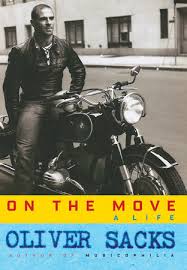
SacksNon-Fiction: Oliver Sacks: On the Move: A Life

Sacks, renowned as both a neurologist on the cutting edge and cogent observer of the eccentric manifestations of the brain’s malfunctionings in his many books, wrote this memoir in the final months of his terminal illness from cancer. As such, it startles with its wisdom and bravery; even more, in its honesty about himself in measuring the successes and shortcomings of his life journey, delivered with verbal beauty uncommonly found among scientists.

Sample Passage:

This gave me a feeling of what seemed wrong with American medicine, that it consisted more and more of specialists. There were fewer and fewer primary care physicians, the base of the pyramid. My father and my two older brothers were all general practitioners, and I found myself feeling not like a super-specialist in migraine but like the general practitioner these patients should have seen to begin with.

__rj

Lexington, KY: Reflections on My Old Kentucky Home

lexingtonI count myself fortunate to live near Lexington, KY. Its assets are many; its liabilities, few.

I like its small town feel—no row housing here; no factories puffing their toxins into the air.

Though ranked 61 among American cities, currently about 311,000, it’s unique in not having freeways threading its thoroughfares, unlike neighboring Louisville and Cincinnati.

To be sure, Kentucky is often synonymous with poverty, but Lexington defies such stereotypes. Located in the center of the pristine Bluegrass countryside renowned for its grandiose thoroughbred farms, Lexington is not only one of our nation’s most beautiful cities, but also one of its most affluent.

Unlike many cities, Lexington enjoys one of the nation’s steadiest local economies, with unemployment currently a miniscule 3.7%. Forbes Magazine has it as the 4th “Best City” for Business careers. Kipplinger ranks it 6th as a “Best Value City.”

Lexington can rightly boast its being “the horse capital of the world.” A 2014 survey revealed that 67,500 horses populated the Bluegrass, including 24,600 in Lexington!

Another laurel is its 6th place ranking as one of the country’s “most inspiring cities” (worldwidelearn.com), topped only by Boston, San Francisco, New York City, Washington, DC, and Los Angeles.

Lexington is also listed 7th as a “Best City for Quality of Life” (nerdwallet.com).

In spite of these accolades, however, Lexington faces continuing challenges from commercial interests who, left to themselves, potentially pose a threat to the city’s bucolic flavor and, as a family city, the superb ambience of the city and surrounding area.

Take what Lexington did in 1996, demurring to commercial interests, and appropriating 5400 acres from the Rural Service Area for development. If Lexington were to further erode the rural landscape of the Rural Service Area, the legacy might well be to make Lexington just one more American city characterized by urban blight.

Fortunately, the city is currently enjoying a hiatus with the tenure of Jim Gray, its progressive mayor. Under the current Five Year Comprehensive Land Use Plan (2011), set to end next year, the city has held out for wise land stewardship, reaffirming the 40 acre minimum set in 1958 for new residential land and commercial development.

As Gray puts it, “building our brand and our economy means that first we preserve what is special and unique about our Lexington—our bluegrass landscape.”

Concurrently, unbridled development has raised its ugly head within the Urban Service Area with numerous architectural gems of the nineteenth century torn down to make way for an underground garage, office tower, hotel, and retail and restaurant space downtown in what has famously turned into a cavernous hole in the ground since its first shovels in 2008.

Meanwhile, yellow dinosaurs gouge the rich soil of a former 56-acre farm to make room for The Summit, a new mall by a national conglomerate just down the road from gargantuan Fayette Mall, which recently expanded by another 26 acres.

You see, I’m an idealist and would have preferred the city’s opting to purchase the farm for green space along one of the city’s most grid-locked traffic corridors, Nicholasville Road—something on the order of the New Haven Green or Savannah’s The Squares. Or like New York’s Central Park or Philadelphia’s Fairmount Park, offering timeout sanctuary in the very heart of urban bustle.

But what about the cost? Well, before you think me insane, consider that the city council had previously come up with a $354 million plan to renovate Rupp Area, home of the University of Kentucky’s men’s basketball team.  I’d say it’s a simple matter of getting our priorities straight.

While Lexington may seem to enjoy a rich tapestry of parks, some 100, they’re relatively small while large areas of the city haven’t any parks at all.  The city’s special gem is Raven Run, a passive park of 734 acres (no sports facilities, etc.), preserving natural habitat and several well maintained hiking trails.

Lexington needs to pay attention to its tree canopy anyway which has experienced a sharp decline, some of it doubtlessly due to the recent infestation of the emerald ash borer. According to a 2012 study, the city’s tree coverage stands at 27%, with 40% the gold standard.

Lexington currently isn’t a member of the City Park Alliance, and it should be. Its rival city, Louisville, is.  The Alliance offers a mapping technology with demographic data that can be accessed online. The Alliance ranks the 75 largest U.S. cities as to how each of them is meeting its park needs. Lexington ranks 51 (parkscore.tpl.org/rankings-advanced.php).

The upshot of all this is that Lexington, while doing well, can do better and must if it’s to assure preservation of its unique ambience, underpinning its attractiveness as one of America’s best cities to call home.

–rj


Paris Bombings, Public Response, and the New Tribalism

CTyf4XOWUAA3a4JEvil is very real and as we know from the Paris mayhem, universal. ISIS, of course, is its mirror image.

This week, Kurdish Peshmerga troops, retaking the city of Sinjar in northern Iraq, discovered two mass graves just outside the city. One contained the bodies of 78 elderly women shot by ISIS; the other, some 60 men, women and children, presumably Yazidis, executed when ISIS captured the city a year ago.

These past several weeks have, in fact, marked a turn in ISIS strategy, since the free flow of recruits has nose-dived with the tightening of borders adjacent to Syria and Iraq and the entrance of Russia into the Syria conflict.

Accordingly, what’s transpired in France may only be the opening round as ISIS licks its wounds.

In the West, we are rightfully angry and troubled by the Parisian carnage. In Facebook, many of us have changed our profile images to include the French flag or Eiffel Tower to show our solidarity.

Contrast this with our visceral indifference with its ethnocentric moorings to ISIS’s barbarism on Muslims or those we perceive as political adversaries. In fact, Muslims have been its greatest victims.

A Russian commercial jet recently went down in the Sinai, taking 224 lives. Intelligence sources suggest a bomb had been placed aboard and ISIS, as with the Parisian violence, claimed they were behind it.

In Lebanon just one evening removed from the Paris massacre, a Hezbollah neighborhood was bombed, resulting in 43 deaths. Again, ISIS was the perpetrator.

In October, 99 lives were taken in twin bombings in Ankara, Turkey.  Although ISIS hasn’t claimed responsibility, they are believed responsible.

Meanwhile, media are saturated with coverage of the Paris horror, as they should be; yet by the same token, the coverage given to the aforementioned violent episodes have proven miniscule.

I’ve seen this same scenario repeated in natural calamities as well. Recently, earthquakes occurred in Pakistan and Iran. Coverage? Well. There’s always Google.

The Russians we don’t care much about these days, so our interest in the Sinai crash seems more out of curiosity as to its cause and not from compassion.

Last week’s bombings in Beirut: So what? These were Muslims, weren’t they? And I should add, Hezbollah. Israel knows their terrorism first hand, so they get what they deserve. Problem is, the casualties were civilian, many of them women and children.

Turkey? Isn’t that something we’ll be eating soon? Ankara? For many Americans, where the hell is that? For the record, it has a population of nearly 5 million! That’s twice the population of Paris!

Think about this: The greatest humanitarian crisis of our time is that of 4 million Syrian refugees, along with another 8 million dislocated Syrians within their country. Our response: bickering as to whether we should take in 30,000 or 65,000, or any at all as some of the GOP presidential candidates have suggested.

Meanwhile, the Washington Post informs us that American contributions to international causes has declined over the last two years.

I think of Shakespeare’s Shylock in The Merchant of Venice, who nails down the cruelty of indifference to the sufferings of those we see as different from ourselves, taking the liberty to replace Jew with Muslim:

I am a Muslim. Hath not a Muslim eyes? Hath not a Muslim hands, organs, dimensions, senses, affections, passions; fed with the same food, hurt with the same weapons, subject to the same diseases, healed by the same means, warmed and cooled by the same winter and summer as a Christian is? If you prick us do we not bleed? If you tickle us do we not laugh? If you poison us do we not die?

Let’s call our indifference, or xenophobia, what it really is–a return to the tribalism we thought we Westerners had shed long ago.

–rj


A Life-Changing Quotation

Every once in a while, I come across a quotation that really stands out. I like this one, though I don’t recall exactly where, or when or how I came upon it, but thought you might like it too:

Did I offer peace today?

Did I bring a smile to someone’s face?

Did I say words of healing?

Did I let go of my anger and resentment?

Did I love?

–Henri Nowen (1932-1996)*

Nowen*Nowen, priest, theologian, and author, lived the life he preached, loving others, and writing some 39 books, translated into thirty languages. His most famous book: The Return of the Prodigal Son.

–rj


Don’t Be a Phoul: When Neighbors Cut Down Trees

NYC Central Park
NYC Central Park

My daughter has been complaining in her recent emails about a family on her street in Bellevue, WA.

They’ve cut down two lovely Douglas fir trees, the kind that startle Easterners like me not used to arboreal skyscrapers, many of them magisterial in their silent dignity bequeathed by longevity.

Bellevue, a fast growing suburb adjacent to Seattle, still enjoys a fecundity most urban areas in America can only envy. When I was there a few weeks ago, I relished walking myriad needle softened pathways of the city’s several forested trails bisecting an urban landscape. Apparently, however, the area has also attracted a newer influx indifferent to the charms of a bucolic setting.

These neighbors complain that their trees were messy. They tired of the needles falling on their roof and car. Around the corner, another neighbor recently did the same thing for the sake of planting a garden free of shade. In its slovenliness, it appears she’s made things worse, not better.

Meanwhile, the company that’s done the cutting directly goes about soliciting customers door-to-door on a regular basis. One of the cutters bragged to my daughter, obviously relishing her displeasure, that he likes chopping down trees.

Unfortunately, we live in an America that prides itself on a free economy, with consumers having sovereignty over their choices. Sadly, in this case, these individuals opted to buzz-saw these magnificent sentries of public health into oblivion for convenience sake.

It’s the way things work in a mutual exchange between the entrepreneurs of the market place, motivated by money, igniting consumer sentiment often detrimental in its long term consequences; for example, alcohol and cigarettes. George Akerlof and Robert Shiller, Nobel Prize winners, term it a “manipulation of focus” in their insightful new book, Phishing for Phools: The Economcs of Manipulation and Deception (Princeton University Press).

Phishing is their term for business interests that phish (i. e., angle) to get phools (consumers) such as you and me to do their bidding to the detriment of ourselves. Think banks, pharmaceuticals, real estate agents, etc.

There are two kinds of phools: those who fall for the falsity of the phishers’ claims and those, the vast majority of the public, who succumb to their own emotions, prone to making bad decisions simply because they initially feed their emotional wants. You see  this in matters of health where our predominant diseases such as atherosclerosis, diabetes and often cancer arise from faulty lifestyle choices such as the wrong food, overeating, indulging in alcohol, or not exercising.

It’s this way of doing things, in this case, overblown avarice with its bubble effect that led to the colossal recession of 2008.

In sum, what’s been happening in my daughter’s neighborhood, threatening its pristine uniqueness, is a facsimile of the phisher-phool conundrum writ large, neighbors manipulated into opting unwittingly against their long term interests.

Maybe you think this is all nonsense. Property owners have the right to do as they like.

But have they the right to harm the public-interest, given the menace of air pollution and global warming, by cutting down their trees?

And what about the neighborhood aesthetic? Hurrah for neighborhood associations!

We aren’t disconnected beings. Yes, we are our brothers’ keepers.

Bellevue government needs to get itself in gear. Trees are public domain just like telephone poles and street lights. Good government is on to this. Consider New York which just completed planting one million trees or Boston which plans to plant 100,000.

It’s estimated that planting trees in urban areas reduces energy use up to 50%. Just one tree absorbs up to 8 pounds of air pollution annually. Trees increase property value. Studies show people drive slower on tree lined streets. They add beauty and lend character.

Let’s not be phouls!

–rj