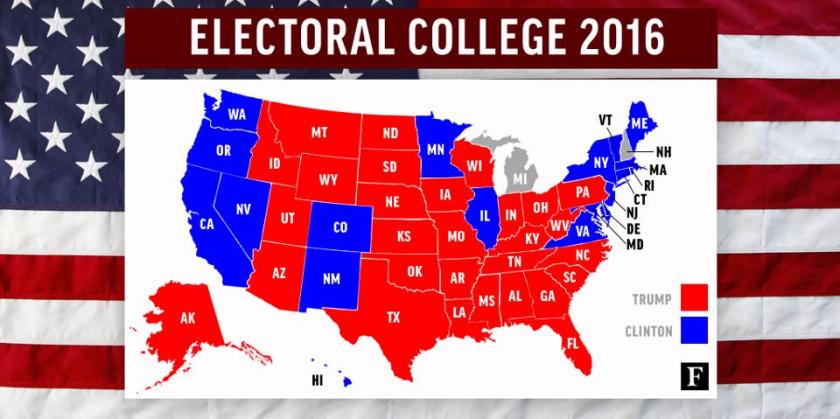
 The Electoral College has been in the news a lot lately. And why not, considering that the loser in the 2016 election garnered nearly 3 million more votes than the declared winner.
In fact, Hillary Clinton’s popular vote turns out to be greater than those that elected John Kennedy, Richard Nixon, Jimmy Carter, and George W. Bush to the presidency. In turn, a good many understandably want the Electoral College abolished. We elect our members of Congress on the basis of vote totals. Why not go national?
But should we? The issue isn’t quite so simple as there exist good arguments either way.
Let’s take a careful look.
Why did the Founding Fathers establish the Electoral College?
The Electoral College goes back to 1787, the year in which our Constitution was first formulated. Because of the expanding geography of the new nation, the Fathers feared local voters wouldn’t have access to the fullest information on a candidate outside their region to choose wisely.
We need to remember there were then just 13 states with a population of only 4 million stretched across a 1000 mile seaboard. There was also the danger that more populated states might dominate lesser populated states. This has remained an issue right up to the present day.
Some, distrusting the electorate, saw the College as a buffer against their folly. Alexander Hamilton, for example, who championed the Electoral College, argued in Federalist Papers 68 that it would preempt “any man who is not in an eminent degree endowed with the requisite qualifications” from taking office.
Ironically, it’s this very set-up that on December 19 will allow electors to rubber-stamp the election into fact, unless they choose to revolt against the norm, which has never occurred.
Hamilton, living in a time when there were no political parties, hadn’t foreseen the rise of partisanship. On the contrary, electors would be free to vote their conscience. The 12th Amendment changed all that with the rise of political parties and their partisanship that Washington took pangs to warn us about in his sobering farewell address.
Hamilton’s proposal, however, was boosted at the time by the interests of Southerners, particularly Virginians, who feared The Northern states, with their greater population, might threaten slavery. Thus, Blacks were partially counted in the Southern population totals, even though they couldn’t vote, allowing Southern states greater electoral clout. Accordingly, Virginians held the presidency 32 of the first 36 years under the new Constitution.
This ugly truth is yet another reason why some have called for the ending of the Electoral College, since they view it as conceived in slavery.
On the other hand, the Founding Fathers were sincerely troubled about equity at every level, whether within state legislatures, or at the Federal level where it’s embedded in the checks and balances provided by the legislative, executive and judicial branches of government, or between larger and smaller states. Balance likewise undergirds resolving the tensions between federal and local sovereignty.
How the Electoral College works:
There are presently 538 electors.
Each state receives as many electors as it has representatives and senators in Congress.
The number of representatives is reapportioned every ten years in conjunction with the census.
States with small populations are assigned 3 electoral votes to promote equity; currently six states, plus D. C.
Residents of U. S. territories, even though they’re American citizens, cannot vote.
Normally, the winner takes all, even if the vote difference is marginal. Two states, however, Maine and Nebraska, proportion their vote, based on the state popular vote.
The major parties nominate electors for their states in the months preceding the election. Some states resort to primaries for that purpose, or rely on a party committee, or state party convention. Electors are frequently selected on the basis of their service to their party.
No person holding federal office, elected, or appointed, is eligible.
The party winning the state vote determines the ultimate electors.
Every effort is made by political parties to assure their electors vote faithfully as pledged, even though the Constitution allows free choice. Those who don’t comply are known as “faithless” electors and may suffer severe censure from their party.
Each Elector delegation votes in their state capitol, this year, on December 19.
Still, 21 states don’t require a pledge at all, potentially setting up a scenario where a few faithless electors could upset even a candidate receiving a majority vote nationally, wiping out the choice of millions. As I write, this weakness lies at the heart of largely Democrat efforts to halt Trump’s accession to the presidency. So much for the fairness argument for Electoral reform.
Tabulation takes place January 6, 2017, in the House of Representatives in Washington.
If the president-elect fails to muster the 270 vote majority, then the final decision on who becomes president is made within the House of Representatives. It could be someone other than the president-elect.
If the House can’t reach a decision by Inauguration Day, the Vice President elect becomes president until such a decision is reached.
The choice of the Vice President ultimately takes place in the Senate, with each senator having one vote. This actually occurred once in our political history when, in 1836, Martin Van Buren’s running mate fell short of the electoral majority by one vote.
Proposals to change or abolish the Electoral College:
Over 700 proposals re: the Electoral College have been made, virtually none of them successful. Only two proposals concerning the Electoral College have ever passed in Congress and succeeded as amendments to the Constitution (12th and 23rd Amendments).
The process of amending the Constitution under the provisions of Article V in the Constitution makes it exceedingly difficult for any proposal to succeed, since it requires a two thirds majority in both chambers of Congress and legislative approval by three quarters of the states.
There is, however, a bi-partisan movement underway known as the National Popular Vote Interstate Compact, which would ultimately preserve the Electoral College, yet assure the top national vote winner secures the presidency. No amendment process would apply, since our Constitution, Article II, Section I, allows states to devise their own elector process.
Specifically. It would be a multi-state pledge to cast their electoral votes for the candidate winning the popular vote nationally. So far, ten states and the District of Columbia have signed on, representing a total of 165 electoral votes. Pro-compact bills, backed by both Democrats and Republicans, have been introduced in other states as well. Imminent passage is anticipated in MN and PA. Should the compact achieve a majority of electoral votes through its member states, it would then go into effect.
One of the chief arguments against its abolishment is that it disenfranchises smaller, less populated states, especially in the American heartland, against the likes of gargantuan states like California and New York.
Candidates wouldn’t visit the small states like New Hampshire, say opponents to change, even if deemed swing states, but shift their focus to metropolitan areas. Cities like New York, Chicago, and Houston would dominate. What happens to rural America?
On the other hand, those for change or abolishing the Electoral College, contend that the small states, if anything, are overly represented. We use the most vote method within our states to elect members to local and national office. Why not go nationwide?
Should the Electoral College be Abolished?
Many think so. After all, it denied the Presidency on five occasions to candidates receiving a majority of votes: 1824, 1876, 1888, 2000, and 2016. Polls reveal overwhelming support for abolishing the College. Even president-elect Donald Trump embraces the idea of a popular vote replacing the Electoral College.
Nonetheless, as I pointed out at the outset, there aren’t any easy answers.
One of the chief arguments against its abolishment is that it disenfranchises smaller, less populated states, especially in the American heartland, against the likes of gargantuan states like California and New York.
Candidates wouldn’t visit the small states like New Hampshire, say opponents to change, even if deemed swing states, but shift their focus to metropolitan areas. Cities like New York, Chicago, and Houston would dominate. What happens to rural America?
On the other hand, those for change or abolishing the Electoral College, contend that the small states, if anything, are overly represented. We use the most vote method within our states to elect members to local and national office. Why not go nationwide?
What’s more, states thought to be in the opposition’s column are already neglected. In 2016, PBS NewsHour found that Donald Trump and Hillary Clinton had made more than 90% of their campaign stops in just eleven so-called battleground states. Of those visits, nearly two-thirds took place in the four battlegrounds with the most electoral votes — Florida, Pennsylvania, Ohio, and North Carolina.
My own opinion, and that’s all it is, favors the genius argument at the heart of the American experiment, which is balance. Historically, we’ve been a nation constructed uniquely through a system of checks and balances, derived from compromise, or consensus. Without it, we could never have achieved the initial unity that founded a nation.
Tensions have always existed in our nation, not only between North and South, but the coasts versus heartland America. The Electoral College does sometimes fail, but it has served us well overall, preserving equilibrium between myriad factions.
Of the ten states that have joined the compact thus far, all of them are blue states or jurisdictions (i.e, D. C.) despite bi-partisan advocates. Passage is anticipated in Oregon, another blue state. While currently red states like Arizona and Oklahoma are possible candidates for inclusion, the movement is largely Democratic in its inspiration. Two states, MN and PA, are likely to join the compact very soon–again, traditional blue states.
Present states along with the District of Columbia that have adopted the National Popular Vote initiative are CA, HI, IL, MA, MD, NJ, NY, RI, VT, WA. Collectively, they now represent 165 electoral votes, or nearly two-thirds of the required 270 majority.
I find this proposal that would assign the state electoral vote to the top voter candidate nationally an absurdity, since it would wipe out even a state’s plurality vote, if that candidate drew up short in a national vote. Let’s take PA, for example; if the compact were in effect, the majority wold see their vote cast aside. Now how fair is that that?
Do you remember looking at the 2016 election geographical map, the small blue areas, almost dots, in a vast tapestry of red, what we used to call “fly-over America”? Thirty states voted for Trump. The Compact would nullify their majority vote in all of them.
Now how is that fair?
Instead, I would like to see a mix of both positions with adoption of a proportional vote measure, doing away with the winner take all–why vote?–and honoring the votes cast by the minority. Let’s allow them a voice in the best interests of a democracy. A proportional College has been proposed before, but went down to defeat in the Congress.
I believe it would result in greater vote turnout. It was hard for me, for example, a Democrat progressive, to get motivated to vote here in Kentucky, overwhelmingly Trump country. In the 2012 election, voter turnout was highest in swing states, where the vote could have gone either way.
In that election, Obama massively won the electoral vote, 332 to 206 for Romney. If it had been a proportional vote, the result would be 51% to 47%, much closer indeed and more reflective of the popular vote (Justin Curtis, “Recrafting the Electoral College” (harvardpoltics.com).
Given the continuing growth of America’s metropolitan areas, particularly on both coasts with their predominantly regional interests, we could end-up with a facsimile of Mexico’s Revolutionary Party, which governed that country for seventy-five years. In short, the end of our two party system which, for better or worse, has worked well for us.
As is, these power states are likely to continue their rapid growth, meaning still more electoral votes by way of a substantial increase in population. Presently, one in every three immigrants chooses CA, FL, OR NY as their residence, exacerbating their population boom.
In life, I’ve learned from the hard places to be wary of peripheries, often embraced by purists. I prefer the middle, drawing from the best of opposing scenarios.
I think a proportional allocation is the reasonable approach. Why resort to a system that like the present Electoral College abrogates the minority vote? Isn’t that the problem now?
Dividing the electoral votes provisionally preempts that unfairness, while achieving recognition for all regional interests like that of coal miners in West Virginia as well as Silicon Valley high techs in CA.
It levels the playing field. I’m all for that!
What does the future hold for the Electoral College?
I think the National Popular Vote Interstate Compact is likely to succeed in attracting a sufficient number of states, among them some Republican ones, that will put the measure over the top. This surprises me, since history’s quirk has yielded a Republic president in all five elections featuring a losing candidate who had won the popular vote, the most egregious being Hillary Clinton’s loss, though garnering a nearly 3 million plurality.
My hunch is that the Compact could possibly be in place even by the next election, and surely by the second, making old hat of the so-called “battleground” or “swing” states scenario, distorting the campaign focus. Campaigning would shift to the most populous states with their big cities and metropolitan areas in particular.
This will be great news for minorities, as both Democrats and Republicans will find them especially attractive to a national ticket, given their urban numbers. The sad fact is that Clinton lost the election because of a drop-off in Black voting since the the 2008 and 2012 campaigns.
If the vastly white Republicans, regardless of what the future holds for the Electoral College, don’t catch-up with the changing demographic and continue sponsoring legislation that would threaten popular entitlement programs such as Medicare and Social Security, along with alienating immigrants, they are doomed to obsolescence, apart from their remaining clout in rural areas at the state level. It’s just that the Compact will force their hand even sooner.
But there’s also a big if that clouds the future of the Compact, since conservatives are likely to view it as an end run around the Constitution and challenge it, both in Congress and the courts, perhaps ultimately reaching the Supreme Court.
There is, after all, that troublesome clause in the Constitution that states that “no state shall, without the consent of Congress enter into any agreement or compact with another state, or with a foreign power.”
–rj
.

 Judging by her phenomenal sales, Mary Oliver surely rates as America’s unofficial poet laureate, and yet the anomaly that she’s never held the office since its inception in 1937.
 Am in a poetry mood again, which just shows you how subversive reading a poet’s biography can be (Nancy Milford’s
  Mindfulness meditation seems everywhere these days. Even the corporate world embraces it, e. g., Google, Facebook, EBay and Twitter. And in medical circles, it’s all the rage, particularly in psychiatry where it increasingly rivals pharmaceutical intervention as a primary therapy in treating depression and general anxiety disorders.

 There are worse crimes than burning books. One of them is not reading them (Joseph Brodsky)
 I came across this still proverbial Tibetan saying in my pre-meditation reading the other day that I wanted to share with you:
 The horror began with the Chinese invasion of Tibet in 1949. In the decades since, Chinese oppression has continued relentlessly, with several hundred thousand Tibetans having been executed, tortured or imprisoned.
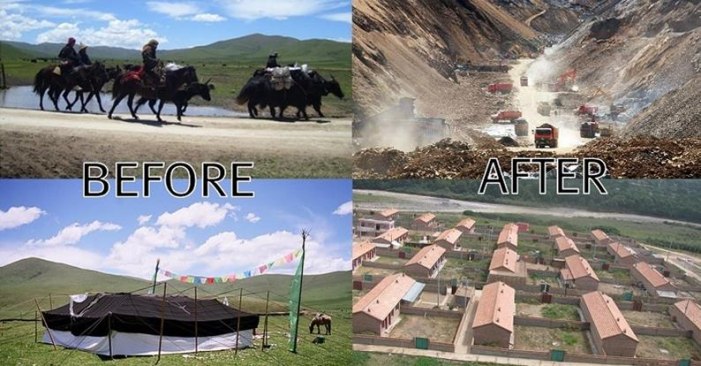 In urban areas, new schools are being built with Mandarin the primary language of instruction.
 When I was in my twenties, I used to keep a running account of what were good and bad years for me. Call it an exercise in ego, or whatever, I still like to weigh each year at its end. On balance, was it a good one? Or one I’d rather not repeat?
