On finding a new booklist quarry

Aaron Hicklin
Aaron Hicklin

I confess I’m addicted to booklists. No sooner do I finish one book, but I’m into another.

What surprises me is that I can’t remember anyone in my family serving as a role model when I was a child, either reading to me or picking-up a book for themselves, with the exception of the late intervention of my eldest brother, David, recently discharged from the army after WWII and anticipating college under the newly inaugurated GI Bill.

One night before David left for the University of Miami, he gave me my first book, Huckleberry Finn. I still remember the occasion–eight years old, sprawled out on the floor of our Philly tenement, absorbed so fully in this really good book that it muffled the adjacent Front Street el with its interminable trains, dutifully groaning past our rattling windows every fifteen minutes.

Soon I discovered the Montgomery County Library. I didn’t mind walking the two miles, knowing what lay up ahead. It was  one of those supreme pleasures like feasting on a well-stacked hoagie or downing a cold strawberry ice cream soda on humid summer Philly nights; maybe I even liked it as much as playing stick ball every day against the factory facades lining our streets.

Books gave me refuge in a home torn apart by alcohol. I became aware of a larger world, where good really did exist, and people could be kind and often courageous. I found heroes like Lincoln, Gandhi, and Gehrig that would become staples in my life.  Books transported me to far away places—Australia, New Zealand, the South Pacific.

Nearly as important as the library was a humble bookstore on Girard Avenue that I often passed on my way home from Chandler Elementary, filled with used paperbacks. What got my attention were two cardboard boxes piled high with comic books. I gravitated to the one filled with Classic Comics with their graphic renditions and abridged texts of literary fare.  The price, five cents, sealed the bargain!  I’d “picture” my way through, say, Les Miserables or Treasure Island, then pick-up the hardback version at the library. By the time I was 13, I had read many of the classics, including War and Peace, Moby Dick, and Silas Marner.

As for the many booklists I’ve ransacked through the years to feed my addiction, I’ll just say my favorite has been Brain Pickings, whose cerebral fiber fences it off from the traffic lane of your typical booklist..

For the most part, I shun the New York Times best seller lists, annoyed by their often fad offerings of dubious value other than to entertain or tell how you, too, can cash in and grow healthy, wealthy and wise.  A few weeks later, I’d find these books either gone awol or sunk to near oblivion.

Before the Internet opened up our information corridors, I’d reminisce earlier times venturing into a library, losing myself in its stacks, often looking for one book, but emerging with another. Call it serendipity, but the chance encounters I’ve had with library books have often proved fortuitous with surprising consequences.

Take, for instance, one chance venture when I pulled a book off the shelf by an author I’d never heard of. Lucky draw, it turned out to be Thomas Wolfe and his Look Homeward Angel. I was 17 at the time, a homesick GI in Korea resorting to the humble base library to annul slow time. Hooked, in subsequent years I rampaged all of his novels, ultimately enrolling at the University of North Carolina at Chapel Hill, the Pulpit Hill of Look Homeward Angel.

Books often haunt my mind, ghosts of delightful company with motley heroes, or of vistas spinning new threads of excitement, belief, and desire in conspiracy against the old.

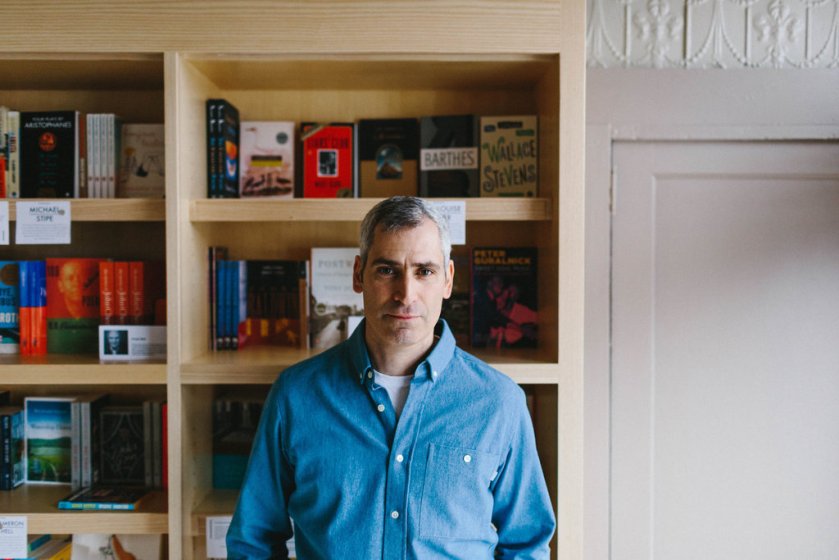
But I’ve found that even the Internet can surprise me. Several days ago, for example, I stumbled upon an extended New York Times Style Magazine series, “My 10 Favorite Books,” edited by Aaron Hicklin.

Hicklin edits a magazine called Out and recently opened up a bookstore called One Grand Books in Narrowsburg, NY. In a clever ploy to attract readers, he’s come up with the idea of asking well-regarded people from various walks of life what ten books they’d want to have with them were they marooned on a desert island. Each listing would feature annotated entries explaining their choices or how these books came to shape their lives.

Hicklin doesn’t want just another bookshop, a dubious business venture in this age of online behemoths like Amazon and Barnes & Noble, but a resource for discriminating readers to find books of substance readily.

As I write, contributors to “My 10 Favorite Books” include, among many others,

 Allan Hollinghurst

 Edmund White

 John Irving

 Ta-Nehesi Coates

 Gloria Steinem

 Gia Coppola

Michael Pollan

Erica Jong

What’s nifty here is how when you select a contributor you get a cascading menu of ten annotated preferences.  In short, each menu constitutes a sub-booklist in the series.  Amazingly, very little overlap occurs among contributor choices, yet each listing is profoundly discriminating.

Absent from the list are two writers I’m unfamiliar who intrigue me for their choices, since they complement my own interests–artist Terence Koh and author, Brett Easton Ellis–the former for his love of Eastern thought with its subdued nuances in a sound byte world; the latter, in sharing tastebuds with me for writers like Tolstoy and Flaubert.

Hicklin, by the way, keeps an online blog, onegrandbooks, that provides you with an archive of previous contributors and a weekly focus on a current contributor, sparing you the cumbersome difficulty of finding each series individually online. You can even sign-up for his weekly newsletter and have your purchased item shipped conveniently to your doorstep.

I hope Hicklin’s venture succeeds. It’s a brave new world out there

Meanwhile, I’m on safari, exploring panoramas of infinite sweep_better because unanticipated, by way of my new booklist quarry.

–rj



Apple vs. the FBI: How Money May Decide the Issue

thThings are really heating up these days in the ongoing dispute between Apple and the FBI.
In December, fourteen people were killed by ISIL sympathizers Farook Malik and his wife Taskeen, in San Bernardino, CA.   In the aftermath, the FBI has been investigating the possibility they may have had accomplices. Backed by a court order, the FBI has requested Apple remove the security blocks on Farook’s iPhone.

CEO Tim Cook, speaking for Apple, refuses to comply, contending it would compromise the privacy of its smartphone users.

I’m not taking sides on the controversy here.  The issue is as heated as it is complicated, with the country divided in its opinion and perhaps SCOTUS inevitably having to make the call.

What does concern me is Apple’s new strategy to move the matter to the Congress for adjudication. (Hearings begin next Tuesday.)

Fact is, the Congress is hardly the right party to decide the issue, given the systemic corruption fostered by business conglomerates soliciting favors through huge sums of money donated to its members.

We see this, for example, with regard to the National Rifle Association (NRA), successfully preempting responsible gun legislation, despite myriad mass shootings like those in San Bernardino,.

In 2014, NRA contributions to members of Congress amounted to $984,152 with an additional $3,360,000 for lobbying.

What really fries my brain is that it spent a whopping $28, 212,718 in outside spending!

Apple, as such, is being disingenuous in attempting to shift the scenario to the Congress, having demonstrated a lengthy penchant, like its fellow high tech icons, in substantially contributing to the Congressional feedbag, their mission to deter any regulatory legislation that would rein them in. In other words, a good many Congressional members owe them favors and now’s an opportune time to collect and circumvent the courts.

Since 1990, Apple has contributed $1,902,870 and spent $27,083,008 on lobbying.

Bernie Sanders was right when he denounced PAC money contributions as undermining our democratic franchise: “People aren’t dumb.” These donors don’t give willy-nilly, but expect something in return.

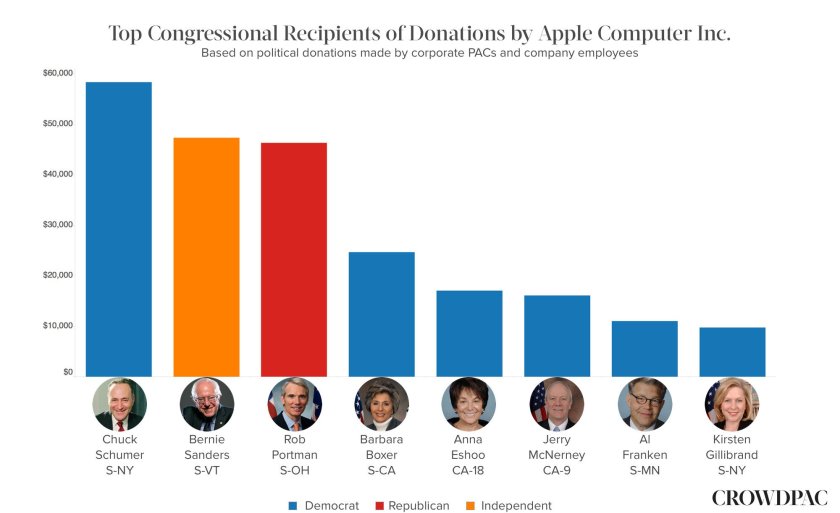
On the other hand, even Bernie has had his hand in the till, ranking second among senators in receiving money from Apple and its employees.

gggty4bqbpvvfgpafcwj

Now let’s see how the system filters out elsewhere. The most prominent Democrat opposing Apple on the issue is Diane Feinstein.   Guess what? You’ll find her absent from the list of top recipients of money from Apple and its allies that include Microsoft, Google, Facebook, and Twitter.  These conglomerates are not about to waste their money on those opposing their interests.

In third world countries, we’d call it bribery.

In the U. S.  Congress, many are willing to take the bribe.

–rj

Bibliography:

OpenSecrets.org

IVN


Brimmings: Five Years and Counting

journalingI’ve been keeping my blog, Brimmings, for five years now, never realizing when I began that I would pursue it for so long, initially undertaking it to assuage my wrestlings with serious illness at the time, or as diversion from anxious self-preoccupation, for liberating reflection of a wider scope. When we let loose our moorings, we sail into discovery.
I suppose I shouldn’t be surprised I’ve persisted beyond that troubled time, now seemingly in remission, enjoying new strength, gathered insight and, undoubtedly, an incipient awareness of life’s essentials in foraging out its meaning.

There has been the joy of Nowness, enriched by moments of solitude, yielding an increased awareness of how interconnected all of us are, bundled in impermanence, and more: of a wider empathy gleaned from that solitude affordng reflection, assuring me that it isn’t how long we live, but how well.

As for the writing, like music and painting, there exists that longevity beyond ourselves that with good fortune we may share with others in another time and place, perhaps bringing not only sobered reflection, but comfort and healing as well.

It doesn’t matter to me how many read Brimmings.  If nothing else, it has taken on the hue of an inner dialogue, often between mind and heart, with no clear winner.

And so I continue.

Peace.

–rj


Macdonald’s H is for Hawks: Finding Passage

The archaeology of grief is not ordered. It is more like earth under a spade turning up things you had forgotten, surprising things come to light: not simply memories, but states of mind, emotions, older ways of seeing the world.
–Helen Macdonald, H is for Hawk

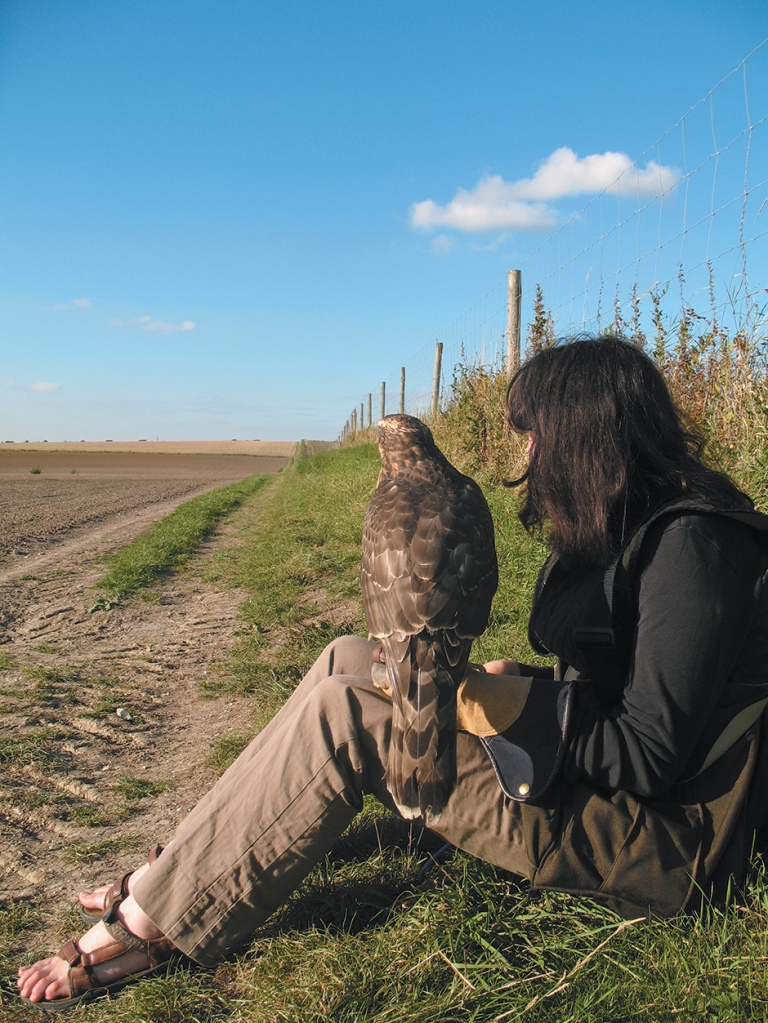
Helen Macdonald with her goshawk, Mabel, near Cambridge, England, 2007

I’ve finished reading Helen Macdonald’s H is for Hawk and want to weigh in on it like someone who’s just dined gourmet and relishing the deed, must boast his good fortune.

I was attracted to Macdonald’s memoir because of its critical esteem in those bastions of literary prowess like The New Yorker and The New York Review of Books, which often ration praise and, even then, not without censure.

H is for Hawk has won two prestigious book awards as well: The Samuel Johnson Prize for non-fiction and Costa Book Award for best book in any genre.

This is Macdonald’s fifth book.

She teaches and does research at Cambridge University.   Her interests include not only falconry, but history and poetry (3 published collections).

Macdonald’s memoir tells the story of her depression following the unexpected death of her father, Alistair MacDonald (2007), a longtime photographer and  journalist for the Daily Mirror, and her resorting to falconry to relieve her grief.

Macdonald’s goshawk, Mabel

This isn’t the first occasion we’ve seen a book testifying to the ability of animals to uplift troubled humans, but may well be among the best. In venturing into the first several pages, I knew immediately I’d be keeping company with a masterpiece.

Macdonald’s training of a goshawk provided a means of continuity with her father, an ardent plane spotter and bird enthusiast, who also taught her patience, a primary motif contributing to her healing and integral to harvesting nature’s plenitude::

My father’s talk of patience had held within it all the magic that is waiting and looking up at the moving sky.

But Macdonald’s memoir is not your romp into a Wordsworthian nature, benevolent and moral.  Mabel kills her prey, suddenly and savagely, or like those artifacts of the human world, airplanes, which link the human and the natural; and yet, even then, there is a vital difference separating the two, with the balance favoring nature:

In my time with Mabel I’ve learned how you feel more human once you have known, even in your imagination, what it is like to be not. And I have learned, too, the danger that comes in mistaking the wildness we give a thing for the wildness that animates it.  Goshawks are things of death and blood and gore, but they are not excuses for atrocities.  Their inhumanity is to be treasured because what they do has nothing to do with us at all.

The writing itself is magnificent in its artfully composed sentences resonant with observation and chiseled detail of landscape and of her travails in training her goshawk, Mabel,  and, most of all, in its poignant psychological journey of retreat from the human community and, ultimately, return to its renewed embrace.

Her memoir is also interlaced with T. H. White’s works, renowned for their Arthurian themes and with his The Goshawk (1951) in particular.

White, who lacked experience, had earlier attempted to train a goshawk, only to fail.  Macdonald, however, didn’t suddenly take up the hobby or, more precisely, being an austringer (i.e., a hawk trainer), having previously trained peregrines, merlins, and kestrels:

While the steps were familiar, the person taking them was not. I was in ruins. Some deep part of me was trying to rebuild itself, and its model was right there on my fist. The hawk was everything I wanted to be: solitary, self-possessed, free from grief and numb to the hurts of human life.

Although MacDonald identifies in many ways with White, who becomes a projection and touchstone of her own anguished struggle to evade life’s seemingly malevolent caprice, she fortunately finds her way past his psychological morass.

As I grew happier his presence receded, his world more and more distant from mine.

Like White I wanted to cut loose from the world, and shared, too, his desire to escape to the wild, a desire that can rip away all human softness and leave you stranded in a world of savage, courteous despair.

Unlike White, she learns that “hands are for other human hands to hold. The wild is not a panacea for the human soul. Too much in the air can corrode it to nothing.”

–rj


My first attempts at meditation

RELAX
Recently I completed a 28-day online course in Zen meditation from a Buddhist source, not that I’m thinking of becoming a Buddhist, but because I’m drawn to its spirituality, virtually absent in current secular approaches such as the wildly popular Mindfulness-Based Stress Reduction (MBSR) and Mindfulness-Based Cognitive Therapy (MBDT) approaches.

I think meditation doesn’t have to be a long, drawn out affair to reap its many benefits. After all, everyday people have been doing it in varied formats across a myriad of traditions and cultures for some 2500 years.

I’m not saying it’s easy. Like playing a musical instrument or learning a new language, you can get to the rudiments fairly quickly, but doing well at it takes practice.

I struggle with my rebellious mind, as we all do with meditation, and its serpentine twists that take me anywhere and everywhere,

It helps, however, that Zen teaches me to be self-forgiving. It’s not really a matter of emptying my mind, but more of allowing it to have its say without imposing judgment or indulging it, conjuring up regrets about the past or anxieties about the future.

When I do this, meditation liberates me from the burden of my attempts to impose control. I see more objectively and don’t personalize disappointment or hurt. I know that my thoughts aren’t really me and that like the clouds, they come and go. I won’t let them chart my course.

When I meditate, I don’t sit cross-legged on a floor or on a bench, The edge of my bed does just fine in the early morning darkness, my back and neck straight, leaning slightly forward.

If my mind wanders, as it always does, I simply return to my breathing, sometimes counting my breaths.

I’m far from being where I want to be, but it’s become easier than when I began, and feeling more relaxed, I’m more eager to continue.

It’s been five weeks now and I’ve not missed a day, though for even better results, I need to do it twice daily for at least 20-minutes a session.

I like it that I can take mindfulness with me throughout my day, practicing awareness in my eating, or sensing my body rhythms; observing the details that compose those I encounter and listening to them acutely; and best of all, in a cosmos often replete with suffering, gaining an empathy for others–not just for humanity–but for the whole sentient world.

Zen informs me of the interconnectedness of all things in a temporal context; consequently, the imperative of my seizing the moment and extracting its goodness. It cautions me about the unhappiness that comes from my cravings.

Meditation has become a game-changer for me; and if it can work for me, bent over with worry in a world I can’t control, then just maybe it will work for you.

–rj


Saving Spring’s Envoys: Our Vanishing Birds

migratorybirdsWe take for granted that birds in the millions returning from their winter feeding grounds in Central and South America will make it back to nest and mate in our yards each spring.

The rude reality, however, paints a scenario of thinning numbers as their habitat continues to give way to human incursion; wetlands get drained; toxic sprays are employed; and GMO agriculture reduces the insects on which many birds feed. Lamentably, up to 4 billion birds are killed by outdoor cats annually. (No typo here.)

And then there’s climate change.

If this scenario continues, we may well see a world devoid of birds and with their disappearance, our own.

Birds do a lot for us:

  1. pollinate plants
  2. disperse seed
  3. consume carrion
  4. recycle nutrients
  5. control insect numbers

Birds do all of this and more, along with providing many of us city folk with a rare contact with nature.

Sadly, fewer of them are completing their already perilous journey, often of several thousand miles, transversing oceans and mountains, to keep company with us every spring.

In one of nature’s greatest marvels, birds don’t require a compass to make their way to where they were born or to their winter habitat.

Guided by the stars, they know North from South. Alert to the sun’s position in daylight, they can discern East from West.

They also intuit the distance they must fly.

Appropriately, migratory birds fly mostly at night, keeping their bodies cool, since their tiny hearts, beating 500 times per minute, generate heat.

Regrettably, their indwelling “magnetic compass” doesn’t always serve them well in a modern world with its tapestry of burgeoning cities filled with light that produces a celestial jamming resulting in their disorientation, exhaustion and death as they unwittingly fly into multi-story buildings, leaving a deadly debris come morning.

With urban sprawl come media towers, like buildings, illuminated nightly to pre-empt airplane collisions. Each year, some 6.8 million birds perish in collision with cell and radio towers and their guy lines.

In a recent summation of studies, researchers found that 63% of bird casualties in the U. S. and Canada are small birds of 156 species, some on the endangered list.

If this isn’t enough, our bird friends face other ominous threats to their survival from our newer technologies such as wind turbines and solar panels integral to our need for renewable, clean energy resources.

This led to the Obama administration, normally on cue with environmental priorities, initiating a federal “permission slip” allowing for wind farms to kill up to 30 bald and golden eagles annually under 30-year permits, despite it’s being against existing law protecting these species, one of which is our national icon.

As I write, I’m happy to learn that our government’s connivance didn’t sit well in a California court, which demanded an impact study. Two weeks ago, the Fish and Wildlife Service dropped its appeal to reinstate the policy.

How bad can wind farms be for birds? A recent California study estimated that up to 573,000 birds and 888,000 bats are killed annually in thar state alone!

Wind turbines now account for 5% of our energy and continue to proliferate, with more than 15,000 presently in service. The death toll must be staggering!

But solar farms also pose another lethal threat to birds, singing, crippling and killing them. Unfortunately, birds often mistake reflective panels for water bodies. Some of these solar farms can be gargantuan in their expanse, with one solar farm in Riverside County, California occupying 4400 acres.

We’re unsure just how many birds solar farms kill, but we believe it to be a considerable number. In a recent investigation, the National Fish and Wildlife Forensics Laboratory recovered 233 birds from three California desert facilities. Many birds literally catch fire on contact with solar panels.

The problem is complex with the need to find new energy sources that don’t pollute and are renewable and yet protect our birds. But we can do more to assure their well-being by demanding impact studies before wind turbines and solar panels come on line.

We can also advocate they not be located in migratory pathways.

We can power down our city lights. A lighted New York City skyline may be spectacular viewing late at night, but it’s a death threat to birds. Cities like Toronto, one of North America’s most progressive cities, supported by the public, has been doing so for years.

We can support preservation of bird habitat such as wetlands and creation of new ones.

I like how Peter Dunne, the director of the Cape May Bird Observatory, has put it: “Without birds, nature would lose its most engaging envoys,” to which I would add that their demise would seal not only their fate, but ours.

–rj


Good News for Elephants!

ele542106059-1024x683CNN reported yesterday that Hong Kong, the world’s largest retail market for ivory, will phase out ivory sales over the next eighteen months and impose severe penalties on those engaging in smuggling and trading of endangered species.

Certainly this is good news! Chinese demand for ivory has long been the primary stimulus to the slaughtering of African elephants, presently an estimated 30,000 annually.

It’s so bad that poaching even outstrips the numbers of elephants being born, which if it continues over the next several decades, will result in these intelligent and emotional creatures vanishing forever.

As just one example, in 1970 Kenya counted 70,000 elephants. That number has dwindled to 38,000.

In 2013, 20,000 elephants were killed across Africa, either through poaching or trophy enthusiasts.

Exacerbating the crisis threatening not only elephants but other exotic wildlife that includes lions and rhinos has been the rise of warlords and terrorists such as the Lord’s Resistance Army and Boku Haram who wantonly prey upon wildlife to finance still more weapon purchases with which to terrorize their fellow Africans.

In all of of this, America is not without blame. The truth is that we are up to our neck in the ivory trade, or second to China in ivory imports, abetted by U.S. law that allows ivory into the country for non-commercial use.

Big game hunters like the dentist who killed Cecil, the Zimbabwe lion, receive fervent support from the powerful NRA, which constitutes one of Washington’s most powerful lobbies. The NRA also backs the large trade in guns with ivory-inlaid stocks.

If the United States along with China, including Hong Kong, were to shut their doors to ivory imports, then our elephant friends would indeed face much better odds.

To bring this about, you and I must never give-up the struggle, converting words into deeds such as liaising with members of Congress, writing op-eds, encouraging corporate giving, and not least, opening up our wallets as well as our hearts to donating what we can to support those frontline organizations (e.g., African Wildlife Foundation and World Wildlife Federation) attempting to bring this cruel carnage to its rightful end.

–rj

Why I Relish Going to the Gym

gty_crowded_gym_kb_141229_12x5_1600

For many of us, throwing off the blankets and crawling out of bed on cold winter mornings to go to the gym seems pretty dumb.

I felt that way too until my pre-diabetic diagnosis several years ago which meant that if I didn’t do something about it, I might well succumb to full-blown diabetes with its many lethal complications that include heart disease, kidney failure, blindness and even limb amputation.

Still, I didn’t do anything about it until a chiropractor friend had me do a full blood workup that showed I had moved even closer to diabetes with an A1c of 5.9 and ominous glucose average of 123.   If you get to 125, you’ve got the disease, for which there’s no cure, only management.

Now, fifteen month later, I’ve gotten the A1c down to 5.2. The A1c tests your blood for glucose management over the previous two to three months. The pre-diabetic range is 5.7-6.4. In short, I’m no longer pre-diabetic.

How did I do it? Quite plainly, by cutting carbs and exercising regularly.

Exercise is good for you no matter what ails you or–if you’re an outlier–from nothing at all, promoting good health, better sleep, stress reduction, more energy, and self-esteem.   What’s nicer than people commenting on how good you look?

But let me add to these verities several other reasons exercise has become a mainstay of my daily regimen.

Personally, I can wax euphoric at the gym like this morning walking my fourteen laps (2 miles), with Herbie Hancock’s pulsating jazz rhythms funneling into my ears via my wireless headset, making me pump my arms still more vigorously.

I like, too, the camaraderie going to the gym gives me, a sense of being part of a group. I see many of these people regularly, of both sexes and of all ages and body types. On occasion, we say our hellos or share smiles and sometimes conversation. Call it tribalism. I like the feeling.

I admire many I see at the gym for the obviously hard work they put into their workouts, whether pumping weights, walking raised treadmills or elliptical machines, or doing stair-steppers, etc. I see the payoffs in their lithe bodies with muscular arms, wide shoulders, and developed pecs. I know it didn’t come easily. Many of them exercise before going to work.   No wonder they inspire me.

But I also get a sense of personal satisfaction, or of time well spent. Call it a relish in self-discipline: I haven’t surrendered to the couch or big screen TV. I take pride in that, knowing my former tendency to both procrastinate and be downright lazy.

Every session becomes a moral lesson, and I remember what my high school track coach told me: “We all get stiches in our side. The good runner, win or lose, ignores the stich, holding out for the second wind that propels him to the finish line.” Today, I resisted cutting my four sets of curls to three. I like to think such lessons learned at the gym can help me better cope with life at large.

And then there’s that sense of jubilation in sharing my good news with my dear wife that today I did 70 sit-ups. Just a few months ago, I could barely do 25!

The Chinese have this wonderful saying that “the longest journey begins with the first step.” In going to the gym, I’ve taken more than one step now and I’m eager to do infinitely more in the climb to good health and the contentment it confers.

–rj


Cultivating Stillness

photo_20I am full of early morning,
tucked beneath my comforter,
stretching my legs,
my brain filling its daily bucket of anxieties
sufficient for another day’s wrestlings.

These several days I’ve laid siege to my citadel of habit,
rising in winter’s early morning coldness
to meditate in dark stillness.
It’s not easy.

Plagued by inertia,
I prefer my cocoon to elbowing out of bed
and sitting cross-legged,
back held straight,
shoulders pushed back.

Engulfed by morning’s opaqueness,
my wayward mind wanders aimlessly
and I am lost in a dark wood.

But it suffices,
for Zen absolves human frailty.
Mind needn’t be emptied,
and it’s mindfulness I lack:

To know the moment
and seize the solace of the Now.
To listen, but not engage.

I trace the pulse of limb and muscle.
I tune in to muffled beating of day’s snare drum
amid gathering pink of celestial fingers.
I count my breaths.

Cultivating stillness,
I discover calm,
and listening,
I grow wise.

–rj


My Best Reads for 2015

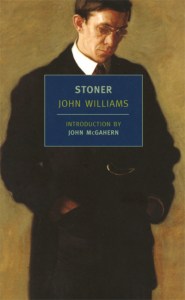
John-Williams-StonerMy thirst for good reads continued in 2015, and among them, two stand out for special praise in providing me with pleasure, insight, and continuing reflection. (I’ve reviewed both more fully elsewhere in Brimmings.)
Fiction:   John Williams. Stoner (New York Review of Books Classics)

My choice is probably subliminal and inevitable, as not since David Copperfield have I identified with a fictional character so fully as with Stoner, having like him, been a professor of English for several decades, thus  familiar with academic intrigue and its pettiness; even more, having, like Stoner, endured a previous incompatible marriage that served neither of us well. But aside from the personal, Stoner has also been the favorite novel of professors across the years, according to a recent article. And why not, since it excels not only for its verisimilitude, but its superlative craft of nuanced, rhythmic sentences replete with stylistic discipline made potent through understatement; in short, easily one of the best written novels I’ve come upon.

Sample Passage:

In his forty-third year William Stoner learned what others, much younger, had learned before him: that is the person one loves at first is not the person one loves at last, and that love is not an end but a process through which one person attempts to know another.

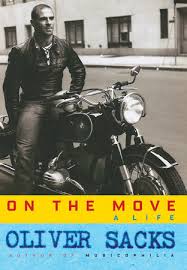
SacksNon-Fiction: Oliver Sacks: On the Move: A Life

Sacks, renowned as both a neurologist on the cutting edge and cogent observer of the eccentric manifestations of the brain’s malfunctionings in his many books, wrote this memoir in the final months of his terminal illness from cancer. As such, it startles with its wisdom and bravery; even more, in its honesty about himself in measuring the successes and shortcomings of his life journey, delivered with verbal beauty uncommonly found among scientists.

Sample Passage:

This gave me a feeling of what seemed wrong with American medicine, that it consisted more and more of specialists. There were fewer and fewer primary care physicians, the base of the pyramid. My father and my two older brothers were all general practitioners, and I found myself feeling not like a super-specialist in migraine but like the general practitioner these patients should have seen to begin with.

__rj