Averted Eyes: Iran’s Atrocities and the Politics of Selective Coverage

Tehran: January, 2026

Why some of the world’s most documented abuses fail to generate sustained global response

Iran, by almost any measure, ranks among the world’s most repressive regimes, much of its coercive power cloaked in religious authority.

It has not hesitated to use lethal force against its own citizens and consistently ranks among the highest globally in executions and political imprisonment (Amnesty International, 2023; United Nations Human Rights Council, 2024).

In the aftermath of the 1979 revolution (1979–1981), mass executions targeted former officials of the Shah’s government, military personnel, and political opponents.

One of the most notorious episodes occurred in 1988, when Ayatollah Khomeini issued a secret fatwa ordering the execution of political dissidents, primarily leftists. Estimates range from 3,000 to 5,000 victims, though human rights organizations place the toll closer to 30,000. The state has never acknowledged these killings; mass graves have been concealed, and public mourning by families has been forbidden (Human Rights Watch, 2024; Amnesty International, 2023; UN Special Rapporteur reports on Iran).

More recently, during the 2019 protests triggered by fuel price increases, security forces killed approximately 1,500 people within days (Amnesty International, 2020).

In 2022–2023, the death of Mahsa Amini, arrested by the Morality Police for alleged hijab violations, sparked nationwide protests. Authorities claimed she died of a heart attack, but eyewitness accounts and leaked medical evidence suggested severe physical abuse. At least 415 protesters were killed, including around fifty children (Human Rights Watch, 2023; IranWire, 2026).

Reports of an even more extreme crackdown emerged following protests beginning in late December 2025. On January 6, 2026, the government reportedly shut down internet access to obscure its response, culminating in a major escalation on January 8.

Official figures claimed 3,117 deaths, though these are widely disputed. The Human Rights Activists News Agency estimates approximately 6,800 civilians killed, with thousands more detained (UK Parliament Commons Library, 2026).

Further reporting suggests even higher numbers, with intelligence-linked documents alleging over 36,000 deaths in just two days (Iran International, 2026). If accurate, this would represent one of the deadliest short-term crackdowns in modern history.

Analysis of verified victim lists indicates that 16.1% of those killed were under 18, drawn from across Iranian society (IranWire, 2026).

Beyond Human Targets

The regime’s record of violence extends beyond human rights.

In July 2022, more than 1,700 dogs were reportedly killed during a raid on the Gandalf Dog Shelter near Damavand. The operation was documented with photos and video, and the animals were reportedly vaccinated and sterilized, undermining any public health justification (Al Bawaba, 2022; One Green Planet, 2022). Fire trucks were deployed afterward to wash away the evidence. Several animal rights advocates who attempted to reach the shelter were arrested (Source: Iran International).

The response from major Western animal rights organizations was, by any measure, shameful. PETA issued a tweet or two. The Humane Society, the ASPCA, and World Animal Protection said nothing of substance. There were no sustained campaigns, no petitions with celebrity endorsements, no diplomatic pressure on Western governments to raise the matter with Iran.

Animal organizations genuinely wary of having their condemnations exploited by hawkish political actors to justify sanctions or military posturing toward Iran. While this is not an entirely unreasonable concern, it produces a paralysis in which documented atrocities go unaddressed to avoid political repercussions.

Dog ownership itself is increasingly restricted in Iran. Municipal bans now exist in eleven Iranian cities, forbidding dog-walking in public spaces (Iran International, 2025; Wikipedia, n.d.).

A proposed law—“Protection of the Public’s Rights Against Animals”—would require government permits for pet ownership, even for common animals such as cats and rabbits (Network for Animals, 2021).

Part of the rationale offered by authorities draws on religious interpretation. In many traditions of Islamic jurisprudence, dogs are considered ritually impure (najis), particularly in relation to saliva, based on certain hadith literature. While the Qur’an does not prohibit dogs and even depicts them in functional roles such as hunting and guarding, later legal interpretations in some schools of thought discouraged close domestic contact.

Importantly, these interpretations are not uniform across the Muslim world. In many Muslim-majority societies, dogs are widely kept as pets or working animals. However, in the Islamic Republic of Iran, clerical authorities have drawn on stricter interpretations to reinforce social stigma and justify periodic enforcement campaigns.

The result is a convergence of ideology and governance: religious framing reinforcing state control over private life, including animal ownership.

A Pattern of Silence

Despite extensive documentation, international response has often been uneven.

Many large Western NGOs lean left politically, and the Iranian regime has long been framed, however implausibly, as a victim of Western imperialism and sanctions. Forceful condemnation of Iranian state conduct sits uncomfortably within that worldview.

The same dynamic has led Western feminist organizations to largely sidestep sustained criticism of Iran’s mandatory hijab laws. The tension between anti-imperialism and universal rights, whether human or animal, is never cleanly resolved, and Iran consistently receives the benefit of the doubt.

This selective principle of bearing witness has a broader parallel. Holocaust photographs—mass graves, liberation of the camps—are reproduced in textbooks and museums on the entirely defensible grounds that visual evidence is essential to bearing witness and resisting denial. Yet equivalent documentation from contemporary atrocities is routinely suppressed or ignored. The principle turns out to be applied not universally, but according to whose suffering fits the prevailing political narrative.

“When it comes to Iran, nothing matters.”
— Marjan Keypour (Jerusalem Post, 2022)

The result is a selective visibility of suffering—where political context shapes not only diplomatic response, but also moral attention.

Conclusion

From the mass executions of the 1980s to recent protest crackdowns and ongoing social controls, the record points to a sustained pattern of repression.

Yet international attention remains intermittent.

What stands out is not only the severity of the abuses, but the unevenness of the world’s willingness to consistently see them.

References

Al Bawaba. (2022). Animal rights activists angry after Iran forces kill over 1,000 dogs.

Amnesty International. (2020). Iran: Details of 304 deaths in crackdown on November 2019 protests.

Amnesty International. (2023). Iran 2022/23.

Human Rights Watch. (2023). Iran: Security forces use lethal force against protesters.

Human Rights Watch. (2024). World report 2024: Iran.

Iran International. (2025). Dog-walking bans expand across Iranian cities.

Iran International. (2026). Report on January 2026 crackdown and intelligence figures.

IranWire. (2026). What do we know about the employment status of January 2026 massacre victims?.

IranWire. (n.d.). History of dog culling and animal treatment in Iran.

Jerusalem Post. (2022). Interview with Marjan Keypour.

Network for Animals. (2021). Iranian government seeks to ban pet ownership.

One Green Planet. (2022). Animal rights activists claim Iranian forces slaughtered over 1,000 dogs.

UK Parliament Commons Library. (2026). Iran: January 2026 protests.

United Nations Human Rights Council. (2022). Fact-finding mission on Iran.

United Nations Human Rights Council. (2024). Special Rapporteur report on Iran.

Wikipedia contributors. (n.d.). Dog walking in Iran.

Presidents’Day and the Enigma of George Washington and a Nation

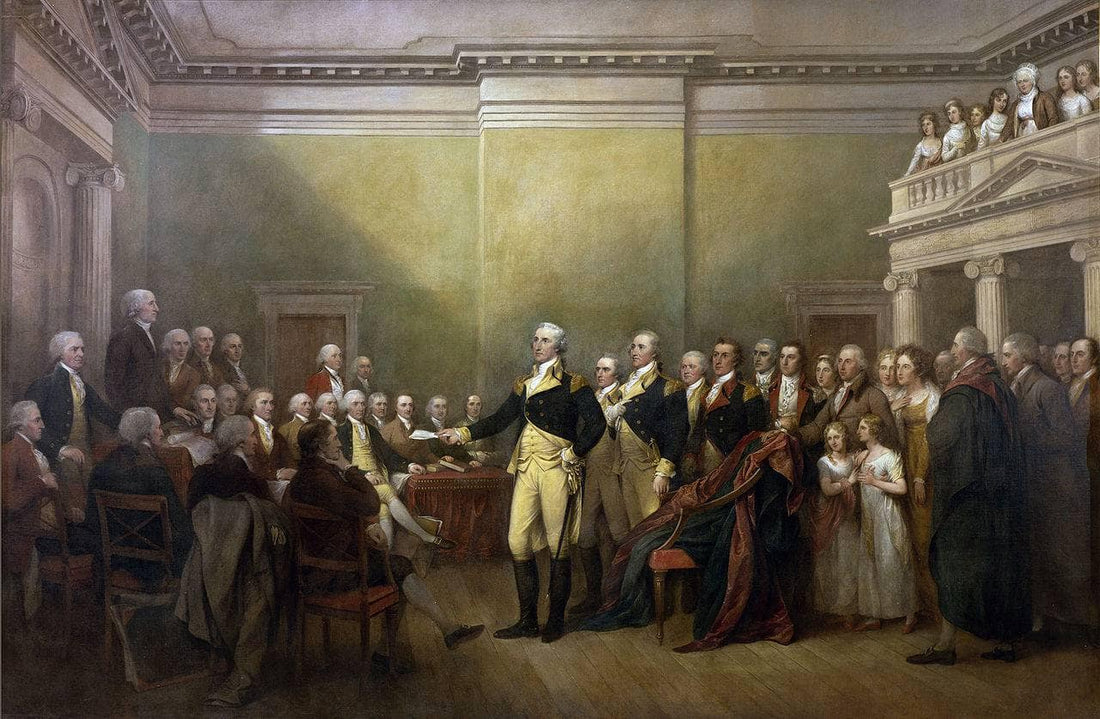
Painting: John Trumbull. George Washington resigns as Commander-in-Chief, Continental Army.

I grew up in an America that celebrated George Washington’s February 22 birthday as a national holiday, signed into law by President Rutherford B. Hayes in 1879 as a federal workers’ holiday, then extended nationally in 1885.

Things changed in 1968 when Congress passed the Uniform Monday Holiday Act, providing longer weekends and consolidating observances. Washington’s Birthday was reassigned to the third Monday in February, still legally designated as his birthday, though some congressional members proposed including Lincoln’s February 12 birthday under the broader aegis of Presidents’ Day.

That broader title caught on. Retailers and state governments increasingly adopted “Presidents’ Day.” Like so many holidays, it became a corporate sales opportunity.

Accordingly, the first item in my email this morning was a Presidents’ Day furniture sale—the first of what will no doubt be a barrage as the third Monday approaches.

Historian Jonathan Horn finds it absurd that we no longer distinctly celebrate Washington’s Birthday, given that it was observed in the young nation even before the framers of the Constitution met in 1787 (“Just Call It Washington’s Birthday,” Free Press, Feb. 11, 2026).

We owe much to this exemplary leader. Ken Burns credits Washington as “the glue that held it all together” in his PBS documentary The American Revolution. Facing superior, disciplined British forces, Washington understood that victory would require patience: knowing when to retreat, striking unexpectedly, and prolonging the war.

After defeats in New York, expiring enlistments, and desertions, matters reached their nadir during the winter encampment at Valley Forge outside British-occupied Philadelphia in 1777. Starvation loomed. Smallpox ravaged the ranks. Soldiers were unpaid, underfed, and poorly clothed.

With sagacity, Washington enlisted the Prussian officer Baron von Steuben, who molded the army into a disciplined fighting force. Recruits followed in greater numbers.

After General Gates’ victory at Saratoga, Washington was able to engage French support, working through liaison with the Marquis de Lafayette.

The decisive blow came when French naval forces blocked Cornwallis’s escape at Yorktown. Washington had deceived Cornwallis into believing New York was his objective while covertly moving his troops south. The British capitulated, leading ultimately to peace in 1783.

Washington had endured criticism without vindictiveness, even surviving a mutiny threat by disgruntled, unpaid officers.

For Burns, Washington’s greatest moment was not Yorktown or Trenton, but his resignation of his commission in Annapolis in 1783. As Burns tells it, he “knew how to defer to Congress, knew how to inspire ordinary people in the dead of night, knew how to pick subordinate talent—just had a kind of presence to him that, without him, we don’t have a country” (Chadwick Moore, New York Post, Nov. 11, 2025).

He did something similar in refusing a third presidential term. His 1796 Farewell Address remains prescient in its warnings against partisanship, permanent foreign alliances, sectionalism, and constitutional usurpation: “Let there be no change by usurpation; for though this, in one instance, may be the instrument of good, it is the customary weapon by which free governments are destroyed.”

Yet Washington has come under fierce attack, criticized for slave holding and judged by contemporary moral standards. Some view him primarily as a symbol of racial oppression and seek removal of his name and likeness from public spaces.

In the aftermath of George Floyd’s killing in 2020 and the ensuing unrest, efforts accelerated to eliminate reminders of racial injustice, including monuments to Washington, Jefferson, Lincoln, Theodore Roosevelt, and Woodrow Wilson. Streets, buildings, and schools were renamed; statues toppled or defaced.

In Portland in 2020, protesters toppled and defaced a statue of Washington in a public park.

At the University of Washington, protesters called for removal of his statue.

In 2020, a statue of Washington at George Washington University was beheaded.

In 2021, the San Francisco Board of Education voted to rename a school honoring Washington, later reversing course after public scrutiny.

A Washington, D.C. working group, commissioned amid racial justice protests, recommended reviewing public names and monuments, suggesting federal sites be reconsidered for contextualization or renaming.

While some of this fury can be understood as anger over longstanding injustice, historian Howard Zinn argues in A People’s History of the United States that Washington’s mythic stature obscures his slaveholding and his violent campaigns against Indigenous peoples. Jill Lepore, in These Truths, likewise underscores the inseparability of his leadership from slavery.

It is painful to read, but much rings true.

Burns recounts Washington’s 1779 campaign against the Iroquois, ordering the destruction of settlements in retaliation for their alliance with the British: “Lay waste all the settlements around… that the country may not be merely overrun, but destroyed.” Towns and crops were burned. Many perished in the ensuing winter from famine and disease.

America was founded on a compromise that would lead to civil war and immense loss of life. Our history is marked by both courage and cruelty, liberty and bondage. We diminish ourselves if we pretend otherwise.

But we also diminish ourselves if we forget the magnitude of what was achieved: a fragile republic wrested from empire, sustained not by perfection but by discipline, restraint, and the voluntary surrender of power.

We are a nation still struggling to reconcile our ideals with our conduct. The work of ordered liberty, of constitutional self-government, of moral reckoning without erasure, remains unfinished.

The Revolution continues—not in the toppling of statues or canceling history, but by whether we can tell the truth about our past without losing the capacity to honor it.

—rj

The Moral Arithmetic of American Capitalism

Did you know that the average CEO compensation at large U.S. public companies now stands at roughly 280 times the pay of a frontline worker?

That represents a staggering shift from the 1960s, when CEOs earned 20 to 30 times what their workers made. Since the 1970s, the CEO-to-worker pay ratio has increased by over 1,000 percent.

This divergence did not occur by accident. One pivotal change came in the late 1970s, when American corporations moved away from a model centered on growth, stability, and shared prosperity toward one focused on maximizing shareholder value. Executive pay was increasingly tied to stock price rather than the long-term health of the firm.

With the rise of stock options and equity grants, CEOs could reap enormous rewards without raising wages, expanding productivity, or strengthening the workforce. Compensation ballooned even when companies stagnated.

Tax policy amplified the effect. In the 1950s and 1960s, top marginal income tax rates exceeded 70 to 90 percent, effectively discouraging runaway executive pay. That restraint largely disappeared in the 1980s, as marginal tax rates fell sharply, making extreme compensation both legal and cheap.

At the same time, labor power collapsed. Union membership declined, offshoring and automation accelerated, and job security eroded. Productivity rose; worker wages did not. Executive compensation absorbed the gains.

Business leaders defend this system by claiming that outsized pay is necessary to attract top talent. In practice, this has produced a self-perpetuating escalation, as boards benchmark CEO pay against ever-rising peer averages. In a globalized economy, profits flow upward, not outward.

Yet America’s extreme CEO-worker wage gap is not an inevitable feature of advanced capitalism.

Consider international comparisons:

Typical CEO-to-worker pay ratios (large firms):

  • United States: ~250–350:1
  • Western Europe: ~40–90:1
  • Japan: ~15–40:1

In much of Europe, workers sit on corporate boards, restraining excess. In Japan, adopting the American compensation model would be seen as collective irresponsibility, not enlightened management.

Public anger is justified—especially amid persistent inflation and decades of wage stagnation. Can the old restraints return?

There are tentative steps. The Tax Excessive CEO Pay Act of 2025, introduced by Rep. Rashida Tlaib and Sen. Bernie Sanders among others, would raise corporate tax rates on companies whose CEO pay exceeds worker pay by extreme margins, beginning at 50-to-1. But meaningful reform would require broad coalitions and a substantial shift in Congress. Change, if it comes, will be slow—and uncertain.

Transparency may be the public’s strongest immediate tool.

What has happened in America is not merely an economic evolution; it is a moral shift. Accumulation has replaced public responsibility as the dominant ethic, not only in corporate life but across society. Its most vivid emblem is the twice-elected billionaire president, Donald Trump, whose politics celebrate wealth while dismantling social safeguards.

Since 1990, the number of U.S. billionaires has grown from 66 to more than 800, while the median hourly wage has increased by only about 20 percent.

This is not efficiency.

It is not merit.

It is not inevitability.

It is obscene.

—rj

When Elections Are Not Enough: Removing Trump From Office

It is now 2026, with the midterm elections approaching in November. My New Year’s wish is straightforward: the impeachment of Donald Trump—assuming Democrats regain a decisive House majority—followed by a Senate trial resulting in his removal from office.

The Framers of the Constitution were not naïve about power. They were steeped in history’s lessons about its corrupting tendencies and had lived, in their own time, under the despotism of a foreign monarch. Their revolution was not merely against a man, but against unchecked executive authority.

Accordingly, the 55 delegates to the Constitutional Convention of 1787 chose to create a president, not a king. Crucially, they did not rely solely on periodic elections as a safeguard. Recognizing that elections alone might prove insufficient in moments of grave danger, they embedded in the Constitution a remedy for removing a corrupt or dangerous chief executive.

Those impeachment provisions are found in Articles I and II. Article I grants the House of Representatives the sole power of impeachment by majority vote and assigns the Senate the sole power to try impeachments, requiring a two-thirds vote of members present for conviction. Article II, Section 4 defines the standard:

“The President, Vice President and all civil Officers of the United States, shall be removed from Office on Impeachment for, and Conviction of, Treason, Bribery, or other high Crimes and Misdemeanors.”

Impeachment, it bears emphasis, is an accusation; removal requires conviction.

Presidential impeachment trials are exceedingly rare. In more than two centuries of constitutional government, only four have occurred:

Andrew Johnson (1868)
Bill Clinton (1999)
Donald Trump (2019 and 2021)

All four trials ended in acquittal. Richard Nixon almost certainly would have been removed, but he resigned before the House could vote on impeachment—the first presidential resignation in American history.

The rarity of impeachment trials reflects not restraint alone, but the gravity of the remedy. As Alexander Hamilton explained, impeachable offenses are those that violate the public trust—abuses of power that strike at the constitutional order itself.

Measured against that standard, there should be little ambiguity regarding Donald Trump’s “high crimes and misdemeanors.” They include conduct that betrays the nation’s best interests and undermines the rule of law: defiance of judicial orders; the use of the Department of Justice to shield allies and punish perceived enemies; and the deployment of violent rhetoric that incites threats against judges and congressional critics, including calls for the execution of former public servants from the military and intelligence communities.

To these may be added the consistent placation of authoritarian foreign leaders and the initiation of military actions—such as attacks on Venezuela and vessels at sea—without clear congressional authorization.

Conviction in the Senate requires 67 votes. Given political realities, Republicans alone are unlikely to supply them. That leaves responsibility where it has always rested in a constitutional democracy: with the electorate.

If the Constitution is to function as intended—if law is to prevail over personal power—then it falls to citizens to vote in numbers sufficient to make accountability possible. The midterms present such a moment.

Whether the nation seizes it will determine not merely the fate of one presidency, but the durability of the constitutional order itself.

–RJ

Ken Burn’s The American Revolution

I’ve finished watching Ken Burns’ six part series, The American Revolution, and I think it brilliant, reproducing through letters, paintings, actual locale, staged reenactment, and historian insight a reasonable, balanced portraiture of the genesis of a new nation.

In watching it, I’ve found myself unlearning the version of American history I absorbed in school—one that portrayed the country as born purely of promise, while minimizing its foundations in slavery and the seizure of Indigenous lands.

I hadn’t realized, for instance, that the Revolution was in effect America’s first civil war: nearly 20 percent of the population sided with Britain as Loyalists. Atrocities occurred on both sides—burned homesteads, pillage, and widespread rape.

George Washington emerges as essential to the colonies’ improbable victory over seasoned British troops, often intuitive, and when necessary, boldly improvisational—especially in his surprise attack on the Hessian garrison at Trenton.

He also also fought with chronically scarce resources, including men and weapons. Smallpox devastated his ranks until ever practical Washington ordered mandatory inoculation for the entire Continental Army. For this, and much more, he merits the accolade, “the father of our country.”

The second sentence of the Declaration of Independence remains, for me, among the greatest ever written: “We hold these truths to be self-evident, that all men are created equal, that they are endowed by their Creator with certain unalienable Rights, that among these are Life, Liberty and the pursuit of Happiness.”

It’s also, as historian Jill Lepore points out in These Truths, proved an instrument of exclusion, its author Thomas Jefferson—like Washington—owning hundreds of enslaved people and enjoying immense wealth.

The Declaration is a document of soaring ideals and deep compromises, and we live with those contradictions still—half of America’s wealth held by one percent of the population, and inequities woven through our social and economic life.

The American Revolution, then, is best understood as a work in progress. It inspires hope that we can do better—and in some respects, we have—though much remains unfinished.

While the Revolution’s principal architects—Jefferson, Adams, Franklin—were men of the Enlightenment who trusted reason to guide human flourishing, the war itself was largely fought by working-class coalitions, many lured by the promise of 100 acres of land taken from Indigenous nations.

Burns isn’t receptive to the argument advanced by the 1619 Project—that American history truly begins with the arrival of enslaved Africans in 1619, and that the Revolution was in part propelled by Southern fears that Britain would eventually abolish slavery.

We do see, however, that the Dunmore Proclamation (1775)—offering freedom to enslaved people who joined the British cause—galvanized Southern resistance. Yet Britain itself, as Burns points out, was hardly on the brink of abolition, its Caribbean wealth built on massive slave labor. Simply a political ploy, Dunmore owned many slaves, and slavery would endure in the Empire for another sixty years.

France entered the conflict in 1777, driven not by idealism but by a desire to avenge its humiliation at Britain’s hands and to reclaim lost influence. Without French military and financial support, the colonies almost certainly would have remained British dominions. By this point, the Revolution had become a global conflict, fought on many fronts.

Part V turns to Valley Forge, outside Philadelphia—the de facto capital of the newly united colonies. There the Revolution reached its nadir: troops half-starved, poorly clothed, ill-housed, and undersupplied as a brutal winter descended, the Congress unable for months to pay the troops. Many died. Many deserted.

With Spring, the French presence is felt, dividing British resources. By 1781, the British suffer massive defeat at Yorktown through a combined force of American troops and the French fleet, blocking British escape. A peace treaty, however, would not ensue until 1783.

The war left the new nation weak and divided, its economy wracked with inflation, huge national debt, and resentful farmers who bore much of the burden, leading to the insurrection in western Massachusetts of 1000 farmers before it was put down by militia. The nation’s weakness would lead, however, to the Constitutional Convention of 1787 defining American governance with its checks and balances under The Constitution.

Women and slaves were, nonetheless, still omitted from the democratic franchise; indigenousness lands seized with violent alacrity.

Washington emerges the series hero, not only innovative on the battlefield with few resources, but committing to democratic rule in resigning his military commission at war’s end.

The series’ central insight is that while the Revolution promised a nation unlike any other, that promise survives only through continual reengagement.

It merits wide viewing: a masterpiece deserving of the highest praise.

—rj

A Heinous Crime That Could Have Been Prevented

It had been the end of a long day when 23 year old Ukrainian refugee Iryna Zartuska boarded Charlotte’s Lynx Blue Line train at 9:46 on August 22, 2025.

Also boarding the train, but evading paying for his ticket, was Decarlos Brown, Jr., a homeless man with fourteen run-ins with the police, awaiting trial for a new offense.

In four minutes, Iryna, who had fled the violence of the Ukraine conflict for a better life in America, would be dead, stabbed three times in the neck while looking at her cellphone by Brown, who sat behind her.

She died almost instantly.

Still wielding a bloody pocket knife, Brown was heard repeatedly shouting, “I got that white girl.”

Video captured the killing.

Brown, 34, has been charged with first degree murder.

In 2014, he was sentenced to prison for armed robbery and released in September, 2020.

In February, 2021, he was arrested for assaulting his sister, leaving her with minor injuries.

A few weeks later, he was arrested for injury to private property and trespassing.

In July 2022, he was arrested for a domestic disturbance.

Shortly after, he was arrested for injury to personal property and trespassing.

Brown’s criminal history is lengthy, reaching back to when he was a minor.

He has a documented history of mental illness. After the armed robbery, his aggressiveness intensified, resulting in his mother having him committed under court order for psychiatric observation—the diagnosis: schizophrenia.

Following his release, his aggressiveness increased still further and his mother ordered him to leave the household.

A few weeks before murdering Zarutzka, police detained Brown for misusing 911.

Despite all of this, he remained free to walk Charlotte’s streets.

Subsequently, Magistrate Teresa Stokes allowed him freedom from incarceration in exchange for his written promise to show up for a later hearing.

In a July 22 continuance hearing on Brown’s 911 misuse, judge Roy Wiggins ordered a forensic evaluation.

Unfortunately, he did not detain Brown in the meantime, a mistake with lethal consequence four weeks later.

As for the evaluation, it never happened.

In the aftermath, some on the Left argued that Brown was as much a victim of a system that failed as was Iryna. In turn, they initiated a GoFundMe account that raised $75,000 dollars to defray his legal expenses as part of the “fight against the racism and bias against our people.”

GoFundMe pulled the account.

Iryna’s murder became politicized, Trump labeling Brown a “lunatic.” Democrats, in turn, accused Trump of exploiting the tragedy for political gain.

Otherwise, Democrats have been largely silent about the murder.

In fairness, North Carolina governor Josh Stein (D) did speak out, denouncing the crime as senseless and calling for a greater police presence.

For many Democrats, however, the story didn’t fit their narrative.

Charlotte mayor Vi Lyles commented that the Charlotte transportation was safe, “by and large,” despite a recent survey reporting just 37% of Charlotte residents consider the Charlotte Area Transit System safe.

It can be argued that Progressives share responsibility for people like Brown being on the streets, abetted by black leadership and liberal media frequently engaging in racial framing that rationalizes black criminality as the offspring of white racism.

Many on the right fault Progressive advocacy of cashless bail, reduced incarceration, expunging felony records; and last, but not least, defunding the police, constitute a litany of liberal efforts more focused on criminals than the law-abiding.

Apart from the Washington Post, liberal news media, by and large, did not report the murder, consequently censoring the public’s right to know through omission, a noticeable detour from its intense coverage of the subway death of Jordan Neely by Daniel Perry, a white man.

Among media not reporting the story,

The New York Times
CNN
NPR
USA Today
Reuters
Axios
ABC News
PBS
MSNBC

(CNN did finally reference the crime, but only after the video’s release on September 5, devoting a two minute blurb to the story in its morning show).

Even Wikipedia has been caught up in the frey, one of its editors calling for the deletion of the posting titled “Killing of Iryna Zarutska.” A box message, later deleted, appeared above the post: “An editor has nominated this article for deletion.”

Wikipedia co-founder Larry Sander believes Wikipedia is now “too left” and “unreliable” (Manhattan Institute).

Brown, obviously mentally ill, should have been removed from the streets long ago in the interest of public safety.


The Brown case is not unprecedented when it comes to the American justice system’s failing the mentally ill, many of them homeless.

As Charlotte council member Edwin Peacock put it,
“If you’re constantly arresting people and they keep coming back out on the streets, what type of message is that sending?”

In 2020, former Democrat governor Roy Cooper, now running for the senate, established the “Task Force for Racial Equity in Criminal Justice,” co-chaired by then Attorney General and current Governor Josh Stein. It recommended “reimagining public safety” to “promote diversion and other alternatives to arrest,” “deemphasize” some felony crimes, prioritize “restorative justice,” and “eliminate cash bail” for many crimes (The Department of Justice (September 9, 2025).

In 2020, Charlotte Mecklenburg Police Chief Johnny Jennings declared  “law enforcement, in general, is based on racism” and their department can “probably slow down” on “discretionary arrests.”

In 2020, Democrat State Senator Mujtaba Mohammed, who represents Charlotte,  declared “independence from rogue police” (DOJ, September 9, 2025).

As I write, the Department of Justice has announced Brown will face federal charges, making him eligible for the death penalty. In a statement, Attorney General Pam Bondi depicted Iryna Zarutska “as a young woman living the American dream. Her horrific murder is a direct result of failed soft-on-crime policies that put criminals before innocent people.”

Ironically, the media is now weighing in. Where have they been? Is it the White House intervention and possibility of the death penalty that motivates this sudden rush to reporting in?

News comes that Paramount has now appointed an ombudsman to review bias at CBS news.

As for our courts, my thoughts drift to the late, gifted satirist Tom Wolfe of “Radical Chic” fame. His acclaimed Bonfire of the Vanities (1987) got it right—America’s highly politicized, often incompetent judicial system, is a sham.

rj

America’s 250th Birthday: Reflections

Next year, America will mark its 250th birthday. Unfortunately, this historic milestone is likely to be politicized, with competing narratives of our past reflecting the deep polarization of our present.

But this need not be our path. If we are to bridge rival ideologies and transcend partisanship, we must come together—not in denial of our differences, but in honest recognition of both our shared ideals and our collective shortcomings.

As true patriots, we can celebrate the birth of a free nation while also acknowledging the ways in which we have fallen short of the Declaration’s enduring promise: “that all men are created equal, that they are endowed by their Creator with certain unalienable Rights, that among these are Life, Liberty and the pursuit of Happiness.”

Our nation was forged in both hope and violence. The challenge before us is not only to remember, but to reckon. To share openly what we love about America—and what we do not. And to commit ourselves to remedying the ills that still confront us.

History taught from the periphery, filtered through rigid ideology or simplified into monolithic narratives, is intrinsically dangerous. It rests on a priori assumptions and is too often promulgated with dogmatism. True understanding requires nuance, humility, and courage.

In a very real sense, our genesis as a nation continues. That reality carries both hope and foreboding—hope, if we can get the conversation right; foreboding, if we fail to heed the lessons of our past. As Jefferson warned: “When once a Republic is corrupted, there is no possibility of remedying any of the growing evils but by removing the corruption and restoring its lost principles; every other correction is either useless or a new evil.” Politicians, take heed.

With this in mind, I eagerly await Ken Burns’ six-part PBS documentary on the American Revolution this November. It may be a vital first step in rekindling the national conversation we so urgently need—and in recovering the promise of the American dream.

RJoly

Beyond Identity Politics: The Case for Economic Unity

Two weeks to go until America decides!

I’m with those who believe Kamala Harris will win. Even so, America will remain deeply divided, unless the grievances of America’s working class, transcending race and ethnicity, are addressed.

Healing lies in abandoning the separation of the political and the economic.

While minority rights matter, they musn’t be set against the economic rights of all Americans to a fair share. Otherwise, we reap continuing resentment, social fissure, and exploitation.

What matters isn’t who you are, or where you’re from, but what you believe. Identity politics conversely promote discord.

Unions have shown us the way, promoting shared economic interests transcending identity factions of Left and Right.

Achieving class unity, America secures a vibrant future, true to its promise of shared equality in the pursuit of happiness.

As distinguished economist Robert Reich rightly observes, unless the new administration enlarges the economic franchise, “future demagogues like Vance will almost surely exploit the same bitterness for their own selfish ends.”

“The strongest defense we have against a future of Trumpist fascism is a large and growing middle class comprised of people who, although they may have supported Trump, come to feel they have a stake in America.”

—rj

Freedom’s Warrior: Timothy Snyder


Chances are you don’t know who Timothy Snyder is, though all who love a free Ukraine should. Snyder is an esteemed centrist Yale historian, graduate of Brown University (B.A.) and the University of Oxford (D. Phil).

Snyder specializes in central and eastern Europe, the former Soviet Union, and the Holocaust. Fluent in English, German, Polish, and Ukrainian, he reads in ten languages.

He’s also a permanent fellow at the Institute for Human Science in Vienna. Prolific, Snyder has authored sixteen books to date, translated into forty languages, with a forthcoming book to be published in September, 2024.

Raised by Quaker parents in Ohio with leftist leanings, there’s a moral insistence conveyed in unadorned prose throughout his many books. In his classes, he uses no notes and with ease can blend Plato, Hegel, DuBois, and polymath René Girard to make his point (Baird, The Guardian, March 23, 2023).

His international awards are numerous. They include Carnegie and Guggenheim fellowships and Hannah Arendt Award for Political Thought. He was a Marshall scholarship student at Oxford.

I hadn’t anticipated an ardent defense of Ukraine, buttressed from someone at Yale, but there he was, Timothy Snyder, forthright, unapologetic, in his op-ed appearance in the New York Times:

“As in the 1930s, democracy is in retreat around the world and fascists have moved to make war on their neighbors. If Russia wins in Ukraine, it won’t be just the destruction of a democracy by force, though that is bad enough. It will be a demoralization for democracies everywhere. Even before the war, Russia’s friends — Marine Le Pen, Viktor Orban, Tucker Carlson — were the enemies of democracy. Fascist battlefield victories would confirm that might makes right, that reason is for the losers, that democracies must fail” (NYT, May 19, 2022).

I’ve been following Snyder ever since.

Snyder has his detractors, of course, some regarding him more as a pundit, offering personal opinion in the guise of expertise. For a good summation, and counterpointing (see LA Review of Books, Unshared History, Oct. 16, 2012).

His Marxist critics principally object to his inclusion of Russia as fascist under Putin, as they like to reserve the term for their right wing opponents. Historically, fascism was a term used by the Soviets to denounce Nazis and other factions opposed to its dictates.

Snyder answers that “People disagree, often vehemently, over what constitutes fascism. But today’s Russia meets most of the criteria that scholars tend to apply. It has a cult around a single leader, Vladimir Putin. It has a cult of the dead, organized around World War II. It has a myth of a past golden age of imperial greatness, to be restored by a war of healing violence — the murderous war on Ukraine” (NYT, May 19, 2022).

If you’re curious about Snyder’s political biases, he endorsed Biden in 2020 and in a Guardian interview, shared, “I vote Democrat!” He sees Trump as an autocrat appealing to popular prejudices inimical to American democracy’s survival. Trump’s policies are about making White people feel comfortable.

Snyder’s immediate concern, however, is the war in Ukraine, about to enter its third year, pitting a David against a Goliath, pitiless and unpausing in attacks on Ukraine’s civilian infrastructure in a crucial struggle presently overshadowed by events in Gaza.

To his credit, Snyder has tried valiantly to keep the Ukrainian conflict center-stage: “If Ukraine does not win, we can expect decades of darkness” (NYT, May 19, 2022).

Hospitals, churches, shopping centers, apartment dwellings, it’s all fair game to Putin, whose aim is to inflict maximum terror, destroy food supplies, disrupt the electricity grid, and deny water resources to a nation he regards as historically integral to the Russian empire.

Much of Putin’s onslaught comes from not only cruise missiles, but thousands of drones, many of them supplied by North Korea and Iran.

The Biden administration and its NATO allies have been slow to respond. Patriot defense batteries are just now arriving, antiquated, and short of the seven President Zelensky says Ukraine needs to ward off the daily aerial assaults.

In contrast, Israel has 32 up-to-date batteries proven highly effective against Iran’s massive missile and drone response of April 14, 2024 (Defense Express, April 15, 2024).

If Ukrainian skies are safer now, it’s because Timothy Snyder stepped in, not the White House, raising $2,300,000 for Safe Skies, a program allowing Ukraine to install thousands of sensors throughout eight Ukrainian regions.

Safe Skies provides an early-warning alert and rapid response to drones and cruise missiles: “I visited one of the sites and saw some of the technology at work, as well as the impressive cooperation between the Ministry of Digital Transformation and the armed forces,” Snyder said (The Free Press, Substack, August 17, 2024).

Donations were largely individual worldwide, with a few corporations also contributing.

We nearly lost Snyder in 2019 when, feeling ill, he resorted to ER in New Haven, spending seventeen hours there, before being diagnosed with a baseball-sized tumor in his liver along with sepsis. Snyder would subsequently spend the next three months in five hospitals.

But you don’t mess with Snyder, who kept notes on his hospital sojourn, the later basis of a scathing indictment of American healthcare: Our Malady:
Lessons in Liberty from a Hospital Diary.

Thankfully, he’s still with us, a boon for freedom lovers everywhere,

–rjoly

The Joy of fellowship with Nature

monarch

One of the best hobbies I’ve ever come upon is that of being an amateur naturalist.  It needn’t be expensive and you can do it in your own yard or on a walk or, believe it or not, from a car window.  And, yes, you don’t even have to leave the house.

Here’s a little checklist to see how versed you are on the natural world around you:

1.     Identify the ten most common trees in your neighborhood.

2.     Name five wild flowers that grow in your area.

3.     Identify ten flowers or plants common to your neighborhood landscaping.

4.     Identify five migrating birds that visit your yard.

5.     Name five birds that are year long residents.

6.     Identify ten common weeds in your yard.

7.     Name the planets and identify three of them in the sky

8.     Locate the North Star.

9.     Identify five rocks in your yard or area.

10.   Identify five insects in your garden

Most of us are hard pressed to do half of these IDs.  But then, that’s the fun of it, that you can begin, anytime, anywhere, and discover kingdoms all around you—and even below your feet.

Be careful, though, for discovery can be addictive.  You may even choose to specialize, maybe on rocks, bees or flowers.

Being connected with nature can yield release from daily stress.

It can also give you awareness of the fragility of nature’s weave of flora and fauna, their delicate balance and our dependency on that balance.  One third of our crops are pollinated by bees, for example, but our sprays have caused a serious threat to their survival.

One other gift that comes from a love for nature is how it develops your powers of observation.   My favorite American poet, Emily Dickinson, had this acuteness, with nature’s minutia a dominant motif in her poetry.  Take, for example, this delighful poem.

A Bird came down the Walk –
He did not know I saw –
He bit an Angleworm in halves
And ate the fellow, raw,

And then he drank a Dew
From a convenient Grass –
And then hopped sidewise to the Wall
To let a Beetle pass –

 He glanced with rapid eyes
That hurried all abroad –
They looked like frightened Beads, I thought –
He stirred his Velvet Head

Like one in danger, Cautious,
I offered him a Crumb
And he unrolled his feathers
And rowed him softer home –

Than Oars divide the Ocean,
Too silver for a seam –
Or Butterflies, off Banks of Noon
Leap, plashless as they swim.

Naturalism can grow friends for you.  There are groups of people out there like you who would gladly welcome you.  It’s fun to be among other gentle stewards of the earth, sharing their experiences and concerns, working together to promote awareness and preservation.  I like the Nature Conservancy.  It buys up threatened habitat and maintains it.

Your new hobby can afford you numerous excellent, often moving, reads, like Rachel Carson’s land mark Silent Spring or Thoreau’s classic Walden.  Good stuff on rainy days!

Think about how much you and your family can enjoy that country hike, park excursion, or neighborhood walk, connecting with what you now know, challenged by what remains to fathom in a hobby salient with retreating horizon.

Through its repetitive rhythms, nature confers assurance that tomorrow the dawn and dusk will come again, the seas will rise, and the moon ascend; that after winter, spring will surely come and our aerial friends return.

In sum, Nature amply rewards those who fellowship with her, conferring not merely release, but blessedness in an often troubled world.

–rj