
It’s a funny thing how I sometimes reach back into my childhood for memories that yield comfort in older years, simple truths endowed with a wisdom that sustains.
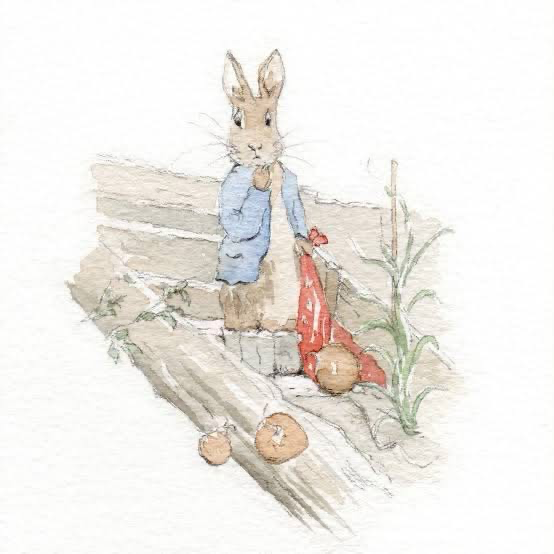
I loved Beatrix Potter’s Peter Rabbit stories, smartly drawn from her keen observation of England’s rural landscape, reinforcing my deep affection for my fellow creatures. Flopsy, Mopsy, Cotton-tail, and Peter have been my buddies all the days of my life.
Along with them came the wild, staccato rhythms of Dr. Seuss and every volume of the Doctor Dolittle series.
Maybe I’m just waxing sentimental—I’ve always been a deeply feeling person—but in surfacing these forgotten memories, I feel reborn.
Here are several gems I indulged in just this morning, each granting its own quiet contentment. First, the anonymous lines of the children’s poem traditionally titled “The Polite Rabbit”:
I met a grey rabbit, at the top of the hill.
We both stopped to look, and stood very still.
But I didn’t scare him, and he didn’t scare me,
Because I was polite, and so was he.
Christina Rossetti captured a similar quiet kinship in “The Caterpillar,” tracking its transformation from humble crawler to exquisite butterfly, a reminder of how what seems simple can, given allowance, mature into unexpected beauty:
Brown and furry
Caterpillar in a hurry,
Take your walk
To the shady leaf, or stalk,
Or what not,
Which may be the chosen spot.
No toad spy you,
Hovering bird of prey pass by you;
Spin and die,
To live again a butterfly.
The capstone for me since my youth has always been William Wordsworth’s celebratory poem of nature’s beauty, “I Wandered Lonely as a Cloud”—that supreme exemplar of poetry rendered in simple language, of “emotion recollected in tranquility”:
I wandered lonely as a cloud
That floats on high o’er vales and hills,
When all at once I saw a crowd,
A host, of golden daffodils;
Beside the lake, beneath the trees,
Fluttering and dancing in the breeze.
Continuous as the stars that shine
And twinkle on the milky way,
They stretched in never-ending line
Along the margin of a bay:
Ten thousand saw I at a glance,
Tossing their heads in sprightly dance.
I have since read every one of his several hundred poems—some better than others, but always granting solace.
Fortunately, great verse is still being written to guide our children and grandchildren on their life journeys. Take, for example, this marvelous stanza by Jeanne Willis, from her illustrated picture book, Wild Child (2012):
They caught all the wild children, and put them in zoos,
They made them do sums and wear sensible shoes.
They put them to bed at the wrong time of day,
And made them sit still when they wanted to play.
They scrubbed them with soap and they made them eat peas.
They made them behave and say pardon and please.
They took all their wisdom and wildness away.
That’s why there are none in the forests today.
Talk about rearing conformist children, alienated from nature, taught never to draw outside the lines, never to rebel and find their true selves—wow!
Call it nostalgia if you like, but William Wordsworth got it right when he wrote in “Ode: Intimations of Immortality” that “The Child is father of the Man.”
By that, he meant that childhood’s gift of innocence and wonder amid nature’s plentiful grace helps define the adults we ultimately become.
I believe, like Wordsworth, that the child lingers within us. Recovering that child within, its capacity for wonder, to notice a rabbit on a hill, a caterpillar on a leaf, a field of daffodils dancing in the wind—these are not childish things to be outgrown.
Discover more from Brimmings: up from the well
Subscribe to get the latest posts sent to your email.


