
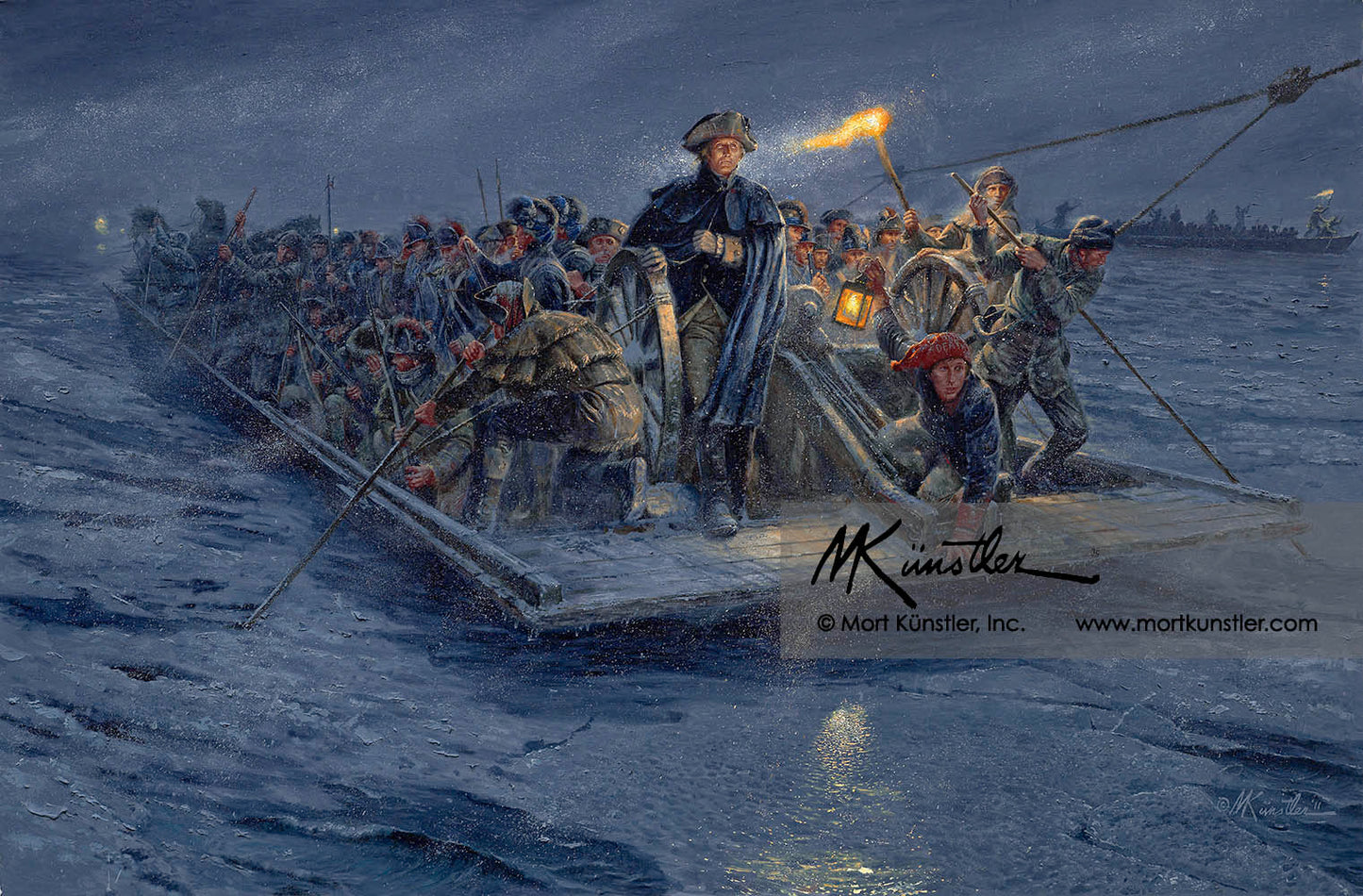
Mort Kūnstler, Washington Crossing the Delaware
I didn’t celebrate America’s 250th birthday yesterday. How could I, with Trump still at the helm of a listing ship? Our country is so deeply fractured that I lack confidence our ship of state can ever be restored to an even keel again.
While the mid-terms loom, a new, more radical faction seems to be taking hold, offering simple remedies, under the aegis of expanded government, to complex problems that may well prove incendiary to America’s best interests.
History is being distorted—accompanied by the rise of a heated rhetoric, the past filtered through a modern lens, as if we can sanitize our heritage by consigning to oblivion our flawed heroes who nonetheless made America possible.
To contend, as some now do, that the Revolution was fought primarily to preserve slavery is a profound untruth. In 1776, Great Britain had no intention of dismantling the institution. While Royal Governor Lord Dunmore famously offered freedom to slaves who fled rebel masters to fight for the Crown, his proclamation was a cynical tactic of war, not a moral crusade; Dunmore himself owned a hundred slaves whom he exempted from his proclamation, and Britain did not outlaw slavery in its empire until 1833. The colonists revolted over representation and imperial overreach, not a defense of bondage.
Far from protecting slavery, the radical ideals unleashed by the Revolution ignited the Western world’s very first widespread abolitionist movement, a moral arc that would ultimately culminate in a bloody Civil War and Lincoln’s Emancipation Proclamation.
History taught from the periphery, filtered through rigid ideology or simplified into monolithic narratives, is intrinsically dangerous. It rests on a priori assumptions and is too often promulgated with dogmatism. True understanding requires nuance, humility, and courage.
Intolerance and intimidation increasingly menace our daily life. It’s a different America from the one I grew up with—dynamic, prosperous, a nation deserving of its patriotism.
And why not?
At the end of WWII, a victorious America was the sole nuclear power. It possessed an army of 14 million, an air force of 50,000 planes, and the largest naval force in history with nearly 7,000 ships, including 99 aircraft carriers.
Yet, alone among the global empires of history, America walked away from total dominion and chose peace over subjugation.
This is the America I remember and want back again.
—RJ
Discover more from Brimmings: up from the well
Subscribe to get the latest posts sent to your email.


Oddly Napoleonic figure….
LikeLike