And This Is Why I Read

Last night, I read my 30th book this year, not that I’m prioritizing numbers, but simply because I’m spending more time at it, reading a minimal fifty pages daily, and not just any book, but some of the best ever written, conglomeration of genres that have shaped my world, defined who I am, not the quixotic schoolboy of sixteen, rebellious, often angry, in pursuit of discovering who I was and, better, who I wanted to be, that best self, enlarged through awareness and sensitivity.

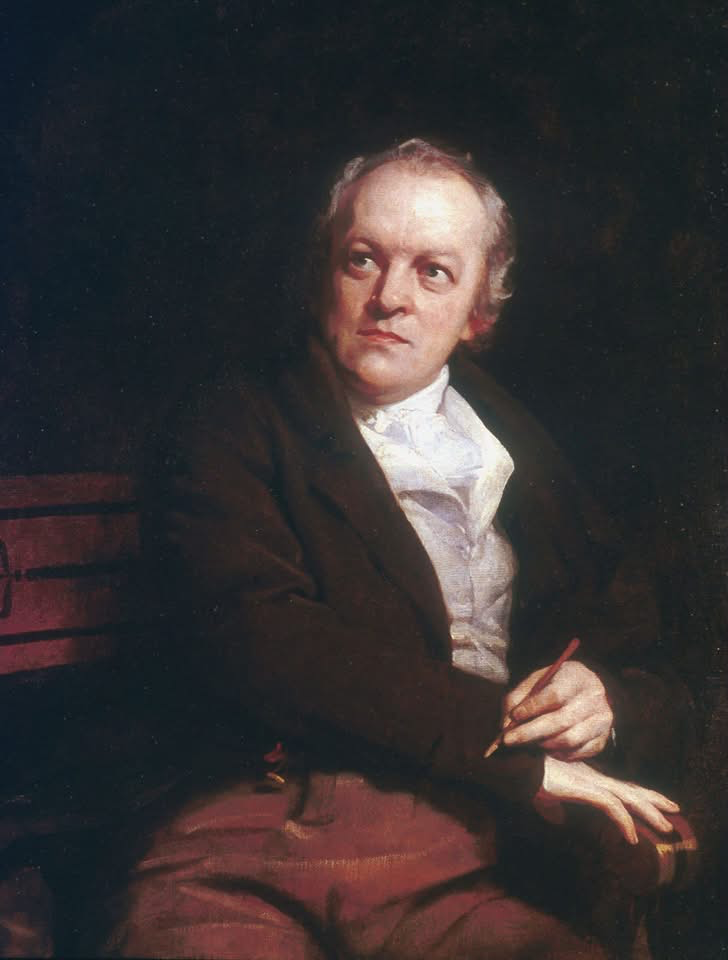
Today, a new book: Philip Hoare’s William Blake and the Sea Monsters of Love: Art, Poetry and the Imaging of a New World (2025), his moving tribute to the great poet and his myriad influence. I first read Blake as a university English major and he’s stayed with me as one of my favorite poets.

Blake taught me to see life as polarity, the mix of opposites, of their necessity to wholeness, like summer and winter, the sun by day, the moon by night, beginning and ending, “the marriage of heaven and hell” as he called their fusion, innuendos of Isaiah 45:7: “I form the light, and create darkness: make peace, and create evil: I the Lord do all these things” (KJV).

Thus began my odyssey with myth, paradox its hub, my later love for Keats and his “negative capability,” of opposites unresolved, my passage into Blake”s protégés, Dante Gabriel Rosetti, William Butler Yeats, Paul Nash, Iris Murdoch, counter culture artists Allen Ginsberg, Dave Bowie, and Bob Dylan.

Ahead of his time, Blake opposed slavery, championed social reform in poems like the “Little Black Boy”:

“…we are put on earth a little space,
That we may learn to bear the beams of love,
And these black bodies and this sun-burnt face
Is but a cloud, and like a shady grove.

For when our souls have learn’d the heat to bear
The cloud will vanish we shall hear his voice.
Saying: come out from the grove my love & care,
And round my golden tent like lambs rejoice.

Thus did my mother say and kissed me,
And thus I say to little English boy.
When I from black and he from white cloud free,
And round the tent of God like lambs we joy:

Ill shade him from the heat till he can bear,
To lean in joy upon our fathers knee.
And then I’ll stand and stroke his silver hair,
And be like him and he will then love me.”

I have cherished his profundity veiled in simplicity, his magnificent “To see a World in a Grain of Sand / And a Heaven in a Wild Flower / Hold Infinity in the palm of your hand / And Eternity in an hour” (”Auguries of Innocence”):

I continue to rejoice in “Jerusalem,” England’s unofficial anthem, with its call to battle injustice:

“I will not cease from Mental Fight,
Nor shall my sword sleep in my hand:
Till we have built Jerusalem,
In Englands green & pleasant Land.”

Arrested for sedition, Blake was not a nationalist, but a champion of the ideals of the French Revolution. Not only opposing slavery, he was anti-monarchy and anti-Church of England, elitists out-of-touch with the laboring class.

My early reverence for Blake led me to seek out his grave in the Bunhill Fields Burial Ground of the London Borough of Islington, an unmarked grave he shared with others—meanwhile, the din of urban traffic that could not muffle an inner quietude of somber reverence.

Blake has been with me in all of life’s flux, an inspiration, a friend.

Reading has granted me converse with the best that’s been thought and said, new landscapes, new friendships, companions I have with me always, in the days and in the nights.

rj
The America I Remember

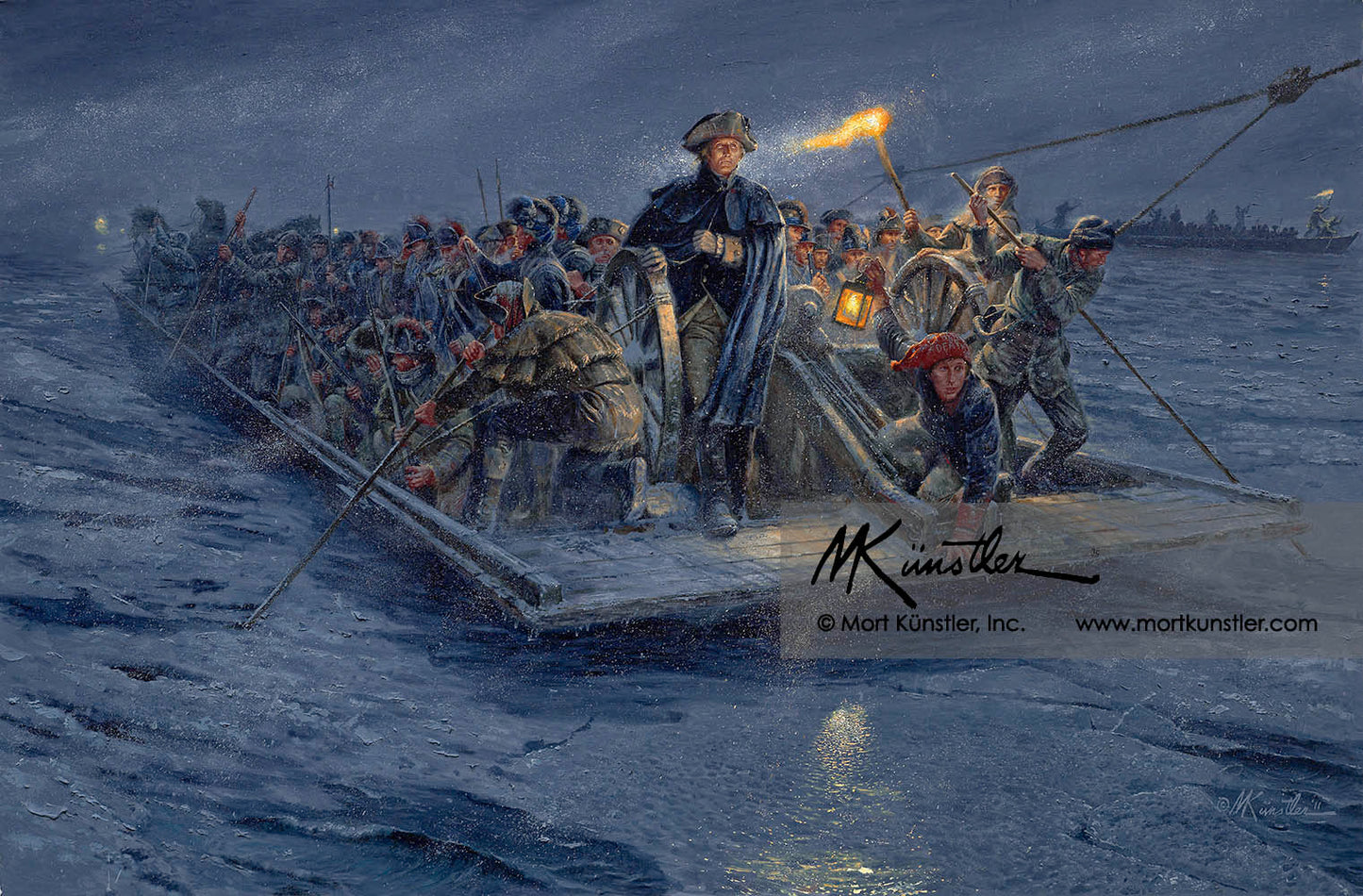
Mort Kūnstler, Washington Crossing the Delaware

I didn’t celebrate America’s 250th birthday yesterday. How could I, with Trump still at the helm of a listing ship? Our country is so deeply fractured that I lack confidence our ship of state can ever be restored to an even keel again.

While the mid-terms loom, a new, more radical faction seems to be taking hold, offering simple remedies, under the aegis of expanded government, to complex problems that may well prove incendiary to America’s best interests.

History is being distorted—accompanied by the rise of a heated rhetoric, the past filtered through a modern lens, as if we can sanitize our heritage by consigning to oblivion our flawed heroes who nonetheless made America possible.

To contend, as some now do, that the Revolution was fought primarily to preserve slavery is a profound untruth. In 1776, Great Britain had no intention of dismantling the institution. While Royal Governor Lord Dunmore famously offered freedom to slaves who fled rebel masters to fight for the Crown, his proclamation was a cynical tactic of war, not a moral crusade; Dunmore himself owned a hundred slaves whom he exempted from his proclamation, and Britain did not outlaw slavery in its empire until 1833. The colonists revolted over representation and imperial overreach, not a defense of bondage.

Far from protecting slavery, the radical ideals unleashed by the Revolution ignited the Western world’s very first widespread abolitionist movement, a moral arc that would ultimately culminate in a bloody Civil War and Lincoln’s Emancipation Proclamation.

History taught from the periphery, filtered through rigid ideology or simplified into monolithic narratives, is intrinsically dangerous. It rests on a priori assumptions and is too often promulgated with dogmatism. True understanding requires nuance, humility, and courage.

Intolerance and intimidation increasingly menace our daily life. It’s a different America from the one I grew up with—dynamic, prosperous, a nation deserving of its patriotism.

And why not?

At the end of WWII, a victorious America was the sole nuclear power. It possessed an army of 14 million, an air force of 50,000 planes, and the largest naval force in history with nearly 7,000 ships, including 99 aircraft carriers.

Yet, alone among the global empires of history, America walked away from total dominion and chose peace over subjugation.

This is the America I remember and want back again.

—RJ

Ken Burn’s The American Revolution

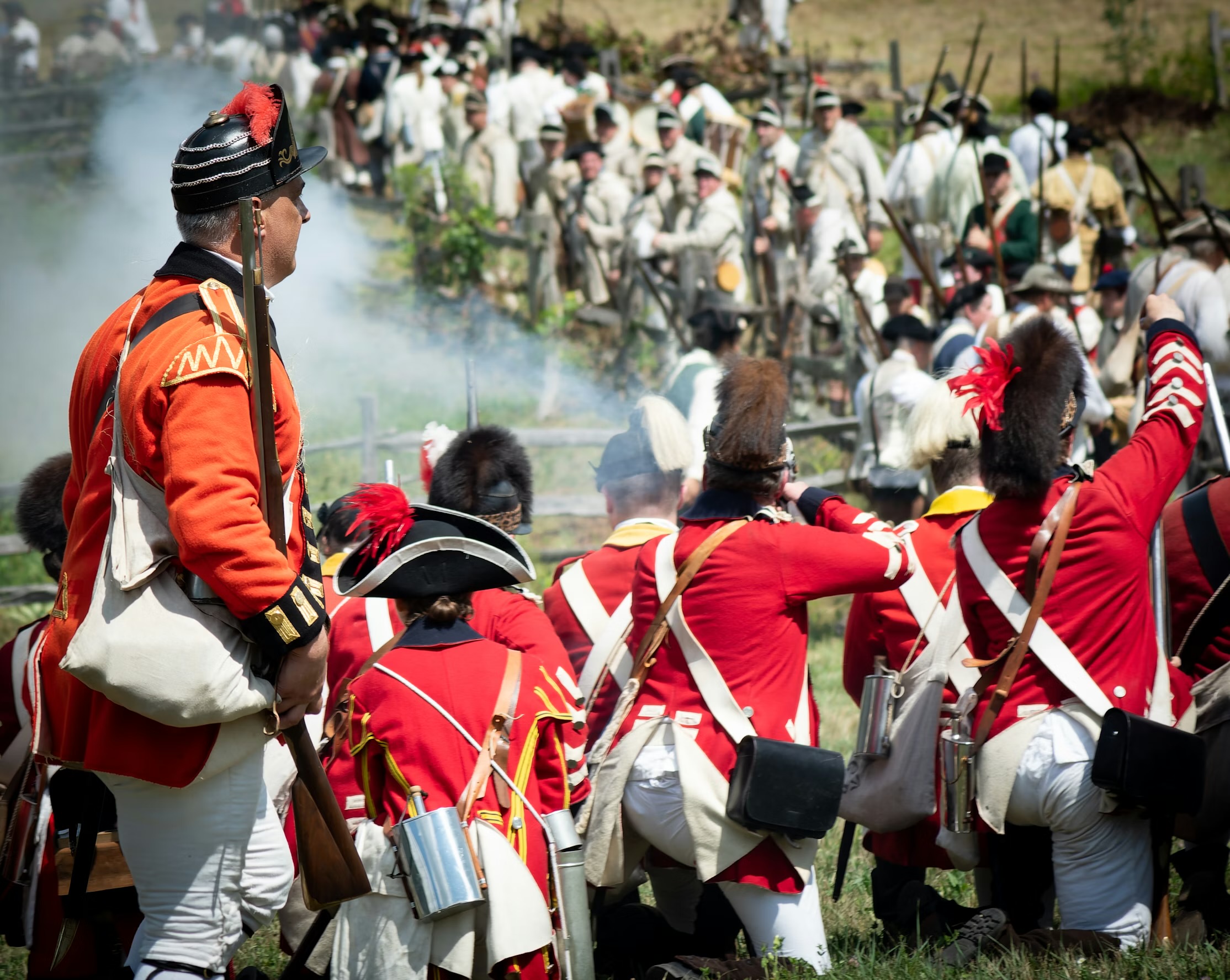
I’ve finished watching Ken Burns’ six part series, The American Revolution, and I think it brilliant, reproducing through letters, paintings, actual locale, staged reenactment, and historian insight a reasonable, balanced portraiture of the genesis of a new nation.

In watching it, I’ve found myself unlearning the version of American history I absorbed in school—one that portrayed the country as born purely of promise, while minimizing its foundations in slavery and the seizure of Indigenous lands.

I hadn’t realized, for instance, that the Revolution was in effect America’s first civil war: nearly 20 percent of the population sided with Britain as Loyalists. Atrocities occurred on both sides—burned homesteads, pillage, and widespread rape.

George Washington emerges as essential to the colonies’ improbable victory over seasoned British troops, often intuitive, and when necessary, boldly improvisational—especially in his surprise attack on the Hessian garrison at Trenton.

He also also fought with chronically scarce resources, including men and weapons. Smallpox devastated his ranks until ever practical Washington ordered mandatory inoculation for the entire Continental Army. For this, and much more, he merits the accolade, “the father of our country.”

The second sentence of the Declaration of Independence remains, for me, among the greatest ever written: “We hold these truths to be self-evident, that all men are created equal, that they are endowed by their Creator with certain unalienable Rights, that among these are Life, Liberty and the pursuit of Happiness.”

It’s also, as historian Jill Lepore points out in These Truths, proved an instrument of exclusion, its author Thomas Jefferson—like Washington—owning hundreds of enslaved people and enjoying immense wealth.

The Declaration is a document of soaring ideals and deep compromises, and we live with those contradictions still—half of America’s wealth held by one percent of the population, and inequities woven through our social and economic life.

The American Revolution, then, is best understood as a work in progress. It inspires hope that we can do better—and in some respects, we have—though much remains unfinished.

While the Revolution’s principal architects—Jefferson, Adams, Franklin—were men of the Enlightenment who trusted reason to guide human flourishing, the war itself was largely fought by working-class coalitions, many lured by the promise of 100 acres of land taken from Indigenous nations.

Burns isn’t receptive to the argument advanced by the 1619 Project—that American history truly begins with the arrival of enslaved Africans in 1619, and that the Revolution was in part propelled by Southern fears that Britain would eventually abolish slavery.

We do see, however, that the Dunmore Proclamation (1775)—offering freedom to enslaved people who joined the British cause—galvanized Southern resistance. Yet Britain itself, as Burns points out, was hardly on the brink of abolition, its Caribbean wealth built on massive slave labor. Simply a political ploy, Dunmore owned many slaves, and slavery would endure in the Empire for another sixty years.

France entered the conflict in 1777, driven not by idealism but by a desire to avenge its humiliation at Britain’s hands and to reclaim lost influence. Without French military and financial support, the colonies almost certainly would have remained British dominions. By this point, the Revolution had become a global conflict, fought on many fronts.

Part V turns to Valley Forge, outside Philadelphia—the de facto capital of the newly united colonies. There the Revolution reached its nadir: troops half-starved, poorly clothed, ill-housed, and undersupplied as a brutal winter descended, the Congress unable for months to pay the troops. Many died. Many deserted.

With Spring, the French presence is felt, dividing British resources. By 1781, the British suffer massive defeat at Yorktown through a combined force of American troops and the French fleet, blocking British escape. A peace treaty, however, would not ensue until 1783.

The war left the new nation weak and divided, its economy wracked with inflation, huge national debt, and resentful farmers who bore much of the burden, leading to the insurrection in western Massachusetts of 1000 farmers before it was put down by militia. The nation’s weakness would lead, however, to the Constitutional Convention of 1787 defining American governance with its checks and balances under The Constitution.

Women and slaves were, nonetheless, still omitted from the democratic franchise; indigenousness lands seized with violent alacrity.

Washington emerges the series hero, not only innovative on the battlefield with few resources, but committing to democratic rule in resigning his military commission at war’s end.

The series’ central insight is that while the Revolution promised a nation unlike any other, that promise survives only through continual reengagement.

It merits wide viewing: a masterpiece deserving of the highest praise.

—rj