

THE ART OF THE RUSHED DEAL

It had seemed, for a fleeting moment, that congressional Republicans were emerging at last from their long cocoon, appearing ready to join Democrats in calling out President Trump’s profound blunder—not only in launching a 110-day war (Operation Epic Fury) heedless of its catastrophic risks, but in his subsequent appeasement of a rogue, murderous regime.

Initial Republican scrutiny was fierce, public, and remarkably direct. Senator Bill Cassidy of Louisiana openly declared the deal “the worst foreign policy blunder in decades,” thirteen American service members dead, families crushed at the pump, only for sanctions to be lifted and the bombing to stop.

Senator Ted Cruz of Texas was even more unsparing, capturing the core absurdity of the framework by warning that “history teaches that giving billions of dollars to theocratic lunatics who want to murder us is a bad idea.” For a few days, it looked as though a genuine, unified groundswell of Republican consensus had taken shape.

What sparked this rare mutiny were emerging details of the newly brokered Memorandum of Understanding (MOU), reading less like calculated diplomacy and more like a wholesale capitulation by a president eager to flee a senseless conflict.

The concessions granted to Tehran are immediate and staggering. Through instant Treasury waivers, the administration has bypassed existing sanctions, leaving Iranian freighters entirely free to ship crude oil to China, their best customer.

A fragile 60-day period of free passage through the Strait of Hormuz has begun, yet the fundamental balance of power has been upended.

While negotiators commence talks on the vital issue of nuclear acquisition, the regime’s potent, increasingly long-range ballistic missile and drone capabilities receive no mention in the text. Neither do its beleaguered citizens—thousands of whom were killed by rooftop snipers last January, with many more imprisoned, including a Nobel Peace Prize winner, as state executions continue unabated.

Furthermore, the agreement features a deeply controversial provision to open the gates for a $300 billion reconstruction and development mechanism, effectively enriching the coffers of a regime that was bordering on total economic collapse.

Trump loudly protests that the windfall is conditional on Tehran’s behavior, promising that if they prove stubborn about their uranium stockpile, the U.S. will simply recommence its bombing. It is a hollow gamble, built on the unconscionable premise of offering a massive financial lifeline to a theocratic dictatorship.

Democrats recognize the MOU for exactly what it is: a desperate attempt by a frightened president, booed at public appearances, to walk away from a historic blunder.

They point out that trading away massive economic leverage upfront just to buy a 60-day dialogue leaves the United States in a vastly inferior strategic position than it occupied before the conflict began, back when Iran’s uranium enrichment was still capped.

For a brief window, initial Republican scrutiny gave teeth to a potential congressional resistance. Lawmakers began drafting legislation to strip the Executive Branch’s ability to issue these oil waivers, a move that would collapse the $300 billion mechanism.

Yet the glaring obstacle remains—the presidential veto. To truly stop the administration, Congress would require a two-thirds supermajority in both chambers—a hill that has suddenly become far too steep to climb.

The resistance effectively crumbled when Senator Lindsey Graham, who had previous dubbed the fund “a Marshall Plan with the Nazis still in charge,” executed his sharp turnabout. Initially vehemently opposed, the leading hawk offered a tepid endorsement of the agreement after a single closed-door briefing. Vice President JD Vance instantly weaponized Graham’s reversal, using it during a blunt White House press conference to excoriate a deeply disillusioned Israel, warning their cabinet to fall in line or risk losing their last major ally.

Once again, Trump’s immense gravitational pull has had its way, dampening conservative scrutiny and fracturing any hope of a unified legislative front.

The emperor wears no clothes, yet Capitol Hill has folded. We are left watching a presidency trade away hard-won geopolitical leverage for a temporary reprieve, like a used car salesman successfully selling the country a piece of junk.

—RJ
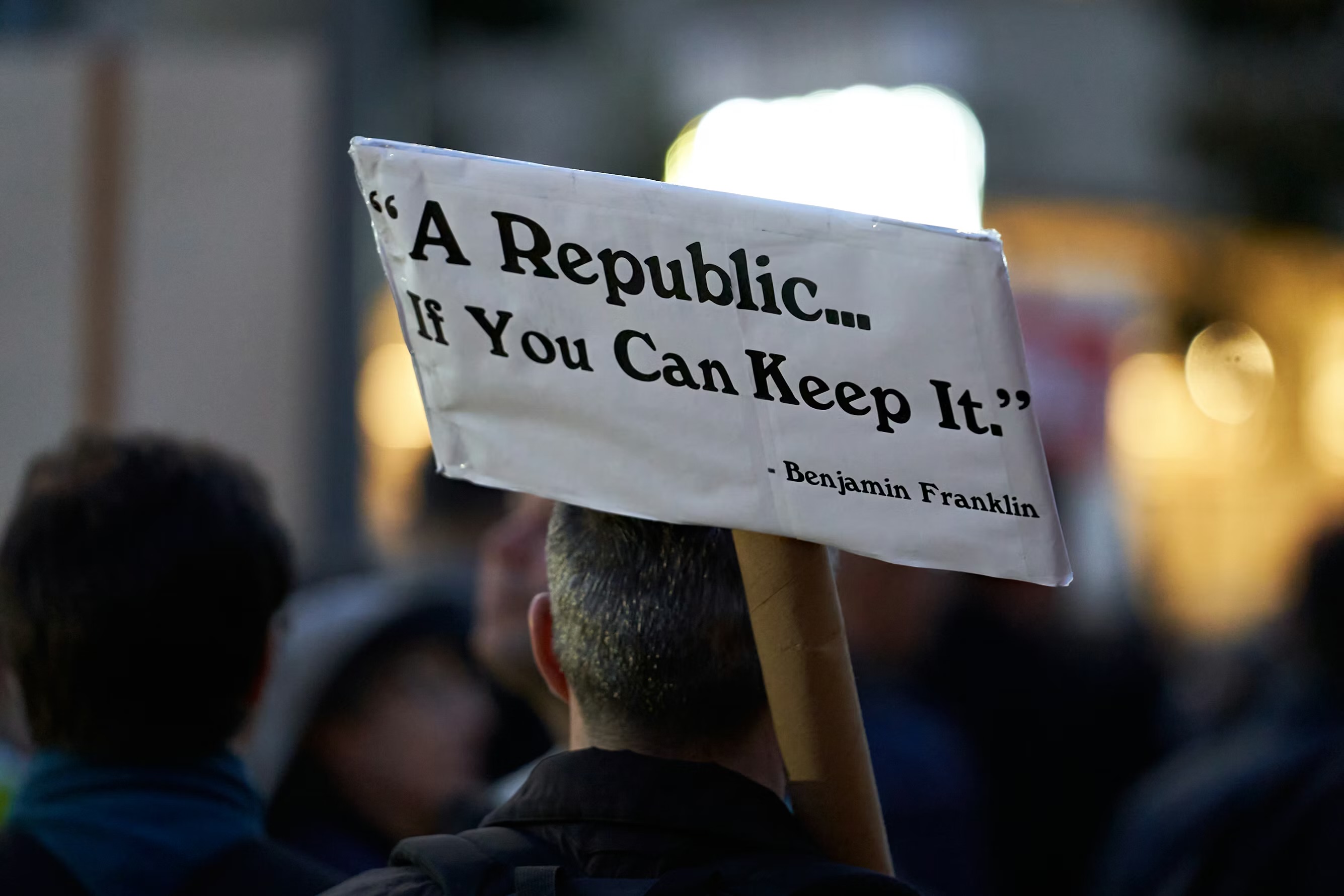
When Elections Are Not Enough: Removing Trump From Office

It is now 2026, with the midterm elections approaching in November. My New Year’s wish is straightforward: the impeachment of Donald Trump—assuming Democrats regain a decisive House majority—followed by a Senate trial resulting in his removal from office.

The Framers of the Constitution were not naïve about power. They were steeped in history’s lessons about its corrupting tendencies and had lived, in their own time, under the despotism of a foreign monarch. Their revolution was not merely against a man, but against unchecked executive authority.

Accordingly, the 55 delegates to the Constitutional Convention of 1787 chose to create a president, not a king. Crucially, they did not rely solely on periodic elections as a safeguard. Recognizing that elections alone might prove insufficient in moments of grave danger, they embedded in the Constitution a remedy for removing a corrupt or dangerous chief executive.

Those impeachment provisions are found in Articles I and II. Article I grants the House of Representatives the sole power of impeachment by majority vote and assigns the Senate the sole power to try impeachments, requiring a two-thirds vote of members present for conviction. Article II, Section 4 defines the standard:

“The President, Vice President and all civil Officers of the United States, shall be removed from Office on Impeachment for, and Conviction of, Treason, Bribery, or other high Crimes and Misdemeanors.”

Impeachment, it bears emphasis, is an accusation; removal requires conviction.

Presidential impeachment trials are exceedingly rare. In more than two centuries of constitutional government, only four have occurred:

Andrew Johnson (1868)
Bill Clinton (1999)
Donald Trump (2019 and 2021)

All four trials ended in acquittal. Richard Nixon almost certainly would have been removed, but he resigned before the House could vote on impeachment—the first presidential resignation in American history.

The rarity of impeachment trials reflects not restraint alone, but the gravity of the remedy. As Alexander Hamilton explained, impeachable offenses are those that violate the public trust—abuses of power that strike at the constitutional order itself.

Measured against that standard, there should be little ambiguity regarding Donald Trump’s “high crimes and misdemeanors.” They include conduct that betrays the nation’s best interests and undermines the rule of law: defiance of judicial orders; the use of the Department of Justice to shield allies and punish perceived enemies; and the deployment of violent rhetoric that incites threats against judges and congressional critics, including calls for the execution of former public servants from the military and intelligence communities.

To these may be added the consistent placation of authoritarian foreign leaders and the initiation of military actions—such as attacks on Venezuela and vessels at sea—without clear congressional authorization.

Conviction in the Senate requires 67 votes. Given political realities, Republicans alone are unlikely to supply them. That leaves responsibility where it has always rested in a constitutional democracy: with the electorate.

If the Constitution is to function as intended—if law is to prevail over personal power—then it falls to citizens to vote in numbers sufficient to make accountability possible. The midterms present such a moment.

Whether the nation seizes it will determine not merely the fate of one presidency, but the durability of the constitutional order itself.

–RJ

No Longer a Democrat. Nor a Republican Either

I’m registered as a Democrat, but am switching to Independent. While an incipient coalition of congressional Democrats has begun voicing opposition to sending arms to Israel—given its genocide Gaza policies— it’s far from enough.

Former Clinton Labor Secretary Robert Reich aptly expresses my view of our current political morass: “There is no longer a Democratic Party as such. There is a big financial machine called the Democratic Party, the Democratic National Committee. On the Republican side, there’s a bunch of absolute zombies that follow Donald Trump. That’s what we have today. We don’t have two governing parties as we did before.”

But I’m also troubled by the increasing infiltration of Leftists into the party such as AOC and Mamdani, who some have hailed as “the future of the party,” active members of the Democratic Socialists of America (DSA).

As I write, 250 DSA members, running largely as Democrats, now hold office at federal, state, or local levels. Read its platform. Advocating seizing the means of production, defunding police, open borders, dismantling our armed forces, should send goosebumps up your spine. Both parties must abandon the peripheries and embrace the center.

The polls are clear: It’s what Americans want.

rj

Reflections on Democrat defeat in Wisconsin recall

Despite large scale union efforts and a tsunami of out-of state money, Wisconsin Democrats fell short in their bid to unseat six Republican state senate incumbents in yesterday’s recall election, with Republicans winning four of the six contests. Democrats, irate at Gov. Scott Walker and his allies whom they view as short-changing the collective bargaining rights of state workers, sought to even the score in an election some have viewed as a bellwether of public sentiment before the November 2012 national election. Democrats had wanted to go after the governor as well, but were preempted by a state law that mandates a governor serve at least one year.

While not taking sides, I am happy with the outcome. For me, the issue of political stability is what’s at stake in such recall elections. Think about the chaos resulting from special interest groups petitioning for recall elections whenever they disagree with their political leadership. Think about the wasted millions in costs. After all, there is a process for change. We call it the ballot box, a right open to citizens every two years. In the interim, we also have the courts. In this instance, the state court upheld the Republican decision-making process.

As is, twelve senate Democrats chose to abandon the decision process by leaving the state in order to prevent a quorum. Again, whatever happened to this thing we call democracy? If I can’t have my way, I’m going to pick-up my marbles and go home.

California’s been dealing with similar gridlock in its state assembly for many years. They also had a recall election, this one successful, in which they got rid of Governor Pete Wilson. His successor? A B-film actor and former body builder without a lick of political experience. Nothing changed. Some might argue things got worse.

Imagine if we acted this way at the federal level. We don’t like a president, so we decide on a recall, never mind waiting another four years.

Soon it will be the turn of Wisconsin Democrats to twist in the wind. Next Tuesday, recall elections for two senate democrats will take place. Where does the retribution end? I am sick of factional politics. Talk to a politician and you won’t get a straight answer. As the Indians had it,”White man speak with forked tongue.”

If you think about it, recall elections have the stuff of lynch-mob mentality behind them. No fair trial. Act on impulse. String ’em up.

I’m starting to think banana republic. Hey, would the last one out get the lights?