
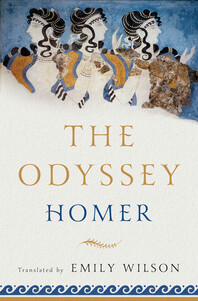
When Christopher Nolan decided to film The Odyssey, he had no shortage of distinguished English translations from which to choose. From among them, he chose Emily Wilson’s, remarkable for its freshness, clarity, and contemporary English while remaining faithful to Homer’s poetry.
Wilson, a classics professor at the University of Pennsylvania, has also translated The Iliad. Unlike some modern “translators,” whose work consists largely of revising earlier English versions, Wilson translates directly from the ancient Greek text. She is equally at home in Latin, a reminder of the extraordinary linguistic preparation classical scholarship once demanded.
That accomplishment is no small feat. Were Homeric Greek taught as a modern foreign language, its highly inflected grammar would make it among the most demanding languages to master, up there with Chinese, Arabic, and Russian.
Wilson also reads classical Greek fluently, the evolved language of Plato, Sophocles, Thucydides, and Aristotle with its unique vocabulary and grammar.
My own acquaintance with the classical languages began in high school, where I studied Latin for two years. The curriculum offered four years, but I opted instead for French and German. Today, my old high school no longer teaches those languages, having replaced them with Spanish.
A few years later, I enrolled in an intensive eight-week Harvard summer course in Koine Greek, the lingua franca of the eastern Mediterranean during the Roman Empire and language of the New Testament. Easier than Homeric or classical Greek, it nevertheless presents formidable challenges.
Our Australian instructor insisted that we learn Greek actively rather than merely decipher it. Instead of translating Greek into English, we were expected to orally translate English into Greek. With only ten students in the room, we couldn’t evade being called upon repeatedly to think, speak, and stumble in the language in real-time. That meant knowing where the accents fell for each word, often very arbitrary, unlike Spanish and Italian.
It was a demanding approach, but by the end of the course I could work through New Testament passages with little more than the aid of a dictionary. Most of that Greek has long since vanished, although I can still read the alphabet, which proved unexpectedly useful years later when I studied Russian, whose Cyrillic alphabet derives in part from Greek.
Impressed with my teacher, I asked him how long he had studied the classical languages. His answer has remained with me ever since: “Thirteen years of Latin; eleven years of Greek.” I was in good hands.
I’ve often regretted not keeping up with Greek, a language renowned for precision in contrast to English, whose richness often lies in words layered with multiple shades of meaning, wonderful for poetry, but often less exact. Reading Greek reveals layers of irony, structural symmetry, and philosophical nuance that disappear in translation.
Growing up in Massachusetts, one could spend a Saturday “junking” through secondhand bookstores and antique shops, coming away with Latin and Greek grammars for a dime apiece, evidence of the former preeminence of classical languages in the curriculum of schools such as Boston Latin School.
Long before my own time, that same New England landscape was shaped by minds saturated in the classics. Ralph Waldo Emerson read Plato in the original Greek, finding in those ancient dialogues the architecture for his own transcendental philosophy. His friend Henry David Thoreau famously carried his Greek text of The Iliad with him to Walden Pond, writing in Walden that true literature must be read in the language in which it was written—the ancient letters “carved out of the breath of life itself.”
Much of that world has faded. Outside a handful of elite institutions like Deerfield Academy, Groton, Phillips Exeter, or in schools like England’s Eton, the sustained study of Latin and Greek has become increasingly rare. Wilson herself began studying both languages at Oxford High School, an independent all-girls school in Oxford before reading Classics (“Greats”) at Balliol College, Oxford, and earning her doctorate at Yale.
I sometimes imagine what it would have been like had I continued with Greek throughout my life: to read Sophocles, Euripides, Plato, and Homer in their own words, perhaps allowing my synapses to mount a quiet resistance to incipient forgetfulness.
I think, too, of modern writers like J.K. Rowling and Toni Morrison, whose formal classical training echoes structurally throughout their work. And yet, the figure who haunts me most is one who had to build her own door to the ancient world: Virginia Woolf.
Denied the university education her brothers received, simply because she was a woman, she taught herself Greek and continued reading it throughout her life. For Woolf, Greek was not an academic ornament, but a living intellectual companion shaping her prose, her essays, and her understanding of literature.
Each year I return to her magnificent essay, “On Not Knowing Greek” (1925), invariably lingering on her summarizing sentence:
“It is to the Greeks that we turn when we are sick of the vagueness, the confusion, the Christianity and its consolations, of our own age.”
—rj


