Perhaps Someday We Will Learn How to Live

Every morning I awaken to a country bristling with hate, intolerance, and violence. 

Trump bullied his way to the presidency, exploiting public anxieties, e. g., steel belt resentment of jobs sent abroad, latent fears of a changing demographic replacing White homogeneity, evangelical rancor against abortion, and Islamaphobia, which sees every Muslim as a potential terrorist.

Trump pledged he’d limit Muslim immigration and reduce refugee numbers.   Shortly into his tenure, he attempted a 90-day immigration ban on seven Muslim nations, fortunately curtailed by the courts, though the recent SCOTUS decision suggests he may now have the upper hand.

One of his gallery of appointed rogues includes top advisor Stephen Bannon, known for his misogynist views on women and feminism that plague our nation.

Early on, Trump appointed the now disgraced retired general Mike Flynn as national security advisor, who’d previously depicted Islam as a “malignant cancer.”

Since his election, hate crimes have risen sharply.   Think Progress has mapped their occurrence from the election through February, 2017, recording 261 hate crimes, 41% of which have been linked to Trump’s rhetoric.

But I want to be fair. Much as I dislike Trump, hate in our country has many sources and targets.

Violence comes from the Left as well as the Right. 13% of the 261 incidents included attacks on Trump supporters.

Now comes the June 14 shooting of four Republican congressmen, one of them critically, while practicing for the annual Congressional Baseball Game for Charity in Alexandria, VA by a disgruntled Bernie supporter.

There’s also Black violence, targeting Whites, often police, the abused becoming the abuser, the most notorious being the Dallas sniper ambush of twelve policemen, five of them killed (June 8, 2016).

Even liberals can become intolerant, as one of my favorites, simply because he’s so even-handed, Fareed Zakaria, reminds us: “American universities these days seem to be committed to every kind of diversity except intellectual diversity. Conservative voices and views, already a besieged minority, are being silenced entirely….Freedom of speech is not just for warm, fuzzy ideas that we find comfortable. It’s for ideas that we find offensive.”

Alarmingly, the number of hate groups in The USA has proliferated, according to the Southern Poverty Law Center, increasing from 892 in 2015 to 917 last year. This number doesn’t track, however, widespread cyperspace hate raconteurs, whose venom sometimes seeps into social violence such as Dylan Roof’s heinous murder of nine Black church members:

ACTIVE HATE GROUPS 2016

KU KLUX KLAN ……………….130                  

NEO-NAZI…………… ………… 99

WHITE NATIONALISTS……..100

RACIST SKINHEAD. …………..79             

CHRISTIAN IDENTITY……… ..21

NEO-CONFEDERATE…………..43

BLACK SEPARATIST…………..193

ANTI-LGBT……………………….52

ANTI-MUSLIM………………….101

GENERAL HATE………………..101

Total:   917 Active Hate Groups (“The Year in Hate and Extremism,” Intelligence Report, SPLC, Spring 2017, Issue 162.)

Top five states for hate groups?   This may surprise you!

1.  California……….79
2.  Florida…………..63
3.  Texas…………….55
4.  New York……….47
5.  Pennsylvania…..40

It’s not any better abroad.  Britain’s decision to exit the European Community, which requires open borders of its members, parallels the upset victory of Donald Trump, many of the pro-exit voters older, working class Whites. France has its Le Pen; the Netherlands, its Geert Wilder; Germany its AFD (Alternative for Germany).

All of this comes down to the age old problem of the Other. Unfortunately, for all our supposed sophistication in today’s world of technological prowess, we’re still engulfed in the tribalism of our ancient progenitors, hostile to the outsider. And it’s not likely to get better, given the increasing anachronism of national borders that same technology makes possible.

Still, I am not without hope that the good side of humanity will ultimately prevail.  Or as   gifted Palestinian-American poet Naomi Shihab Nye puts it,

My father’s hopes travel with me
years after he died.  Someday
we will learn how to live. All of us
surviving without violence
never stop dreaming how to cure it.

–rj


?

Is Mindfulness Warmed-over Buddhism?

momentMindfulness meditation seems everywhere these days. Even the corporate world embraces it, e. g., Google, Facebook, EBay and Twitter. And in medical circles, it’s all the rage, particularly in psychiatry where it increasingly rivals pharmaceutical intervention as a primary therapy in treating depression and general anxiety disorders.

But is there any real science behind mindfulness, or is it simply Buddhism warmed over for Western consumers?

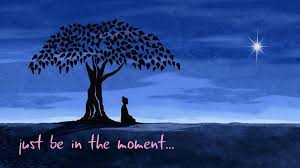
Supposedly, mindfulness is all about being in the present. Never mind regrets about mistakes you made or things you’ll do to make things better. Just let go.  What matters is being sentient in the Now.  In the sports world, you might call it, “Being in the zone.”

Mindfulness, as in Buddhism, has three steps; namely, concentration, insight and its sequel, empathy.

You get there largely by focusing on your breathing. While your mind will inevitably stray with what Buddhists call “monkey mind,” don’t worry about it.  Simply listen to, and not engage, any thoughts that press-in on you.  Mindfulness encourages acceptance and avoids being judgmental.

But why mindfulness, even if its does help relieve your stress?

Why not a pill?

Why not counseling?

Or soft music?

Or having fun with a good friend?

Or relaxing on the beach?

Why not just slow things down and sit still?

Where’s the research to back-up the craze or to validate it’s more effective than traditional ways of promoting well-being?

In short, mindfulness has its critics, some of whom argue that self-confrontation can even be dangerous for you.  Do you really want to probe repressed memories and labyrinthian chambers of loss, grief, and failure?

Melanie McDonagh, a writer for the Evening Standard (London), argues in Spectator that Mindfulness didn’t work for her, given her inability to stay focused.

Mindfulness is supposed to ultimately make you more compassionate. But where’s the proof of that?:

…as far as I can gather, it’s mostly About Me Sitting.  Concentration on your breathing is a good way to chill out and de-stress, but it’s not a particularly good end in itself. Radiating compassion is fine, but it doesn’t obviously translate into action. Where’s the bit about feeding the hungry, visiting the prisoner, all the virtues that Christianity extols? Where in fact is your neighbor in the practice of self-obsession?

In rebuttal, the test of properly practiced mindfulness is demonstrated outwardly in leaving ourselves behind and thinking of others. Any failure doesn’t lie in mindfulness, but those who really haven’t entered into what it’s all about.  I like how Shinzen Young  phrases it:  “The new self is not a noun, it is a verb” (The Science of Enlightenment: How Meditation Works).

What really irks McDonagh is an underlying dislike of Buddhism. While extolling the virtues of Christianity, she glosses over its redolent history of crusades, inquisitions, misogyny, embrace of slavery, hostility towards gays, colonial genocide, etc. You’ll not find any of this in Buddhism.

Mindfulness, as in Buddhism, or even Christianity, teaches you to rid yourself of the sense of a separate self. In short, we’re all part of the experiential flux of time and the temporal.

Stephen Batchelor, a former Buddhist monk, puts it this way in his observations of its exemplum in the Dalai Lama, whom he has met and spent time with on several occasions:

At the heart of [his] sensibility plays a deep empathy for the plight of others, which seemed to pour forth from him effortlessly and abundantly…Such empathy requires that one undergoes a radical emptying of self, so that instead of experiencing oneself as a fixed, detached ego, one comes to see how one is inextricably enmeshed in the fabric of the world (Confessions of a Buddhist Atheist).

McDonagh is just plain wrong in her reductionism, which short-circuits any fair appraisal based on a thorough knowledge of mindfulness in its antecedents, methodology, and scientific appraisal when she asserts that mindfulness is just essentially warmed-over hash: “Think meditation, think Buddhism, and you’re there, so long as you don’t forget the breathing.”

On the contrary, while Western mindfulness owes much to Buddhism, it’s essentially rationalistic, eschewing metaphysics, and eclectic in its make-up, drawing from many strands to implement those methodologies congruent with current science, validated through empirical research, much of it utilizing brain imaging data.

It professes no deities, practices no rituals; has no hierarchy, and no theology. It attracts the best minds.

What it does share with Buddhism–and science for that matter–is a belief in the interweave of causality and effect and the primary role of empiricism, not speculation, in assessing evidence.

Hence its appeal to Western minds and the fact that it works for diverse needs and in a plethora of settings.

–rj

Live Longer Now

Bodybuilder Ernestine Shepard, 78

It’s funny how your mind takes vast jumps, transcending time and space, hurling you into the past or thrusting you into the future. It’s happening to me now.

I remember sitting in my sixth grade class in Florida, fascinated with my teacher’s story of Ponce de Leon’s search for the fountain of youth, motivating him to travel to a new place, which he called Florida.

I think we’re all Ponce de Leons in quest of perpetual youth. We fear ending, the withering of our youth with its exuberance and beauty; the diminishing of resolve motivated by idealism, born of innocence; the advent of entropy and the descent into morbidities presaging that eternal sleep.

We evade our mortality in many guises, obsessing about film icons who seem to have the best of good looks and agelessness.

Advertisers grow rich, pedaling snake oils to mummify us from time’s erosion.

Religion offers consolation; materialism, avoidance; power, the illusion of mastery.

Mortality is the underlying cadence of the arts, arresting time’s flow in capturing the moment’s essence. Think Keats’ Endymion: “A Thing of beauty is a joy forever/Its loveliness increases;/it will never pass into nothingness….”

Medical science isn’t any less pervaded by its own Ponce de Leon quests into unlocking the mysteries of aging, harnessing our genetic codes, refining the regimens of diet and exercise.

A good number of scientists are busy at work, confident that they’ll ultimately win the day. There is Silicon Valley’s California life Company (Calico) for example, determined and well-funded, zealously hiring the foremost scientists on what it deems a moral mission to vastly beat back aging and pre-empt physical demise.

And there are other start-ups, too, like Venter with its ambitious plan to augment Calico’s efforts by creating a gargantuan database of one million human genomes by 2020.

Unfortunately, the landscape of new technologies is littered with bad case scenarios of Frankenstein prototypes unleashing their new horrors on humanity.

I’ve been reading this wonderful book, The Science of Enlightenment by Shinzen Young, an immensely learned Buddhist monk who has made it his mission to reconcile the best of Asian mindfulness practice with contemporary neuroscience.

I happened to come across this passage that set this present blog in motion on how we needn’t concern ourselves with whether science succeeds in its endeavors of extending longevity. We can have it now:

Now imagine that you will live just a normal number of years, but that your experience of each moment will be twice as full as it currently is; that is, the scale at which you live each moment will be doubled. If you only lived each moment twice as fully as the ordinary person lives it, that would be the equivalent of one hundred twenty years of richesse. Not a bad deal.

Hey, I’ll buy into that. I’m 76 and well aware of the math underpinning insurance actuaries. I’m lucky to have gotten this far, and with reasonable health, but it wouldn’t have mattered to me overly if my demise had been at 60.

I’ve lived my life up to the brim with world travel, including third world countries, conversing and making friends; gone from a Philly street urchin, raised by an alcoholic father,  to a professor of English, privileged to share the beauty and wisdom of literature with several thousand students who’ve enriched my life and, I trust, theirs.

I’ve filled my life with passions that have anchored my happiness–a love for reading, nature, languages and writing.

I wake each day, plotting new ventures. As the remarkable Hellen Keller wonderfully put it, “Life is either a great adventure or nothing.”

Not least, there’s been Karen, who entered my life some twenty-five years ago, balancing my introversion with her openness and steady optimism, igniting new vistas with her refusal to foreclose on possibility and stunning ability to rebound from life’s vicissitudes.

Hopefully, the best part of all of this transcends Self in its yield of an encompassing empathy that’s taught me how connected we are to each other and the absolute that we love one another.

For Shinzen Young, longevity is best measured experientially, not chronologically, when we live mindfully in the present. “Meditation is the key to this kind of non-mythical life extension,” he writes. “By developing an extraordinary degree of focus and presence, it allows you to live your life two or three hundred percent ‘bigger.'”

I couldn’t agree more.
–rj

My first attempts at meditation

RELAX
Recently I completed a 28-day online course in Zen meditation from a Buddhist source, not that I’m thinking of becoming a Buddhist, but because I’m drawn to its spirituality, virtually absent in current secular approaches such as the wildly popular Mindfulness-Based Stress Reduction (MBSR) and Mindfulness-Based Cognitive Therapy (MBDT) approaches.

I think meditation doesn’t have to be a long, drawn out affair to reap its many benefits. After all, everyday people have been doing it in varied formats across a myriad of traditions and cultures for some 2500 years.

I’m not saying it’s easy. Like playing a musical instrument or learning a new language, you can get to the rudiments fairly quickly, but doing well at it takes practice.

I struggle with my rebellious mind, as we all do with meditation, and its serpentine twists that take me anywhere and everywhere,

It helps, however, that Zen teaches me to be self-forgiving. It’s not really a matter of emptying my mind, but more of allowing it to have its say without imposing judgment or indulging it, conjuring up regrets about the past or anxieties about the future.

When I do this, meditation liberates me from the burden of my attempts to impose control. I see more objectively and don’t personalize disappointment or hurt. I know that my thoughts aren’t really me and that like the clouds, they come and go. I won’t let them chart my course.

When I meditate, I don’t sit cross-legged on a floor or on a bench, The edge of my bed does just fine in the early morning darkness, my back and neck straight, leaning slightly forward.

If my mind wanders, as it always does, I simply return to my breathing, sometimes counting my breaths.

I’m far from being where I want to be, but it’s become easier than when I began, and feeling more relaxed, I’m more eager to continue.

It’s been five weeks now and I’ve not missed a day, though for even better results, I need to do it twice daily for at least 20-minutes a session.

I like it that I can take mindfulness with me throughout my day, practicing awareness in my eating, or sensing my body rhythms; observing the details that compose those I encounter and listening to them acutely; and best of all, in a cosmos often replete with suffering, gaining an empathy for others–not just for humanity–but for the whole sentient world.

Zen informs me of the interconnectedness of all things in a temporal context; consequently, the imperative of my seizing the moment and extracting its goodness. It cautions me about the unhappiness that comes from my cravings.

Meditation has become a game-changer for me; and if it can work for me, bent over with worry in a world I can’t control, then just maybe it will work for you.

–rj


Why I Relish Going to the Gym

gty_crowded_gym_kb_141229_12x5_1600

For many of us, throwing off the blankets and crawling out of bed on cold winter mornings to go to the gym seems pretty dumb.

I felt that way too until my pre-diabetic diagnosis several years ago which meant that if I didn’t do something about it, I might well succumb to full-blown diabetes with its many lethal complications that include heart disease, kidney failure, blindness and even limb amputation.

Still, I didn’t do anything about it until a chiropractor friend had me do a full blood workup that showed I had moved even closer to diabetes with an A1c of 5.9 and ominous glucose average of 123.   If you get to 125, you’ve got the disease, for which there’s no cure, only management.

Now, fifteen month later, I’ve gotten the A1c down to 5.2. The A1c tests your blood for glucose management over the previous two to three months. The pre-diabetic range is 5.7-6.4. In short, I’m no longer pre-diabetic.

How did I do it? Quite plainly, by cutting carbs and exercising regularly.

Exercise is good for you no matter what ails you or–if you’re an outlier–from nothing at all, promoting good health, better sleep, stress reduction, more energy, and self-esteem.   What’s nicer than people commenting on how good you look?

But let me add to these verities several other reasons exercise has become a mainstay of my daily regimen.

Personally, I can wax euphoric at the gym like this morning walking my fourteen laps (2 miles), with Herbie Hancock’s pulsating jazz rhythms funneling into my ears via my wireless headset, making me pump my arms still more vigorously.

I like, too, the camaraderie going to the gym gives me, a sense of being part of a group. I see many of these people regularly, of both sexes and of all ages and body types. On occasion, we say our hellos or share smiles and sometimes conversation. Call it tribalism. I like the feeling.

I admire many I see at the gym for the obviously hard work they put into their workouts, whether pumping weights, walking raised treadmills or elliptical machines, or doing stair-steppers, etc. I see the payoffs in their lithe bodies with muscular arms, wide shoulders, and developed pecs. I know it didn’t come easily. Many of them exercise before going to work.   No wonder they inspire me.

But I also get a sense of personal satisfaction, or of time well spent. Call it a relish in self-discipline: I haven’t surrendered to the couch or big screen TV. I take pride in that, knowing my former tendency to both procrastinate and be downright lazy.

Every session becomes a moral lesson, and I remember what my high school track coach told me: “We all get stiches in our side. The good runner, win or lose, ignores the stich, holding out for the second wind that propels him to the finish line.” Today, I resisted cutting my four sets of curls to three. I like to think such lessons learned at the gym can help me better cope with life at large.

And then there’s that sense of jubilation in sharing my good news with my dear wife that today I did 70 sit-ups. Just a few months ago, I could barely do 25!

The Chinese have this wonderful saying that “the longest journey begins with the first step.” In going to the gym, I’ve taken more than one step now and I’m eager to do infinitely more in the climb to good health and the contentment it confers.

–rj


Cultivating Stillness

photo_20I am full of early morning,
tucked beneath my comforter,
stretching my legs,
my brain filling its daily bucket of anxieties
sufficient for another day’s wrestlings.

These several days I’ve laid siege to my citadel of habit,
rising in winter’s early morning coldness
to meditate in dark stillness.
It’s not easy.

Plagued by inertia,
I prefer my cocoon to elbowing out of bed
and sitting cross-legged,
back held straight,
shoulders pushed back.

Engulfed by morning’s opaqueness,
my wayward mind wanders aimlessly
and I am lost in a dark wood.

But it suffices,
for Zen absolves human frailty.
Mind needn’t be emptied,
and it’s mindfulness I lack:

To know the moment
and seize the solace of the Now.
To listen, but not engage.

I trace the pulse of limb and muscle.
I tune in to muffled beating of day’s snare drum
amid gathering pink of celestial fingers.
I count my breaths.

Cultivating stillness,
I discover calm,
and listening,
I grow wise.

–rj


Don’t Be a Phoul: When Neighbors Cut Down Trees

NYC Central Park
NYC Central Park

My daughter has been complaining in her recent emails about a family on her street in Bellevue, WA.

They’ve cut down two lovely Douglas fir trees, the kind that startle Easterners like me not used to arboreal skyscrapers, many of them magisterial in their silent dignity bequeathed by longevity.

Bellevue, a fast growing suburb adjacent to Seattle, still enjoys a fecundity most urban areas in America can only envy. When I was there a few weeks ago, I relished walking myriad needle softened pathways of the city’s several forested trails bisecting an urban landscape. Apparently, however, the area has also attracted a newer influx indifferent to the charms of a bucolic setting.

These neighbors complain that their trees were messy. They tired of the needles falling on their roof and car. Around the corner, another neighbor recently did the same thing for the sake of planting a garden free of shade. In its slovenliness, it appears she’s made things worse, not better.

Meanwhile, the company that’s done the cutting directly goes about soliciting customers door-to-door on a regular basis. One of the cutters bragged to my daughter, obviously relishing her displeasure, that he likes chopping down trees.

Unfortunately, we live in an America that prides itself on a free economy, with consumers having sovereignty over their choices. Sadly, in this case, these individuals opted to buzz-saw these magnificent sentries of public health into oblivion for convenience sake.

It’s the way things work in a mutual exchange between the entrepreneurs of the market place, motivated by money, igniting consumer sentiment often detrimental in its long term consequences; for example, alcohol and cigarettes. George Akerlof and Robert Shiller, Nobel Prize winners, term it a “manipulation of focus” in their insightful new book, Phishing for Phools: The Economcs of Manipulation and Deception (Princeton University Press).

Phishing is their term for business interests that phish (i. e., angle) to get phools (consumers) such as you and me to do their bidding to the detriment of ourselves. Think banks, pharmaceuticals, real estate agents, etc.

There are two kinds of phools: those who fall for the falsity of the phishers’ claims and those, the vast majority of the public, who succumb to their own emotions, prone to making bad decisions simply because they initially feed their emotional wants. You see  this in matters of health where our predominant diseases such as atherosclerosis, diabetes and often cancer arise from faulty lifestyle choices such as the wrong food, overeating, indulging in alcohol, or not exercising.

It’s this way of doing things, in this case, overblown avarice with its bubble effect that led to the colossal recession of 2008.

In sum, what’s been happening in my daughter’s neighborhood, threatening its pristine uniqueness, is a facsimile of the phisher-phool conundrum writ large, neighbors manipulated into opting unwittingly against their long term interests.

Maybe you think this is all nonsense. Property owners have the right to do as they like.

But have they the right to harm the public-interest, given the menace of air pollution and global warming, by cutting down their trees?

And what about the neighborhood aesthetic? Hurrah for neighborhood associations!

We aren’t disconnected beings. Yes, we are our brothers’ keepers.

Bellevue government needs to get itself in gear. Trees are public domain just like telephone poles and street lights. Good government is on to this. Consider New York which just completed planting one million trees or Boston which plans to plant 100,000.

It’s estimated that planting trees in urban areas reduces energy use up to 50%. Just one tree absorbs up to 8 pounds of air pollution annually. Trees increase property value. Studies show people drive slower on tree lined streets. They add beauty and lend character.

Let’s not be phouls!

–rj


Snobbery’s Menace

0f42ae99-9c8e-38c1-96bd-8806ca19dd1d

Politics can be a mean way of life, filled with scurrilous attacks on opponents, replete with prevarication, and downright lying. I stay away from it, as much as possible.

Case in point, just the other day former Vermont governor and one time seeker of the Oval Office, Howard Dean, took a shot at Wisconsin governor, Scott Walker, commenting on MSNBC’s Morning Joe: “The issue is, how well-educated is this guy?”

Walker, who may throw his hat into the ring for the Republican nomination in 2016, dropped out of college almost at the finish line in the spring of his senior year to join the Red Cross.

Our Constitution, however, lists only three prerequisites for our nation’s highest office: natural born citizen, at least 35 years old, and a minimum of 14 years lived in the United States.

Maybe Dean and others of his stripe might want to try amending our Constitution to secure their elitist government.

I would contend our government is just too elitist as it is, an oligarchy of power interests distanced from the vast majority of working Americans, three quarters of whom don’t sport a college degree.

I would also question the underlying assumption that a college degree automatically confers knowledgeability on anyone for any job.

I was a prof for 40 years and I can tell you first hand my students learned best, not from books or lecture, but hands-on. That’s what internships are all about, Dean, and you of all people, a medical doctor, should know this, since M. D.’s do a year of internship followed by several years of residency.

I have to confess I made a lot of dumb mistakes as a young prof despite 10 years of college before I was really fit to step into the classroom.

I would like to ask Dean how it was, judging by his own maxim, he was suddenly fit to be governor having trained to be a physician. That’s a huge gap. Maybe Rand Paul can help us out here.

My father had only an elementary school education, dropping out of the public schools like so many of his generation in the pre-World War I years. Like several of my uncles, he worked as a leather tacker for all of his working life in a brutal environment of body-sapping humidity and toxic fumes in one of the most deprived areas of Philly.

But for all his lack of schooling, he was one of the wisest men I’ve known across a life time, intuitive, and possessed of a healthy dose of skepticism whenever the facts didn’t seem to line up.

Not only do I owe my love of baseball to him, but the importance of being aware of what’s going on the world. The TV evening news with John Cameron Swayze or Douglas Edwards was time out and you’d better not be talking while they were on.

Every Sunday morning, he’d send me up the block for the Philadelphia Inquirer, just a dime then (imagine!) and split the newspaper with me on my return, which I’d eagerly devour, sprawled out on the floor. At 10, I was fully aware of a new war in a far off place called Korea, and spell bound by the firing of MacArthur not long after.

I remember his love for Winston Churchill, who had warned the West in the early thirties of the menace of Joseph Stalin.

My father was always slow to swallow the government line, speculating that we might never really know the facts behind that “surprise” attack on Pearl Harbor, a surmise that historian John Toland’s recent book. Infamy: Pearl Harbor and Its Aftermath, lends credence to.

I take offense when the snobs start wagging their tongues, the privileged lording it over the common herd, whether in the political area or anywhere else

Money, celebrity and, unfortunately, education–one of the most rampant bastions of elitism– can become divisive weaponry in putting down others to boost yourself up.

Or to efface those opinions you don’t like. Dummies!

Snobs always want to impress. As Virginia Woolf put it, herself a snob, “The essence of snobbery is that you wish to impress other people.”

I like best how one of my favorite authors, D. H. Lawrence, who came from miner stock, defined it: “[Snobbery] is the desire for what divides men and the inability to value what unites them.”

Ah, let me call to mind just a few names of those from a humble way of life, without college diplomas, who have made a positive mark upon the world. You just may be surprised:

In Science:

Thomas Edison

George Washington Carver

In Business:

Henry Ford

John D. Rockefeller

Steve Jobs

Mark Zuckerberg

In the Arts

Thomas Hardy

Mark Twain

William Faulkner

Vincent Van Gogh

William Shakespeare

In Politics

Andrew Jackson

John Glenn

Winston Churchill

Abraham Lincoln

These are my heroes.

These are my greats!

My favorite people also spring from everyday people I’ve known who never did a mean social thing in their lives like dismissing others for their lack of money, possessions, or the right diploma; or practicing a trade; or for being Black, Asian, Hispanic, Muslim, or gay; or because their political beliefs don’t mesh.

I measure people by a different yardstick: people who inspire with their kindness and compassion, from every walk of life, whose praise comes from the mouths of others and not their own; whose intelligence makes room for them to lead; who, to go back to Lawrence, unite rather than divide.

I like Shaw’s wisdom in his play Pygmalion, where he has Professor Henry Higgins put his finger on what makes for good manners–not whether what you do is in itself good or bad, but that you behave the same way towards everyone.

I must warn, however of another kind of elitism that has taken vogue, of a pride in defiance, or smashing icons for its own sake; a snobbery of rebellion where even norms that have given life grace, and with it, expectancy, are trampled upon in a frenzied allegiance to a vulgarity of self-indulgence of antinomian hue.

Snobbery is a way of life that will always be with us, but you and I, forewarned, needn’t embrace it and, by doing so, gain so much more.

–rj



Why I blog, though few will read

Why I keep a journal, or blog for that matterIt’s time to write again about why I bother keeping a blog.

I can’t speak for others, only for myself.

What got me started this early morning was looking at a recent blog I subscribe to, and that’s very few. The writer says she’s moved from WordPress to her own domain, WordPress no longer giving her the expansive options she needs.

She doesn’t, however, specify, those needs.

Anyway, I’m glad for her success.

But wait a minute!

What do we mean by success where blogging’s concerned?

Is it all about numbers?

How many followers or comments or likes or hits?

If that’s so, then I’ve failed dramatically and the gig is up. Hey, best be movin’ on.

But I don’t play it this way, or like a lot of people who build-up masses of friends in Facebook, for example. as its own end. If you don’t hear from them again, even on your birthday, what the hell!

Yeah, I like to know people are out there, reading me for sure.

But for me, blogging has simply replaced my manuscript journal, Echoes, into which I poured myself for thirty years.

Which is another way of saying I blog foremost for myself, my posts serving to filter issues entangling my thoughts.

Blogging gives them release, enables me to scrutinize and deal with them, and just maybe, and best, provides catharsis.

I don’t blog for validation.

I blog because I’m excited about life, though often it puzzles me, especially suffering, violence, and ill-will. I want to sort it out, find equilibrium through understanding and, with it, empathy and compassion.

I blog, too, because I’ve always had this love affair with the beauty and power of words, the cadence of sentences harmoniously patterned, the sweep of metaphor that makes abstraction palpable.

If you want to join me in the conversation, all the better drinking coffee with you, bridging time and space.

There are millions upon millions of us writing blogs. We just may be rivaling the stars for sheer plentitude.

And so I’m grateful for you who do manage to find and read me.

And especially for the more than two hundred of you who follow me.

But again, I blog not to advance a particular ideology, or to serve pecuniary interests, or to assure myself I’m likable, even lovable, or to shore up verbal sandbags against tidal waves of loneliness.

I blog because I like keeping company with myself, for only then, liking myself, can I connect meaningfully with you in this one journey each of us makes beneath the vast canopy of the silent stars.

–rj


Traits we should all want

leadershipI saw a recent piece in the Huffington Post, called “7 Habits of Natural Leaders,” and found it riveting. You don’t necessarily have to be in a leadership position, however, to benefit from making these attributes staples of your everyday life.

I’ll list them and give my own take on each of the attributes:

1.  They dare to fail: I was a prof for nearly forty years and found that most students opted to play it safe–take the easier courses, avoid the good, but tough professors who gave A’s only for singular achievement. I have often thought of Lincoln, who mostly failed in his early political efforts. But he never gave up, and the rest is history.

One of the problems with not assuming risk is that it can pursue us all our lives and we simply run away from all life’s tough spots and sometimes ourselves. If you think about it, we owe our country’s greatness to its founding fathers, willing to risk their lives to confront tyranny.

I have always liked how the poet Robert Browning famously put it: “A man’s reach should exceed his grasp, or what’s a heaven for?”

2.   They follow their purpose. In short, they stay the course. Over my lifetime, I’ve found the real nemesis of success is not that we quit, but that we quit so soon. Consequently we find ourselves saying, “what if?, when with perseverance, we might have achieved our goals.

Strong people can be difficult to get along with, since passion often governs what they do. At the same time, I find them attractive people, the kind you want to be friends with. They have a vision, know what they want, follow their bliss, and are exciting to be around.

3.   They give. I think we shouldn’t just think of giving in the way of money, but of ourselves. Currently, there’s a seeming panic going on about ebola. Several caretakers, or medical staff, have recently returned to the States, victims of the disease. What’s extraordinary to me is that they went to West Africa in the first place to confront this ugly disease. One of them has actually labored in Liberia for sixteen years, trying to improve its meager medical resources.

When it comes to the monetary aspect, while the vast lot of us aren’t rich, we can still give something. As Peter Singer, a philosopher who specializes in ethics, has said–if all of us in western counties just set aside five percent of our incomes for special needs, we’d eradicate poverty.  I would add, maybe a good many of our diseases as well.

I do know that what we give of ourselves and our assets is a sure indicator of our capacity to love.

4.    They give themselves a break: It’s important to sometimes treat yourself. Right now, I try to keep up my health as I grow older, working out on our elliptical machine and even lifting weights.

But I also schedule timeouts, one or two days when I don’t work out, like Wednesdays and Saturdays. It makes my exercise far more palatable, knowing tomorrow I can simply relax, and without the guilt. I sometimes suspect that dieters would be more successful if they’d cheat one day a week.

We Americans are hard-working and studies show we don’t take much time off.

That’s a pity!

5.    They really listen: Now here’s a trait I’m trying hard to achieve. After all, when we interrupt or ignore what someone’s saying to us, it’s a form of self-absorption, maybe even narcissism. Certainly, it’s selfish

It’s also demeaning to others, a way of saying you don’t matter or what you’ve come to me with is trivial. I don’t want to be this way. I want to value people and for them to know that. I want them to feel when they talk to me that they’re the only one in the room. In short, that they matter, for they do.

6.    They seek out new experiences and ways of thinking: Hey, I’m all over this one and hope you are, too. I like seeing new places, meeting people, chance conversations, reading serious books and magazines.

Guess that’s why I love being around college campuses, especially their real beauty–young people excited about life, filled with dreams, willing to challenge cultural norms turned into unthinking rituals.

Always, I yearn for stimulation, of being challenged to new ways of seeing things. TV doesn’t do that for me. I’m into romping blogs, trying new things, meeting people whose ideas may often challenge my own. I aim to grow, not stagnate, to wake tomorrow wiser than I am today.

7.   They empathize with others:  I like this a lot! Can’t come by a better trait than this, putting yourself in another’s shoes. This happened for me in a unique way many years ago when I took a chance and accepted an invitation form a college friend to visit his country, India.

I saw not only the Taj Mahal, but more importantly, how much the greater portion of humanity suffers in the shackles of ubiquitous poverty, disease and early demise.

I have learned since, and am still learning, the way of compassion, for people, animals and, yes, a wounded earth. I wish I were wealthy, not as its own end, but that I might empty my wallet for others.

If there really does exist what they call an “emotional quotient,” or EQ, then surely compassion is its ultimate marker.

I want it, and want it bad. Hope you do, too!

–rj