Mary Oliver was perhaps the most beloved American poet since Robert Frost, whose nature-centered poems continue to reverberate.
Oliver’s gifts were different from Frost’s. She rarely pursued the subtle symbolism beneath his seemingly familiar surfaces or the double meanings hidden within his plain diction. Yet we continue to read her for a similar invitation: to find rest, not among our busy fellows, absorbed in the pursuit of the volatile, but in nature’s quietude—the bubbling stream, the scurrying chipmunk, the scent of pine, the intricate tapestry of a snowflake.
As always when I read her, a quiet solace takes hold. I grow tranquil, reminded that contentment is found not in possessions but in nature’s moods, even its thunder—in the sense that I, too, belong to something larger than myself, a continuity that neither time nor circumstance can annul.
My childhood returns: memories of a pine-scented grove, a whispering wind, a fox moving silently through the brush.
A few moments ago, I read an Oliver poem I had somehow missed, despite having read much of her work. It’s “What Can I Say,” one of her final poems, included in “Swan: Poems and Prose Poems.”
Once again, she beckons us to immerse ourselves in nature’s quiet wonders, to gather its gifts, and to discover grace by accepting its rhythms.
Her poems never insist; they invite. They ask us to linger long enough for the ordinary to become luminous.
Nature still speaks, if we’ll but listen. As Oliver reminds us, “the leaf is singing still.”:
“What Can I Say”
What can I say that I have not said before? So I’ll say it again. The leaf has a song in it. Stone is the face of patience. Inside the river there is an unfinishable story and you are somewhere in it and it will never end until all ends. Take your busy heart to the art museum and the chamber of commerce but take it also to the forest. The song you heard singing in the leaf when you were a child is singing still. I am of years lived, so far, seventy-four, and the leaf is singing still.
Today is “Poem in Your Pocket Day,” a chance to carry a poem with you and share it. Poetry speaks to the feeling dimension at the heart of who we are, most often through metaphor.
I’ve chosen Sara Teasdale’s “Stars,” first published in 1917. Teasdale is also known for “There Will Come Soft Rains,” whose title Ray Bradbury later borrowed for one of his most memorable stories. She was the first woman to win the Pulitzer Prize for Poetry.
“Stars” is a short poem whose apparent simplicity conceals careful craft:
“Stars”
Alone in the night On a dark hill With pines around me Spicy and still,
And a heaven full of stars Over my head, White and topaz And misty red;
Myriads with beating Hearts of fire That aeons Cannot vex or tire;
Up the dome of heaven Like a great hill, I watch them marching Stately and still,
And I know that I Am honored to be Witness of so much majesty.
The opening stanza—“Alone in the night / On a dark hill”—does not suggest loneliness so much as attentiveness. The speaker is set apart in order to perceive more fully. The “spicy and still” pines engage not only sight but scent, grounding the experience in the physical world.
In the second stanza, the sky’s “white and topaz / And misty red” stars introduce a quiet richness of color. Rather than dramatizing emotion, the imagery gently intensifies perception, drawing us into a heightened awareness.
The third stanza personifies the stars as having “beating / Hearts of fire.” This is a form of pathetic fallacy, but it feels less like projection than kinship. The stars are not indifferent; they seem alive with a steady, enduring energy, untouched by time’s vexations.
By the fourth stanza, the speaker’s response becomes more clearly shaped: the stars “marching / Stately and still” evoke a ceremonial procession, ordered and serene.
The final tercet—departing from the earlier quatrains—serves as a quiet coda:“I am honored to be witness of so much majesty.”
The shift in form underscores the inward turn toward gratitude.
A small poem, yet it opens onto something vast: a moment in which solitude becomes not isolation but privilege—the chance to witness a universe both immense and strangely intimate.
Reading The Times Literary Supplement this morning, I learned of the death of Helen Vendler, one of our most astute literary critics, who died on April 23, 2024, at her home in Laguna Beach, California, at age 90.
I cannot quite account for how I missed this as she mattered enormously to me, beginning with my first encounter with her splendid elucidations of Emily Dickinson’s teasing, cryptic lines.
Harvard’s first female University Professor, the university’s highest academic distinction, Vendler produced a body of work remarkable in its breadth: essays and book-length studies of Shakespeare, Milton, Herbert, Blake, Keats, Hopkins, Yeats, Stevens, Plath, Lowell, and Heaney, among others.
She declined to write on living poets, believing that time was needed to properly weigh their achievement.
With her passing, the great cohort of Anglo-American literary critics has thinned further: Kermode (d. 2010), Bloom (d. 2019), Perloff (d. 2024). Only Sir Christopher Ricks, now 92, remains among the preeminent critics of the last century.
Vendler’s particular gift was guiding readers line by line through the most demanding verse, illuminating rather than overwhelming.
She was a lifelong devotee of I. A. Richards, whose landmark PracticalCriticism advocated close attention to a poem’s formal patterns, setting aside authorial intent, reader response, and historical context. Poetry yields its meaning, Richards argued, through how it is shaped; above all, through its diction.
This was also the foundation of the New Criticism as developed by John Crowe Ransom and Cleanth Brooks (see Brooks’ The Well Wrought Urn and Understanding Poetry).
It is the way I was schooled to read poetry, which may explain why I found Vendler’s skepticism toward deconstructionism and other theoretical fashions so congenial.
Her dictum to aspiring poets, “Write so your mother could understand,” captured her conviction precisely: convolution out, clarity in.
She was not without controversy. Her pointed dismissal of Rita Dove’s Penguin Anthology of Twentieth Century American Poetry in the New York Review of Books:’”Are These the Poems to Remember?,” drew sharp criticism for what many saw as racial bias in her canonical judgments.
That she apologized to Dove as she lay dying, speaks volumes to her integrity. Her criticism of Gerard Manley Hopkins, a poet she loved as a “fastidious aesthete” and “intemperate dogmatist,” illustrates her refusal of hagiography. She evaluated poets on aesthetic terms, not identity, and expected the same rigor of herself.
Her path to that eminence was hard-won. As a Harvard graduate student in the 1950s, she was told by the English Department Chair: “You know we don’t want you here…. We don’t want any women here.”
Pregnancy barred her from teaching. At 34, divorced, she supported a son on child support and the income from four courses, one of them in the evenings. When first offered a professorship she declined it. (She would not accept a position at Harvard until the mid-1980s.).
The irony is that she had not begun as an English major at all, winning a Fulbright in mathematics. But poetry had claimed her early. As a teenager, she had committed several Shakespearean sonnets to memory.
Fluent in reading Latin, Spanish, Italian, and French from her youth, she became, by common consent, the preeminent literary critic of the second half of the twentieth century.
Her honors included the Jefferson Lecture — the federal government’s highest humanities recognition; the presidency of the Modern Language Association; and 28 honorary doctorates.
Her final book, InhabitingthePoem: LastEssays, published by the Library of America, was written as she knowingly was dying and is a fitting capstone. Yeats presides over it, as he always did for her: “the finest poet of the twentieth century.”
As poet Tom Cook observes in the TLS, “It is hard to imagine a critic of her sheer range and depth, with the time and willingness to share it, emerging again.
It was at Exeter College, Oxford, in 1979, while doing a course in modern poetry, that I first heard of Philip Larkin, featured among the poets we studied..
Many critics consider him Britain’s best poet since WWII. Later, I would make him a staple of my own university courses in modern poetry. One Larkin poem that impressed me tremendously was “Church Going,” with its somber reflection on Christianity’s demise and, by extension, religion in contemporary life. Larkin, a librarian at the University of Hull, was slated to visit our tutorial, only to cancel for whatever reason at the last minute. He died a few years later.
While “Church Going” remains my favorite Larkin poem, it had its thematic precedent, however, in modernist American poet Wallace Steven’s “Sunday Morning,” published in 1915 and revised in 1923. Like Larkin, Stevens takes up the embers of a once vibrant faith.
It’s not an easy read, Stevens perhaps with Eliot the most erudite of modernists poets. I’ve been thinking a lot of Stevens and this particular poem as Easter approaches. The resurrection, whether mythic or historical, is the poem’s underlying centripetal force that energizes this magnificent poem.
I.
Complacencies of the peignoir, and late Coffee and oranges in a sunny chair, And the green freedom of a cockatoo Upon a rug mingle to dissipate The holy hush of ancient sacrifice. She dreams a little, and she feels the dark Encroachment of that old catastrophe, As a calm darkens among water-lights. The pungent oranges and bright, green wings Seem things in some procession of the dead, Winding across wide water, without sound. The day is like wide water, without sound, Stilled for the passing of her dreaming feet Over the seas, to silent Palestine, Dominion of the blood and sepulchre.
Commentary:
The poem commences on a Sunday morning, moving intermittently from the palpable, sensory present—an anonymous woman in nightgown, lounging on a couch, enjoying her coffee and oranges, a green parrot resting on her rug.
An interlocutor voice intrudes with philosophic reflection, setting up dialectic tension: nature’s plenitude versus a “silent Palestine/Dominion of the blood and sepulchre,” vague and distant.
II.
Why should she give her bounty to the dead? What is divinity if it can come Only in silent shadows and in dreams? Shall she not find in comforts of the sun, In pungent fruit and bright, green wings, or else In any balm or beauty of the earth, Things to be cherished like the thought of heaven? Divinity must live within herself: Passions of rain, or moods in falling snow; Grievings in loneliness, or unsubdued Elations when the forest blooms; gusty Emotions on wet roads on autumn nights; All pleasures and all pains, remembering The bough of summer and the winter branch. These are the measures destined for her soul.
Commentary:
The idea of paradise distant and abstract, vividly contrasts with the pungency of the physical world, sufficient in both “grievings” and “elations.”
III.
Jove in the clouds had his inhuman birth. No mother suckled him, no sweet land gave Large-mannered motions to his mythy mind. He moved among us, as a muttering king, Magnificent, would move among his hinds, Until our blood, commingling, virginal, With heaven, brought such requital to desire The very hinds discerned it, in a star. Shall our blood fail? Or shall it come to be The blood of paradise? And shall the earth Seem all of paradise that we shall know? The sky will be much friendlier then than now, A part of labor and a part of pain, And next in glory to enduring love, Not this dividing and indifferent blue.
Commentary:
The ancient myth of Jove, the Roman sky-father, and his non-human birth yields a deity absent of human experience, a monarch remote from sensory, earthly life, suggestive of Jesus born of a virgin (“virginal,” “star”). Blood, “commingling…With heaven” implies the Incarnation. “Muttering”suggests incomprehensibility, a divine speech not relevant to human need, an indicting of the traditional transcendent god, absent from daily life. The several symbols — Jove, blood, the Virgin, the star, the hinds (female deer)—suggest their man-made origins. Humans project on the universe their need for the palpable (i.e., “blood) to meet what fulfills their longing for a deity who co-mingles among them (“requital to desire”). Requital means reciprocation, a satisfying of longing. Several pivotal questions are raised toward the stanza’s end:
“Shall our blood fail?” — Will human desire for the divine simply die out?
“Or shall it come to be the blood of paradise?” — Or will we succeed in sacralizing earthly life itself?
“Shall it give back all that it has absorbed?” — Will heaven (the sky, the idea of transcendence) return what it has taken from us — our energy, our desire, our consolation?
“Or shall men gather and make hymns to what / Is left of paradise?” Or shall they celebrate / The sky, the sun, the earth?”
In sum, the human-wrought Incarnation is needless, for Earth functions sufficiently as our sole paradise (i.e., heaven): “A part of labor and a part of pain.” Nature, woven into our experiential world, yields a friendlier, knowable cosmos, the stuff of human experience.
IV.
She says, “I am content when wakened birds, Before they fly, test the reality Of misty fields, by their sweet questionings; But when the birds are gone, and their warm fields Return no more, where, then, is paradise?” There is not any haunt of prophecy, Nor any old chimera of the grave, Neither the golden underground, nor isle Melodious, where spirits gat them home, Nor visionary south, nor cloudy palm Remote on heaven’s hill, that has endured As April’s green endures; or will endure Like her remembrance of awakened birds, Or her desire for June and evening, tipped By the consummation of the swallow’s wings.
Commentary:
Here, Stevens address the poem’s pervasive anxiety, the longing for immortality. The woman worries that the beauty of the earth—the “green of April” or the “plum on the golden plate”—is too ephemeral to satisfy the human soul’s longing for something eternal. In rebuttal, the voice argues the insufficiency of vague, mythic afterlife narratives, the “chimera of the grave,/Neither the golden underground, nor isle/Melodious, where spirits gat them home,” to cyclic nature’s sustaining cornucopia of delight.
V.
She says, “But in contentment I still feel The need of some imperishable bliss.” Death is the mother of beauty; hence from her, Alone, shall come fulfilment to our dreams And our desires. Although she strews the leaves Of sure obliteration on our paths, The path sick sorrow took, the many paths Where triumph rang its brassy phrase, or love Whispered a little out of tenderness, She makes the willow shiver in the sun For maidens who were wont to sit and gaze Upon the grass, relinquished to their feet. She causes boys to pile new plums and pears On disregarded plate. The maidens taste And stray impassioned in the littering leaves.
Commentary:
The woman longs for assurance of a heaven with its bliss in the conflict between rejecting religion and persistent emotional need. Mortality, the voice argues, heightens our awareness of present beauty resplendent in human event.
VI.
Is there no change of death in paradise? Does ripe fruit never fall? Or do the boughs Hang always heavy in that perfect sky, Unchanging, yet so like our perishing earth, With rivers like our own that seek for seas They never find, the same receding shores That never touch with inarticulate pang? Why set the pear upon those river-banks Or spice the shores with odors of the plum? Alas, that they should wear our colors there, The silken weavings of our afternoons, And pick the strings of our insipid lutes! Death is the mother of beauty, mystical, Within whose burning bosom we devise Our earthly mothers waiting, sleeplessly.
Commentary:
The interlocutor’s musing as to the nature of heaven. Is it a place of unchanging sameness, absent of ending ,where “fruit never falls” and the “boughs hang always in that perfect sky”? Is it a place, like earth, of continuing longing, “With rivers like our own that seek for seas They never find…?” Mortality intensifies an awareness of life’s intrinsic value.
VII.
Supple and turbulent, a ring of men Shall chant in orgy on a summer morn Their boisterous devotion to the sun, Not as a god, but as a god might be, Naked among them, like a savage source. Their chant shall be a chant of paradise, Out of their blood, returning to the sky; And in their chant shall enter, voice by voice, The windy lake wherein their lord delights, The trees, like serafin, and echoing hills, That choir among themselves long afterward. They shall know well the heavenly fellowship Of men that perish and of summer morn. And whence they came and whither they shall go The dew upon their feet shall manifest.
Commentary:
The poem’s climax opens with an extended auditory image of a naturalistic celebration of life—“a chant of paradise”!—cognitive of mortality, enhancing acceptance of its ending: “They shall know well “the heavenly fellowship Of men that perish and of summer morn.”
VIII.
She hears, upon that water without sound, A voice that cries, “The tomb in Palestine Is not the porch of spirits lingering. It is the grave of Jesus, where he lay.” We live in an old chaos of the sun, Or old dependency of day and night, Or island solitude, unsponsored, free, Of that wide water, inescapable. Deer walk upon our mountains, and the quail Whistle about us their spontaneous cries; Sweet berries ripen in the wilderness; And, in the isolation of the sky, At evening, casual flocks of pigeons make Ambiguous undulations as they sink, Downward to darkness, on extended wings.
Commentary:
The concluding stanza commences with the speaker’s rejection of the Resurrection:
“The tomb in Palestine Is not the porch of spirits lingering. It is the grave of Jesus, where he lay.”
Independent of a transcendent deity, we are granted autonomy (“freedom”), our lives governed by ancient, impersonal physical laws (the “dependency of day and night”) rather than a moral or spiritual prerequisite.
The stanza concludes with the image of an evening flock of pigeons making “Ambiguous undulations as they sink, Downward to darkness, on extended wings.”
“Ambiguous undulations” suggests impermanence, the inevitable intrusion of change as life transitions from beauty to death. We, like these birds, glide gracefully (“extended wings”), “sinking” inevitably toward the “darkness” of extinction.
REFLECTIONS:
Previous to my retirement, I had taught this poem for some twenty years as part of my course in Modern Poetry, unceasingly admiring its resonant Keats and Wordsworth innuendos.
Paradoxically modern in its delivery, cerebral and image focused, the poem is rooted in English Romanticism, celebrating the imagination’s witness to our fated passage into a parenthesis of light suspended between spheres of darkness.
Like much of Romantic poetry, again that of Wordsworth in its blank verse of unrhymed pentameter, melancholic disposition, rich symbolism, and lofty diction, its voluptuous fantasy, reminiscent of Keats, it supremely celebrates nature.
While there is an insistent tension through much of the poem between nature’s plenitude and the woman’s expressed need for something more, it’s crucial to Stevens’ purpose of philosophical debate.
The final stanza proffers epiphany, the woman’s possible acceptance of a cosmos devoid of divine certitude—“the old chaos of the sun,” a realm of “ambiguous undulations,” where no promise of resurrection intrudes upon the flux of being. We cannot be sure the woman is even present here. Critic Frank Kermode points out Stevens preference for open endings. He sees the poem’s final stanza as process, not conclusion.
Distinguished critic Helen Vender reads the poem as a movement toward a “natural supernaturalism”—a vision in which transcendence is reabsorbed into nature. The final stanza’s birds and “ambiguous undulations” affirm process, not permanence.
Stevens’ masterpiece, a secular hymn, grants solace not in transcendence but in the acceptance—and even the aesthetic affirmation—of metaphysical ambiguity: the freedom to choose, to become arbiters of all that we define as beautiful, grounded wholly within a mortal world.
On winter mornings, before the day has decided what it will become, the fields hold a stillness that feels provisional—frost clinging to the grass, fence lines darkened with damp, the land waiting without impatience. It is a good hour for reading slowly, for choosing words that do not hurry ahead of their meanings.
I have begun the year reading Wendell Berry. Now in his ninety-second year, he continues—more slowly, more deliberately—to farm and to write, unchanged in his fidelity to limits: the authority of place over abstraction, the moral claims of the local over the corporate, tradition understood not as nostalgia but as knowledge earned through use and endurance.
I read him most mornings. His work steadies the day. It does not offer solutions so much as orientation—toward what is given, what is sufficient, and what must be borne. Berry has always made room for joy, but never without sorrow, nor for hope without the acknowledgment of failure, including one’s own.
Some of his most influential prose appeared early, when his voice was still finding its public footing. The Long-Legged House and The Unsettling of America argued, quietly and insistently, that culture and agriculture are inseparable, and that when land is treated as commodity rather than community, both soil and people are diminished.
I return often to his poetry, especially A Timbered Choir: The Sabbath Poems. Written on Sundays and largely free of polemic, these poems are acts of attention. They move patiently through the stages of a human life—birth, labor, love, diminishment—offering a sacramental vision of ordinary days lived close to the ground. Among them is Berry’s most widely known poem, “The Peace of Wild Things,” whose calm acceptance of life’s ephemerality offers not escape from anxiety, but release from the burden of false mastery:
“I come into the peace of wild things who do not tax their lives with forethought of grief.”
The peace the poem offers is not consolation so much as proportion. Its discipline lies in relinquishing the anxious reach into the future and reentering creaturely time—where life is finite, local, and sufficient.
That same discipline governs Berry’s essay “Why I Am Not Going to Buy a Computer,” first published in 1987 and often misread as a rejection of technology itself. It is instead a meditation on the moral weight of tools. Berry does not deny their usefulness; he questions their claims. Certain technologies, he suggests, quietly privilege speed over deliberation and convenience over care, reshaping habits of attention until efficiency becomes an unquestioned good.
The good life, in Berry’s accounting, is not optimized. It is inhabited. To live well requires learning the difference between what is necessary and what merely promises ease.
Barbara Kingsolver, another Kentuckian, names this work plainly when she writes:
“I consider it no small part of my daily work to sort out the differences between want and need. I’m helped along the way by my friend Wendell, without his ever knowing it. He advises me to ask, in the first place, whether I wish to purchase a solution to a problem I don’t have.”
Berry’s essay is not finally about computers at all. It is about scale and consequence. It asks not simply what a tool can do, but what it may undo—what forms of patience, responsibility, and mutual care it quietly displaces. It asks how our choices shape our relationships to family, to community, and to the land that sustains both.
Berry still writes with pencil on a yellow legal pad. He still farms, though within the limits age imposes. He still publishes—new poems, even a recent novel. The persistence itself feels instructive.
In a culture bent on expansion and acceleration, Berry’s life suggests another measure of success: fidelity to place, restraint in use, and the long patience required to learn what is enough.
Silence has always allured me, most often when it is bound to expanses empty of people—though not always. I can find it just as readily in a library, or even in my own home when left to myself.
It is not, I believe, a resistance to an oppressive environment—work, academics, trauma, peer pressure, or the quotidian churn of human caprice—what psychiatry terms “psychological reactance.” It goes deeper than that, perhaps rooted in my introversion, which inclines me away from crowds and constant social encounter.
I carry memories of three landscapes that produced instant rapture: a sense of detachment, of absence from time itself—something larger than me, and yet intimately felt.
The first occurred when I was a graduate student in North Carolina, visiting the hillside at Kitty Hawk where the Wright brothers first achieved sustained flight in their ungainly aerial contraption. I had gone with friends, who wandered along the beachfront below, leaving me alone atop the hill. There, history seemed to recede. The wind moved through the grass, the sky stretched open and unmarked, and for a moment the present dissolved, as though time itself had paused in reverence.
Then there was Arlington National Cemetery, its vast rows of symmetrical white grave markers extending beyond easy comprehension. The stillness there was not empty but weighted, a silence shaped by collective sacrifice. For a brief moment, the eternal peace of America’s fallen became my own.
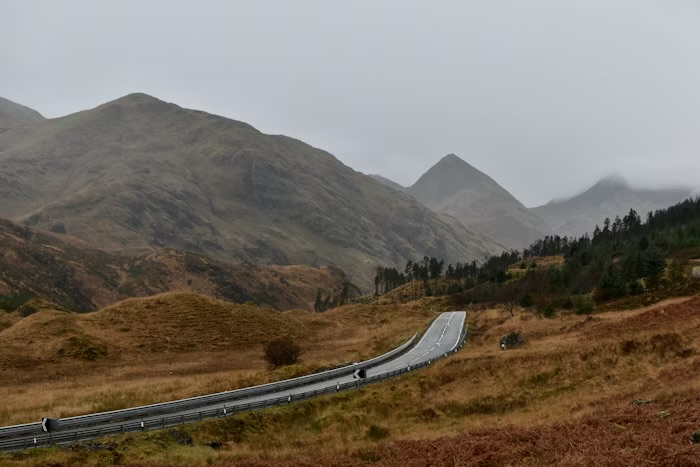
Most memorable of all were Scotland’s Highlands. Driving eastward from Edinburgh, they rose suddenly and unexpectedly across the horizon—rugged, green, and seemingly untouched by human intrusion. I pulled over, stepped out, tested the firmness of their verdure beneath my feet, and listened to what I can only call their shouting silence. That moment remains my most cherished travel memory.
As an English major in college, I once took a course devoted entirely to Wordsworth—England’s great poet of landscape. I am, perhaps, a rarity in having read all of his several hundred poems. Among them, “Tintern Abbey” most fully captures my response to those landscapes:
“…that serene and blessed mood, In which the affections gently lead us on,— Until, the breath of this corporeal frame And even the motion of our human blood Almost suspended, we are laid asleep In body, and become a living soul…”
Literary scholars describe this response under the notion of the sublime: the experience of being overwhelmed through intimacy with nature, a flash of clarity in which one intuits a larger coherence behind nature’s mystery. Wordsworth gives it further voice:
“And I have felt A presence that disturbs me with the joy Of elevated thoughts; a sense sublime Of something far more deeply interfused, Whose dwelling is the light of setting suns, And the round ocean and the living air, And the blue sky, and in the mind of man….”
Psychology approaches the experience from another angle. One theory frames it as a sensory reset—the mind’s need to unburden itself from obligation and affliction, a release from the cognitive overload of daily life.
I am especially drawn to E. O. Wilson’s Biophilia Hypothesis, which proposes that humans evolved in constant contact with nature, calibrating the nervous system through millennia of hunter-gatherer life. In that context, a deserted landscape could signal safety—the absence of predators, permission to rest.
Another perspective, the Default Mode Network, suggests that quiet environments can trigger awe by suspending habitual rumination. Freed from constant external demands, the mind drifts toward reflection, memory, and imaginative connection. In such moments, the brain is allowed to hear the rhythms it evolved to monitor.
This makes intuitive sense. We live in a world saturated with anthropophonic noise—human-made sound without pause or mercy. Though nature is never truly silent—wind, water, and the subtle movements of life persist—these sounds soothe rather than assault. They restore rather than demand.
Wordsworth seems to anticipate this longing even in the heart of the city. In “Composed upon Westminster Bridge, September 3, 1802,” he finds London redeemed by a rare moment of stillness:
“Earth has not any thing to show more fair: Dull would he be of soul who could pass by A sight so touching in its majesty: This City now doth, like a garment, wear The beauty of the morning; silent, bare, Ships, towers, domes, theatres, and temples lie Open unto the fields, and to the sky; All bright and glittering in the smokeless air. Never did sun more beautifully steep In his first splendour, valley, rock, or hill; Ne’er saw I, never felt, a calm so deep! The river glideth at his own sweet will: Dear God! the very houses seem asleep; And all that mighty heart is lying still!”
Perhaps silence, then, is not an absence but a presence—one that returns us to ourselves, quiets the mind’s noise, and restores a way of listening we once possessed, and have not entirely forgotten.
I’ve been keeping a list for some time of my favorite blogs. There are so many to choose from that discovering one capable of sparking genuine enthusiasm often feels like chance—like gazing nightly at the starry heavens and marveling at what lies beyond human reach. When such a blog does appear, it draws me back again and again, not out of habit but wonder.
Relying on that list, I came upon a short paragraph-poem this morning by Dr. Drew Lanham, the award-winning African American professor of environmental studies at Clemson University. Lanham confesses to being “a man in love with nature—a wanderer finding foundation in wild places.” What follows is both intimate and expansive:
Handle my life in your hands as if it were your own. Feel the heart beating—small as it may be—and imagine it in your own chest. Beating in syncopated time to become shared meter. That pulse, the breathing, is your rhythm. Your in’s and out’s, its in’s and out’s. Look close under whatever warty skin or soft fur or gaudy feathers and see self. Its being is your being. Be in that same skin for what moments it will allow. Then, when the convergence between you is sealed, release that wild soul to free roaming as you would desire of your own.
What strikes me is the poem’s quiet tone: a persona grounded in kinship with the natural world, alive with empathy for the vulnerable. Applied beyond nature—to our fellow humans—it gestures toward something transcendent: a way of bridging difference, whether of creed, ethnicity, or race.
Such bridging begins only when we recognize our linkage, when we are willing, even briefly, to see ourselves in others—“Be in that same skin for what moments it will allow.”
Lanham wrote this poem after rescuing a frog from his cat’s pursuit.
Yesterday, Dec. 10th, marked the 194th birthday of Emily Dickinson (b. 1830), one of America’s most gifted poets.
Her love of nature, keen observations on life’s ironies, and daring truthfulness won me over early. I know of no poetry with more nuance.
Of her many poems, my favorite is “A Wounded Deer Leaps Highest” with its nature analogies exhibiting the incongruity of the outer appearance with the inner reality. We are often masters at concealing life’s griefs.
Though I’ve visited The Homestead (Amherst , MA) on several occasions, I’m ready to visit again to take-in the Dickinson Museum updates, which include the restoration of Emily’s beloved garden, her father’s gifted conservatory to Emily and her sister, Lavinia, and the recently completed reconstruction of the family’s carriage house.
In short, The Homestead is my literary Mecca, as there is much in Emily’s sensibility that resonates with me.
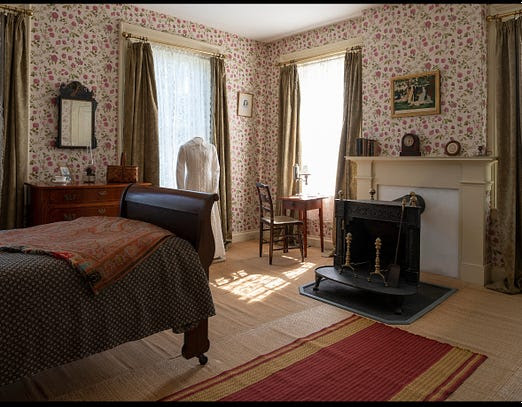
Below, Emily’s upstairs bedroom where she composed her nearly 2000 poems and many letters:
It was cerebral musician Patty Smith who reminded me of Dickinson’s birthday in her substack post, replete with quotations from her poems and letters.
I’m repeating them here, as they superbly express Dickinson’s keen sensitivity and writing acumen. Smith observes that any of them would serve well as a writing prompt:
“Forever is composed of nows.”
“I am out with lanterns, looking for myself.”
“We turn not older with years but newer every day.”
“The soul should always stand ajar, ready to welcome the ecstatic experience.”
“I know nothing in the world that has as much power as a word. Sometimes I write one, and I look at it, until it begins to shine.”
“That it will never come again is what makes life sweet. Dwell in possibility. Find ecstasy in life; the mere sense of living is joy enough.”
“If I read a book and it makes my whole body so cold no fire can warm me, I know that is poetry. If I feel physically as if the top of my head were taken off, I know that is poetry. These are the only ways I know it. Is there any other way?”
“Not knowing when the dawn will come, I open every door.”
“The dearest ones of time, the strongest friends of the soul–BOOKS.”
“The lovely flowers embarrass me. They make me regret I am not a bee…”
“I don’t profess to be profound; but I do lay claim to common sense.”
“Life is a spell so exquisite that everything conspires to break it.”
“Whenever a thing is done for the first time, it releases a little demon.”
“To shut your eyes is to travel.”
“your brain is wider than the sky”
“How do most people live without any thought? There are many people in the world,–you must have noticed them in the street,–how do they live? How do they get strength to put on their clothes in the morning?”
“I have been bent and broken, but -I hope- into a better shape.”