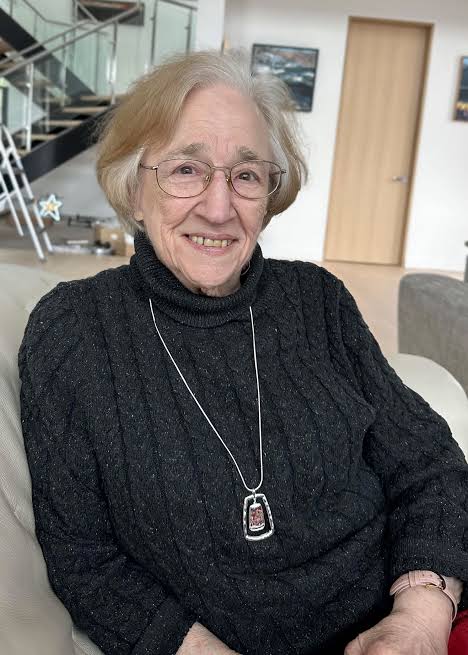
Reading The Times Literary Supplement this morning, I learned of the death of Helen Vendler, one of our most astute literary critics, who died on April 23, 2024, at her home in Laguna Beach, California, at age 90.
I cannot quite account for how I missed this as she mattered enormously to me, beginning with my first encounter with her splendid elucidations of Emily Dickinson’s teasing, cryptic lines.
Harvard’s first female University Professor, the university’s highest academic distinction, Vendler produced a body of work remarkable in its breadth: essays and book-length studies of Shakespeare, Milton, Herbert, Blake, Keats, Hopkins, Yeats, Stevens, Plath, Lowell, and Heaney, among others.
She declined to write on living poets, believing that time was needed to properly weigh their achievement.
With her passing, the great cohort of Anglo-American literary critics has thinned further: Kermode (d. 2010), Bloom (d. 2019), Perloff (d. 2024). Only Sir Christopher Ricks, now 92, remains among the preeminent critics of the last century.
Vendler’s particular gift was guiding readers line by line through the most demanding verse, illuminating rather than overwhelming.
She was a lifelong devotee of I. A. Richards, whose landmark Practical Criticism advocated close attention to a poem’s formal patterns, setting aside authorial intent, reader response, and historical context. Poetry yields its meaning, Richards argued, through how it is shaped; above all, through its diction.
This was also the foundation of the New Criticism as developed by John Crowe Ransom and Cleanth Brooks (see Brooks’ The Well Wrought Urn and Understanding Poetry).
It is the way I was schooled to read poetry, which may explain why I found Vendler’s skepticism toward deconstructionism and other theoretical fashions so congenial.
Her dictum to aspiring poets, “Write so your mother could understand,” captured her conviction precisely: convolution out, clarity in.
She was not without controversy. Her pointed dismissal of Rita Dove’s Penguin Anthology of Twentieth Century American Poetry in the New York Review of Books:’”Are These the Poems to Remember?,” drew sharp criticism for what many saw as racial bias in her canonical judgments.
That she apologized to Dove as she lay dying, speaks volumes to her integrity. Her criticism of Gerard Manley Hopkins, a poet she loved as a “fastidious aesthete” and “intemperate dogmatist,” illustrates her refusal of hagiography. She evaluated poets on aesthetic terms, not identity, and expected the same rigor of herself.
Her path to that eminence was hard-won. As a Harvard graduate student in the 1950s, she was told by the English Department Chair: “You know we don’t want you here…. We don’t want any women here.”
Pregnancy barred her from teaching. At 34, divorced, she supported a son on child support and the income from four courses, one of them in the evenings. When first offered a professorship she declined it. (She would not accept a position at Harvard until the mid-1980s.).
The irony is that she had not begun as an English major at all, winning a Fulbright in mathematics. But poetry had claimed her early. As a teenager, she had committed several Shakespearean sonnets to memory.
Fluent in reading Latin, Spanish, Italian, and French from her youth, she became, by common consent, the preeminent literary critic of the second half of the twentieth century.
Her honors included the Jefferson Lecture — the federal government’s highest humanities recognition; the presidency of the Modern Language Association; and 28 honorary doctorates.
Her final book, Inhabiting the Poem: Last Essays, published by the Library of America, was written as she knowingly was dying and is a fitting capstone. Yeats presides over it, as he always did for her: “the finest poet of the twentieth century.”
As poet Tom Cook observes in the TLS, “It is hard to imagine a critic of her sheer range and depth, with the time and willingness to share it, emerging again.
–RJ

