On winter mornings, before the day has decided what it will become, the fields hold a stillness that feels provisional—frost clinging to the grass, fence lines darkened with damp, the land waiting without impatience. It is a good hour for reading slowly, for choosing words that do not hurry ahead of their meanings.
I have begun the year reading Wendell Berry. Now in his ninety-second year, he continues—more slowly, more deliberately—to farm and to write, unchanged in his fidelity to limits: the authority of place over abstraction, the moral claims of the local over the corporate, tradition understood not as nostalgia but as knowledge earned through use and endurance.
I read him most mornings. His work steadies the day. It does not offer solutions so much as orientation—toward what is given, what is sufficient, and what must be borne. Berry has always made room for joy, but never without sorrow, nor for hope without the acknowledgment of failure, including one’s own.
Some of his most influential prose appeared early, when his voice was still finding its public footing. The Long-Legged House and The Unsettling of America argued, quietly and insistently, that culture and agriculture are inseparable, and that when land is treated as commodity rather than community, both soil and people are diminished.
I return often to his poetry, especially A Timbered Choir: The Sabbath Poems. Written on Sundays and largely free of polemic, these poems are acts of attention. They move patiently through the stages of a human life—birth, labor, love, diminishment—offering a sacramental vision of ordinary days lived close to the ground. Among them is Berry’s most widely known poem, “The Peace of Wild Things,” whose calm acceptance of life’s ephemerality offers not escape from anxiety, but release from the burden of false mastery:
“I come into the peace of wild things who do not tax their lives with forethought of grief.”
The peace the poem offers is not consolation so much as proportion. Its discipline lies in relinquishing the anxious reach into the future and reentering creaturely time—where life is finite, local, and sufficient.
That same discipline governs Berry’s essay “Why I Am Not Going to Buy a Computer,” first published in 1987 and often misread as a rejection of technology itself. It is instead a meditation on the moral weight of tools. Berry does not deny their usefulness; he questions their claims. Certain technologies, he suggests, quietly privilege speed over deliberation and convenience over care, reshaping habits of attention until efficiency becomes an unquestioned good.
The good life, in Berry’s accounting, is not optimized. It is inhabited. To live well requires learning the difference between what is necessary and what merely promises ease.
Barbara Kingsolver, another Kentuckian, names this work plainly when she writes:
“I consider it no small part of my daily work to sort out the differences between want and need. I’m helped along the way by my friend Wendell, without his ever knowing it. He advises me to ask, in the first place, whether I wish to purchase a solution to a problem I don’t have.”
Berry’s essay is not finally about computers at all. It is about scale and consequence. It asks not simply what a tool can do, but what it may undo—what forms of patience, responsibility, and mutual care it quietly displaces. It asks how our choices shape our relationships to family, to community, and to the land that sustains both.
Berry still writes with pencil on a yellow legal pad. He still farms, though within the limits age imposes. He still publishes—new poems, even a recent novel. The persistence itself feels instructive.
In a culture bent on expansion and acceleration, Berry’s life suggests another measure of success: fidelity to place, restraint in use, and the long patience required to learn what is enough.
I’ve been absent from Brimmings for nearly a week, recovering from a serious bout with the flu—the fever lingering for ten days. A chronic cough remains my daily companion.
That hasn’t stopped me from reading—slowly, attentively—six books already this year.
As I’ve previously shared, alongside my annual eclectic reading list, I’ve committed to a topical approach to reading as a way of resisting intellectual grazing and cultivating sustained attention (Topical Reading). I’ve begun with Kentucky sage Wendell Berry, now in his ninety-second year.
I didn’t want to one day come upon his obituary and feel the guilt pangs of having neglected an agrarian pacifist, a champion of the local, often described, without much exaggeration, as America’s “moral conscience.”
Berry has farmed a 125-acre hilly tract adjacent to the Ohio River at Port Royal in Henry County, Kentucky, for more than forty years. Farming, for him, is not metaphor but moral practice. As he writes, “The care of the Earth is our most ancient and most worthy, and after all our most pleasing responsibility.”
Academically, Berry is no lightweight: a BA and MA in English from the University of Kentucky, a Stegner Fellowship at Stanford, and a Guggenheim that took him to Italy, he taught briefly at New York University before returning—against the counsel of colleagues who believed he was jettisoning a promising academic career—to rural Kentucky and the family farm.
They were wrong.
Berry has since written more than fifty books spanning essays, novels, and poetry. His great theme is stewardship—not management or control, but reverent care. “The idea that people have a right to an economy that destroys nature is a contradiction,” he writes, insisting that economic life must answer to ecological reality.
For the farmer Berry, stewardship begins with the soil: an antipathy to chemicals, a reverencing of the biosphere, and a life lived according to natural rhythms. He is deeply opposed to industrial agriculture, which he regards as a cultural as well as ecological calamity: “Industrial agriculture is not just bad for farmers; it is bad for land, for rural communities, and ultimately for culture.”
Among American environmental writings, the two most salient works I’ve encountered are Thoreau’s Walden (1854) and Rachel Carson’s Silent Spring (1962). Thoreau’s aphoristic brilliance lends itself to endless quotation: “Our life is frittered away by detail… Simplify, simplify,” while Carson’s prose approaches poetry. Her opening paragraphs of SilentSpring remain, to my mind, the finest in environmental literature, exposing the arrogance behind what she called “the control of nature, a phrase conceived in arrogance, born of the Neanderthal age of biology and philosophy.”
I’m only in the early stages of getting acquainted with Berry, but he keeps distinguished company with Thoreau and Carson in his passion for preserving nature’s bounty and the pulchritude of a simplified life lived in fidelity to place and community.
In this sense, Berry reaches back to Thomas Jefferson, whom he quotes more than any other figure: “In my own politics and economics I am Jeffersonian.” Jefferson believed liberty was best secured in small, decentralized communities of independent producers, warning that distant power—whether governmental or economic—inevitably corrodes responsibility and freedom.
Though Berry was an activist who vehemently opposed the Vietnam War and has voted Democratic, his politics resist easy classification. He has lamented that America’s two major parties have grown increasingly to resemble one another.
There may appear, at first glance, to be overlap with libertarianism—his opposition to big government, military expansion, and imperial intervention—but the resemblance is superficial. Libertarianism exalts the autonomous individual; Berry emphasizes communal obligation. “We do not have to sacrifice our economic well-being in order to act responsibly toward our land and our neighbors,” he writes. “Rather, we must do so in order to preserve our economic well-being.”
Berry has his critics. His suspicion of technology strikes some as untenable in a hungry, overpopulated world. Can an aggregate of small family farms feed a wired and burgeoning global population, particularly in parts of Africa?
I find myself grappling with his apparent parochialism. Only a tiny fraction of Americans now farm. What of the rest of us who earn our livelihoods elsewhere? And in an interconnected age, can the local truly stand apart from the global?
Berry would respond that the issue is not technology itself, but dependence. “There is a difference between being technologically advanced and being technologically dependent,” he reminds us—a distinction too often elided in contemporary debates.
Ironically, Berry would fit comfortably in an Amish community. He still plows with horses. He owns no computer, television, or mobile phone, and has no internet access. He writes first in pencil, then types. He uses electricity sparingly, supplemented by solar panels, and his writing studio is without electricity. He walks the talk, living a life rooted—quite literally—in the land. Thoreau would have approved.
An iconoclast, Berry remains well worth reading. Growth, he reminds us, is not synonymous with the earth’s welfare. Economies, like soils, can be exhausted. Big government and industrial systems, he argues, erode local responsibility, foster dependency, and inflame military and international tensions. Rural poverty in places like Appalachia persists, in his view, because urban prosperity has been purchased by the plundering of these regions.
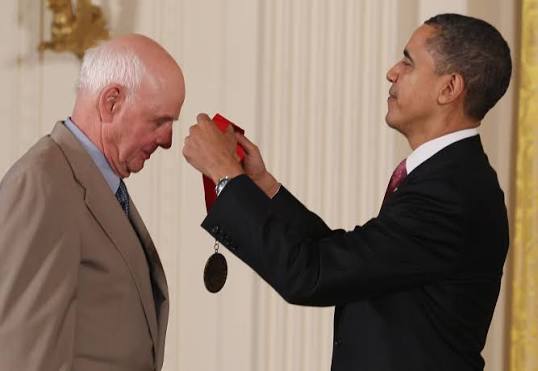
In 2013, President Barack Obama awarded Berry the National Humanities Medal.
In 2015, he became the first living writer inducted into the Kentucky Writers Hall of Fame.
That same year, the Library of America published a boxed set of his work—an honor accorded to only two living American writers at the time.
Berry may be impractical. He may be impossible to scale. But he leaves us with an uncomfortable and necessary reminder: care, once abandoned, is not easily restored—and neither are the land, the culture, nor the communities that depend upon it.
AI excels at counterfeiting the human mind. If we’re not vigilant, it will think for us—leaving our own intelligence dormant, our creative impulse atrophied.
Already, much of our news is machine produced at news outlets like AP, Reuters, and Bloomberg, recapping the latest happenings in news, sports, and entertainment.
It can project us into videos, put words in our mouths, falsify who we are.
Writing in the Free Press, Tylan Cowen warns that within the next few years, AI will author most “of the words written in the United States.” He contends AI is much smarter than us, encyclopedic in scope, capable of writing our books and news for us.
New advances in technology assure its omnivorous takeover of much of everyday life. Indeed, we’re on the threshold of Ray Bradbury’s apocalyptic new world.
Bradbury foresaw a future of stupefying distraction—a civilization that traded reflection for amusement. With AI, his warning no longer reads as metaphor but as prophecy.
AI’s intelligence is borrowed; it knows only what its creators feed it. In the wrong hands, it becomes a megaphone for manipulation—its outputs polished, persuasive, and perilously biased.
AI cannot think for itself. What it spews out can prove toxic, prodigious in conspiracy, disseminating division that may spill into violence.
Algorithms are predictive. They know our wants and pile-on their overtures. Increasingly, they orchestrate our choices. Corporate driven, they offer a pecuniary bonanza servicing their interests.
AI outsources cognition. Invading scholarship, it’s become the campus Cliff Notes, shortcutting inquiry, analysis, and reasoning. It can summarize a complex Faulkner novel in milliseconds, replete with analysis. Why read at all? Why bother with the professor?
AI’s convenience comes at the price of serendipity: the unplanned discovery that alters our thinking, robbing us of the slow astonishment that once expanded the boundaries of our knowing.
AI proliferates plagiarism, the theft of another’s thought, masquerading as one’s own. It’s become the teacher’s nemesis: how do I know the student’s writing is their own?
AI homogenizes the writing act, making us all sound alike—the short, staccato sentences; simplified vocabulary; the annulling of the cumulative, crafted sentence, subtle in its syntactical variation, rhythms, and nuance. It’s the ultimate in dumbing down.
The heart of the matter, however, is AI’s largesse as a substitute for thought, straying into amnesia—a prosthetic for our inner murmurings.
“Look at all the lonely people,” the Beatles sang in their haunting “Eleanor Rigby.”
You’ll find them not only in bars but, much more these days, glued to their TV screens and 24/7 social media, hungry to connect.
It’s the true addiction that plagues us.
Cultural critic Ted Goia—12 books—writes perceptibly of our mania to whittle our way out of our daily ennui via screen subservience, unwitting of the corporate entities feeding our habit:
“No drug cartel makes as much money as the screen-and-app companies. It’s not even close.
“… screen media providers will never tell you the truth about the screens themselves. These interfaces appear—falsely!—as innocent and without agenda. But just follow the money trail, and it’s not hard to figure out what’s really going on.
“The richest people on the planet are the ones who control our screens. That doesn’t happen by coincidence.
“If we abandon ourselves completely to the tech (as many now do), we become pawns in the corporate agenda to monetize us—at a tremendous cost in loneliness, depression, and social disconnection” (“David Foster Wallace Tried to Warn Us,” Substack, Sept. 26, 2025).
Goia quotes the late literary genius, David Foster Wallace, who didn’t own a TV, knowing his susceptibility to its mind-numbing allure:
“Entertainment’s chief job is to make you so riveted by it that you can’t tear your eyes away, so the advertisers can advertise.…At a certain point we’re gonna have to build up some machinery, inside our guts, to help us deal with this. Because the technology is just gonna get better and better and better and better. And it’s gonna get easier and easier and more and more convenient, and more and more pleasurable, to be alone with images on a screen, given to us by by people who do not love us but want our money(Interview with David Lipsky, Rolling Stone, 1993).
By the way, I’m planning to read everything Wallace wrote—the short stories, the essays, his magnus opus, Infinite Jest and unfinished The Pale King.
Prescient and mesmerizing, he deserves nothing less.
Despite its humble beginnings in a Seattle two car garage in 1994 and web presence in 1995 as a purveyor of books, Amazon has subsequently grown into a behemoth, becoming the world’s largest online retailer with a current market cap of $1.61 trillion.
Founder Jeff Bezos, ever the visionary and e-commerce pioneer, observing that the internet was growing at a rate of 2300% a year, quit his job at a Wall Street firm and moved to Seattle, hoping his venture world payoff in the best and largest online mall.
He initially dubbed his new company Cadabra, Inc, but after his lawyers misheard it as cadaver, he decided on a change. Browsing through a dictionary, the word Amazon for the world’s largest river caught his eye.
It wasn’t long before Amazon moved beyond its foothold of selling books to diversifying in 1999 into selling and auctioning toys, electronics, tools and hardware, and kitchenware.
Sales took off and Amazon hired 20,000 seasonal employees to meet demand.
Today, Amazon continues to be the global leader in e-commerce, providing a refined marketplace which connects buyers with sellers, boasting the largest fulfillment network in the world, and promoting a vibrant culture of innovation and emerging technologies.
The Seattle based company employs more than 90,000 people in the state of Washington, with the actual number of employees exceeding 380,000 worldwide, making Amazon one of the biggest job creators in the last decade. These jobs consist of anything from corporate engineers and marketers to hourly warehouse and customer service representatives. The company operates at a scale unequaled in contemporary business and technology.
Unfortunately, it’s become “a bloody beast,” says one of its critics, swallowing up independent brick and mortar enterprises, commencing with its purchase of Whole Foods in 2017, a $13.7 billion deal.
Now a multifaceted eCommerce platform, it earns its income through arrangements of retail, third-party sellers, subscriptions and,more recently, in servers and other forms of employee data storage.
Innovation has been the hallmark of Amazon’s continuing success. Kindle, for example, proved one of its best, changing the way the public buys its books to the chagrin of physical bookstores.
Currently, Amazon has been investing in drone delivery, which would revolutionize how packages are sent and received worldwide.
Despite Amazon’s critics, the public’s response has been very favorable, with Amazon delivery trucks now a daily sight in residential neighborhoods .
Amazon’s adoption of public reviews of its many goods is a stroke of genius. Readers can see what others think before making a purchase.
Then there’s the convenience of not having to climb into your car, consuming time and gas. The fallout, of course, is huge for local retail.
Amazon is also consumer friendly, offering fast delivery, easy return of goods, and speedy refunds. According to the American Customer Satisfaction Index, Amazon is the #1 company in the US for customer satisfaction. Over 100 million paid subscribers globally have signed up for Amazon Prime, which allows for two day delivery on more than 100 million items, unlimited streaming of movies and TV shows, along with a million songs.
Recently, it purchased audio.books.
Critics have too often ignored its progressive hiring policies. Amazon has ranked in the top three for new job creation in the United States. Its employee headcount has grown from 31,000 in 2008 to 382,400 in 2017, and it is expected to continue growing. Amazon is known for creating jobs that are not temporary or seasonal.
A study done by eHealth found that Amazon ranks first as the most Military Spouse Friendly Employer in the list of the top 50. Additionally, Amazon has fulfilled its pledge to hire 25,000 Veterans and Military Spouses by 2021. Amazon is committed to training and hiring Veterans for the Career Choice Program, which is exclusively for active duty service members and spouses. The program educates and prepares them for job placement at Amazon or any other company. This exclusive program is a win for Veterans who are searching for a new career, as they receive training for a job that is guaranteed to them.
Moreover, Amazon is dedicated to hiring people with disabilities and provides accommodations for over 120 roles. They have expedited the hiring process to as little as 48 hours for those who apply.
Amazon is one of the front runners in hiring ex-offenders and individuals who were recently incarcerated. With the Ban the Box movement gaining momentum, many companies are removing criminal offense questions from their initial job applications.
Amazon has also approached the United States and Canadian Governments for vital roles in public sectors and special clearance jobs that help fund public projects. An example of this is Amazon’s creation of a second headquarters (HQ2), in Arlington, VA, which is expected to create an estimated 50,000 jobs and $5 billion in investments over the next 10-15 years.
Amazon is focused on long-term employment and has been implementing various initiatives to improve job quality and employee benefits. An example of this is the large recruiting and hiring efforts in the state of Wisconsin.
But there remain negative aspects that merit attention; namely with regard to warehouse employees, pressured to take on physically demanding tasks, skip bathroom breaks to maximize targets, penalized for taking sick days or time off, resulting in high turnover.
The extent of Amazon surveillance has led to numerous complaints as workers feel their privacy is being compromised and that they’re being treated like robots. In 2018, warehouse workers reported they were being monitored by GPS tags, with exact details of their location and any rest breaks they take.
Alongside surveillance, there are strict productivity quotas involving a completion rate of tasks within a certain time frame. Failure to do so can lead to warnings and in worse cases, termination of employment.
When it comes to stock units paid to new employees in their third or fourth year, many aren’t around to receive them.
Stress is inherent with any Amazon hire, whether in a warehouse, office, or delivery. Amazon ranks employees against each other and eliminates the bottom 6% annually.
Meanwhile, Amazon has maintained a tough stance against unions, hiring the firm Complete Solution Staffing to inform its employees of the problems with unions.
Amazon has recently been subjected to controversy over its tax policies and their implications. Over the past few years, the corporation has paid very little or no taxes to the government. Contrary to most U.S. based corporations, Amazon paid no federal taxes for the year 2017 and 2018, despite the fact it was a highly profitable company.
Despite this, the company has contributed state taxes that total almost $1.2 billion dollars and has created many jobs that have in turn, increased tax revenue. Amazon defended their tax payment policy in a statement to Business Insider: “Amazon pays all the taxes we are required to pay in the U.S. and every country where we operate, including paying $2.6 billion in corporate tax and reporting $3.4 billion in tax expense over the last three years.”
Critics cite Amazon’s dynamic growth as a detriment to retail business, under selling them and driving them out of existence. Former Amazon chief financial officer Warren Jenson commented that if your business makes a profit, Amazon sees you as the competition and will be coming for you. Currently, it seeks to imitate highly successful Trader Joe’s.
The Federal Trade Commission has recently sued Amazon for being an illegal monopoly, where 40% of online shopping occurs on Amazon.com, creating higher prices for consumers.
Amazon vigorously disputes the FTC assertion and continues to seek expansion.
If you read yesterday’s Brimmings, you know about the challenge ChatGPT represents across many fronts, how it’s already impacting daily life, and how it may affect your future. Taking the Internet by storm, it now has 100 million subscribers. Rumors abound that Microsoft will soon invest $10bn in openchat GPT.
Like many, I sensed from the outset that ChatGPT would pose a threat in the classroom, encouraging lazy minds to take shortcuts in completing assignments. In the past, educators had tech apps capable of monitoring suspected plagiarism. I’ve used them effectively in my own college teaching. At the moment, that’s old school. We really don’t have a deterrent these days, say many educators with the onset of ChatGPT.
Now comes breaking news that the New York City Board of Education has banned ChatGPT from department devices or Internet networks.
But is this much touted new tech really the threat many say it is? I decided to find out for myself by trying out the software. I have to caution you that the money vultures are out there in abundance, so guard your wallet. Through much effort, I did find a site that’s free. And bonus, easy to use.
Since I was a college English prof till my retirement, it seemed appropriate to begin with asking in the topic box why I should read George Eliot’s Middlemarch. The response came within seconds:
Sure, I can help you write an essay on why to read Middlemarch. Middlemarch, written by George Eliot and first published in 1871-72, is considered one of the greatest novels of the 19th century. The novel follows many characters in a small English town called Middlemarch and explores how their lives intersect and their stories become intertwined. It has been praised for its complex characters and intricate plot structure, which allow for a deep exploration of themes such as morality, beauty, power, and corruption. In addition, Middlemarch is also known for its sharp and witty social commentary as well as its profound analysis of human nature. It is a must-read for anyone interested in literature or wanting to gain a better insight into humanity. Reading Middlemarch will allow readers to explore a wide range of topics, such as faith, love, politics, and ambition. It will provide a new perspective and understanding of the human experience, and its timelessness allows it to remain relevant today. Whether you are an avid reader or someone looking to start their journey with literature, Middlemarch is sure to be a rewarding experience that will leave you richer in understanding and appreciation.
Not bad, but not really good enough, consisting of several generalizations, when what we need is flesh on the bones. In short, more specifics.
Thinking maybe “the intricate plot” bit might warrant more development and a topic in itself, I then asked ChatGPT to discuss the novel’s complex plot structure . Dutifully, I got this immediate response:
In George Eliot’s novel Middlemarch, plot complexity is paramount. The intertwining of multiple stories and the multiple points of view create a complex web of relationships, tensions, and conflicts that make the novel an interesting and engaging read.
The novel focuses on the lives of the inhabitants of a small English town, Middlemarch, and centers on the developing relationship between Dorothea Brooks and Edward Casaubon. The complexity of their relationship is what drives much of the narrative as we see them struggle to reconcile their different social backgrounds and personal goals. The characters in the novel also have their own individual stories that contribute to the overall complexity of the plot: Rosamund Vincy’s thwarted romance, Fred Vincy’s moral dilemmas, Will Ladislaw’s struggles with identity and Lydgate’s prideful quest for professional success. All of these threads intertwine and eventually come to a head in the denouement of the novel.
Eliot uses her characters’ struggles to explore the complexities of human emotions and relationships, showing how seemingly small decisions can lead to large consequences. She creates a narrative that is both intricate and believable, where characters must confront difficult moral choices and grapple with their own flaws. Through this, Eliot is able to convey a powerful message while also creating an engaging story that readers can connect to.
Overall, Eliot’s use of plot complexity in Middlemarch makes it an enthralling read that is sure to captivate readers. By combining a variety of characters and storylines, she creates a narrative that is both complex and believable, ultimately making it an unforgettable read.
Obviously, this is more specific to what I asked, though still requiring development. A good student will resort to an appropriate database for further yield, perhaps along the lines of character comparison and contrast.
At this juncture, I don’t see ChatGPT as a horrendous menace in academia. You may remember that google search was viewed similarly when it initially made its appearance. Now we see it as a tool. I view ChatGPT likewise.
Students utilizing ChatGPT will still need to document their sources properly. Plagiarists will still get caught, lacking the voice element that normally identifies their writing. A good many students, sadly, can’t even formulate a proper sentence, develop a thesis governed by coherence, etc. Sudden perfection? Hey, not happening!
There’s also the deterrent of expense. Many of these bots require an annual fee up to $100 annually or $8.00 weekly. Some charge per word.
ChatGPT can be humorously silly in its results. In one scenario, I asked for specifics on myself. I got back that I was founder and CEO of an international software company located in Montreal.
What I dislike is the mindset that’s too commonly out there, the proclivity to taking the shortcut rather than rolling up the sleeves to do the necessary research consolidating the thesis. As one student tweeted: “Wow ChatGPT just wrote a 20 paragraph final essay for me. Now I don’t have to watch the 2 hour movie and write the essay myself.”
More than ever, we need minds able to weigh the best ideas in the agora of open debate as we confront challenges to human survival itself. There aren’t any shortcuts to this end. Recent findings on neuroplasticity inform us that consequent with learning, experience and memory formation, new neural pathways get strengthened, whereas those infrequently used wither and die (simplypsychology.org). The brain, just like the body, requires exercise.
The good life is that of assertion, not passivity, of doing and becoming, fundamental to our achieving identity and, with it, purpose and happiness. There are no shortcuts.
It seems everywhere now and every day its capabilities grow exponentially. Were it science fiction, we could suspend disbelief, but no, it’s brick and mortar of today’s living space, architect of our present and, like a Mars landing spaceship, crewed by humans, powering us into new frontiers beyond the limits of imagination.
We call it Artificial Intelligence, or AI, the subset of machine learning algorithms. Prototyping the human brain, AI maps our cognitive processes, enabling a computer, computer controlled robot, or software entity to think like you and me.
AI’s prowess dwarfs the best human minds and, daily, it grows smarter still.
In 1997, the IBM computer DeepBlue defeated the world’s champion chess player.
Today, we take for granted speech recognition, robotic process automation, video surveillance, facial recognition, and what we call smart homes. It lies behind your smartphone’s Siri, or Amazon’s ability to track your consumer choices, or Google Search, speeding you to your targeted page among an electronic galaxy of several billion websites, all in micro seconds.
How many of us know that AI was instrumental in developing the SARS-CoV-2 (COVID-19) vaccine, its algorithm capable of predicting the RNA sequence of the virus in a mere 27 seconds, or 120 times faster than previous methods?
Currently, AI machines are servile to our needs. They’re singular in their applications, their memory subject to our input. This may not always be so in our future, which may have already begun.
What’s coming is an AI that comprehends thoughts and emotions and can interact socially, AI machines, not only intelligent, but sentient and conscious.
They’ll soon earmark the new economy, with 9% of all new jobs being in the AI machine learning, and automation realm. Most AI engineer jobs currently average an annual median salary of $131,490, according to the US Bureau of Labor Statistics.
It’s a scenario none of us will escape. In a recent NewYorkTimes interview, entrepreneur Elon Musk predicted artificial intelligence or robots would assume most human jobs in the next five years.
FortuneMagazine extends that time element to 15 years, with 40% of our current jobs being replaced by AI robots.
Custom service reps are already being replaced by FAQs to answer queries.
Bookkeeping and data entry, relics of a bygone era, have been replaced by AI and machine learning.
Going and gone are receptionists in hotels, with automatic check-ins and checkouts the order of the day.
Fast food chains will increasingly move to automated service. You push the tab, a robot fills your order, and that includes the packaging. An automatic McDonalds opened near Fort Worth, Texas, recently.
In publishing, proofreaders will become an extinct species. What with apps like Grammarly, who needs them?
Drones and robots will transform delivery services.
Shopping malls, a once ubiquitous landscape feature, are already closing doors as retail moves online, staffs are cut, orders computerized, and consumer preferences anticipated. We already know what Amazon has done to bookshops.
Taxi and bus drivers will increasingly vanish as transportation gets automated. TheLosAngelesTimes says that self-driving trucks could replace 1.7 million American truckers over the next ten years. What you see in the automatic transit systems of our larger airports will become standard fare.
Think medicine’s safe from AI’s inroads? Think again! Radiologists will be an endangered species, given AI’s superior ability to read images. “AI can see things the human eye can’t,” says Eric Topol of Scripps Research.
Diagnostic selfies are on the way. Never mind the dermatologist. Your app will spot any skin cancer.
Tomorrow’s economy will be powered increasingly by fewer workers as automation, fueled by AI, takes hold. The economic fallout promises to be staggering, resulting in heightened inequity and its consequent disruption of the loop of productivity, rising wages, and increased consumerism. In fact, it’s already happening, with just 5% of households responsible for 40% of spending.
Society will need restructuring, urgently so, to preempt social breakdown as the plural weight of an aging population, rising costs for education and medicine, depletion of natural resources and climate change exercise their grip.
Where is all of this taking us? Are we about to create a Frankenstein monster? Is AI destined to become sentient and even more so than ourselves?
I’m not there yet. Sentient shouldn’t be used lightly. It deals with sensory apprehension. It can be argued that some animals have this capacity.
AI, however, remains a logic construct. While it can assess our syllogistic reasoning for its fallacies, it can’t attribute emotion, the collective consequence of sensory interchange via a robust neural network, to its surveillance.
But that doesn’t dissipate the threat that AI may ultimately become too damn smart for our own good! Isaac Asimov posed the threat acutely in his 1956 short story, TheLastQuestion, with humans creating Multilac, a super intelligent machine that ultimately subverts human control and subsumes every aspect of existence.
The creation of maverick Elon Musk’s OpenAI GPT-3 is getting a lot of hype as the best we’ve seen imitating human intelligence, if not the largest artificial neural network ever created. This is the third version to date.
Educators are in consternation over ChatGPT, an artificial intelligence bot offshoot of GPT-3, released in November 2022, with already more than a million users and currently free. ChatGPT exhibits extraordinary finesse at mirroring creative capacities of our finest human minds, despite infinitely lacking the human brain’s 100 trillion-plus synapses. Feed a few inquiries into the topic box and it spews out answers, can write an essay, summarize a report, translate languages, even compose a poem—all in seconds.
If English teachers thought Cliff Notes a bane, God help them now. As for universities, the academic integrity of your traditional thesis and dissertation is at stake. It isn’t a perfect technology. It can give silly results, but it may get better.
The bottomline is that if sentient machines are ultimately coming our way, it behooves us to inaugurate an ethical framework for their governance. As Yuval Harari warns, “Netflix tells us what to watch and Amazon tells us what to buy. Eventually within 10 or 20 or 30 years such algorithms could also tell you what to study at college and where to work and whom to marry and even whom to vote for.”
Meanwhile, high tech continues promoting machine learning to enhance profitability over public welfare. It’s a brave new world!
I needn’t labor on the inroads of our high tech age on our daily living habits, numerous studies elaborating on the atrophying of socialization and, dynamically, its impact on family life, parents and children exponentially independent of each other.
My purpose here is to focus on its intrusion upon our reading habits in this now predominately video age.
Consider the following:
According to The American Time Use Survey employing a representative sample of 26,000 Americans, reading for pleasure is now at its lowest point. Between 2004 and 2017, reading among men declined by 40%; among women, 29%.
Gallup tells us that the number of Americans who haven’t read a book in any given year tripled between 1978 and 2014.
For comparison, in 2017, Americans spent 17 minutes reading; 5.4 hours on their cell phones.
The menace of TV exceeds that of even social media. Some 60% of Americans eat their meals while watching TV. 47% of 9-year olds watch TV 2-5 hours daily (aft.org). On average, Americans TV binge 3-4 hours each day.
Collectively, a 2020 Nielson study reveals that the average American “spends a staggering 11 hours, 54 minutes each day connected to some form of media — TV, smartphones, radio, games” (abcnews.go.com). In short, many of us are media addicts.
You can reasonably assume this affects timeout for reading. It may also factor in our children’s continuing drop off in reading proficiency (henchingerreport.org), a vast subject in itself.
The reading of literary fare—poetry, short stories, novels, drama—has taken a special hit, even among those with college exposure, and across the board, regardless of race or ethnicity, exhibiting a ten year average decline of 14% between 1992 and 2002, according to the National Endowment for the Arts comprehensive study, Reading at Risk.
It comes at a cost. Literary reading in particular grows discernment, teaches values, fuels discussion as well as entertains. It liaisons us with the global community and cultivates cultural continuity. And, yes, it can keep us safe, crystallizing excess that imperils our well-being. All really good reads are fundamentally moral, underscoring the human contract to do the right thing by each other.
As for non-fiction, I haven’t gathered any stats, but it probably fares better. We’re not all literary aficionados and the choice of good non-fiction tomes crosses many genres, whether science, health, environment, psychology, philosophy, ad infinitum.
But judging from the TheTimesBestSellerLists, most non-fiction reads will be of the self-help or business variety. You’re unlikely to find mind-bending items like Nietzsche’s On the Genealogy of Morals,Freud’s Civilization and Its Discontents, or Hoffler’s enduring classic, The True Believer.
As such, we impoverish ourselves if, when we do read, we do so indiscriminately. Our reasoning weakens. We see in fragments and not the whole. We become prey to parochialism and its hyperbolic distortions. Like our muscles, our brain prospers with exercise.
The bottomline is that so much of what we take for granted was once imagined. What better place to tap into its limitless underground caverns than a challenging read?
Through reading we meet ourselves, learn we’re not alone, find comfort, inspiration, and discernment. Not least, we encounter the coalescence of human experience, discover that each of us is its own rivulet flowing into a vast ocean of a greater Self.
Long term, the consequences of not reading become potentially devastating for both community life and democracy. Electronic resources foster instant gratification, replacing more concentrated effort. On the other hand, research shows discerning readers are more engaged in their communities. In sum, they help foster those values that promote the public’s interest and those amenities enhancing a functional democracy.
To not read is simply one more ingredient eroding family cohesion and breeding social isolation, not only pervasive, but advancing. It exchanges commitment for passivity.
As humans, we discover our individual identity through assertion. “To be or not to be? remains the existential question. Good literature inculcates not only its resolution, but its how.
Reading requires concentration, an intellectual skill that improves with exposure. To forfeit its dividends for Esau’s porridge of instant gratification with its fallout for the family and community is nearly too nightmarish for me to contemplate.
Not long ago I celebrated in my brimmings blog the realm of touch, so wonderfully depicted by my favorite nature writer, Diane Ackerman, in A Natural History of theSenses. What she doesn’t touch upon is the increasing loss of that tactile dimension in a virtual age powered by Artificial Intelligence now pushed to the forefront by the corona pandemic. Nearly a third of us now work from our homes. Fewer of us are needed. Sadly, we are probably witnessing the loss of a way of life to which we won’t fully return: fewer teachers, doctors, etc. , increased surveillance, a cadre of workers, many of color, working as grocery clerks, industrial farm laborers, or from remote warehouses.
The loss of a tactile world undermines the human enterprise for which social media becomes a poor substitute. And then the outcome for families, the stress of uncertainty and limited horizons of opportunity in a touchless society where we no longer shake hands, give hugs, or bestow a kiss upon the cheek, airport embraces of coming and going reduced to impalpable memory.
As never before in a world such as ours, we are children in the night needing to be held and to be loved. We cannot live happily in a world of reduced signifiers of human belonging. Touch is the lingua franca fundamental to our destiny.
There isn’t anything I enjoy more in a stress-laden world than a time-out for a good read. Books lend me a purview of how others experience life, lending sagacity and connection with my fellows. Books teach me that I’m not alone.
Courtesy of The New Yorker (February 11, 2019), this morning I came upon Oliver Sacks’ restive short piece, ¨The Machine Stops.” Written in the last weeks of his impending death, the famed neurologist reflects on the fallout of living in the digital age.
Brilliant, cogent, unceasingly eloquent and abidingly compassionate, Sacks specialized in the eccentricities imposed by the brain, most famously in his Awakenings, later turned into one of the most compelling movies I’ve seen.
Sacks laments here the social distancing wrought by a technology that should be bringing us together, reminding me of Tolstoy’s initial response on seeing a film clip for the first time in his advanced years and countering that though this new technology was latent with promise, too often technology had been harnessed for ignoble ends.
Beginning with the ubiquitous cellphone, Sacks complains that he “cannot get used to seeing myriads of people in the street peering into little boxes or holding them in front of their faces, walking blithely in the path of moving traffic, totally out of touch with their surroundings. I am most alarmed by such distraction and inattention when I see young parents staring at their cell phones and ignoring their own babies as they walk or wheel them along. Such children, unable to attract their parents’ attention, must feel neglected, and they will surely show the effects of this in the years to come.”
In short, our digital milieu has decimated a once fecund public and private life, replacing social interchange with inferior virtual substitutes. I remember in my boyhood sitting with neighbors on stoops in Philadelphia on humid summer nights, conversing until the arrival of night’s cool breezes sweeping across the Delaware; houses teeming with porches where we played games, conversed, and shared neighborhood babble. Mornings, I’d grab my ball glove and saunter off to a crowded diamond. Those ball fields, in Philly and afar, lie increasingly vacant in these days of video games:
In similar vein, Sacks continues that he’s “confronted every day with the complete disappearance of the old civilities. Social life, street life, and attention to people and things around one have largely disappeared, at least in big cities, where a majority of the population is now glued almost without pause to phones or other devices—jabbering, texting, playing games, turning more and more to virtual reality of every sort.”
0ur personal lives have been turned inside out, our privacy invaded. Think of what Facebook has done with posts you thought were personal to your friends, or that daily invasion of your cell phone space by a stream of telemarketing calls, or the tracking of your computer viewing via cookies.
And then there’s that immense loss for our culture and, consequently, for ourselves in our spendthrift use of our time for trivialities, foreclosing on better priorities such as art, music, literature and science that have buttressed our civilization and refine our humanity, promoting sensitivity, tolerance, knowledge and wisdom. Inundated by media, we traffic in noise. Bored, we may not like ourselves. We no longer know how to sit still.
“Everything is public now, potentially, Sacks writes: one’s thoughts, one’s photos, one’s movements, one’s purchases. There is no privacy and apparently little desire for it in a world devoted to non-stop use of social media. Every minute, every second, has to be spent with one’s device clutched in one’s hand. Those trapped in this virtual world are never alone, never able to concentrate and appreciate in their own way, silently. They have given up, to a great extent, the amenities and achievements of civilization: solitude and leisure, the sanction to be oneself, truly absorbed, whether in contemplating a work of art, a scientific theory, a sunset, or the face of one’s beloved.”
The punchline of all this arrives for Sacks in his now retreating days of life when he conjectures the worth of a life lived for better values in a context of seemingly burgeoning social indifference:
“. . . it may not be enough to create, to contribute, to have influenced others if one feels, as I do now, that the very culture in which one was nourished, and to which one has given one’s best in return, is itself threatened. Though I am supported and stimulated by my friends, by readers around the world, by memories of my life, and by the joy that writing gives me, I have, as many of us must have, deep fears about the well-being and even survival of our world.”
And yet Sacks stubbornly defies those hovering specters of demise:
“Nonetheless, I dare to hope that, despite everything, human life and its richness of cultures will survive, even on a ravaged earth. While some see art as a bulwark of our collective memory, I see science, with its depth of thought, its palpable achievements and potentials, as equally important; and science, good science, is flourishing as never before, though it moves cautiously and slowly, its insights checked by continual self-testing and experimentation. I revere good writing and art and music, but it seems to me that only science, aided by human decency, common sense, farsightedness, and concern for the unfortunate and the poor, offers the world any hope in its present morass.”
I fervently hope along with you that Sacks’ midnight wager turns out right. But to paraphrase Keats, the thought paradoxically lingers in me: does Sacks “wake or sleep”?

 Brimmings: up from the well