When despair for the world grows in me and I wake in the night at the least sound in fear of what my life and my children’s lives may be, I go and lie down where the wood drake rests in his beauty on the water, and the great heron feeds. —Wendell Berry, “The Peace of Wild Things”
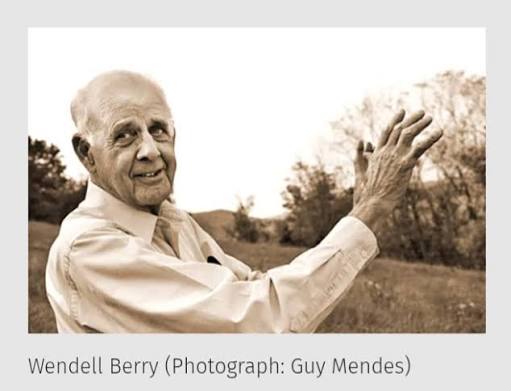
The NYT this evening is reporting the death of Kentucky sage Wendell Berry at his home in Henry County. Earlier this year, I focused on reading his major essay collections and two of his novels.
Berry stridently opposed agribusiness, advocating for family farmers and the sustaining of local communities. He refrained from using farm machinery and chemical fertilizers. Horses and mules, they did the plowing.
Berry had his stubborn ways, nearly Amish in his habits. He wrote his many books in pencil on a yellow legal pad, his wife Tanya typing them up for publishers. He never owned a computer or even a television. His clock was set by sunrise and sunset. In simplicity, he found a happiness that possessions could not give.
He had much to teach us about a way of life that yielded contentment through resourcefulness and the social intimacy of small-town America—a way of life lamentably vanishing in the throes of urbanization, the decline of the family farm, the corporate erosion of local industries, and the flight of young people to the cities.
I remember the America he loved: the small town with its eccentric characters; schoolmates, many from family farms; baseball on the town common; a trip to the big city a major happening; the doctor, with his little black bag, coming to the house; a trip to the barber, a conversation. Families seemed stationary, one generation succeeding another. Faces changed. The surnames remained. This is the America Wendell wrote about.
When hard times came, as inevitably they do, we were there for each other, binding up the wounds. We knew our heroes, and we gladly paid them tribute.
I miss that America. And I will miss Wendell.
He tried to teach us, but we didn’t listen. A voice is silenced, but his wisdom hovers.
Rest peacefully, Wendell, in the dark Kentucky soil you so loved.
Last night, I read my 30th book this year, not that I’m prioritizing numbers, but simply because I’m spending more time at it, reading a minimal fifty pages daily, and not just any book, but some of the best ever written, conglomeration of genres that have shaped my world, defined who I am, not the quixotic schoolboy of sixteen, rebellious, often angry, in pursuit of discovering who I was and, better, who I wanted to be, that best self, enlarged through awareness and sensitivity.
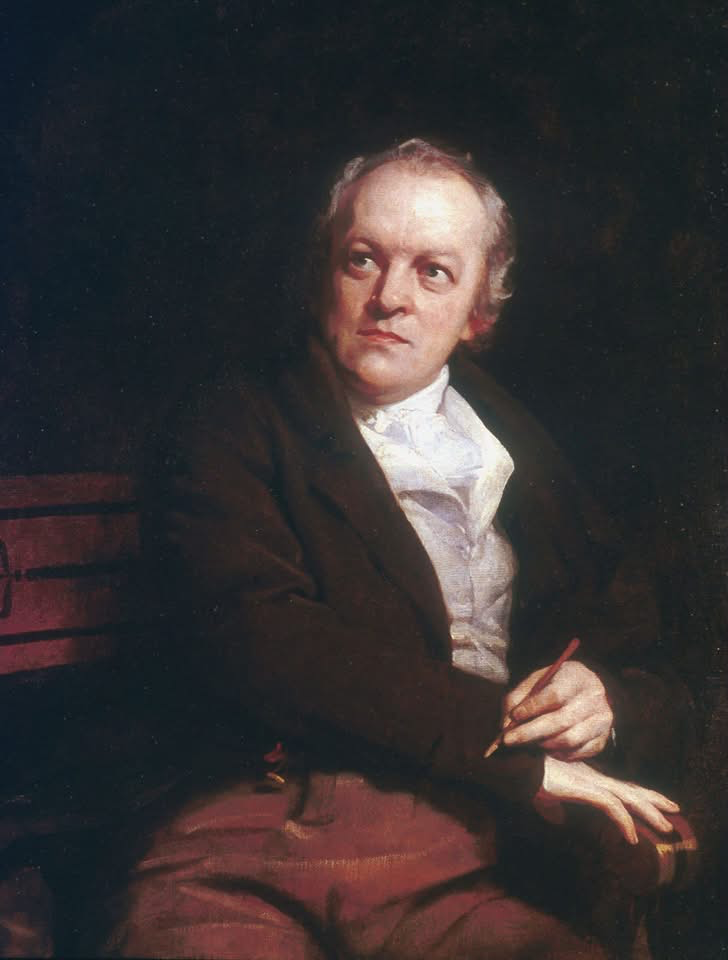
Today, a new book: Philip Hoare’s William Blake and the Sea Monsters of Love: Art, Poetry and the Imaging of a New World (2025), his moving tribute to the great poet and his myriad influence. I first read Blake as a university English major and he’s stayed with me as one of my favorite poets.
Blake taught me to see life as polarity, the mix of opposites, of their necessity to wholeness, like summer and winter, the sun by day, the moon by night, beginning and ending, “the marriage of heaven and hell” as he called their fusion, innuendos of Isaiah 45:7: “I form the light, and create darkness: make peace, and create evil: I the Lord do all these things” (KJV).
Thus began my odyssey with myth, paradox its hub, my later love for Keats and his “negative capability,” of opposites unresolved, my passage into Blake”s protégés, Dante Gabriel Rosetti, William Butler Yeats, Paul Nash, Iris Murdoch, counter culture artists Allen Ginsberg, Dave Bowie, and Bob Dylan.
Ahead of his time, Blake opposed slavery, championed social reform in poems like the “Little Black Boy”:
“…we are put on earth a little space, That we may learn to bear the beams of love, And these black bodies and this sun-burnt face Is but a cloud, and like a shady grove.
For when our souls have learn’d the heat to bear The cloud will vanish we shall hear his voice. Saying: come out from the grove my love & care, And round my golden tent like lambs rejoice.
Thus did my mother say and kissed me, And thus I say to little English boy. When I from black and he from white cloud free, And round the tent of God like lambs we joy:
Ill shade him from the heat till he can bear, To lean in joy upon our fathers knee. And then I’ll stand and stroke his silver hair, And be like him and he will then love me.”
I have cherished his profundity veiled in simplicity, his magnificent “To see a World in a Grain of Sand / And a Heaven in a Wild Flower / Hold Infinity in the palm of your hand / And Eternity in an hour” (”Auguries of Innocence”):
I continue to rejoice in “Jerusalem,” England’s unofficial anthem, with its call to battle injustice:
“I will not cease from Mental Fight, Nor shall my sword sleep in my hand: Till we have built Jerusalem, In Englands green & pleasant Land.”
Arrested for sedition, Blake was not a nationalist, but a champion of the ideals of the French Revolution. Not only opposing slavery, he was anti-monarchy and anti-Church of England, elitists out-of-touch with the laboring class.
My early reverence for Blake led me to seek out his grave in the Bunhill Fields Burial Ground of the London Borough of Islington, an unmarked grave he shared with others—meanwhile, the din of urban traffic that could not muffle an inner quietude of somber reverence.
Blake has been with me in all of life’s flux, an inspiration, a friend.
Reading has granted me converse with the best that’s been thought and said, new landscapes, new friendships, companions I have with me always, in the days and in the nights.
I’ve just finished reading the proposed Texas State Board of Education reading list.
In fairness, it contains a number of worthwhile works that introduce students to foundational texts in American history and culture. Yet it is also unmistakably the product of a Republican-controlled State Board of Education, reflecting a distinctly conservative vision of what students should read.
Biblical passages appear at nearly every grade level, Nothing comparable is drawn from Islam, Buddhism, Hinduism, or other religious traditions, despite the growing religious diversity of Texas classrooms.
Its political leanings are equally unmistakable. High school students encounter Margaret Thatcher’s “Eulogy for President Reagan,” Ayn Rand’s “What Is Capitalism?” (from Capitalism: The Unknown Ideal), and Thomas Sowell’s “Flattering Unction” (from The Vision of the Anointed).
Missing are serious countervailing perspectives that might encourage students to weigh competing ideas rather than inherit a single ideological framework.
Although students read excerpts from Martin Luther King’s “I’ve Been to the Mountaintop,” major literary voices are conspicuously absent. Toni Morrison, Zora Neale Hurston, Sandra Cisneros. Prominent Asian-American writers are nowhere to be found.
Mark Twain is absent as well, conveniently avoiding the controversies surrounding Adventures of Huckleberry Finn, while Harper Lee’s To Kill a Mockingbird has likewise disappeared.
The proposed list, scheduled to take effect in 2030 if approved, has already been reduced from roughly 300 works to 200. Among those removed were The GreatGatsby, The Alchemist, The Hate U Give, and To Kill a Mockingbird.
Even more striking is the absence of books published during the past half century. Lois Lowry’s The Giver, a riveting dystopian novel introducing middle-school readers to questions of memory, conformity, and moral choice—is missing.
So is Stephen Chbosky’s The Perks of Being a Wallflower, a coming-of-age novel confronting trauma, mental illness, and adolescence.
Maya Angelou’s I Know Why the Caged Bird Sings, one of the defining memoirs of twentieth-century America, is absent as well.
What remains is a reading list whose omissions reveal its priorities as clearly as its selections. This is less an exercise in literary judgment than an attempt to shape civic identity through selective reading.
The response has been swift. PEN America, the National Council of Teachers of English, and the American Federation of Teachers have all criticized the proposal.
While many states publish recommended reading lists, Texas’s carries unusual weight in defining what students are expected to encounter and, just as importantly, what they are not.
In the end, this is censorship by omission.
At a moment when reading proficiency is declining and many young people struggle to finish even a single book, schools should be placing in students’ hands works that ignite curiosity rather than merely satisfy ideological objectives.
Jason Reynolds’s Long Way Down, for example, can be read in a single evening. A fifteen-year-old boy enters an elevator intent on avenging his brother’s murder; at every floor another ghost steps inside. The novel is impossible to put down, yet its real power lies in the moral questions that linger long after the final page.
The same can be said of Laura Hillenbrand’s Unbroken, the extraordinary true story of Olympic runner Louis Zamperini, whose survival of a plane crash, weeks adrift at sea, and years in a Japanese prisoner-of-war camp, becomes ultimately a story not simply of endurance, but of forgiveness.
A good book invites a conversation with its author. It excites. It unsettles. It enlarges the imagination.
Reading lists are, by necessity, adult constructions. But Alan Jacobs, in ThePleasures of Reading in an Age of Distraction” (2011), reminds us that the deepest reading often begins elsewhere, not with official lists, but with curiosity.
The books that stay with us are frequently those discovered by chance, books that cultivate sustained attention amid the constant distractions of modern life.
“I have always imagined that Paradise will be a kind of library.” — Jorge Luis Borges
This year I decided to overhaul my reading habits by adopting what I call focused reading—pursuing a subject deeply rather than wandering endlessly from book to book. Instead of grazing randomly across titles, I try to follow a particular vein: reading several works that illuminate a topic, an author, an era, or a historical moment until the subject begins to feel textured and alive.
For years, though my reading had been eclectic, and not without pleasure, I began to sense that the most memorable intellectual experiences of my life had come, not from isolated books, but from immersion, one work leading naturally to another, ideas conversing across pages and centuries.
Reading then becomes less a pastime than a form of exploration, the mind moving gradually through a landscape rather than darting past it from the window of a passing train.
This year I began, as usual, with my annual eclectic list of fiction and non-fiction culled from authoritative sources. But going forward, I hope to limit that list to perhaps twenty titles—books that seem especially deserving of attention.
Alongside these, I’ve begun concentrating on several areas. This year they include the farming iconoclast Wendell Berry; the conservative economist Thomas Sowell; the late historian Walter Johnson; and the classical world—an area where I lack deeper exposure.
Next year, should I still walk the planet, I can imagine expanding the method further: perhaps ten topic areas, each composed of primary and secondary works. Five books per topic would yield roughly fifty works of focused reading, in addition to the twenty eclectic titles.
To give an example, one of this year’s areas of focus is the classical milieu. Staying within my five-book limit, I chose the following:
• The Republic — Plato • Nicomachean Ethics — Aristotle • The Bacchae — Euripides • Metamorphoses — Ovid • Letters from a Stoic — Seneca the Younger
So far, my experiment is yielding dividends. I’ve committed to reading a minimum of fifty pages a day—assuming an average book length of about three hundred pages—and by mid-March I’ve completed twelve books. Last year, by contrast, I finished only twenty.
I should confess that Atomic Habits by James Clear helped inspire the discipline. Clear’s practical application of behavioral psychology, ideas traceable to B. F. Skinner, encouraged me to approach reading not merely as an aspiration but as a daily practice. Nowadays I cringe when my routine threatens the minimum and will sometimes delay sleep simply to complete my pages.
Such discipline may seem quaint in an age that offers a thousand distractions. Once it was linear television that eroded the nation’s reading habits; today, the Internet amplifies the trend. Last year, nearly half of Americans, 48.5 percent, did not read a single book. In Britain, the figure stood at 40 percent, according to a YouGov poll reported in the Times Literary Supplement.
Bottom line, Americans spend roughly four to five hours each day watching television or streaming media; in Britain, the average approaches four and a half hours. Platforms such as Netflix, Hulu, YouTube, and Facebook dominate much of that viewing.
Add the hours spent on smartphones, computers, and tablets and the total easily approaches seven hours a day, nearly the equivalent of a full workday, devoted to screens. Much of that time is spent watching movies, sports, or the endless scroll of digital entertainment.
Younger generations, though still fond of sports and films, increasingly inhabit the fast-moving currents of TikTok, YouTube, and video games.
Reading, by contrast, has steadily fallen out of fashion.
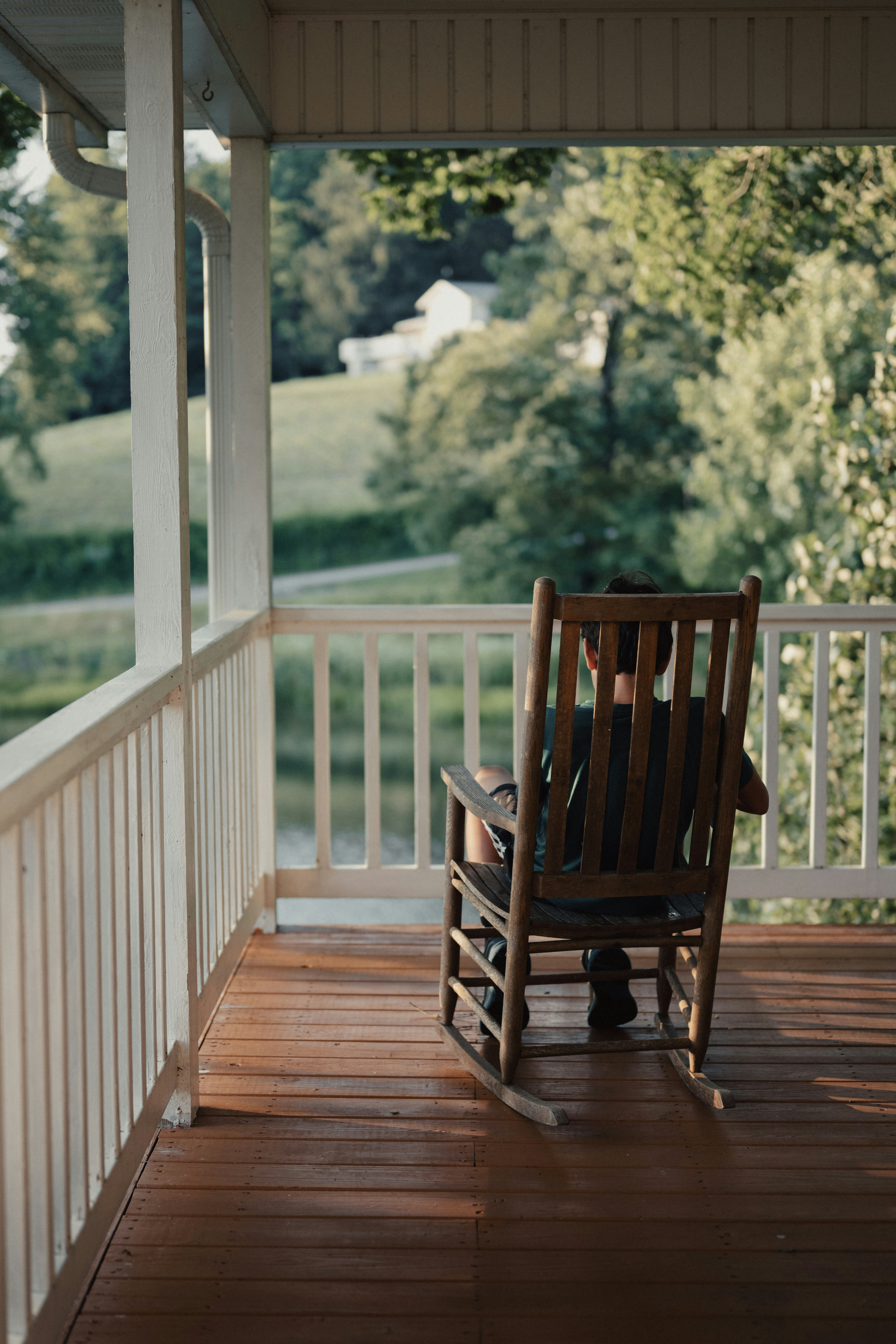
Nor has reading alone suffered. The social fabric has frayed as well. I remember when houses faced the street with broad porches where neighbors gathered in the evening, waiting the advent of night’s coolness, conversation drifting unhindered from one subject to another, board games on small tables, laughter an abundant sprinkling of neighborly fellowship.
This simple act of sitting together seemed reason enough to linger.
Today, many houses turn their porches to the rear, facing private yards rather than the street, as if community itself had quietly retreated.
Perhaps this is why books continue to matter.
Reading restores a community the modern world has forsaken.. Open a book and time folds in upon itself: Plato resumes his patient inquiry into justice; Seneca counsels composure in adversity; Ovid reminds us that the human story is one long sequence of transformations. The centuries speak again in voices at once distant and intimate.
Books, in this sense, comprise the old porch of civilization.
There we sit again with the living and the dead alike, the conversation unbroken. The room grows quiet, the hour late, yet the mind moves freely—wandering Athens with Aristotle, pausing in the tragic shadows of Euripides, or returning, perhaps a little wiser, to our own small corner of the world.
So I keep my modest covenant of fifty pages a day. Not simply to finish more books, though that is pleasant enough. I read because within those pages waits a larger company and a wider horizon.
In a distracted age, the turning of a page may be one of the last quiet forms of freedom left to us.
I’ve just finished Donna Tartt’s The Goldfinch alongside Wendell Berry’s TheUnsettling of America.
I’ve never read two books simultaneously before, but the pairing worked. The Goldfinch proved a genuine page-turner for me—a Dickensian, plot-driven suspense novel layered with thematic, even philosophical, meditations on life’s meaning.
Berry, by contrast, is at his consummate best in The Unsettling of America, distilling a passionate defense of the rural, the sanctity of non-industrial agriculture free of chemicals and heavy machinery. It is, finally, a lament for the erosion of community in our contemporary drift toward urbanization and accumulation. Berry is Thoreau à la mode. Simplicity, he reminds us, yields contentment.
I’m now reading Berry’s Jayber Crow, perhaps the finest introduction to his Port William novels, sixteen in number.
Since my experiment of reading two books at once has proven fruitful, I’m also reading A Beginner’s Guide to Japan by renowned travel writer Pico Iyer.
Iyer never disappoints in his genius for illuminating the subtle ambiences of disparate cultures. I confess I’m easy prey for this particular read as a longtime devotee of Japanese culture, now under threat. May ikigai, the art of pursuing one’s bliss, never meet its end.
My decision to weave a topical thread through my otherwise eclectic reading marks a meaningful turning in my reading approach. Last year I read twenty books. With ten already read this year, I anticipate—barring life’s interruptions—fifty or even sixty by year’s end.
But numbers surely are incidental. To read this way is to live more than one life, testing long held convictions, enlarging sympathies, and keeping my mind unsettled in the best sense of the word.
The other day I posted on my Brimmings blog a new method I’ve devised to inspire myself to read more—specifically, to aim for 80 books a year, assuming an average length of 300 pages. That works out to 24,000 pages annually, divided by 365 days.
I didn’t linger long over the arithmetic. What mattered was putting the idea immediately into practice. I set a daily goal of 50 pages, read first thing in the morning. For me, any attempt at habit formation has to be anchored in time. Once the day’s interruptions begin, resolve alone is no match for contingency.
Experience has taught me that it takes roughly four to six weeks of daily repetition for a habit to take hold. Once anchored, the reluctance to break a streak becomes a force in its own right. Acquiring a new habit, I’ve found, is less about willpower than about showing up.
The results have been gratifying. In the past two weeks I’ve finished two books, one of them nearly 600 pages. Fifty pages a day takes me about an hour. I could read faster, but speed isn’t my aim. I underline, annotate, argue with the text. I’m not a passive reader; I want to engage—agree, disagree, extend.
At this pace, I’ll read roughly 18,250 pages a year. Divided by 300 pages per book, that comes to just under 62 books annually. Not 80—but what a start. If I can raise my yearly total from my long-standing average of 20–25 books, I’ll consider the experiment a success.
Quantity, of course, is not an end in itself. The real aim is access to the best fiction and nonfiction available, the works that challenge and enlarge the mind. Increasingly, I’ve been drawn to cluster reading, concentrating on subjects where I feel thin or want deeper understanding.
What excites me most is the daily result: fifty pages read before the day properly begins. The reward is immediate, and reward, as we know, is integral to habit formation. Each book brings with it a flood of ideas—fuel for writing, and an invitation into community with others who share similar intellectual and aesthetic appetites.
Stephen King reads sixty or more books a year. I’m lucky if I reach twenty—and the disparity bothers me more than I care to admit. Not because I value quantity over quality, but because there are simply too many books I want to live with, too many voices I want time to answer back to.
Time flows from us like a running faucet. Time is our common currency granted daily. How do we spend it? It comes down to our priorities.
King has been candid about how he does it. He treats reading as a necessity, not a luxury, reading every day for two or three hours, sometimes more. As he puts it in OnWriting: “If you don’t have time to read, you don’t have the time (or the tools) to write.”
That rings true for me. When I write, it’s almost always in response to what I’ve read—to extend an argument, disagree with it, enthuse about it, or share it with others.
King refuses to slog through books that fail to engage him. He abandons them without guilt. Interest propels reading; boredom kills it. And he always has a book with him—reading while waiting, traveling, between tasks, or before bed. Those fragments accumulate.
The numbers themselves are demystifying. Suppose your goal is eighty books a year with an average length of 300 pages. That’s 24,000 pages annually. Divide by 365, and you arrive at roughly 66 pages a day. At a moderate pace of about 40 pages per hour, that comes to around an hour and forty minutes of daily reading.
That’s doable.
My final tip is one that has helped me most: read in clusters. Choose a topic that genuinely interests you and commit to five or six books in that area.
Reading a single book from a wildly eclectic list can feel shallow; focused reading builds momentum, deepens understanding, and increases motivation.
This year, for example, I’ve chosen to immerse myself in Kentucky sage Wendell Berry—two biographies and three of Berry’s own books. Depth, it turns out, can be the best catalyst for volume.
My fierce love for books has its ancient beginnings as a seven year old, sprawled on a Philly tenement floor, enthralled with a Christmas gift, Twain’s HuckleberryFinn.
Moments ago I rediscovered this passage from France’s Michel Houellebecq, who has this special capacity to rattle the cages of accepted opinion—daring, provocative, forthright—writing novels you simply don’t walk away from.
I had read his Submission several years ago, an initial novel that launched his fame. His take on literature, a dying indulgence in a digital age, is poignant with meaning for me, for literature has surely been among life’s greatest gifts to me:
“…the special thing about literature, the major art form of a Western civilization now ending before our very eyes, is not hard to define. Like literature, music can overwhelm you with sudden emotion, can move you to absolute sorrow or ecstasy; like literature, painting has the power to astonish, and to make you see the world through fresh eyes. But only literature can put you in touch with another human spirit, as a whole, with all its weaknesses and grandeurs, its limitations, its pettinesses, its obsessions, its beliefs; with whatever it finds moving, interesting, exciting, or repugnant. Only literature can grant you access to a spirit from beyond the grave—a more direct, more complete, deeper access than you’d have in conversation with a friend” (Submission).
I have not found a more eloquent articulation of my own passion for literature and think often of what I would have missed had I not been introduced to literary reads—above all, to see past the literal text and be transported into a galaxy of resonance where words could mean beyond themselves, open new vistas, shaping life, capable of numinosity, a sense that life exceeds appearances, infinite in its labyrinthian corridors, a non-ending conversation with what is, has been, and will endure.
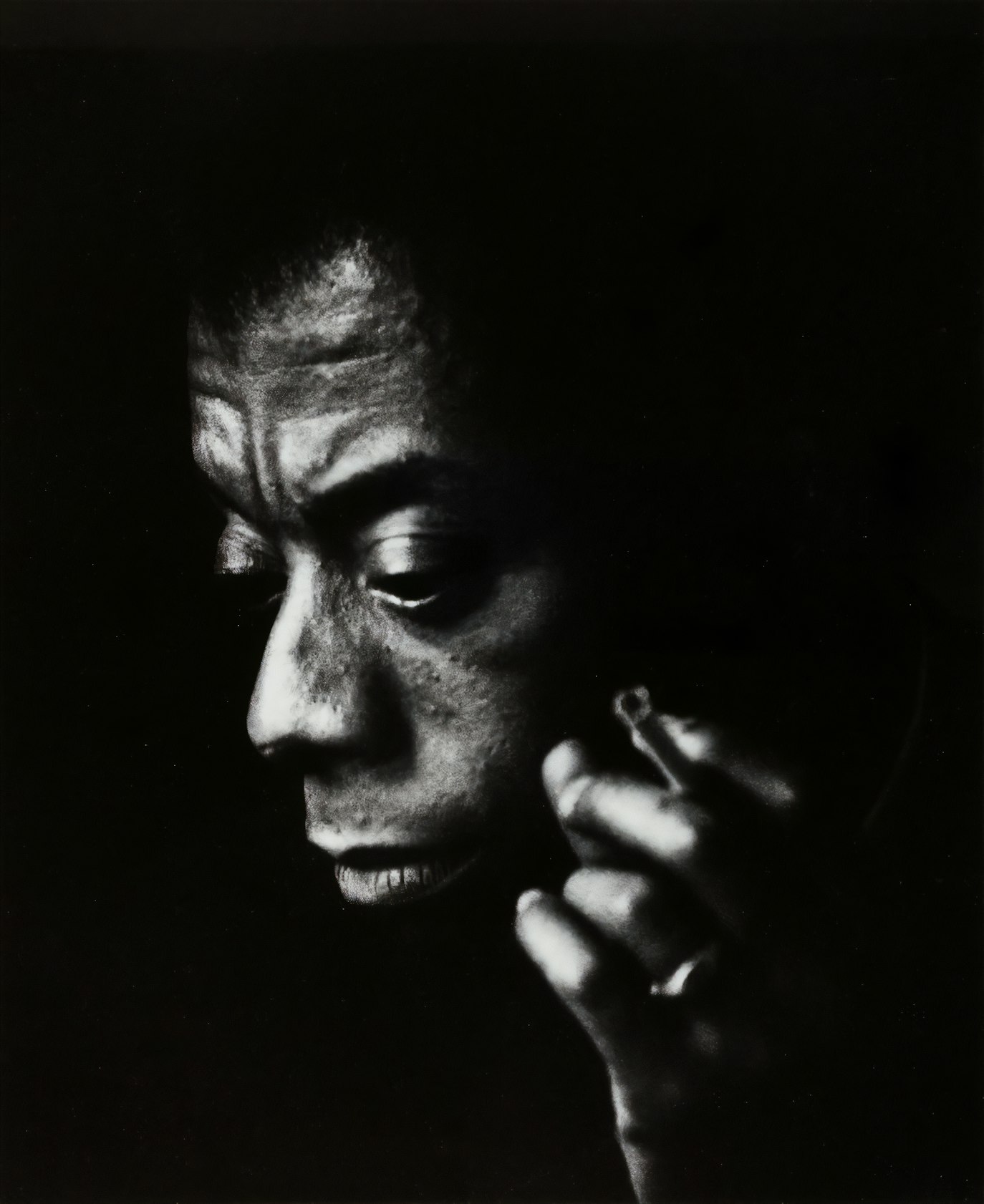
There are many excellent Black writers, deserving of their fame, but it’s James Baldwin I keep returning to for his wisdom, sensitivity, and eloquence.
Whenever I read him, I find cleansing—a washing away of grievances, the soothing salve of empathy for those visited by life’s unfairness, the unanticipated gifts of seeing with new eyes and walking in another’s shoes.
Reading Baldwin, I find connection. Suffering is never isolated; it is universal:
“You think your pain and your heartbreak are unprecedented in the history of the world, but then you read. It was Dostoevsky and Dickens who taught me that the things that tormented me most were the very things that connected me with all the people who were alive, or who ever had been alive. Only if we face these open wounds in ourselves can we understand them in other people” (The Price of a Ticket, 1985).
I have now read Cormac McCarthy’s All the Pretty Horses, remarkable in its stark, yet lyrical beauty reminiscent of Hemingway and Faulkner, intense in its palpable confrontation of goodness with evil; an elegy for a lost way of life; a saga of idealism’s betrayal; of mythic passage from innocence into knowledge offering no redemption, apart from the grace of endurance and a refusal to forfeit honor.
The traditional rancher spreads of west Texas have fallen on hard times, threatening a way of life. The novel opens appropriately with the death of central protagonist John Grady Cole’s grandfather, a former baron among ranch owners. The ranch, grown to 18,000 acres in 1871, has been sold, an inheritance lost. Working with horses is the only life Grady knows:
The Grady name was buried with that old man the day the norther blew the lawnchairs over the dead cemetery grass. The boy’s name was Cole. John Grady Cole.
The first of a three novels known as the Border Trilogy,All the Pretty Horses underscores the death of the Western frontier, once ripe with promise of plenitude—fortunes to be made and dreams fulfilled.
Foregrounded in historical fact, a pastoral, unfenced way of life has fallen prey to change—the dividing of holdings among family, increased taxation, a drift of young people to the cities, mechanization, the invasion of industry, government’s encroachment, relentless droughts—above all, the railroad’s ubiquity, all of which McCarthy turns into metaphor for an agrarian culture bound by hard labor and a code of honor irretrievably lost. Metaphor becomes elegy.
All the Pretty Horses narrates the journey of cowboys John Grady and his friend Lacey Rawlins from West Texas into Mexico, joined later by a mysterious youth, Jimmy Blevins, who owns a gun and rides an elegant bay mare, foreshadowing trouble ahead.
The novel abounds in resounding passages, poetic in resonance, like this one of stellar vastness, a cosmos indifferent to Man and of a fusion with nature and of a connection now severed:
He lay on his back in his blankets and looked out where the quartermoon lay cocked over the heel of the mountains. In that false blue dawn the Pleiades seemed to be rising up into the darkness above the world and dragging all the stars away, the great diamond of Orion and Cepella and the signature of Cassiopeia all rising up through the phosphorous dark like a sea-net. He lay a long time listening to the others breathing in their sleep while he contemplated the wildness about him, the wildness within.
Acquaintance with archetype helps readers tap more easily into the novel’s multiple levels of meaning—the hero archetype of initiation, trial, and return; the paradisiacal garden of northern Mexico’s La Purisima with its grassland abundance, grazing cattle of upwards of a thousand head, and 400 horses, attended by valeros, finding fulfillment in their labor; a siren temptress, Alejandra, the forbidden fruit, daughter of wealthy hacendado Don Héctor:
She passed five feet away and turned her fineboned face and looked full at him. She had blue eyes and she nodded or perhaps she only lowered her head.
The hero’s mentor appears, Dueña Alfonsa, great aunt of Alejandra, delivering stern warning from experience, that fate often annuls human wish and that economic and social determinism govern universally. Unlike traditional mentors, she’s unhelpful, even sinister, serving as forewarner and enforcer of social codes.
Not unexpectantly, trespass —Grady and Alejandra have become lovers—makes inevitable Grady’s expulsion from paradise, commencing an ordeal with uncertain outcome in a world where idealism is often judged as weakness and evil corrupts honor with impunity.
Unjustly imprisoned, Grady and Rawlins undergo brutal imprisonment for a crime they never committed. Blevins has been executed earlier by a rogue officer. We have reached the novel’s nadir, a replay of mythic hell. A Mexican prison, governed by bribery and savagery, tests their courage and capacity to endure.
Dueña Alfonso buys their freedom, under condition he not return to La Purisima, only to have Grady resist and encounter Alejandra’s rejection. Rawlings has returned to Texas.
Throughout, the novel remains faithful to its hero archetype—the hero, wiser now, returns to exact justice, wounded not only by a rifle’s bullets, but a pervasive knowledge of human capacity for caprice and injustice. Grady’s loss of his horses is inextricably linked to his identity. He returns to reclaim them, necessitating violence.
Restoration of wrong occurs, but not without a tarnished innocence and a sadness that knowledge brings.
Symbolism abounds, particularly through the horses of the narrative that give rise to the novel’s title. Virtual characters, they symbolize a dying way of life and nature’s nobility.
Grady’s affinity with horses affirms a vestige of traditional human communion with nature, once vibrant, but now vulnerable to a modern world in disconnect.
I have only one criticism, and that concerns its last fifty pages in which the prose splendor slackens and we arrive at a conclusion seemingly hurried and simplistic, anticlimactic in contrast to the mesmerizing narrative of its preceding pages that sustain a reader’s interest.
But make no mistake. McCarthy succeeds in writing an extraordinary novel, and I am embarrassed to have not caught-up with him sooner.
He passed from us in 2023 at age 89, having written twelve novels, several plays and short stories. Several of his books became movies.
He was his own person, disdaining celebrity status, living much of his life in poverty. Like Grady, he persevered. Recognition came late, beginning with Allthe Pretty Horses, which won the National Book Award, our nation’s highest literary award. He was 59 and now famous.
I intend to continue with his trilogy, then on to Blood Meridian, which many critics regard as his opus magnum.
Transcending time and geography, McCarthy rivals Faulkner as our greatest American author.





 Brimmings: up from the well