
On finding a new booklist quarry

Aaron Hicklin
Aaron Hicklin

I confess I’m addicted to booklists. No sooner do I finish one book, but I’m into another.

What surprises me is that I can’t remember anyone in my family serving as a role model when I was a child, either reading to me or picking-up a book for themselves, with the exception of the late intervention of my eldest brother, David, recently discharged from the army after WWII and anticipating college under the newly inaugurated GI Bill.

One night before David left for the University of Miami, he gave me my first book, Huckleberry Finn. I still remember the occasion–eight years old, sprawled out on the floor of our Philly tenement, absorbed so fully in this really good book that it muffled the adjacent Front Street el with its interminable trains, dutifully groaning past our rattling windows every fifteen minutes.

Soon I discovered the Montgomery County Library. I didn’t mind walking the two miles, knowing what lay up ahead. It was  one of those supreme pleasures like feasting on a well-stacked hoagie or downing a cold strawberry ice cream soda on humid summer Philly nights; maybe I even liked it as much as playing stick ball every day against the factory facades lining our streets.

Books gave me refuge in a home torn apart by alcohol. I became aware of a larger world, where good really did exist, and people could be kind and often courageous. I found heroes like Lincoln, Gandhi, and Gehrig that would become staples in my life.  Books transported me to far away places—Australia, New Zealand, the South Pacific.

Nearly as important as the library was a humble bookstore on Girard Avenue that I often passed on my way home from Chandler Elementary, filled with used paperbacks. What got my attention were two cardboard boxes piled high with comic books. I gravitated to the one filled with Classic Comics with their graphic renditions and abridged texts of literary fare.  The price, five cents, sealed the bargain!  I’d “picture” my way through, say, Les Miserables or Treasure Island, then pick-up the hardback version at the library. By the time I was 13, I had read many of the classics, including War and Peace, Moby Dick, and Silas Marner.

As for the many booklists I’ve ransacked through the years to feed my addiction, I’ll just say my favorite has been Brain Pickings, whose cerebral fiber fences it off from the traffic lane of your typical booklist..

For the most part, I shun the New York Times best seller lists, annoyed by their often fad offerings of dubious value other than to entertain or tell how you, too, can cash in and grow healthy, wealthy and wise.  A few weeks later, I’d find these books either gone awol or sunk to near oblivion.

Before the Internet opened up our information corridors, I’d reminisce earlier times venturing into a library, losing myself in its stacks, often looking for one book, but emerging with another. Call it serendipity, but the chance encounters I’ve had with library books have often proved fortuitous with surprising consequences.

Take, for instance, one chance venture when I pulled a book off the shelf by an author I’d never heard of. Lucky draw, it turned out to be Thomas Wolfe and his Look Homeward Angel. I was 17 at the time, a homesick GI in Korea resorting to the humble base library to annul slow time. Hooked, in subsequent years I rampaged all of his novels, ultimately enrolling at the University of North Carolina at Chapel Hill, the Pulpit Hill of Look Homeward Angel.

Books often haunt my mind, ghosts of delightful company with motley heroes, or of vistas spinning new threads of excitement, belief, and desire in conspiracy against the old.

But I’ve found that even the Internet can surprise me. Several days ago, for example, I stumbled upon an extended New York Times Style Magazine series, “My 10 Favorite Books,” edited by Aaron Hicklin.

Hicklin edits a magazine called Out and recently opened up a bookstore called One Grand Books in Narrowsburg, NY. In a clever ploy to attract readers, he’s come up with the idea of asking well-regarded people from various walks of life what ten books they’d want to have with them were they marooned on a desert island. Each listing would feature annotated entries explaining their choices or how these books came to shape their lives.

Hicklin doesn’t want just another bookshop, a dubious business venture in this age of online behemoths like Amazon and Barnes & Noble, but a resource for discriminating readers to find books of substance readily.

As I write, contributors to “My 10 Favorite Books” include, among many others,

 Allan Hollinghurst

 Edmund White

 John Irving

 Ta-Nehesi Coates

 Gloria Steinem

 Gia Coppola

Michael Pollan

Erica Jong

What’s nifty here is how when you select a contributor you get a cascading menu of ten annotated preferences.  In short, each menu constitutes a sub-booklist in the series.  Amazingly, very little overlap occurs among contributor choices, yet each listing is profoundly discriminating.

Absent from the list are two writers I’m unfamiliar who intrigue me for their choices, since they complement my own interests–artist Terence Koh and author, Brett Easton Ellis–the former for his love of Eastern thought with its subdued nuances in a sound byte world; the latter, in sharing tastebuds with me for writers like Tolstoy and Flaubert.

Hicklin, by the way, keeps an online blog, onegrandbooks, that provides you with an archive of previous contributors and a weekly focus on a current contributor, sparing you the cumbersome difficulty of finding each series individually online. You can even sign-up for his weekly newsletter and have your purchased item shipped conveniently to your doorstep.

I hope Hicklin’s venture succeeds. It’s a brave new world out there

Meanwhile, I’m on safari, exploring panoramas of infinite sweep_better because unanticipated, by way of my new booklist quarry.

–rj



Apple vs. the FBI: How Money May Decide the Issue

thThings are really heating up these days in the ongoing dispute between Apple and the FBI.
In December, fourteen people were killed by ISIL sympathizers Farook Malik and his wife Taskeen, in San Bernardino, CA.   In the aftermath, the FBI has been investigating the possibility they may have had accomplices. Backed by a court order, the FBI has requested Apple remove the security blocks on Farook’s iPhone.

CEO Tim Cook, speaking for Apple, refuses to comply, contending it would compromise the privacy of its smartphone users.

I’m not taking sides on the controversy here.  The issue is as heated as it is complicated, with the country divided in its opinion and perhaps SCOTUS inevitably having to make the call.

What does concern me is Apple’s new strategy to move the matter to the Congress for adjudication. (Hearings begin next Tuesday.)

Fact is, the Congress is hardly the right party to decide the issue, given the systemic corruption fostered by business conglomerates soliciting favors through huge sums of money donated to its members.

We see this, for example, with regard to the National Rifle Association (NRA), successfully preempting responsible gun legislation, despite myriad mass shootings like those in San Bernardino,.

In 2014, NRA contributions to members of Congress amounted to $984,152 with an additional $3,360,000 for lobbying.

What really fries my brain is that it spent a whopping $28, 212,718 in outside spending!

Apple, as such, is being disingenuous in attempting to shift the scenario to the Congress, having demonstrated a lengthy penchant, like its fellow high tech icons, in substantially contributing to the Congressional feedbag, their mission to deter any regulatory legislation that would rein them in. In other words, a good many Congressional members owe them favors and now’s an opportune time to collect and circumvent the courts.

Since 1990, Apple has contributed $1,902,870 and spent $27,083,008 on lobbying.

Bernie Sanders was right when he denounced PAC money contributions as undermining our democratic franchise: “People aren’t dumb.” These donors don’t give willy-nilly, but expect something in return.

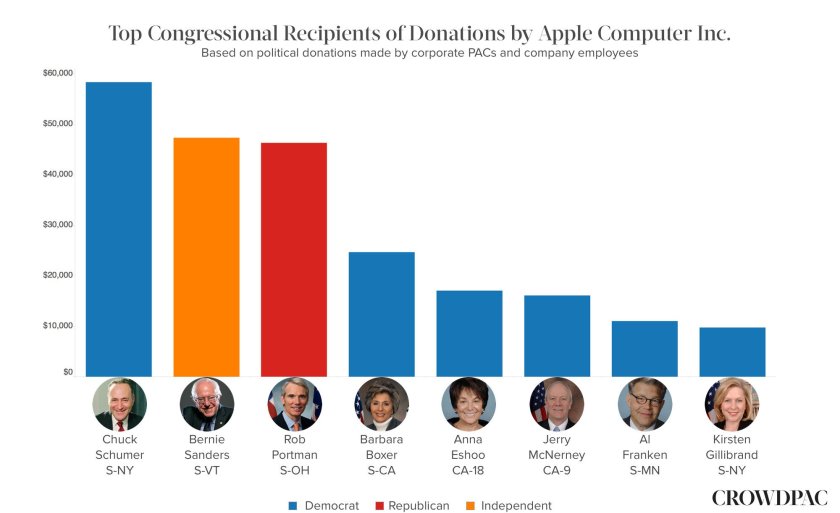
On the other hand, even Bernie has had his hand in the till, ranking second among senators in receiving money from Apple and its employees.

gggty4bqbpvvfgpafcwj

Now let’s see how the system filters out elsewhere. The most prominent Democrat opposing Apple on the issue is Diane Feinstein.   Guess what? You’ll find her absent from the list of top recipients of money from Apple and its allies that include Microsoft, Google, Facebook, and Twitter.  These conglomerates are not about to waste their money on those opposing their interests.

In third world countries, we’d call it bribery.

In the U. S.  Congress, many are willing to take the bribe.

–rj

Bibliography:

OpenSecrets.org

IVN


Brimmings: Five Years and Counting

journalingI’ve been keeping my blog, Brimmings, for five years now, never realizing when I began that I would pursue it for so long, initially undertaking it to assuage my wrestlings with serious illness at the time, or as diversion from anxious self-preoccupation, for liberating reflection of a wider scope. When we let loose our moorings, we sail into discovery.

I suppose I shouldn’t be surprised I’ve persisted beyond that troubled time, now seemingly in remission, enjoying new strength, gathered insight and, undoubtedly, an incipient awareness of life’s essentials in foraging out its meaning.

There has been the joy of Nowness, enriched by moments of solitude, yielding an increased awareness of how interconnected all of us are, bundled in impermanence, and more: of a wider empathy gleaned from that solitude affordng reflection, assuring me that it isn’t how long we live, but how well.

As for the writing, like music and painting, there exists that longevity beyond ourselves that with good fortune we may share with others in another time and place, perhaps bringing not only sobered reflection, but comfort and healing as well.

It doesn’t matter to me how many read Brimmings.  If nothing else, it has taken on the hue of an inner dialogue, often between mind and heart, with no clear winner.

And so I continue.

Peace.

–rj


Why I Relish Going to the Gym

gty_crowded_gym_kb_141229_12x5_1600

For many of us, throwing off the blankets and crawling out of bed on cold winter mornings to go to the gym seems pretty dumb.

I felt that way too until my pre-diabetic diagnosis several years ago which meant that if I didn’t do something about it, I might well succumb to full-blown diabetes with its many lethal complications that include heart disease, kidney failure, blindness and even limb amputation.

Still, I didn’t do anything about it until a chiropractor friend had me do a full blood workup that showed I had moved even closer to diabetes with an A1c of 5.9 and ominous glucose average of 123.   If you get to 125, you’ve got the disease, for which there’s no cure, only management.

Now, fifteen month later, I’ve gotten the A1c down to 5.2. The A1c tests your blood for glucose management over the previous two to three months. The pre-diabetic range is 5.7-6.4. In short, I’m no longer pre-diabetic.

How did I do it? Quite plainly, by cutting carbs and exercising regularly.

Exercise is good for you no matter what ails you or–if you’re an outlier–from nothing at all, promoting good health, better sleep, stress reduction, more energy, and self-esteem.   What’s nicer than people commenting on how good you look?

But let me add to these verities several other reasons exercise has become a mainstay of my daily regimen.

Personally, I can wax euphoric at the gym like this morning walking my fourteen laps (2 miles), with Herbie Hancock’s pulsating jazz rhythms funneling into my ears via my wireless headset, making me pump my arms still more vigorously.

I like, too, the camaraderie going to the gym gives me, a sense of being part of a group. I see many of these people regularly, of both sexes and of all ages and body types. On occasion, we say our hellos or share smiles and sometimes conversation. Call it tribalism. I like the feeling.

I admire many I see at the gym for the obviously hard work they put into their workouts, whether pumping weights, walking raised treadmills or elliptical machines, or doing stair-steppers, etc. I see the payoffs in their lithe bodies with muscular arms, wide shoulders, and developed pecs. I know it didn’t come easily. Many of them exercise before going to work.   No wonder they inspire me.

But I also get a sense of personal satisfaction, or of time well spent. Call it a relish in self-discipline: I haven’t surrendered to the couch or big screen TV. I take pride in that, knowing my former tendency to both procrastinate and be downright lazy.

Every session becomes a moral lesson, and I remember what my high school track coach told me: “We all get stiches in our side. The good runner, win or lose, ignores the stich, holding out for the second wind that propels him to the finish line.” Today, I resisted cutting my four sets of curls to three. I like to think such lessons learned at the gym can help me better cope with life at large.

And then there’s that sense of jubilation in sharing my good news with my dear wife that today I did 70 sit-ups. Just a few months ago, I could barely do 25!

The Chinese have this wonderful saying that “the longest journey begins with the first step.” In going to the gym, I’ve taken more than one step now and I’m eager to do infinitely more in the climb to good health and the contentment it confers.

–rj


Cultivating Stillness

photo_20I am full of early morning,
tucked beneath my comforter,
stretching my legs,
my brain filling its daily bucket of anxieties
sufficient for another day’s wrestlings.

These several days I’ve laid siege to my citadel of habit,
rising in winter’s early morning coldness
to meditate in dark stillness.
It’s not easy.

Plagued by inertia,
I prefer my cocoon to elbowing out of bed
and sitting cross-legged,
back held straight,
shoulders pushed back.

Engulfed by morning’s opaqueness,
my wayward mind wanders aimlessly
and I am lost in a dark wood.

But it suffices,
for Zen absolves human frailty.
Mind needn’t be emptied,
and it’s mindfulness I lack:

To know the moment
and seize the solace of the Now.
To listen, but not engage.

I trace the pulse of limb and muscle.
I tune in to muffled beating of day’s snare drum
amid gathering pink of celestial fingers.
I count my breaths.

Cultivating stillness,
I discover calm,
and listening,
I grow wise.

–rj


Paris Bombings, Public Response, and the New Tribalism

CTyf4XOWUAA3a4JEvil is very real and as we know from the Paris mayhem, universal. ISIS, of course, is its mirror image.


This week, Kurdish Peshmerga troops, retaking the city of Sinjar in northern Iraq, discovered two mass graves just outside the city. One contained the bodies of 78 elderly women shot by ISIS; the other, some 60 men, women and children, presumably Yazidis, executed when ISIS captured the city a year ago.

These past several weeks have, in fact, marked a turn in ISIS strategy, since the free flow of recruits has nose-dived with the tightening of borders adjacent to Syria and Iraq and the entrance of Russia into the Syria conflict.

Accordingly, what’s transpired in France may only be the opening round as ISIS licks its wounds.

In the West, we are rightfully angry and troubled by the Parisian carnage. In Facebook, many of us have changed our profile images to include the French flag or Eiffel Tower to show our solidarity.

Contrast this with our visceral indifference with its ethnocentric moorings to ISIS’s barbarism on Muslims or those we perceive as political adversaries. In fact, Muslims have been its greatest victims.

A Russian commercial jet recently went down in the Sinai, taking 224 lives. Intelligence sources suggest a bomb had been placed aboard and ISIS, as with the Parisian violence, claimed they were behind it.

In Lebanon just one evening removed from the Paris massacre, a Hezbollah neighborhood was bombed, resulting in 43 deaths. Again, ISIS was the perpetrator.

In October, 99 lives were taken in twin bombings in Ankara, Turkey.  Although ISIS hasn’t claimed responsibility, they are believed responsible.

Meanwhile, media are saturated with coverage of the Paris horror, as they should be; yet by the same token, the coverage given to the aforementioned violent episodes have proven miniscule.

I’ve seen this same scenario repeated in natural calamities as well. Recently, earthquakes occurred in Pakistan and Iran. Coverage? Well. There’s always Google.

The Russians we don’t care much about these days, so our interest in the Sinai crash seems more out of curiosity as to its cause and not from compassion.

Last week’s bombings in Beirut: So what? These were Muslims, weren’t they? And I should add, Hezbollah. Israel knows their terrorism first hand, so they get what they deserve. Problem is, the casualties were civilian, many of them women and children.

Turkey? Isn’t that something we’ll be eating soon? Ankara? For many Americans, where the hell is that? For the record, it has a population of nearly 5 million! That’s twice the population of Paris!

Think about this: The greatest humanitarian crisis of our time is that of 4 million Syrian refugees, along with another 8 million dislocated Syrians within their country. Our response: bickering as to whether we should take in 30,000 or 65,000, or any at all as some of the GOP presidential candidates have suggested.

Meanwhile, the Washington Post informs us that American contributions to international causes has declined over the last two years.

I think of Shakespeare’s Shylock in The Merchant of Venice, who nails down the cruelty of indifference to the sufferings of those we see as different from ourselves, taking the liberty to replace Jew with Muslim:

I am a Muslim. Hath not a Muslim eyes? Hath not a Muslim hands, organs, dimensions, senses, affections, passions; fed with the same food, hurt with the same weapons, subject to the same diseases, healed by the same means, warmed and cooled by the same winter and summer as a Christian is? If you prick us do we not bleed? If you tickle us do we not laugh? If you poison us do we not die?

Let’s call our indifference, or xenophobia, what it really is–a return to the tribalism we thought we Westerners had shed long ago.

–rj


A Life-Changing Quotation

Every once in a while, I come across a quotation that really stands out. I like this one, though I don’t recall exactly where, or when or how I came upon it, but thought you might like it too:

Did I offer peace today?

Did I bring a smile to someone’s face?

Did I say words of healing?

Did I let go of my anger and resentment?

Did I love?

–Henri Nowen (1932-1996)*

Nowen*Nowen, priest, theologian, and author, lived the life he preached, loving others, and writing some 39 books, translated into thirty languages. His most famous book: The Return of the Prodigal Son.

–rj


Don’t Be a Phoul: When Neighbors Cut Down Trees

NYC Central Park
NYC Central Park

My daughter has been complaining in her recent emails about a family on her street in Bellevue, WA.

They’ve cut down two lovely Douglas fir trees, the kind that startle Easterners like me not used to arboreal skyscrapers, many of them magisterial in their silent dignity bequeathed by longevity.

Bellevue, a fast growing suburb adjacent to Seattle, still enjoys a fecundity most urban areas in America can only envy. When I was there a few weeks ago, I relished walking myriad needle softened pathways of the city’s several forested trails bisecting an urban landscape. Apparently, however, the area has also attracted a newer influx indifferent to the charms of a bucolic setting.

These neighbors complain that their trees were messy. They tired of the needles falling on their roof and car. Around the corner, another neighbor recently did the same thing for the sake of planting a garden free of shade. In its slovenliness, it appears she’s made things worse, not better.

Meanwhile, the company that’s done the cutting directly goes about soliciting customers door-to-door on a regular basis. One of the cutters bragged to my daughter, obviously relishing her displeasure, that he likes chopping down trees.

Unfortunately, we live in an America that prides itself on a free economy, with consumers having sovereignty over their choices. Sadly, in this case, these individuals opted to buzz-saw these magnificent sentries of public health into oblivion for convenience sake.

It’s the way things work in a mutual exchange between the entrepreneurs of the market place, motivated by money, igniting consumer sentiment often detrimental in its long term consequences; for example, alcohol and cigarettes. George Akerlof and Robert Shiller, Nobel Prize winners, term it a “manipulation of focus” in their insightful new book, Phishing for Phools: The Economcs of Manipulation and Deception (Princeton University Press).

Phishing is their term for business interests that phish (i. e., angle) to get phools (consumers) such as you and me to do their bidding to the detriment of ourselves. Think banks, pharmaceuticals, real estate agents, etc.

There are two kinds of phools: those who fall for the falsity of the phishers’ claims and those, the vast majority of the public, who succumb to their own emotions, prone to making bad decisions simply because they initially feed their emotional wants. You see  this in matters of health where our predominant diseases such as atherosclerosis, diabetes and often cancer arise from faulty lifestyle choices such as the wrong food, overeating, indulging in alcohol, or not exercising.

It’s this way of doing things, in this case, overblown avarice with its bubble effect that led to the colossal recession of 2008.

In sum, what’s been happening in my daughter’s neighborhood, threatening its pristine uniqueness, is a facsimile of the phisher-phool conundrum writ large, neighbors manipulated into opting unwittingly against their long term interests.

Maybe you think this is all nonsense. Property owners have the right to do as they like.

But have they the right to harm the public-interest, given the menace of air pollution and global warming, by cutting down their trees?

And what about the neighborhood aesthetic? Hurrah for neighborhood associations!

We aren’t disconnected beings. Yes, we are our brothers’ keepers.

Bellevue government needs to get itself in gear. Trees are public domain just like telephone poles and street lights. Good government is on to this. Consider New York which just completed planting one million trees or Boston which plans to plant 100,000.

It’s estimated that planting trees in urban areas reduces energy use up to 50%. Just one tree absorbs up to 8 pounds of air pollution annually. Trees increase property value. Studies show people drive slower on tree lined streets. They add beauty and lend character.

Let’s not be phouls!

–rj


The Elephant Factor in Last Night’s Debate

demsGrowing older may not be a disease, but like many diseases, it’s progressive. Not only do we diminish in physical capacity, but in mental acuteness as well, resulting in a lower threshold in processing information.

Aging needn’t be feared per se, however, since scores of elderly enjoy a quality of life many young people can only envy. Take last night’s Democratic debate. Hillary Clinton, who may very well be elected president in the coming year, is 67; her chief rival, Bernie Sanders, 74;  Jim Webb, former Virginia senator, 69.

Personally, I found their performance under conditions of surely immense pressure immensely gratifying. I say this because I live in an America that frequently denigrates its older citizenry with “old” often taking on pejorative connotation approximating the “n-word.” If it’s hideous to discriminate on the basis of color, no less so when it comes to your age.

Psychologically, we need more discussion on the subject of aging. Does it confer strengths, in this case, in leadership acumen? I believe it does.

Consider what animal studies might show us; for example, elephants where it’s the matriarch, or oldest elephant, that often leads the herd to a waterhole only she knows about. In short, age often confers the wisdom of experience.

When it comes to being president of the United States, it’s hardly an on-the-job learning experience. Every decision in our more than ever complex world is fraught with consequences, some of them impacting upon our very survival. We need leaders who can take us to the water hole.

Of course, younger leadership may connote creativity, or initiation of new approaches to problem solving; older leadership, a rigidity, or running in place.

In a dangerous world, however, I prefer stability. Unfortunately, the human proclivity is to select on the basis of looks, or youthfulness, rather than functioning. Implanted by evolution to augment progeny, beauty proves a formula few of us can resist. I suspect the birds and the bees know a thing or two about this.

Interestingly, the issue of candidates having changed their positions over time came up. I like Hillary’s answer: “I think all of us have changed positions.”

In short, we evolve, experience conferring wisdom. I call it “seasoning.” The elephant thing again.

Oh, shucks! Missing from the debate was crusty Joe Biden, 72.

Just imagine!

–rj


On Visiting Bloedel Reserve

If you have a garden and a library you have everthing you need.–Cicero

I’ve been doing a lot of walking in the Seattle area these past several days, while visiting my daughter and family. As a gardener back home in Kentucky, it’s nice to see what cool temperatures and ample moisture can do for making verdant landscapes and, maybe more to the point, motivating green thumbs to spend time outside, free of humidity, high temperatures and, of course, mosquitoes.

Case in point was yesterday’s day long excursion to Bainbridge Island via one of Seattle’s ubiquitous ferries that add to the area’s delights. There we took in the 150 acre Bloedel Reserve with its rich tapestry of Douglas fir forest intersected by well-kept trails, rhododendron and tea garden displays, reflecting pool and sea vistas.

As the Irish poet Yeats might say, “peace comes dropping slow” in a place like this.

I confess to being a Romantic unashamedly, though tempered sufficiently with realism to know nature’s moods. Unfailingly, gardens possess a spirituality for me, moving me out of myself into an awareness of connection with universal rhythms of genesis, maturation, and ending. I am but a leaf of the tree of life. Beauty lies here in the now, not in a speculative destiny.

there, all days, my heart goes
Because there, first, my heart began to know
The glories of the summer and the snow,
The loveliest of harvest and of spring
.  _Edith Nesbit

–rj