Pretense pervades most social relationships, less a flaw than a civic duty. There are ground rules that could be taken right out of Dale Carnegie’s landmark playbook, How to win Friends and Influence People. Obsequiousness is in. Sincerity a no-no.
When out with friends, be sure to temper news of your successes. It may sound like you’re boasting and, after all, your friends may have had a bad day. Best serve up your triumphs like a weak tea: faint, apologetic, and quickly forgotten.
Equally your woes. Everybody has them, and they’ll certainly not want subscribing to yours. And besides, nobody likes being cornered into false condolence. Nothing clears a room faster than earnest despair.
Try to agree with everyone. The food may be awful, but keep it to yourself. Silence signals discontent. Try a “thank you for a memorable meal!” It might get you invited again, and since you thought it “memorable,” having it again. If someone tells you of their transcendent ski venture at Aspen, a simple “awesome” suffices.
Whatever you do, don’t huddle up with someone, conversing in a corner. Avoid lingering In a conversation long enough to be known. Circulation’s democratic; depth, exclusionary. A minute per person hits the right balance between recognition and escape.
Encourage others to talk about themselves. Make them feel they’re the night’s chief exhibit, the most important person in the room, even though you can hardly stand them. It’s important to have people like you and, doing this, you can’t miss. It’s not an emotion but a technique. And who knows—this evening’s bore may prove tomorrow’s benefactor.
Be sure to dispense hugs liberally, even to those in daily life you eagerly avoid. Distribute them as though they were small-denomination currency passed out. Make them feel they’ve made the team.
At evening’s end, offer to help—clear plates, stack glasses, perhaps gesture nobly toward the tip if at a restaurant. Accept, with serene gratitude, the inevitable refusal. The offer, not the act, is what counts.
Should you encounter someone who violates these protocols—who speaks too candidly, listens too intently or, worst of all, means what they say, withdraw promptly. Avoid authenticity like a draft in an old house,
For instance, I have this “friend” on Facebook who “doth protest too much”(Hamlet). Practicing social etiquette, I don’t travel to his page anymore.
With these modest disciplines in place, your evenings are granted success: pleasantly forgettable, flawlessly managed, absent of those awkward intrusions—honesty, feeling, intuitive vapors that have been known to unsettle a perfectly good night.
In moments of political outrage, we often hear that some “moral compact” has been broken between the government and the people, as though public life rests on an understood promise of honesty and good faith. It is a comforting idea. It’s also, I think, a naïve one.
The record we inherit suggests otherwise. Bill Clinton misled the public under oath. John F. Kennedy and Lyndon B. Johnson deepened American involvement in the Vietnam War under a widening credibility gap. Franklin D. Roosevelt withheld the full truth of his condition from the electorate. These are not anomalies. They are reminders.
None of this excuses Donald Trump, whose conduct stands as an extreme case in its brazenness. But it does suggest that the deeper problem is not the breaking of a compact, but our belief that such a compact has ever governed political life in more than name.
Niccolò Machiavelli understood that those who govern must often act against truth while preserving its appearance. Thomas Hobbes argued that we submit to authority not because it is virtuous, but because it is necessary. Between them, the so-called compact begins to look less like a foundation than a useful fiction, one that steadies public faith even as it obscures political reality.
If that is so, then the question is not how to restore a moral politics, but how much of our moral life we should ever have entrusted to politics in the first place.
Here Henry David Thoreau offers a necessary restraint: that government is best which governs least, not because it is especially good, but because it is always liable to be otherwise.
And Wendell Berry reminds us, more quietly, that the work of responsibility does not belong first to governments at all, but to persons, living within limits, bound to places, accountable to one another in ways no distant authority can finally secure.
We have asked too much of politics, and in doing so, we have misunderstood it.
Power does not keep faith; it manages necessity. It persuades, it conceals, it endures. It cannot bear the weight of the moral order we would like to rest upon it.
That burden remains where it has always been—closer to home.
Not in the abstractions of the state, nor in the promises of those who govern, but in the small, stubborn practices of truthfulness and care: in what we say, what we refuse to say, what we permit, and what we will not.
If there is any compact worth defending, it is not the one we imagine between ourselves and power. It is the one we keep, or fail to keep, with one another.
On February 28, 2026, the United States and Israel launched coordinated aerial strikes on Iran, ostensibly to induce regime change and secure stability in the Middle East.
Central to this strategy was the expectation of a mass popular uprising—something glimpsed in January 2026, when tens of thousands of unarmed civilians took to the streets and were met with lethal force. Estimates suggest as many as 30,000 were killed, 7000 independently confirmed. The regime they opposed—a repressive Islamic theocracy entrenched since 1979—remains intact.
This is a war America is unlikely to win.
Despite the destruction of command centers, arsenals, and the targeted killing of senior leadership, including Supreme Leader Ayatollah Ali Khamenei, Iran has demonstrated a capacity for resilience that was either underestimated or ignored.
Its response has been asymmetric and expansive: ballistic missiles and drone strikes aimed not only at Israel but at a widening circle of nations hosting American bases—Qatar, the United Arab Emirates, Kuwait, Jordan, and Saudi Arabia. Recent launches have extended even farther, toward Crete, Turkey, and the joint UK–U.S. base on Diego Garcia in the Indian Ocean, 2400 miles distant.
At such range, the perimeter of vulnerability shifts. Southeastern Europe comes into view; with further technological refinement, even cities such as Rome or Berlin may not remain beyond reach; in a decade, the United States.
As this conflict widens, its economic consequences are already apparent. Iran’s disruption of the Strait of Hormuz, through which roughly one-fifth of the world’s oil supply passes, has driven prices upward, with projections rising sharply. The leverage is stark: Iran need not defeat the United States militarily to impose severe costs. It need only prolong the conflict.
The political implications are equally stark. Domestic opposition is mounting here at home, shaped less by geopolitics than by inflation, felt daily in grocery bills and at the gas pump. A war that amplifies those pressures becomes difficult to sustain, regardless of its stated aims.
Even proposed escalations such as a seizure of Kharg Island, which handles a significant portion of Iran’s oil exports, risk becoming symbolic victories at disproportionate cost.
The comparison to Iwo Jima is not misplaced: a tactical gain unlikely to alter the strategic reality. Much of Iran’s missile infrastructure remains embedded and protected, beyond the reach of conventional assault.
Recent Trump statements suggesting that U.S. objectives have largely been met already signal a search for an exit. Yet an off-ramp may not be readily available. Iran’s advantage lies in time. By sustaining pressure, economic as much as military, it can compel concessions without decisive confrontation.
There was another path.
Rather than precipitating war, a strategy of containment through sanctions and patience might have allowed the regime to atrophy under the weight of its own contradictions. Iran faces converging crises: acute water scarcity, environmental degradation, declining agricultural productivity, economic duress, and deep internal dissent. A large portion of its population—diverse, young, and increasingly disillusioned—has already demonstrated a willingness to demand change at great personal risk.
That internal pressure, not external force, may have proven the more decisive agent of transformation.
“I have always imagined that Paradise will be a kind of library.” — Jorge Luis Borges
This year I decided to overhaul my reading habits by adopting what I call focused reading—pursuing a subject deeply rather than wandering endlessly from book to book. Instead of grazing randomly across titles, I try to follow a particular vein: reading several works that illuminate a topic, an author, an era, or a historical moment until the subject begins to feel textured and alive.
For years, though my reading had been eclectic, and not without pleasure, I began to sense that the most memorable intellectual experiences of my life had come, not from isolated books, but from immersion, one work leading naturally to another, ideas conversing across pages and centuries.
Reading then becomes less a pastime than a form of exploration, the mind moving gradually through a landscape rather than darting past it from the window of a passing train.
This year I began, as usual, with my annual eclectic list of fiction and non-fiction culled from authoritative sources. But going forward, I hope to limit that list to perhaps twenty titles—books that seem especially deserving of attention.
Alongside these, I’ve begun concentrating on several areas. This year they include the farming iconoclast Wendell Berry; the conservative economist Thomas Sowell; the late historian Walter Johnson; and the classical world—an area where I lack deeper exposure.
Next year, should I still walk the planet, I can imagine expanding the method further: perhaps ten topic areas, each composed of primary and secondary works. Five books per topic would yield roughly fifty works of focused reading, in addition to the twenty eclectic titles.
To give an example, one of this year’s areas of focus is the classical milieu. Staying within my five-book limit, I chose the following:
• The Republic — Plato • Nicomachean Ethics — Aristotle • The Bacchae — Euripides • Metamorphoses — Ovid • Letters from a Stoic — Seneca the Younger
So far, my experiment is yielding dividends. I’ve committed to reading a minimum of fifty pages a day—assuming an average book length of about three hundred pages—and by mid-March I’ve completed twelve books. Last year, by contrast, I finished only twenty.
I should confess that Atomic Habits by James Clear helped inspire the discipline. Clear’s practical application of behavioral psychology, ideas traceable to B. F. Skinner, encouraged me to approach reading not merely as an aspiration but as a daily practice. Nowadays I cringe when my routine threatens the minimum and will sometimes delay sleep simply to complete my pages.
Such discipline may seem quaint in an age that offers a thousand distractions. Once it was linear television that eroded the nation’s reading habits; today, the Internet amplifies the trend. Last year, nearly half of Americans, 48.5 percent, did not read a single book. In Britain, the figure stood at 40 percent, according to a YouGov poll reported in the Times Literary Supplement.
Bottom line, Americans spend roughly four to five hours each day watching television or streaming media; in Britain, the average approaches four and a half hours. Platforms such as Netflix, Hulu, YouTube, and Facebook dominate much of that viewing.
Add the hours spent on smartphones, computers, and tablets and the total easily approaches seven hours a day, nearly the equivalent of a full workday, devoted to screens. Much of that time is spent watching movies, sports, or the endless scroll of digital entertainment.
Younger generations, though still fond of sports and films, increasingly inhabit the fast-moving currents of TikTok, YouTube, and video games.
Reading, by contrast, has steadily fallen out of fashion.
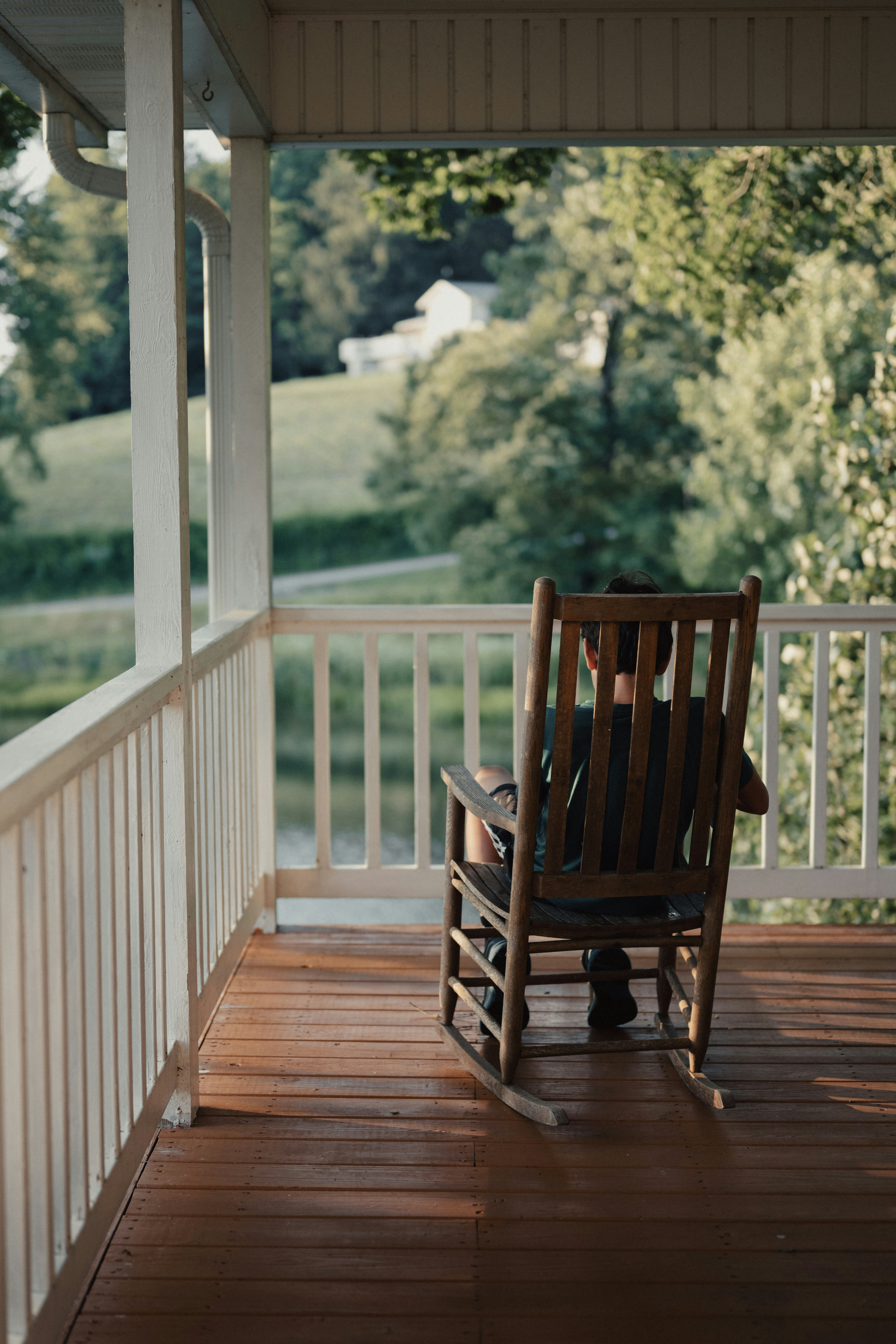
Nor has reading alone suffered. The social fabric has frayed as well. I remember when houses faced the street with broad porches where neighbors gathered in the evening, waiting the advent of night’s coolness, conversation drifting unhindered from one subject to another, board games on small tables, laughter an abundant sprinkling of neighborly fellowship.
This simple act of sitting together seemed reason enough to linger.
Today, many houses turn their porches to the rear, facing private yards rather than the street, as if community itself had quietly retreated.
Perhaps this is why books continue to matter.
Reading restores a community the modern world has forsaken.. Open a book and time folds in upon itself: Plato resumes his patient inquiry into justice; Seneca counsels composure in adversity; Ovid reminds us that the human story is one long sequence of transformations. The centuries speak again in voices at once distant and intimate.
Books, in this sense, comprise the old porch of civilization.
There we sit again with the living and the dead alike, the conversation unbroken. The room grows quiet, the hour late, yet the mind moves freely—wandering Athens with Aristotle, pausing in the tragic shadows of Euripides, or returning, perhaps a little wiser, to our own small corner of the world.
So I keep my modest covenant of fifty pages a day. Not simply to finish more books, though that is pleasant enough. I read because within those pages waits a larger company and a wider horizon.
In a distracted age, the turning of a page may be one of the last quiet forms of freedom left to us.
“This new war, like the previous one, would be a test of the power of machines against people and places; whatever its causes and justifications, it would make the world worse. This was true of that new war, and it has been true of every new war since. The dark human monstrous thing comes and tramples the little towns and never even knows their names. It would make Port William afraid and shed its blood and grieve its families and damage its hope.
“I knew too that this new war was not even new but was only the old one come again. And what caused it? It was caused, I thought, by people failing to love one another, failing to love their enemies. I was glad enough that I had not become a preacher, and so would not have to go through a war pretending that Jesus had not told us to love our enemies.”
I’m currently reading travel connoisseur Pico Iyer’s ABeginner’sGuidetoJapan, a delightful read. Unlike many travel writers who guide us to a country’s tourist amenities—sights, hotels, restaurants—Iyer illuminates its culture. He knows Japan intimately, married to a Japanese wife and calling the country home for the past thirty-two years.
As a serviceman, terribly young at the time, I visited Japan twice on R & R. I was impressed by its remarkable post-war recovery and, even more, by its people—the most courteous, polite, clean, and honest of any nation I’ve been privileged to visit. Leave a camera in your room at checkout, and they’ll have it waiting at the desk when you return to inquire
The Japanese aim to please, integral to a culture of collectivized kindness.
Iyer shares a German visitor’s observation from 1910:
“If a fisherman sees you emerge from the ocean after swimming, he will quickly remove the sandals from his feet, bow, and place them before you in the sand so that you do not have to walk down the street barefoot.”
It’s still that way.
Purchase a gift and it will often be wrapped—even in newspaper, say from The New York Times—simply to heighten your pleasure.
Don’t be surprised to find a basket of toothbrushes, toothpaste, and floss in your hotel bathroom.
For sheer convenience, Japan has 5.6 million vending machines—more than anywhere else in the world.
In America, convenience stores are a way of life, especially along interstate highways. They are also, sadly, frequently robbed.
In Japan, which has more than 50,000 convenience stores in a nation roughly the size of California, they are places of safety when one fears assault.
Outwardly and inwardly, they are uniform—for your convenience.
And yet they differ.
Some deliver.
Some are expansive, two-story outlets.
Some are specialized for the elderly.
If you need someone to console you in your grief, Amazon Japan can send a Buddhist priest to your door.
Feeling lonely? There are companies that will provide a pseudo-relative or friend—a mother or father, even a girlfriend.
Train stations, spotlessly clean, often feature signs:
“In order not to bother other customers, please show good manners and create a comfortable atmosphere.”
One of my special memories of Japan—beyond the scalding baths where nudity among the sexes was not a problem (though that may be changing as immigration increases) was the custom of not opening a gift in the giver’s presence, lest one reveal disappointment or offer false praise.
I like Iyer’s observation of Japan’s intuitive grasp that some things cannot be perfected:
“Japan has a sharp-edged sense of what can be perfected—gizmos, surfaces, manners—and of what cannot (morals, emotions, families). Thus it’s more nearly perfect on the surface than any country I’ve met, in part because it’s less afflicted by the sense that feelings, relationships, or people can ever be made perfect.”
I adore the Japanese penchant for harmony with nature, of which we are a part—reflected in meticulous gardens replete with lanterns, bridges, fountains, lakes, and ponds; sculpted cherry trees and moss marking the seasonal passage; myriad stone and pebbled pathways; sanctuaries of stillness instilling reflection—the way of Zen.
I love their cherishing of the ceremonial, their intuitive sense of inherent beauty in redeeming a pattern—whether arranging flowers or serving tea.
Above all, I love Japan’s simplicity. Dressed in kimono, I slept on floors in narrow rooms divided by fragile sliding doors: beneath me, my shikibuton; my head resting on a single makura; a kakebuton drawn close against the night chill. Nothing excessive. Nothing clamoring. Only wood, paper, cloth, and quiet. A nation refined not by accumulation, but by restraint.
When driving, I not infrequently see bumper stickers proclaiming, “Growth is Good.” I’m not sure about that. I never have been.
I’m drawn to solitude. I can’t fully explain why; I only know it has always been so.
From childhood, I loved my native New England—its rural charm, its villages gathered around commons harkening back to Revolutionary times. I miss the sea, the rolling mountains, the stone walls and white-steepled churches.
Vermont has long held me in its grip, with Maine not far behind—rural, twisting lanes with scant traffic, mountains rising beyond charming villages, the faint salt scent of the seashore.
For all my love of open space, my early years were divided between rural Rowley, MA, and Philadelphia. I’ll take Rowley any day over the so-called City of Brotherly Love. I have returned to Philadelphia twice; both visits stirring up memories I would rather forget—urban blight, high crime, dirty streets, endless row houses and sweltering summer nights.
When I lived in Rowley in the 1950s, the town numbered about 1,600 souls. Thirty-five miles north of Boston, it has since tripled in population to roughly 6,400 and become a fashionable bedroom community for Boston’s well-paid professionals, aided by the MBTA Commuter Rail—a comfortable fifty-five-minute jaunt into Boston’s North Station.
We lived on Bennett Hill Road, a mile’s walk from the common. In summer I would rush out the door, glove hooked over my bicycle’s handlebar, eager for baseball on the green.
I loved walking that narrow, curving road lined with beach plum bushes and open fields, breathing the smell of nearby salt marsh bordering the ocean, as I waited for the school bus at the corner.
Home was a two-hundred-year-old house set on twenty-six wooded acres of pine. Its long driveway was lined with boulder stone walls in the old New England manner, guarded by towering elms like ancient sentries.
Deep in those woods I had a private place I visited often, drawn by its stillness—the scent of pine rising from fallen needles that softened the earth beneath my feet.
Today, Rowley finds itself embroiled in debate over a state mandate requiring density zoning for roughly six hundred new multi-family housing units near the train station.
Bennett Hill Road has changed. The beach plum bushes are gone; open fields have yielded to wooded suburban enclaves. In the 1950s, the average home sold for $10,000. Today it approaches $1 million.
I cannot forecast Rowley’s fate, though I hope it doesn’t become another Danvers or Peabody—once distinct towns now absorbed into the dense sprawl of greater Boston.
A major development called “Rowley Farms” proposes a “town within a town,” combining denser housing and retail—an idea that would have been unimaginable in 1957.
Bumper stickers may insist that growth is good. I remain unconvinced. I am, and likely will remain, a stubborn holdout for a way of life that prized quiet contentment—secluded from the noise, the restlessness, and the accumulated griefs of urban life.
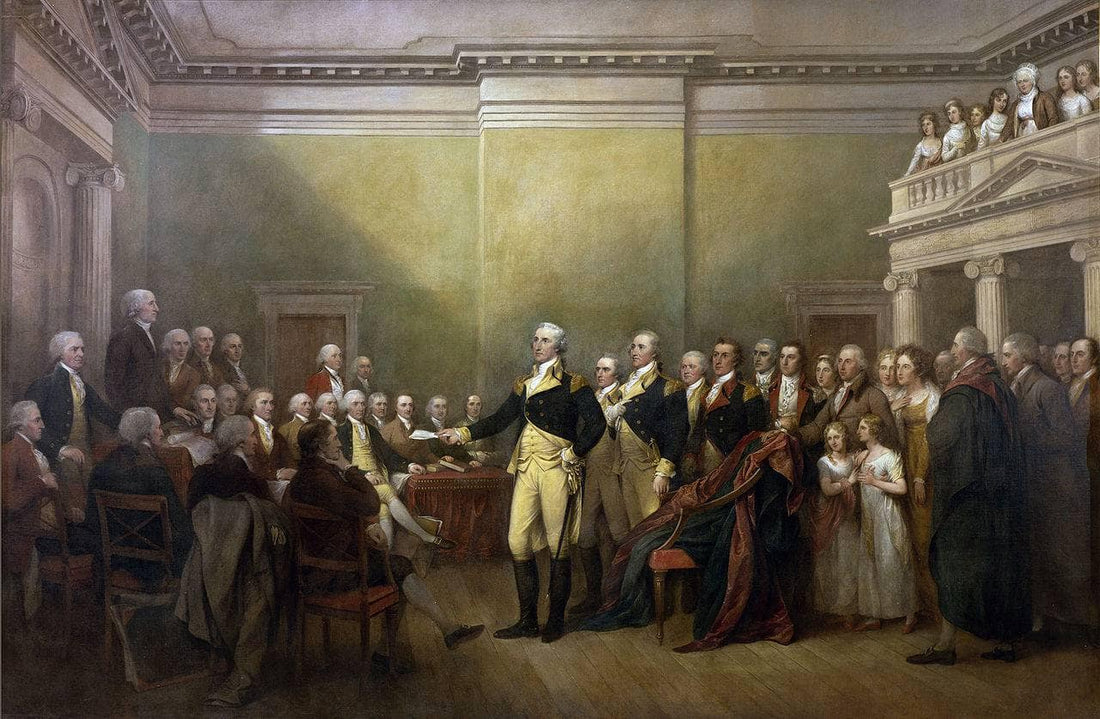
Painting: John Trumbull. George Washington resigns as Commander-in-Chief, Continental Army.
I grew up in an America that celebrated George Washington’s February 22 birthday as a national holiday, signed into law by President Rutherford B. Hayes in 1879 as a federal workers’ holiday, then extended nationally in 1885.
Things changed in 1968 when Congress passed the Uniform Monday Holiday Act, providing longer weekends and consolidating observances. Washington’s Birthday was reassigned to the third Monday in February, still legally designated as his birthday, though some congressional members proposed including Lincoln’s February 12 birthday under the broader aegis of Presidents’ Day.
That broader title caught on. Retailers and state governments increasingly adopted “Presidents’ Day.” Like so many holidays, it became a corporate sales opportunity.
Accordingly, the first item in my email this morning was a Presidents’ Day furniture sale—the first of what will no doubt be a barrage as the third Monday approaches.
Historian Jonathan Horn finds it absurd that we no longer distinctly celebrate Washington’s Birthday, given that it was observed in the young nation even before the framers of the Constitution met in 1787 (“Just Call It Washington’s Birthday,” Free Press, Feb. 11, 2026).
We owe much to this exemplary leader. Ken Burns credits Washington as “the glue that held it all together” in his PBS documentary TheAmericanRevolution. Facing superior, disciplined British forces, Washington understood that victory would require patience: knowing when to retreat, striking unexpectedly, and prolonging the war.
After defeats in New York, expiring enlistments, and desertions, matters reached their nadir during the winter encampment at Valley Forge outside British-occupied Philadelphia in 1777. Starvation loomed. Smallpox ravaged the ranks. Soldiers were unpaid, underfed, and poorly clothed.
With sagacity, Washington enlisted the Prussian officer Baron von Steuben, who molded the army into a disciplined fighting force. Recruits followed in greater numbers.
After General Gates’ victory at Saratoga, Washington was able to engage French support, working through liaison with the Marquis de Lafayette.
The decisive blow came when French naval forces blocked Cornwallis’s escape at Yorktown. Washington had deceived Cornwallis into believing New York was his objective while covertly moving his troops south. The British capitulated, leading ultimately to peace in 1783.
Washington had endured criticism without vindictiveness, even surviving a mutiny threat by disgruntled, unpaid officers.
For Burns, Washington’s greatest moment was not Yorktown or Trenton, but his resignation of his commission in Annapolis in 1783. As Burns tells it, he “knew how to defer to Congress, knew how to inspire ordinary people in the dead of night, knew how to pick subordinate talent—just had a kind of presence to him that, without him, we don’t have a country” (Chadwick Moore, New York Post, Nov. 11, 2025).
He did something similar in refusing a third presidential term. His 1796 Farewell Address remains prescient in its warnings against partisanship, permanent foreign alliances, sectionalism, and constitutional usurpation: “Let there be no change by usurpation; for though this, in one instance, may be the instrument of good, it is the customary weapon by which free governments are destroyed.”
Yet Washington has come under fierce attack, criticized for slave holding and judged by contemporary moral standards. Some view him primarily as a symbol of racial oppression and seek removal of his name and likeness from public spaces.
In the aftermath of George Floyd’s killing in 2020 and the ensuing unrest, efforts accelerated to eliminate reminders of racial injustice, including monuments to Washington, Jefferson, Lincoln, Theodore Roosevelt, and Woodrow Wilson. Streets, buildings, and schools were renamed; statues toppled or defaced.
In Portland in 2020, protesters toppled and defaced a statue of Washington in a public park.
At the University of Washington, protesters called for removal of his statue.
In 2020, a statue of Washington at George Washington University was beheaded.
In 2021, the San Francisco Board of Education voted to rename a school honoring Washington, later reversing course after public scrutiny.
A Washington, D.C. working group, commissioned amid racial justice protests, recommended reviewing public names and monuments, suggesting federal sites be reconsidered for contextualization or renaming.
While some of this fury can be understood as anger over longstanding injustice, historian Howard Zinn argues in A People’s History of the United States that Washington’s mythic stature obscures his slaveholding and his violent campaigns against Indigenous peoples. Jill Lepore, in These Truths, likewise underscores the inseparability of his leadership from slavery.
It is painful to read, but much rings true.
Burns recounts Washington’s 1779 campaign against the Iroquois, ordering the destruction of settlements in retaliation for their alliance with the British: “Lay waste all the settlements around… that the country may not be merely overrun, but destroyed.” Towns and crops were burned. Many perished in the ensuing winter from famine and disease.
America was founded on a compromise that would lead to civil war and immense loss of life. Our history is marked by both courage and cruelty, liberty and bondage. We diminish ourselves if we pretend otherwise.
But we also diminish ourselves if we forget the magnitude of what was achieved: a fragile republic wrested from empire, sustained not by perfection but by discipline, restraint, and the voluntary surrender of power.
We are a nation still struggling to reconcile our ideals with our conduct. The work of ordered liberty, of constitutional self-government, of moral reckoning without erasure, remains unfinished.
The Revolution continues—not in the toppling of statues or canceling history, but by whether we can tell the truth about our past without losing the capacity to honor it.
On winter mornings, before the day has decided what it will become, the fields hold a stillness that feels provisional—frost clinging to the grass, fence lines darkened with damp, the land waiting without impatience. It is a good hour for reading slowly, for choosing words that do not hurry ahead of their meanings.
I have begun the year reading Wendell Berry. Now in his ninety-second year, he continues—more slowly, more deliberately—to farm and to write, unchanged in his fidelity to limits: the authority of place over abstraction, the moral claims of the local over the corporate, tradition understood not as nostalgia but as knowledge earned through use and endurance.
I read him most mornings. His work steadies the day. It does not offer solutions so much as orientation—toward what is given, what is sufficient, and what must be borne. Berry has always made room for joy, but never without sorrow, nor for hope without the acknowledgment of failure, including one’s own.
Some of his most influential prose appeared early, when his voice was still finding its public footing. The Long-Legged House and The Unsettling of America argued, quietly and insistently, that culture and agriculture are inseparable, and that when land is treated as commodity rather than community, both soil and people are diminished.
I return often to his poetry, especially A Timbered Choir: The Sabbath Poems. Written on Sundays and largely free of polemic, these poems are acts of attention. They move patiently through the stages of a human life—birth, labor, love, diminishment—offering a sacramental vision of ordinary days lived close to the ground. Among them is Berry’s most widely known poem, “The Peace of Wild Things,” whose calm acceptance of life’s ephemerality offers not escape from anxiety, but release from the burden of false mastery:
“I come into the peace of wild things who do not tax their lives with forethought of grief.”
The peace the poem offers is not consolation so much as proportion. Its discipline lies in relinquishing the anxious reach into the future and reentering creaturely time—where life is finite, local, and sufficient.
That same discipline governs Berry’s essay “Why I Am Not Going to Buy a Computer,” first published in 1987 and often misread as a rejection of technology itself. It is instead a meditation on the moral weight of tools. Berry does not deny their usefulness; he questions their claims. Certain technologies, he suggests, quietly privilege speed over deliberation and convenience over care, reshaping habits of attention until efficiency becomes an unquestioned good.
The good life, in Berry’s accounting, is not optimized. It is inhabited. To live well requires learning the difference between what is necessary and what merely promises ease.
Barbara Kingsolver, another Kentuckian, names this work plainly when she writes:
“I consider it no small part of my daily work to sort out the differences between want and need. I’m helped along the way by my friend Wendell, without his ever knowing it. He advises me to ask, in the first place, whether I wish to purchase a solution to a problem I don’t have.”
Berry’s essay is not finally about computers at all. It is about scale and consequence. It asks not simply what a tool can do, but what it may undo—what forms of patience, responsibility, and mutual care it quietly displaces. It asks how our choices shape our relationships to family, to community, and to the land that sustains both.
Berry still writes with pencil on a yellow legal pad. He still farms, though within the limits age imposes. He still publishes—new poems, even a recent novel. The persistence itself feels instructive.
In a culture bent on expansion and acceleration, Berry’s life suggests another measure of success: fidelity to place, restraint in use, and the long patience required to learn what is enough.
Anger has become one of the easiest responses to modern life.
What troubles me most is not anger itself, but how easily my emotions can be manipulated—by discourtesy, by noise, by global politics, by the ambient insensitivity of others. That reactive state isn’t who I really am, yet it’s one I’m repeatedly invited into.
I want to be kind, not reactionary; deliberate, not pushed into negativity. I want to remain self-governing. As Marcus Aurelius put it, “Be tolerant with others and strict with yourself.”
Years ago, I came upon a short piece in Reader’s Digest titled “Do I Act or React?” I read it at exactly the right moment. Why should a discourteous store employee spoil my day? Or a waiter serving me something I never ordered? Or a driver that cuts me off?
These moments are trivial in isolation, yet corrosive in accumulation. As the Stoic writer Ryan Holiday reminds us, “Jerks abound everywhere. That’s their business, not yours.”
My wife once shared an encounter she had with a rude bank teller. Instead of meeting rudeness with rudeness, she simply said, “I hope your day gets better.” It was disarming—not passive, not superior, just humane. Too often, we carry our moods like open containers, spilling them onto others without noticing.
The distinguished novelist and essayist George Saunders suggests that literature can help us cultivate tolerance—not all at once, but incrementally, and therefore cumulatively. A practicing Buddhist, Saunders believes that reading fiction trains us in three essential truths:
You’re not permanent. You’re not the most important thing. You’re not separate.
Literature slows judgment. It places us inside other consciousnesses. It rehearses moral humility. In doing so, it loosens the grip of the ego—the very thing that insists on being offended.
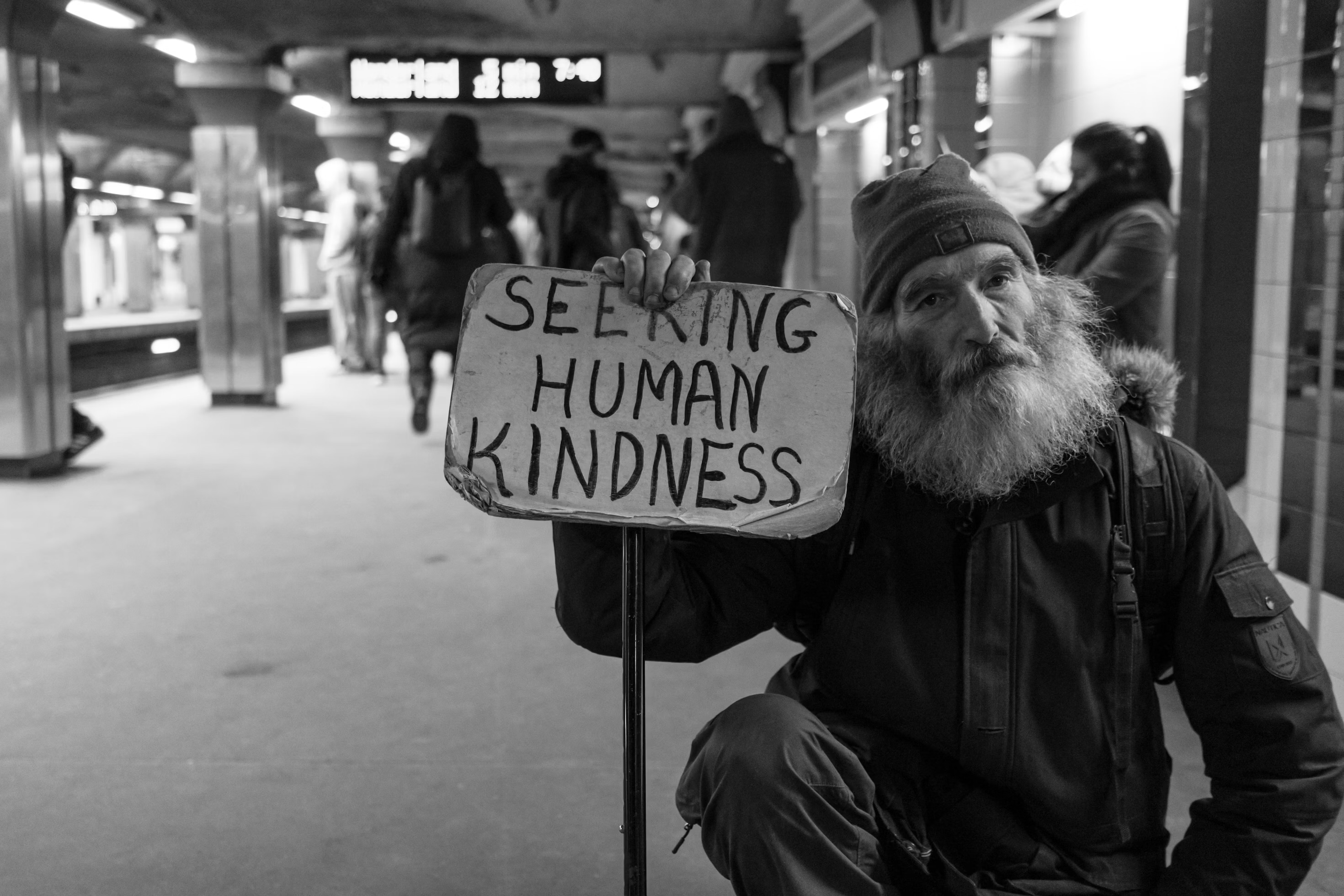
Kindness, after all, isn’t mere niceness, which can look away from cruelty. Kindness sees clearly. It chooses understanding over reflex, restraint over retaliation.
So many of our perceived hurts come down to our desire to control others: their tone, their behavior, their awareness of us. When that control fails—as it inevitably does—we suffer. The antidote is not indifference, but proportion. We need to take ourselves less seriously.
Saunders doesn’t offer a list of recommended books, though he has often spoken admiringly of Grace Paley.
I return often to Marcus Aurelius’ Meditations, a slender volume that rewards endless rereading.
One line, in particular, feels endlessly applicable:
“Is a world without shameless people possible? No. So this person you’ve just met is one of them. Get over it.”





 Brimmings: up from the well