Morning Thoughts

Morning returns. My mind, as always, tumbles at wake of day, waves touching every shore.

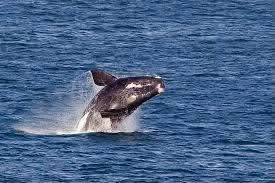
Whales fill my thoughts, those biblical, wondrous leviathans of the deep, the creatures Job extols as exempla of divine majesty beyond infinity’s reach.

I think of Rachel Carson, guardian of the deep, her The Sea Around Us, prescient in its admonition, eloquent in its utterance, observing in 1951 alteration of climate: “… the frigid top of the world is very clearly warming up” and “the surface waters of the North Atlantic {are} showing rising temperatures.”

Childhood memories of Newburyport sea-captain mansions lining High Street, their terraced porches, vistas toward the ocean. Moby Dick. Coastal Maine. Nantucket’s cobbled lanes. Whalers and harpoons.

We hunted them to near extinction. Right whales, only a scarce few.

Thoughts of Gerard Manley Hopkins and “Binsey Poplars”:

“O if we but knew what we do
When we delve or hew…”

Sea mining has begun.

There are no boundaries.

As sea lover Philip Hoare writes, stirred by a whale sighting off my beloved Cape Cod, “I watch as the whale plays in the surf the way a dog runs around a field. There are less than three hundred and forty of their kind left, set against the teeming multitude of the whole human race. Too few whales now to fill this great ocean, or animate it enough to save themselves. Too few to fertilise it, with their living excretions or their dead bodies. Too few females to continue the line” (William Blake and the Sea Monsters of Love).

We don’t hunt Right whales anymore, but human activity menaces still—fishing-net entanglements, vessel collisions, plastic pollution. Navy underwater sonar shakes the ocean deep.

Most ominously, only about 70 breeding females remain.

A world without whales? Like dinosaurs, the stuff of children’s storybooks and museum displays? It’s a world I’m glad to leave.

Poet Robinson Jeffers echoes my thought in his “End of the World”:

“When I was young in school in Switzerland, about the time of the Boer War,
We used to take it for known that the human race
Would last the earth out, not dying till the planet died. I wrote a schoolboy poem
About the last man walking in stoic dignity along the dead shore
Of the last sea, alone, alone, alone, remembering all
His racial past. But now I don’t think so. They’ll die faceless in flocks,
And the earth flourish long after mankind is out.”

I have no more words.

RJ

A Legacy of Righteous Minds

Existence exerts a randomness in its distribution of fate. The wicked, as Job tells us, often live long, escaping their misdeeds with impunity; the just and talented, curtailed lives amid their greatest promise.

The list of those I deem the “righteous,” those who’ve especially influenced who I am, the values I embrace, and my hopes for a better human future taken from us early, their age at death indicated in parentheses, includes Princeton sage Walter Kaufman (59), biologist Stephen Jay Gould (62), astronomer Carl Sagan (62), science fiction writer Octavia Butler (58), essayist and novelist George Orwell (46), political sage and philosopher John Stewart Mill (66), and, not least, poet Gerard Manley Hopkins (44).

I’m tempted to write a series of extended separate tributes to each of them in Brimmings, but will limit my commentary for now.

I was in my early twenties. a college student just out of the military, when I somehow came upon Walter Kaufmann’s The Faith of a Heretic (1961), which I’m re-reading now. He was the first to admonish me to accept only the empirical in the quest to discern the probable, to find courage to change course, and live daringly: “The question is not whether one has doubts, but whether one is honest about them.”

Evolutionary biologist Stephen Jay Gould impressed me early with his clear cutting, scintillating prose endowed with grace, teaching me that science is not simply pursuing the factual, but a way of thinking that enlarges one’s humanity. Life is by-product of chance and contingency: “Human beings arose, rather, as a consequence of thousands of linked events, none of which foresaw the future.”

Astronomer Carl Sagan demanded the imprimatur of evidence for any accepted belief. Rationality demands we not cloister ourselves in cultural hand downs—that extraordinary beliefs merit skepticism: Compromising truth invites demagoguery and superstition’s advance: “We make our world significant by the courage of our questions and the depth of our answers.”

African-American Octavia Butler has been a remarkable recent read, writing eleven science fiction novel standouts resonating urgency in confronting systemic collapse of ecosystems consequent with climate change. Her Parable of the Sower, a must read, has proven chillingly prescient. Change is life’s inevitability, morally indifferent, demanding adaptability to survive: “Human beings fear difference, and they fear it so deeply that they will not only oppress but destroy what they see as different.”

George Orwell, well known for his clairvoyant 1984, has always impressed me with the clarity of his writing, achieved through disciplined study; his wariness of manipulative despotism and its verbal deceit stratagems such as ’doublespeak,” timely and precise in their warnings of euphemism and abstraction: “Political language… is designed to make lies sound truthful and murder respectable.”

John Stewart Mill, “the saint of rationalism,” remains a seminal influence, ahead of his time, a champion of classical liberalism and its advocacy of the minority’s right to dissent. He taught me about nature’s indifference and logic’s necessity in a world absent of revelation. I return to him repeatedly for wisdom and inspiration: “If all mankind minus one, were of one opinion, and only one person were of the contrary opinion, mankind would be no more justified in silencing that one person, than he, if he had the power, would be justified in silencing mankind.”

Gerard Manley Hopkins has long been my most esteemed poet with his vibrant “sprung rhythm,” latent with emotion, a passion for nature and for those who suffer—so many—life’s inequities. His poetry sings, reenacting experience via the sensory, capturing the essence of all things. As a Jesuit priest, while not resolving the problem of suffering by resorting to a cozy theodicy or relying on sentimentality, he helps render its endurance: ‘I wake and feel the fell of dark, not day.”

I am forever grateful for their stalwart witness to life’s truths. Their lives argue by example rather than system—that meaning isn’t guaranteed by justice, nor extinguished by its absence. Fate distributes arbitrarily; conscience does not.

—rj