Reading Ove Knausgaard at 4 AM: A Friend to See Me Through the Night

I woke up at 4 a.m. this morning, dawn’s light still absent, an annoying habit of mine, worsened by turning-in too late, despite ardent resolve to do better. God knows, I need more than four hours of sleep, and I pay for it, drifting off repeatedly as day unfolds.

To cope, I try teasing myself back to slumber—whatever works—like counting up to 100 in Italian, gleaned from daily Italian lessons. Or better, groping for the iPad beside me to resume my daylight read, Karl Ove Knausgaard’s massive My Struggle, despite blue light barriers to sleeping well.

I read a lot—mainly books I often list in Brimmings each New Year’s Day. Right now, I’m deep into Book Two of My Struggle, part of a six-volume series totaling nearly 3,600 pages—or three times the length of War and Peace.  In contemporary writing, only Elena Ferrante’s Neapolitan Novels, at roughly 2,000 pages, come close in length. (Proust’s Remembrance of Things Past runs to 3000 pages across seven volumes.)

Overall, Book Two details Knausgaard’s move to Sweden, his family life with second wife, Linda, and their three children; the tensions arising from his obligations to family life and dedication to writing:

Now I had everything I had dreamed of having since I was a teenager: a family, a wife, children—yet none of it made me happy. On the contrary, I was constantly on the verge of tears, I was always angry, always tired.”

The love I had for Linda was not stable and warm but consuming and often destructive.

I’m attempting all six volumes. I wonder how many have done this and for what reasons. My guess is very few have climbed the mountain, but I’m liking the climb.

In his penchant for recalling past event, interspersed with personal reflection narrated over several volumes, Knausgaard has often been compared with Marcel Proust.

While his prose may lack Proust’s lyricism, it compensates with acute playback of places lived, voices heard, and life’s everyday ironies. It’s like he’s sitting across from you, filling the room, talking to you directly.

Though he’s won several Scandinavian literary awards, he’s yet to take home a prestigious International Booker translation prize or Nobel.

Writing in Norwegian hasn’t helped. There are only 5.5 million Norwegians. It’s the uphill climb all non-English writers face in an industry still dominated by native Anglophones.  And so I commend  The New York Review of Books for its continued effort to revive works originally not written in English.

Some critics think Knausgaard narcissistic for his self-focus, but they forget: he’s writing memoir. Anyway, when is writing anything but a quest to be heard or validated? I think they’re being simplistic.

In Norway, readers were shocked at Knausgaard’s inclusion of family and friends, names unchanged, intimate details not held back. An uncle threatened to sue and former wife, Linda, suffered mental distress, requiring therapy.

Knausgaard can make anyone uncomfortable. He doesn’t hold back about life’s often brutal truths. But to me, that’s his strength. I like writers who unflinchingly deliver human experience.

Knausgaard writes what’s known as autofiction, a blurring of the distinction between the factual and the fictional. Memory, subject to filtering, is unreliable. We cannot even say we fully know ourselves. By this yardstick, even autobiography becomes an act of arbitrary inventory—selecting, omitting, fabricating—and, hence, approximates fiction, or as Knausgaard puts it, memory “is not a reliable quantity in life” as it  “doesn’t  prioritise the truth, but rather self-interest.”

I admire his directness and minute detail. I revel in his feel for nature’s splendors, vignettes of people and their eccentricities, the fiery fever of first love; thoughts on today’s politics, obsessions imposing self-censure, the ennui often accompanying contemporary existence, and not least, the myriad burdens of the writer’s life.

I always longed to be away from it. So the life I led was not my own. I tried to make it mine, this was my struggle, because of course I wanted it, but I failed, the longing for something else undermined all my efforts.

The foregoing passage helps explain the series title, My Struggle, with its provocative echoes of Hitler’s Mein Kampf.  Knausgaard’s struggle, however, is an existential one—that of locating oneself in a world often hostile to individuality, of finding balance between writing and family, each under pressure of cultural conformity.

…perhaps it was the prefabricated nature of the days in this world I was reacting to, the rails of routine we followed, which made everything so predictable that we had to invest in entertainment to feel any hint of intensity?

Knausgaard’s critique of cultural homogenization, creeping across Europe like some unchecked fungus, especially resonates with me:

There was the revulsion I felt based on the sameness that was spreading through the world and making everything smaller? If you traveled through Norway now you saw the same everywhere. The same roads, the same houses, the same gas stations, the same shops. As late as the sixties you could see how local culture changed as you drove through Gudbrandsdalen, for example, the strange black timber buildings, so pure and somber, which were now encapsulated as small museums in a culture that was no different from the one you had left or the one you were going to. And Europe, which was merging more and more into one large, homogeneous country. The same, the same, everything was the same.

Thoughts arise of  a visit to Moscow’s Red Square with my students, of fast-food chains—TGI Friday’s, McDonald’s, Pizza Hut, KFC—littering its periphery, exporting America’s consumer culture and eroding local identity; memories of a journey to France—a student lamenting time and money visiting Europe, only to find blue jeans, blaring American music, and global brands echoing home.

There ‘s a humility clinging to Knausgaard’s narrative, a confessed reticence to assert himself in a society indifferent and perhaps judgmental in its appraisal of those differing from the norm:

I subordinated myself, almost to the verge of self-effacement; some uncontrollable internal mechanism caused me to put their thoughts and opinions before mine.

I saw myself as the weak, trammeled man I was, who lived his life in the world of words.

My Struggle abounds in quotable reflections that I hasten to underscore like this hauntingly melancholic passage, evoking a past where dignity, nature, and artistry coexisted—however harsh the drawbacks of its era:

…if there was a world I turned to in my mind, it was that of the sixteenth and seventeenth centuries, with its enormous forests, its sailing ships and horse-drawn carts, its windmills and castles, its monasteries and small towns, its painters and thinkers, explorers and inventors, priests and drugstores. What would it have been like to live in a world where everything was made from the power of your hands, the wind, or the water? What would it have been like to live in a world where the American Indians still lived their lives in peace? Where that life was an actual possibility? Where Africa was unconquered? Where darkness came with the sunset and light with the sunrise? Where there were too few humans and their tools were too rudimentary to have any effect on animal stocks, let alone wipe them out? Where you could not travel from one place to another without exerting yourself, and a comfortable life was something only the rich could afford, where the sea was full of whales, the forests full of bears and wolves, and there were still countries that were so alien no adventure story could do them justice, such as China, to which a voyage not only took several months and was the prerogative of only a tiny minority of sailors and traders, but was also fraught with danger. Admittedly, that world was rough and wretched, filthy and ravaged with sickness, drunken and ignorant, full of pain, low life expectancy and rampant superstition, but it produced the greatest writer, Shakespeare, the greatest painter, Rembrandt, the greatest scientist, Newton, all still unsurpassed in their fields, and how can it be that this period achieved this wealth? Was it because death was closer and life was starker as a result? Who knows?

Knausgaard has this way of arresting you mid-thought and making you reassess your values.

Book 2  emphasizes the fissure between the expected of you and living your true self. For writers living in a world of the utilitarian with its compromises, the challenge of finding equilibrium can be daunting :

To write is to carve a path through the wilderness. It is to find something that has not been said before, something you can believe in, something that gives meaning to your life.

Again, the unstinting honesty, whether commenting on contemporary mores, engaging in philosophic reflection, or offering informed opinion separating the trivial from the significant.

They say Book 6, 1000 pages long, is steep in philosophical reflection. Whatever, I look forward to the climb.

The New Yorker critic James Wood praises Knausgaard’s ability to extract the profound from the mundane as “hypnotically compelling.”

The Atlantic’s William Deresiewicz applauds Knausgaard’s philosophical depth as a “contemporary Proustian endeavor.”

Life is never simple for Knausgaard in his dense weave of mystery and randomness, of inheritance and free will, of human frailty and moral striving..
I find that compelling.

And so, even when I awake, the silent stars my sole companions, I find pleasure in his company, a friend to see me through the night.

–rj

 

Celebrating Emily Dickinson’s Birthday

Yesterday, Dec. 10th, marked the 194th birthday of Emily Dickinson (b. 1830), one of America’s most gifted poets.

Her love of nature, keen observations on life’s ironies, and daring truthfulness won me over early. I know of no poetry with more nuance.

Of her many poems, my favorite is “A Wounded Deer Leaps Highest” with its nature analogies exhibiting the incongruity of the outer appearance with the inner reality. We are often masters at concealing life’s griefs.

Though I’ve visited The Homestead (Amherst , MA) on several occasions, I’m ready to visit again to take-in the Dickinson Museum updates, which include the restoration of Emily’s beloved garden, her father’s gifted conservatory to Emily and her sister, Lavinia, and the recently completed reconstruction of the family’s carriage house.

In short, The Homestead is my literary Mecca, as there is much in Emily’s sensibility that resonates with me.

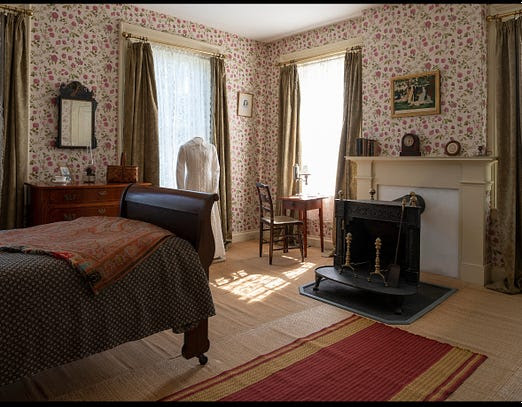
Below, Emily’s upstairs bedroom where she composed her nearly 2000 poems and many letters:

It was cerebral musician Patty Smith who reminded me of Dickinson’s birthday in her substack post, replete with quotations from her poems and letters.

I’m repeating them here, as they superbly express Dickinson’s keen sensitivity and writing acumen. Smith observes that any of them would serve well as a writing prompt:

“Forever is composed of nows.”

“I am out with lanterns, looking for myself.”

“We turn not older with years but newer every day.”

“The soul should always stand ajar, ready to welcome the ecstatic experience.”

“I know nothing in the world that has as much power as a word. Sometimes I write one, and I look at it, until it begins to shine.”

“That it will never come again is what makes life sweet. Dwell in possibility. Find ecstasy in life; the mere sense of living is joy enough.”

“If I read a book and it makes my whole body so cold no fire can warm me, I know that is poetry. If I feel physically as if the top of my head were taken off, I know that is poetry. These are the only ways I know it. Is there any other way?”

“Not knowing when the dawn will come, I open every door.”

“The dearest ones of time, the strongest friends of the soul–BOOKS.”

“The lovely flowers embarrass me. They make me regret I am not a bee…”

“I don’t profess to be profound; but I do lay claim to common sense.”

“Life is a spell so exquisite that everything conspires to break it.”

“Whenever a thing is done for the first time, it releases a little demon.”

“To shut your eyes is to travel.”

“your brain is wider than the sky”

“How do most people live without any thought? There are many people in the world,–you must have noticed them in the street,–how do they live? How do they get strength to put on their clothes in the morning?”

“I have been bent and broken, but -I hope- into a better shape.”

–RJoly

Julia Thurman: Crafting Worlds with Words

The writers I admire most never use a careless word. Their sentences are unimprovable —Judith Thurman, A Left-Handed Woman.

There exist those books we scarce can put down, riveting us with suspense, prose eloquence, and resonance of human experience.

Others, we struggle with, bored or chagrined by their non-relevance or absurdities. The usual counsel is to jettison them quickly.

Had I done so with Julia Thurman’s A Left-Handed Woman, a book largely focused on fashion couture, playground of wealthy indulgence, I’d have lost out immensely.

Collectively, Thurman’s adroitly articulated 39 essays, gathered mostly from fifty years of writing for The New Yorker, transcend her primary fashion genre, yielding portraitures mostly of heroic women finding autonomy in a patriarchal milieu, leading to my admiration for Thurman, awe at her salient intelligence, fine-tuned to meticulous observation and set-apart brilliance in prose mastery.

As Henry Finder, one of her editors at The New Yorker observes, “She’s not happy with a paragraph until it sings.”

Thurman’s acumen is indisputable, having achieved numerous awards that include a National Book Award for Non-fiction for her biography, Isak Dinesen: The Life of a Writer (1983), inspiring the hit movie, Out of Africa.

Her Secrets of the Flesh: A Life of Colette (1999), earned a finalist National Award for Nonfiction.

She is a recipient of the Ordre des Artes et Lettres by the French government for her contributions to French literature.

A Left-Handed Woman has won PEN’s award for essay excellence .

Nothing surprises me about Thurman. Is there anything she misses in her myriad subject matter teeming with wide-ranging vignettes on not only fashion designers such as Sara Berman, Isabel Toledo, Elsa Schiaparelli , Miuccia Prada Guo Pei and Ann Lowe, but disparate entities like Margaret Fuller, Emily Dickinson, Elena Ferrante, Lee Miller, Eva Zeisel, Amelia Earhart, Isa Genzken, Greta Stern, Alison Bechdel, Laura Elizabeth Ingalls Wilder, Rachel Cusk, Yasmina Reza, Vladimir and Vera Nabokov, and even Helen Gurley Brown and Cleopatra, among still others, their successes and, yes, the not infrequent intrusions of fate cascading fame and fortune to their doom.

While men do appear in her essays, they’re a distinct minority, sometimes perversely objectifying women as ancillaries of male prerogative:

Conversely, she writes of women, “I scoured literature for exceptions, and there were some. But nearly all of them had achieved distinction at a price their male counterparts didn’t have to pay. In that respect, one might say they were all left-handed: they defied the message they were not right.”

My favorite essays come toward the book’s close, featuring Simone de Beauvoir and in a surprising thematic shift, Thurman’s memoir of cave exploration, torch in hand, accompanying renowned French anthropologists at ancient Dordogne cave painting sites, Chauvet and Niaux.

I believe Thurman is right in crediting de Beauvoir with the genesis of the modern feminist movement with her seminal The Second Sex. As for her revels exploring caves and pedaling across French landscape, it’s truly a tour de force.

One last thing: Thurman is a self-taught fluent speaker of two languages beyond her native English that include French and Italian, highly engaged as she is in French and Italian literary and artistic culture.

She also achieved reading fluency in Danish as prerequisite to her research on Isak Dinesen.

Favorite passages:

“What we bring with us—embedded in our flesh and bugging it; embedded in art and animating it—is the mystery of how we become who we are.”

“There’s a hidden cavity in every story, a recess of meaning, and it’s often blocked by the rubble of your own false starts, or by an accretion of received ideas left behind by others. That updraft of freshness is typically an emotion you’ve buried.”

“The transcendence of shame is a prominent theme in the narrative of women’s lives. The shame of violation; the shame of appetite; the shame of anger; the shame of being unloved; the shame of otherness; the shame, perhaps above all, of drive.”

“Most of the time, a piece of prose lies on the page bristling with cleverness, yet inert, until I hit upon the precise sequence of words—the spell, if you like—that brings it to life. At that moment, language recovers its archaic power to free a trapped spirit.”

“She could love and desire intensely, but rarely at the same moment, and she could think and feel deeply, but not often in the same sentence.”

—rjoly

Discovering Ourselves Through Writing

What to write about, or finding your subject matter, doesn’t come easily.

Some writers respond to prompts to get them started.

Most writers probably get started out of a chance remark thrown their way in casual conversation or through stimuli in something they’ve read, or a keen interest, say in health research or climate change, that drives their protocol.

Political writers with an agenda find an especially easy route, simply reacting to adversary axioms they view as detrimental to public welfare. They’re never out of material, the spring never running dry in a media era of incessant scrutiny.

Popular author Tim Cotton just throws a sentence out there, not knowing where he’s headed: “What you don’t know about me, and won’t care, is that everything I write starts with a random sentence, typed onto a screen with no idea where I am going.”

Probing deeper, however, you’ll find this may be misleading. Cotton doesn’t simply post an initial sentence without an underlying coterie of everyday happenings—a visit with his aging father, the dream residue of an afternoon nap, the challenge of what to keep or toss, etc.

The key is to be mindful and present in the ordinary, and Cotton does this better than most of us. I suspect he jots down incipient observations he can expand upon later. Like many writers, he may keep a journal.

No matter how the writing venture begins, it has its mysterious aspects that all of us know very well. I remember a fellow graduate seminar student telling me that my writing exhibited a different person from the one of daily conversation.

That doesn’t surprise me. However I begin writing, I tunnel into a buried mineshaft of a separate self, perhaps akin to what Jung called the Shadow, surfacing in the writing act like a Yellowstone geyser bursting from subterranean depths.

Occasionally, I’ll bump into something I wrote several years ago and come away, Did I write that?

The poet Coleridge famously ascribed his Kubla Khan poem to an afternoon opium induced nap. On the other hand, Harvard scholar John Livingston Lowes pointed out Coleridge’s possible myriad reading sources in The Road to Xanadu.

In short, the depth psychologists Freud and Jung were right: We file our experiences, even the most trivial, at the unconscious level, lying dormant, only to spill suddenly into awareness, triggered by associative stimuli.

And so Tim Cotton is also right. However you start, your writing will reveal unknown vistas, revelatory of a much wiser Self than that quotidian persona we publicly assume.

Cotton inspired this post. I simply typed the first sentence, not knowing what I’d say. I had no notes, did not google, etc. That concealed self, automatic writing psychic enthusiasts might call it, filled out the blank.

Our minds are a file cabinet of our human experience, waiting retrieval. Writing may prove laborious, but think of what you miss when you don’t bother to write—the confluence of your life’s journey and its meaning; above all, your linkage with wider humanity, fostering understanding and empathy.

A journey of serpentine twists, leading to unanticipated trajectories, you never really know where you’ll end up.

–rj

Dr. Henry Marsh’s And Finally: Matters of Life and Death


Am reading Henry Marsh’s And Finally: Matters of Life and Death. Marsh is a retired brain surgeon, who recently was diagnosed (2021) with advanced prostate cancer, presently in remission, but with a 75% chance of reoccurrence.

His previous books include Do No Harm and Admissions: Life as a Brain Surgeon, both well received. Professionally, he has published 179 papers in peer reviewed journals and performed 50,000 surgeries over a 40-year span.

In his fulsome writing, Marsh reminds me of the late neurosurgeon Oliver Sacks, gifted in eloquence, humble, and unfailingly compassionate.

Perhaps I’m stereotyping, but he’s unlike many in the medical sciences, consumed by professional interests and profit motive, insensitive or ignorant of the arts and, professionally, objectifying their patients rather than seeing them as individuals, each with gradients of need and longing.

One of his cherished accomplishments is the creation of two balcony gardens for neurological patients at St. George’s hospital

Impressively, he’s been working pro bonum with colleagues in Ukraine since 1992. Neither cancer nor the Russian 2022 invasion of Ukraine has deterred the good doctor visiting the country regularly to consult and advise colleagues.

At home, Marsh is an assisted dying activist.

Of his previous Do No Harm, now translated into 37 languages, The Economist wrote that it’s “so elegantly written it is little wonder some say that in Mr Marsh neurosurgery has found its Boswell.”

Marsh reads widely, owns several thousand books, keeps a garden, raises bees, and enjoys woodcrafting.

I’m early in my reading of And Finally, so I’ll delay full commentary for another post when fully read. But let me share a passage I read this morning that amplifies Marsh’s writing talent infused with observation and an affinity for nature, under assault by climate change:

The {COVID} lockdown coincided with perfect spring weather – so fine, prolonged and warm that it spoke of climate change. The bushes in the little paradise of my back garden almost all burst into flower all at once, and the trees went from being bare winter skeletons to towers of spreading green leaves in a matter of days. The bees came rushing out of their hive in front of my workshop and shot up into the sunlight, rejoicing in vertical zigzags. And the lockdown brought complete peace and quiet. The air felt as fresh as if you were in the countryside and the sky was a clear and deep blue. The only sounds were of birds singing, children playing and the wind in the trees. And at night, at first there was a full moon, looking down kindly on the suddenly silent city, and you could see the stars. It was a vision of heaven, here in London, SW19. Time had stopped. Eternity is not the infinite prolongation of time but instead its abolition.

The silence and clear air, and the return of birdsong, reminded us of what we have already lost with cars, pollution and the changing climate, and the unnaturally fine weather told us that Nature is out of joint, and that there is much, much worse to come.

I feel it in my bones. This is going to be a great read.

—rj


Jack Kerouac: Soulful Wanderer

Jack Kerouac turned 102 a week ago. The fierceness of his writing overwhelms, lyrical, sensory, harnessing human moods, a fiery warmth beneath a canopy of gazing stars on cold stellar nights:

“Fury flashing on rocks that rise like gloomy sea shroud towers out of the cove, the bingbang cove with its seas booming inside caves and slapping out, the cities of seaweed floating up and down you can even see their dark leer in the phosphorescent seabeach nightlight.”

Big Sur

“…the only people for me are the mad ones, the ones who are mad to live, mad to talk, mad to be saved, desirous of everything at the same time, the ones who never yawn or say a commonplace thing, but burn, burn, burn like fabulous yellow roman candles exploding like spiders across the stars and in the middle you see the blue centerlight pop and everybody goes ‘Awww!’”

—Jack Kerouac, On the Road

We were never really born, we will never really die. It has nothing to do with the imaginary idea of a personal self, other selves, many selves everywhere: Self is only an idea, a mortal idea. That which passes into everything is one thing. It’s a dream already ended. There’s nothing to be afraid of and nothing to be glad about. I know this from staring at mountains months on end. They never show any expression, they are like empty space. Do you think the emptiness of space will ever crumble away? Mountains will crumble, but the emptiness of space, which is the one universal essence of mind, the vast awakenerhoo 0d, empty and awake, will never crumble away because it was never born.”

The Portable Jack Kerouac

The world you see is just a movie in your mind.
Rocks dont see it.
Bless and sit down.
Forgive and forget.
Practice kindness all day to everybody
and you will realize you’re already
in heaven now.
That’s the story.
That’s the message.
Nobody understands it,
nobody listens, they’re
all running around like chickens with heads cut
off. I will try to teach it but it will
be in vain, s’why I’ll
end up in a shack
praying and being
cool and singing
by my woodstove
making pancakes.

—The Portable Kerouac

I miss you, Jack. You left us all too soon.

rj

John Muir: Nature’s Gifted Scribe

Sierra Club founder John Muir was extraordinary, not only for his devotion to preserving nature’s wilderness, but for his eloquence in articulating its grandeur. An example:

Wonderful how completely everything in wild nature fits into us, as if truly part and parent of us. The sun shines not on us but in us. The rivers flow not past, but through us, thrilling, tingling, vibrating every fiber and cell of the substance of our bodies, making them glide and sing. The trees wave and the flowers bloom in our bodies as well as our souls, and every bird song, wind song, and tremendous storm song of the rocks in the heart of the mountains is our song, our very own, and sings our love. The Song of God, sounding on forever (from John of the Mountains: The Unpublished Journals of John Muir).

All told, he would publish 300 articles and 10 major books, not bad for someone who nearly lost his sight in a work accident.

One of his closest friends was President Theodore Roosevelt. In 1903, they would hike wilderness terrain together for two months. Inspired by Muir, Roosevelt designated 230 million acres of public land, including Yosemite and four other national parks and 18 national monuments, for preservation.

Earlier, in 1867, at age 29, Muir walked 1000 miles from Indiana to Florida, taking along only sugar and bread, buttressed by wild berries. (Muir never weighed more than 148 pounds. ) You can read an account of his journey: A Thousand Mile Walk to the Gulf (1916). Excerpt:

Though alligators and snakes naturally repel us, they are no mysterious evils. They dwell happily in these flowery wilds, are part of God’s family, unfallen, un-depraved and cared for with the same species of tenderness and love as is bestowed on angels in heaven or saints on earth.

John Muir was one of those rare people that cross our pathway in life’s journey, keenly sentient of life’s best values and eager to share. Of all the nature writers I’ve imbibed, I’ve not found his equal for rendering nature’s transcendent allure with lyrical cadence that informs, moves, and underscores its mystery and  moods, culminating in an elixir for healing both body and soul.

All good nature writing may well begin with Muir.

—rj


RJ’s Morning Musings

Mornings are best for me, sun filling every recess, my thoughts teeming into overflow. I am one with the universe and find peace in the stillness it confers. And so let me share with you my morning musings:


Good writing doesn’t come easily, but not daring it stifles who we are and wish to be, for it’s with words we share ourselves, inspire others, find ourselves, and discover we’re not alone.

Ancestral, marauding voices of nurturing hover like ghosts in the thoroughfares of the present, haunting our happiness. Only when we rebel and cease our clinging can we be free, and discovering freedom, make friends with ourselves.

Good poetry observes Dickinson’s dictum to “tell the truth, but tell it slant,” for artifice sows the sensory and when we show and do not tell, we plough the soul.

Think of good poetry as a bouquet and you’ll not go wrong, a unity of balance, imagery and shape, coalescing into what pleases and is, therefore, beautiful.

Good poetry mines deeply, unafraid to tap crevices in obdurate darkness, cutting away the unessential, with right tools pursuing every line, digging earnestly, buoyed by passion and not a little of intelligence.

I am in love with the stillness of every sunrise, elbowing the darkness and wakening the earth; its gift of new beginning, putting away yesterday’s might-have beens; the grace of another day to forgive and to love and be thankful.

A good poem likes to think, but avoiding prose, sings its truth with beauty dressed in feeling.

—+

Why is it I must pass things by without seeing a thing once? This sky, for instance, pageantry of mercurial mood, of cloud, wind, storm and calm, pink dawns and flaming sunsets, pitch fork lightning and rolling thunder, starry nights and lunar mystery—the majesty of it—our imperial dome, to which we owe the breath of life.


If that lunar beacon we call the moon borrows its silvery brilliance from reflected light, so on earth we’d do well to debit blessings often owed to others.

Poetry has an uncanny way of happening, reviving the sensory, meant for survival, not truth dulled by habit, thriving on vagary. Through metaphor, our exile ends, we find connection, and receive benediction.

In every dawn I am like a newly lit candle, my thoughts spilling everywhere. I rejoice in the cardinal’s song, emissary of a new day redolent with promise, the chance to meet up with blessings I had overlooked yesterday.

I admit to being passionate, sometimes to excess, sensitive to the disenfranchised, the voiceless, whether human or animal, strident in contesting a world that often plays unfairly and mutilates the Earth. I do not repent!

May I cherish each day’s renewed grace and seek virtue only, knowing I cannot own what was never mine to keep, and that what matters lies in the present, for the past I can remember, but not retrieve and tomorrow I may not wake to see.

Nothing wise hasn’t been said before, but the doing is hard, making it necessary to repeat.

Good writers, like all artists, celebrate their audience, and not themselves, recreating the human stream that succeeds when readers exclaim, “I’ve been there!“ All else is but an unlit candle.

Every quest begins with desire, but when desire lusts for possession, it commences our journey into sorrow.

I knew age had caught up with me when, yesterday, my doctor said, “Now if you were my father, I’d advise….”

As humans, we often filter what we perceive, influenced by our wishes and fears, born of past experience and, yes, the weight of culture and even our friends, fostering expectations as false as they are limiting. May I learn not always to believe what I sometimes think.

It’s how I draw the bow and not the target. It’s the journey, not the goal.

We are all story makers, each day our thoughts composing new chapters in life’s journey; but as in reading books, discerning between fantasy and truth, fiction and non-fiction, is essential to getting the story right and space for choosing action over inertia.

Yes, I admit to following a daily regimen that some may call being in a rut; but I much prefer its discipline, the empowerment it confers over my many infirmities, and the peace it affords in keeping chaos at bay and getting things done. I believe the passions must be made obedient to the mind. Or as Epictetus put it, “One person likes tending to his farm, another to his horse; I like to daily monitor my self-improvement.” Virtue doesn’t fall upon us out of the blue. We must toil at it.

I stumble in the darkness, the stars invisible, the earth’s silence my companion, but I do not tremble, for I know all things pass and the sun will surely rise and morning’s birds sing earth’s song.

Letting go yesterday to indulge today and sow tomorrow.

A good poem is its own immensity, tributaries of nuance coalescing into unity. It is neither more nor less. It is itself.

—rj


Sally Rooney: Up to the Hype?

I took up reading Irish literary sensation Sally Rooney to find out what the fuss was all about. After all, she’s only twenty-eight and has written two novels that have rocked the literary world, Conversations with Friends (2017) and Normal People (2018), dubbing her the gatekeeper of the millennial generation. Saying you’ve read Rooney is the new chic.

Where does such youthful sagacity come from, that sureness of stroke distilled in cerebral awareness of the ambiguity, especially defining relationships, of society’s cultural constructs, social, political, and economic? Adding to the enigma, why attempt sorting out others, when we’re a mystery to ourselves as her characters abundantly demonstrate?

Rooney is a graduate of prestigious Trinity College, which becomes the principal foreground of Normal People. Its graduates include luminaries like Bram Stoker, George Berkeley, Edmund Burke, Samuel Beckett, Oscar Wilde, Jonathan Swift, William Trevor and Mary Robinson. Rooney received a master’s degree from Trinity in American literature.

She has the smarts. No one doubts that. As for her two novels, if you’re into politics, especially the progressive kind, you’ll rollick to their beat, both novels pounding the political turf with trendy leftisms, fashioned in the aftermath of the market collapse of the Celtic tiger economy in 2008 and Rooney’s own upbringing in a Marxist household. Good novelists are inevitably iconoclasts and Rooney’s two novels, love stories, don’t disappoint in this regard. The question is how well she succeeds.

Conversations with Friends is narrated in first person by Frances, a bisexual communist in love with a married man, Nick, in a dysfunctional marriage. Her political sentiments come early and uncompromisingly when confessing to Nick that she had sex recently with a guy she met on Tinder, an admirer of Yeats, whom she earlier dismisses as fascist: “No one who likes Yeats is capable of human intimacy.”

Wage inequity arises in Conversations and discourages Frances from seeking work, a sentiment shared by many unemployed or under-emplored millennials these days:

I had no plans as to my future financial sustainability: I never wanted to earn money for doing anything. […] I’d felt that my disinterest in wealth was ideologically healthy. I’d checked what the average yearly income would be if the gross world product were evenly divided among everyone, and according to Wikipedia it would be $16,100. I saw no reason, political or financial, ever to make more money than that.

In Normal People, both Connell and Marianne worry about employment, even though they’re academically achieving university students. Marianne is unfailing in dotting the i’s and crossing the t’s in her ripostes of leftist student platitudes.

Marianne comes from a well-situated family; Connell, from a working class, single mother household. Class dialectic underlines a fundamental tension between the two, save there’s no genuine synthesis, despite their mutual love.

Connell’s mother is a housecleaner in Marianne’s parents’ upscale home. Ironically, she’s a disillusioned socialist, who undermines with laughter Connell’s recent enthusiasm for a local communist candidate:

Come on now, comrade, she said. I was the one who raised you with your good socialist values, remember?

Connell texts the disappointing election results of Fine Gael’s victory to Marianne who replies, “The Party of Franco,” alluding to the sending of a brigade of 700 combatants supporting the Nationalists in Spain’s civil war, despite the party’s official neutrality status. Connell has to look up the history. Rooney has a history of never letting her Leftist orthodoxy tolerate perceived apostasy.

Although sex is paramount in both novels, replete with minutiae and underscore’s women’s sexuality and love, it pervasively mutates into pathology, or power constructs, contributing little to promoting where the narratives should be headed—the social interchanges with others that comprise our identities and potential for self-realization. In relationships of disparity, subordinates, like Frances or Marianne, may utilize sex to approximate getting what they want, but cannot have. So much of this comes down to, Am I worthy of love? Replete with self-analysis as provender of self-mastery, it sputters into repetitive ineffectuality.

If anything, sex in these novels mirrors momentary catharsis, not sequels of emancipation from social, or class, determinants. Except for Bonni, in Conversations with Friends, the characters would do well with a bit of professional counseling. Supposedly in love but enmeshed in self-interest, characters in both novels emotionally engage in mutual tug of war.

Psychologically, Conversations with Friends and Normal People exhibit all the trademarks of co-dependency. Nick and wife, Melissa, for all their mutual infidelity, will not abandon their marriage. Nick, not incidentally, suffers from chronic depression and has been an in-patient at a psychiatric hospital. Marianne engages in self-injury behavior, symptomatic of deep-seated anxiety and self-loathing. Similarly, she hooks-up with a BDSM artist while a student in Sweden. In one scene, she wants Connell to throw her out of bed. Connell lacks self-confidence and resembles Nick in his depression. Rooney foreshadows in Conversations the self-inflicted masochism we see in Normal People, Frances ruminating about Nick, “I wanted him to be cruel now, because I deserved it. I wanted him to say the most vicious things he could think of, or shake me until I couldn’t breathe.”

But let’s talk about the writing itself. Both novels are like Twitter exchanges rather than vibrant telling. Language seems almost an intrusion in the short, blunt dialogue that frequently consists of text messaging and emails absent of punctuation and capitalization, not atypical of millennials. Quotation marks never occur in these novels to demarcate speakers, a mannerism serving no purposeful function other than an underlying contrariness that earmarks her essays and interviews. Normal People meanders into cliches, and not very good ones at that.

Absent of artifice, devoid of symbol or pattern, these novels read more more like sociology texts, laconic and, worse, so continuous, they provide no real climax or meaningful denouement leading to resolution. Despite the politics, there’s no genuine revolt and we end in stasis, or where we began. At Normal People’s end, Connell still waxes control, with Marianne’s validation dependent on his acceptance in what seems a rushed ending. You’ve got oppression without liberation. Sadly, both Frances and Marianne are non-assertive women in symbiotic relationships. There are no breakthroughs.

Whether these two novels merit their accolades, they do mirror the lifestyle of many millennials today, less sure of their futures than their parents were, rebellious against traditional mores, steeped in social media, while religiously and politically cynical. Both novels are trendy, but is this enough?

Out of curiosity, I wandered over to Goodreads to view reader reactions. While Rooney has her coterie of enthusiasts, a fair number complained of a dullness in plot and characters fundamentally unhinged who you’d not like rubbing shoulders with in everyday life.

Having read both novels, I’ve gone on to reading Anita Brookner’s Hotel du Lac, a Booker Prize winning novel. No contest with lines such as “That sun, that light had faded, and she had faded with them. Now she was as grey as the season itself.” For me, Brookner wins hands down for insight, delivery, and relevance in depicting women’s efforts at finding emancipation in a patriarchal culture. Or as one critic put it long ago, “She makes some writers look a bit unsheveled and a little vulgar” (Rosemary Dinnage).

I think, too, of Edna O’Brien, Ireland’s preeminent feminist novelist hailing, like Rooney, from west Ireland and still writing at nearly ninety on similar themes of women’s internal lives, meriting a comparison to gain Rooney’s full measure, despite the generational divide. Like Rooney, she captured the essence of a new generation of women. In her formulae for writing, O’Brien comments, “Everything is very important – the landscape, the story, the character – but the rhythm and musicality and the spell of language, that’s what it is. Otherwise you’d put it on a postcard” (Irish Times, Nov. 7, 2015). I wish Rooney had taken note.

I like to think we really need something like fifty years to objectively validate a novel and, say, judge it a classic. Will posterity still read Hotel du Lac come fifty years? I’d wager yes. Not so for Conversations With Friends or Normal People.

We’d do better to heed critic Harold Rosenberg’s observation about generational thinking: “Except as a primitive means of telling time, generations are not a serious category. The opinions of a generation never amount to more than fashion. In any case, belonging to a generation is one of the lowest forms of solidarity.”

–rj

Review: Paul Collier, Exodus: How Migration is Changing Our World

Not long ago, Hillary Clinton controversially summed up Britain’s Brexit morass as essentially about immigration: “Europe needs to get a handle on migration because that is what lit the flame.” https://www.theguardian.com/world/2018/nov/22/hillary-clinton-europe-must-curb-immigration-stop-populists-trump-brexit

A way of saying that only then can Europe tame the groundswell of white, nativist resentment that has given rise to Donald Trump and Britain’s now confirmed exit from the European Union, January 31, 2020.

Surprisingly, you would think the port city of Dover, robust shipping hub just twenty miles across the Channel from France, would smell a threat to what’s generated its prosperity but, no, it wanted Brexit, voting 62% in favor in 2016’s national referendum.

Except for Britain’s urban centers with their strong diaspora presence, Northern and rural Britain voted decisively in December’s parliamentary election for Boris Johnson’s Tories.

Before the referendum, Britain had seen its Eastern European born population increase four fold between 2004 and 2016. According to the Office for National Statistics (ONS), the number of migrants born in Eastern Europe employed in Britain rose by 49,000 between July and September, 2016, to 1,077,000.

Immigration continues as well from former Commonwealth nations in Asia, Africa and the Caribbean. East Asian immigrants alone constituted nearly 4 million in the 2011 census. That same census showed a Black population of 1.9 million.

Some younger movie-goers of Dunkirk ludicrously complained of the film’s lack of diversity, having grown-up in today’s Britain. Britain has vastly changed in its demographics. Like its American cousin, it’s now multicultural.

Obviously, this isn’t without its consequences, the immigration surge sparking widespread indigenous resentment as newcomers, not all of them legal, compete for jobs, housing, and social services. Along with the Netherlands, Britain is already the most densely populated nation in Europe.

Against this backdrop comes Sir Paul Collier’s Exodus: How Migration is Changing Our World (2013). Collier is a well-seasoned, highly regarded Oxford development economist, who has written a number of influential books, including his recent The Future of Capitalism (2018), which Bill Gates included among his five recommended summer reads (2019). Collier, a former World Bank economist, frequently advises government leaders.

This past year, Collier’s book was one of several I pursued on immigration, which Collier argues is analogous to climate change in its centrality and effects, demanding scrupulous and immediate reappraisal.

What’s refreshing is his painstaking, fair-minded, low-key analysis, employing a wide-ranging empirical modality that includes graphs and salient research sources applied to a complex, often emotionally charged issue. He’s unafraid to confront both conservatives and progressives when facts merit frankness or confessing limitation when knowledge forbears on solutions. Migration has both pluses and minuses. Collier appraises both.

For the positive, immigration ameliorates poverty in third world countries, allowing for a diaspora abroad that sends back remittances averaging $1000 annually to families in their former countries.

It rewards young people for their education and skills that contribute to their new homelands.

Host societies garner a steady revenue flow in taxes in a return on education it didn’t have to pay for. (Collier suggests host countries pay back the countries of origin.)

Nationalism needn’t be made synonymous with racism. As Collier sees it, “identifying with a nation has proved to be an extremely powerful way in which people bond.” You might think of it as the family writ large.

This becomes nearly a refrain in the book, the assertion that without the goodwill of the host society, immigration can flounder. Multiculturalism, while conferring stimulating variation, can foster resentment of the outsider who prefers not to assimilate while competing for employment, housing, and social benefits. On the other hand, seeing others as members of the same community fosters acceptance of social and economic equality.

Ironically, it’s the failure of clans in many African nations to integrate into the national fabric that’s played havoc with social stability and economic progress, with local loyalty prioritized over national welfare:

A standard characterization of African political economy is that each clan regards the public purse as a common pool resource to be looted on behalf of the clan.

Migrants from developing nations are largely escaping from dysfunctional social models. That they are poor countries is the net result of that dysfunction:

Functional social models are decisive, but they do not just happen: they are built as a result of decades, and sometimes centuries, of social progress.

Collier cautions that immigration requires continual monitoring. If a diaspora grows disproportionately large, it can deter integration and exacerbate public sentiment.

Large diasporas can even offset point admission criteria in countries like Canada and Australia by way of chain immigration, ultimately leading to less educated and skilled immigrants that may become public charges and increase crime.

While Collier doesn’t advocate discriminatory immigration on the basis of race, he notes that the more culturally distant the immigrants are from the host population, the less likely assimilation will occur. Some may even bring with them the dysfunction of their homeland. Conversely, America’s large Latinx influx has assimilated fairly well, perhaps largely as a result of cultural similarity.

Point systems, in any event, accelerate the flight of those vitally needed to build capital investment and stability that can potentially help developing nations achieve a reasonable prosperity for their people. When the educated and skilled emigrants leave, pervasive incompetence, disregard for rules, and corruption occur, setting in motion imitative behavior.

Nations like Haiti can never catch up. With a 10 million population, it has lost 85% of its educated people. While taking-in large numbers of a poor nation’s intelligentsia may benefit prosperous nations, it has tragic fallout for nations like Haiti.

Meanwhile, many in the West fear not only competition from immigrants, but replacement. As Hillary Clinton astutely observed, “I admire the very generous and compassionate approaches that were taken particularly by leaders like Angela Merkel, but I think it is fair to say Europe has done its part, and must send a very clear message – ‘we are not going to be able to continue provide refuge and support’ – because if we don’t deal with the migration issue it will continue to roil the body politic.”

Collier’s answer is that “for assimilation and fusion to work, there is a need for controls on the rate of migration that are fine-tuned to take into account its composition.” Government policy needs to assess both domestic and homeland impact.

Without monitoring, immigration is likely to rapidly increase with potentially harmful results for both host nations and those left behind in impoverished countries. (In the U. S., low wage undocumented immigrants compete with unskilled indigenous workers, frequently people of color.)

Not everyone will find Collier’s conclusions palatable; for example, his view that educated immigrants might possibly be granted guest worker status, then returned to their homeland as nation builders.

As for “brain drain,” they may argue that Collier exaggerates, with Haiti an isolated example. According to The Guardian, two thirds of government officials in developing countries have studied abroad. Still, how many others leave, never to return? Critics seem to forget that Collier knows his turf as a World Bank economist with expertise in development economics and lived several years in Africa.

Enthusiasts for immigration may find Collier’s analysis rather pessimistic. But this isn’t really the narrative Collier delivers. He attempts a balanced assessment of immigration’s effects on migrants, their host nation, and on those left behind. Who does immigration help? Who does it hurt?

Critics alleging the success of immigrants in Britain curiously ignore Britain and the Continent’s growing unease and incipient popular front resistance to immigrants in France, Germany, Italy and, especially, Hungary and Poland, menacing the European Union. As I suggested at the outset, Brexit resonates Britain’s desire to recover its identity and control its destiny.

I’ve learned so much from Collier’s painstaking analysis of a controversial issue, likely to accelerate like climate change in its immediacy, the latter propelling mind-boggling numbers of climate refugees, particularly from Africa, by century end.

Presently, the U. S. takes-in more than two million immigrants annually, not including millions more through chain immigration and asylum seekers. And then there are the undocumented, now grown to 12 million.

The U. S. also conducts an annual lottery for 55,000 immigrant visas for applicants from countries with low immigration rates to assure diversity. In 2018, 23 million applied.

None of this occurs in a vacuum. Immigration is a complicated issue and done a grave disservice by xenophobic, even racist, conservatives and naive progressives advocating virtually open borders and tax payer supported social benefits for the undocumented.

Collier doesn’t propose he has all the answers and often tells readers when the evidence proves lacking or ambiguous. But I respect his acumen and, even more, his honesty.

As Collier rightly puts it, “The angry debate between xenophobes and “progressives” addresses the wrong question: is migration good or bad? The relevant question for policy is not whether migration has been good or bad overall. Rather, it is the likely effects at the margin should migration continue to accelerate.”
–rj