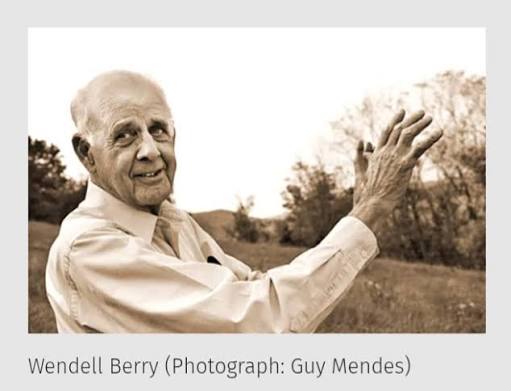
When despair for the world grows in me and I wake in the night at the least sound in fear of what my life and my children’s lives may be, I go and lie down where the wood drake rests in his beauty on the water, and the great heron feeds. —Wendell Berry, “The Peace of Wild Things”
The NYT this evening is reporting the death of Kentucky sage Wendell Berry at his home in Henry County. Earlier this year, I focused on reading his major essay collections and two of his novels.
Berry stridently opposed agribusiness, advocating for family farmers and the sustaining of local communities. He refrained from using farm machinery and chemical fertilizers. Horses and mules, they did the plowing.
Berry had his stubborn ways, nearly Amish in his habits. He wrote his many books in pencil on a yellow legal pad, his wife Tanya typing them up for publishers. He never owned a computer or even a television. His clock was set by sunrise and sunset. In simplicity, he found a happiness that possessions could not give.
He had much to teach us about a way of life that yielded contentment through resourcefulness and the social intimacy of small-town America—a way of life lamentably vanishing in the throes of urbanization, the decline of the family farm, the corporate erosion of local industries, and the flight of young people to the cities.
I remember the America he loved: the small town with its eccentric characters; schoolmates, many from family farms; baseball on the town common; a trip to the big city a major happening; the doctor, with his little black bag, coming to the house; a trip to the barber, a conversation. Families seemed stationary, one generation succeeding another. Faces changed. The surnames remained. This is the America Wendell wrote about.
When hard times came, as inevitably they do, we were there for each other, binding up the wounds. We knew our heroes, and we gladly paid them tribute.
I miss that America. And I will miss Wendell.
He tried to teach us, but we didn’t listen. A voice is silenced, but his wisdom hovers.
Rest peacefully, Wendell, in the dark Kentucky soil you so loved.
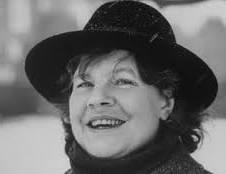
I’ve been reading A. S. Byatt’s Possession, published in 1990 and now hailed as a contemporary masterpiece.
Each year, I compile a carefully chosen list of books I hope to read. Possession was among them, though I can’t quite recall how I first came upon Byatt.
It has turned out to be an inspired choice—a rare literary mystery centered on a scholarly quest to uncover a suspected love affair, pieced together from newly discovered letters between the Victorian poet Randolph Henry Ash, modeled on the married Robert Browning, and poet Christabel LaMotte, inspired by Christina Rossetti.
If such a relationship can be proven, it would mark a major coup for the novel’s modern-day protagonists, Roland and Maud, who join forces to solve this academic puzzle.
I won’t be a spoiler; I’m still reading, mesmerized by Byatt’s creative brilliance. Drawing on her vast knowledge of Victorian literature, she invents letters, diaries, and poems that feel astonishingly authentic—plausible echoes of Browning and Rossetti themselves.
There’s also a compelling counterpoint: as Roland and Maud pursue their literary investigation, they, too, seem to fall in love. And the suspense deepens with rival scholars competing to uncover the same secret.
Possession won the Booker Prize and became an international favorite, translated into more than thirty languages. A film version followed—all of which amazes me, as I wouldn’t have expected a novel so steeped in academia to achieve bestseller status.
Byatt, an academic for many years and fluent in several languages, left teaching in 1983 to write full time. Gifted with formidable imagination, she could also be intimidating in her intellectual precision and resistance to literary fashion. Critic, novelist, short-story writer, and essayist, she produced twenty-five books and, in 1999, was made a Dame Commander of the Order of the British Empire (DBE) for her services to literature.
Her prose is detailed, introspective, and resonant—at times, poetic. More than any writer I’ve read, she possessed an extraordinary gift for mimicry, able to write convincingly in many voices.
I’ve especially liked this passage, though there are many others:
It is a dangerous business, reading of the passions of the dead. We try on their feelings, like garments, and for a moment we seem to stand in their light — and yet, as we close the book, we find ourselves once again alone in our own darkness, aware that our borrowed flame is only memory’s trick.
She is the writer’s writer.
As Jay Parini wrote in his 1990 New York Times review, “Possession is a tour de force that opens every narrative device of English fiction to inspection without, for a moment, ceasing to delight.”
I remember it well. I was a young graduate student, privileged to study under one of the world’s foremost professors of Victorian literature, a renowned authority on Thomas Hardy.
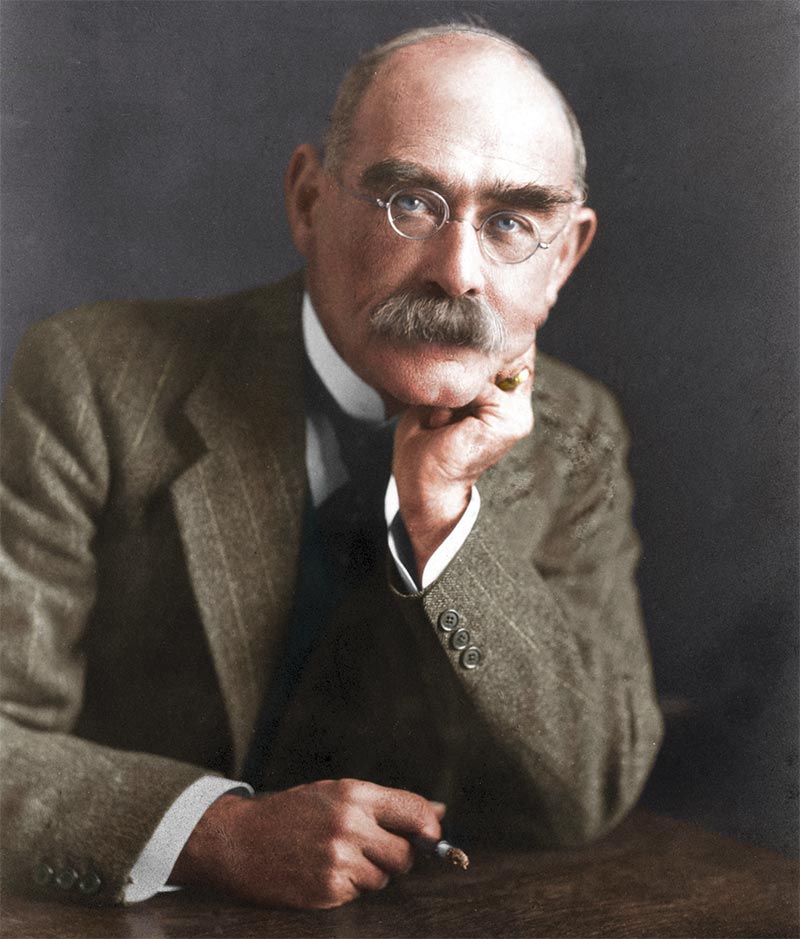
The course was rigorous. We read the greats of the age—Macaulay, Tennyson, Browning, Dickens, Mill, Newman, Arnold, Morris, Ruskin, the Rossettis, Swinburne, Hopkins, Pater, and of course Hardy. Yet strikingly absent was Rudyard Kipling. Our professor dismissed him as the mere voice of imperialist Britain—an attitude then dominant in the Academy, and one I suspect still lingers on American university campuses.
I had never read Kipling. I had not yet learned to question. I accepted what I was told.
It was only later, during a summer course at Exeter College, Oxford, that I encountered another view: one that esteemed Kipling’s literary brilliance without committing the American folly of conflating his politics with the merits of his artistry.
Kipling’s literary range was astonishing. His verse, endowed with rhythmic command, borders on the hypnotic. He opened poetry to colloquial speech and became a supreme craftsman of the ballad form.
Yes, he gave voice to Empire in works like The White Man’s Burden, Kim, and The Jungle Books. But he also revered Indian culture—its spirituality, wisdom, and sensory richness. Often, with subtle irony, he questioned the very order he seemed to affirm.
Perhaps his greatest achievement lies in the short story. With precision and nuance, he crafted narratives of extraordinary compression, modern in their suggestiveness, wide-ranging in their scope. The Man Who Would Be King remains a masterpiece—its sweep and power undiminished. Kipling’s influence on Conrad, Maugham, Hemingway, Borges, and others is beyond doubt.
He was awarded the Nobel Prize in Literature in 1907—the first English-language writer to receive it—honored for his “power of observation, originality of imagination, virility of ideas, and remarkable talent for narration.”
Kipling’s stories, like all enduring art, probe psychological depths. They are complex, skeptical of conventional wisdom, and riveting in their precision.
In today’s multicultural Britain, he is taught in context: his genius as a storyteller acknowledged, his colonial perspective rejected. Lewis, Tolkien, and Pullman have recognized him as a precursor to modern fantasy.
In India, where he was born and spent his early years, his reception is understandably ambivalent: many readers disdaining his imperial condescension, yet acknowledging his literary craftsmanship. Salman Rushdie has called Kim “one of the greatest novels written about India,.” Other Indian writers continue where Kipling left off, offering vivid vignettes of India, but through an Indian prism.
Controversy about his place in the Western literary canon remains. Vladimir Nabokov, in his Cornell lectures, dismissed Kipling for his moralizing, He deemed his indulgence in exotic adventure stories as juvenile. Great literature, he argued, obeys the aesthetic imperative of narrative neutrality, or distance, as in Flaubert and Joyce.
On the other hand, the late eminent Yale critic Harold Bloom came to Kipling’s defense. In his The Western Canon. Bloom lists Kipling among hundreds of writers deserving inclusion in the canon. Bloom saw Kipling as a myth maker and gifted story teller, especially in his short stories. On the other hand, he found his poetry “scarcely bear reading.”
While I find merit in both Nabokov’s and Bloom’s arguments, I lean towards Bloom’s appraisal as more balanced. I have long resisted either/or equations, particularly as to the political or aesthetic. Over a lifetime, I have frequently found reasoned judgment occupies a middle place. I have given my own arguments earlier in this essay for his belonging in the canon.
Whatever a reader’s verdict, Kipling was a singular voice, very much his own man. In short, authentic. As he said in an interview shortly before his death,
“The individual has always had to struggle to keep from being overwhelmed by the tribe. To be your own man is a hard business. If you try it, you’ll be lonely often, and sometimes frightened. But no price is too high to pay for the privilege of owning yourself” (Qtd. in the Kipling Journal, June 1967).