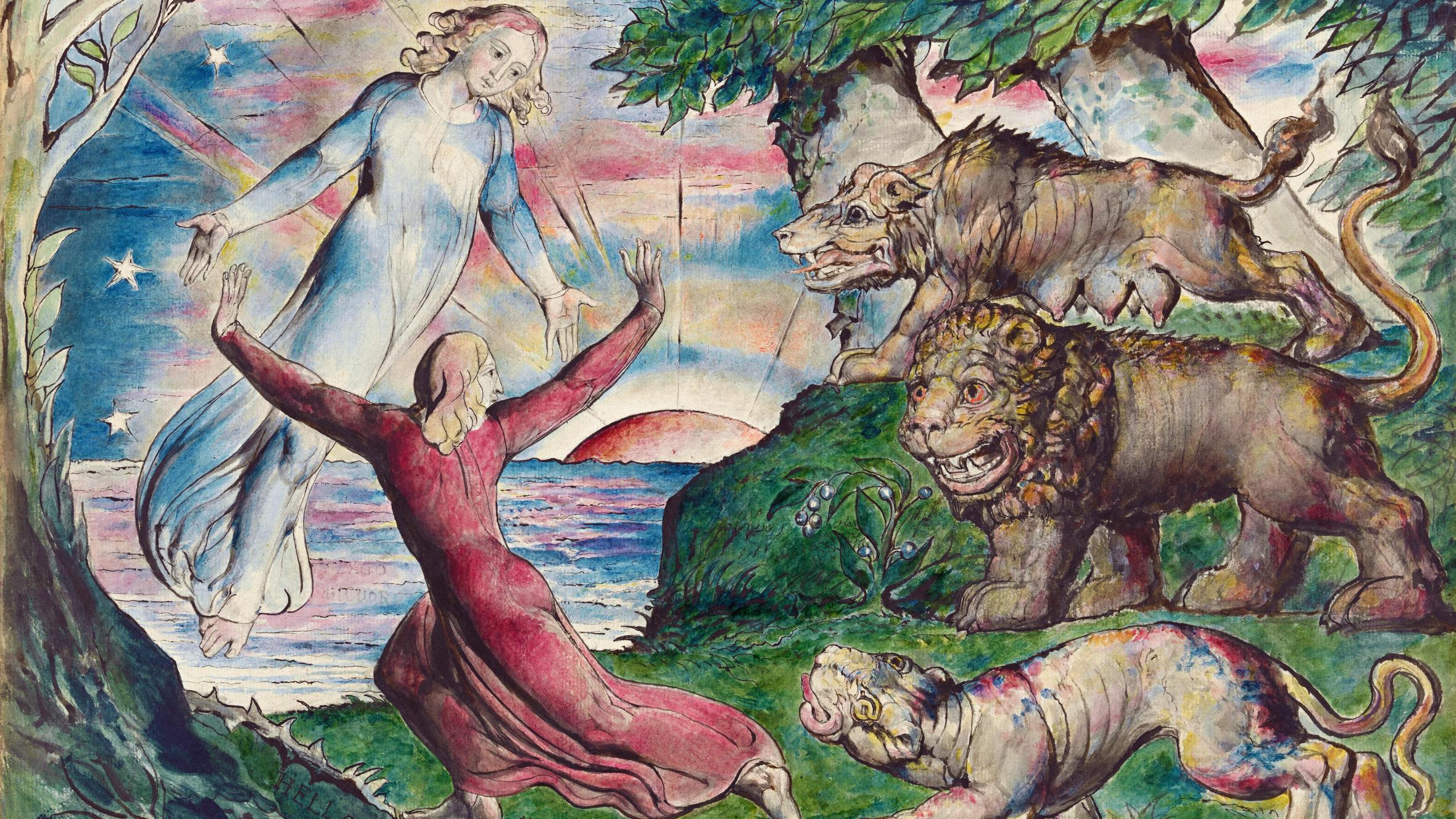
Dante Running from the Three Beasts
Writer and filmmaker Philip Hoare has of this date written ten well-received books of non-fiction, including multiple award-winning Leviathan, or the Whale (2008). His expertise ranges widely as a connoisseur of poetry, painting, and environmental concern. He once rescued a butterfly from a crowded tube platform. Every winter, for twenty-four years, he has traveled from his native Britain to Cape Cod to film and research the few Right Whales that remain.
These eclectic interests repeat themselves in his latest book, William Blake and the Sea Monsters of Love (2025), extraordinary in its telling as a mix of tribute and memoir embedded in seascapes and the long cast of those Blake influenced—among them Mary Wollstonecraft, Mary Shelley, Dante Gabriel Rossetti, Gerard Manley Hopkins, W. B. Yeats, Ezra Pound, James Joyce, T. E. Lawrence, Paul Nash, Nancy Cunard, Iris Murdoch, and Patti Smith. Hoare elaborates at length on each of them.
Readers may find this annoying in a book supposedly focused on Blake, but Hoare sees them as linked to Blake in their radical politics. I found these vignettes intriguing, especially regarding Hopkins, Lawrence, and Murdoch, who I was unaware were bisexual. I had not known that Lawrence translated The Odyssey directly from Greek, or that Blake learned Italian to read Dante’s Divine Comedy in the original.
I did not, however, find most of the vignettes convincing emissaries of Blake’s influence. To have read Blake does not invoke influence; Hopkins, Lawrence, and Cunard loom especially tentative. While Hoare is concerned with seascapes in Blake’s work, that Hopkins’s The Wreck of the Deutschland is situated in an aquatic domain does not evidence Blakean influence by itself. T. E. Lawrence read Blake, but no specific instances of linkage occur in his work. And while Blake abhorred painting landscapes, Nancy Cunard was obsessed with them.
What all these figures share with Blake is not artistic continuity, but their remaining authentic, defiant selves, eccentric in their otherness, endowed with vision, often revolutionary.
Nonetheless, I’m fond of this book, having been drawn to Blake years ago—the genesis of much of my subsequent musings on myth, Carl Jung, and Northrop Frye, whose Fearful Symmetry laid bare Blake’s mythology, handing me a roman à clef to unlock literature’s portals.
I’m biased, I suppose, in sharing Hoare’s radical politics, his fierce accusatory polemic of capitalist transgression, his compassion for the marginalized, and his anxiety for the environment—especially whales, those denizens of the deep that profusely populate Blake’s artistry, emblematic of divine paradox, or contraries: “I form the light, and create darkness: I make peace, and create evil: I the Lord do all these things” (Isaiah 45:7, KJV).
Blake’s renegade politics as a devotee of the French Revolution align with Hoare’s own mindset, reflected in the bestselling 1972 environmental broadside The Blueprint for Survival (known as The Manifesto). Hoare traces its primogeniture back to Blake, who unsparingly critiqued burgeoning capitalism, state religion, and the military. “The prophet against Empire,” as historian David Erdman called him, Blake thundered his radicalism in works like Visions of the Daughters of Albion. He viewed Admiral Nelson not as a hero, but as an emissary of colonialism rife with exploitation.
In 1803, Blake was arrested for sedition after pushing a drunken soldier, John Schofield, out of his Felpham garden. Schofield retaliated by falsely claiming Blake had cursed the king—a charge that could have led to Blake’s execution. Fortunately, local jurors refused to testify against him and the court dismissed the case. This traumatic incident resonated through literary history, ultimately finding its way into James Joyce’s Ulysses when Stephen Dedalus encounters British soldiers in the Circe episode.
The book may be difficult for readers, emerging as much personal memoir as biography. Moving in a semi-stream-of-consciousness style—without chapters or quotation marks—time shifts fluidly from Blake’s Lambeth cottage to the present day. Along the way, tidbits fall like raindrops, yielding passages of sheer poetry: “Always different, always the same. The sea had no limits and neither did he. It promised everything. So did he.”
At times, Hoare comes close to hagiography in his reverence, yet his exuberance proves contagious: “People tell me I get over-excited, as if excitement were rationed. Well, bollocks to that.”
While he gives due credit to patron Thomas Butts and collector W. Graham Robertson for preserving Blake’s paintings, it was W. B. Yeats and John Ellis’s 1893 three-volume study, The Works of William Blake: Poetic. Symbolic and Critical (1893), that restored Blake to modern poetic awareness, probing deep into his multidimensional mythology. Joyce read this work and would later lecture on Blake in Trieste.
One of the book’s bonuses is its photo inclusions of many of Blake’s principal prints, paintings and engravings, a number of them accompanied by delineations of their technique and purpose.
In his lifetime, Blake was largely dismissed as mad for claiming inspiration from the dead. Following the death of his brother Robert at just nineteen, Blake took over Robert’s notebook (often called the Rossetti Manuscript), which is now held in the British Library. Over a lifetime, Blake filled its pages with his own notes and sketches alongside his brother’s.
Hoare does not query Blake’s claims. Whatever the source of his genius, Blake’s imagination is to be celebrated—promiscuous in its daring, defiant of the restraints of reason. What Blake critics so often miss, however, is that his wife, Catherine, whom Blake taught to read, claimed that very same source of inspiration for her own art. Hoare reminiscences holding the notebook in his hands.
He tries on Blake’s steel-rimmed glasses at Cambridge University’s Fitzwilliam Museum, an hour before closing time “to see through Blake’s eyes.”
Across the way, he visits the University Museum of Zoology, housing its massive fin whale skeleton hanging above the entrance and the vast collection of bones, baleen, and marine specimens. Moved, his thoughts shift to Isaac Newton, whose rationalist reductionism Blake angrily dismissed.
Where is the wonder that Blake proclaimed: “To see a World in a Grain of Sand / And a Heaven in a Wild Flower, / Hold Infinity in the palm of your hand / And Eternity in an hour”?
Hoare’s book emerges a moving tribute to Blake, to those who courageously followed in his daring to be himself, to the Earth, infinite, but exploited. If it reads like poetry, it is poetry—direct, passionate, creative, resonant:
You get more for your money with Blake. He’s the Willy Wonka of art, your golden ticket to other worlds. He takes you there by the hand. His generosity is magical and without limits. Blake in fire, in iron, in paint; in ink, in the flesh, in the stars. Like the sea, you can’t be for or against him; he doesn’t give you that choice and he never, ever gives way. In his certainty is his ambiguity. He’s a cloud floating over the ocean, a layer of unknowingness through which new worlds arise. The stars rearrange themselves before your eyes.
—rj
Discover more from Brimmings: up from the well
Subscribe to get the latest posts sent to your email.


