Learning What Is Enough

On winter mornings, before the day has decided what it will become, the fields hold a stillness that feels provisional—frost clinging to the grass, fence lines darkened with damp, the land waiting without impatience. It is a good hour for reading slowly, for choosing words that do not hurry ahead of their meanings.

I have begun the year reading Wendell Berry. Now in his ninety-second year, he continues—more slowly, more deliberately—to farm and to write, unchanged in his fidelity to limits: the authority of place over abstraction, the moral claims of the local over the corporate, tradition understood not as nostalgia but as knowledge earned through use and endurance.

I read him most mornings. His work steadies the day. It does not offer solutions so much as orientation—toward what is given, what is sufficient, and what must be borne. Berry has always made room for joy, but never without sorrow, nor for hope without the acknowledgment of failure, including one’s own.

Some of his most influential prose appeared early, when his voice was still finding its public footing. The Long-Legged House and The Unsettling of America argued, quietly and insistently, that culture and agriculture are inseparable, and that when land is treated as commodity rather than community, both soil and people are diminished.

I return often to his poetry, especially A Timbered Choir: The Sabbath Poems. Written on Sundays and largely free of polemic, these poems are acts of attention. They move patiently through the stages of a human life—birth, labor, love, diminishment—offering a sacramental vision of ordinary days lived close to the ground. Among them is Berry’s most widely known poem, “The Peace of Wild Things,” whose calm acceptance of life’s ephemerality offers not escape from anxiety, but release from the burden of false mastery:

“I come into the peace of wild things who do not tax their lives with forethought of grief.”

The peace the poem offers is not consolation so much as proportion. Its discipline lies in relinquishing the anxious reach into the future and reentering creaturely time—where life is finite, local, and sufficient.

That same discipline governs Berry’s essay “Why I Am Not Going to Buy a Computer,” first published in 1987 and often misread as a rejection of technology itself. It is instead a meditation on the moral weight of tools. Berry does not deny their usefulness; he questions their claims. Certain technologies, he suggests, quietly privilege speed over deliberation and convenience over care, reshaping habits of attention until efficiency becomes an unquestioned good.

The good life, in Berry’s accounting, is not optimized. It is inhabited. To live well requires learning the difference between what is necessary and what merely promises ease.

Barbara Kingsolver, another Kentuckian, names this work plainly when she writes:

“I consider it no small part of my daily work to sort out the differences between want and need. I’m helped along the way by my friend Wendell, without his ever knowing it. He advises me to ask, in the first place, whether I wish to purchase a solution to a problem I don’t have.”

Berry’s essay is not finally about computers at all. It is about scale and consequence. It asks not simply what a tool can do, but what it may undo—what forms of patience, responsibility, and mutual care it quietly displaces. It asks how our choices shape our relationships to family, to community, and to the land that sustains both.

Berry still writes with pencil on a yellow legal pad. He still farms, though within the limits age imposes. He still publishes—new poems, even a recent novel. The persistence itself feels instructive.

In a culture bent on expansion and acceleration, Berry’s life suggests another measure of success: fidelity to place, restraint in use, and the long patience required to learn what is enough.

—rj


Why Wendell Berry Still Matters

I’ve been absent from Brimmings for nearly a week, recovering from a serious bout with the flu—the fever lingering for ten days. A chronic cough remains my daily companion.

That hasn’t stopped me from reading—slowly, attentively—six books already this year.

As I’ve previously shared, alongside my annual eclectic reading list, I’ve committed to a topical approach to reading as a way of resisting intellectual grazing and cultivating sustained attention (Topical Reading). I’ve begun with Kentucky sage Wendell Berry, now in his ninety-second year.

I didn’t want to one day come upon his obituary and feel the guilt pangs of having neglected an agrarian pacifist, a champion of the local, often described, without much exaggeration, as America’s “moral conscience.”

Berry has farmed a 125-acre hilly tract adjacent to the Ohio River at Port Royal in Henry County, Kentucky, for more than forty years. Farming, for him, is not metaphor but moral practice. As he writes, “The care of the Earth is our most ancient and most worthy, and after all our most pleasing responsibility.”

Academically, Berry is no lightweight: a BA and MA in English from the University of Kentucky, a Stegner Fellowship at Stanford, and a Guggenheim that took him to Italy, he taught briefly at New York University before returning—against the counsel of colleagues who believed he was jettisoning a promising academic career—to rural Kentucky and the family farm.

They were wrong.

Berry has since written more than fifty books spanning essays, novels, and poetry. His great theme is stewardship—not management or control, but reverent care. “The idea that people have a right to an economy that destroys nature is a contradiction,” he writes, insisting that economic life must answer to ecological reality.

For the farmer Berry, stewardship begins with the soil: an antipathy to chemicals, a reverencing of the biosphere, and a life lived according to natural rhythms. He is deeply opposed to industrial agriculture, which he regards as a cultural as well as ecological calamity: “Industrial agriculture is not just bad for farmers; it is bad for land, for rural communities, and ultimately for culture.”

Among American environmental writings, the two most salient works I’ve encountered are Thoreau’s Walden (1854) and Rachel Carson’s Silent Spring (1962). Thoreau’s aphoristic brilliance lends itself to endless quotation: “Our life is frittered away by detail… Simplify, simplify,” while Carson’s prose approaches poetry. Her opening paragraphs of Silent Spring remain, to my mind, the finest in environmental literature, exposing the arrogance behind what she called “the control of nature, a phrase conceived in arrogance, born of the Neanderthal age of biology and philosophy.”

I’m only in the early stages of getting acquainted with Berry, but he keeps distinguished company with Thoreau and Carson in his passion for preserving nature’s bounty and the pulchritude of a simplified life lived in fidelity to place and community.

In this sense, Berry reaches back to Thomas Jefferson, whom he quotes more than any other figure: “In my own politics and economics I am Jeffersonian.” Jefferson believed liberty was best secured in small, decentralized communities of independent producers, warning that distant power—whether governmental or economic—inevitably corrodes responsibility and freedom.

Though Berry was an activist who vehemently opposed the Vietnam War and has voted Democratic, his politics resist easy classification. He has lamented that America’s two major parties have grown increasingly to resemble one another.

There may appear, at first glance, to be overlap with libertarianism—his opposition to big government, military expansion, and imperial intervention—but the resemblance is superficial. Libertarianism exalts the autonomous individual; Berry emphasizes communal obligation. “We do not have to sacrifice our economic well-being in order to act responsibly toward our land and our neighbors,” he writes. “Rather, we must do so in order to preserve our economic well-being.”

Berry has his critics. His suspicion of technology strikes some as untenable in a hungry, overpopulated world. Can an aggregate of small family farms feed a wired and burgeoning global population, particularly in parts of Africa?

I find myself grappling with his apparent parochialism. Only a tiny fraction of Americans now farm. What of the rest of us who earn our livelihoods elsewhere? And in an interconnected age, can the local truly stand apart from the global?

Berry would respond that the issue is not technology itself, but dependence. “There is a difference between being technologically advanced and being technologically dependent,” he reminds us—a distinction too often elided in contemporary debates.

Ironically, Berry would fit comfortably in an Amish community. He still plows with horses. He owns no computer, television, or mobile phone, and has no internet access. He writes first in pencil, then types. He uses electricity sparingly, supplemented by solar panels, and his writing studio is without electricity. He walks the talk, living a life rooted—quite literally—in the land. Thoreau would have approved.

An iconoclast, Berry remains well worth reading. Growth, he reminds us, is not synonymous with the earth’s welfare. Economies, like soils, can be exhausted. Big government and industrial systems, he argues, erode local responsibility, foster dependency, and inflame military and international tensions. Rural poverty in places like Appalachia persists, in his view, because urban prosperity has been purchased by the plundering of these regions.

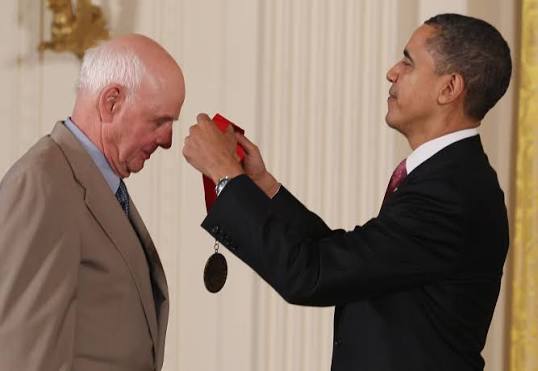
In 2013, President Barack Obama awarded Berry the National Humanities Medal.

In 2015, he became the first living writer inducted into the Kentucky Writers Hall of Fame.

That same year, the Library of America published a boxed set of his work—an honor accorded to only two living American writers at the time.

Berry may be impractical. He may be impossible to scale. But he leaves us with an uncomfortable and necessary reminder: care, once abandoned, is not easily restored—and neither are the land, the culture, nor the communities that depend upon it.

—rj

Convergence: Seeing Others as Ourselves

I’ve been keeping a list for some time of my favorite blogs. There are so many to choose from that discovering one capable of sparking genuine enthusiasm often feels like chance—like gazing nightly at the starry heavens and marveling at what lies beyond human reach. When such a blog does appear, it draws me back again and again, not out of habit but wonder.

Relying on that list, I came upon a short paragraph-poem this morning by Dr. Drew Lanham, the award-winning African American professor of environmental studies at Clemson University. Lanham confesses to being “a man in love with nature—a wanderer finding foundation in wild places.” What follows is both intimate and expansive:

Handle my life in your hands as if it were your own. Feel the heart beating—small as it may be—and imagine it in your own chest. Beating in syncopated time to become shared meter. That pulse, the breathing, is your rhythm. Your in’s and out’s, its in’s and out’s. Look close under
whatever warty skin or soft fur or gaudy feathers and see self. Its being is your being. Be in that same skin for what moments it will allow. Then, when the convergence between you is sealed, release that wild soul to free roaming as you would desire of your own.

What strikes me is the poem’s quiet tone: a persona grounded in kinship with the natural world, alive with empathy for the vulnerable. Applied beyond nature—to our fellow humans—it gestures toward something transcendent: a way of bridging difference, whether of creed, ethnicity, or race.

Such bridging begins only when we recognize our linkage, when we are willing, even briefly, to see ourselves in others—“Be in that same skin for what moments it will allow.”

Lanham wrote this poem after rescuing a frog from his cat’s pursuit.

Not Without Consequences: Trump Rolls Back Biden’s Gasoline Mandate

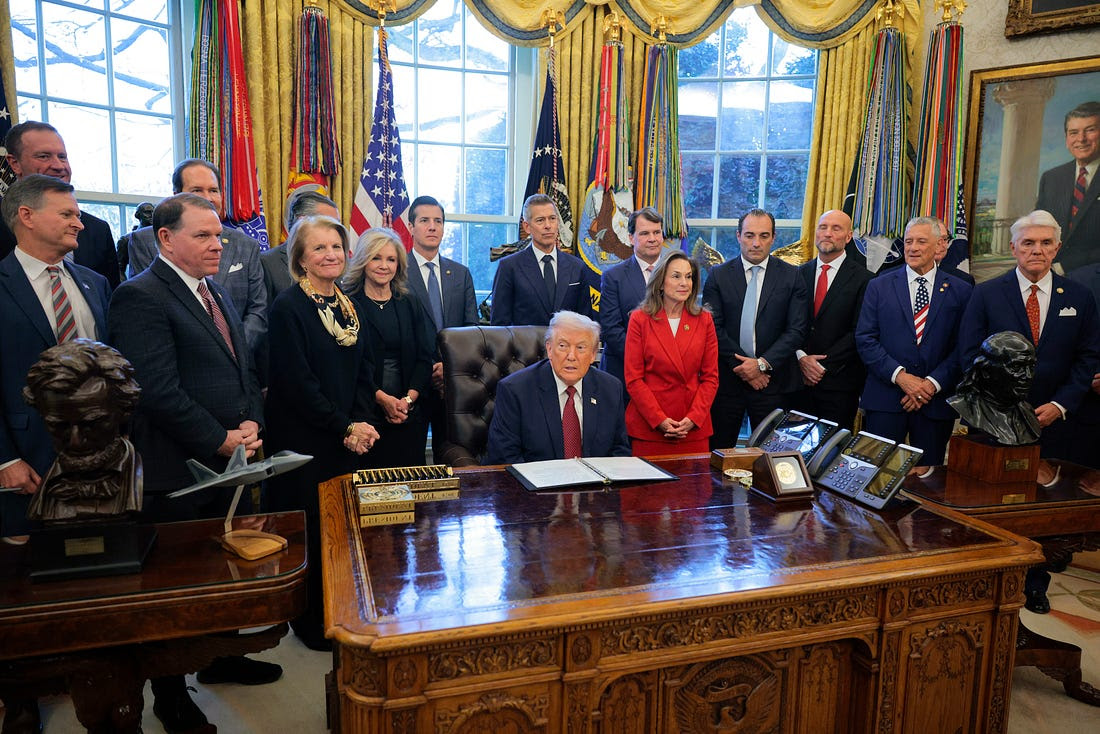
One of Trump’s ugliest moments as President, and there have been far too many, occurred yesterday when, surrounded by applauding auto executives, he rolled back Biden’s 50 mpg gasoline mandate to 35 mpg by 2031, assuring along with suspension of tax credits, the death of electric vehicles in the U.S.

This can only mean more trucks, more SUVs. And—yes—more carbon discharge, escalating ocean temperatures already soaring, the disruption of marine life, and rising seas as the Alaskan Arctic and Antarctica glaciers continue to melt.

In the meantime, what a boon all of this is to China’s burgeoning EV sales in world markets that includes Europe as well as Africa, Asia and Oceania, some models selling in the $10,000 dollar range. China now is a majority stock holder in Volvo.

But Trump thinks climate change is just a hoax, despite overwhelming scientific evidence to the contrary, declaring on signing the bill into law that climate change is “the greatest scam in American history, the Green New Scam a quest to end the gasoline powered car. This is what they wanted to do even though we have more gasoline than any other country by far.”

What Trump has just done will have its consequences, the best estimates of media and environmental groups informing us that under the earlier standards, gasoline consumption would have been reduced by 14 billion gallons by 2050: Long term, more drought, more forest fires and, ominously, the dissolution of ocean currents fundamental to mammal well-being, which includes ourselves.

Trump’s lackeys argue the president’s bill is a boon to consumers, reducing car prices by a projected $1000, as if that’s going to dent a stagnant auto market, the average vehicle price now $50,000 and faulting on auto loans at a record high.

Mind you, this is just empty rhetoric when it comes to curbing inflation, The truth is the president’s tariffs potentially increase builder costs from $7,500 to $10,000 per home, with every $1,000 increase in the median price of a new home pricing out roughly 106,000 potential buyers, according to the National Home Builders Association.

Along with rising home prices, this president’s hysteria when it comes to renewables is costing you monthly electric bills averaging 12% over those of 2024, all of which means less disposable income, and fated to impact low wage households the most.

But back to CO₂, pollutants from tailpipe emissions like nitrogen oxides (NO), volatile organic compounds (VOC), and particulate matter hasten poor air quality and generate respiratory health issues as well.

Trump gets none of this. He runs government as a business, reaping profits for himself and family members. A derelict president, he’s more absent than present in the Oval Office, this fiscal year thus far, spending $371 million dollars on flights at tax payer expense to play golf at his Florida haven, Mar-a-Lago.

Off message as usual, he used the occasion to assault Minnesota’s Somali community whom, the day before, he called “garbage.” Today, it was “they had “destroyed Minnesota” and “destroyed our country.” The “Somalians should be out of here.”

If I asked you what was the fastest warming area of the U.S. outside of Alaska, would it surprise you that it’s New England, where I was born and raised in my early years? The winters I knew as a child are filled with memories of frequent snow fall, frozen lakes, hockey, sledding, skiing, and maple syrup.

Weather experts report New England “has heated up by 2.5C (4.5F) on average from 1900 to 2024, far in excess of the global average, with the world warming by around 1.3C due to the release of heat-trapping gases from burning fossil fuels” (The Guardian, 4 December 2025).

That’s a shocking increase and may prove a portent of what lies ahead. The UN and climate experts have set a maximum goal of 1.5°C (2.7°F) of warming above pre-industrial levels as the threshold, above which we reach the tipping point of near impossible reversal.

Meanwhile, Trump ignores the coming apocalyptic fallout of unrestrained fossil fuel policy, eco systems destroyed, famine common, forest fires ubiquitous, unbearable heat, polluted air, whales and elephants reduced to children’s picture books.

In sum, the Trump administration’s assault on the environment in the context of exponential climate change exhibits all too well the earmarks of corporate denial in the pursuit of monetary gain, whose consequences none of us will escape.

A nation can survive incompetence; what it cannot survive is deliberate blindness to the world burning at its door.

–RJ

The Amazon, COP30, and Our Vanishing Future

It has barely made the headlines, but the UN’s COP30 climate summit is now underway in Belém, Brazil. COP—the Conference of the Parties under the UN Framework Convention on Climate Change—has met annually for three decades, each gathering framed as another decisive moment for the planet.

More than 100 American environmental leaders are in attendance. Missing, however, is President Trump, who still calls climate change a “hoax.” His absence is symbolic, but not surprising: it reflects a larger political reluctance to acknowledge the crisis unfolding around us.

Even among nations that accept the science, there is growing tension between the high costs of climate mitigation and the competing pressures of social needs. Yet this framing—climate action versus human welfare—is a false narrative. Climate disruption is already degrading food systems, water security, economic stability, and public health. Inaction is the costliest option of all.

COP’s central mandate is clear: limit global temperature rise to 1.5°C above pre-industrial levels, as pledged in the 2015 Paris Agreement. Countries submit national climate plans (NDCs), augmented every five years. But despite the Agreement’s “ratchet mechanism,” current projections put us on track for 2.5°C to 3°C of warming by century’s end.

At those levels, the world becomes unmistakably harsher: failing crops, drying rivers, rising seas, disappearing species, and regions becoming uninhabitable under extreme heat. And nowhere is the alarm more urgent than in the Amazon Basin.

I’ve been studying this region for years, most recently through an eight-week online course under the auspices of the University of São Paulo.

The Amazon is not merely a forest—it is one of Earth’s greatest climate regulators. Spanning more than seven million square kilometers and home to an extraordinary share of the planet’s animals and plants, it stores 150–200 billion tons of carbon in its intact ecosystems. It cools the continent, generates rainfall, and sustains the livelihoods of millions.

But the Amazon is weakening under relentless human encroachment: logging, mining, agribusiness, hydroelectric projects, roads, railways, and shrinking indigenous territories. Fourteen percent of its pristine forest has already vanished; another seventeen percent is degraded.

Scientists warn that if deforestation—now around 14–17%—reaches 20–25%, the forest may tip into irreversible decline, releasing vast stores of carbon and destabilizing global climate systems, including the Atlantic ocean currents that moderate Europe’s weather.

This would be more than a regional tragedy. It would be a global catastrophe.

The people with the most to lose are those who have protected the forest the longest. When Europeans arrived in 1500, 8–10 million indigenous people lived throughout the Basin. Today, only about 2–2.5 million remain, yet they still speak 300 languages across more than 400 groups. Their 12,000-year history of sustainable land management is one of humanity’s greatest environmental achievements—and one of its least respected.

Meanwhile, fossil fuel interests continue drilling and recording historic profits. Their influence hangs heavily over every climate summit, often shaping negotiations more than science does.

This is the dangerous paradox at the heart of COP30: we gather each year to declare urgency, even as our actions fall fatally short of what the moment demands.

The Amazon is nearing a threshold from which we cannot retreat. The window for preserving a habitable planet is still open, but narrowing fast. What we need now—what COP30 must deliver—is not another set of distant promises but a global commitment to end deforestation, accelerate renewable energy, and center indigenous stewardship.

The science is clear. The stakes are overwhelming. What remains uncertain is our political will.

If the world cannot act decisively now, in Belém—on the doorstep of the very forest that helps stabilize the Earth—then when?

—rj

A Candle Has Gone Out: The Legacy of Jane Goodall

It’s with profound sadness I learned yesterday of primatologist Jane Goodall’s death at age 91.

Blessed with remarkable genes, she lived life with zest up to the very last, tirelessly traveling across international landscapes to raise funds for her Jane Goodall Institute in Tanzania, founded in 1977.

I read her NY Times obituary, but it falls short in evaluating the plenitude of her achievement and its significance for all of us. I learned some time ago that the NYT composes many of its obituaries in advance, ready-to-go like a frozen pizza.

It doesn’t take into account her devotion to the Tanzanians among whom she worked for sixty years, as earnest for their welfare as she was for chimpanzees, humanity’s closest relatives, possessed like us with dual capacity for good and evil.

She gave early warning of climate change as an eyewitness of its exponential ravages in Africa, the front line of its advance.

You can learn much of what she accomplished through reading among her many books The Shadow of Man or A Reason for Hope of her work in Africa, breakthroughs in science, and personal beliefs, some of them controversial such as her advocacy of birth control availability to help African families limit their family size. Tanzania is second among Africa’s 54 nations in population growth. With a present population of 68 million, its projected 2100 population will swell to 283 million, imperiling its subsistence resources.

Goodall had faced an uphill climb in winning acceptance among male scientists, stubbornly suspicious of any woman’s achievement in investigative research. Initially, when setting out for Africa, she had been a waitress and secretary. A wealthy donor, however, recognizing her brilliance, provided the funding for a Ph.D. in ethology at Cambridge University, Goodall one of the rare individuals to directly achieve a Ph. D., not having been an undergraduate.

I confess to a personal attachment to Goodall who, like me, suffered from lifelong prosopagnosia, a neurological disorder inhibiting one’s ability to recognize faces.

Currently the fate of her African investment, employing thousands of Tanzanians, remains under unrelenting threat with population growth, agricultural expansion, deforestation, fragmented forest, habitat loss, logging, and lack of consistent government enforcement of land use laws; not least, the volatility of donor contributions on which the work depends, collectively posing a Sword of Damocles hovering over its future.

There remain just 2300 chimpanzees throughout Tanzania, with an estimated 90 to 100 in Gombe National Park, the site of her research. Those numbers are down from the original 150 as elsewhere in Tanzania, bush meat remains a frequent staple despite its health risks. AIDS had its origin in Africa, consequent with eating chimpanzees harboring the Simian Immunodeficiency Virus (SIV). Goodall was a committed vegan, ardently opposed to factory farming.

Also contributing to their demise is ever expanding human encroachment.

A friend of animals, champion of Mother Earth, always with passion and never without hope, Dr. Goodall is in my pantheon of heroes, her many awards including the Presidential Medal of Freedom (USA), the Steven Hawking Medal of Science for Communication, and designation as Dame Commander of the Order of the British Empire (DBE).

Acknowledging her advanced age, she approached death as her “next great adventure. When you die, there’s either nothing, it’s the end, or there’s something. And things have happened to me in my life that I feel there is something. And if there is, I can’t think of a greater adventure than dying.” 

I wish I lived in a world which lowered its flags in tribute to Dr. Goodall:

”Somehow we might keep hope alive—a hope we can find a way to alleviate poverty, assuage anger, and live in harmony with the environment, with animals, and with each other,” she wrote.

A candle has gone out and I feel lonely and in a dark place.

rj

Sheer Lunacy: Trump’s Assault on the Environment

The Trump administration’s assault on the environment in the context of exponential climate change exhibits all too well the earmarks of corporate denial in the pursuit of monetary gain that will reap catastrophic consequences.

When Rachel Carson’s Silent Spring appeared in 1962, it moved two presidents to take action, Kennedy ordering an investigation of pesticide use and Nixon founding the Environmental Protection Agency.

Unfortunately, Trump’s EPA version bears little resemblance and to chart his myriad changes would try your patience.

I confess to being an environmental zealot. I read eco literature vividly, keep up with the latest happenings, donate regularly to environmental groups.

I support protecting endangered species like the whooping crane, manatee, blue and finback whales. I accept evolution’s tapestry of a variegated offspring, reaping the legacy of successful adaptation over vast aeons of time, our human presence but a wink by comparison.

I do not subscribe to the administration’s either/or assumption of jobs vs. environment. On the contrary, abundant studies show commitment to the Green New Deal would inaugurate new technologies and promote GNP growth. According to a University of Massachusetts study, commitment to a climate jobs program would generate 1.5-2 million net jobs annually for a decade (Pollin et al.).

Trump and his lackeys ignore such research. They are of a stubborn mindset, devotees of fossil industry interests,

Recently, this administration waived thirty environmental and public health studies in pursuit of building a wall through the Lower Rio Grande Valley National Wildlife Refuge, placing endangered species habitats and ecosystem corridors in jeopardy.

Meanwhile, they’ve slashed the EPA budget by 65%, cancelled or unenforced dozens of environmental rules, opened the Arctic National Wildlife Refuge and US coastal waters to oil drilling, slated public lands with their indigenous monuments for auctioning, and severely reduced national park staffing.

As for the Endangered Species Act, this administration has compromised it to allow for economic considerations. Good-bye, my beloved manatees, the Everglades, Yosemite as we once knew it in its pristine beauty,

As Rachel Carson reminds us, “Beauty — and all the values that derive from beauty — are not measured and evaluated in terms of the dollar.” (Lost Woods).

Addendum:

Yesterday, my heart quickened as Dee Dee and I drove into Lexington, honked our horn at several groups of Trump protestors gathered along the way, who exuberantly reciprocated our waves.

We learned we’re not alone.

Collectively, it is our duty to resist.

RJ

Nature Isn’t All Butterflies

I want to step back from writing about politics, at least for now. We all have our views, and too often—much like professing religious beliefs—we run headlong into barbed-wire intolerance.

Some find distraction, even intoxication, in endless hours of media; others in sports; still others in hobbies that bring both pleasure and mastery—or in the familiar solace of alcohol.

I prefer reading, not just any kind, but what helps me grow and be more aware I’m not alone. Lately, it’s been nature memoirs, especially like H is for Hawk. I want to get back to my beloved Thoreau and not least, Wendell Berry. I miss Tolstoy.

Of course, we shouldn’t extract from nature what really derives from our imposed views such as we find in Wordsworth’s poetry. Nature, as writer James Rebank reminds us, “isn’t all butterflies, sunshine and healing.”

Still, whenever I step outside the human world, there descends this quieting solace, and I think myself made whole again.

rj

An Owl’s Story: Carl Safina’s Alfie and Me

There exist those books you wish wouldn’t end. Carl Safina’s Alfie and Me: What Owls Know and Humans Think was that kind of book for me.

I had read Safina’s excellent View from Lazy Point several years ago, impressed with its detailed oberservations of wildlife and an arctic indigenous community across four seasons. That same concern for indigenous well-being and the plight of animals in a changing world continue with Alfie and Me.

Safina, a widely published ecological author and Endowed Professor of Nature and Humanity at Stony Brook University, is an expert in marine biology and recipient of many honors, including a MacArthur Fellowship, sometimes dubbed “the genius grant.”

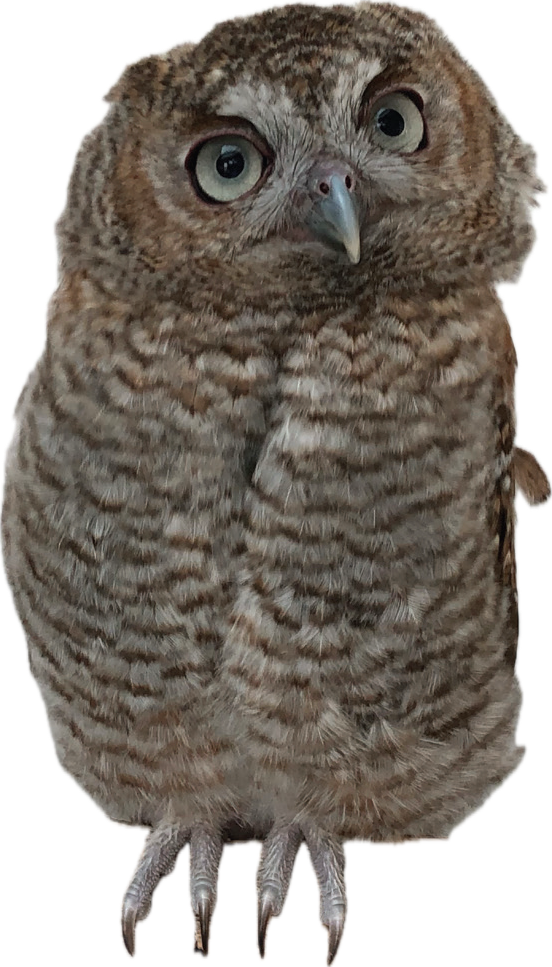
In all his writings, Safina’s focus is on how humans relate to nature, a theme manifestly central to Alfie and Me, chronicling the story of an orphaned Eastern screech owl found in Safina’s Long Island backyard in 2018. Over the course of eighteen months, Safina and his wife, Patricia, nurtured the owl—whom they named Alfie—until her eventual release, creating a rare, intimate portrait of interspecies connection and nature’s resilience.

Safina becomes nearly a helicopter parent, monitoring Alfie’s daily development, torn between fostering her independence and protecting her from the harsh realities of the wild: “… I knew—as she did not—the relative meaninglessness of a life without risks.” An estimated two thirds of young screech hours die shortly after leaving their parents’s nest.

I found myself anxious for Alfie’s survival. Would she learn to fly, to hunt, to mate? Could she survive storms, drought, and the many predators that lurk in her world?

Species survival today depends not only on healthy ecosystems, but increasingly on humans recognizing their relationship with nature as essential to mutual survival.

Safina criticizes Western philosophy for severing this connection, beginning with Plato’s split between the material and spiritual worlds—deeming the material inferior and ultimately fueling nature’s exploitation: “Plato and his followers were perhaps the first people to feel revulsion toward the world. By forever separating our material world from the realm of perfection, Plato propounded a stark dualist doctrine,” Safina says.

For Safina, “This might be the most consequential idea in the history of human thought, its implications almost literally Earth-shattering. Most fundamentally, we are left with: an existence at odds with itself.”

Descartes and Bacon subsequently embodied a modern mechanistic view of nature, oblivious to nature’s sanctity and evolutionary intelligence, leading to its objectification. “The great blindness of the West is to grope the world as inventory,” Safina writes.

In contrast, Safina draws richly from Eastern traditions, which emphasize the unity of all life and the reverence owed to the source from which we came. Although his book is replete with references to Hindu, Buddhist, and Taoist thought, he finds Confucianism especially compelling for its focus on relationships.

Safina also turns to Indigenous cultures as contemporary models of living in harmony with nature. Their ways often involve mindful observation and sustainable stewardship rooted in mutual respect: “For most of human history, Native peoples, more intimate with their existence than we with ours, perceived that Life and the cosmos are mainly relational,” Safina says.

Reading Alfie and Me, I couldn’t help but think of the estimated one billion birds projected to die globally in 2025. According to the Audubon Society, North America alone has lost 25% of its bird population since 1970—about 3 billion birds. Contributing factors include climate change, deforestation, pesticides, habitat destruction, urban structures, insect decline, and free-roaming cats.

Safina’s book appeared in 2023, or before the current avian flu outbreak, which over the past 18 months has led to the confirmed deaths of millions of wild birds in North America—many of them common backyard visitors. The virus has now reached poultry as well, despite the culling of over 166 million birds. A future in which birds no longer sing at sunrise, once unthinkable, now feels disturbingly plausible.

This avian decline is largely human-made, driven by an economy that prioritizes profit over preservation

Why write about birds, some might ask. Shouldn’t human needs come first?

Safina answers with the words of Catholic monk Thomas Merton: “Someone will say you worry about birds: why not worry about people? I worry about both birds and people. … It is all part of the same sickness, and it all hangs together.”

Alfie and Me is not only a poignant narrative about an orphaned owl, but also a powerful meditation on our shared existence, affirming Safina’s truth: “that no isolated separation is possible. We are participant members in one existence—of life, of the cosmos, of time.”

–rj

Trump Environmental Rollbacks: Travesty in the Making

The Trump administration is accelerating its broad assault on environmental protections and climate change mitigation, putting both public health and the planet at risk. It began with the U.S. withdrawal from the Paris Climate Agreement, a pact signed by 200 nations.

Dismantling Biden’s Inflation Reduction Act, Trump has rolled back roughly 125 environmental policies in just two months, issuing executive orders to expand oil and gas drilling on public lands and increase logging in national forests.

Meanwhile, 1,600 workers have been cut from the National Oceanic and Atmospheric Administration (NOAA), undermining critical weather forecasting and public safety.

Aid to developing countries for green initiatives, once provided through the International Partners Group, has been halted.

FEMA, responsible for disaster relief, is under review.

The Environmental Protection Agency (EPA)—established by Richard Nixon in response to Rachel Carson’s Silent Spring—has pivoted to pro-fossil fuel advocacy. Forget about EVs, charging stations, or clean energy incentives.

It doesn’t stop there. Reuters reports today that the Department of Energy is considering slashing millions in funding for two major carbon capture projects in Louisiana and Texas. These projects, once fully operational, could remove an estimated two million metric tons of carbon annually.

Long standing congressional mandated legislation such as the Clean Air Act, the National Environmental Policy Act, the Clean Air Act, the Endangered Species Act, the Noise Reduction Act, and the Endangered Species Act face Trump’s bludgeoning. The courts must act to stop the carnage.

All of this comes as the world falls short of its pledge to limit warming to 3.6°F (1.5°C) above pre-industrial levels.

Trump, of course, remains unbothered. He has long dismissed climate change as a “hoax.”

Unfortunately, we will all pay an incalculable price for electing a renegade despot, mindlessly sabotaging the public’s welfare and our children’s future.

—rj