Culture as Reenactment: Wallace Stevens, UNESCO, and the Fate of Living Traditions

Recently I posted my personal reading of Wallace Steven’s “Sunday Morning,” exploring what might replace religious transcendence once belief dissolves. Stevens’ answer is not despair but immanence, the sufficiency of the natural world, apprehended through the shaping power of imagination.

Yet it is not only religion that now shows signs of erosion. Embedded cultures, those dense inheritances that confer identity through their singularity, are likewise under strain.

In an increasingly global village, accelerated by digital transmission, the world assumes a more monocultural cast, often shaped by the diffuse reach of corporate and algorithmic influence. Against this drift, UNESCO convenes its Intergovernmental Committee each year to review additions to its Intangible Cultural Heritage lists.

Among these is the Urgent Safeguarding List, devoted to imperiled dialects, ritual songs, oral epics, and traditional crafts, forms of life whose disappearance would constitute not mere loss, but erasure.

We are inclined to think of culture as something we visit: a museum, a concert hall, a staged performance. But culture, more fundamentally, is not exhibition but enactment, a way of life sustained through repetition. When cultural memory vanishes, what is lost is not simply artifact but identity itself, as irreplaceable in its domain as the disappearance of elephants, lions, or polar bears from the natural world.

Meaning, then, is not merely conceived; it is made. It inheres in what a people does repeatedly, across time. Imagination, Stevens’ great theme, does not operate in abstraction alone; it is embedded in language, craft, music, and ritual. Culture is the accumulated expression of that imaginative labor.

I am no anthropologist, nor a specialist in indigenous societies; yet it is difficult to ignore the accelerating pressures placed upon such cultures, systems of knowledge refined over centuries of intimacy with specific environments, often encompassing ecological and medicinal understanding that modern systems only belatedly recognize.

Missionary activity, whatever its intentions, has frequently contributed to cultural leveling, supplanting local cosmologies with imported belief systems. Likewise, the expansion of agribusiness, mining, and deforestation, whether in the Amazon Basin or regions such as Papua New Guinea, has disrupted not only ecosystems, but the cultural worlds entwined with them.

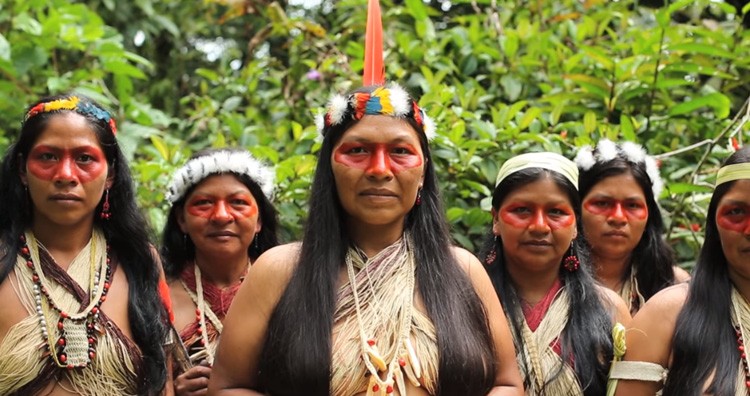
The history of the Waorani in Ecuador offers a particularly stark instance. In 1956, a group of missionaries, including Jim Elliot, made contact with a people then labeled “Auca,” a Quechua term meaning “savage.” The encounter ended in violence, an event long framed as martyrdom but more plausibly understood as the defense of a bounded world.

Subsequent missionary and governmental incursions encouraged the Waorani to settle in centralized villages, disrupting their semi-nomadic, kin-based lifeways. The introduction of Christianity and Western norms altered not only belief, but social organization itself.

These transformations deepened with the discovery of oil. Companies such as Texaco, along with the state firm Petroecuador, initiated exploration and drilling across Waorani territory. Roads penetrated previously isolated tribal habitat, bringing loggers, settlers, and a cash economy. Environmental degradation followed: oil spills, polluted waterways, and the decline of flora and fauna, some unique to the region.

Cultural consequences were no less profound. Native language use diminished; oral traditions weakened; customary practices eroded. Some Waorani communities entered agreements with oil interests, while others resisted. Still others, the Tagaeri and Taromenane, remain in voluntary isolation, defending their autonomy with increasing difficulty.

In effect, a territory once lived as its own world has been recast as resource. Missionaries sought to save souls; governments and corporations sought to extract value. The result has been not only cultural change, but a destabilization of the very conditions under which meaning is made.

To read the Waorani encounter alongside Wallace Stevens and UNESCO is to see more clearly the stakes of each. Stevens imagines that, in the absence of transcendence, meaning may be remade through attentive presence to the world.

UNESCO seeks, more cautiously, to preserve the practices that make such meaning possible. The Waorani experience, however, reveals that these practices are neither secure nor easily restored. They can be fractured by missionization, by development, by the redefinition of land itself.

What follows is not silence, but improvisation. Meaning persists, though not intact: a continual effort to live coherently amid altered circumstances.

If Stevens offers a philosophy of immanence and UNESCO a strategy of cultural continuity, the Waorani expose their shared vulnerability, as meaning clings precipitously to practices that can be weakened, displaced, or undone.

For indigenous cultures like that of the Waorani, what is at stake is existential: the vanishing of a way of life, uniquely intelligible to those who inhabit it.”

—RJ

The Amazon, COP30, and Our Vanishing Future

It has barely made the headlines, but the UN’s COP30 climate summit is now underway in Belém, Brazil. COP—the Conference of the Parties under the UN Framework Convention on Climate Change—has met annually for three decades, each gathering framed as another decisive moment for the planet.

More than 100 American environmental leaders are in attendance. Missing, however, is President Trump, who still calls climate change a “hoax.” His absence is symbolic, but not surprising: it reflects a larger political reluctance to acknowledge the crisis unfolding around us.

Even among nations that accept the science, there is growing tension between the high costs of climate mitigation and the competing pressures of social needs. Yet this framing—climate action versus human welfare—is a false narrative. Climate disruption is already degrading food systems, water security, economic stability, and public health. Inaction is the costliest option of all.

COP’s central mandate is clear: limit global temperature rise to 1.5°C above pre-industrial levels, as pledged in the 2015 Paris Agreement. Countries submit national climate plans (NDCs), augmented every five years. But despite the Agreement’s “ratchet mechanism,” current projections put us on track for 2.5°C to 3°C of warming by century’s end.

At those levels, the world becomes unmistakably harsher: failing crops, drying rivers, rising seas, disappearing species, and regions becoming uninhabitable under extreme heat. And nowhere is the alarm more urgent than in the Amazon Basin.

I’ve been studying this region for years, most recently through an eight-week online course under the auspices of the University of São Paulo.

The Amazon is not merely a forest—it is one of Earth’s greatest climate regulators. Spanning more than seven million square kilometers and home to an extraordinary share of the planet’s animals and plants, it stores 150–200 billion tons of carbon in its intact ecosystems. It cools the continent, generates rainfall, and sustains the livelihoods of millions.

But the Amazon is weakening under relentless human encroachment: logging, mining, agribusiness, hydroelectric projects, roads, railways, and shrinking indigenous territories. Fourteen percent of its pristine forest has already vanished; another seventeen percent is degraded.

Scientists warn that if deforestation—now around 14–17%—reaches 20–25%, the forest may tip into irreversible decline, releasing vast stores of carbon and destabilizing global climate systems, including the Atlantic ocean currents that moderate Europe’s weather.

This would be more than a regional tragedy. It would be a global catastrophe.

The people with the most to lose are those who have protected the forest the longest. When Europeans arrived in 1500, 8–10 million indigenous people lived throughout the Basin. Today, only about 2–2.5 million remain, yet they still speak 300 languages across more than 400 groups. Their 12,000-year history of sustainable land management is one of humanity’s greatest environmental achievements—and one of its least respected.

Meanwhile, fossil fuel interests continue drilling and recording historic profits. Their influence hangs heavily over every climate summit, often shaping negotiations more than science does.

This is the dangerous paradox at the heart of COP30: we gather each year to declare urgency, even as our actions fall fatally short of what the moment demands.

The Amazon is nearing a threshold from which we cannot retreat. The window for preserving a habitable planet is still open, but narrowing fast. What we need now—what COP30 must deliver—is not another set of distant promises but a global commitment to end deforestation, accelerate renewable energy, and center indigenous stewardship.

The science is clear. The stakes are overwhelming. What remains uncertain is our political will.

If the world cannot act decisively now, in Belém—on the doorstep of the very forest that helps stabilize the Earth—then when?

—rj

I Altered My Routine Last Week


I altered my routine last week, signing up for an eight week edX course, The Living Amazon: Science, Cultures and Sustainability in Practice.

It’s all that I could hope for, an intense, but well-informed analysis of the Amazon’s plight, with 21% of its forest already harvested to make room for cattle ranches, mining and lumber interests.

The fallout for its 1 million indigenous, suddenly brought into contact with an entrenched, and growing profit-motive corporate presence, has been disastrous, violence not uncommon, indigenous lands degraded or appropriated, and cultures eroded.

Not only does the Amazon, so vital to mitigating climate change, need saving, but social justice must prevail.

The course, hosted by distinguished earth system scientist Carlos Nobre, is conducted in Portuguese, but subtitled in Spanish, and English.

Despite the Amazon’s plight, Nobre doesn’t lose hope that remedies can be found to halt the carnage while simultaneously offering a prosperous economic future, founded on eco-safeguards and beneficial for its indigenous peoples.

Frankly, if we don’t achieve solutions, the consequences will prove apocalyptic for all of us. As is, we’re nearing the tipping point of no return in the existential challenge of climate change.

In actuality, the Amazon transcends Brazil, the Amazon basin embracing portions of nine countries, housing the largest tropical forest on earth and, with its river system, 7 million square kilometers, or about 40% of South America.

50 diverse Andean-Amazonian ecosystems are within its traverse, collectively comprising 13% of the world’s biodiversity. 34% of the world’s birds and 20% of its mammals are endemic to the basin.

The Amazon biome functions as an important carbon sink, helping
to reduce the global heating rate. Unfortunately, its effect seems to be weakening, the basin experiencing diminished rainfall and forest fire occurrence.

I’m excited about this course and trust that informed, I can do my part in helping sustain the Amazon’s crucial contribution to earth’s welfare.

rj