Strokes of Havoc: The Felling of Trees

Mary Oliver wrote appealing nature poems, several of them featuring trees.  Take her opening lines of “When I am among the trees,” for example, crafted in simplicity, yet resonant of the capacity of trees to yield serenity:

When I am among the trees,
especially the willows and the honey locust,
equally the beech, the oaks, and the pines,
they give off such hints of gladness.
I would almost say that they save me, and daily.

Trees, however, are in trouble these days, whether from disease, climate change, or human over-reach. Sentries of earth’s welfare, trees sequester carbon and discharge oxygen, mitigate heat stress, conserve water, preserve soil, anchor landscape and shelter animals. They are also a human resource for many of our needs, be it housing, furniture, fuel, or even boxes and paper.

It’s when seen as a commodity that the primary danger looms. Before the coming of Europeans to North America, vast virgin forests covered half the continent’s land area. In the three centuries that followed, settlers cut down trees for farms and pasture at a rapid pace, removing half of that native forest.

With the eclipse of farming as a primary means of subsistence in the 20th century, American deforestation has largely stalemated, with abandoned farms reverting to forest, government implementing federal and state safeguards, and private lumber interests investing in replanting.

Nonetheless, our forests remain under threat, the U. S. experiencing a 3% decline consequent with urban growth since 1997. There are big bucks to be made with logging. America happens to be the world’s fourth largest consumer of wood despite being just 6% of the world’s population. Unfortunately, it’s been the intrinsic legacy of capitalism to prioritize profit over social and environmental welfare.

As is, the old growth forest is virtually gone and with it, a once abundant wildlife. Remaining forest, often reduced to isolated tracts, may not offer sufficient habitat for animal survival. Meanwhile, illegal logging also continues.

It gets worse in third world countries like Indonesia and Brazil where forests are plundered daily both for profit and to make room for cattle ranches and palm oil plantations.

Indonesia has lost some 50% of its forest and at its present pace the lowland forests of Borneo and Sumatra will be gone in the next two years. Transparency International reported in 2019 that illegal logging had occurred in 37 of 41 of Indonesia’s national parks, abetted by political corruption .

I’ll not touch on other third world nations, Mexico, Ethiopia, the Democratic Republic of Congo, for example.

All of this fuels climate change with its devastating fallout: rising temperatures, depleted rainfall, long-term drought, burning forests, flora and fauna extinction; in turn, promoting abject poverty, hunger and disease, exacerbating refugee masses desperate for new homelands.

Each year, world forest removal equals the size of Greece, with consequential climate change hastening the doom of what remains.

If humans were wise, less given to comfort and custom, they could mitigate this unfolding scenario of disaster by consuming less meat, a primary instigator of deforestation and climate change:.

As a recent New Republic article points out,

The livestock industry directly produces more greenhouse gas than the ocean of petroleum burnt to power all the world’s planes, cars, ships, trains, and trucks. Abolishing the livestock industry and replacing it with vast new forests could achieve more than electrifying the entire transport sector, and it would be easier and quicker to accomplish because it requires no new technologies or dramatic infrastructural change.

To do so requires behavioral change, no easy thing. It needs to begin with the wealthy nations who consume the most meat.

With the third world poor, we must think long-term and invest in strategies that grow sustainability and encourage less dependence on livestock. As is, Africa, for example, contributes only 3.8% of emissions contributing to global warming, yet remains extremely vulnerable in its agricultural dependence on rainfall, now projected to decrease up to 50% in the next decade.

In actuality, some 1.3 billion people globally, directly or indirectly, support an estimated 600 million poor smallholder farmers in third world nations, with livestock one of the fastest growing agricultural sub-sectors in developing countries.

Given the exponential consequences of climate change, this poses apocalyptical consequences in coming decades. The burden must rest upon affluent nations in the meantime as developed nations transition to a new economic paradigm.

The need for brevity curtails my wanting to write more fully on a complicated subject with no simple, reductionist solutions. Forgive my seeming digression from the matter of trees, whose fate remains inexorably linked to our own.

–rj

Edith Wharton’s The House of Mirth: Timely as Ever

There are some books written long ago that we still read for good reasons. Edith Wharton’s The House of Mirth is one of them.

Though Wharton wrote it in 1905, it remains resonant in our own time with its extant hierarchal social structures where one percent own half our nation’s wealth, twenty percent live in poverty, and the middle class faces inexorable decline.

And yet it seems an anomaly that Wharton, so deeply endowed with wealth, should prove one of its harshest critics. Free from economic anxiety, she never knew the duress of marginal income and its daily weight in meeting the monthly rent or mortgage, paying rising utility bills, putting food on the table, having just enough to last until the next paycheck; worse, the cyclic loss of employment amid the vicissitudes of a market economy. She crossed the Atlantic some 60 times, moving permanently to France in 1913. Her parents, who had accumulated substantial wealth from real estate investment, provided their two children with every privilege wealth can confer. A debutante, she never lacked for suitors and married rich. Enjoying replete cultural exposure, she spoke French, German, and Italian fluently, became expert in architectural design, and was a knowledgeable gardener.  Yet the fact remains, she’s among America’s most insightful literary critics of what we now call the Gilded Age with its plutocracy of concentrated wealth.

Unlike the novel’s protagonist, the snobbish Lily Bart, Wharton is unsparing in bursting the bubble of the wealthy, the often shallowness of their wanton materialism, the competitive rigors of keeping up appearances, its social intrigues, smug superiority and indifference to the working class.

Wharton’s conscience finds its mindset in foil Gerty Farish’s inveterate altruism who, as Lily observes, “likes being good.”

And though she evolves, it comes too late. Adulating the wealthy, “she liked their elegance, their lightness. They were lords of the only world she cared for, and they were ready to admit her to their ranks and let her lord it with them. That very afternoon they had seemed full of brilliant qualities; now she saw that they were merely dull in a loud way. Under the glitter of their opportunities she saw the poverty of their achievement.”

Like all tragic figures, Lily’s downfall is self-wrought, knowing the encumbrance of her social aspirations, yet subscribing to its comforts. As Selden, the man she loves, astutely observes, “She was so evidently the victim of the civilization which had produced her that the links of her bracelet seemed like manacles chaining her to her fate.”

Selden’s observation, which reverberates throughout the narrative, links her with the naturalist school of writers that includes Crane, Zola, and Dreiser. Cosmic indifference infuses our universe and those unable to adapt it destroys, moral exigencies not withstanding. The House of Mirth has no easy fix. It is tragedy writ large.

As for Selden, he may love Lily, but unable to accomodate her quest for opulence and distinction, he cannot reciprocate. Sadly, he comes to believe the gossip he has heard, stifling his giving her the saving love she requires most by story end: “Selden had given her of his best, but he was as incapable as herself of an uncritical return to former states of feeling.”

Lily’s catalyst to insight is working-class Nettie Struther, whom she runs into toward novel end. In a singular act of previous charity, Lily provided money for Netty to access medical treatment, saving her life. Married and a recent mother, she offers that she had not only been ill, but unhappy. Like Gertie, Nettie has found contentment nonetheless, not in material goods, but in the bonds of affection: “It was the first time she had ever come across the results of her spasmodic benevolence, and the surprised sense of human fellowship took the mortal chill from her heart.”

In the novel’s most salient passage, Lily perceives that

all the men and women she knew were like atoms whirling away from each other in some wild centrifugal dance; her first glimpse of the continuity of life had come to her that evening in Nettie Struther’s kitchen. The poor little working-girl who had found strength to gather up the fragments of her life and build herself a shelter with them seemed to Lily to have reached the central truth of existence….If only life could end now—end on this tragic yet sweet vision of lost possibilities, which gave her a sense of kinship with all the loving and foregoing in the world…The little bottle was at her bed-side, waiting to lay its spell upon her.

Though written in 1905, the novel’s women reflect changing mores and the earliest intrusion of feminism, married women venturing into adultery and divorce and smoking becoming commonplace. Bertha Dorset, Lily’s primary antagonist, has no misgivings about her serial adultery: “The code of Lily’s world decreed that a woman’s husband should be the only judge of her conduct; she was technically above suspicion while she had the shelter of his approval, or even of his indifference.” Its author, trapped in a 28-year unfulfilling marriage, would venture into a long affair, then divorce, rare for its time.

Contemporary readers may find Wharton’s lugubrious sentences tedious to navigate and, yet, read closely, redolent with observational detail probing human behavior in its myriad particulars not unlike England’s literary master, George Eliot, in Middlemarch.

I’ve long held up Wharton as among America’s foremost women novelists, supreme not only in her acuity observing social behavior, but its motivation. Wharton’s novel emerges as America’s rendition of close friend Henry James’ The Portrait of a Lady, both Isabel Archer and Lily Bart, not only victims of betrayal and lost freedom, but of themselves. The House of Mirth ultimately epitomizes the conflict between society’s impositions and the quest to live our authentic selves.

–rj


What More Needs To Be Said?

It’s rare I venture into the entertainment world, imbibing the latest tidbits of gossip. It’s not my thing. Never has been. My heroes lie elsewhere—those who’ve made the world a better place. Having said that, there exist those I admire in the film industry for their aplomb as film auteurs, writers and directors dedicated to moving beyond titillation and using this powerful medium as high artistry to make us think about those values lending meaning to our lives: Aaron Sorkin, Oliver Stone, Francois Truffault, Michael Moore, Stephen Spielberg, Werner Herzog, and still others, among them Woody Allen, a personal favorite, come to mind.

This morning I came upon this wonderful passage in Woody’s just published Apropos About Nothing where he’s elaborating on Zelig, his attempt at documentary commentary. It reverberates with insight that reinforces my own in our turbulent time of “wrongthink,” or revived McCarthyism with its notorious blacklisting, its pile-ons and would-be lynchings of those who dissent:

“Zelig was about how we all want to be accepted, to fit in, to not offend, that we often present a different person to different people knowing which person might best please. In the end this obsession for conformity leads to fascism.”

What more needs to be said?

The Vanishing World of Touch

Not long ago I celebrated in my brimmings blog the realm of touch, so wonderfully depicted by my favorite nature writer, Diane Ackerman, in A Natural History of the Senses. What she doesn’t touch upon is the increasing loss of that tactile dimension in a virtual age powered by Artificial Intelligence now pushed to the forefront by the corona pandemic. Nearly a third of us now work from our homes. Fewer of us are needed. Sadly, we are probably witnessing the loss of a way of life to which we won’t fully return: fewer teachers, doctors, etc. , increased surveillance, a cadre of workers, many of color, working as grocery clerks, industrial farm laborers, or from remote warehouses.

The loss of a tactile world undermines the human enterprise for which social media becomes a poor substitute. And then the outcome for families, the stress of uncertainty and limited horizons of opportunity in a touchless society where we no longer shake hands, give hugs, or bestow a kiss upon the cheek, airport embraces of coming and going reduced to impalpable memory.

As never before in a world such as ours, we are children in the night needing to be held and to be loved. We cannot live happily in a world of reduced signifiers of human belonging. Touch is the lingua franca fundamental to our destiny.

—rj

The Left’s Problem with Free Speech

It didn’t take long for opposition to Harper’s Magazine letter featuring 153 heavyweight intellectuals, largely academics and writers protesting censorship, to engage counter protest. Not from the Right as one might suppose, but from the Left in a counter letter featuring 160 signatories, published in the online site, The Objective.

Some argued the Harper signatories were white, economically privileged, academic elitists who don’t merit any claim to duress for their views. “They are totalitarians in the waiting,“ commented Parker Molloy of Media Matters. “They are bad people. They want you to shut-up.” Molloy is referencing the current cancel culture conflict, intimating the Harper signatories would repress minorities from speaking out.

Not only is this the race card fallback again, but it’s absurd on two counts:

Twenty-four of the signees were people of color. As one Black signatory to the Harper letter wrote, “If they didn’t recognize your name, they assumed you’re white.”

Protestors seem to have ignored signatories Salman Rushdie who had to go into hiding after a fatwah was issued on his life and must still change his addresses frequently, or chess champion Garry Kasparov who was ostracized in Russia for opposing Vladimir Putin.

Do you think Noam Chomsky and Gloria Steinem haven’t been told to shut-up by adversaries from the Right?

What especially rankles some is J.K. Rowling’s presence on the Harper list. You may not agree with her sentiments re: transgender access to bathrooms as a traumatized rape victim, but she’s the one they specifically want to shut-up, with some calling for a boycott.

Ironically, there are several rank hypocrites among the Harper signatories: New York Times editor Bari Weiss, literary scholar Cary Nelson, and political scientist Yascha Mounk.  Weiss and Nelson have actively worked to silence pro-Palestinian voices;  Mounk in 2019 enthusiastically supported the Bolivian coup bringing Jeanine Añez to power.  Since then, massacres have followed, dissent been restricted, and an election postponed.

In all of this comes the need to distinguish criticism from censorship. The first is fundamental to liberal democracy; the latter, its nemesis. The Left’s vitriolic response, its ad hominem assault by race, economic status, and on alleged motives of the Harper signatories bear all the trademarks of a repressive body politic inimical to debate.

Leftist writer Freddie de Boer’s gets it right: “The people furious at this letter largely have genuine ideological problems with liberal norms and laws regarding free speech. Please, think for a minute and consider: what does it say when a completely generic endorsement of free speech and open debate is in and of itself immediately diagnosed as anti-progressive and anti-left?”

—rj

Unlearning Mt. Rushmore: Legacy of Injustice

I just downloaded the late Howard Zinn’s masterful A People’s History of the United States. You might say I’m divesting myself of the whitewash of American history handed down to me by a white culture.
As I write, Trump plans to visit Mt. Rushmore today, July 3, replete with flyover and fireworks, 7500 lottery selected attendees not observing social distancing, few wearing masks.  It sits upon sacred land, 1200 acres, stolen from the Lakota in violation of the Ft. Laramie Treaty (1868) following the discovery of gold in the Black Hills.

We know about Washington, Jefferson and Teddy. I didn’t know Lincoln ordered the hanging of 38 Dakota in Mankato, Minnesota in 1862, the largest mass execution in American history, following their uprising. In the aftermath, the Dakota were expelled, their lands seized. Subsequently, the bodies of the executed, buried in a mass grave, were exhumed and used for cadavers.

The sculptor, Gutzon Borglum, held racist sentiments and was previously known for his earlier contribution to Stone Mountain (he was dismissed from the project for his competing interest in Rushmore) near Atlanta with its gargantuan effigies of Lee, Stonewall Jackson, and Jefferson Davis.

While not a member of the Ku Klux Klan, he supported their views. In one of his letters, he complained of a “mongrel horde” contaminating the “Nordic purity” of the West. In another, he wrote of his successor at Stone Mountain, “They got themselves a Jew.”

–RJoly

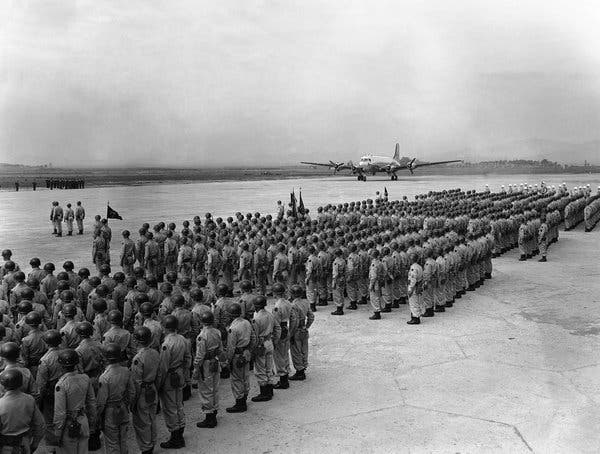
70th Anniversary: Korea, the Forgotten War

A forgotten war that shaped the modern world

Seventy years ago today, North Korean troops crossed the 38th parallel, invading South Korea. I was ten years old, but my father would send me up Front Street in Philly to get the Inquirer or Bulletin. I think it was five cents in those days, fifteen on Sundays. Pa would split the paper with me.

I knew the details intimately and followed the battle lines faithfully that summer, when U. S. troops intervened in large numbers.

And then came MacArthur’s superbly executed amphibious Inchon invasion behind enemy lines that fall, reigning in the North Korean forces. Boldly, we marched into North Korea. It turned into a protracted war, however, with the intrusion of vast numbers of Chinese soldiers into the conflict in a colossal failure of U. S. intelligence that would cost many lives. I remember GI’s telling me how the bodies of charging waves of Chinese would pile-up in front of their machine guns, preventing clear fire.

Truman dismissed MacArthur, who returned home to a hero’s welcome. He had wanted to hit China. The bridges across the Yalu were never touched, allowing the Chinese free access. I remember the Chinese encirclement of our marines at the Chosin Reservoir, their desperate retreat after seventeen days of protracted battle amid sub-zero temperatures in what became America’s version of Dunkirk.

The war would continue unabated into election year, 1952, with an unpopular Truman bowing out. Eisenhower would be swept into office, pledging to end the conflict, which he did by intimating nuclear intervention. The enemy got the message and in 1953, an armistice was signed. It provided for prisoner exchange. The sad reality is it never fully happened, some 7,800 American POWs unaccounted for. All told, more than 50,000 Americans perished, 100,000 were wounded. Five million Koreans, North and South, died, the vast majority civilians.

The war proved to be the opening salvo of the Cold War, foreshadowing Vietnam. As a little boy sprawled out on the floor reading the war accounts, I never imagined I’d be part of an occupying force four years after the war’s end, safeguarding the Republic of South Korea from the North. I spent thirteen months there, initially as a seventeen year old. I remember naked, hungry children begging, adults living in holes covered over with sheet metal, bullet shredded walls.

Today, North Korea remains a rogue state, menacing not only the Republic, but with its increasingly sophisticated nuclear arsenal, the U. S. mainland as well. We are at a loss for answers.

You’ll be hard-pressed to find anniversary accounts of the conflict in today’s press, understandably consumed with the pandemic, economic turndown and, not least, Donald Trump. Still, the Korean War has long been called America’s forgotten war. It hasn’t been that way for me. More like a shadow I can’t escape.

—RJoly

Business as Usual: Lockdown Unenforced

Protestors in Texas

As experts have warned and a rogue president, prioritizing reelection, has ignored, recharging the economy when Covid-19 continues to ravage has exacted a surge in the pandemic’s victims, with a new wave anticipated this fall.

But Americans are its lead cause, a spoiled populace ignoring the laws governing exit from the crisis, wearing a mask in public, practicing social distancing, limiting unnecessary activity. Fifty states, each with its own governance, unequal to enforcing these mandates of public safety, subservient to economic interests, fuel our crisis. Shamefully, we lead the world in the pandemic’s victims.

Meanwhile, climate change exacts its continuing world toll. We tied the record in May for the highest monthly average on record; investment in renewable energy has plummeted; in the next five years, five-hundred species will disappear as humanity continues its assault on Nature, despoiling fauna and flora in a greedy rush for profit. Worse is the meat industry, a virus hotspot, progenitor of the pandemic, not just now, but historically in its previously related strains.

As I write, the Amazon forest continues to burn to make room for cattle ranches, environmentalists have been killed or discredited, indigenous tribes decimated. In Croatia, yesterday, 50 million bees died, suspected victims of pesticides. You think it only happens abroad? It’s happening here. Last year in Texas, someone deliberately set fire to beehives, killing 500,000 bees. Almonds, a prime contributor to California’s agricultural sector, may soon devolve into memory.

Where do we go from here? For the sake of the present we are ravaging our children’s future. I think anew of poet Robinson Jeffers’ credo of “inhumanism,” a summons to abandon a plethora of mass murder and commodification, to simplify our lives, to embrace with stoic discipline those values that both uplift and secure our children’s destiny.

—rjoly

Reflections on Patti Smith’s Devotion

I hadn’t heard of Patti Smith before reading Devotion, her slim volume of 112 pages that expands upon her lecture presentation at Yale (2016), initiating the Windham-Campbell series, “Why I Write.”

Rock aficionados remember Smith for her punk-rock as a singer with her own band and award-winning albums.  Politically, her “People Have the Power” became the theme song for Ralph Nader in his 2000 campaign for the presidency. In 2007, she was admitted into the Rock and Roll Hall of Fame. Rolling Stone ranks her among the top 100 rock artists of all time.

She isn’t the norm among rock artists. A gifted painter, poet, and memoirist, she has achieved eminence both at home and abroad for her literary achievement, winning America’s most prestigious prize, The National Book Award for her memoir, Just Kids (2010), sharing company with the likes of Faulkner, Bellow, Didion, Ellison, Auden and Roth. Earlier (2005), France awarded her one of its most prestigious cultural honors, “Commander of the Order of the Arts and Letters.”

Smith is an ardent francophile, with a special love for symbolist poet Arthur Rimbaud. Devotion largely takes place in France, with Simone Weil and Albert Camus receiving special attention.

I stumbled upon the book when I was alerted to Good Reads during our national lockdown and Devotion got mentioned. Years ago, I had read J. M. Cameron’s early biography of the French mystic, Weil, whose posthumous writings became influential. Not least, I’ve always been enamored with Albert Camus. Their presence in the memoir drew me in.

Devotion is divided into three sections, the first and last forming a frame for a fictional narrative of sixteen year old Eugenia, and her fateful liaison with much older Alexander and his exploitation.

In the first portion, we breathe Paris everywhere, its hotels, streets, restaurants, and artist luminaries. Voltaire, Nabokov, Genet, Joyce, Weil, Camus, Modiano—they hover over the City of Light, silent emissaries of the imagination, catalysts of its powers, instigators of imitation. It’s the France I love.

Smith provides readers here with antecedents, or fragments of what we experience, often unwittingly, if not hazardly, of encounters that surreptitiously have a way of becoming part of us, influencing who we are and become.

Devotion doesn’t define the imaginative process. It demonstrates it, and thus the fictional tale at its center, an amalgram of subtle encounters in life’s passage, a mosaic the end result. As she tells us, “Most often the alchemy that produces a poem or a work of fiction is hidden within the work itself, if not embedded in the coiling ridges of the mind.”

Many readers dislike the narrative of Eugenia with its theme of alienation from what gives solace and fulfillment, ending tragically, as its center placement implies: the raison d’etre of Devotion, the essence of imagination’s weaving, or of what Smith fondly calls “alchemy” in the fusing of inchoate elements into an assemblage of unified nuance.

Eugenia, is an Estonian survivor, escaping the deportation of thousands of Estonians to Siberia by a paranoid Stalin during World War II, and owes her genesis to a Martti Helde documentary trailer called Risttuules, translated as In the Crosswind.

Similarly, Eugenia’s studied pursuit of ice skating had its source in Smith’s admiration for a sixteen year old Olympic Russian skater she saw on TV. Smith had no previous experience with the sport.

Weil is important as well in her separation at an early age from her mother through war and Jewish ancestry. Eugenia likewise experiences maternal loss, ultimately learning that her paternal grandmother was Jewish. Like Weil, Eugenia is shy, sensitive and highly intelligent, incorporating Smith’s decision to fuse the physical and intellectual in her protagonist. Writers not only imbibe, they invent.

Eugenia yearns to know her family’s history, having been raised by her mother’s sister, Irna, to keep her safe from the Soviets. She tries to recoup the past “in a futile effort to uncover a father’s eyes, a mother’s face.“

Smith’s pastiche of myriad contributory sources underscores writing as an act of retrieving the past, of making time palpable, of discovering who we are, often unknowable, or as Irina comments in her letter near the story’s end, “There are no signs that tell us who we are. Not a star, not a cross, not a number on the wrist. We are ourselves.”

Artists must be free to hone their craft. Alexander nicknames Eugenia “Philadelphia,“ central in America’s quest for freedom. When he ties her hands late in the story, he symbolically shackles that freedom and pays its consequences:

“Yes, Philadelphia, a hotbed of freedom,“ she said, pulling the trigger.

(Smith grew up in Philadelphia. I did, too.)

Eugenia has been on an archetypal journey, crossing a continent, traversing an ocean, to sojourn on a new continent, now to return to an old. She subsequently enters Alexander’s apartment, reads his notes on presumably Camus’ The Myth of Sisyphus:

The text posed a philosophic examination of the question of suicide—Is life worth living? He (Alexander) had written in the margin that perhaps there existed a deeper question—“Am I worthy of living? Five words that shook her entire being.”

Thematically, Eugenia is an orphaned child, vulnerable in her need for affection, abandoned by her last relative at sixteen. She finds compensation in daily ice skating on a secret winter pond hidden in the woods and becomes very good at it. Stalked by outsider Alexander, she is lured away from her devotion to what sustains: “Her defining sense of self was completely entwined with the laces of her skates.”

Having lost her freedom and with it, her innocence, she enters into knowledge, and seeks freedom’s retrieval. Guilt, however, intrudes with its heavy weight and she cannot pay its cost. Earlier, she had asked her tempter of a better life, “What is the price of this privilege?” Social and cultural constructs have done their mischief: “… she vowed to never skate again. It was her penance, to deny herself the one thing she could not live without.”

Devotion manifests not only Imagination’s dynamism, but its necessity for artists to complete themselves.  In sum, Smith has delivered an embedded parable of the consequences of its loss. As she tells us near Devotion’s end, defining the writer’s mission, “What is the task? To compose a work that communicates on several levels, as in a parable, devoid of the stain of cleverness.”

In resuming the frame, we again return to non-fiction in real time, a gathering of additional antecedents informing the embedded narrative—this time, not Paris, but the South of France.

There is Smith’s successful search for poet Paul Valéry’s grave, similar to her search for Weil’s when back in England, having garnered her material. She stops at an older tombstone with the word DEVOULEMENT carved diagonally across its border and asks her friend, what it means. “Devotion,” he replies, and a title is born, resonating the discipline that engenders successful artistry.

I’m curious about this. Despite the anecdote’s implied explanation of the title’s source, we should remember Rimbaud had written a poem, “Dévotion.” Rimbaud is Alexander’s favorite poet, as in real life, Smith’s. It turns out, dévoulement isn’t the word the French employ for devotion as Rimbaud’s poem title indicates. It means “devolution,” i. e., regression to a lower level or abnegation, its synonym in French. Smith doesn’t speak French and reads its literature only in translation.

In a telephone interview, Smith says she first came upon Rimbaud in a bookstall in a Philadelphia bus station. Sixteen at the time, the same age when Eugenia meets Alexander, she saw Rimbaud’s photo on the cover of a 99 cent paperback edition of Rimbaud’s Illuminations, and found him “beautiful.” No money on her, she slipped it into her pocket. Dévotion is one of its poems (Tristram Fane Sanders, telegraph.co.uk, 9 November 2019).

It’s this third section I find Smith at her very best, so many sentences I’m underscoring, observant, moving, waxing poetic. She tells of receiving an invitation from Camus’ daughter, Catherine, to visit the family residence in Lourmarin near my favorite French city, Aix-en-Province.

She is given his bedroom, still housing his books, and access to his uncompleted manuscript, Le Premier Homme. She senses his presence, that affinity of one writer with another: “One could feel a sense of a focused mission and the racing heart propelling the last words of the final paragraph, the last he was to write.” True artistry, impelling its imitation, she senses the urgency, accompanied by confidence, to create her own.

There follows Smith’s compelling close, compe in its succinctness, unceasing in its resonance:

“Why do I write? My finger, as a stylus, traces the question in the blank air. A familiar riddle posed since youth, withdrawing from play, comrades and the valley of love, girded with words, a beat outside. Why do we write? A chorus erupts. Because we cannot simply live.”

–rj

Emily Brontë’s Faith Poem: “No Coward Soul is Mine”

I’ve always admired Emily Brontë’s Wuthering Heights as a supreme literary achievement. In teaching it over the years, its structural complexity, thematic depth, and passionate intensity never failed to astound me. Putting it another way, Wuthering Heights has haunted me, much like Catherine’s ghost at Heathcliff’s window.

Years ago, I had the good fortune to visit the parsonage where she lived out her brief life in Hayworth, Yorkshire. (Her father was a clergyman with Methodist leanings.) A cramped, but lovingly preserved house, eerily next door to the church cemetery, you could easily surmise the Brontë children were temporarily out and be back shortly and we could settle down to robust conversation over a pot of tea.

While we remember Brontë for her novel, she also wrote poetry, 200 poems in fact. Sadly, her sister Charlotte, renowned for Jane Eyre, subsequently revised many of them, adding whole lines, rewording others, attempting to widen their public appeal. Scholars, trying to recover Emily’s probable texts, have found her cramped script difficult to decipher.

Of her poems, “No Coward Soul Is Mine” is well-known and my favorite. Brontë wrote it in the context of her fateful illness from tuberculosis. I’m so fond of this poem that I’ve been tempted to memorize it. I could almost think I was reading Emily Dickinson with its dismissal of religious orthodoxy and affinity for nature. That same fierce voice element of Wuthering Heights, perhaps a Wesleyan revivalism influence, you’ll find here, carried out by its heavy trochees as in the poem’s initial two lines or lines one and three of stanza five with their opening trochee feet.

You can be a non-believer and still appreciate the poem, for good poetry offers reading variance, or to borrow from medicine, “referral” nuance through well-crafted interweave of image, structure and diction. Our mortality spells change, not ending; a return to Nature’s genesis, or to what was, and is, and will always be.

No Coward Soul of Mine

No coward soul is mine
No trembler in the world’s storm-troubled sphere
I see Heaven’s glories shine
And Faith shines equal arming me from Fear

O God within my breast
Almighty ever-present Deity
Life, that in me hast rest,
As I Undying Life, have power in Thee

Vain are the thousand creeds
That move men’s hearts, unutterably vain,
Worthless as withered weeds
Or idlest froth amid the boundless main

To waken doubt in one
Holding so fast by thy infinity,
So surely anchored on
The steadfast rock of immortality.

With wide-embracing love
Thy spirit animates eternal years
Pervades and broods above,
Changes, sustains, dissolves, creates and rears

Though earth and moon were gone
And suns and universes ceased to be
And Thou wert left alone
Every Existence would exist in thee

There is not room for Death
Nor atom that his might could render void
Since thou art Being and Breath
And what thou art may never be destroyed.

The poem’s imagery, drawn from nature, supports the poem’s theme of Deity’s abiding presence. Composed of seven quatrains, reminiscent of Methodist hymnody, in alternating tetrameter/pentameter meter, rime occurs consistently throughout, lines one with three, and two with four, including the fourth stanza with its near rime, suggesting a purposive, or teleological, cosmos.

Brontë effectively softens “the world’s wind-troubled sphere” in line two of the initial stanza with alliteration, suggesting tranquility in context of storm.

Each sentence is declarative, resonating conviction. Unlike Tennyson’s “In Memoriam,” there is absence of tension, no struggle with doubt in the persona’s resolute faith, “So surely anchored on/The steadfast rock of immortality” ( Stz. 4).

Emily’s God isn’t Dickinson’s transcendent, mysterious, removed deity or Blake’s “No bods’ daddy.” Refulgent in his creation, He lives in our hearts, canceling any fear we might otherwise have, given the “world’s storm-troubled sphere” (Stz. 2). A poem of faith, it finds its affirmation not through anthropomorphic rendering, but in a pantheistic vision of Deity’s universal immanence.

Stanzas 3 and 4 logically follow in their rejection of creedal orthodoxies that are but worthless speculations, promoting anxiety, not peace. The repeated use of “vain” proves double entendre, human speculations fruitless and conceited, or of no more significance than the “idlest foam” of an infinite ocean:

Vain are the thousand creeds
That move men’s hearts, unutterably vain,
Worthless as withered weeds
Or idlest froth amid the boundless main

To waken doubt in one
Holding so fast by thy infinity,
So surely anchored on
The steadfast rock of immortality.

The stanzas that conclude the poem reiterate the persona’s vibrant faith in a deity who transcends the temporal, “Thy spirit animates eternal years,” and for all the volatile elements of impermanence, remains its arbiter, Who maternally “sustains, dissolves, creates and rears.”

Were the very cosmos to disappear, He would remain, for He is creation’s essence. The plural “universes” of the penultimate stanza intrigues. Did Emily believe in the modern concept of multiple universes? Whatever, God is infinite, boundless, present always:

Though earth and moon were gone
And suns and universes ceased to be
And Thou wert left alone
Every Existence would exist in thee.

How then can there be any cowering at death’s door? A deity synonymous with Nature, He is what has been, is now, and will be, the effulgence of it all:

There is not room for Death
Nor atom that his might could render void
Since thou art Being and Breath
And what thou art may never be destroyed.

Brontë dated her poems and wrote “No Coward Soul of Mine” on January 2, 1846. It would be her last poem (she passed two years later at age 30). At the time of the poem’s composition, she’d been completing Wuthering Heights. Emily Dickinson came upon this poem and loved it. She asked it be read at her funeral, her wish fulfilled by her friend and later editor, Thomas Wentworth Higginson, at the funeral’s conclusion.

As for Brontë, following several labored days, she slipped into eternity on December 19, 1848, unafraid, and deeply mourned by her sisters, Anne and Charlotte, and canine friend, Keeper. As with Keats, a young talent struck down early by the same illness, her posthumous fame has restored her to us, though not without conjecture of future talent lost.

As I said at the outset, the poem endures as a favorite of mine, one I’d take gladly to a desert isle, or read repeatedly when my last day summons. It accompanies me, too, when I engage Nature in the present, the sense of a hovering spirituality, that everything is linked, and means, and infinitely bigger and grander than ourselves.

–rj