Fifty Morning Pages: Showing-up to Read

The other day I posted on my Brimmings blog a new method I’ve devised to inspire myself to read more—specifically, to aim for 80 books a year, assuming an average length of 300 pages. That works out to 24,000 pages annually, divided by 365 days.

I didn’t linger long over the arithmetic. What mattered was putting the idea immediately into practice. I set a daily goal of 50 pages, read first thing in the morning. For me, any attempt at habit formation has to be anchored in time. Once the day’s interruptions begin, resolve alone is no match for contingency.

Experience has taught me that it takes roughly four to six weeks of daily repetition for a habit to take hold. Once anchored, the reluctance to break a streak becomes a force in its own right. Acquiring a new habit, I’ve found, is less about willpower than about showing up.

The results have been gratifying. In the past two weeks I’ve finished two books, one of them nearly 600 pages. Fifty pages a day takes me about an hour. I could read faster, but speed isn’t my aim. I underline, annotate, argue with the text. I’m not a passive reader; I want to engage—agree, disagree, extend.

At this pace, I’ll read roughly 18,250 pages a year. Divided by 300 pages per book, that comes to just under 62 books annually. Not 80—but what a start. If I can raise my yearly total from my long-standing average of 20–25 books, I’ll consider the experiment a success.

Quantity, of course, is not an end in itself. The real aim is access to the best fiction and nonfiction available, the works that challenge and enlarge the mind. Increasingly, I’ve been drawn to cluster reading, concentrating on subjects where I feel thin or want deeper understanding.

What excites me most is the daily result: fifty pages read before the day properly begins. The reward is immediate, and reward, as we know, is integral to habit formation. Each book brings with it a flood of ideas—fuel for writing, and an invitation into community with others who share similar intellectual and aesthetic appetites.

—rj

Convergence: Seeing Others as Ourselves

I’ve been keeping a list for some time of my favorite blogs. There are so many to choose from that discovering one capable of sparking genuine enthusiasm often feels like chance—like gazing nightly at the starry heavens and marveling at what lies beyond human reach. When such a blog does appear, it draws me back again and again, not out of habit but wonder.

Relying on that list, I came upon a short paragraph-poem this morning by Dr. Drew Lanham, the award-winning African American professor of environmental studies at Clemson University. Lanham confesses to being “a man in love with nature—a wanderer finding foundation in wild places.” What follows is both intimate and expansive:

Handle my life in your hands as if it were your own. Feel the heart beating—small as it may be—and imagine it in your own chest. Beating in syncopated time to become shared meter. That pulse, the breathing, is your rhythm. Your in’s and out’s, its in’s and out’s. Look close under
whatever warty skin or soft fur or gaudy feathers and see self. Its being is your being. Be in that same skin for what moments it will allow. Then, when the convergence between you is sealed, release that wild soul to free roaming as you would desire of your own.

What strikes me is the poem’s quiet tone: a persona grounded in kinship with the natural world, alive with empathy for the vulnerable. Applied beyond nature—to our fellow humans—it gestures toward something transcendent: a way of bridging difference, whether of creed, ethnicity, or race.

Such bridging begins only when we recognize our linkage, when we are willing, even briefly, to see ourselves in others—“Be in that same skin for what moments it will allow.”

Lanham wrote this poem after rescuing a frog from his cat’s pursuit.

Read Eighty Books a Year: A Reader’s Arithmetic:

Stephen King reads sixty or more books a year. I’m lucky if I reach twenty—and the disparity bothers me more than I care to admit. Not because I value quantity over quality, but because there are simply too many books I want to live with, too many voices I want time to answer back to.

Time flows from us like a running faucet. Time is our common currency granted daily. How do we spend it? It comes down to our priorities.

King has been candid about how he does it. He treats reading as a necessity, not a luxury, reading every day for two or three hours, sometimes more. As he puts it in On Writing: “If you don’t have time to read, you don’t have the time (or the tools) to write.”

That rings true for me. When I write, it’s almost always in response to what I’ve read—to extend an argument, disagree with it, enthuse about it, or share it with others.

King refuses to slog through books that fail to engage him. He abandons them without guilt. Interest propels reading; boredom kills it. And he always has a book with him—reading while waiting, traveling, between tasks, or before bed. Those fragments accumulate.

The numbers themselves are demystifying. Suppose your goal is eighty books a year with an average length of 300 pages. That’s 24,000 pages annually. Divide by 365, and you arrive at roughly 66 pages a day. At a moderate pace of about 40 pages per hour, that comes to around an hour and forty minutes of daily reading.

That’s doable.

My final tip is one that has helped me most: read in clusters. Choose a topic that genuinely interests you and commit to five or six books in that area.

Reading a single book from a wildly eclectic list can feel shallow; focused reading builds momentum, deepens understanding, and increases motivation.

This year, for example, I’ve chosen to immerse myself in Kentucky sage Wendell Berry—two biographies and three of Berry’s own books. Depth, it turns out, can be the best catalyst for volume.

—rj

My Passion for Literature: Reading’s Gifts

My fierce love for books has its ancient beginnings as a seven year old, sprawled on a Philly tenement floor, enthralled with a Christmas gift, Twain’s Huckleberry Finn.

Moments ago I rediscovered this passage from France’s Michel Houellebecq, who has this special capacity to rattle the cages of accepted opinion—daring, provocative, forthright—writing novels you simply don’t walk away from.

I had read his Submission several years ago, an initial novel that launched his fame. His take on literature, a dying indulgence in a digital age, is poignant with meaning for me, for literature has surely been among life’s greatest gifts to me:

“…the special thing about literature, the major art form of a Western civilization now ending before our very eyes, is not hard to define. Like literature, music can overwhelm you with sudden emotion, can move you to absolute sorrow or ecstasy; like literature, painting has the power to astonish, and to make you see the world through fresh eyes. But only literature can put you in touch with another human spirit, as a whole, with all its weaknesses and grandeurs, its limitations, its pettinesses, its obsessions, its beliefs; with whatever it finds moving, interesting, exciting, or repugnant. Only literature can grant you access to a spirit from beyond the grave—a more direct, more complete, deeper access than you’d have in conversation with a friend” (Submission).

I have not found a more eloquent articulation of my own passion for literature and think often of what I would have missed had I not been introduced to literary reads—above all, to see past the literal text and be transported into a galaxy of resonance where words could mean beyond themselves, open new vistas, shaping life, capable of numinosity, a sense that life exceeds appearances, infinite in its labyrinthian corridors, a non-ending conversation with what is, has been, and will endure.

On Reading A.S. Byatt’s Possession: A Serendipitous Find

I’ve been reading A. S. Byatt’s Possession, published in 1990 and now hailed as a contemporary masterpiece.

Each year, I compile a carefully chosen list of books I hope to read. Possession was among them, though I can’t quite recall how I first came upon Byatt.

It has turned out to be an inspired choice—a rare literary mystery centered on a scholarly quest to uncover a suspected love affair, pieced together from newly discovered letters between the Victorian poet Randolph Henry Ash, modeled on the married Robert Browning, and poet Christabel LaMotte, inspired by Christina Rossetti.

If such a relationship can be proven, it would mark a major coup for the novel’s modern-day protagonists, Roland and Maud, who join forces to solve this academic puzzle.

I won’t be a spoiler; I’m still reading, mesmerized by Byatt’s creative brilliance. Drawing on her vast knowledge of Victorian literature, she invents letters, diaries, and poems that feel astonishingly authentic—plausible echoes of Browning and Rossetti themselves.

There’s also a compelling counterpoint: as Roland and Maud pursue their literary investigation, they, too, seem to fall in love. And the suspense deepens with rival scholars competing to uncover the same secret.

Possession won the Booker Prize and became an international favorite, translated into more than thirty languages. A film version followed—all of which amazes me, as I wouldn’t have expected a novel so steeped in academia to achieve bestseller status.

Byatt, an academic for many years and fluent in several languages, left teaching in 1983 to write full time. Gifted with formidable imagination, she could also be intimidating in her intellectual precision and resistance to literary fashion. Critic, novelist, short-story writer, and essayist, she produced twenty-five books and, in 1999, was made a Dame Commander of the Order of the British Empire (DBE) for her services to literature.

Her prose is detailed, introspective, and resonant—at times, poetic. More than any writer I’ve read, she possessed an extraordinary gift for mimicry, able to write convincingly in many voices.

I’ve especially liked this passage, though there are many others:

It is a dangerous business, reading of the passions of the dead. We try on their feelings, like garments, and for a moment we seem to stand in their light — and yet, as we close the book, we find ourselves once again alone in our own darkness, aware that our borrowed flame is only memory’s trick.

She is the writer’s writer.

As Jay Parini wrote in his 1990 New York Times review, “Possession is a tour de force that opens every narrative device of English fiction to inspection without, for a moment, ceasing to delight.”

–rj

My Journey Through Books: From Childhood to Lifelong Learning

I’ve been a reading addict since childhood, when as a young boy I’d walk a mile—sometimes more—just to lose myself in a library’s cool hush, seated at a table, surrounded by shelf-lined books inviting adventure.

My love for animals found early confirmation in the Dr. Doolittle books I devoured. I read every one. Years later, that same fascination with the speech of creatures led me to Jane Goodall’s revelatory studies of chimpanzees—proof that empathy can grow into insight.

Another passion took root in the dusty bleachers of Shibe Park—later Connie Mack Stadium—in Philadelphia. I loved baseball with an intensity only children know, lingering outside the gates, hungry for autographs as players boarded their buses. I read passionately about my idols—Ruth, Gehrig, immortals who remain with me.

Travel books, too, called out to me. Mutiny on the Bounty and its aftermath on Pitcairn’s Island transported me to the South Seas, where I imaginatively romped through Tahiti, New Zealand, and Australia. In later years, that early enchantment led me to consider emigrating to New Zealand. I was, in fact, approved.

Languages fascinated me. One day, at ten, I brought home books in Russian from Philadelphia’s Free Library, expecting the Cyrillic script to magically transform itself into English. That early infatuation would one day carry me across the world to Russia and the homesteads of Tolstoy, Dostoevsky, and Chekhov.

I call myself an autodidact, though I’ve graduated from several reputable universities. I started behind most students, having fled a troubled home at seventeen, enlisting in the Air Force, which sent me to Korea. Our base library was a single room, yet its shelves were somehow populated with a few classics. One off-duty evening, I pulled down a book called Look Homeward, Angel. It changed my life.

After Korea, I read everything Thomas Wolfe wrote, visited his home in Asheville, eventually enrolling as a Ph.D. student at his alma mater—the University of North Carolina at Chapel Hill, “Pulpit Hill” in Wolfe’s novel. On my first campus day, waiting to register for classes, I bumped into a retired professor, who asked what brought me to Chapel Hill. “Thomas Wolfe,” I said without hesitation.

A serendipity moment, that professor had known Wolfe. Becoming lifelong friends, they traveled together to prewar Germany, where Wolfe witnessed the Nazi persecution of Jews, which he would later feature in You Can’t Go Home Again. He shared anecdotes about Wolfe, who stood six feet, six inches. His hands too wide to use a typewriter, Wolfe wrote standing up, a refrigerator top serving for a desk.

Despite the scores of books I’ve read, there remain gaps I want to fill. The books I’ve read have been my faithful companions along life’s road, shaping who I am.

Were I granted another life, I think I’d come back as a librarian. No other choice comes close.

The Thinking Machine That Makes Us Stop Thinking

AI excels at counterfeiting the human mind. If we’re not vigilant, it will think for us—leaving our own intelligence dormant, our creative impulse atrophied.

Already, much of our news is machine produced at news outlets like AP, Reuters, and Bloomberg, recapping the latest happenings in news, sports, and entertainment.

It can project us into videos, put words in our mouths, falsify who we are.

Writing in the Free Press, Tylan Cowen warns that within the next few years, AI will author most “of the words written in the United States.” He contends AI is much smarter than us, encyclopedic in scope, capable of writing our books and news for us.

New advances in technology assure its omnivorous takeover of much of everyday life. Indeed, we’re on the threshold of Ray Bradbury’s apocalyptic new world.

Bradbury foresaw a future of stupefying distraction—a civilization that traded reflection for amusement. With AI, his warning no longer reads as metaphor but as prophecy.

AI’s intelligence is borrowed; it knows only what its creators feed it. In the wrong hands, it becomes a megaphone for manipulation—its outputs polished, persuasive, and perilously biased.

AI cannot think for itself. What it spews out can prove toxic, prodigious in conspiracy, disseminating division that may spill into violence.

Algorithms are predictive. They know our wants and pile-on their overtures. Increasingly, they orchestrate our choices. Corporate driven, they offer a pecuniary bonanza servicing their interests.

AI outsources cognition. Invading scholarship, it’s become the campus Cliff Notes, shortcutting inquiry, analysis, and reasoning. It can summarize a complex Faulkner novel in milliseconds, replete with analysis. Why read at all? Why bother with the professor?

AI’s convenience comes at the price of serendipity: the unplanned discovery that alters our thinking, robbing us of the slow astonishment that once expanded the boundaries of our knowing.

AI proliferates plagiarism, the theft of another’s thought, masquerading as one’s own. It’s become the teacher’s nemesis: how do I know the student’s writing is their own?

AI homogenizes the writing act, making us all sound alike—the short, staccato sentences; simplified vocabulary; the annulling of the cumulative, crafted sentence, subtle in its syntactical variation, rhythms, and nuance. It’s the ultimate in dumbing down.

The heart of the matter, however, is AI’s largesse as a substitute for thought, straying into amnesia—a prosthetic for our inner murmurings.

—RJ

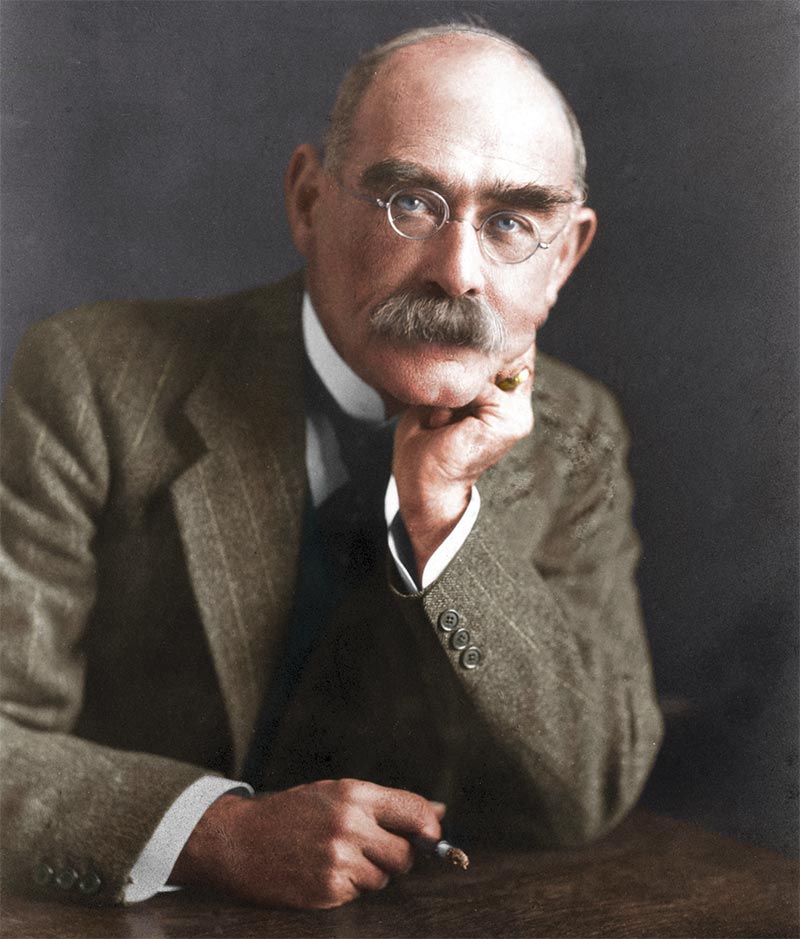
A Polarizing Artist: Rudyard Kipling’s Legacy

I remember it well. I was a young graduate student, privileged to study under one of the world’s foremost professors of Victorian literature, a renowned authority on Thomas Hardy.

The course was rigorous. We read the greats of the age—Macaulay, Tennyson, Browning, Dickens, Mill, Newman, Arnold, Morris, Ruskin, the Rossettis, Swinburne, Hopkins, Pater, and of course Hardy. Yet strikingly absent was Rudyard Kipling. Our professor dismissed him as the mere voice of imperialist Britain—an attitude then dominant in the Academy, and one I suspect still lingers on American university campuses.

I had never read Kipling. I had not yet learned to question. I accepted what I was told.

It was only later, during a summer course at Exeter College, Oxford, that I encountered another view: one that esteemed Kipling’s literary brilliance without committing the American folly of conflating his politics with the merits of his artistry.

Kipling’s literary range was astonishing. His verse, endowed with rhythmic command, borders on the hypnotic. He opened poetry to colloquial speech and became a supreme craftsman of the ballad form.

Yes, he gave voice to Empire in works like The White Man’s Burden, Kim, and The Jungle Books. But he also revered Indian culture—its spirituality, wisdom, and sensory richness. Often, with subtle irony, he questioned the very order he seemed to affirm.

Perhaps his greatest achievement lies in the short story. With precision and nuance, he crafted narratives of extraordinary compression, modern in their suggestiveness, wide-ranging in their scope. The Man Who Would Be King remains a masterpiece—its sweep and power undiminished. Kipling’s influence on Conrad, Maugham, Hemingway, Borges, and others is beyond doubt.

He was awarded the Nobel Prize in Literature in 1907—the first English-language writer to receive it—honored for his “power of observation, originality of imagination, virility of ideas, and remarkable talent for narration.”

Kipling’s stories, like all enduring art, probe psychological depths. They are complex, skeptical of conventional wisdom, and riveting in their precision.

In today’s multicultural Britain, he is taught in context: his genius as a storyteller acknowledged, his colonial perspective rejected. Lewis, Tolkien, and Pullman have recognized him as a precursor to modern fantasy.

In India, where he was born and spent his early years, his reception is understandably ambivalent: many readers disdaining his imperial condescension, yet acknowledging his literary craftsmanship. Salman Rushdie has called Kim “one of the greatest novels written about India,.” Other Indian writers continue where Kipling left off, offering vivid vignettes of India, but through an Indian prism.

Controversy about his place in the Western literary canon remains. Vladimir Nabokov, in his Cornell lectures, dismissed Kipling for his moralizing, He deemed his indulgence in exotic adventure stories as juvenile. Great literature, he argued, obeys the aesthetic imperative of narrative neutrality, or distance, as in Flaubert and Joyce.

On the other hand, the late eminent Yale critic Harold Bloom came to Kipling’s defense. In his The Western Canon. Bloom lists Kipling among hundreds of writers deserving inclusion in the canon. Bloom saw Kipling as a myth maker and gifted story teller, especially in his short stories. On the other hand, he found his poetry “scarcely bear reading.”

While I find merit in both Nabokov’s and Bloom’s arguments, I lean towards Bloom’s appraisal as more balanced. I have long resisted either/or equations, particularly as to the political or aesthetic. Over a lifetime, I have frequently found reasoned judgment occupies a middle place. I have given my own arguments earlier in this essay for his belonging in the canon.

Whatever a reader’s verdict, Kipling was a singular voice, very much his own man. In short, authentic. As he said in an interview shortly before his death,

“The individual has always had to struggle to keep from being overwhelmed by the tribe. To be your own man is a hard business. If you try it, you’ll be lonely often, and sometimes frightened. But no price is too high to pay for the privilege of owning yourself” (Qtd. in the Kipling Journal, June 1967).

rj

Sorry Emerson: Money is NOT the Prose of Life

Ralph Waldo Emerson ranks high on any list of frequently quoted American sages. He has a special way of rendering human experience palpable.

Among his many essays, I’ve especially liked “Compensation,” which I first read as a young graduate student in an American Lit class.

Undoubtedly a residue of his exploration of Eastern thought, this essay has journeyed a lifetime with me in its karma undertones, buoying me up in its harbinger of moral recompense for life’s myriad inequities.

But on occasion, Emerson fumbled, as when he wrote that “money represents the prose of life, and which is hardly spoken of in parlors without an apology, is, in its effects and laws, as beautiful as roses” (“Nominalist and Realist,” Essays: Second Series, 1844).

Critics were quick to pounce, Marxists in particular seeing it as capitulating to capitalism. Emerson probably meant that the pecuniary is an integral component of the natural order.

Still, it seems a passage one wants to expunge like disturbing phlegm.

I like Saul Bellow’s correction: “Uch! How they love money, thought Wilhelm. They adore money! Holy money! Beautiful money! It was getting so that people were feeble-minded about everything except money. While if you didn’t have it you were a dummy, a dummy! You had to excuse yourself from the face of the earth!” (“Seize the Day”).

But let me also share psychologist and poet Pamela Joyce Shapiro’s response to Emerson’s remark. Her poem speaks for me and perhaps for you:

If money is the prose of life
as beautiful as roses,
poetry it seems must be
the soil and sun of infinity,
without which surely nothing grows.
I see the pleasures each might bring,
when flourishing in abundant spring.
Though stocks and petals tend to fall
in drought or storm or just because,
poetry survives it all.
What losses can define what loss is?
Waning wealth or stolen roses?
Forget the till and till the mind,
plant poetry and praise the sky.

rj


Why I’m Still Reading Yeats

I’ve always been a devotee of the poetry of William Butler Yeats, though not of his metaphysics or his politics. Certainly, his reception in Ireland over the years has been bleak, the latest hostile critic, contemporary novelist Sally Rooney piling on, dismissing his politics as fascist, with the takeaway he isn’t worth reading.

Though he flirted with authoritarianism, agitated by the chaos he associated with democracy, he supported the Free State and later repudiated Mussolini, whom he initially admired. He was never the likes of Ezra Pound. In one of his final poems, “Politics,” he expresses his disillusionment with political ideologies proffering easy remedies for society’s ills.

Yeats should not be judged removed from the convulsions that gave birth to an Ireland free of its English masters.

Ireland’s ostracizing of its literary giants has a long history, not only with Yeats, but James Joyce, Samuel Beckett, Frank O’Connor, Sean O’Faoláin, and the late Edna O’Brien, all of whom chose exile.

I bristle against censorship and book banning to which it often leads. Things are changing in Ireland, a nation I know well, but old attitudes can find an audience still.

Yeats remains worth reading, his poetry arguing for itself in its craftsmanship, beauty, and relevance. His often quoted “The Second Coming” hovers over us in its prescient warning of autocracy’s sinister reach.

“A Prayer for My Daughter” remains among my favorite Yeats poems—subdued in tone, subtle in rhythm, redolent in wisdom.

Written in 1919 in the context of Ireland’s incipient nationalism that would spark a civil war and the country’s ultimate partition, the poem expresses Yeats’ hopes for his new daughter in a less turbulent future.

A poem abundant in symbolism, Yeats prays she shun hatreds, value inner over external beauty, find solace in tradition and ceremony.

I value the poem, not least, for its relevance to our own time.

Excerpt:

May she become a flourishing hidden tree
That all her thoughts may like the linnet be,
And have no business but dispensing round
Their magnanimities of sound,
Nor but in merriment begin a chase,
Nor but in merriment a quarrel.
O may she live like some green laurel
Rooted in one dear perpetual place.

My mind, because the minds that I have loved,
The sort of beauty that I have approved,
Prosper but little, has dried up of late,
Yet knows that to be choked with hate
May well be of all evil chances chief.
If there’s no hatred in a mind
Assault and battery of the wind
Can never tear the linnet from the leaf.

An intellectual hatred is the worst,
So let her think opinions are accursed.
Have I not seen the loveliest woman born
Out of the mouth of Plenty’s horn,
Because of her opinionated mind
Barter that horn and every good
By quiet natures understood
For an old bellows full of angry wind?

This last stanza obviously alludes to Maude Gonne, who had become a strident voice of Irish nationalism and to whom Yeats had twice proposed marriage, but was rejected.

In 1990, I was privileged to meet and converse with Anne, the daughter in this poem.

Whatever our views on artists such as Yeats, or antisemite T.S. Eliot, or Chilean fervent communist Pablo Neruda, I subscribe to the autonomy of art. It’s narcissistic to think artists must share our views.

rj