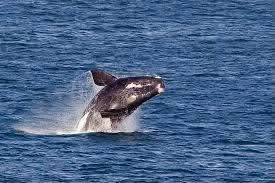
Morning returns. My mind, as always, tumbles at wake of day, waves touching every shore.
Whales fill my thoughts, those biblical, wondrous leviathans of the deep, the creatures Job extols as exempla of divine majesty beyond infinity’s reach.
I think of Rachel Carson, guardian of the deep, her The Sea Around Us, prescient in its admonition, eloquent in its utterance, observing in 1951 alteration of climate: “… the frigid top of the world is very clearly warming up” and “the surface waters of the North Atlantic {are} showing rising temperatures.”
Childhood memories of Newburyport sea-captain mansions lining High Street, their terraced porches, vistas toward the ocean. MobyDick. Coastal Maine. Nantucket’s cobbled lanes. Whalers and harpoons.
We hunted them to near extinction. Right whales, only a scarce few.
Thoughts of Gerard Manley Hopkins and “Binsey Poplars”:
“O if we but knew what we do When we delve or hew…”
Sea mining has begun.
There are no boundaries.
As sea lover Philip Hoare writes, stirred by a whale sighting off my beloved Cape Cod, “I watch as the whale plays in the surf the way a dog runs around a field. There are less than three hundred and forty of their kind left, set against the teeming multitude of the whole human race. Too few whales now to fill this great ocean, or animate it enough to save themselves. Too few to fertilise it, with their living excretions or their dead bodies. Too few females to continue the line” (William Blake and the Sea Monsters of Love).
We don’t hunt Right whales anymore, but human activity menaces still—fishing-net entanglements, vessel collisions, plastic pollution. Navy underwater sonar shakes the ocean deep.
Most ominously, only about 70 breeding females remain.
A world without whales? Like dinosaurs, the stuff of children’s storybooks and museum displays? It’s a world I’m glad to leave.
Poet Robinson Jeffers echoes my thought in his “End of the World”:
“When I was young in school in Switzerland, about the time of the Boer War, We used to take it for known that the human race Would last the earth out, not dying till the planet died. I wrote a schoolboy poem About the last man walking in stoic dignity along the dead shore Of the last sea, alone, alone, alone, remembering all His racial past. But now I don’t think so. They’ll die faceless in flocks, And the earth flourish long after mankind is out.”
I’ve always liked environment activist Bill McKibben, longtime prof at Middlebury College and prolific writer, though sometimes I disagree.
For example, he recently parried a reader’s hint that just maybe overpopulation poses our greatest challenge in mitigating the exponential fallout of climate change by saying he didn’t think so, given that where population is rising most, Africa, there’s little contribution to carbon discharge .
While that may presently hold true, the reason for this is Africa’s falling short on Western amenities that along with their comfort and convenience, foster carbon discharge.
The fact is Africa is incipiently engaged in catching-up to the follies of more advanced economies in adopting technologies promoting carbon discharge, especially with regard to excavating industries in places like the Democratic Republic of Congo.
As Africa’s clamor for meat likewise grows with surging population, more deforestation is occurring, and we know that spells diminished carbon sinks, fostering destabilization of weather patterns.
As I write, prolonged drought plagues Africa, creating a vast risk of starvation and malnutrition. What it doesn’t need are more mouths to feed.
In game refuges, elephants and even rhinos, seen as competitors for flora and landscape, are being slaughtered to feed a growing population in Angola, Zimbabwe and, yes, in Bechuanaland, Africa’s last great elephant sanctuary.
McKibben entangles himself similarly in joining the chorus advocating more wind turbines, despite emerging evidence of their dire consequences, at least for seabirds and whales, according to the recent 600 page report from the Bureau of Ocean Energy Management (BOEM).
On the other hand, he’s right about so much of our climate morass.
This year was the hottest on record, with next year unpromising. Phoenix, our fastest America growth city, endured 31 days of 110F temperatures, its emergency rooms overflowing with the burned and dying.
And he’s right—there’s no safe place to move. Vermont, where he lives, sheltered by its mountains, suffered an atmospheric river this past summer, resulting in unprecedented downpours inflicting catastrophic flooding.
Last night, I learned of America’s new housing crisis, this one weather related. It seems 30-year mortgages can’t withstand climate change, natural disasters occurring not only more frequently, but with accelerating violence.
Take Florida, for example, where home insurers are pulling out. Where they remain, and I mean across the nation, annual premiums increases are eroding many homeowners’ ability to pay.
Currently, 9% of the world’s population, or 600 million of us, lives outside what’s known as “the climate niche,” meaning safety zone. By century’s end, an estimated one third of us will fall into this doughnut hole.
Now comes the orange hair threat assuming office, January 20, 2025. Denying climate change as a hoax, he pledges “drill, baby, drill.”
I was raised a New Englander and, by custom, eating lobster had been a staple in my diet. The problem with custom, however, is that we seldom question its tenets, propelling us to mindlessly continue behavior that scrutiny might render pause, if not discontinuance.
My misgivings began some years years ago when I found myself in a restaurant featuring a large water tank, containing lobsters scavenging its pebbled bottom, oblivious to their impending fate of being boiled live.
It spoiled everything for me. I no longer could enjoy squeezing the shell until it cracked, exposing the meat of the hideously killed creature.
Several years ago, my wife and I met up with our children in Maine, a favorite haunt for us with its rocky coasts, salty air, deep forests, quaint villages and, yes, super ice cream. In Maine, you eat crabs, clams, or lobsters. And so, here I am in a seafood restaurant, my family toiling at their lobsters; that is, except me.
But are lobsters sentient? Do they feel pain?
I say yes, based on recent science research, indicating their nervous system is complex. The fact they have a spine should suffice. When you drop them into that boiling water, however, they lack vocal chords to voice their screams.
You don’t really need the lab to confirm their suffering. Just witness a lobster or crab hurling itself violently against the sides of a pot of boiling water.
Opponents retort it’s simply reflex, taking us back to Descartes and his mechanistic assessment of animal behavior, ignoring their neurological components. On the other hand, crabs in a recent experiment rapidly adjusted their habits to avoid areas where they had previously experienced an electric shock.
A number of countries have taken legal measures to protect crustaceans like lobsters from unnecessary pain, among them, Norway, New Zealand, Austria and parts of Italy and Germany.
Switzerland set the precedent in 2018, banning boiling crustaceans alive, based on research indicating they feel pain. They needn’t possess a neocortex to experience pain. Biologist Robert Elwood, whose research led to Switzerland’s ruling, tells us that “crustacean brains and nervous systems are configured differently” (aldf.org).
But what about freezing them, a predominate recourse in shipping lobsters over long distances, say, to Biden’s recent celeb bash for the French president?
In June 2016, Italy’s highest court outlawed the practice, ruling it inflicted unjustifiable suffering. That makes sense. Freezing sentient creatures is no less repulsive than boiling them alive.
But environment also looms as a pressing concern involving the lobster industry.
Whole Foods has joined the debate, announcing it will no longer sell lobster after two consumer-focused environmental watchdogs— the Maine Stewardship Council and Seafood Watch—pulled their certifications due to concerns over impacts on North Atlantic right whales. The National Oceanic and Atmospheric Administration says it will reduce whale deaths and injuries by 69%.
This morning I woke to TheGuardian’s lead article, “Save whales or eat lobster”: the battle reaches the White House” (11 December 2022), centering on the Federal court’s decision to curtail Maine’s lobster industry employing 10,000 workers in order to safeguard the diminishing North Atlantic right whales.
The Biden staff, nonetheless, ordered 200 lobsters be flown in for the Macron fete, despite the 2021 1st Circuit Court of Appeals decision reinstating a ban on lobster harvesting in some 940 square miles of the Gulf of Maine from October to January to protect endangered North Atlantic right whales menaced by entanglement in fishing gear and collision with large ships.
White House Executive Chef Cris Comerford responded that they wanted to “honor our lobstermen from Maine.” Meanwhile, the court’s decision is under fast track appeal.
I’m not hopeful. Sadly, politics often govern, expediency prevails, and the pecuniary nearly always wins, with accelerated biodiversity loss and climate warming their consequence.
My high regard for environmentalist Rachel Carson persists. An oceanographer by profession, her eloquent The Sea Around Us won the National Book Award, America’s highest literary award, in 1952.
Living summers on Southport Island, Maine, adjacent to touristy Boothbay, she loved the then abundant whale life. With her typical prescience, she also served an incipient warning: “We live in an age of rising seas,” she wrote. “In our own lifetime we are witnessing a startling alteration of climate.”
That was 1964, or 58-years ago.
The North American right whale, an endangered species under the Endangered Species Act, has since declined to a scant 340, of which only 100 fertile females remain. We know the seas are ubiquitously afflicted with fishing gear, imposing an immense burden and much suffering upon sea life.
The lobster industry, instead of shouting their outrage, would do better to observe the U.S. Oceanic and Atmospheric Administration mandate to employ multiple break points to pull up lobster traps in order to prevent right whale entanglement.
Declining rapidly in number, unless we protect these whales, they will have vanished forever.