
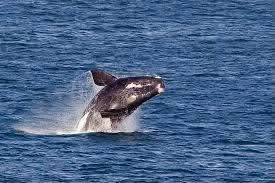
Morning returns. My mind, as always, tumbles at wake of day, waves touching every shore.
Whales fill my thoughts, those biblical, wondrous leviathans of the deep, the creatures Job extols as exempla of divine majesty beyond infinity’s reach.
I think of Rachel Carson, guardian of the deep, her The Sea Around Us, prescient in its admonition, eloquent in its utterance, observing in 1951 alteration of climate: “… the frigid top of the world is very clearly warming up” and “the surface waters of the North Atlantic {are} showing rising temperatures.”
Childhood memories of Newburyport sea-captain mansions lining High Street, their terraced porches, vistas toward the ocean. Moby Dick. Coastal Maine. Nantucket’s cobbled lanes. Whalers and harpoons.
We hunted them to near extinction. Right whales, only a scarce few.
Thoughts of Gerard Manley Hopkins and “Binsey Poplars”:
“O if we but knew what we do
When we delve or hew…”
Sea mining has begun.
There are no boundaries.
As sea lover Philip Hoare writes, stirred by a whale sighting off my beloved Cape Cod, “I watch as the whale plays in the surf the way a dog runs around a field. There are less than three hundred and forty of their kind left, set against the teeming multitude of the whole human race. Too few whales now to fill this great ocean, or animate it enough to save themselves. Too few to fertilise it, with their living excretions or their dead bodies. Too few females to continue the line” (William Blake and the Sea Monsters of Love).
We don’t hunt Right whales anymore, but human activity menaces still—fishing-net entanglements, vessel collisions, plastic pollution. Navy underwater sonar shakes the ocean deep.
Most ominously, only about 70 breeding females remain.
A world without whales? Like dinosaurs, the stuff of children’s storybooks and museum displays? It’s a world I’m glad to leave.
Poet Robinson Jeffers echoes my thought in his “End of the World”:
“When I was young in school in Switzerland, about the time of the Boer War,
We used to take it for known that the human race
Would last the earth out, not dying till the planet died. I wrote a schoolboy poem
About the last man walking in stoic dignity along the dead shore
Of the last sea, alone, alone, alone, remembering all
His racial past. But now I don’t think so. They’ll die faceless in flocks,
And the earth flourish long after mankind is out.”
I have no more words.
RJ

