Recently I posted my personal reading of Wallace Steven’s “Sunday Morning,” exploring what might replace religious transcendence once belief dissolves. Stevens’ answer is not despair but immanence, the sufficiency of the natural world, apprehended through the shaping power of imagination.
Yet it is not only religion that now shows signs of erosion. Embedded cultures, those dense inheritances that confer identity through their singularity, are likewise under strain.
In an increasingly global village, accelerated by digital transmission, the world assumes a more monocultural cast, often shaped by the diffuse reach of corporate and algorithmic influence. Against this drift, UNESCO convenes its Intergovernmental Committee each year to review additions to its Intangible Cultural Heritage lists.
Among these is the Urgent Safeguarding List, devoted to imperiled dialects, ritual songs, oral epics, and traditional crafts, forms of life whose disappearance would constitute not mere loss, but erasure.
We are inclined to think of culture as something we visit: a museum, a concert hall, a staged performance. But culture, more fundamentally, is not exhibition but enactment, a way of life sustained through repetition. When cultural memory vanishes, what is lost is not simply artifact but identity itself, as irreplaceable in its domain as the disappearance of elephants, lions, or polar bears from the natural world.
Meaning, then, is not merely conceived; it is made. It inheres in what a people does repeatedly, across time. Imagination, Stevens’ great theme, does not operate in abstraction alone; it is embedded in language, craft, music, and ritual. Culture is the accumulated expression of that imaginative labor.
I am no anthropologist, nor a specialist in indigenous societies; yet it is difficult to ignore the accelerating pressures placed upon such cultures, systems of knowledge refined over centuries of intimacy with specific environments, often encompassing ecological and medicinal understanding that modern systems only belatedly recognize.
Missionary activity, whatever its intentions, has frequently contributed to cultural leveling, supplanting local cosmologies with imported belief systems. Likewise, the expansion of agribusiness, mining, and deforestation, whether in the Amazon Basin or regions such as Papua New Guinea, has disrupted not only ecosystems, but the cultural worlds entwined with them.
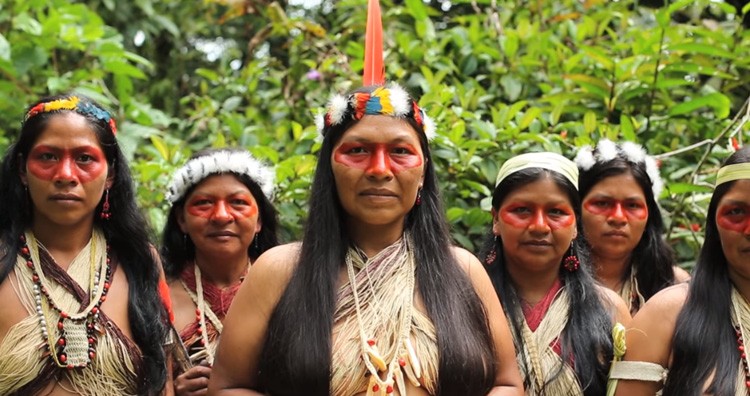
The history of the Waorani in Ecuador offers a particularly stark instance. In 1956, a group of missionaries, including Jim Elliot, made contact with a people then labeled “Auca,” a Quechua term meaning “savage.” The encounter ended in violence, an event long framed as martyrdom but more plausibly understood as the defense of a bounded world.
Subsequent missionary and governmental incursions encouraged the Waorani to settle in centralized villages, disrupting their semi-nomadic, kin-based lifeways. The introduction of Christianity and Western norms altered not only belief, but social organization itself.
These transformations deepened with the discovery of oil. Companies such as Texaco, along with the state firm Petroecuador, initiated exploration and drilling across Waorani territory. Roads penetrated previously isolated tribal habitat, bringing loggers, settlers, and a cash economy. Environmental degradation followed: oil spills, polluted waterways, and the decline of flora and fauna, some unique to the region.
Cultural consequences were no less profound. Native language use diminished; oral traditions weakened; customary practices eroded. Some Waorani communities entered agreements with oil interests, while others resisted. Still others, the Tagaeri and Taromenane, remain in voluntary isolation, defending their autonomy with increasing difficulty.
In effect, a territory once lived as its own world has been recast as resource. Missionaries sought to save souls; governments and corporations sought to extract value. The result has been not only cultural change, but a destabilization of the very conditions under which meaning is made.
To read the Waorani encounter alongside Wallace Stevens and UNESCO is to see more clearly the stakes of each. Stevens imagines that, in the absence of transcendence, meaning may be remade through attentive presence to the world.
UNESCO seeks, more cautiously, to preserve the practices that make such meaning possible. The Waorani experience, however, reveals that these practices are neither secure nor easily restored. They can be fractured by missionization, by development, by the redefinition of land itself.
What follows is not silence, but improvisation. Meaning persists, though not intact: a continual effort to live coherently amid altered circumstances.
If Stevens offers a philosophy of immanence and UNESCO a strategy of cultural continuity, the Waorani expose their shared vulnerability, as meaning clings precipitously to practices that can be weakened, displaced, or undone.
For indigenous cultures like that of the Waorani, what is at stake is existential: the vanishing of a way of life, uniquely intelligible to those who inhabit it.”
—RJ