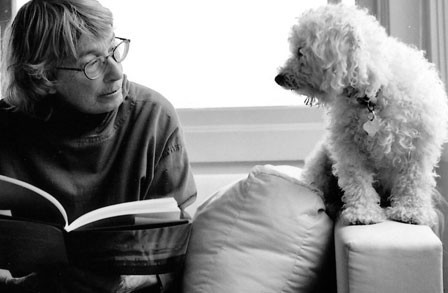
 Judging by her phenomenal sales, Mary Oliver surely rates as America’s unofficial poet laureate, and yet the anomaly that she’s never held the office since its inception in 1937.
I have to confess that I hadn’t heard of her, despite teaching modern poetry for some thirty-five years, probably because the Modernists held sway when I was in graduate school and during much of my tenure.
Likewise, she’s excluded from The Norton Anthology of Modern Poetry, a principal text in modern poetry courses, despite having won both a Pulitzer and a National Book Award.
In her favor, however, is a sympathetic overview of her work by the Poetry Foundation, which I recommend as a starting place for those new to her poetry.
I came to her poetry late and in the oddest way through an online course in meditation called “Demystifying Mindfulness, ” where one of her poems, Mindful,” was included for its affinity with mindfulness practice, often associated with Buddhism:
Every day
I see or hear
something
that more or less
kills me
with delight,
that leaves me
like a needle
in the haystack
of light.
It was what I was born for –
to look, to listen,
to lose myself
inside this soft world –
to instruct myself
over and over
in joy,
and acclamation.
Nor am I talking
about the exceptional,
the fearful, the dreadful,
the very extravagant –
but of the ordinary,
the common, the very drab,
the daily presentations.
Oh, good scholar,
I say to myself,
how can you help
but grow wise
with such teachings
as these –
the untrimmable light
of the world,
the ocean’s shine,
the prayers that are made
out of grass?
I’ve now read a lot of her poetry, with many more to go–she’s written 26 books of verse–with every poem a kingdom of delight.
I think she’s given poetry back to us with her craft wielded in directness and simplicity, yet latent in nuance. And then there’s that redolent pathos, or intensity, of a voice resolute with conviction hammered out on the anvil of experience, not always kind.
Over a lifetime, I’ve preferred a poetry complicit in ambiguity, or tension; poetry resounding in the inequities of existence and the paradoxical.
Oliver wins me over, nonetheless, because like the Romantics before her, her verse glistens with acute awareness of life’s brevity and the imperative of living each day as Wordsworth might say in “wise passivity,” mindful of the sensory aspects within ourselves that connect us with all sentient beings in the bubble of transience.
Best of all, I’ve found that in those nights that I cannot sleep, in turning to her poetry I find solace and with it, sleep.
I’m not surprised there are Buddhist affinities in poems such as “Mindful.”
Buddhism isn’t really about reincarnation; its about being alive to the nowness of the moment, whether good or bad, in a cosmos of impermanence where even the stars ultimately suffer mortality.
Buddhism, however, can’t claim her, for her poetry embraces a spirituality that transcends religion with its orthodoxies, reverencing the sanctity of all things, like her great master, Walt Whitman, in its celebration of the holiness of the profane.
Of her many poems, I think “When Death Comes,” surely a thematic key to her poetry, is my favorite. Accordingly, I find myself hungry to lock its wisdom into the privilege of each morning’s waking:
When death comes
like the hungry bear in autumn;
when death comes and takes all the bright coins from his purse
to buy me, and snaps the purse shut;
when death comes
like the measle-pox
when death comes
like an iceberg between the shoulder blades,
I want to step through the door full of curiosity, wondering:
what is it going to be like, that cottage of darkness?
And therefore I look upon everything
as a brotherhood and a sisterhood,
and I look upon time as no more than an idea,
and I consider eternity as another possibility,
and I think of each life as a flower, as common
as a field daisy, and as singular,
and each name a comfortable music in the mouth,
tending, as all music does, toward silence,
and each body a lion of courage, and something
precious to the earth.
When it’s over, I want to say all my life
I was a bride married to amazement.
I was the bridegroom, taking the world into my arms.
When it’s over, I don’t want to wonder
if I have made of my life something particular, and real.
I don’t want to find myself sighing and frightened,
or full of argument.
I don’t want to end up simply having visited this world.
–rj