Gretel Ehrlich, in her splendid The Solace of Open Spaces, writes that “a person’s life is not a series of dramatic events for which he or she is applauded or exiled but a slow accumulation of days, seasons, years, fleshed out by the generational weight of one’s family and anchored by a land-bound sense of place.”
This brings to mind Israel’s Bedouins, a traditionally nomadic people once populating a vast desert terrain, whom T. E. Lawrence understood and celebrated. And they reciprocated.
In his own time, Lawrence lamented the increasing fate of urbanized Bedouins, their loss of place and a way of life: “The perfectly hopeless vulgarity of the half-Europeanised Arab is appalling. Better a thousand times the Arab untouched.”
Much of that traditional way of life is but memory, especially in Israel, where Jewish settlers in the Negev have frequently seized Bedouin lands and driven out their people.
A vivid example is Twayil Abu Jarwal, one of forty unrecognized Bedouin villages in the Negev. Lying north of Beersheba and off the beaten track, you’ll not find it on any map.
It has no permanent structures for its 450 inhabitants, housed in tents, and clinging stubbornly to place and a way of life.
The village and its fields have been bulldozed so many times that no definitive account exists, perhaps between 25-50 times.
Still they cling to what’s long been theirs for two millennia or more.
After each razing, they re-assess, restore their sheltering tents, and plant anew.
Ilan Yeshurun, who directs the local Israel Land Authority, interviewed in the JerusalemReport, defends these demolitions: “This is not a village. It doesn’t exist on any map or in any legal registration. It’s only a village in the eyes of the Bedouin.”
Critics call it “urbicide,” an Israeli attempt to destroy perceived communities of potential Palestinian resistance. I think it more than that—a quest for expanding settler homesteads, akin to America’s violent history of seizure of Native American lands.
Meanwhile, some fifty illegal settler farms have sprung up and, politics as usual, nothing is done.
There are now just six Israeli authorized Bedouin villages. Presently, an extended Highway 6 thrusts its way into their traditional landscape, with Israeli plans to continue their policy of demolition and resettlement.
Understandably, Trayil Abu Jarwal villagers fear not only a loss of their land, but a way of life.
Thomas Wolfe famously wrote that “you can’t go home again,” meaning that time brings evolution and experience changes us, uprooting past constituents of our nurturing tied to place.
On the other hand, his dictum locates the modern tragedy of living in a mobile society. Home is an extension of ourselves, evoking sanctuary and fostering identity..
T. E. Lawrence had promised the Bedouins emancipation from the Ottomans Turks. But with takeover of Ottoman land by a modern Israel, they languish still, their cries unheard.
My post on Elon Musk yesterday elicited one of the largest Brimmings audiences in its twelve year history. I endeavored to be fair to all sides in assessing this polarizing man.
But I need to do a postscript that may help clarify what lies behind his thinking and purchase of one of the world’s leading media platforms and, notably, his resistance to censorship, whether of Left or Right. As he’s told us, he’ll not please either.
You see, I view him as essentially a libertarian, not conservative. Unfortunately, many conflate the terms. Libertarians agree with conservatives in opposing government interference with free enterprise, curtailing deficit spending, mandated protocols and alleged incursions on free speech.
They also agree with conservatives on a strong miliitary, capable of responding to threats to the nation’s security, gun ownership rights, etc.
On the other hand, libertarians believe abortion is a free choice option, a huge difference indeed. They support same sex marriage, judicial reform, and ending capital punishment. While they support a capable military, they eschew bloated spending and policies of overseas intervention that have led to Vietnam, Iraq and Afghanistan. They describe the Bush administration’s incursion in Iraq as “an obscene, depraved act of naked aggression”(libertarian.org).
Libertarians believe we need to follow George Washington’s counsel in his Farewell Address to avoid foreign intervention and alliances. We are not the world’s police or its savior.
Libertarians, unlike many conservatives, are hugely supportive of the environment: “We support a clean and healthy environment and sensible use of our natural resources. Private landowners and conservation groups have a vested interest in maintaining natural resources. Pollution and misuse of resources cause damage to our ecosystem. Governments, unlike private businesses, are unaccountable for such damage done to our environment and have a terrible track record when it comes to environmental protection…..We realize that our planet’s climate is constantly changing, but environmental advocates and social pressure are the most effective means of changing public behavior” (ontheissues.org).
On immigration, there is much that even Progressives could like: “We welcome all refugees to our country. Furthermore, immigration must not be restricted for reasons of race, religion, political creed, age, or sexual preference. We therefore call for the elimination of all restrictions on immigration, the abolition of the Immigration and Naturalization Service and the Border Patrol, and a declaration of full amnesty for all people who have entered the country illegally” (ontheissues.org).
Presently, Libertarians have grown to be the nation’s third largest party. In 2020, they took 20% of the vote in Virginia; surprisingly, 9.4% of the vote in my native Massachusetts.
As the libertarian label suggests, they advocate a live-and-let live approach with priority on personal liberty and limited government.
Musk is an enigma when it comes to his politics. He says he’s half Democrat, half-Republican; in short, a moderate. Despite his avowal, he exhibits a strong libertarian streak, emphasizing citizen polity over government imposition.
Revealingly, our space-minded mogul has hinted at what a Mars government might look like, or oriented along libertarian lines with people voting directly on issues: “I think that’s probably better, because the potential for corruption is substantially diminished in a direct versus a representative democracy” (metro.co.uk).
We know his friend and PayPal co-founder Peter Thiel is decidedly libertarian, as Musk admits: “I’m somewhat libertarian, but Peter’s extremely libertarian” (newyorker.com).
In January he tweeted “True national debt, including unfunded entitlements, is at least $60 trillion – roughly three times the size of the entire US economy. Something has got to give” (nationalinterest.com). Libertarians, ardent critics of social security, would hardly disagree.
A libertarian mindsets goes far in contextually explaining his vociferous resistance to censorship and government interference. As a visionary, he outdistances conservatives with his free-wielding views on needful social reforms ranging from judicial, military, environment, abortion and free trade.
Like libertarians, he exhibits affinity with Victorian Britain’s liberals, vociferous advocates of limited government, non-censorship and social reform (e.g., Bentham, Mill, Gladstone).
It may be limiting to label protean Elon a libertarian, but as American poet James Whitcomb Riley (1849–1916) famously put it, “When I see a bird that walks like a duck and swims like a duck and quacks like a duck, I call that bird a duck.”
Whatever your opinion may be about entrepreneur Elon Musk, who shocked the social media world with his purchase of Twitter, you can’t ignore him.
Voted TimeMagazine’s Person of the Year in December 2021, he happens to be the world’s wealthiest man with an estimated net worth of $253 billion, far out-distancing Amazon’s Jeff Bezos at $162 billion (ceobuz.com, April 28, 2022).
He can buy just about anything and does. Coca Cola may be next.
Affluence brings influence, and Musk doesn’t shirk from peddling it. Last year his Space X’s PAC contributed a record-breaking $2.4 million to politicians of both parties; Tesla, 1.5 million (opensecrets.org).
He has donated money to the presidential campaigns of Barak Obama and Hillary Clinton.
In California, he contributed to the campaigns of Gov. Gavin Newsom, Dianne Feinstein, Meg Whitman, and former governor Jerry Brown.
Though he says he prefers to stay out of politics, it hasn’t stopped him from entering the political fray. He opposes Biden’s tax credit proposal to give a $4,500 discount to consumers buying vehicles made by union workings, affording an advantage over Tesla, Toyota, and others.
He supported Andrew Yang, who advocated for a universal basic income, in his 2020 primary run.
Since 2003, Space X has secured $1.5 billion in contracts, mostly NASA related.
He vehemently opposes Biden’s proposal to close the tax loophole for billionaires to help finance his safety net plan.
His battle with the FEC over regulation has been ongoing.
He abhors union organizing.
To brand him as an ultra conservative, however, is untrue in its simple-minded reductionism. Like others such as rival Bezos, he’s pragmatic, focused on his business interests.
Musk isn’t easy to like and there exist significant foreshadowings of trouble with his takeover of Twitter. Despite his advocacy of freedom of speech, he’s been known to fly off the handle with subordinates who have disagreed with him, or engage in “rage firing.” In his just published book, Power Play: Tesla, Elon Musk, and the Bet of the Century, TheWallStreet Journal writer Jim Higgins gives numerous, detailed instances of Musk’s firing of contractors and employees out of sheer rage.
Nonetheless, he deserves credit for being a climate change hawk, if not pioneer, founding Tesla, an EV concern. 75% of EV vehicles sold this year were Teslas. Tesla solar panels are on thousands of rooftops in the U.S. Climate change hasn’t been a priority issue for most conservatives. He was among the first in line to oppose Trump’s withdrawal from the Paris climate accord.
Musk is one of your consummate engineers, a segment to whom we owe substantial, but unacknowledged, gratitude for its contribution to the public welfare and many of the amenities we enjoy.
He revitalized a non-viable EV industry, designing a new battery and reviving a waning space program as well. Courageously championing the new technology and investing heavily, he taught himself rocketry and invented an entirely new space craft.
The pity would be that his new venture might distract him from the substantial contributions he’s made to mitigating climate change, Tesla bridging the gap on the issue between liberals and conservatives, a sentiment echoed by environmentalist Bill McKibben, founder of 350.org.
A registered independent, Musk has tweeted, “To be clear, I am not a conservative. Am registered independent & politically moderate. Doesn’t mean I’m moderate about all issues. Humanitarian issues are extremely important to me & I don’t understand why they are not important to everyone.”
He takes Russia’s Ukraine incursion seriously and has supplied the country with thousands of Starlink kits to maintain its Internet, essential to its survival. Zelensky has thanked him for this. Critics minimize the charity component, saying the U.S. government did the financing. The reality is Space X donated thousands of kits on its own.
The Left has, nonetheless, turned him into Lord Voldemort, infamously rich, tax-dodging and a taunting critic of its activism: “The far left hates everyone, themselves included! But I’m no fan of the right either,” Musk tweeted Friday morning. “Let’s have less hate and more love” (April 29, 2022).
If he’s paid little tax, it’s the fault of the system, not Musk. A good many Democrat and Republican members of Congress, many of them millionaires, maximize their own exemptions.
Musk views government regulation as hostile to innovation and laments huge deficit spending, contributing to inflation.
Conservatives are liking Musk and enthusiastic about his acquisition of Twitter. They applauded his moving Tesla headquarters from blue state California to red state Texas. They’ve long felt that Twitter has frequently discriminated against them. Last year, it banned Trump permanently. Enthusiasts advocate a presidential run in 2024, ruled out for the South African born Musk by the Constitution.
Conservatives point out the Taliban’s presence on Twitter, yet Trump is banned. On the other hand, the Southern Poverty Law Center has criticized Twitter’s allowing right wing extremists a platform for staging the January 6, 2020 Capitol attack.
Musk says he bought Twitter to promote free speech and has plans to make it better: “Free speech is the bedrock of a functioning democracy, and Twitter is the digital town square where matters vital to the future of humanity. I also want to make Twitter better than ever by enhancing the product with new features, making the algorithms open source to increase trust, defeating the spam bots, and authenticating all humans. Twitter has tremendous potential — I look forward to working with the company and the community of users to unlock it.”’
The problem is we don’t really know what Musk means by this. Democrats, understandably, remain fearful. Will the likes of Donald Trump and misinformation saturate the new Twitter? Many leftist tweeters have already departed.
Not much talked about, Musk has considerable business ties with China, hardly your paragon of free speech. In fairness, he isn’t alone in the business community when it comes to prioritizing profit over human rights issues. Would it make Twitter more reluctant to remove China propaganda or misinformation posts? China is Tesla’s second largest market with half of its cars produced there. Musk has been the beneficiary of several billion in Chinese investment loans.
Several leading Congressional Democrats are advocating a review of the purchase.
Truth is, many Twitter aficionados, including Democrats, adore Musk, who has 81.2 million followers.
He’s admired by the public for his fierce independence. He’ll not be reigned in. He speaks to the issue, not the political mindset. He does what many can only dream.
On the other hand, most Democrats see him as a wolf in sheep’s clothing. He may not be able to run for president, but were Trump reinstated and make a run to regain the office, Twitter could potentially impact the race in his favor. Twitter enjoys an estimated 300 million users worldwide, 38 million of them in the U.S.
Just the other day, Musk hinted at the possible scenario: “Time outs are better than permanent bans. A good sign of free speech is: Is someone you don’t like allowed to say something you don’t like? … Twitter has become a de facto town square. It’s important people have the reality and the perception that they’re able to speak freely within the bounds of the wall.”
Reinstating Trump would likely trigger a Tsunami tidal wave, with many skilled staff and millions of Twitter users deserting its ranks and unleashing an aroused Congress. Meanwhile, Trump says he’ll never return to the platform, no matter what Musk does.
But no need for heart palpitations just yet. The deal doesn’t close for six months, allowing for a lot to happen. Thursday, the Federal Trade Commission, announced its seeking whether Musk observed an antitrust reporting requirement when he initially invested in Twitter (Reuters).
Then, too, the UK and EU, concerned that that a Musk owned Twitter may attract extremists, insists Twitter conform to new content rules or face sanctions that would include fines or even a total ban.
Given his mercurial temperament, it’s conceivable he could withdraw from the deal, triggering a billion dollar penalty, agreed to by Musk.
In its latest issue, TimeMagazine states “the lesson of Musk’s career is to take his ambitions seriously. He’s rich not because he gamed the system but because he’s a genius who uses the incredible force of his will to mobilize resources to pursue his ideas. He’s devoted himself to tackling what he views as humanity’s biggest problems, and he has decided, as he put it recently, that ‘having a public platform that is maximally trusted and broadly inclusive is extremely important to the future of civilization.’”
Russia’s cruise missile attack on Kyiv yesterday just after UN Secretary António Guterres’ visit with Ukraine’s President Zelenskiy demonstrates the determined, relentless resolve of Putin to bring Ukraine to heel and punish its Western sympathizers.
We know about Russia’s crimes against civilians, raped, tortured and executed; its killing of soldiers who have surrendered; bombings of train facilities providing civilian egress from war zones; attacks on schools and hospitals.
The truth is Russia blundered into this war, thinking a quick assault on Kyiv and regime change would yield victory within a few weeks.
Surprised by the vehemence of Western reprisals via sanctions and steadfast supply of weaponry, increasingly of an advanced nature, and fierce Ukrainian resistance, Russia now faces prolonged, bloody entrenchment and even defeat.
British intelligence indicates a loss of 15,000 troops, with many more wounded.
American sources indicate the Russians have lost 25% of their military capability.
Now the war has expanded into Russia, with military infrastructure within Russia being hit, causing panic upon nearby civilians and calls for retaliation.
Meanwhile, despite Putin’s denials, the Russian economy has suffered enormously.
For several weeks, Putin has been menacing the West with apocalyptic warnings of nuclear consequences for nations threatening its security, notably the U.S. and Britain: “If anyone intervenes in Ukraine and creates unacceptable threats for us that are strategic in nature, our response will be lightning fast. We have all the tools for this that no one else can boast of having. We won’t boast about it, we’ll use them, if needed.”
Will Putin carry out his threat?
Yes, but not against NATO nations, for that would lead to an unimaginable horror fallout of nuclear exchange and Moscow’s decimation to rubble in minutes.
What’s more likely to happen is a low-yield employment of nuclear tactical weaponry delivered through aircraft and artillery.
Russia, probably correctly, thinks the West will pull back its support and Ukraine will surrender, with huge loss of its territory, in short order.
Putin cannot afford to lose this war he’s presumptuously waged.
Thus far, the West has not singled any probable response to nuclear weaponry in Ukraine, increasing the likelihood of Russia’s adopting such draconian measures similar to what the U.S. resorted to in Japan.
I begin my day daily, reading the news, the wrong way to commence a new day, heavy with humanity’s burdens I can do little about.
I would do better in rising with the sun, to set my day’s course like a compass pointing to true North on what matters, enriches, and contributes to well-being, not only for myself but, more importantly, for others.
I remember lines from one of Mary Oliver’s last poems: “Wherever I am, /the world comes after me. /It offers me its busyness. /It does not believe that I do not want it.”
We think of ourselves as separate from the main. Prisoners of self-interest, we’ve relinquished poet John Donne’s maxim, “No man is an island.“
As humans we crave togetherness.
We abhor loneliness.
We require bonding and the cohesion it brings.
I’ve traveled to many places, often alone, but the trips I remember most were those I’ve shared with others. To experience something awesome, but with no one to share it, somehow bottoms out its delight.
Like leaves on a tree, individual in their shape and shimmering on their branches, we feed into a trunk that flourishes when its leaves work collectively. We are citizenry of a greater Self.
We live in a time of electronic fellowship. Billions turn to Facebook, Twitter, Instagram, ad infinitum, in a desire to connect, ample evidence we need one another to complete ourselves.
We find the relational in other, more meaningful ways. We love, we marry, we have children, we make friends, we frat with those sharing like interests, we bond with our pets. And yes, we write books—and even do blogs!
Unfortunately, since Descartes with his “I think, therefore I am,” we’ve weighed our lives down with ego indulgence, mindless of that greater entity of collective humanity and of Nature that grants us being and sustains.
In Victorian times, Bentham’s notion of utilitarianism was in vogue, its thesis that what promotes happiness is good; what promotes pain is bad. Essentially hedonistic, it was vehemently satirized by Dickens in Hard Times as serving the wealthy at the expense of the working class.
Modern psychology hasn’t helped mend our ways. Self-validation defines its focus. Witness the plethora of books on self-improvement. I was schooled in behaviorism at the grad level with its notion that humans are little more than pigeons, subject to stimulus response, driven by self-interest. Accordingly, prescribed behavior can be reenforced through operant conditioning that awards the positive; conversely, extinguishing the negative via the punitive. Anthony Burgess, whom I met briefly many years ago, deciphered it rightly in Clockwork Orange (1962), one of the 20th century’s most profound books.
In economics, capitalism is founded upon the same a priori of what’s in it for me, ushering in the Adam Smith credo of self-interest and competition as prerequisites to prosperity. Its consequences are with us daily, the one percent owning half the wealth, the exponential decline of the middle class, the continuous emphasis on growth despite diminishing natural resources.
In his widely published The Selfish Gene (1976), evolutionary biologist Richard Dawkins tells us that genes act to preserve their self-interest, with altruism, when it does exist, functionally symbiotic as in bees and ants. In fairness, Dawkins does propose that humans have potential capacity with growth in moral intelligence to modify evolution’s predilection for self-interest. Harvard’s eminent psychologist Stephen Pinker, who sets out in The Angels of Our Better Nature (2011) to statistically validate the decline of violence, should be pleased.
On a human scale, I think of Japan, unique in its protocol of collective behavior in the interest of public welfare that critics might disdainfully dismiss as herd mentality or, essentially, a vestige of Hobbes’ “enlightened self-interest.” Nonetheless, Japan is one of our few stable nations, high in economic equality, rare homelessness, and little crime. When the tsunami struck in 2011, unlike in other nations, there were few reports of looting. No need to send in the National Guard. My own memories of Japan confirm a pervasive politeness and honesty I’ve found unequaled in my travels.
In contrast, I think of what took place with the COVID outbreak, nearly a third of Americans not getting vaccinated and, even more, refusing to mask. As one business man told me, “It’s a personal choice.” But then this isn’t confined to America. In France, Belgium, and Germany gargantuan anti COVID protocol demonstrations, some of them violent, have occurred. Theirs is the right to infect others and continue the pandemic. By the way, Japan’s COVID mortality rate was 14.52 versus 233.8 in the U.S. as of Nov. 21, 2021, according to Johns Hopkins University stats.
Reading the news reminds me of the human folly behind the headlines, whether of individuals or nations, in pursuing self-interest. Sowing greed, we have reaped social dissonance with high crime, economic disparity, and homelessness among its results.
Frost wrote a renowned poem, “Mending Wall” in which the persona tells us of his neighbor, who advocates “Good fences make good neighbors.” I’m for tearing down walls that separate us.
In mutuality we find our common denominator, making for a better world. In discovering the Other, we find ourselves.
Across the country, even globally, the mad rush is on by politicians to indulge the public mood and eliminate COVID restrictions. I think it a mistake and that it comes too soon.
At home, nearly a million Americans have perished and our medical grid buckles as COVID patients, the vast majority unvaccinated, take up hospital beds. Meanwhile, many needing cancer screening, surgery or follow-up are turned aside. New research reveals its devastating consequences.
Long term COVID can be dehabilitating, even for those vaccinated. Recently, I had conversation with a man from Louisville, a home physical therapist. He shared he had come down with the virus six months ago, was placed on a ventilator, then developed pneumonia. He still doesn’t feel right. He’s married with four children and just 29. He told me—I didn’t need convincing—that he’d not be here at, all had he not been vaccinated.
Yes, omicron infections have been plummeting, but they still highly exceed the number of infections before the Delta impact, then averaging between 12,000 and 16,000 daily cases. In contrast, “the U. S. daily average of cases and hospitalizations on 16 February was about 124,000 and 81,000” (NYT).
As Vanderbilt University School of Medicine infectious disease expert William Schaffner cautions, “Some governors think we are almost there – they are dropping mask mandates – and my response is: good luck to you. My fingers are crossed on your behalf.”
I believe strongly in Biden’s mandates to ensure public safety, sadly thwarted by the courts under the auspices of the First Amendment and public non-compliance. Good government that seeks the welfare of its citizens fulfills government’s proper role without nullifying the tenets of our Constitution.
Observing COVID protocol is not a personal choice. It’s a necessity.
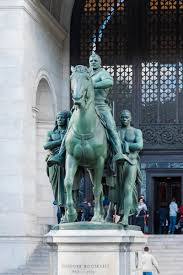
The press largely missed last week’s removal of the Teddy Roosevelt statue from the grounds of New York’s American Museum of Natural History, which had been in place for eighty years. Progressives argued it was colonialist in nature, a white man on horseback accompanied by an African and Native American on foot.
Roosevelt is consistently rated as among America’s best ten presidents, an ardent naturalist and political liberal. The African and Native American reflect his renowned role as explorer, not colonialist bent on exploitation. Nonetheless, the efforts of the Left, ignoring cultural antecedents, persist in rewriting history, or what I call “purging” it to conform with ideology.
I’m reminded of Orwell’s still relevant observation that “the really frightening thing about totalitarianism is not that it commits ‘atrocities’ but that it attacks the concept of objective truth; it claims to control the past as well as the future.” Similarly, progressives seek to assuage history’s realities by projecting their politics on to the past, while hypocritically ignoring the malignant realities of today’s Cuba, Venezuela, and Nicaragua.
As always, we do well to avoid peripheries, whether of Left or Right. We properly amend history by learning from its failures and not repeating them.
Yesterday’s Tampa Bay come-back win, led by legendary Tom Brady in the final two minutes over the Jets, highlights Brady’s remarkable career. His greatest moment, however, may have come with his compassion for troubled teammate Antonio Brown, who quit the team in the third quarter, tossing his shirt into the crowd and running into the exit tunnel. “I think everybody should do what they can to help him in ways that he really needs it. We all love him, we care about him deeply. We want to see him be at his best, and unfortunately it won’t be with our team.” Johns Hopkins Medicine reports that 26% of AmerIcans over 18 suffer from some form of mental illness, including anxiety disorders; of our homeless, an estimated 25% from mental illness. Obviously a troubled man, Brown, needs professional help, like so many others in these stressful times. “I think everyone should be very compassionate and empathetic toward some very difficult things that are happening,” Brady added. Thank you, Tom, for showing us the way. —rj
Of all character attributes, what counts most? For me, it’s integrity, or doing the right thing, regardless of circumstance, especially when no one’s around. I say this because of the pervasive anonymity our high tech age confers. I confess to being a Marcus Aurelius devotee, who in Meditations wisely counseled, “Do not act as if you were going to live ten thousand years. Death hangs over you. While you live, while it is in your power, be good.”
I was seated by a corporate CE0 on a flight years ago and we began to converse. He shared that what he looked for most were trustworthy employees committed to doing the job right, workers not requiring micromanagement. Warren Buffett echoes this sentiment when he counseled, “We look for three things when we hire people. We look for intelligence, we look for initiative or energy, and we look for integrity. Without the latter, the first two can hurt you.“
In short, trustworthiness is primary, sorely lacking in business, politics and even religion today. And yes, too frequently in private conduct. Some may call it, ‘walking the talk.” I call it Integrity.—rj
In his Meditations, Marcus Aurelius recommends we accept all things, even the painful: “Convince yourself that everything is the gift of the gods.” Although this seems problematic, with everything that happens to us, good or bad, we can gain insight, transcend rather than recoil or take offense. If someone hurts me, I reach for the good that remains in that person. If stricken ill, I’m more mindful of healthy changes I must make. With the pandemic, I gain awareness of my need to protect others and give thanks for more time at home with those I love. As Epictetus, whom Aurelius follows, tells us, “Everything has two handles.” In all things, grasp the easier, more positive handle, and give thanks, both now and always.