The Caspian Sea linking Iran and Russia may seem to be a quiet body of water, but the reality is that it has become Iran’s busy artery for exporting weaponry to Russia in violation of the United Nations Security Council’s 2015 prohibition on missile and uninhabited aerial vehicles (UAV) transfer, known as Resolution 2231.
Lloyd’s List Intelligence has indicated a recent uptick in Caspian shipping between Russia and Iran, some ships going dark. Additionally, CNN has tracking data, showing 85 Iranian cargo plane trips to Moscow airports between May 2022 and March 2023.
In any case, Iran has been violating the Resolution for several years, supplying drones to Houthi rebels in Yemen, who’ve employed them to attack Saudi Arabia and, this week, American naval vessels in the Persian Gulf.
Additionally, we know from intelligence sources that they’ve been supplying lethal drones to the Russians since the summer of 2022, who have been employing them on a near daily basis in Ukraine.
Both Iran and Russia vociferously deny violating Resolution 2231. They needn’t worry. It expired on October 18, 2023.
Unfortunately, the Biden administration has been amiss in soft-pedaling Iran’s intransigence in a concerted effort to renew the 2015 Nuclear Arms Limitations Treaty with Iran. Though the US has pledged to monitor the illegal weaponry trade, employing sanctions if needed, Biden approved the return of $6 bn of frozen Iranian funds from South Korean banks as part of a prisoner exchange deal in August.
Qatar will administer Iranian access, to be used only for humanitarian purposes. This will free, however, Iranian budget money elsewhere for terrorist groups such as Hezbollah.
Hamas’ brutal attack on Israeli civilians was augmented by hundreds of Iranian supplied rocket salvos into the Israeli infrastructure, including Tel Aviv. Meanwhile, Hezbollah in Lebanon have been firing missiles into northern Israeli settlements and attacking American forces in Syria and Iraq.
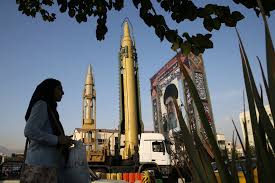
Iran possesses a sophisticated arsenal of some 2000-3000 missiles that include short-and medium-range ballistic missiles, a long-range cruise missile, and long-range rockets. Its medium ballistic missiles could conceivably be armed with a nuclear payload, should Iran continue its advance to a nuclear bomb.
We know, too, that the Iranians have been working on a ballistic anti-ship missile to be potentially used against American aircraft carriers.
Will they ultimately effect a nuclear capacity to hit the US mainland as North Korea has done? Or before then, will Israel, under grave nuclear threat, launch a first strike of its own on Iran’s myriad underground bunkers, plunging the world into a nightmare scenario?
As we all know, several thousand Gaza Hamas fighters bulldozed their way through an Israeli security fence on October 7, 2023, and committed some of the most barbaric crimes against humanity not seen since Cambodia, Rwanda, and the Holocaust.
More than 1400 Israelis died, most of them civilians, some slaughtered in nearby fields while celebrating the ending of Sukkot, an annual fall event in the Jewish calendar; others, in their beds on nearby kibbutzim. Reports are that Hamas insurgents raped, pillaged, and slaughtered even children, including babies. More than 200 civilians and soldiers were taken hostage, including citizens of other countries. Israeli wounded stands at 4600.
The Israeli response has been unceasingly withering in Gaza, Prime Minister Netanyahu declaring war on Hamas, calling up 300,000 reservists, bombing Gaza’s civilian infrastructure daily, and ordering one million Gaza civilians to evacuate to southern Gaza.
A land invasion of Gaza by Israel Defense Forces (IDF) is anticipated. They will face up to 50,000 Hamas fighters, dispersed in a labyrinthian tunnel weave, threatening a Stalingrad consequence of casualties in house-to-house fighting. American pressure has slowed any launching of an immediate invasion, but not halted the daily bombing, killing 700 civilians in the last twenty-four hours, half of them women and children.
Hezbollah, to the north in Lebanon, have been firing rockets into nearby Israeli border towns, forcing their evacuation and possibly opening a second front in a dangerously escalating Middle East conflict. Iran has pledged to intervene if Israel launches a land invasion of Gaza.
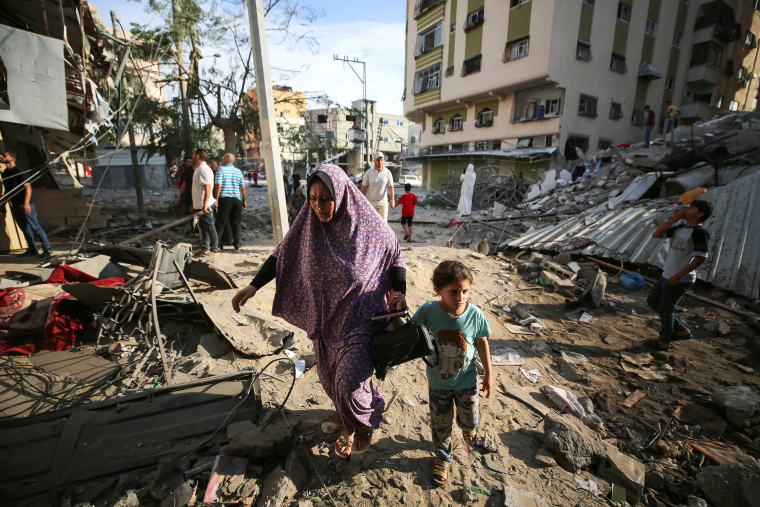
In the meantime, the death toll of Gaza civilians now exceeds 5,000, including more than 2000 children, the cut off of food, water, and energy to Gaza, the forestalling of shipments of humanitarian aid from Egypt, which threatens the closure of hospitals treating thousands of wounded civilians. Mass starvation and disease looms as an aftermath, Israel insisting that hostages be released, despite international calls for restraint and observance of humanitarian values.
Recently, a Christian hospital in Gaza came under rocket attack, killing 500 people among those taking shelter. International intelligence indicates it was an errant Hamas rocket that caused this tragedy. Nonetheless, the World Health Organization has documented 171 Israeli attacks on health care in the occupied Palestinian territory,” killing 473 health workers.
As I write, unrest continues on the West Bank, with some 100 Arab protestors killed. A pending historic security alliance has been withdrawn by the Saudis and Israel’s peaceful relationship with Jordan has been strained. Settler crimes against West Bank farmers have been chronicled over the years, with killing of livestock, destruction of olive groves, and slaying of those who resist.
The U.S. response has been typical, Biden ordering two aircraft carriers into the gulf and threatening to intervene should Hezbollah open a second front. It has called for a two state settlement for many years, yet overlooked Israeli intransigence. It gives $3 billion in aid annually to Israel and recently concluded a $37 billion loan agreement in military aid. Israel will have access to the F-35, the world’s most advanced fighter jet.
At home, dissenters are regaled as antisemitic. Many, including Democrats, have called for disbandment of Palestinian student campus organizations and denounced the growing Leftist faction in the Democratic Party that includes Bernie Sanders. Frenzied Republicans, increasingly resistant to continuing aid to Ukraine, have no difficulty supporting huge expenditures to Israel. Lindsey Graham says, “Do whatever the hell you have to do to defend yourself. Level the place!”
There is, in short, a context for Arab and Palestinian resentment and outburst. We seem to have learned nothing from the rage that lay behind the 9/11 horror. We began two long wars, fought by America’s poor White and Blacks. We lost both. Did Vietnam teach us nothing?
Do we lust for another war? Have we forgotten George Washington’s warning to avoid “entangling alliances”? “The nation which indulges toward another an habitual hatred or an habitual fondness is in some degree a slave” (Farewell Address).
UN secretary-general António Guterres speaks for me: “Hamas did not happen in a vacuum. The Palestinian people have been subjected to 56 years of suffocating occupation.” He likewise condemned Hamas: “No injustice to the Palestinians justifies the appalling attacks by Hamas.”
The Israeli response to Guterres? “Due to his remarks we will refuse to issue visas to UN representatives” (Gilad Erdan, Israel ambassador to the UN). “The time has come to teach them a lesson. Guterres should resign.”
Hamas was elected to power in 2006. There have been no elections since. Does “Israel’s right to defend itself” (Biden) justify its war on Gaza civilians, half of whom are children?
Ultimately an apartheid Israel will reap its own folly. Israel’s growing Arab population will soon outnumber Israelis. It will become a South Africa before Nelson Mandela’s victorious crusade for a liberated biracial nation enjoying equity.
I’ve never formally studied Walt Whitman’s poetry, despite a graduate degree in English. That’s because I made Victorian Literature my major interest, with modern American and British Literature secondary. Still, I’ve read his landmark Leaves of Grass many times, America’s psalmody in its pioneering free verse; in its robustness, an encomium of America were it doing more than lip service to the American dream.
It says much about Whitman, out-of-joint with his generation much like contemporary Emily Dickinson, uncomfortable with the cultural shibboleths of middle class Amherst. Perhaps influenced by his father’s radical views on politics and religion, Whitman emerges an essential element of America’s constant of progressive rebellion, resistant to mercenary interests that gave us slavery, wealth inequality, desecration of nature, racial injustice, and imperialism.
If you’re looking for a summation of Leaves of Grass, nothing excels his “Credo” in the poem’s Preface. Conscious of America’s failure to live up to its promise, “Credo” exemplifies its gulf and champions its realization:
“This is what you shall do; Love the earth and sun and the animals, despise riches, give alms to everyone that asks, stand up for the stupid and crazy, devote your income and labor to others, hate tyrants, argue not concerning God, have patience and indulgence toward the people, take off your hat to nothing known or unknown or to any man or number of men, go freely with powerful uneducated persons and with the young and with the mothers of families, read these leaves in the open air every season of every year of your life, re-examine all you have been told at school or church or in any book, dismiss whatever insults your own soul, andyour very flesh shall be a great poem and have the richest fluency not only in its words but in the silent lines of its lips and face and between the lashes of your eyes and in every motion and joint of your body.”
I remember Japan fondly, falling in love at first sight. It was twelve years after WWII and a place remarkably different from anywhere else and, in large measure, it has remained so.
It had been a long flight from Travis AFB in California, a brief stop in Honolulu for a crew change, then on to Wake Island, where President Truman had a few years before confronted a defiant General MacArthur, then on to Yamoto Air Station, 23 miles from Tokyo.
I was 17, an airman headed for Korea for the next 12 months. Yamoto meant processing before continuing on a C-47 for Osan AFB near Seoul.
Japan was then this kaleidoscope of sensuous bombast—human drawn rickshaws, coolies in straw conical hats, buckets suspended on long poles between their shoulders, and everywhere, women garbed in flowery kimonos on densely packed streets.
I would return to Japan twice on rest leave, the first time centering on Tokyo and its Ginza, even then, bustling with elegant department stores, game shops, restaurants, art galleries, theaters and night clubs, illuminated at night by a swarm of neon lights rivaling those of Vegas and New York. I would visit the grounds of the Imperial Palace, the Great Kanto Earthquake Memorial, and the Great Buddha of Kamakura bronze statue originally cast in 1252.
One of the supreme highlights was keeping company with American Quaker friends in Tokyo, who arranged a get-together with university students, fluent in English. They gave me a different war vista in narrating the American fire bombing of Tokyo, March 9-10, 1945, killing 100,000 civilians and leaving 1,000,000 homeless. I learned that it’s the victors who write the history we imbibe and I remain moved by their civility to me, an American serviceman.
A few days later, I journeyed by car with my friends, laboring up twisting mountain roads to the shrine city of Nikko 97 miles from Tokyo, where I lived several days in traditional Japanese manner, sleeping in minimalist fashion on a tatami soft mat made with rice straw fill, rolled out on the floor, then layered with a Shikifuton, or thin mattress, and a buckwheat hull pillow. To keep warm, an added Kakefuton , or soft quilt.
Following a hot bath, dressed in kimono, served a fish-seaweed meal, no links to an external world, I slept soundly.
I’m not certain how prevalent this ancient sleeping mode survives in modern Japan, though I know traditional inns abound in Kyoto, that magical city of April cherry blossom.
On my second visit, I took a long distance train from Tokyo to Fukuoka, one of Japan’s most populated cities on the southern island of Kyushu. I wish I could remember what I took in there, but I draw a blank, though I recall being dazzled by its department store elevators, on each floor, a young girl, often giggling at this lanky Westerner, helping you get on and off the escalator, and from my train window a passing landscape of brick houses contrasting with the fragile wooden structures dominant in central Honshu, Japan’s largest island.
There’s much I admire in the Japanese culture, still unique in spite of the cultural leveling you see in other nations, or what can be called Americanization, hastened by film and TV.
They’re surely the most hygienic-centered people I’ve known, indulging nearly daily in the hot bath and painstaking to remove their shoes before entering your home.
Streets are free of trash, yet you won’t find trash cans.
Politeness is the hallmark of Japanese culture, san often added to to a surname to render respect. It extends even to the language’s several pronouns, a tier gauged approach to courtesy.
Some of the customs are especially endearing. If given a gift with the donator present, you don’t open it, lest you hurt their feelings or, worse, feel pressured to masquerade your dislike on unwrapping it.
You reciprocate by sending a gift, usually candies.
Etiquette extends to not eating on a train or while walking.
Not interrupting
Not talking loud.
Not bragging.
Then there’s the ubiquitous honesty. Unlike in many countries, you don’t have to safeguard your pockets in a train station, not even on a packed commuter train.
Leave a camera on checking out of your hotel, housekeepers will see it to the registration desk.
You don’t shake hands or hug, bowing instead as a way of modesty and respect.
Sample your rice first, before nibbling other dishes, then go back to the rice, viewed as a palate cleanser.
Japanese gardens obsess me. I’ve always wanted one. With their emphasis on simplicity, harmony, and verisimilitude with nature, they confer sanctuary from everyday bustle and induce an inner calm. Many Japanese homes feature their own courtyard garden, bringing nature close.
Then there’s the tea ceremony, derived from Zen Buddhism, emphasizing mindfulness and bonding between host and guest. Thankfully, it remains a revered ceremony.
As for crime, it’s rare in Japan, mass shootings virtually unknown. Contrast with this, the 400 mass killings (4 or more dead per incident) in the U.S. in the first six months of 2023.
Unlike America, it’s not about doing your own thing. It’s thinking about others and not bringing shame to your family.
But Japan’s changing, inevitably because unless it does, it will simply vanish in several generations. The Japanese aren’t replacing themselves and unless they do, its present population of 124 million will dwindle to 87 million by 2070.
Consequently, traditionally xenophobic and homogeneous Japan has turned to immigration to solve its labor needs and sustain its population. 3,000,000 immigrants now call Japan home, triple the number in 1990. They come from not only Asia, the Philippines, Vietnam, and Indonesia especially, but from Africa and the Middle East. There are cities where 10-15% are foreign born. Today, you’ll find 113 mosques across Shinto-Buddhist Japan. In 1999, there were 15.
Will Japan’s new citizens bring their resentments with them, as in France, England, and Sweden?
Will they end-up in ghettoes of the unassimilated?
As their numbers swell with immigration and higher birthrates, will they overwhelm the world’s most exemplary society?
Will the Japanese fade like countless fauna and flora into memory, their substantial contributions to civilization relegated to history books like those of the fabled Pharaohs’ Egypt or Nebuchadnezzar’s Hanging Gardens of Babylonia?
In sum, what happens when the Japanese don’t look Japanese?
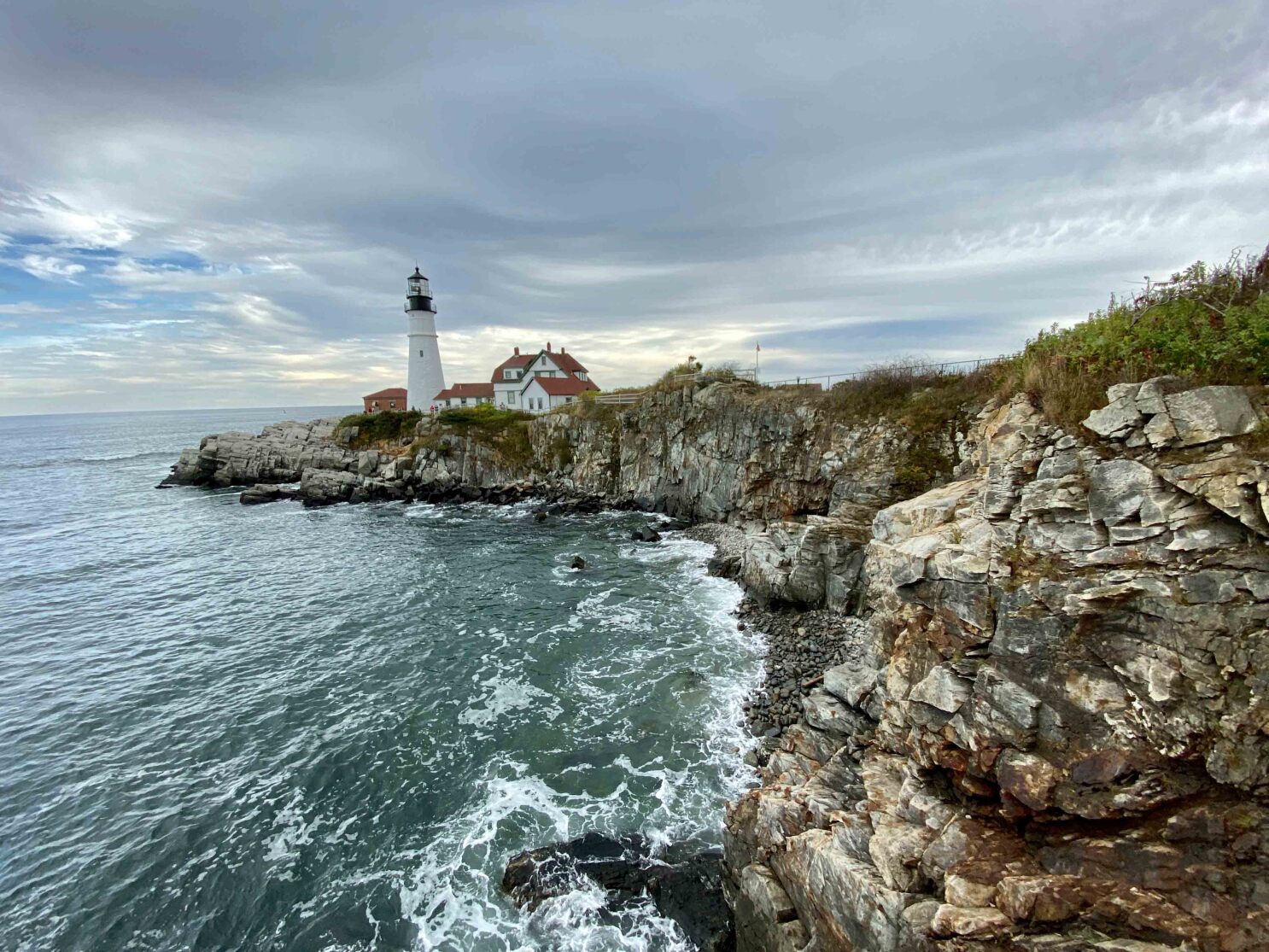
I grew up a New England child and though I’ve lived many places since, my memories of its moods abide: salt spray air; the nocturnal thunder of pounding waves as I drifted into sleep; Yankee villages, replete with white steepled churches and verdant commons; stone walls; Concord’s Old Manse, its bridge, and Lexington, where my country labored into birth; summer expeditions to Rockport’s boat-laden harbor and wharf artistry; harvesting clam shells on a Salem beach; warm chowder on cold days; Cape Cod and sand dunes; Martha’s Vineyard and sea-drenched Nantucket; Ted Williams, the Celtics and Bruins; the Boston Pops and Freedom Trail; undulating rural roadways framed by mountains, freshly painted in autumnal hues; snowfall and hushed landscape; my beloved Newburyport, where I went to school and schoolmates, their faces luminous, triumphant over time. My speech betrays its accents. This summer, it’s Maine again—lighthouses, pristine beaches, Camden, Bar Harbor, Acadia. Ice cream! The poet Wordsworth wrote that “the child is father of the man.” I can’t speak for others, but in my case, it’s true. —rj
A year ago today, Russian troops invaded Ukraine. Bravely, the Ukrainians have held out, despite massive loss of life and daily drone and missile attacks on civilian infrastructure. Fighting remains intense in Bakhmut, with many killed on both sides.
It’s a ruthless enemy, resorting to crimes against humanity, as the mass burial sites of Bucha and Izium bear witness, hundreds of civilians shot, their bodies evidencing torture and mutilation. Wheat fields have been bombed, Ukrainian children deported to Russia.
Western military assistance has been crucial to the Ukrainian resistance. That’s now in jeopardy, given increasing malaise in the West to support Ukraine. In the U.S., a newly elected House majority of Republicans presses for a funding cutoff.
If this happens, Ukraine loses the war and previous Russian imperialism (Chechnya, Georgia, Moldavia), continues and its contagion spreads. Think China, Iran, North Korea.
Loss of Western political will is demagogue Putin’s best hope.
I don’t know if he still walks the planet. He’d be at least 85. I tried looking him up on the Internet, but there were hundreds with his name.
He was just a young prof teaching an evening course, IntroductiontoLiterature, at Eastern Michigan University. He would change my life.
The course featured OedipusRex, GulliversTravels, TheGreatGatsby, AFarewelltoArms; short stories by Mansfield, Hemingway, Faulkner, Fitzgerald and Jackson.
He had a unique way of teaching, like a language teacher, parsing a verb cluster, focusing on verbal inflection. Literature became electric, pulsating with nuance.
It was beautiful! It was inspiring.
He taught me to see behind the literal—that good writers, like their poet kin, weave multiplicity; that the literal isn’t the text. It’s what lies underneath. Hemingway critics dubbed it “the iceberg technique,” three quarters hidden.
Words were never simple things. They were latent with connotation.
He taught me the subtlety of irony, the discrepancy between statement and meaning, expectation and event, appearance and reality; the role of symbol in undergirding theme and prognosticating outcome.
In short, he taught me how to read: Good readers were translators. Literature exhibits its own grammar of codes and rules, imposing a specific exegesis.
He and I clicked. He had wanted me to take a creative writing course with him, but I had other priorities then.
He urged me to pursue a Ph. D. and join the profession.
Two years later, I began the long journey that would define my life.
Being an English prof won’t get you riches, but making hoards of money was never my life acumen. Ironically, the money pursuit may make us poorer. Saul Bellow, my favorite novelist, conveyed my aversion to the Faustian wager aptly in SeizetheDay: “Uch! How they love money, thought Wilhelm. They adore money! Holy money! Beautiful money! It was getting so that people were feeble-minded about everything except money. While if you didn’t have it you were a dummy, a dummy!”
I owe considerably to a young zealous professor with Keatsian fervor for the aesthetic dominion, who gave me entrance to “the milk of Paradise” (Coleridge, “Kubla Khan”).
I’ve always had this curiosity about art, but feel I’m an outsider. I simply lack the wherewithal needed to unlock its portals. On the several occasions I’ve visited art galleys, whether in LA, Santa Fe, Paris, Florence, Rome, and Madrid, I tried vainly to stare paintings down, hoping a mindfulness approach might unleash an avalanche of revelation. A good many of the contemporary paintings could be hung upside down and I wouldn’t know the difference.
Scroll back to summer, 1978, and a graduate course in Southern California. A classmate invites me to go with him to the Los Angeles County Museum of Art, a treasure trove of art, in fact, the largest in the U.S. west of the Mississippi.
An hour in, I grow bored, regretting my hasty acceptance, hoping my friend will share my mood.
Another hour idles by when he tells me he’s exhausted. He’s looked at three paintings. Really, just three! “There’s just too much to take-in,” he says. What does he see that I can’t? Fetch me my sunglasses and tin cup!
Over the years, I’ve tried to close the gap, taking students to Aix-en Provence and its Cézanne vestiges, picnicking on a sun drenched afternoon with Mont Sainte Victoire, beloved haunt of many of his paintings, looming in the background.
We visited Arles, where moody van Gogh and tempestuous Gauguin put up with each other in the Yellow House in 1888, now gone, and take-in the local museum housing many of van Gogh’s renowned paintings.
As a literature student in grad school, I was familiar with the art poems of Keats, Browning, Rossetti and Ruskin’s aesthetics. Among modernists poets, Auden’s “Musee des Beaux Art, for all its brevity, haunts me almost daily in its depiction from Breugal’s “The Fall of Icarus” (1560) of human indifference in a context of suffering.
In the early 1980s, I invested in a Time Magazine multi-volume edition of art books, each volume with its illustrated slip case cover. Replete with photos, biography, and salient details of art masterpieces, it was the closest you come to the paint by numbers art kits I delighted in as a child.
When we moved to New Mexico in 2018, I grieved to have to donate these exquisite volumes to the performing arts school library where my wife previously taught. The moving cost was already mind-boggling and we had to jettison items replete with memory, especially my many books.
Why am I telling you this? Simply because art still engages me. Today, I came upon a poem by beloved poet Mary Oliver, commemorating German artist Franz Marc’s “Blue Horses” (1911) painting. I had never heard of him.
Franz Marc was a dedicated painter who pursued his craft assiduously, living several years in Paris and studying the great masters. Post impressionist Vincent van Gogh influenced him greatly in his broad brush strokes and vivid colors. Marc’s paintings often feature animals, especially horses, in combination with landscape to achieve an organic whole.
He shunned their objectification, contending for their mystical import: “I never, for instance, have the urge to paint animals ‘the way I see them,’ but rather the way they are. The way they themselves look at the world and feel their being.”
Marc was a color symbolist, colors having individual nuance: “Blue is the male principle, stern and spiritual. Yellow the female principle, gentle, cheerful and sensual. Red is matter, brutal and heavy and always the colour which must be fought and vanquished by the other two.”
This helps elucidate his latent purpose in “Blue Horses” (1911). He told his wife it dealt with his foreboding of an imminent war, though this was three years before Sarajevo, leading to the Great War that would result in a combined twenty million military and civilian dead.
In the painting, horses symbolize freedom and vitality: blue is the color of calm and peace and the male principle at the spiritual level; yellow, the female principle, gentle and sensuous; red, the inharmonious and conflictive.
Marc adored animals, seeing them as harmonious with nature and representing the good in the world.
In contrast, mankind has adulterated that natural tranquility through deceit and corruption. Only by reconciling with nature and art can Man find restoration to his better self.
Marc was right in his premonition of war and was called up. He would die of a shrapnel head wound at Verdun in 1916. He was 36.
Oliver’s poetry, like Marc’s art, is nearly always centered in nature, so scarce wonder Marc’s painting would lead to her moving poem tribute:
“FRANZ MARC’S BLUE HORSES”
I step into the painting of the four blue horses. I am not even surprised that I can do this. One of the horses walks toward me. His blue nose noses me lightly. I put my arm over his blue mane, not holding on, just commingling. He allows me my pleasure. Franz Marc died a young man, shrapnel in his brain. I would rather die than try to explain to the blue horses what war is. They would either faint in horror, or simply find it impossible to believe. I do not know how to thank you, Franz Marc. Maybe our world will grow kinder eventually. Maybe the desire to make something beautiful is the piece of God that is inside each of us. Now all four horses have come closer, are bending their faces toward me as if they have secrets to tell. I don’t expect them to speak, and they don’t. If being so beautiful isn’t enough, what could they possibly say?
I may sometimes feel locked out when it comes to art, but as Oliver says so well, “Maybe the desire to make something beautiful is the piece of God that is inside each of us.” It explains why art engages me still.
Once again, fundamentalist Islam has shown its ugly side in the attempted slaying of Salman Rushdie for writing The Satanic Verses. After two decades in hiding, he thought he was safe from Ayatollah Khomeini’s fatwa (1989). He was wrong.
We expect secular regimes to impose imprisonment and death on those who quarrel with their governance. Think Stalin, Hitler, Mao, and, currently center stage, Kim Yong- un, the Myanmar military regime, Xi Jinping, Putin, Maduro, and Ortega.
But religion sponsoring terrorism? For the most part, no; but not when it comes to much of the Islamic world.
Ironically, Islam has remained a largely medieval faith, inimical to change. A PEW Center Analysis (2019) surveyed 198 countries and territories and found that 40% had laws prohibiting blasphemy, defined as irreverence against God and sacred objects. 11% had laws against apostasy. Most of these countries are Muslim.
In 2019, Pakistan sentenced seventeen individuals to death for blasphemy, though the sentences haven’t been carried out as I write.
Iran executes “blasphemers” regularly as public policy, often as means to quell dissent, i.e., to oppose the regime is to oppose Allah.
Iranian execution doesn’t exclude stoning, usually for adultery. Human rights groups report that between 1980 and 2009, 150 people have been stoned to death. Currently, leaked prison documents reveal 51 individuals slated for execution by stoning, 23 of them women, 28 of them, men (thesunco.uk).
We are, indeed, back to ancient ways.
The publisher, Penguin, kept a stiff upper lip in pursuing publication of The Satanic Verses, despite death threats to its executives. An anomaly in a film-dominated time, books still had power to move the needle!
In 1989, Iran’s supreme ruler, Ayatollah Ruhollah Khomeini, issued a fatwa and $3m award for killing Rushdie for blasphemy in writing The Satanic Verses (1988).
This is the same holy man who sanctioned the execution of up to 5,000 Iranians accused of conspiracy in 1988. He would die a natural death four months after his fatwa.
What followed the fatwa was a bloodbath, forcing Rushdie into hiding under protection of British intelligence. Though he would apologize, the current Ayatollah, Ali Khamenei, rejected his apology. (Rushdie has long since recanted his apology: “The worst thing I ever did.”)
Subsequent to the fatwa, thousands of Muslims assaulted bookstores, threatening to bomb those selling his book.
In 1991, the book’s Italian translator was knifed, but survived.
A few days later, Japanese translator Hitoshi Igarashi was stabbed to death.
In 1993, the novel’s Norwegian publisher, William Nygaard, was shot, fortunately surviving his wounds.
In Tunisia and Saudi Arabia, two clerics protesting the fatwa, were fatally shot.
Riots broke out in Iran, India, and Pakistan. An estmated sixty people died.
Then, as now, many of Rushdie’s writing cohorts came to his defense, among them, Martin Amis, Joan Didion, Ian McEwan, and Christopher Hitchens.
I like how Steven King took on J. B. Dalton, one of three book chains refusing to sell Rushdie’s novel: “You don’t sell The Satanic Verses, you don’t sell Stephen King.” It reversed course immediately (vanityfair.com).
There were holdouts, arguing we should refrain from offending the sensitivities of others, much like what we hear in today’s cancel culture.
Among the holdouts was John le Carré, who wrote in The Guardian that “nobody has a God-given right to insult a great world religion and be published with impunity.”
In similar vein was former American president, Jimmy Carter, who wrote an op-ed in the NYT: “While Rushdie’s First Amendment freedoms are important, we have tended to promote him and his book with little acknowledgment that it is a direct insult to those millions of Moslems whose sacred beliefs have been violated.”
Rather strange, I think, for someone who permitted the detested shah to enter America, commencing the seizure of embassy hostages and the bringing to power a theocracy of repression and terror that remains with us still.
They were not isolated cases. Children’s author Roald Dahl depicted Rushdie in a letter to the London Times as a “dangerous opportunist” who “must have been totally aware of the deep and violent feelings his book would stir up among devout Muslims.”
In a tear-down New York Review of Books piece, “The Salman Rushdie Case,” author Zoë Heller wrote that “a man living under threat of death for nine years is not to be blamed for occasionally characterizing his plight in grandiloquent terms. But one would hope that when recollecting his emotions in freedom and safety, he might bring some ironic detachment to bear on his own bombast” (NYRB, Dec. 12, 2012).
It seems a strange twist of fate that there should erupt a groundswell of sympathy for perpetrators of violence rather than for a fierce defender of freedom of speech. But such are the times in which we live, trolls abundant and thought police, both Left and Right, ready to pounce and, not infrequently, message death threats to those it deems adversaries.
The climax in sympathy for rampaging Muslims seen as victims occurred in the aftermath of the French satirical magazine CharlieHebdo being awarded a freedom of expression courage award by PEN America. You may remember that eight of its staff and four other people, including two policemen, were murdered in Paris by Islamic terrorists (January 2015). Some 200 prominent writers wrote to PEN, criticising it for “valorising selectively offensive material” (“Observer Opinion”: The Guardian, 14 August, 2022).
Fatwas need not emanate from distant ayatollahs. They can be home-brewed.
Rushdie got it right in his 1990 essay “In Good Faith,” that “individuals shape their futures by arguing and challenging and questioning and saying the unsayable; not by bowing the knee whether to gods or to men.”
Let us hope that our wounded freedom warrior mends well and soon. Early medical reports say he will likely lose an eye, that nerves in his arm have been slashed, and his liver stabbed.
Freedom of speech defines a vital tenet of civilization as essential as the air we breathe, yet many of us take it for granted. We need voices like Rushdie’s to remind us that it can slip away and one day be gone if we forfeit being its sentries.
As for the repressive theocracy that prioritizes hate over love and its apologists, my sentiments lie with writer Jill Filopic’s eloquent summation:
Religion is a belief system. If yours cannot stand up to criticism, interrogation, and even mockery or insult – if you need to threaten or punish, up to the point of death, those who insult an idea you hold dear – it is perhaps worth asking if your beliefs are as strong as you believe they are. And this is the lesson of Salman Rushdie: it is courageous and necessary to stand up against tyrants and those who would use violence to suppress words and art – even when those tyrants claim to have God on their side” (The Guardian, 14 August, 2014).
Mornings are best for me, sun filling every recess, my thoughts teeming into overflow. I am one with the universe and find peace in the stillness it confers. And so let me share with you my morning musings:
Good writing doesn’t come easily, but not daring it stifles who we are and wish to be, for it’s with words we share ourselves, inspire others, find ourselves, and discover we’re not alone. —
Ancestral, marauding voices of nurturing hover like ghosts in the thoroughfares of the present, haunting our happiness. Only when we rebel and cease our clinging can we be free, and discovering freedom, make friends with ourselves.
—
Good poetry observes Dickinson’s dictum to “tell the truth, but tell it slant,” for artifice sows the sensory and when we show and do not tell, we plough the soul.
—
Think of good poetry as a bouquet and you’ll not go wrong, a unity of balance, imagery and shape, coalescing into what pleases and is, therefore, beautiful.
—
Good poetry mines deeply, unafraid to tap crevices in obdurate darkness, cutting away the unessential, with right tools pursuing every line, digging earnestly, buoyed by passion and not a little of intelligence.
—
I am in love with the stillness of every sunrise, elbowing the darkness and wakening the earth; its gift of new beginning, putting away yesterday’s might-have beens; the grace of another day to forgive and to love and be thankful.
—
A good poem likes to think, but avoiding prose, sings its truth with beauty dressed in feeling.
—+
Why is it I must pass things by without seeing a thing once? This sky, for instance, pageantry of mercurial mood, of cloud, wind, storm and calm, pink dawns and flaming sunsets, pitch fork lightning and rolling thunder, starry nights and lunar mystery—the majesty of it—our imperial dome, to which we owe the breath of life.
—
If that lunar beacon we call the moon borrows its silvery brilliance from reflected light, so on earth we’d do well to debit blessings often owed to others.
—
Poetry has an uncanny way of happening, reviving the sensory, meant for survival, not truth dulled by habit, thriving on vagary. Through metaphor, our exile ends, we find connection, and receive benediction.
—
In every dawn I am like a newly lit candle, my thoughts spilling everywhere. I rejoice in the cardinal’s song, emissary of a new day redolent with promise, the chance to meet up with blessings I had overlooked yesterday.
—
I admit to being passionate, sometimes to excess, sensitive to the disenfranchised, the voiceless, whether human or animal, strident in contesting a world that often plays unfairly and mutilates the Earth. I do not repent!
—
May I cherish each day’s renewed grace and seek virtue only, knowing I cannot own what was never mine to keep, and that what matters lies in the present, for the past I can remember, but not retrieve and tomorrow I may not wake to see.
—
Nothing wise hasn’t been said before, but the doing is hard, making it necessary to repeat.
—
Good writers, like all artists, celebrate their audience, and not themselves, recreating the human stream that succeeds when readers exclaim, “I’ve been there!“ All else is but an unlit candle.
—
Every quest begins with desire, but when desire lusts for possession, it commences our journey into sorrow.
—
I knew age had caught up with me when, yesterday, my doctor said, “Now if you were my father, I’d advise….”
—
As humans, we often filter what we perceive, influenced by our wishes and fears, born of past experience and, yes, the weight of culture and even our friends, fostering expectations as false as they are limiting. May I learn not always to believe what I sometimes think.
—
It’s how I draw the bow and not the target. It’s the journey, not the goal.
—
We are all story makers, each day our thoughts composing new chapters in life’s journey; but as in reading books, discerning between fantasy and truth, fiction and non-fiction, is essential to getting the story right and space for choosing action over inertia.
—
Yes, I admit to following a daily regimen that some may call being in a rut; but I much prefer its discipline, the empowerment it confers over my many infirmities, and the peace it affords in keeping chaos at bay and getting things done. I believe the passions must be made obedient to the mind. Or as Epictetus put it, “One person likes tending to his farm, another to his horse; I like to daily monitor my self-improvement.” Virtue doesn’t fall upon us out of the blue. We must toil at it.
—
I stumble in the darkness, the stars invisible, the earth’s silence my companion, but I do not tremble, for I know all things pass and the sun will surely rise and morning’s birds sing earth’s song.
—
Letting go yesterday to indulge today and sow tomorrow.
—
A good poem is its own immensity, tributaries of nuance coalescing into unity. It is neither more nor less. It is itself.