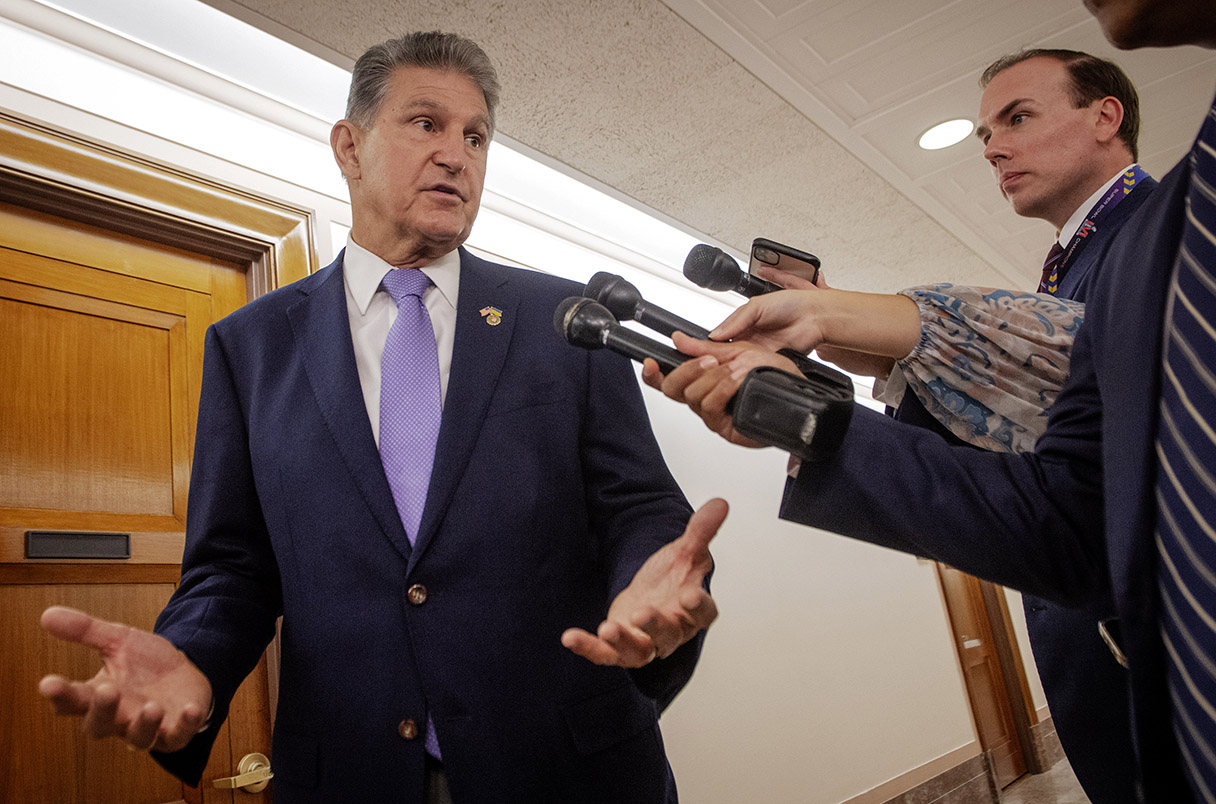
WASHINGTON, DC – JULY 21:
Sen. Joe Manchin(D-WV) faces reporters as he arrives at a hearing of the Senate Energy and Natural Resources committee at the Dirksen S.O.B. at the U.S. Capitol, in Washington, DC.
(Photo by Bill O’Leary/The Washington Post via Getty Images)
The so-called Inflation Reduction Act of 2022 promises much, but better read the fine print in this massive 700 page proposal.
A patchwork compromise with coal baron Senator Joe Manchin, its motivation is the Democratic Party leadership’s desperate need for a legislative victory in addressing escalating inflation, the primary concern of American voters, as the mid-term elections loom. Thus the bill’s name. (The previous version was called Build Back Better).
With close analysis, you’ll discover it isn’t up to the hype. While an unprecedented $369bn is dedicated to mitigating climate change, it locks in reliance on fossil fuel expansion by hamstringing the Interior Department: no renewable energy development on public lands unless drilling leases are also offered to oil and gas entities.
As such, this bill is pure political charade. Fossil fuels cause climate change, yet they’re locked into the bill’s provisions. There is no mechanism to phase them out.
What we get is the loosening of regulations regarding environmental review and, horribly, mandated drilling leases in Alaska’s Cook Inlet and the Gulf of Mexico. The result? More pipelines, oil leaks, methane leaks, wilderness lost, species endangered, and continuing temperature rise. In 2016, the U.S. averaged one crude oil spill every other day (undark.org).
There are no caps on carbon admissions!
While the legislation features tax credits for carbon capture and sequestration, the fallout is that this could extend the life of polluting coal plants, exposing the public to toxic fumes, and making it difficult to achieve clean power goals.
Not talked about is an ominous separate agreement to move a bill in September that could potentially weaken protections under the Environmental Policy Act, which grants communities a say in what happens to their local environment. This is subterfuge, pure and simple.
You’re told the legislation will reduce greenhouse gas admissions 40% by 2030 (Rhodium Group, rpg.com). Considering the pressing problems we have with securing energy resources, it’s dangerously possible that fossil fuels will gain the upper hand over renewables, upsetting any trajectory of even-handedness. As is, the Biden administration in early July held its first onshore lease auction, releasing a proposed plan for off shore drilling, despite Biden’s campaign pledge to cease new oil and gas development on federal lands and waters (insideclimatenews.org).
In short, the Inflation Reduction Act takes back what it gives out, a Faustian wager that forfeits the future for a short-sighted political shell game in the present.
I’m not saying there aren’t good things in the bill. And, yes, there are groups like Nature Conservancy, the Sierra Club, and Earth Justice, urging speedy passage of the legislation. They may be willing to drink the Kool-Aid, but not me, nor should you.
I go by the late E. O. Wilson, “Darwin’s heir,” my icon in environmental matters, who repeatedly denounced such organizations for their compromises, perpetuating environmental demise. They’ve thrown in the towel, their credo, Nature is already gone. We live in the Anthropocene. Wilderness must serve human needs (Wilson, Half–Earth: OurPlanet’sFightforLife).
This is a climate suicide pact,” comments Brett Hartl, government affairs director for the Center for Biological Diversity (CBD). “It’s self-defeating to handcuff renewable energy development to massive new oil and gas extraction.”
The 10th Amendment is used by right to life advocates to justify the U.S. Supreme Court’s overturning Roe vs Wade. Implying two distinct legislative spheres, it reads, “The powers not delegated to the United States by the Constitution, nor prohibited by it to the States, are reserved to the States respectively, or to the people.”
This is the same Amendment that was used by SCOTUS to justfy the infamous Dred Scott decision (1857), defining slave/free state boundaries. Lincoln intuited its liabilities, leading to the Emancipation Proclamation (1863).
Its history is complex, Jefferson supporting it; Hamilton, opposed. It has been cited by local jurisdictions opposing federal Covid mandates.
I believe it needs revision, our founding Fathers not foreseeing the complexities of our present times. The Constitution must always give precedence to public welfare, not factional interest, whether left or right. How else could the government have rescinded segregation in the Little Rock school integration crisis of 1957, ending with Republican Dwight Eisenhower’s employment of federal troops?
I vigorously support John Stuart Mill’s principle of “disinterested benevolence,” i.e., the right of government to advocate policy conducive to society’s welfare, not factional interest: its right to impose environmental laws, construct highways, mandate taxes, allow unions, sanction military drafts, regulate commerce, provide medical access, govern immigration, ensure the liberties of marginalized entities, etc. The list is long.
Government’s true role is to ensure not only traditional freedoms, but to promote progressive policy implementation enhancing the citizenry’s collective well-being.
Simplistic, the 10th Amendment has historically proven an impediment across many fronts, seen again in the abrogation of a woman’s right to sovereignty over her own body. Contraception access may be next.
As the late Christopher Hitchens said, “Religion poisons everything.”
We see it firsthand with SCOTUS about to overturn Roe vs. Wade, a devastating turnaround that will impact people of color and marginal financial resources the most.
We see religion’s trespass behind the daily atrocities of fundamentalists in Iraq, Afghanistan, Iraq, India and Pakistan.
We have the witness of history in the Crusader wars waged against Muslims, the bloody conflicts between Catholics and Protestants, the Inquisition, Bartholomew massacre, witchcraft trials in my birthplace, Salem, MA, Al-Quaeda’s 911 attack, ISIS and Boko Haram.
Not on the same scale, religious despotism exists right now in America, its constituency supporters of Trump. They’ve become the virus that’s brought shame to the party of Lincoln and division to our nation.
SCOTUS needs a new look, not simply by adding people of color. Six of its nine members are Roman Catholics, four of them conservative: Alito, Kavanaugh, Barrett, and Thomas.
The two liberal Catholics are Roberts and Sotomeyer. Another, Gorsuch, a former Catholic and conservative, now attends Episcopal services. Three justices, Kavanaugh, Barrett, and Gorsuch, were appointed by Trump.
Catholicism isn’t really the issue. It’s when faith embraces an intolerant conservatism. Evangelicals, Hindu nationalists, Muslim fundamentalists and, yes, Israeli settlers, all bear responsibility for attempting to impose their agendas on others.
My family, French Canadian and Irish, was devoutly Catholic. When my maternal grandmother deserted the Catholic church, my other grandmother, the Irish one, cut off all communication. My father was buried with the rites of the Church.
I think we’ve made progress since the election of John Kennedy, our first Catholic president, and a good one. I remember the bigotry existing at the time, compelling Kennedy to pledge his independence of the Vatican. Religion thankfully didn’t raise its ugly head in the election of Joe Biden, a church-going Catholic, and just second Catholic in our nation’s history.
Unfortunately, he’s been pursued not by Protestants, but by conservative Catholic bishops, who want to deny him communion. Sadly, the Catholic church, despite liberal reform efforts, remains a medieval institution in need of reform. Hierarchical and dominated by elderly white males, it allows no female priests, opposes homosexuality, gay marriage and, of course, not only abortion, but contraception.
Thankfully, the vast majority of American Catholics, like Biden and Pelosi, don’t subscribe to its parochialism. They are not the enemy.
On the other hand, that four of our justices embrace Catholic conservative values troubles me. One in particular, Amy Coney Barrett, has long ties with People of Praise, a charismatic group in South Bend. It holds traditional beliefs about gender and sexuality and its officers are males. Meetings are gender segregated. She served as “handmaid.”
Barrett sent three of her children to its Trinity School campus in South Bend and sat on its board for nearly three years. It also has campuses in Falls Church, Virginia, and in Eagan, Minnesota.
In 2006, along with hundreds, she signed an anti-abortion letter that accompanied a January 2006 ad in the South Bend Tribune calling for “an end to the barbaric legacy of Roe v. Wade” (southbendtribune.com).
The danger lurks when both religion and politics converge into concerted imposition of their views upon the public. As the NPR has pointed out, “Conservative catholics are the new evangelicals” (npr.org, Apr 20, 2020): “‘It was the Catholic vote that won those states for Donald Trump,’ according to Tim Huelskamp, a former Republican congressman from Kansas now serving as an adviser to the Catholics for Trump movement” (NPR).
In 2016, Trump prevailed in Wisconsin, Michigan, and Pennsylvania, traditionally Democrat bastions, where Catholics significantly outnumber Evangelicals, securing Trump’s victory, despite losing the popular vote nationally. In 2020, half of Catholics voters opted for Trump over Biden.
Recent polls indicate a majority of Catholics now favor Biden over Trump in a hypothetical matchup. Still, an activist conservative faction exists, sharing with Evangelicals a vehement opposition to abortion and gay rights.
Conservative Catholic media include EWTN News, the National Catholic Register and Church Militant, and CatholicVote.org.
Unfortunately, four conservative Catholic justices are on the supreme court, two of them nominated by Trump; the third, Gorsuch, is now Episcopalian, as I mentioned.
If SCOTUS enacts its reputed decision, it will have widened America’s cavernous divide, with states pitted against each other, something not seen since the Civil War.
My post on Elon Musk yesterday elicited one of the largest Brimmings audiences in its twelve year history. I endeavored to be fair to all sides in assessing this polarizing man.
But I need to do a postscript that may help clarify what lies behind his thinking and purchase of one of the world’s leading media platforms and, notably, his resistance to censorship, whether of Left or Right. As he’s told us, he’ll not please either.
You see, I view him as essentially a libertarian, not conservative. Unfortunately, many conflate the terms. Libertarians agree with conservatives in opposing government interference with free enterprise, curtailing deficit spending, mandated protocols and alleged incursions on free speech.
They also agree with conservatives on a strong miliitary, capable of responding to threats to the nation’s security, gun ownership rights, etc.
On the other hand, libertarians believe abortion is a free choice option, a huge difference indeed. They support same sex marriage, judicial reform, and ending capital punishment. While they support a capable military, they eschew bloated spending and policies of overseas intervention that have led to Vietnam, Iraq and Afghanistan. They describe the Bush administration’s incursion in Iraq as “an obscene, depraved act of naked aggression”(libertarian.org).
Libertarians believe we need to follow George Washington’s counsel in his Farewell Address to avoid foreign intervention and alliances. We are not the world’s police or its savior.
Libertarians, unlike many conservatives, are hugely supportive of the environment: “We support a clean and healthy environment and sensible use of our natural resources. Private landowners and conservation groups have a vested interest in maintaining natural resources. Pollution and misuse of resources cause damage to our ecosystem. Governments, unlike private businesses, are unaccountable for such damage done to our environment and have a terrible track record when it comes to environmental protection…..We realize that our planet’s climate is constantly changing, but environmental advocates and social pressure are the most effective means of changing public behavior” (ontheissues.org).
On immigration, there is much that even Progressives could like: “We welcome all refugees to our country. Furthermore, immigration must not be restricted for reasons of race, religion, political creed, age, or sexual preference. We therefore call for the elimination of all restrictions on immigration, the abolition of the Immigration and Naturalization Service and the Border Patrol, and a declaration of full amnesty for all people who have entered the country illegally” (ontheissues.org).
Presently, Libertarians have grown to be the nation’s third largest party. In 2020, they took 20% of the vote in Virginia; surprisingly, 9.4% of the vote in my native Massachusetts.
As the libertarian label suggests, they advocate a live-and-let live approach with priority on personal liberty and limited government.
Musk is an enigma when it comes to his politics. He says he’s half Democrat, half-Republican; in short, a moderate. Despite his avowal, he exhibits a strong libertarian streak, emphasizing citizen polity over government imposition.
Revealingly, our space-minded mogul has hinted at what a Mars government might look like, or oriented along libertarian lines with people voting directly on issues: “I think that’s probably better, because the potential for corruption is substantially diminished in a direct versus a representative democracy” (metro.co.uk).
We know his friend and PayPal co-founder Peter Thiel is decidedly libertarian, as Musk admits: “I’m somewhat libertarian, but Peter’s extremely libertarian” (newyorker.com).
In January he tweeted “True national debt, including unfunded entitlements, is at least $60 trillion – roughly three times the size of the entire US economy. Something has got to give” (nationalinterest.com). Libertarians, ardent critics of social security, would hardly disagree.
A libertarian mindsets goes far in contextually explaining his vociferous resistance to censorship and government interference. As a visionary, he outdistances conservatives with his free-wielding views on needful social reforms ranging from judicial, military, environment, abortion and free trade.
Like libertarians, he exhibits affinity with Victorian Britain’s liberals, vociferous advocates of limited government, non-censorship and social reform (e.g., Bentham, Mill, Gladstone).
It may be limiting to label protean Elon a libertarian, but as American poet James Whitcomb Riley (1849–1916) famously put it, “When I see a bird that walks like a duck and swims like a duck and quacks like a duck, I call that bird a duck.”
Whatever your opinion may be about entrepreneur Elon Musk, who shocked the social media world with his purchase of Twitter, you can’t ignore him.
Voted TimeMagazine’s Person of the Year in December 2021, he happens to be the world’s wealthiest man with an estimated net worth of $253 billion, far out-distancing Amazon’s Jeff Bezos at $162 billion (ceobuz.com, April 28, 2022).
He can buy just about anything and does. Coca Cola may be next.
Affluence brings influence, and Musk doesn’t shirk from peddling it. Last year his Space X’s PAC contributed a record-breaking $2.4 million to politicians of both parties; Tesla, 1.5 million (opensecrets.org).
He has donated money to the presidential campaigns of Barak Obama and Hillary Clinton.
In California, he contributed to the campaigns of Gov. Gavin Newsom, Dianne Feinstein, Meg Whitman, and former governor Jerry Brown.
Though he says he prefers to stay out of politics, it hasn’t stopped him from entering the political fray. He opposes Biden’s tax credit proposal to give a $4,500 discount to consumers buying vehicles made by union workings, affording an advantage over Tesla, Toyota, and others.
He supported Andrew Yang, who advocated for a universal basic income, in his 2020 primary run.
Since 2003, Space X has secured $1.5 billion in contracts, mostly NASA related.
He vehemently opposes Biden’s proposal to close the tax loophole for billionaires to help finance his safety net plan.
His battle with the FEC over regulation has been ongoing.
He abhors union organizing.
To brand him as an ultra conservative, however, is untrue in its simple-minded reductionism. Like others such as rival Bezos, he’s pragmatic, focused on his business interests.
Musk isn’t easy to like and there exist significant foreshadowings of trouble with his takeover of Twitter. Despite his advocacy of freedom of speech, he’s been known to fly off the handle with subordinates who have disagreed with him, or engage in “rage firing.” In his just published book, Power Play: Tesla, Elon Musk, and the Bet of the Century, TheWallStreet Journal writer Jim Higgins gives numerous, detailed instances of Musk’s firing of contractors and employees out of sheer rage.
Nonetheless, he deserves credit for being a climate change hawk, if not pioneer, founding Tesla, an EV concern. 75% of EV vehicles sold this year were Teslas. Tesla solar panels are on thousands of rooftops in the U.S. Climate change hasn’t been a priority issue for most conservatives. He was among the first in line to oppose Trump’s withdrawal from the Paris climate accord.
Musk is one of your consummate engineers, a segment to whom we owe substantial, but unacknowledged, gratitude for its contribution to the public welfare and many of the amenities we enjoy.
He revitalized a non-viable EV industry, designing a new battery and reviving a waning space program as well. Courageously championing the new technology and investing heavily, he taught himself rocketry and invented an entirely new space craft.
The pity would be that his new venture might distract him from the substantial contributions he’s made to mitigating climate change, Tesla bridging the gap on the issue between liberals and conservatives, a sentiment echoed by environmentalist Bill McKibben, founder of 350.org.
A registered independent, Musk has tweeted, “To be clear, I am not a conservative. Am registered independent & politically moderate. Doesn’t mean I’m moderate about all issues. Humanitarian issues are extremely important to me & I don’t understand why they are not important to everyone.”
He takes Russia’s Ukraine incursion seriously and has supplied the country with thousands of Starlink kits to maintain its Internet, essential to its survival. Zelensky has thanked him for this. Critics minimize the charity component, saying the U.S. government did the financing. The reality is Space X donated thousands of kits on its own.
The Left has, nonetheless, turned him into Lord Voldemort, infamously rich, tax-dodging and a taunting critic of its activism: “The far left hates everyone, themselves included! But I’m no fan of the right either,” Musk tweeted Friday morning. “Let’s have less hate and more love” (April 29, 2022).
If he’s paid little tax, it’s the fault of the system, not Musk. A good many Democrat and Republican members of Congress, many of them millionaires, maximize their own exemptions.
Musk views government regulation as hostile to innovation and laments huge deficit spending, contributing to inflation.
Conservatives are liking Musk and enthusiastic about his acquisition of Twitter. They applauded his moving Tesla headquarters from blue state California to red state Texas. They’ve long felt that Twitter has frequently discriminated against them. Last year, it banned Trump permanently. Enthusiasts advocate a presidential run in 2024, ruled out for the South African born Musk by the Constitution.
Conservatives point out the Taliban’s presence on Twitter, yet Trump is banned. On the other hand, the Southern Poverty Law Center has criticized Twitter’s allowing right wing extremists a platform for staging the January 6, 2020 Capitol attack.
Musk says he bought Twitter to promote free speech and has plans to make it better: “Free speech is the bedrock of a functioning democracy, and Twitter is the digital town square where matters vital to the future of humanity. I also want to make Twitter better than ever by enhancing the product with new features, making the algorithms open source to increase trust, defeating the spam bots, and authenticating all humans. Twitter has tremendous potential — I look forward to working with the company and the community of users to unlock it.”’
The problem is we don’t really know what Musk means by this. Democrats, understandably, remain fearful. Will the likes of Donald Trump and misinformation saturate the new Twitter? Many leftist tweeters have already departed.
Not much talked about, Musk has considerable business ties with China, hardly your paragon of free speech. In fairness, he isn’t alone in the business community when it comes to prioritizing profit over human rights issues. Would it make Twitter more reluctant to remove China propaganda or misinformation posts? China is Tesla’s second largest market with half of its cars produced there. Musk has been the beneficiary of several billion in Chinese investment loans.
Several leading Congressional Democrats are advocating a review of the purchase.
Truth is, many Twitter aficionados, including Democrats, adore Musk, who has 81.2 million followers.
He’s admired by the public for his fierce independence. He’ll not be reigned in. He speaks to the issue, not the political mindset. He does what many can only dream.
On the other hand, most Democrats see him as a wolf in sheep’s clothing. He may not be able to run for president, but were Trump reinstated and make a run to regain the office, Twitter could potentially impact the race in his favor. Twitter enjoys an estimated 300 million users worldwide, 38 million of them in the U.S.
Just the other day, Musk hinted at the possible scenario: “Time outs are better than permanent bans. A good sign of free speech is: Is someone you don’t like allowed to say something you don’t like? … Twitter has become a de facto town square. It’s important people have the reality and the perception that they’re able to speak freely within the bounds of the wall.”
Reinstating Trump would likely trigger a Tsunami tidal wave, with many skilled staff and millions of Twitter users deserting its ranks and unleashing an aroused Congress. Meanwhile, Trump says he’ll never return to the platform, no matter what Musk does.
But no need for heart palpitations just yet. The deal doesn’t close for six months, allowing for a lot to happen. Thursday, the Federal Trade Commission, announced its seeking whether Musk observed an antitrust reporting requirement when he initially invested in Twitter (Reuters).
Then, too, the UK and EU, concerned that that a Musk owned Twitter may attract extremists, insists Twitter conform to new content rules or face sanctions that would include fines or even a total ban.
Given his mercurial temperament, it’s conceivable he could withdraw from the deal, triggering a billion dollar penalty, agreed to by Musk.
In its latest issue, TimeMagazine states “the lesson of Musk’s career is to take his ambitions seriously. He’s rich not because he gamed the system but because he’s a genius who uses the incredible force of his will to mobilize resources to pursue his ideas. He’s devoted himself to tackling what he views as humanity’s biggest problems, and he has decided, as he put it recently, that ‘having a public platform that is maximally trusted and broadly inclusive is extremely important to the future of civilization.’”
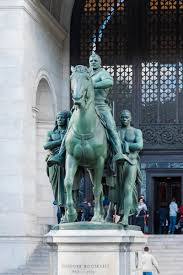
The press largely missed last week’s removal of the Teddy Roosevelt statue from the grounds of New York’s American Museum of Natural History, which had been in place for eighty years. Progressives argued it was colonialist in nature, a white man on horseback accompanied by an African and Native American on foot.
Roosevelt is consistently rated as among America’s best ten presidents, an ardent naturalist and political liberal. The African and Native American reflect his renowned role as explorer, not colonialist bent on exploitation. Nonetheless, the efforts of the Left, ignoring cultural antecedents, persist in rewriting history, or what I call “purging” it to conform with ideology.
I’m reminded of Orwell’s still relevant observation that “the really frightening thing about totalitarianism is not that it commits ‘atrocities’ but that it attacks the concept of objective truth; it claims to control the past as well as the future.” Similarly, progressives seek to assuage history’s realities by projecting their politics on to the past, while hypocritically ignoring the malignant realities of today’s Cuba, Venezuela, and Nicaragua.
As always, we do well to avoid peripheries, whether of Left or Right. We properly amend history by learning from its failures and not repeating them.
It didn’t take long for opposition to Harper’s Magazine letter featuring 153 heavyweight intellectuals, largely academics and writers protesting censorship, to engage counter protest. Not from the Right as one might suppose, but from the Left in a counter letter featuring 160 signatories, published in the online site, The Objective.
Some argued the Harper signatories were white, economically privileged, academic elitists who don’t merit any claim to duress for their views. “They are totalitarians in the waiting,“ commented Parker Molloy of Media Matters. “They are bad people. They want you to shut-up.” Molloy is referencing the current cancel culture conflict, intimating the Harper signatories would repress minorities from speaking out.
Not only is this the race card fallback again, but it’s absurd on two counts:
Twenty-four of the signees were people of color. As one Black signatory to the Harper letter wrote, “If they didn’t recognize your name, they assumed you’re white.”
Protestors seem to have ignored signatories Salman Rushdie who had to go into hiding after a fatwah was issued on his life and must still change his addresses frequently, or chess champion Garry Kasparov who was ostracized in Russia for opposing Vladimir Putin.
Do you think Noam Chomsky and Gloria Steinem haven’t been told to shut-up by adversaries from the Right?
What especially rankles some is J.K. Rowling’s presence on the Harper list. You may not agree with her sentiments re: transgender access to bathrooms as a traumatized rape victim, but she’s the one they specifically want to shut-up, with some calling for a boycott.
Ironically, there are several rank hypocrites among the Harper signatories: New York Times editor Bari Weiss, literary scholar Cary Nelson, and political scientist Yascha Mounk. Weiss and Nelson have actively worked to silence pro-Palestinian voices; Mounk in 2019 enthusiastically supported the Bolivian coup bringing Jeanine Añez to power. Since then, massacres have followed, dissent been restricted, and an election postponed.
In all of this comes the need to distinguish criticism from censorship. The first is fundamental to liberal democracy; the latter, its nemesis. The Left’s vitriolic response, its ad hominem assault by race, economic status, and on alleged motives of the Harper signatories bear all the trademarks of a repressive body politic inimical to debate.
Leftist writer Freddie de Boer’s gets it right: “The people furious at this letter largely have genuine ideological problems with liberal norms and laws regarding free speech. Please, think for a minute and consider: what does it say when a completely generic endorsement of free speech and open debate is in and of itself immediately diagnosed as anti-progressive and anti-left?”
I just downloaded the late Howard Zinn’s masterful A People’s History of the United States. You might say I’m divesting myself of the whitewash of American history handed down to me by a white culture.
As I write, Trump plans to visit Mt. Rushmore today, July 3, replete with flyover and fireworks, 7500 lottery selected attendees not observing social distancing, few wearing masks. It sits upon sacred land, 1200 acres, stolen from the Lakota in violation of the Ft. Laramie Treaty (1868) following the discovery of gold in the Black Hills.
We know about Washington, Jefferson and Teddy. I didn’t know Lincoln ordered the hanging of 38 Dakota in Mankato, Minnesota in 1862, the largest mass execution in American history, following their uprising. In the aftermath, the Dakota were expelled, their lands seized. Subsequently, the bodies of the executed, buried in a mass grave, were exhumed and used for cadavers.
The sculptor, Gutzon Borglum, held racist sentiments and was previously known for his earlier contribution to Stone Mountain (he was dismissed from the project for his competing interest in Rushmore) near Atlanta with its gargantuan effigies of Lee, Stonewall Jackson, and Jefferson Davis.
While not a member of the Ku Klux Klan, he supported their views. In one of his letters, he complained of a “mongrel horde” contaminating the “Nordic purity” of the West. In another, he wrote of his successor at Stone Mountain, “They got themselves a Jew.”
Just a few days ago comes news that a San Francisco school district is mulling getting rid of a series of murals honoring our first president because a commissioned working group alleges it’s traumatizing students.
Imagine my surprise that founding father George Washington is now under attack by politically enlightened, self-lacerating guardians of the public interest, bent on scrubbing the pantheon of American heroes clean in writing a revisionist history:
We come to these recommendations due to the continued historical and current trauma of Native Americans and African Americans with these depictions in the mural that glorifies slavery, genocide, colonization, manifest destiny, white supremacy, oppression, etc.
Seems our anointed censors will neither forgive nor forget that George was a slave owner and killed Native Americans in the French and Indian War. And, of course, we have to take into account its psychological fallout for students exposed daily to the murals.
Ironically, these murals were painstakingly done in 1936 by communist Victor Arnautoff, who simply wanted in his own words “to provoke a nuanced view of Washington’s legacy,” which the San Francisco United School District (SFUSD) has obviously misconstrued in its literalist approach.
Wonder what Dolly Madison would say about all of this.
But it doesn’t stop here. There’s Christ Church that Washington and his family attended in Alexandria, Virginia. Washington had purchased a family pew, marked by a plaque. Well, no more!
The plaques in our sanctuary make some in our presence feel unsafe or unwelcome. Some visitors and guests who worship with us choose not to return because they receive an unintended message from the prominent presence of the plaques.
Washington was a founding and contributing member of the congregation. Ironically, the church is located on North Washington Street. Y’uh thinking maybe they should move?
Last, but not least, comes this news from academia: Washington and Lee University board of trustees has decided on replacing portraits of Washington and Lee in military uniform with portraits of them in civilian garb.
In a formal statement, J. Donald Childress, rector of the board of trustees, and William C. Dudley, university president, said, “We appreciate the seriousness and thoughtfulness with which our fellow trustees have approached these matters. On behalf of the board, we want to express our gratitude to all of those members of the community who contributed to our deliberations, through countless letters and conversations over the summer and on campus this weekend. We are fortunate to be part of a community that cares deeply about this institution and is so dedicated to its continued success.”
Seems the leader of the Continental Army has been relieved of command.
I prefer distinguished American historian Fergus M. Bordewich’s take on these things in exclaiming it’s “a deeply wrongheaded habit to project today’s norms, values, ideals backwards in time to find our ancestors inevitably falling short. It betrays a very troubling intolerance of art and the ambiguity of art and the aspirations of art. It’s incredibly stupid if we try to erase history. It still happened, and you should argue about its meanings.”
The White Man’s misdeeds in America towards its indigenous peoples are incalculable in number and cruelty. I was reminded of this last week when Karen and I visited the Grand Canyon and learned from the Visitor Center that Yavapai and Apaches once lived adjacent to the Canyon. That is, until 1874, when the government closed the Camp Verde Reservation and forced its residents to trek 180 miles to the San Carlos Apache Reservation. More than 100 Native Americans perished.
Nearly two years ago we witnessed the subjugation of the Dakota Access Pipeline protests in North Dakota that had commenced in 2016. Primarily affecting Sioux residents of America’s fifth largest Indian reservation, encompassing 2 million acres, the pipeline traverses sites sacred to the tribe and perhaps compromises the Reservation’s water purity.
Initially, it appeared the tribe had won when President Obama shelved the plan in late 2016, pending an environmental review, which would take years to complete.
Alas, there came the surprise of Trump’s election win and the inauguration of an administration strident in anti-environmental bias. In January 2017, came Trump’s executive order approving both the Keystone (Alaska) and Dakota pipelines.
The result, several hundred thousand barrels of oil now flow beneath the once pristine landscape.
This wasn’t a first happening for the tribe. In the 1960s, the Army Corps of Engineers built the Oahe Dam near Pierre, SD, flooding 56,000 acres of the Reservation’s farms and woodlands. Elderly residents recall their homes being burned prior to the flooding.
Ironically, the Standing Rock Reservation is the birthplace and final residence of Sitting Bull, who fiercely resisted white infringement on Indian land. It was his refusal to submit to the government’s order to remove the Sioux to a reservation that led to the famous Battle of the Little Big Horn, in which the Sioux defeated federal troops led by Custer’s 7th Cavalry in 1876.
In 1890, he was shot to death at Standing Rock Reservation by Indian agents attempting his arrest. Several weeks later, the army massacred 150 Sioux, perhaps more, at Wounded Knee Creek. Some historians suggest it was an act of vengeance, carried out by the 7th cavalry.
A wise, observant chief, it was Sitting Bull who asserted, “Hear me people: we now have to deal with another race—small and feeble when our fathers first met them, but now great and overbearing. Strangely enough they have a mind to till the soil and the love of possession is a disease with them. These people have made many rules that the rich may break but the poor may not. They take their tithes from the poor and weak to support the rich and those who rule.”
Prescient and explicit, Sitting Bull’s comment lends context to the historical narrative of White infringement on the rights of its native peoples that continues even now.



 just downloaded the late Howard Zinn’s masterful A People’s History of the United States. You might say I’m divesting myself of the whitewash of American history handed down to me by a white culture.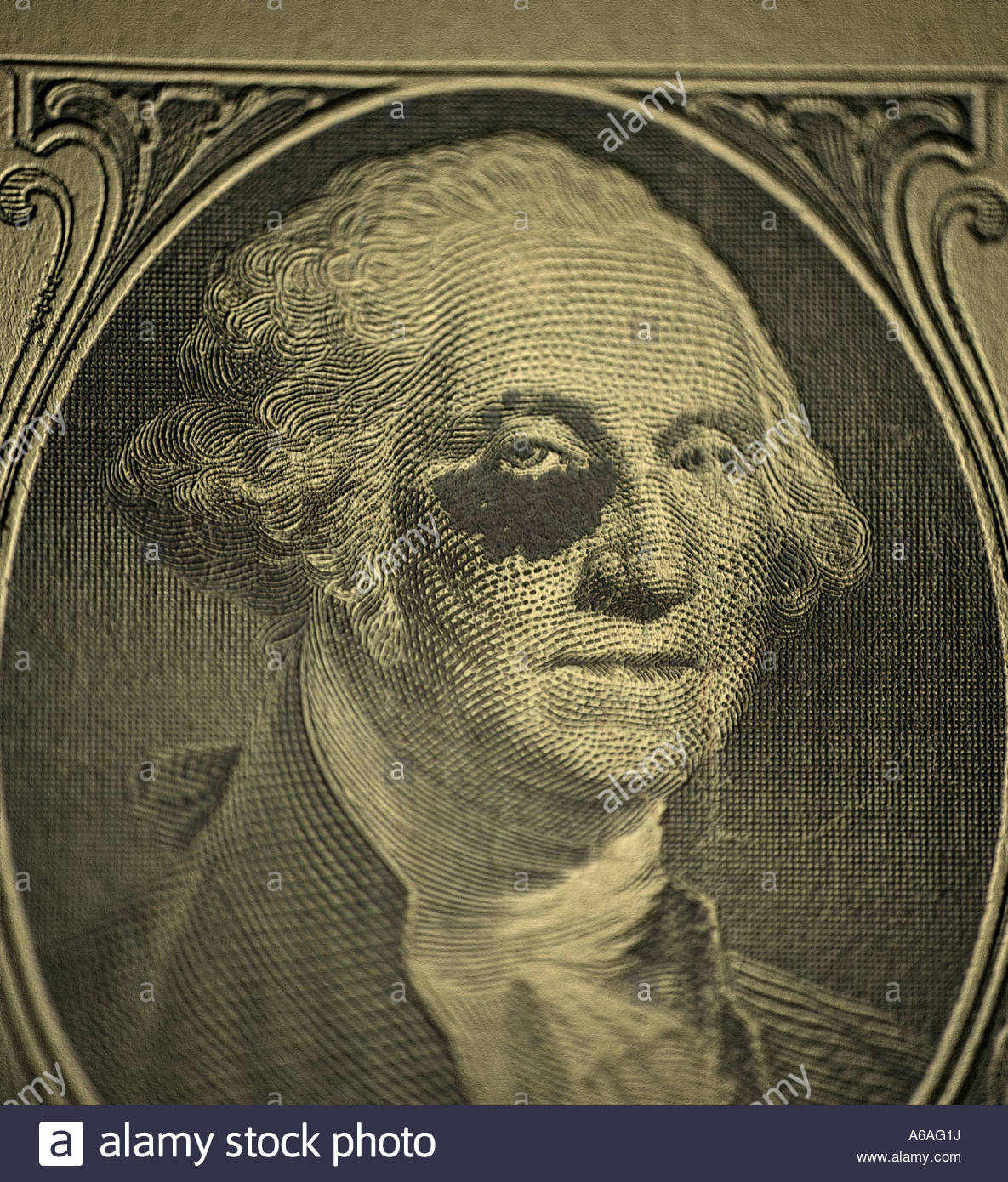
 Just a few days ago comes news that a San Francisco school district is mulling getting rid of a series of murals honoring our first president because a commissioned working group alleges it’s traumatizing students.
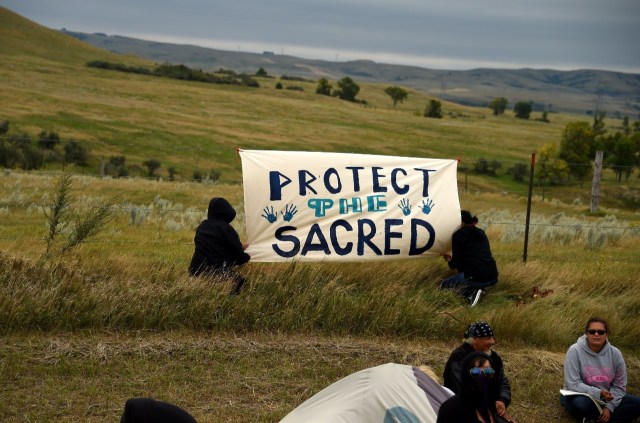 The White Man’s misdeeds in America towards its indigenous peoples are incalculable in number and cruelty. I was reminded of this last week when Karen and I visited the Grand Canyon and learned from the Visitor Center that Yavapai and Apaches once lived adjacent to the Canyon. That is, until 1874, when the government closed the Camp Verde Reservation and forced its residents to trek 180 miles to the San Carlos Apache Reservation. More than 100 Native Americans perished.
