Does the Electoral College Have a Future?

azThe Electoral College has been in the news a lot lately. And why not, considering that the loser in the 2016 election garnered nearly 3 million more votes than the declared winner.

In fact, Hillary Clinton’s popular vote turns out to be greater than those that elected John Kennedy, Richard Nixon, Jimmy Carter, and George W. Bush to the presidency. In turn, a good many understandably want the Electoral College abolished. We elect our members of Congress on the basis of vote totals. Why not go national?

But should we? The issue isn’t quite so simple as there exist good arguments either way.

Let’s take a careful look.

Why did the Founding Fathers establish the Electoral College?

The Electoral College goes back to 1787, the year in which our Constitution was first formulated. Because of the expanding geography of the new nation, the Fathers feared local voters wouldn’t have access to the fullest information on a candidate outside their region to choose wisely.

We need to remember there were then just 13 states with a population of only 4 million stretched across a 1000 mile seaboard. There was also the danger that more populated states might dominate lesser populated states. This has remained an issue right up to the present day.

Some, distrusting the electorate, saw the College as a buffer against their folly. Alexander Hamilton, for example, who championed the Electoral College, argued in Federalist Papers 68 that it would preempt “any man who is not in an eminent degree endowed with the requisite qualifications” from taking office.

Ironically, it’s this very set-up that on December 19 will allow electors to rubber-stamp the election into fact, unless they choose to revolt against the norm, which has never occurred.

Hamilton, living in a time when there were no political parties, hadn’t foreseen the rise of partisanship.   On the contrary, electors would be free to vote their conscience. The 12th Amendment changed all that with the rise of political parties and their partisanship that Washington took pangs to warn us about in his sobering farewell address.

Hamilton’s proposal, however, was boosted at the time by the interests of Southerners, particularly Virginians, who feared The Northern states, with their greater population, might threaten slavery. Thus, Blacks were partially counted in the Southern population totals, even though they couldn’t vote, allowing Southern states greater electoral clout. Accordingly, Virginians held the presidency 32 of the first 36 years under the new Constitution.

This ugly truth is yet another reason why some have called for the ending of the Electoral College, since they view it as conceived in slavery.

On the other hand, the Founding Fathers were sincerely troubled about equity at every level, whether within state legislatures, or at the Federal level where it’s embedded in the checks and balances provided by the legislative, executive and judicial branches of government, or between larger and smaller states. Balance likewise undergirds resolving the tensions between federal and local sovereignty.

How the Electoral College works:

There are presently 538 electors.

Each state receives as many electors as it has representatives and senators in Congress.

The number of representatives is reapportioned every ten years in conjunction with the census.

States with small populations are assigned 3 electoral votes to promote equity; currently six states, plus D. C.

Residents of U. S. territories, even though they’re American citizens, cannot vote.

Normally, the winner takes all, even if the vote difference is marginal. Two states, however, Maine and Nebraska, proportion their vote, based on the state popular vote.

The major parties nominate electors for their states in the months preceding the election.   Some states resort to primaries for that purpose, or rely on a party committee, or state party convention. Electors are frequently selected on the basis of their service to their party.

No person holding federal office, elected, or appointed, is eligible.

The party winning the state vote determines the ultimate electors.

Every effort is made by political parties to assure their electors vote faithfully as pledged, even though the Constitution allows free choice. Those who don’t comply are known as “faithless” electors and may suffer severe censure from their party.

Each Elector delegation votes in their state capitol, this year, on December 19.

Still, 21 states don’t require a pledge at all, potentially setting up a scenario where a few faithless electors could upset even a candidate receiving a majority vote nationally, wiping out the choice of millions. As I write, this weakness lies at the heart of largely Democrat efforts to halt Trump’s accession to the presidency. So much for the fairness argument for Electoral reform.

Tabulation takes place January 6, 2017, in the House of Representatives in Washington.

If the president-elect fails to muster the 270 vote majority, then the final decision on who becomes president is made within the House of Representatives. It could be someone other than the president-elect.

If the House can’t reach a decision by Inauguration Day, the Vice President elect becomes president until such a decision is reached.

The choice of the Vice President ultimately takes place in the Senate, with each senator having one vote. This actually occurred once in our political history when, in 1836, Martin Van Buren’s running mate fell short of the electoral majority by one vote.

Proposals to change or abolish the Electoral College:

Over 700 proposals re: the Electoral College have been made, virtually none of them successful. Only two proposals concerning the Electoral College have ever passed in Congress and succeeded as amendments to the Constitution (12th and 23rd Amendments).

The process of amending the Constitution under the provisions of Article V in the Constitution makes it exceedingly difficult for any proposal to succeed, since it requires a two thirds majority in both chambers of Congress and legislative approval by three quarters of the states.

There is, however, a bi-partisan movement underway known as the National Popular Vote Interstate Compact, which would ultimately preserve the Electoral College, yet assure the top national vote winner secures the presidency. No amendment process would apply, since our Constitution, Article II, Section I, allows states to devise their own elector process.

Specifically. It would be a multi-state pledge to cast their electoral votes for the candidate winning the popular vote nationally. So far, ten states and the District of Columbia have signed on, representing a total of 165 electoral votes.   Pro-compact bills, backed by both Democrats and Republicans, have been introduced in other states as well. Imminent passage is anticipated in MN and PA. Should the compact achieve a majority of electoral votes through its member states, it would then go into effect.

One of the chief arguments against its abolishment is that it disenfranchises smaller, less populated states, especially in the American heartland, against the likes of gargantuan states like California and New York.

Candidates wouldn’t visit the small states like New Hampshire, say opponents to change, even if deemed swing states, but shift their focus to metropolitan areas. Cities like New York, Chicago, and Houston would dominate. What happens to rural America?

On the other hand, those for change or abolishing the Electoral College, contend that the small states, if anything, are overly represented. We use the most vote method within our states to elect members to local and national office. Why not go nationwide?

Should the Electoral College be Abolished?

Many think so.  After all, it denied the Presidency on five occasions to candidates receiving a majority of votes: 1824, 1876, 1888, 2000, and 2016.  Polls reveal overwhelming support for abolishing the College.  Even president-elect Donald Trump embraces the idea of a popular vote replacing the Electoral College.

Nonetheless, as I pointed out at the outset, there aren’t any easy answers.

One of the chief arguments against its abolishment is that it disenfranchises smaller, less populated states, especially in the American heartland, against the likes of gargantuan states like California and New York.

Candidates wouldn’t visit the small states like New Hampshire, say opponents to change, even if deemed swing states, but shift their focus to metropolitan areas. Cities like New York, Chicago, and Houston would dominate. What happens to rural America?

On the other hand, those for change or abolishing the Electoral College, contend that the small states, if anything, are overly represented. We use the most vote method within our states to elect members to local and national office. Why not go nationwide?

What’s more, states thought to be in the opposition’s column are already neglected. In 2016, PBS NewsHour found that Donald Trump and Hillary Clinton had made more than 90% of their campaign stops in just eleven so-called battleground states. Of those visits, nearly two-thirds took place in the four battlegrounds with the most electoral votes — Florida, Pennsylvania, Ohio, and North Carolina.

My own opinion, and that’s all it is, favors the genius argument at the heart of the American experiment, which is balance.   Historically, we’ve been a nation constructed uniquely through a system of checks and balances, derived from compromise, or consensus. Without it, we could never have achieved the initial unity that founded a nation.

Tensions have always existed in our nation, not only between North and South, but the coasts versus heartland America. The Electoral College does sometimes fail, but it has served us well overall, preserving equilibrium between myriad factions.

Of the ten states that have joined the compact thus far, all of them are blue states or jurisdictions (i.e, D. C.) despite bi-partisan advocates. Passage is anticipated in Oregon, another blue state.   While currently red states like Arizona and Oklahoma are possible candidates for inclusion, the movement is largely Democratic in its inspiration. Two states, MN and PA, are likely to join the compact very soon–again, traditional blue states.

Present states along with the District of Columbia that have adopted the National Popular Vote initiative are CA, HI, IL, MA, MD, NJ, NY, RI, VT, WA. Collectively, they now represent 165 electoral votes, or nearly two-thirds of the required 270 majority.

I find this proposal that would assign the state electoral vote to the top voter candidate nationally an absurdity, since it would wipe out even a state’s plurality vote, if that candidate drew up short in a national vote. Let’s take PA, for example; if the compact were in effect, the majority wold see their vote cast aside. Now how fair is that that?

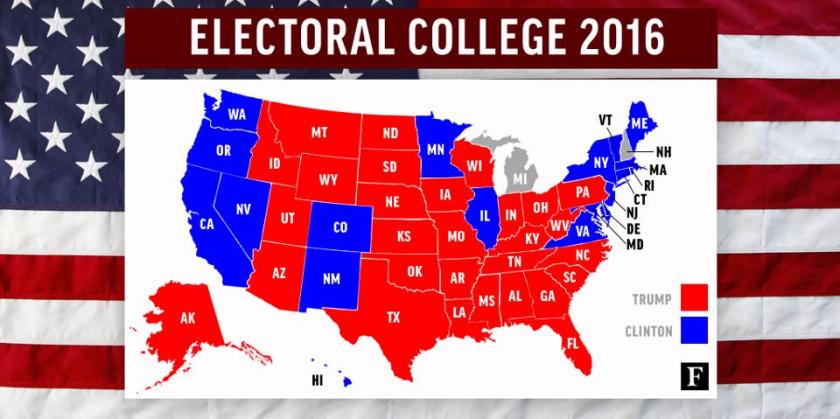
Do you remember looking at the 2016 election geographical map, the small blue areas, almost dots, in a vast tapestry of red, what we used to call “fly-over America”? Thirty states voted for Trump. The Compact would nullify their majority vote in all of them.

Now how is that fair?

Instead, I would like to see a mix of both positions with adoption of a proportional vote measure, doing away with the winner take all–why vote?–and honoring the votes cast by the minority. Let’s allow them a voice in the best interests of a democracy. A proportional College has been proposed before, but went down to defeat in the Congress.

I believe it would result in greater vote turnout. It was hard for me, for example, a Democrat progressive, to get motivated to vote here in Kentucky, overwhelmingly Trump country. In the 2012 election, voter turnout was highest in swing states, where the vote could have gone either way.

In that election, Obama massively won the electoral vote, 332 to 206 for Romney. If it had been a proportional vote, the result would be 51% to 47%, much closer indeed and more reflective of the popular vote (Justin Curtis, “Recrafting the Electoral College” (harvardpoltics.com).

Given the continuing growth of America’s metropolitan areas, particularly on both coasts with their predominantly regional interests, we could end-up with a facsimile of Mexico’s Revolutionary Party, which governed that country for seventy-five years. In short, the end of our two party system which, for better or worse, has worked well for us.

As is, these power states are likely to continue their rapid growth, meaning still more electoral votes by way of a substantial increase in population.   Presently, one in every three immigrants chooses CA, FL, OR NY as their residence, exacerbating their population boom.

In life, I’ve learned from the hard places to be wary of peripheries, often embraced by purists. I prefer the middle, drawing from the best of opposing scenarios.

I think a proportional allocation is the reasonable approach. Why resort to a system that like the present Electoral College abrogates the minority vote? Isn’t that the problem now?

Dividing the electoral votes provisionally preempts that unfairness, while achieving recognition for all regional interests like that of coal miners in West Virginia as well as Silicon Valley high techs in CA.

It levels the playing field. I’m all for that!

What does the future hold for the Electoral College?

I think the National Popular Vote Interstate Compact is likely to succeed in attracting a sufficient number of states, among them some Republican ones, that will put the measure over the top. This surprises me, since history’s quirk has yielded a Republic president in all five elections featuring a losing candidate who had won the popular vote, the most egregious being Hillary Clinton’s loss, though garnering a nearly 3 million plurality.

My hunch is that the Compact could possibly be in place even by the next election, and surely by the second, making old hat of the so-called “battleground” or “swing” states scenario, distorting the campaign focus. Campaigning would shift to the most populous states with their big cities and metropolitan areas in particular.

This will be great news for minorities, as both Democrats and Republicans will find them especially attractive to a national ticket, given their urban numbers. The sad fact is that Clinton lost the election because of a drop-off in Black voting since the the 2008 and 2012 campaigns.

If the vastly white Republicans, regardless of what the future holds for the Electoral College, don’t catch-up with the changing demographic and continue sponsoring legislation that would threaten popular entitlement programs such as Medicare and Social Security, along with alienating immigrants, they are doomed to obsolescence, apart from their remaining clout in rural areas at the state level. It’s just that the Compact will force their hand even sooner.

But there’s also a big if that clouds the future of the Compact, since conservatives are likely to view it as an end run around the Constitution and challenge it, both in Congress and the courts, perhaps ultimately reaching the Supreme Court.

There is, after all, that troublesome clause in the Constitution that states that “no state shall, without the consent of Congress enter into any agreement or compact with another state, or with a foreign power.”

–rj


.

Apple vs. the FBI: How Money May Decide the Issue

thThings are really heating up these days in the ongoing dispute between Apple and the FBI.
In December, fourteen people were killed by ISIL sympathizers Farook Malik and his wife Taskeen, in San Bernardino, CA.   In the aftermath, the FBI has been investigating the possibility they may have had accomplices. Backed by a court order, the FBI has requested Apple remove the security blocks on Farook’s iPhone.

CEO Tim Cook, speaking for Apple, refuses to comply, contending it would compromise the privacy of its smartphone users.

I’m not taking sides on the controversy here.  The issue is as heated as it is complicated, with the country divided in its opinion and perhaps SCOTUS inevitably having to make the call.

What does concern me is Apple’s new strategy to move the matter to the Congress for adjudication. (Hearings begin next Tuesday.)

Fact is, the Congress is hardly the right party to decide the issue, given the systemic corruption fostered by business conglomerates soliciting favors through huge sums of money donated to its members.

We see this, for example, with regard to the National Rifle Association (NRA), successfully preempting responsible gun legislation, despite myriad mass shootings like those in San Bernardino,.

In 2014, NRA contributions to members of Congress amounted to $984,152 with an additional $3,360,000 for lobbying.

What really fries my brain is that it spent a whopping $28, 212,718 in outside spending!

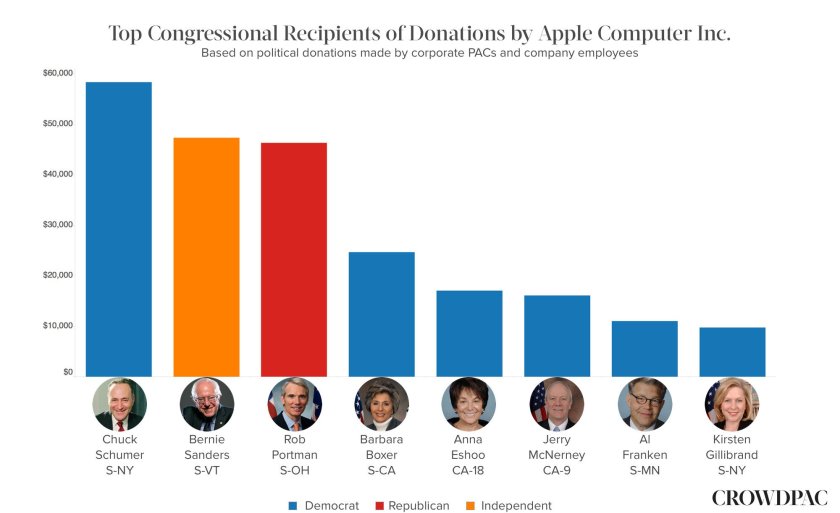
Apple, as such, is being disingenuous in attempting to shift the scenario to the Congress, having demonstrated a lengthy penchant, like its fellow high tech icons, in substantially contributing to the Congressional feedbag, their mission to deter any regulatory legislation that would rein them in. In other words, a good many Congressional members owe them favors and now’s an opportune time to collect and circumvent the courts.

Since 1990, Apple has contributed $1,902,870 and spent $27,083,008 on lobbying.

Bernie Sanders was right when he denounced PAC money contributions as undermining our democratic franchise: “People aren’t dumb.” These donors don’t give willy-nilly, but expect something in return.

On the other hand, even Bernie has had his hand in the till, ranking second among senators in receiving money from Apple and its employees.

gggty4bqbpvvfgpafcwj

Now let’s see how the system filters out elsewhere. The most prominent Democrat opposing Apple on the issue is Diane Feinstein.   Guess what? You’ll find her absent from the list of top recipients of money from Apple and its allies that include Microsoft, Google, Facebook, and Twitter.  These conglomerates are not about to waste their money on those opposing their interests.

In third world countries, we’d call it bribery.

In the U. S.  Congress, many are willing to take the bribe.

–rj

Bibliography:

OpenSecrets.org

IVN


Cultivating Stillness

photo_20I am full of early morning,
tucked beneath my comforter,
stretching my legs,
my brain filling its daily bucket of anxieties
sufficient for another day’s wrestlings.

These several days I’ve laid siege to my citadel of habit,
rising in winter’s early morning coldness
to meditate in dark stillness.
It’s not easy.

Plagued by inertia,
I prefer my cocoon to elbowing out of bed
and sitting cross-legged,
back held straight,
shoulders pushed back.

Engulfed by morning’s opaqueness,
my wayward mind wanders aimlessly
and I am lost in a dark wood.

But it suffices,
for Zen absolves human frailty.
Mind needn’t be emptied,
and it’s mindfulness I lack:

To know the moment
and seize the solace of the Now.
To listen, but not engage.

I trace the pulse of limb and muscle.
I tune in to muffled beating of day’s snare drum
amid gathering pink of celestial fingers.
I count my breaths.

Cultivating stillness,
I discover calm,
and listening,
I grow wise.

–rj


Paris Bombings, Public Response, and the New Tribalism

CTyf4XOWUAA3a4JEvil is very real and as we know from the Paris mayhem, universal. ISIS, of course, is its mirror image.
This week, Kurdish Peshmerga troops, retaking the city of Sinjar in northern Iraq, discovered two mass graves just outside the city. One contained the bodies of 78 elderly women shot by ISIS; the other, some 60 men, women and children, presumably Yazidis, executed when ISIS captured the city a year ago.

These past several weeks have, in fact, marked a turn in ISIS strategy, since the free flow of recruits has nose-dived with the tightening of borders adjacent to Syria and Iraq and the entrance of Russia into the Syria conflict.

Accordingly, what’s transpired in France may only be the opening round as ISIS licks its wounds.

In the West, we are rightfully angry and troubled by the Parisian carnage. In Facebook, many of us have changed our profile images to include the French flag or Eiffel Tower to show our solidarity.

Contrast this with our visceral indifference with its ethnocentric moorings to ISIS’s barbarism on Muslims or those we perceive as political adversaries. In fact, Muslims have been its greatest victims.

A Russian commercial jet recently went down in the Sinai, taking 224 lives. Intelligence sources suggest a bomb had been placed aboard and ISIS, as with the Parisian violence, claimed they were behind it.

In Lebanon just one evening removed from the Paris massacre, a Hezbollah neighborhood was bombed, resulting in 43 deaths. Again, ISIS was the perpetrator.

In October, 99 lives were taken in twin bombings in Ankara, Turkey.  Although ISIS hasn’t claimed responsibility, they are believed responsible.

Meanwhile, media are saturated with coverage of the Paris horror, as they should be; yet by the same token, the coverage given to the aforementioned violent episodes have proven miniscule.

I’ve seen this same scenario repeated in natural calamities as well. Recently, earthquakes occurred in Pakistan and Iran. Coverage? Well. There’s always Google.

The Russians we don’t care much about these days, so our interest in the Sinai crash seems more out of curiosity as to its cause and not from compassion.

Last week’s bombings in Beirut: So what? These were Muslims, weren’t they? And I should add, Hezbollah. Israel knows their terrorism first hand, so they get what they deserve. Problem is, the casualties were civilian, many of them women and children.

Turkey? Isn’t that something we’ll be eating soon? Ankara? For many Americans, where the hell is that? For the record, it has a population of nearly 5 million! That’s twice the population of Paris!

Think about this: The greatest humanitarian crisis of our time is that of 4 million Syrian refugees, along with another 8 million dislocated Syrians within their country. Our response: bickering as to whether we should take in 30,000 or 65,000, or any at all as some of the GOP presidential candidates have suggested.

Meanwhile, the Washington Post informs us that American contributions to international causes has declined over the last two years.

I think of Shakespeare’s Shylock in The Merchant of Venice, who nails down the cruelty of indifference to the sufferings of those we see as different from ourselves, taking the liberty to replace Jew with Muslim:

I am a Muslim. Hath not a Muslim eyes? Hath not a Muslim hands, organs, dimensions, senses, affections, passions; fed with the same food, hurt with the same weapons, subject to the same diseases, healed by the same means, warmed and cooled by the same winter and summer as a Christian is? If you prick us do we not bleed? If you tickle us do we not laugh? If you poison us do we not die?

Let’s call our indifference, or xenophobia, what it really is–a return to the tribalism we thought we Westerners had shed long ago.

–rj


The Elephant Factor in Last Night’s Debate

demsGrowing older may not be a disease, but like many diseases, it’s progressive. Not only do we diminish in physical capacity, but in mental acuteness as well, resulting in a lower threshold in processing information.

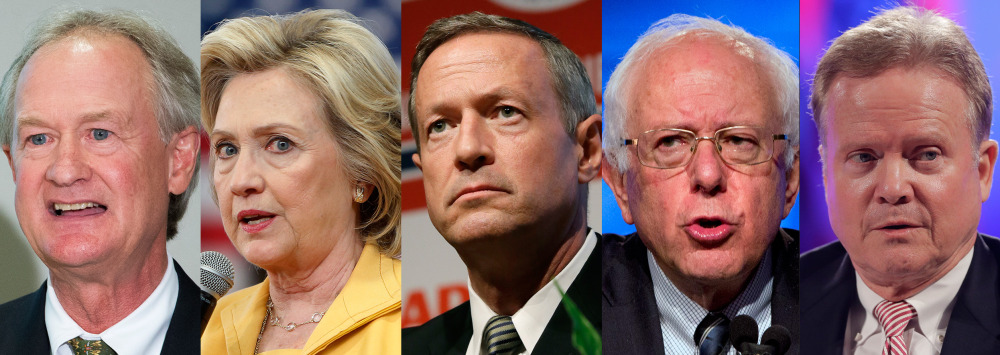
Aging needn’t be feared per se, however, since scores of elderly enjoy a quality of life many young people can only envy. Take last night’s Democratic debate. Hillary Clinton, who may very well be elected president in the coming year, is 67; her chief rival, Bernie Sanders, 74;  Jim Webb, former Virginia senator, 69.

Personally, I found their performance under conditions of surely immense pressure immensely gratifying. I say this because I live in an America that frequently denigrates its older citizenry with “old” often taking on pejorative connotation approximating the “n-word.” If it’s hideous to discriminate on the basis of color, no less so when it comes to your age.

Psychologically, we need more discussion on the subject of aging. Does it confer strengths, in this case, in leadership acumen? I believe it does.

Consider what animal studies might show us; for example, elephants where it’s the matriarch, or oldest elephant, that often leads the herd to a waterhole only she knows about. In short, age often confers the wisdom of experience.

When it comes to being president of the United States, it’s hardly an on-the-job learning experience. Every decision in our more than ever complex world is fraught with consequences, some of them impacting upon our very survival. We need leaders who can take us to the water hole.

Of course, younger leadership may connote creativity, or initiation of new approaches to problem solving; older leadership, a rigidity, or running in place.

In a dangerous world, however, I prefer stability. Unfortunately, the human proclivity is to select on the basis of looks, or youthfulness, rather than functioning. Implanted by evolution to augment progeny, beauty proves a formula few of us can resist. I suspect the birds and the bees know a thing or two about this.

Interestingly, the issue of candidates having changed their positions over time came up. I like Hillary’s answer: “I think all of us have changed positions.”

In short, we evolve, experience conferring wisdom. I call it “seasoning.” The elephant thing again.

Oh, shucks! Missing from the debate was crusty Joe Biden, 72.

Just imagine!

–rj


When Religion Strays too Far: The Hobby Lobby Aftermath

SpringArborIt’s sufficiently dismaying that the Supreme Court via its Hobby Lobby decision has further defined corporate entities as people, and thus with inherent individual rights.

Not only do corporations have unlimited spending rights when it comes to elections, but with the Hobby Lobby ruling, for-profit corporations can now refuse to observe government mandates under the ACA to provide birth control coverage in health coverage for their employees on religious grounds. (Religious non-profits were previously exempted under the law.)

Intriguingly, the majority decision that denigrates a woman’s sovereignty over her own body was made by five men, all of them Catholics.

We can only speculate the slippery slope the Court may have set in motion. In fact, it suggests that for-profit corporations with moral or religious scruples are now free to discriminate in hiring gays or even divorced people. They might even opt to dismiss those opting for abortion or living with a significant other, or terminating their marriage.

At the very least, the Court’s decision establishes a precedent for the expansion of exclusion rights, and not just with regard to corporations, since the underlying assumption is based upon the notion of a person’s right to his or her convictions and corporations are now people.

Historically, following upon a corporate scandal, Congress in 1907 passed a measure forbidding corporate investment in federal elections, which held until 1978 when the high court ruled that corporations have First Amendment rights to finance state ballot initiatives. Even then, only individuals or groups of individuals–political action committees–could do so.

Then came the Supreme Court’s 5-4 decision in 2010, granting corporations unlimited spending rights in all elections, federal, state or local.

In the Hobby Lobby case, the Supreme Court had never in any similar case ruled a for-profit corporation to be a religious entity for purpose of exclusion from federal law. The Justice Department, in fact, contended it would be unable to effectively enforce other laws affecting child labor, immunization, serving racial minorities, or income tax laws requiring universal compliance regardless of how government spends the money.

It’s bad enough as is that in the non-corporate sector, even though Title IX bars schools that receive federal funds (e.g, public student loans and Pell grants) from discriminating against transgender and gays, there exists a specific exemption for religious colleges who find such mandates incompatible with their religious beliefs.

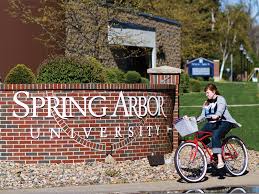
Consequently, the Department of Education has recently granted exemptions to George Fox University, Simpson University, and Spring Arbor University. Since there are a good number of evangelical colleges that fall under the religious umbrella, it’s likely there will be many more exemptions.

Unfortunately, the dark side of religion is often one of imposing beliefs on others, and its history continues stained with violence and intolerance.

We know that majorities can constitute their own tyranny, but so can minorities. Hence Congress needs to review the laws governing these exemptions and narrow their scope.

–rj


Convincing meteorologists that climate change is real

Obamaclimate

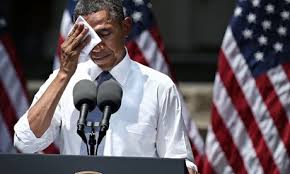
You can see from the above photo the challenge our president faces in convincing, of all people, our meteorologists, that climate change isn’t simply cyclic, but ongoing, posing devastating consequences for America, with no region spared. Further, we humans are its driving force.

The National Climate Assessment came out yesterday, only to be immediately dismissed as “alarmist” by–imagine my surprise–Mitch McConnell (R-Ky). Guess he must think the same about the recently released  UN Panel’s 40 volume plus study conducted by leading climate scientists. I’m reminded as a former prof of Victorian lit just what it must have been like for Darwin in the outpouring of public vitriol that followed upon his perceived tampering with hallowed establishment assumptions. By the way, I never cease to be amazed at the gall of politicians assuming equal footing with reputable scientists.

But it isn’t just the Republicans we have to worry about in Washington when it comes to taking climate change seriously and initiating immediate steps to at least mitigate its effects. You see this most pointedly when it comes to the Keystone XL project. Presently there’s a bipartisan effort to get a two-thirds majority in the Senate in favor of the project, assuring veto proof passage.   So far, 11 Democrats have shown willingness to join 45 Republicans in such a move, with one Democrat optimistic of getting several more.

As always, it’s the old song-and-dance scenario of jobs, when the fact is that if we were to put environment on a war-footing we’d have universal employment in harnessing the forces to slow global warming.   Solar energy has considerable promise, for example, and is already a key component in countries like Denmark. Instead of constructing pipelines with their potential for spills–and sabotage–we’d do better in shoring up our coast lines.

How wonderful it would be to see Republicans and Democrats give priority to long term public welfare rather than short term corporate interests and their reelection prospects. (Once again, a good point for term limits. If it exists for the Presidency, why not for Congress?)

As for the meteorologists, a George Mason University survey in 2010 showed only 19% of them accepted human activity as the primary contributor to global warming.  Some deny climate change period! (http://journals.ametsoc.org/doi/abs/10.1175/BAMS-D-13-00091.1 ) While good at short term forecasting, they fall considerably short at the long term. Public icons, they can be given to a narcissism of overreach. Unfortunately, 62% of us trust our TV weather forecasters more than we do climate scientists!

The greatest proofs of climate change lie not simply in natural catastrophes, but in their ever increasingly frequency. We have computer models for that!

above

–rj


Climate Change: Can we win the fight?

divest395581_155622104590737_1008694978_n

We just celebrated Earth Day on April 22, an annual fête of huge importance for those of us wanting to increase the public’s awareness of the challenge of climate change, and our substantial human contribution to it, and ways we might fight it.

It’s an important time for us in another way, too, as this yearly outpouring of Green advocacy transcending borders buoys up our enthusiasm, telling us we’re not alone in our caring. After all, sometimes it seems that we’re on this great big mountain we impulsively thought we could climb; so rituals of solidarity like Earth Day give us pause to catch our breath, reassess, and press on to our worthy goal of a humanity in harmony with nature as one species among others, each necessary to all. Just maybe we can pull this thing off. Anyway, good to dream big rather than live small.

The truth is that so much more needs to be done and that we’ve been moving at a snail’s pace in making climate change a palpable issue for the public. I saw this demonstrated all too clearly in the presidential debates in 2012, or just 18 months ago, with not a single question directed to environmental matters raised by debate moderators.

If the press can seemingly have no feel for the greatest issue ever to menace us with its destructive pay-load should we evade addressing it, then how much less can we expect the public to grasp what’s at stake? As is, individual lifestyle changes like driving less, getting rid of plastic, cutting back on electricity in our homes aren’t going to do the trick. We need more than bandages to treat the Earth’s hemorrhaging.

Now consider that a recent poll suggests that 37% of Americans don’t even believe in climate change. There exist also a good many, perhaps even more, who look at climate change as simply cyclic and that, just maybe, it might even right itself. Of course that view gets us off the hook and we can conduct business as usual.

Just recently the United Nations released the findings of its Intergovernmental Panel on Climate Change, a careful study by credentialed scientists encompassing some 40 volumes. Insiders say they toned down some of their language and projections so as not to unduly frighten, though their findings still emerge as deeply sobering, with none of us escaping vulnerability to what surely are predictions on an apocalyptic scale. In all honesty, I haven’t noticed any work-up by media or any concerted effort by members of Congress to hold hearings on the report and what we might do to save the day. Like many of you, I grow weary–and wary–of their feckless accommodations to corporate interests.

What’s vital is that we impact the political process, as happened with the Vietnam War, ultimately culminating in LBJ’s decision not to pursue reelection. It started with just a few protesters, then took hold and proved unstoppable. Unfortunately, I don’t see anything like this breaking out. I think this is because many of our projections for climate change impacting us lie still in the future, whereas flag covered body bags coming into Dover AFB were a daily, tangible occurrence, which the media ultimately caught up with when it perceived a muscular protest movement, packing a punch, that wasn’t going to go away.

On the other hand, if we haven’t been able to muster cadres of protestors against our Iraq and Afghanistan incursions with their costly toll in life and wounded for a dubious cause, how much less likely for an environmental movement devoid of blood and gore? And that’s what makes climate warming so horrendously insidious, or like some invisible killer we know is out there, but don’t know where he is, or when he’ll strike, or how.

Perhaps our young people will again show us the way as they did with Vietnam by way of their fossil fuel divestment sit-ins sweeping our college campuses, some 300 as I write, with several success stories, including Harvard with its $32 billion endowment. If it’s wrong to destroy our planet, it follows we shouldn’t be seeking to profit from those who do.   I wrote earlier of the Vietnam days when students rallied to make a difference. All of us: unions, retirees, teachers, tech workers, etc., might do well to follow their lead in choosing our retirement portfolios more discriminately.

But divestment has its limitations, too. While it was practiced widely in the 70’s and 80’s to pressure South Africa’s apartheid regime, the invariable result was that other investors stepped in. It’s true value lay in shaping public discourse, and I venture this holds true with this present endeavor.

Still, I question the wisdom of painting with a broad brush the fossil fuel industry as some kind of axis of evil. We need energy. Are our students willing to follow through and divest themselves of their cars and their electricity and take on an Amish likeness? We would do better to focus on the coal sector, our greatest polluter.

I still like our president–articulate in his efforts to assure health care access, social and economic equality, tax, immigration and drug sentencing reform. So far, he’s championed alternative energy efforts, sought restrictions on coal burning power plants, held out against the Keystone XL project, endorsed alternative energy efforts.

As for Keystone, he needs our support even as we must sustain, and grow our protests, to keep a fire under his feet. When I think of Keystone and the big money behind it–think Koch brothers–I get nauseous: the obscenity of it, given the perils of climate change; the stench of it, given its association with pet coke; the callowness of it, given its destruction of farmland, water aquifers, and wildlife habitat.

The President will presumably make his decision after this fall’s elections, but faces immense pressure, even in his own party. It isn’t a given he’ll opt for courage over pragmatism. In the end, it’s important we all get to the polls and endorse environmentally friendly candidates such as the courageous Gary Peters (D-MI), who hopes to succeed retiring senator Carl Levin (D-MI).   Peters has come out against Keystone, provoking the Koch brothers to contribute substantially to his Republican opponent, who now leads in campaign funding. Peters is our leading spokesperson on pet coke. (By the way, you can access online the Sierra Club’s political endorsements, which include Peters.)

If it came down to, say, an errant asteroid making its way to befuddle our planet as once happened, plunging the world into a rebirth of its pre-evolutionary darkness, then you can bet your life we’d all get off our bottoms and fight the good fight. Well, think of that asteroid as climate change.

–rj


Putin: Better Think Again!

putinIn a recent interview with Fox’s Chris Wallace, former Defense Secretary Robert Gates has said Crimea can be written off as a Ukrainian entity, with the possibility of still further Russian intervention in Ukraine until Putin gets a government to his liking.  I’ve always respected Gates, one of the best defense secretaries ever. 

The problem with Putin is that escalating our threats just won’t work.  He has options too.  Just recently there’s been a rumbling that if the West plays rough, then Russia will no longer allow inspections of its nuclear arsenal.  In short, we’d be virtually back to the Cold War.  And if Europe does take meaningful measures–highly unlikely–it can easily limit natural gas supplies Europe depends on.

Tough talk may even provoke Putin to order troops into Kiev to depose its interim government, which he argues resulted from an illegal coup.  We take it for granted we’re dealing with a rational leader, not a Kim Jong Un, but don’t bet on it.  We do know that he served 16-years with The KGB, or secret police, much of it in East Germany with its Stasi repression.  In a post-Soviet era, his thinking is a throwback to Communist conspiracy.

Asked recently what he considered Russia’s greatest catastrophe, he replied, “the break-up of the Soviet Union,” which goes a long way to explaining his designs on Ukraine and desire to reconsolidate its former vast territorial domain under the guise of the Eurasian Customs Union, slated to go into effect next year.  (See my earlier post,  February 28, 2014:  Russia Likely to Intervene in Ukraine.)

Certainly, world criticism never bothered the Soviets when they invaded Hungary in 1956; nor the Putin regime when it invaded Georgia in 2008, occupying two breakaway provinces where they still remain.  It’s bare-chested, black belt Putin fully on display, true to the narcissistic personality disorder with its broad symptoms of enhanced self-regard, arrogance, absence of sympathy for others, and readiness to exploit.  We’ve seen it all before in the Hitler and Mussolini demagogues of modern history.

I don’t think for a moment our president impresses the Kremlin leader, certainly not after turning his back on a cruise missile strike.  So far the White House response has been one of rhetoric rather than any substance.  While I don’t agree with Republican hawks advocating revival of a missile defense system for eastern Europe, I do think this isn’t the time for reducing our troop numbers.  I’d settle for booting Russia out of the G8 rather than just canceling its upcoming June meeting.  As in most things, the bottom line is money.  We must make Putin’s Ukraine strategy costly.

Russia’s economy, by the way, for all the show time glitter of robust health in its $40 billion outlay for the winter olympics at Sochi, continues in disarray, with present growth forecast at just 1%.  Much of Russia’s financial resources depend on gas and oil exports, or as much as 80% by most financial analysts.

For Russia to cut supplies to Europe is a no-starter.  Russia’s future, in fact, looks ominous, with America on a fast track to energy independence and with potential capacity to supply Europe.  Ironically,  securing the Ukraine, a nation $35 billion in the red, is surely the albatross around the neck that should give Putin pause.

Russia ought to worry instead about shoring up its deplorable infrastructure.  When I traveled by bus several years ago from Moscow to Tula, a distance of about 120 miles, I wished I’d had a kidney belt, what with our wheels tumbling in yard wide holes all the way to the nearby Tolstoy homestead (Yasnaya Polyana).

Its oil and gas infrastructure is declining as well and will entail Russia laying out billions to modernize, compounded by worldwide demand for technical prowess at competitive prices.

Putin has seemingly forgotten his Russian comrades–all 144 million.  Just a few days ago, Russia underwent the biggest stock sell off in 5-years, with the ruble tumbing to a record low, requiring the central bank to raise interest rates.

As is, Russia is fast losing its talented young people with emigration increasing 22% in 2012, and with them, its future.  In the last ten years, nearly two million from the middle class have left Russia.   Ukraine, understandably, wants no part of a dismal future with the Russian Federation.

The pity of Russia with its vast resources is that, like many third world nations, its economy is dominated by a kleptomaniac oligarchy lining its pockets at the expense of a long suffering people.   No wonder the exodus.

Will the last one out please get the lights!

–rj

Sequel to Russian Incursion: Ukraine’s Likely Fate

ukraine4

What we’re seeing in Ukraine we’ve seen before; namely, Russia’s incursion into Georgia in 2008 when that government attempted to wrest back its secessionist breakaway territories of South Ossetia and Abkhazia.  We did nothing then.  We will do little now, simply because we lack leverage.

The Crimea itself,  now fully occupied by Russian troops, poses a strategic necessity for Russia that goes back 240 years.  Adjacent to the Black Sea, it provides Russia with warm water naval outreach to the Eastern Mediterranean and Middle East.   Russia is unlikely to hand it back to a belligerent regime.

The scenario could get even worse for Ukraine, since Russian incursion may not stop with seizing the Crimea.  After all, a large swath of Eastern Ukraine is also Russian speaking.  One incident and Putin is likely to seize upon it as pretext for moving troops into this area as well.  Just yesterday, there was a bloody exchange between rival factions in the region.  In short, the dismemberment of Ukraine may already be underway.

But the situation could prove even more sinister:  Russia may decide to depose the Ukraine’s interim government and install a puppet regime loyal to its interests.  It tried to do this in Afghanistan in the 1980s, propping up a Marxist government.  What this would mean for Ukrainians is painful to contemplate–perhaps civil war between the factions or an incipient resistance movement.

I find it ironic, to say the least, that Russia has waged two conflicts to keep Chechnya within the Mother Land, yet has abetted secession efforts in Georgia and, currently, Ukraine.

In all of this, our hands are sadly tied, exacerbated by our own confusion.  The G8 nations of which Russia is a member, could refuse to attend this June’s trade summit scheduled in Sochi. Acting more bravely–don’t hold your breath–it could expel Russia.  This would sting.

But doing so could hurt our own interests as well.  We need Russian cooperation on Syria and Iran, say critics.  I would argue, however, that this is moot discussion, since it assumes Russian cooperation as a verity.  The truth is that Russia continues its efforts to support a ruthless Syrian regime and remains a potential menace to our efforts to curtail Iranian access to nuclear weaponry.  It’s quite evident that Russia, deeply jealous of the West and, especially the U. S., suffers from an immense insecurity complex reflected in a historic penchant for destabilizing Western aims.

Meanwhile, the UN can muster the Security Council, but to what end, since Russia will employ its veto yet again.

In all of this, Russia ironically doesn’t need to invoke troops, since its ultimate weapon to keep Ukraine in line is natural gas, which it enjoys in abundance.  Ukraine needs that gas desperately and presently owes Russian billions in deferred payment.  Putin, additionally, was already supplying the country with natural gas at sharply reduced rates.

As for the EU, it’s a given that it knows the potential seismic effects of a reduced gas supply from Russia to power its own economies, several of which are already floundering.

In all of this, I would draw a parallel with what happened in 1956 in Hungry, when the Soviets invaded to overthrow an insurgent rebel government.  2000 Hungarians and 700 Soviet soldiers died;  13,000 Hungarians were imprisoned; hundreds executed; and 200,000 refugees fled to the West.  Then, as now, the invaders blamed the revolt on western instigation and facist-nazi reactionaries.

The more the free-world protested, the more things stayed the same.  The Russians vetoed the Security Council’s mandate to withdraw and ignored the General Assembly’s majority vote.  Then, as now, the Kremlin called the West’s bluffs.  A few months later, both East and West were working trade deals.

And this is the way things will end for the brave people of Ukraine, despite Western protests and threatened sanctions.  Human rights didn’t keep the world from swarming to Sochi for the Winter Olympics.

The heavy truth is that politics has always operated in a context of power, not morality.  Right now, Russia enjoys the upper hand.

–rj