Continue reading “Review: Rabih Alameddine’s An Unnecessary Woman”
Category: Political
RJ’s 2021 Draw-bag Booklist
In compiling my annual draw-bag list for 2021 I’ve invested many hours, seeking the most relevant, informative, and challenging books out there, of which there are so many that I’ve had to practice tough-mindfulness in deciding what to exclude. My list includes classics that remain resonant as well as newer works on many subjects, providing provocation and challenge. As we travel 2021 together, I wish you good reading, health and abundant joy. —rj
Fiction:
Anderson, Sherwood. Winesburg, Ohio. (Often considered among the first modernist American novels, narrated in twenty-two short stories exploring the psychological consciousness of protagonist George Willard, it remains an enduring and influential classic of life in pre-industrial small town America.)
Anyuru, Johannes. A Storm Blew In From Paradise. (Taking Sweden by storm, Anyuru’s novel, drawn from the life of his Uganda father and himself, movingly, and without sentimentality, narrates a story of loss, exile, and search for identity.)
Bruner, John. Stand on Zanzibar. (Bruner is largely unknown, save to science fiction buffs, which is a pity. A prolific genius, Bruner penned more than 80 SF novels along with short stories, of which Stand7 on Zanzabar (1968) is eerily prescient in anticipating our contemporary world.)
le Carré, John. The Spy Who Came in From the Cold. (le Carré’s most renowned espionage novel set in East Germany, it transcends plot to indict practices inconsistent with professed democratic and moral values.)
Lewis. Sinclair. Main Street. (Edged out for the Pulitzer because it was judged too political, it remains Lewis’most renowned novel, satirizing small town America and setting the stage for the Nobel Prize for Literature a decade later.)
Marquez, Gabriel Garcia. Love in the Time of Cholera. (One of Latin America’s greatest writers, Marquez’ embraces love, aging and mortality in what will remain an enduring classic.)
McEwan, Ian. Atonement. (A stunning achievement telling of love, war and the destructive capacity of the imagined, rendered in stunning prose.)
Penny, Louise. Still Life. (First in detective series featuring inspector Armand Gamanche. Penny’s mysteries, numbering fifteen, have been translated into twenty-three languages.)
Robinson, Kim Stanley. Ministry for the Future. (Prolific and gifted, science fiction writer Robinson presciently narrates a killing heat wave that may become our future. Superbly relevant.)
Roy, Arundhati. The God of Small Things. (Set in Kerala, India, Roy’s novel narrates an illegal liaison with fateful consequence. A novel destined to become a classic.)
Shakespeare, William. The Tempest. (Believed to be one of Shakespeare’s last plays, The Tempest has sparked revived interest for its timeless relevance.)
Wharton, Edith. Age of Innocence. (An enduring classic, set in the Gilded Age, it was awarded the Pulitzer Prize, making Wharton its first female recipient.)
Non-Fiction:
Aronoff, Kate, et al. A Planet to Win: Why We Need a Green New Deal. (A specific strategy for limiting global carbon emissions simultaneous with promoting economic equity.)
Aurelius, Marcus. Meditations. Tr. Gregory Hays. (If I were exiled to a remote island I can’t fathom a better companion. Wise meditations on what really matters.)
Berlin, Isaiah. Four Essays on Liberty. (GPS host Fareed Zakaria says Berlin’s book profoundly impacted his political views. That’s good enough for me.)
Blum, David. Quintet: Five Journeys Toward Musical Fulfillment. (The late conductor Blum’s revealing portraits of five beloved classical music performers: cellist Yo-Yo Ma, the conductor Jeffrey Tate, the violinist Josef Gingold, the pianist Richard Goode, and the opera singer Birgit Nilsson. )
Cose, Ellis. The Short Life and Curious Death of Free Speech in America. (A cogent polemic revealing the usurpation of the First Amendment by marginal interests groups bent on distorting truth and despoiling American democracy.)
Dalrymple, William. The Anarchy: The Relentless Rise of the East Asia Company. (The history of an international corporation in India, its arrogance, racism, and corporate abuse.)
Dawkins, Richard. River Out of Eden. (A summation for the layman of Dawkin’s previous works on the legacy and centrality of evolution. )
Davis, Wade. Magdalena: River of Dreams. (Davis’ exploration of Columbia’s arterial waterway, explores not only a river, but through largely indigenous narratives, the lives it touches. Powerful, unforgettable.)
Dillard, Annie. For the Time Being. (Miscellaneous topics, among them Dillard’s rejection of “the doctrines of divine omniscience, divine mercy, and divine omnipotence.”)
Ferry, Matthew. Quiet Mind Epic Life: Escape the Status Quo and Experience Enlightened Prosperity Now. (Ferry compellingly shows us how to escape a chattering mind and find inner peace,)
Graeber, David. Bullshit Jobs: A Theory. (Best selling, Graebner’s exploration of the rise of “meaningless” jobs and their social consequences.)
Hãaglund, Martin. This Life: Secular Faith and Spiritual Freedom. (A powerful reexamination of our material pursuits under capitalism and challenge to commit ourselves to values that sustain and promote true freedom.)
Jefferies, Richard. The Story of my Heart. (Jefferies died at 39, leaving behind some of the keenest observations of nature ever written. This moving work will leave you wiser.)
Kendi. Ibram X. Stamped from the Beginning: The Definitive History of Racist Ideas in America. (A sobering critique of the continuing presence of racism in American life,)
Kolbert, Elizabeth. The Sixth Extinction: An Unnatural History. (Humanity’s destructive contribution to species decline.)
Nussbaum, Martha. The Monarchy of Fear: A Philosopher Looks at Our Political Crisis. (A brilliant and candid analysis of the culture of fear by one of our leading moral philosophers.)
Obama, Barak. Dreams from my Father. (I love this man for his decency and eloquence. This seems a good place to begin.)
Obama, Barack. The Promised Land. (No former president has written so remarkably candid a memoir like this, first of two volumes.)
Pickney, Steve. Angels of our Better Nature. (Harvard psychologist’s reasoned contention that violence is not our future.)
Sheehy, Gail. Passages: Predictable Crises of Adult Life. (The late Sheehy’s 1976 study explores transitional stages of human development from early adulthood to midlife and beyond.)
Thompson, Evan. Why I am not a Buddhist. (A critique of modernism within Buddhism per se. Thompson, for example, views the notions of non-self, mindfulness and nirvana as empirically problematic.)
Westover, Tara. Educated. (Raised in a survivalist Mormon family, Westover recounts her journey to independence, academic achievement and self-esteem.)
Wilkerson, Isabel. Caste: The Origins of our Discontents.
(May well-be the priority non-fiction read of 2020 in its timely assessment of America’s enduring legacy of racial divide. Riveting, transforming, magisterial.)
Zakaria, Fareed. Ten Lessons for a Post-Pandemic World.
(What constitutes good governance? Drawing on economic and cultural resources, Zakaria provides a convincing answer.)
Stein’s Map of the Soul—Persona: Review

Anima, animus, archetype, shadow, persona, apperception, individuation—pure Jungian parlance that remains with me still, despite the passage of years since I first read depth psychiatrist, Carl Jung. For a time, I seriously thought about changing careers and becoming a Jungian therapist.
I initially came upon Jung in teaching a college course dubbed Introduction to Literature, designed to teach students how to write expository essays, using literary models. One of its units featured Jungian archetypes. I was hooked.
The archetypal offered a simple palette for opening up literature for my students, baffled at how I somehow could extract meaning from a text that otherwise was simply prose. Know the pattern and you unlocked the door. The hero archetype, for example, with its separation, initiation, return triad.
Jung began my fascination with myth, which led to a National Humanities stipend to study the subject at Claremont Graduate School in 1978. I would learn that myth transcended what the public associated with, say, Greek and Roman mythology popularized by Edith Hamilton. Much more, myth was any attempt to render meaning in an an accidental cosmos, whether religious, political or philosophical, etc. If nature abhors a vacuum, so does the human mind. Myth confirmed Jung’s notion of a Collective Unconscious, or primordial repository of symbolization embedded universally. All cultures, for example, share legacies of a flood, or of Man’s first sojourn in a garden paradise.
In 1986, I studied Jung and Freud in an eight week seminar at Yale. In that wonderful summer, I read perhaps a layman’s best introduction by the sage himself, Man in Search of a Soul. Critic Northrup Frye’s Anatomy of Criticism proved a cogent, expansive source on archetype, and then there was Joseph Campbell’s The Power of Myth with Bill Moyers series, enjoying popular acclaim on PBS.
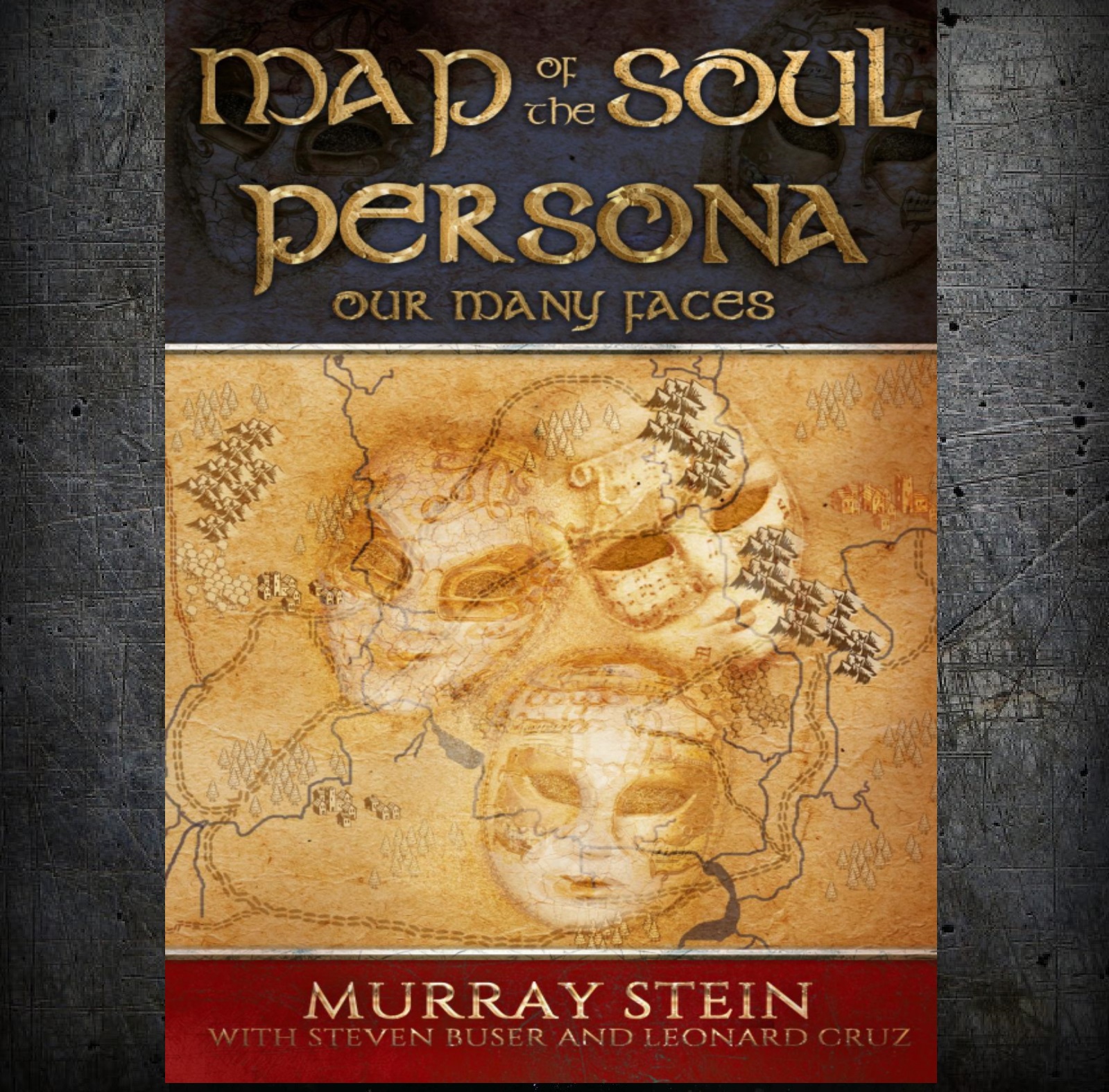
A few weeks ago, I downloaded on my Kindle Murray Stein’s recent book, Map of the Soul—Persona: Our Many Faces, which gathers not only his own insights, but those of other prominent Jungians.
I knew Murray when he was just sixteen, not yet a Yale student. His father was pastor of our church in Sterling Heights, Michigan, and we’d share long talks on varied topics, especially contemporary biblical criticism. Murray now trains analysts at the International Analytical Institute in Zurich, of which he’s president, has published widely, and lectures internationally.
Stein’s book is a short, but welcome, review of Jungian essentials for lay people, particularly on the persona:
Persona is a type of mask. It hides parts of the self that you do not want to be seen by others, and it also expresses who you feel you are at the present time.…But it does not say who you are when you are alone.
In brief, we are much deeper than the masquerades performed by our personas, which unchanged, inspire those complexes, or sub-conscious elements of charged emotion frustrating our living authentic lives and achieving the happiness authenticity makes possible. Deep within our subconscious, lies the Shadow, or unknown self, contrary to the personas we project. Often, we repress it for its contradictions to our social roles or its resulting angst. And here lies the crux and challenge of the Jungian approach—to acknowledge that repressed element and achieve reconciliation in what Jung called “individuation”:
But if we understand anything of the unconscious, we know that it cannot be swallowed. We also know that it is dangerous to suppress it, because the unconscious is life and this life turns against us if suppressed, as happens in neurosis.…Consciousness should defend its reason and protect itself, and the chaotic life of the unconscious should be given the chance of having its way too – as much of it as we can stand. This means open conflict and open collaboration at once. That, evidently, is the way human life should be. It is the old game of hammer and anvil: between them the patient iron is forged into an indestructible whole, an ‘individual.’ This, roughly, is what I mean by the individuation process.
Stein’s earlier book, also titled Map of the Soul (minus the persona tag), ironically caught the attention of the Korean rock group BTS, which have spread Stein’s Jungian message worldwide in their album, Map of the Soul Persona. Stein comments extensively on the album’s songs and their Jungian components in the book’s opening pages.
I think you’ll find Stein’s book riveting and a good place to begin your acquaintance with Jung, one of psychology’s foremost discerners of the human psyche and a principal influence on my own life.
–rj
Edith Wharton’s The House of Mirth: Timely as Ever

There are some books written long ago that we still read for good reasons. Edith Wharton’s The House of Mirth is one of them.
Though Wharton wrote it in 1905, it remains resonant in our own time with its extant hierarchal social structures where one percent own half our nation’s wealth, twenty percent live in poverty, and the middle class faces inexorable decline.
And yet it seems an anomaly that Wharton, so deeply endowed with wealth, should prove one of its harshest critics. Free from economic anxiety, she never knew the duress of marginal income and its daily weight in meeting the monthly rent or mortgage, paying rising utility bills, putting food on the table, having just enough to last until the next paycheck; worse, the cyclic loss of employment amid the vicissitudes of a market economy. She crossed the Atlantic some 60 times, moving permanently to France in 1913. Her parents, who had accumulated substantial wealth from real estate investment, provided their two children with every privilege wealth can confer. A debutante, she never lacked for suitors and married rich. Enjoying replete cultural exposure, she spoke French, German, and Italian fluently, became expert in architectural design, and was a knowledgeable gardener. Yet the fact remains, she’s among America’s most insightful literary critics of what we now call the Gilded Age with its plutocracy of concentrated wealth.
Unlike the novel’s protagonist, the snobbish Lily Bart, Wharton is unsparing in bursting the bubble of the wealthy, the often shallowness of their wanton materialism, the competitive rigors of keeping up appearances, its social intrigues, smug superiority and indifference to the working class.
Wharton’s conscience finds its mindset in foil Gerty Farish’s inveterate altruism who, as Lily observes, “likes being good.”
And though she evolves, it comes too late. Adulating the wealthy, “she liked their elegance, their lightness. They were lords of the only world she cared for, and they were ready to admit her to their ranks and let her lord it with them. That very afternoon they had seemed full of brilliant qualities; now she saw that they were merely dull in a loud way. Under the glitter of their opportunities she saw the poverty of their achievement.”
Like all tragic figures, Lily’s downfall is self-wrought, knowing the encumbrance of her social aspirations, yet subscribing to its comforts. As Selden, the man she loves, astutely observes, “She was so evidently the victim of the civilization which had produced her that the links of her bracelet seemed like manacles chaining her to her fate.”
Selden’s observation, which reverberates throughout the narrative, links her with the naturalist school of writers that includes Crane, Zola, and Dreiser. Cosmic indifference infuses our universe and those unable to adapt it destroys, moral exigencies not withstanding. The House of Mirth has no easy fix. It is tragedy writ large.
As for Selden, he may love Lily, but unable to accomodate her quest for opulence and distinction, he cannot reciprocate. Sadly, he comes to believe the gossip he has heard, stifling his giving her the saving love she requires most by story end: “Selden had given her of his best, but he was as incapable as herself of an uncritical return to former states of feeling.”
Lily’s catalyst to insight is working-class Nettie Struther, whom she runs into toward novel end. In a singular act of previous charity, Lily provided money for Netty to access medical treatment, saving her life. Married and a recent mother, she offers that she had not only been ill, but unhappy. Like Gertie, Nettie has found contentment nonetheless, not in material goods, but in the bonds of affection: “It was the first time she had ever come across the results of her spasmodic benevolence, and the surprised sense of human fellowship took the mortal chill from her heart.”
In the novel’s most salient passage, Lily perceives that
all the men and women she knew were like atoms whirling away from each other in some wild centrifugal dance; her first glimpse of the continuity of life had come to her that evening in Nettie Struther’s kitchen. The poor little working-girl who had found strength to gather up the fragments of her life and build herself a shelter with them seemed to Lily to have reached the central truth of existence….If only life could end now—end on this tragic yet sweet vision of lost possibilities, which gave her a sense of kinship with all the loving and foregoing in the world…The little bottle was at her bed-side, waiting to lay its spell upon her.
Though written in 1905, the novel’s women reflect changing mores and the earliest intrusion of feminism, married women venturing into adultery and divorce and smoking becoming commonplace. Bertha Dorset, Lily’s primary antagonist, has no misgivings about her serial adultery: “The code of Lily’s world decreed that a woman’s husband should be the only judge of her conduct; she was technically above suspicion while she had the shelter of his approval, or even of his indifference.” Its author, trapped in a 28-year unfulfilling marriage, would venture into a long affair, then divorce, rare for its time.
Contemporary readers may find Wharton’s lugubrious sentences tedious to navigate and, yet, read closely, redolent with observational detail probing human behavior in its myriad particulars not unlike England’s literary master, George Eliot, in Middlemarch.
I’ve long held up Wharton as among America’s foremost women novelists, supreme not only in her acuity observing social behavior, but its motivation. Wharton’s novel emerges as America’s rendition of close friend Henry James’ The Portrait of a Lady, both Isabel Archer and Lily Bart, not only victims of betrayal and lost freedom, but of themselves. The House of Mirth ultimately epitomizes the conflict between society’s impositions and the quest to live our authentic selves.
–rj
Reflections on Patti Smith’s Devotion
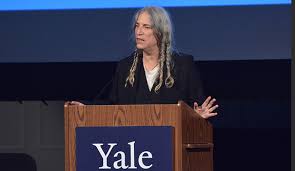
I hadn’t heard of Patti Smith before reading Devotion, her slim volume of 112 pages that expands upon her lecture presentation at Yale (2016), initiating the Windham-Campbell series, “Why I Write.”

Rock aficionados remember Smith for her punk-rock as a singer with her own band and award-winning albums. Politically, her “People Have the Power” became the theme song for Ralph Nader in his 2000 campaign for the presidency. In 2007, she was admitted into the Rock and Roll Hall of Fame. Rolling Stone ranks her among the top 100 rock artists of all time.
She isn’t the norm among rock artists. A gifted painter, poet, and memoirist, she has achieved eminence both at home and abroad for her literary achievement, winning America’s most prestigious prize, The National Book Award for her memoir, Just Kids (2010), sharing company with the likes of Faulkner, Bellow, Didion, Ellison, Auden and Roth. Earlier (2005), France awarded her one of its most prestigious cultural honors, “Commander of the Order of the Arts and Letters.”
Smith is an ardent francophile, with a special love for symbolist poet Arthur Rimbaud. Devotion largely takes place in France, with Simone Weil and Albert Camus receiving special attention.
I stumbled upon the book when I was alerted to Good Reads during our national lockdown and Devotion got mentioned. Years ago, I had read J. M. Cameron’s early biography of the French mystic, Weil, whose posthumous writings became influential. Not least, I’ve always been enamored with Albert Camus. Their presence in the memoir drew me in.
Devotion is divided into three sections, the first and last forming a frame for a fictional narrative of sixteen year old Eugenia, and her fateful liaison with much older Alexander and his exploitation.
In the first portion, we breathe Paris everywhere, its hotels, streets, restaurants, and artist luminaries. Voltaire, Nabokov, Genet, Joyce, Weil, Camus, Modiano—they hover over the City of Light, silent emissaries of the imagination, catalysts of its powers, instigators of imitation. It’s the France I love.
Smith provides readers here with antecedents, or fragments of what we experience, often unwittingly, if not hazardly, of encounters that surreptitiously have a way of becoming part of us, influencing who we are and become.
Devotion doesn’t define the imaginative process. It demonstrates it, and thus the fictional tale at its center, an amalgram of subtle encounters in life’s passage, a mosaic the end result. As she tells us, “Most often the alchemy that produces a poem or a work of fiction is hidden within the work itself, if not embedded in the coiling ridges of the mind.”
Many readers dislike the narrative of Eugenia with its theme of alienation from what gives solace and fulfillment, ending tragically, as its center placement implies: the raison d’etre of Devotion, the essence of imagination’s weaving, or of what Smith fondly calls “alchemy” in the fusing of inchoate elements into an assemblage of unified nuance.
Eugenia, is an Estonian survivor, escaping the deportation of thousands of Estonians to Siberia by a paranoid Stalin during World War II, and owes her genesis to a Martti Helde documentary trailer called Risttuules, translated as In the Crosswind.
Similarly, Eugenia’s studied pursuit of ice skating had its source in Smith’s admiration for a sixteen year old Olympic Russian skater she saw on TV. Smith had no previous experience with the sport.
Weil is important as well in her separation at an early age from her mother through war and Jewish ancestry. Eugenia likewise experiences maternal loss, ultimately learning that her paternal grandmother was Jewish. Like Weil, Eugenia is shy, sensitive and highly intelligent, incorporating Smith’s decision to fuse the physical and intellectual in her protagonist. Writers not only imbibe, they invent.
Eugenia yearns to know her family’s history, having been raised by her mother’s sister, Irna, to keep her safe from the Soviets. She tries to recoup the past “in a futile effort to uncover a father’s eyes, a mother’s face.“
Smith’s pastiche of myriad contributory sources underscores writing as an act of retrieving the past, of making time palpable, of discovering who we are, often unknowable, or as Irina comments in her letter near the story’s end, “There are no signs that tell us who we are. Not a star, not a cross, not a number on the wrist. We are ourselves.”
Artists must be free to hone their craft. Alexander nicknames Eugenia “Philadelphia,“ central in America’s quest for freedom. When he ties her hands late in the story, he symbolically shackles that freedom and pays its consequences:
“Yes, Philadelphia, a hotbed of freedom,“ she said, pulling the trigger.
(Smith grew up in Philadelphia. I did, too.)
Eugenia has been on an archetypal journey, crossing a continent, traversing an ocean, to sojourn on a new continent, now to return to an old. She subsequently enters Alexander’s apartment, reads his notes on presumably Camus’ The Myth of Sisyphus:
The text posed a philosophic examination of the question of suicide—Is life worth living? He (Alexander) had written in the margin that perhaps there existed a deeper question—“Am I worthy of living? Five words that shook her entire being.”
Thematically, Eugenia is an orphaned child, vulnerable in her need for affection, abandoned by her last relative at sixteen. She finds compensation in daily ice skating on a secret winter pond hidden in the woods and becomes very good at it. Stalked by outsider Alexander, she is lured away from her devotion to what sustains: “Her defining sense of self was completely entwined with the laces of her skates.”
Having lost her freedom and with it, her innocence, she enters into knowledge, and seeks freedom’s retrieval. Guilt, however, intrudes with its heavy weight and she cannot pay its cost. Earlier, she had asked her tempter of a better life, “What is the price of this privilege?” Social and cultural constructs have done their mischief: “… she vowed to never skate again. It was her penance, to deny herself the one thing she could not live without.”
Devotion manifests not only Imagination’s dynamism, but its necessity for artists to complete themselves. In sum, Smith has delivered an embedded parable of the consequences of its loss. As she tells us near Devotion’s end, defining the writer’s mission, “What is the task? To compose a work that communicates on several levels, as in a parable, devoid of the stain of cleverness.”
In resuming the frame, we again return to non-fiction in real time, a gathering of additional antecedents informing the embedded narrative—this time, not Paris, but the South of France.
There is Smith’s successful search for poet Paul Valéry’s grave, similar to her search for Weil’s when back in England, having garnered her material. She stops at an older tombstone with the word DEVOULEMENT carved diagonally across its border and asks her friend, what it means. “Devotion,” he replies, and a title is born, resonating the discipline that engenders successful artistry.
I’m curious about this. Despite the anecdote’s implied explanation of the title’s source, we should remember Rimbaud had written a poem, “Dévotion.” Rimbaud is Alexander’s favorite poet, as in real life, Smith’s. It turns out, dévoulement isn’t the word the French employ for devotion as Rimbaud’s poem title indicates. It means “devolution,” i. e., regression to a lower level or abnegation, its synonym in French. Smith doesn’t speak French and reads its literature only in translation.
In a telephone interview, Smith says she first came upon Rimbaud in a bookstall in a Philadelphia bus station. Sixteen at the time, the same age when Eugenia meets Alexander, she saw Rimbaud’s photo on the cover of a 99 cent paperback edition of Rimbaud’s Illuminations, and found him “beautiful.” No money on her, she slipped it into her pocket. Dévotion is one of its poems (Tristram Fane Sanders, telegraph.co.uk, 9 November 2019).
It’s this third section I find Smith at her very best, so many sentences I’m underscoring, observant, moving, waxing poetic. She tells of receiving an invitation from Camus’ daughter, Catherine, to visit the family residence in Lourmarin near my favorite French city, Aix-en-Province.
She is given his bedroom, still housing his books, and access to his uncompleted manuscript, Le Premier Homme. She senses his presence, that affinity of one writer with another: “One could feel a sense of a focused mission and the racing heart propelling the last words of the final paragraph, the last he was to write.” True artistry, impelling its imitation, she senses the urgency, accompanied by confidence, to create her own.
There follows Smith’s compelling close, compe in its succinctness, unceasing in its resonance:
“Why do I write? My finger, as a stylus, traces the question in the blank air. A familiar riddle posed since youth, withdrawing from play, comrades and the valley of love, girded with words, a beat outside. Why do we write? A chorus erupts. Because we cannot simply live.”
–rj
Rachel Carson’s Silent Spring: An Earth Day Tribute

I’ve just finished reading Rachel Carson’s classic Silent Spring, written back in 1962, but still timely. President Kennedy read it eagerly, followed by Nixon in a time when presidents read books. (President Obama is another omnivorous reader in our own time.) Nixon was so deeply affected, that he founded the Environmental Protection Agency (EPA) as a safeguard.
I first became aware of the book in teaching college English composition classes where it appeared as an anthology excerpt, modeling sound expository writing. While Carson had written a thoroughly researched book steeped in chemical analysis, she did so in a way that rendered science transparent to the public, fostering its appeal, unlike a rival text written on the same topic that virtually no one read outside the science community.
Carson’s work models not only coherent analysis at its best, but delivers its thesis with a lyrical beauty underscoring its urgency and moving readers to call for policy change. In a letter to her close friend, Dorothy Freeman, she would write, “Once the emotions have been aroused—a sense of the beautiful, the excitement of the new and unknown, a feeling of sympathy, pity, admiration and love—then we wish for the knowledge of our emotional response. Once found, it has lasting meaning.”
A perfectionist, she researched exhaustively and revised continually, concerned not only with message, but delivery. She had begun her college days as an English major before switching to biology. Carson composed Silent Spring while battling aggressive breast cancer, initially misdiagnosed. She had planned to write four other science books. The miracle is that she produced anything at all.
Since those days of teaching writing and my growing commitment to the green movement and awareness of the existential, exponential threat of climate change, I have wanted to return to her foundational work. I’m not sure how many of us are into eco-literature and Silent Spring or her other noted works, The Sea Around Us (National Book Award Winner) and best selling, The Edge of the Sea, but I knew reading it fully was something I just had to do to do, not least, to honor her—she passed so quickly from us after Silent Spring—but also as a means to gauging our progress in addressing her concerns.
Silent Spring deals with the havoc waged by land, sea, and air to the environment through indiscriminate use of pesticides by federal, state and local communities in support of economic interests, e.g., logging, agriculture, community agendas, heedless of consequences, repeatedly so, even when evidence of harmful repercussions had proven pervasive. An act of willful hubris, a genocide against nature, it resembles our own era when fossil fuels, primary contributors to a changing climate, continue as principal sources of energy reliance.
Silent Spring can be painful reading in its strident account of corporate interests in liaison with government, pillaging our environment and disregarding human welfare. Today, nearly every plant, and animal, including ourselves, even where spraying has ceased, show chemical residue. Species have been sharply reduced, disturbing a complex ecology, while augmenting pest resistance and promoting cancer proliferation.
There was a strange stillness. The birds, for example—where had they gone? Many people spoke of them, puzzled and disturbed. The feeding stations in the backyards were deserted. The few birds seen anywhere were moribund; they trembled violently and could not fly. It was a spring without voices. On the mornings that had once throbbed with the dawn chorus of robins, catbirds, doves, jays, wrens, and scores of other bird voices there was now no sound; only silence lay over the fields and woods and marsh.
All of this fallout unnecessary, for safer biological tools had proven successful, yet still, the spraying continued. The corporate sector, spending $250,000, a huge sum at the time, resisted Carson’s assault, much like today’s Monsanto, arguing correlation not establishing causality, and disparaging Carson’s credentials: no Ph. D, no standing in the science community, no academic affiliation, a “bird lover,” her followers, “health quacks.” Shockingly, the American Entomological Society listed Velsicol, Monsanto, Shell Chemical Company, and other chemical corporations among their “sustaining associates.” One major pesticide firm threatened her publisher, Houghton Mifflin, with a lawsuit if the book were published without changes.
Carson was understandably surprised by the book’s smashing success, selling 65,000 copies in its first two weeks and its subsequent Book of the Month Club selection.
Against all odds, Silent Spring had found its way into the public’s consciousness. DDT was halted, though hypocritically allowed for export, much like cigarettes later on. As noted, the EPA came into being as the book’s consequence. In 1981, years after her passing in 1964, Carson was posthumously awarded our nation’s highest civilian honor, The Presidential Medal of Freedom.
Sadly, Carson’s critics have continued their assaults, covertly changing their tactics and employing political correctness. The late science fiction novelist, Michael Crichton, for example, a vociferous climate change denier, branded her “a mass murderess” for the ultimate banning of DDT and deaths of millions of African children from malaria, while others have dismissed her as a white elitist. They ignore that DDT was actually banned only domestically, subsequently proven ineffectual against increasing mosquito resistance abroad, and replaced by newer, more effectual pesticides and innovative pharmaceuticals to contain malaria. Ironically, Carson hadn’t actually called for its banishment, but for its judicial use along with other pesticides.
Among poisonous chemical substances Carson addressed in Silent Spring, herbicides continue as a primary public menace, particularly for gardeners using the ubiquitous box store Roundup. There have been three trials involving pesticide giant Monsanto, two in state courts and the other in federal court, with up to 100,000 plaintiffs, alleging resulting non-Hodgkin lymphoma and consistent Monsanto coverup. Significantly, on March 19, 2018, a unanimous jury found Monsanto culpable and $25 million was awarded to plaintiff Edwin Hardeman.
Dismayingly, Trump’s EPA has currently sanctioned Monsanto’s employment of a new crop herbicide, dicamba, resulting in widespread crop damage, and Monsanto’s presently facing legal intervention by the Ninth Circuit Court of Appeals. As with the frequent scenario Carson underscored in Silent Spring, corporate priorities like those of Monsanto have plunged headlong into pressing economic gains, even when their own studies revealed imminent liabilities, conspiring with the EPA to soft-pedal the herbicide’s dangers:
Documents filed in court show Monsanto met multiple times with EPA officials about the concerns, even editing EPA language about certain steps Monsanto should take in communications with retailers. In an October 2017 email, an EPA official forwarded a Monsanto official comment from the agency regarding the company’s product label, writing: “Like I said, no surprises.” (Carey Gillam, The Guardian, April 2, 2020).
After so many years, Carson’s legacy continues. The Sea Around US (1951) and Silent Spring have been translated into more than forty languages, with the latter averaging 25,000 sales annually. A collection of Carson’s unpublished work appears in Lost Words: The Discovered Writing of Rachel Carson., ed. Linda Lear (1998). For a biography, and there are several, I would begin with M. H. Lytle’s thorough and cogent, The Gentle Subversive: Rachel Carson, Silent Spring, and the Rise of the Environmental Movement (2007).
I’m glad to have read Silent Spring, which launched the modern day environmental movement, and unhesitatingly regard her as one of the foremost women of the last one-hundred years, unflinching, passionate, yet empirically based in her environmental witness. I end with the final paragraph of Silent Spring:
The “control of nature” is a phrase conceived in arrogance, born of the Neanderthal age of biology and philosophy, when it was supposed that nature exists for the convenience of man. The concepts and practices of applied entomology for the most part date from that Stone Age of science. It is our alarming misfortune that so primitive a science has armed itself with most modern and terrible weapons, and that in turning them against the insects it has also turned them against the earth.
–rj
Sally Rooney: Up to the Hype?

I took up reading Irish literary sensation Sally Rooney to find out what the fuss was all about. After all, she’s only twenty-eight and has written two novels that have rocked the literary world, Conversations with Friends (2017) and Normal People (2018), dubbing her the gatekeeper of the millennial generation. Saying you’ve read Rooney is the new chic.
Where does such youthful sagacity come from, that sureness of stroke distilled in cerebral awareness of the ambiguity, especially defining relationships, of society’s cultural constructs, social, political, and economic? Adding to the enigma, why attempt sorting out others, when we’re a mystery to ourselves as her characters abundantly demonstrate?
Rooney is a graduate of prestigious Trinity College, which becomes the principal foreground of Normal People. Its graduates include luminaries like Bram Stoker, George Berkeley, Edmund Burke, Samuel Beckett, Oscar Wilde, Jonathan Swift, William Trevor and Mary Robinson. Rooney received a master’s degree from Trinity in American literature.
She has the smarts. No one doubts that. As for her two novels, if you’re into politics, especially the progressive kind, you’ll rollick to their beat, both novels pounding the political turf with trendy leftisms, fashioned in the aftermath of the market collapse of the Celtic tiger economy in 2008 and Rooney’s own upbringing in a Marxist household. Good novelists are inevitably iconoclasts and Rooney’s two novels, love stories, don’t disappoint in this regard. The question is how well she succeeds.
Conversations with Friends is narrated in first person by Frances, a bisexual communist in love with a married man, Nick, in a dysfunctional marriage. Her political sentiments come early and uncompromisingly when confessing to Nick that she had sex recently with a guy she met on Tinder, an admirer of Yeats, whom she earlier dismisses as fascist: “No one who likes Yeats is capable of human intimacy.”
Wage inequity arises in Conversations and discourages Frances from seeking work, a sentiment shared by many unemployed or under-emplored millennials these days:
I had no plans as to my future financial sustainability: I never wanted to earn money for doing anything. […] I’d felt that my disinterest in wealth was ideologically healthy. I’d checked what the average yearly income would be if the gross world product were evenly divided among everyone, and according to Wikipedia it would be $16,100. I saw no reason, political or financial, ever to make more money than that.
In Normal People, both Connell and Marianne worry about employment, even though they’re academically achieving university students. Marianne is unfailing in dotting the i’s and crossing the t’s in her ripostes of leftist student platitudes.
Marianne comes from a well-situated family; Connell, from a working class, single mother household. Class dialectic underlines a fundamental tension between the two, save there’s no genuine synthesis, despite their mutual love.
Connell’s mother is a housecleaner in Marianne’s parents’ upscale home. Ironically, she’s a disillusioned socialist, who undermines with laughter Connell’s recent enthusiasm for a local communist candidate:
Come on now, comrade, she said. I was the one who raised you with your good socialist values, remember?
Connell texts the disappointing election results of Fine Gael’s victory to Marianne who replies, “The Party of Franco,” alluding to the sending of a brigade of 700 combatants supporting the Nationalists in Spain’s civil war, despite the party’s official neutrality status. Connell has to look up the history. Rooney has a history of never letting her Leftist orthodoxy tolerate perceived apostasy.
Although sex is paramount in both novels, replete with minutiae and underscore’s women’s sexuality and love, it pervasively mutates into pathology, or power constructs, contributing little to promoting where the narratives should be headed—the social interchanges with others that comprise our identities and potential for self-realization. In relationships of disparity, subordinates, like Frances or Marianne, may utilize sex to approximate getting what they want, but cannot have. So much of this comes down to, Am I worthy of love? Replete with self-analysis as provender of self-mastery, it sputters into repetitive ineffectuality.
If anything, sex in these novels mirrors momentary catharsis, not sequels of emancipation from social, or class, determinants. Except for Bonni, in Conversations with Friends, the characters would do well with a bit of professional counseling. Supposedly in love but enmeshed in self-interest, characters in both novels emotionally engage in mutual tug of war.
Psychologically, Conversations with Friends and Normal People exhibit all the trademarks of co-dependency. Nick and wife, Melissa, for all their mutual infidelity, will not abandon their marriage. Nick, not incidentally, suffers from chronic depression and has been an in-patient at a psychiatric hospital. Marianne engages in self-injury behavior, symptomatic of deep-seated anxiety and self-loathing. Similarly, she hooks-up with a BDSM artist while a student in Sweden. In one scene, she wants Connell to throw her out of bed. Connell lacks self-confidence and resembles Nick in his depression. Rooney foreshadows in Conversations the self-inflicted masochism we see in Normal People, Frances ruminating about Nick, “I wanted him to be cruel now, because I deserved it. I wanted him to say the most vicious things he could think of, or shake me until I couldn’t breathe.”
But let’s talk about the writing itself. Both novels are like Twitter exchanges rather than vibrant telling. Language seems almost an intrusion in the short, blunt dialogue that frequently consists of text messaging and emails absent of punctuation and capitalization, not atypical of millennials. Quotation marks never occur in these novels to demarcate speakers, a mannerism serving no purposeful function other than an underlying contrariness that earmarks her essays and interviews. Normal People meanders into cliches, and not very good ones at that.
Absent of artifice, devoid of symbol or pattern, these novels read more more like sociology texts, laconic and, worse, so continuous, they provide no real climax or meaningful denouement leading to resolution. Despite the politics, there’s no genuine revolt and we end in stasis, or where we began. At Normal People’s end, Connell still waxes control, with Marianne’s validation dependent on his acceptance in what seems a rushed ending. You’ve got oppression without liberation. Sadly, both Frances and Marianne are non-assertive women in symbiotic relationships. There are no breakthroughs.
Whether these two novels merit their accolades, they do mirror the lifestyle of many millennials today, less sure of their futures than their parents were, rebellious against traditional mores, steeped in social media, while religiously and politically cynical. Both novels are trendy, but is this enough?
Out of curiosity, I wandered over to Goodreads to view reader reactions. While Rooney has her coterie of enthusiasts, a fair number complained of a dullness in plot and characters fundamentally unhinged who you’d not like rubbing shoulders with in everyday life.
Having read both novels, I’ve gone on to reading Anita Brookner’s Hotel du Lac, a Booker Prize winning novel. No contest with lines such as “That sun, that light had faded, and she had faded with them. Now she was as grey as the season itself.” For me, Brookner wins hands down for insight, delivery, and relevance in depicting women’s efforts at finding emancipation in a patriarchal culture. Or as one critic put it long ago, “She makes some writers look a bit unsheveled and a little vulgar” (Rosemary Dinnage).
I think, too, of Edna O’Brien, Ireland’s preeminent feminist novelist hailing, like Rooney, from west Ireland and still writing at nearly ninety on similar themes of women’s internal lives, meriting a comparison to gain Rooney’s full measure, despite the generational divide. Like Rooney, she captured the essence of a new generation of women. In her formulae for writing, O’Brien comments, “Everything is very important – the landscape, the story, the character – but the rhythm and musicality and the spell of language, that’s what it is. Otherwise you’d put it on a postcard” (Irish Times, Nov. 7, 2015). I wish Rooney had taken note.
I like to think we really need something like fifty years to objectively validate a novel and, say, judge it a classic. Will posterity still read Hotel du Lac come fifty years? I’d wager yes. Not so for Conversations With Friends or Normal People.
We’d do better to heed critic Harold Rosenberg’s observation about generational thinking: “Except as a primitive means of telling time, generations are not a serious category. The opinions of a generation never amount to more than fashion. In any case, belonging to a generation is one of the lowest forms of solidarity.”
–rj
Review: Paul Collier, Exodus: How Migration is Changing Our World

Not long ago, Hillary Clinton controversially summed up Britain’s Brexit morass as essentially about immigration: “Europe needs to get a handle on migration because that is what lit the flame.” https://www.theguardian.com/world/2018/nov/22/hillary-clinton-europe-must-curb-immigration-stop-populists-trump-brexit
A way of saying that only then can Europe tame the groundswell of white, nativist resentment that has given rise to Donald Trump and Britain’s now confirmed exit from the European Union, January 31, 2020.
Surprisingly, you would think the port city of Dover, robust shipping hub just twenty miles across the Channel from France, would smell a threat to what’s generated its prosperity but, no, it wanted Brexit, voting 62% in favor in 2016’s national referendum.
Except for Britain’s urban centers with their strong diaspora presence, Northern and rural Britain voted decisively in December’s parliamentary election for Boris Johnson’s Tories.
Before the referendum, Britain had seen its Eastern European born population increase four fold between 2004 and 2016. According to the Office for National Statistics (ONS), the number of migrants born in Eastern Europe employed in Britain rose by 49,000 between July and September, 2016, to 1,077,000.
Immigration continues as well from former Commonwealth nations in Asia, Africa and the Caribbean. East Asian immigrants alone constituted nearly 4 million in the 2011 census. That same census showed a Black population of 1.9 million.
Some younger movie-goers of Dunkirk ludicrously complained of the film’s lack of diversity, having grown-up in today’s Britain. Britain has vastly changed in its demographics. Like its American cousin, it’s now multicultural.
Obviously, this isn’t without its consequences, the immigration surge sparking widespread indigenous resentment as newcomers, not all of them legal, compete for jobs, housing, and social services. Along with the Netherlands, Britain is already the most densely populated nation in Europe.
Against this backdrop comes Sir Paul Collier’s Exodus: How Migration is Changing Our World (2013). Collier is a well-seasoned, highly regarded Oxford development economist, who has written a number of influential books, including his recent The Future of Capitalism (2018), which Bill Gates included among his five recommended summer reads (2019). Collier, a former World Bank economist, frequently advises government leaders.
This past year, Collier’s book was one of several I pursued on immigration, which Collier argues is analogous to climate change in its centrality and effects, demanding scrupulous and immediate reappraisal.
What’s refreshing is his painstaking, fair-minded, low-key analysis, employing a wide-ranging empirical modality that includes graphs and salient research sources applied to a complex, often emotionally charged issue. He’s unafraid to confront both conservatives and progressives when facts merit frankness or confessing limitation when knowledge forbears on solutions. Migration has both pluses and minuses. Collier appraises both.
For the positive, immigration ameliorates poverty in third world countries, allowing for a diaspora abroad that sends back remittances averaging $1000 annually to families in their former countries.
It rewards young people for their education and skills that contribute to their new homelands.
Host societies garner a steady revenue flow in taxes in a return on education it didn’t have to pay for. (Collier suggests host countries pay back the countries of origin.)
Nationalism needn’t be made synonymous with racism. As Collier sees it, “identifying with a nation has proved to be an extremely powerful way in which people bond.” You might think of it as the family writ large.
This becomes nearly a refrain in the book, the assertion that without the goodwill of the host society, immigration can flounder. Multiculturalism, while conferring stimulating variation, can foster resentment of the outsider who prefers not to assimilate while competing for employment, housing, and social benefits. On the other hand, seeing others as members of the same community fosters acceptance of social and economic equality.
Ironically, it’s the failure of clans in many African nations to integrate into the national fabric that’s played havoc with social stability and economic progress, with local loyalty prioritized over national welfare:
A standard characterization of African political economy is that each clan regards the public purse as a common pool resource to be looted on behalf of the clan.
Migrants from developing nations are largely escaping from dysfunctional social models. That they are poor countries is the net result of that dysfunction:
Functional social models are decisive, but they do not just happen: they are built as a result of decades, and sometimes centuries, of social progress.
Collier cautions that immigration requires continual monitoring. If a diaspora grows disproportionately large, it can deter integration and exacerbate public sentiment.
Large diasporas can even offset point admission criteria in countries like Canada and Australia by way of chain immigration, ultimately leading to less educated and skilled immigrants that may become public charges and increase crime.
While Collier doesn’t advocate discriminatory immigration on the basis of race, he notes that the more culturally distant the immigrants are from the host population, the less likely assimilation will occur. Some may even bring with them the dysfunction of their homeland. Conversely, America’s large Latinx influx has assimilated fairly well, perhaps largely as a result of cultural similarity.
Point systems, in any event, accelerate the flight of those vitally needed to build capital investment and stability that can potentially help developing nations achieve a reasonable prosperity for their people. When the educated and skilled emigrants leave, pervasive incompetence, disregard for rules, and corruption occur, setting in motion imitative behavior.
Nations like Haiti can never catch up. With a 10 million population, it has lost 85% of its educated people. While taking-in large numbers of a poor nation’s intelligentsia may benefit prosperous nations, it has tragic fallout for nations like Haiti.
Meanwhile, many in the West fear not only competition from immigrants, but replacement. As Hillary Clinton astutely observed, “I admire the very generous and compassionate approaches that were taken particularly by leaders like Angela Merkel, but I think it is fair to say Europe has done its part, and must send a very clear message – ‘we are not going to be able to continue provide refuge and support’ – because if we don’t deal with the migration issue it will continue to roil the body politic.”
Collier’s answer is that “for assimilation and fusion to work, there is a need for controls on the rate of migration that are fine-tuned to take into account its composition.” Government policy needs to assess both domestic and homeland impact.
Without monitoring, immigration is likely to rapidly increase with potentially harmful results for both host nations and those left behind in impoverished countries. (In the U. S., low wage undocumented immigrants compete with unskilled indigenous workers, frequently people of color.)
Not everyone will find Collier’s conclusions palatable; for example, his view that educated immigrants might possibly be granted guest worker status, then returned to their homeland as nation builders.
As for “brain drain,” they may argue that Collier exaggerates, with Haiti an isolated example. According to The Guardian, two thirds of government officials in developing countries have studied abroad. Still, how many others leave, never to return? Critics seem to forget that Collier knows his turf as a World Bank economist with expertise in development economics and lived several years in Africa.
Enthusiasts for immigration may find Collier’s analysis rather pessimistic. But this isn’t really the narrative Collier delivers. He attempts a balanced assessment of immigration’s effects on migrants, their host nation, and on those left behind. Who does immigration help? Who does it hurt?
Critics alleging the success of immigrants in Britain curiously ignore Britain and the Continent’s growing unease and incipient popular front resistance to immigrants in France, Germany, Italy and, especially, Hungary and Poland, menacing the European Union. As I suggested at the outset, Brexit resonates Britain’s desire to recover its identity and control its destiny.
I’ve learned so much from Collier’s painstaking analysis of a controversial issue, likely to accelerate like climate change in its immediacy, the latter propelling mind-boggling numbers of climate refugees, particularly from Africa, by century end.
Presently, the U. S. takes-in more than two million immigrants annually, not including millions more through chain immigration and asylum seekers. And then there are the undocumented, now grown to 12 million.
The U. S. also conducts an annual lottery for 55,000 immigrant visas for applicants from countries with low immigration rates to assure diversity. In 2018, 23 million applied.
None of this occurs in a vacuum. Immigration is a complicated issue and done a grave disservice by xenophobic, even racist, conservatives and naive progressives advocating virtually open borders and tax payer supported social benefits for the undocumented.
Collier doesn’t propose he has all the answers and often tells readers when the evidence proves lacking or ambiguous. But I respect his acumen and, even more, his honesty.
As Collier rightly puts it, “The angry debate between xenophobes and “progressives” addresses the wrong question: is migration good or bad? The relevant question for policy is not whether migration has been good or bad overall. Rather, it is the likely effects at the margin should migration continue to accelerate.”
–rj
2020 Draw-Bag Reading List
I can’t believe it! Another year has passed. Last year, I drew up my first annual Draw-Bag Reading List (2019). Happy to say, I’m glad I did it, as it structured my reading. While I didn’t get to read every book, I did read many and the plan kept me motivated. This year I’ve had better sense to list authors alphabetically, along with annotated commentary to remind myself just why I should read a particular book. There are so many wonderful books out there that I had difficulty choosing which ones should make my list.
I can’t say when I learned to read, but it was early, nor who my teachers were that taught me how, but I’m grateful. I am so much an offspring of the books I’ve read that I can’t fathom a life without them. In the witness of others, we find community and with it, both solace and wisdom.
A Happy New Year to all of you, filled with many hours of good reading.
FICTION:
Aciman, André. Call me by Your Name. (Coming of age novel by famed Egyptian writer)
Adiche, Chimanda Ngozi. Americanah. (Prize-winning novel by a Nigerian immigrant to U. S., who discovers what it means to be Black in America.)
Akhmatova, Anna. You Will Hear the Thunder. (Shafak says this is a book that makes her wish she could speak Russian.)
Alameddine, Rabih. An Unnecessary Woman. (Nominated for National Book Award, tells story of a 72 year old divorced woman who translates literature in her Beirut apartment.)
Atwood, Margaret. The Testaments. (The sequel to The Handmaid’s Tale.)
Benjamin, Walter. The Arcades Project. (You’ll never see an urban landscape the same way again. Written by a superb intellect and rebel.)
Brookner, Anita. Hotel du Lac. ( Brookner’s novels center on intelligent, marginalized women attempting to find themselves in a society where the greedy and shallow often win out over the kind and generous.)
Choi, Susan. Trust Exercise. (Love between teens at a performance school meets teacher intervention. Pulitzer nominated.}
Clegg, Bill. Did You Ever Have a Family? (Nominated for Booker Prize, what happens when life throws you a curve.)
Eugenides, Jeffrey. Middlesex. (One of the most beautifully told family sagas treating issues of identity.)
Ishiguro, Kazuo. An Artist of the Floating World. (About aging, memory, solitude, loss, and art set in post war Japan.)
Johnson, Denis. Twain Dreams. (A novella of the American West that captures the ending of a way of life and the unfolding of a new America.)
Kafka, Franz. The Trial. (The classic novel that propelled Kafka to fame.)
Lerner, Ben. 10:04. (“Lerner captures what it’s like to be alive now, during the twilight of an empire, when the difficulty of imagining a future is changing our relationship to both the present and the past,” —Publisher)
Melville, Herman. Benito Cereno. (Poet Gary J. Whitehead wrote a screenplay adaptation.)
Mitford, Nancy. In Pursuit of Love. (Sardonic portraitures of upper class English life, mirrored on her own.)
Obreht, Téa. The Tiger’s Life. (Set in an unnamed Balkan country, a story of love, loss, and legend and novel debut by a Serbian-American novelist recognized as one of our most talented young writers.)
O’Brien, Edna. Country Girl. (Her debut novel that shocked Ireland with its sexual frankness. O’Brien considered one of the greatest living Irish authors.)
Robinson, Marilynne. Lila. (Girlhood lived on the fringes of society by one of our finest contemporary novelists,)
Rooney, Sallie. Conversations. (Remarkable debut novel by an Irish 26-year old that has rocked the literary world.)
Rooney, Sallie. Normal People. (Rooney’s most recent second novel many say is even better than Conversations. On Obama’s 2019 reading list.)
Rushdie, Salmon. Quichotte: A Novel. (Rushdie delivers with wit and humor reminiscent of Don Quixote}.
Shafak, Elif. The Bastard of Istanbul. (Good intro to Shafak, in my view, one of our foremost women authors.)
Wharton, Edith. The House of Mirth. (Perhaps America’s best female novelist, Wharton’s 1905 portrayal of upper class mores remains timely and brilliant.)
NON-FICTION
Ackerman, Diane. One Hundred Names for Love: A Stroke, A Marriage, and the Language of Healing. (Ackerman endures as one of my favorites. This book narrates what happens in a loving marriage when your spouse undergoes a devastating illness.)
Amanat, Abbas. A History of Modern Iran. (One of the best places to begin.)
Baldwin, James. Notes of a Native Son. (Baldwin’s first book (1955), a collection of ten riveting essays still relevant by a remarkable writer.)
Boska, Bianca. Cork Dork: A Wine-Fueled Adventure Among the Obsessive Sommeliers, Big Bottle Hunters, and Rogue Scientists Who Taught Me to Live for Taste. (Sensory, fascinating exploration of wine aficionado expertise.)
Carson, Rachel. Silent Spring. (The early classic that would initiate environmental consciousness.)
Epictetus. The Enchiridion. (Stoicism, with its philosophy of rational living and quest of virtue, begins with this ancient work.)
Goldstein, Joshua S. and Steffan A. Qvist. A Bright Future: How Some Countries Have Solved Climate Change and the Rest Can Follow. (Some countries have replaced fossil fuels. We can do the same by mid-century if we have the courage.)
McKibben, Bill. Falter: Has the Human Game Begun to Play Itself Out? (“As climate change shrinks the space where our civilization can exist, new technologies like artificial intelligence and robotics threaten to bleach away the variety of human experience.”)
Montgomery, Sy. How to be a Good Creature. (National Book Award finalist. Book features 13 animals from whom author has x learned life lessons.)
Piketty, Thomas. Capital in the Twenty-First Century. (Ground-breaking history and analysis of capitalism and its contemporary contribution to rising inequality.)
Rich, Nathaniel. Losing Ground: A Recent History. (In 1979, we knew about global warming and how to stop it. This book tells of those who risked their careers to convince the world to take action before it was too late.)
Solnit, Rebecca. A Field Guide to Getting Lost. (Essays in Wanderlust, or of wandering, getting lost, and exploring new vistas and relationships.)
Stein, Murray. Map of the Soul—Persona: Our Many Faces. ((I knew Murray and his family well in my early youth. Murray went on to become a leading Jungian, the famed Swiss psychiatrist who influenced me profoundly.)
Wallace-Wells, David. The Uninhabitable Earth: New A Story of the Future. (The consequence in our near future of our not taking action to mitigate climate change.)
Wohlleben, Peter. The Hidden Life of Trees. What They Feel and How They Communicate. (The title says it all. You’ll never look at a tree the same way again.)
–rj