Philip Hoare’s William Blake and the Sea Monsters of Love: A Review

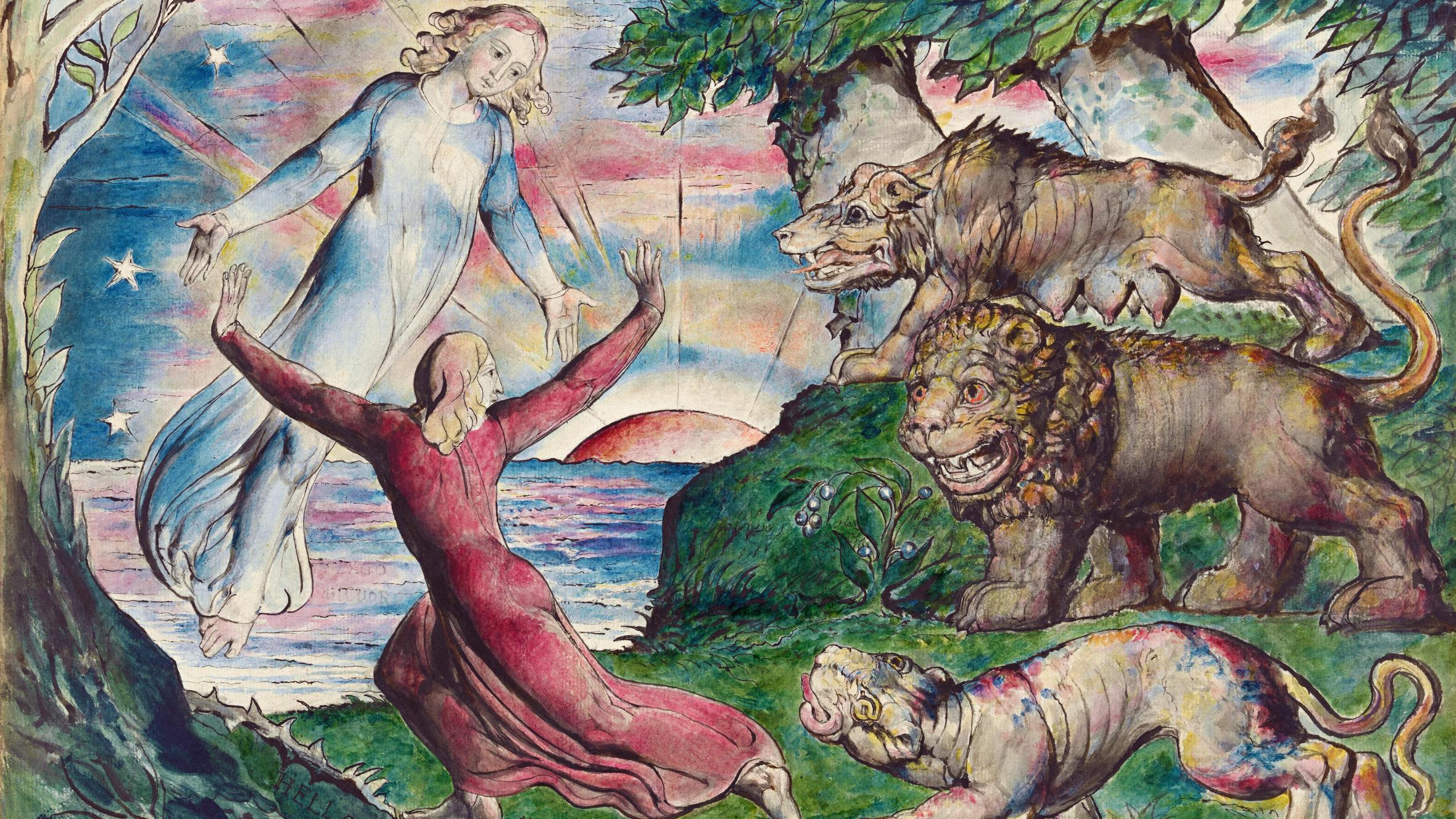
Dante Running from the Three Beasts

Writer and filmmaker Philip Hoare has of this date written ten well-received books of non-fiction, including multiple award-winning Leviathan, or the Whale (2008). His expertise ranges widely as a connoisseur of poetry, painting, and environmental concern. He once rescued a butterfly from a crowded tube platform. Every winter, for twenty-four years, he has traveled from his native Britain to Cape Cod to film and research the few Right Whales that remain.

These eclectic interests repeat themselves in his latest book, William Blake and the Sea Monsters of Love (2025), extraordinary in its telling as a mix of tribute and memoir embedded in seascapes and the long cast of those Blake influenced—among them Mary Wollstonecraft, Mary Shelley, Dante Gabriel Rossetti, Gerard Manley Hopkins, W. B. Yeats, Ezra Pound, James Joyce, T. E. Lawrence, Paul Nash, Nancy Cunard, Iris Murdoch, and Patti Smith. Hoare elaborates at length on each of them.

Readers may find this annoying in a book supposedly focused on Blake, but Hoare sees them as linked to Blake in their radical politics. I found these vignettes intriguing, especially regarding Hopkins, Lawrence, and Murdoch, who I was unaware were bisexual. I had not known that Lawrence translated The Odyssey directly from Greek, or that Blake learned Italian to read Dante’s Divine Comedy in the original.

I did not, however, find most of the vignettes convincing emissaries of Blake’s influence. To have read Blake does not invoke influence; Hopkins, Lawrence, and Cunard loom especially tentative. While Hoare is concerned with seascapes in Blake’s work, that Hopkins’s The Wreck of the Deutschland is situated in an aquatic domain does not evidence Blakean influence by itself. T. E. Lawrence read Blake, but no specific instances of linkage occur in his work. And while Blake abhorred painting landscapes, Nancy Cunard was obsessed with them.

What all these figures share with Blake is not artistic continuity, but their remaining authentic, defiant selves, eccentric in their otherness, endowed with vision, often revolutionary.

Nonetheless, I’m fond of this book, having been drawn to Blake years ago—the genesis of much of my subsequent musings on myth, Carl Jung, and Northrop Frye, whose Fearful Symmetry laid bare Blake’s mythology, handing me a roman à clef to unlock literature’s portals.

I’m biased, I suppose, in sharing Hoare’s radical politics, his fierce accusatory polemic of capitalist transgression, his compassion for the marginalized, and his anxiety for the environment—especially whales, those denizens of the deep that profusely populate Blake’s artistry, emblematic of divine paradox, or contraries: “I form the light, and create darkness: I make peace, and create evil: I the Lord do all these things” (Isaiah 45:7, KJV).

Blake’s renegade politics as a devotee of the French Revolution align with Hoare’s own mindset, reflected in the bestselling 1972 environmental broadside The Blueprint for Survival (known as The Manifesto). Hoare traces its primogeniture back to Blake, who unsparingly critiqued burgeoning capitalism, state religion, and the military. “The prophet against Empire,” as historian David Erdman called him, Blake thundered his radicalism in works like Visions of the Daughters of Albion. He viewed Admiral Nelson not as a hero, but as an emissary of colonialism rife with exploitation.

In 1803, Blake was arrested for sedition after pushing a drunken soldier, John Schofield, out of his Felpham garden. Schofield retaliated by falsely claiming Blake had cursed the king—a charge that could have led to Blake’s execution. Fortunately, local jurors refused to testify against him and the court dismissed the case. This traumatic incident resonated through literary history, ultimately finding its way into James Joyce’s Ulysses when Stephen Dedalus encounters British soldiers in the Circe episode.

The book may be difficult for readers, emerging as much personal memoir as biography. Moving in a semi-stream-of-consciousness style—without chapters or quotation marks—time shifts fluidly from Blake’s Lambeth cottage to the present day. Along the way, tidbits fall like raindrops, yielding passages of sheer poetry: “Always different, always the same. The sea had no limits and neither did he. It promised everything. So did he.”

At times, Hoare comes close to hagiography in his reverence, yet his exuberance proves contagious: “People tell me I get over-excited, as if excitement were rationed. Well, bollocks to that.”

While he gives due credit to patron Thomas Butts and collector W. Graham Robertson for preserving Blake’s paintings, it was W. B. Yeats and John Ellis’s 1893 three-volume study, The Works of William Blake: Poetic. Symbolic and Critical (1893), that restored Blake to modern poetic awareness, probing deep into his multidimensional mythology. Joyce read this work and would later lecture on Blake in Trieste.

One of the book’s bonuses is its photo inclusions of many of Blake’s principal prints, paintings and engravings, a number of them accompanied by delineations of their technique and purpose.

In his lifetime, Blake was largely dismissed as mad for claiming inspiration from the dead. Following the death of his brother Robert at just nineteen, Blake took over Robert’s notebook (often called the Rossetti Manuscript), which is now held in the British Library. Over a lifetime, Blake filled its pages with his own notes and sketches alongside his brother’s.

Hoare does not query Blake’s claims. Whatever the source of his genius, Blake’s imagination is to be celebrated—promiscuous in its daring, defiant of the restraints of reason. What Blake critics so often miss, however, is that his wife, Catherine, whom Blake taught to read, claimed that very same source of inspiration for her own art. Hoare reminiscences holding the notebook in his hands.

He tries on Blake’s steel-rimmed glasses at Cambridge University’s Fitzwilliam Museum, an hour before closing time “to see through Blake’s eyes.”

Across the way, he visits the University Museum of Zoology, housing its massive fin whale skeleton hanging above the entrance and the vast collection of bones, baleen, and marine specimens. Moved, his thoughts shift to Isaac Newton, whose rationalist reductionism Blake angrily dismissed.

Where is the wonder that Blake proclaimed: “To see a World in a Grain of Sand / And a Heaven in a Wild Flower, / Hold Infinity in the palm of your hand / And Eternity in an hour”?

Hoare’s book emerges a moving tribute to Blake, to those who courageously followed in his daring to be himself, to the Earth, infinite, but exploited. If it reads like poetry, it is poetry—direct, passionate, creative, resonant:

You get more for your money with Blake. He’s the Willy Wonka of art, your golden ticket to other worlds. He takes you there by the hand. His generosity is magical and without limits. Blake in fire, in iron, in paint; in ink, in the flesh, in the stars. Like the sea, you can’t be for or against him; he doesn’t give you that choice and he never, ever gives way. In his certainty is his ambiguity. He’s a cloud floating over the ocean, a layer of unknowingness through which new worlds arise. The stars rearrange themselves before your eyes.

—rj

Review: Paul Collier, Exodus: How Migration is Changing Our World

Not long ago, Hillary Clinton controversially summed up Britain’s Brexit morass as essentially about immigration: “Europe needs to get a handle on migration because that is what lit the flame.” https://www.theguardian.com/world/2018/nov/22/hillary-clinton-europe-must-curb-immigration-stop-populists-trump-brexit

A way of saying that only then can Europe tame the groundswell of white, nativist resentment that has given rise to Donald Trump and Britain’s now confirmed exit from the European Union, January 31, 2020.

Surprisingly, you would think the port city of Dover, robust shipping hub just twenty miles across the Channel from France, would smell a threat to what’s generated its prosperity but, no, it wanted Brexit, voting 62% in favor in 2016’s national referendum.

Except for Britain’s urban centers with their strong diaspora presence, Northern and rural Britain voted decisively in December’s parliamentary election for Boris Johnson’s Tories.

Before the referendum, Britain had seen its Eastern European born population increase four fold between 2004 and 2016. According to the Office for National Statistics (ONS), the number of migrants born in Eastern Europe employed in Britain rose by 49,000 between July and September, 2016, to 1,077,000.

Immigration continues as well from former Commonwealth nations in Asia, Africa and the Caribbean. East Asian immigrants alone constituted nearly 4 million in the 2011 census. That same census showed a Black population of 1.9 million.

Some younger movie-goers of Dunkirk ludicrously complained of the film’s lack of diversity, having grown-up in today’s Britain. Britain has vastly changed in its demographics. Like its American cousin, it’s now multicultural.

Obviously, this isn’t without its consequences, the immigration surge sparking widespread indigenous resentment as newcomers, not all of them legal, compete for jobs, housing, and social services. Along with the Netherlands, Britain is already the most densely populated nation in Europe.

Against this backdrop comes Sir Paul Collier’s Exodus: How Migration is Changing Our World (2013). Collier is a well-seasoned, highly regarded Oxford development economist, who has written a number of influential books, including his recent The Future of Capitalism (2018), which Bill Gates included among his five recommended summer reads (2019). Collier, a former World Bank economist, frequently advises government leaders.

This past year, Collier’s book was one of several I pursued on immigration, which Collier argues is analogous to climate change in its centrality and effects, demanding scrupulous and immediate reappraisal.

What’s refreshing is his painstaking, fair-minded, low-key analysis, employing a wide-ranging empirical modality that includes graphs and salient research sources applied to a complex, often emotionally charged issue. He’s unafraid to confront both conservatives and progressives when facts merit frankness or confessing limitation when knowledge forbears on solutions. Migration has both pluses and minuses. Collier appraises both.

For the positive, immigration ameliorates poverty in third world countries, allowing for a diaspora abroad that sends back remittances averaging $1000 annually to families in their former countries.

It rewards young people for their education and skills that contribute to their new homelands.

Host societies garner a steady revenue flow in taxes in a return on education it didn’t have to pay for. (Collier suggests host countries pay back the countries of origin.)

Nationalism needn’t be made synonymous with racism. As Collier sees it, “identifying with a nation has proved to be an extremely powerful way in which people bond.” You might think of it as the family writ large.

This becomes nearly a refrain in the book, the assertion that without the goodwill of the host society, immigration can flounder. Multiculturalism, while conferring stimulating variation, can foster resentment of the outsider who prefers not to assimilate while competing for employment, housing, and social benefits. On the other hand, seeing others as members of the same community fosters acceptance of social and economic equality.

Ironically, it’s the failure of clans in many African nations to integrate into the national fabric that’s played havoc with social stability and economic progress, with local loyalty prioritized over national welfare:

A standard characterization of African political economy is that each clan regards the public purse as a common pool resource to be looted on behalf of the clan.

Migrants from developing nations are largely escaping from dysfunctional social models. That they are poor countries is the net result of that dysfunction:

Functional social models are decisive, but they do not just happen: they are built as a result of decades, and sometimes centuries, of social progress.

Collier cautions that immigration requires continual monitoring. If a diaspora grows disproportionately large, it can deter integration and exacerbate public sentiment.

Large diasporas can even offset point admission criteria in countries like Canada and Australia by way of chain immigration, ultimately leading to less educated and skilled immigrants that may become public charges and increase crime.

While Collier doesn’t advocate discriminatory immigration on the basis of race, he notes that the more culturally distant the immigrants are from the host population, the less likely assimilation will occur. Some may even bring with them the dysfunction of their homeland. Conversely, America’s large Latinx influx has assimilated fairly well, perhaps largely as a result of cultural similarity.

Point systems, in any event, accelerate the flight of those vitally needed to build capital investment and stability that can potentially help developing nations achieve a reasonable prosperity for their people. When the educated and skilled emigrants leave, pervasive incompetence, disregard for rules, and corruption occur, setting in motion imitative behavior.

Nations like Haiti can never catch up. With a 10 million population, it has lost 85% of its educated people. While taking-in large numbers of a poor nation’s intelligentsia may benefit prosperous nations, it has tragic fallout for nations like Haiti.

Meanwhile, many in the West fear not only competition from immigrants, but replacement. As Hillary Clinton astutely observed, “I admire the very generous and compassionate approaches that were taken particularly by leaders like Angela Merkel, but I think it is fair to say Europe has done its part, and must send a very clear message – ‘we are not going to be able to continue provide refuge and support’ – because if we don’t deal with the migration issue it will continue to roil the body politic.”

Collier’s answer is that “for assimilation and fusion to work, there is a need for controls on the rate of migration that are fine-tuned to take into account its composition.” Government policy needs to assess both domestic and homeland impact.

Without monitoring, immigration is likely to rapidly increase with potentially harmful results for both host nations and those left behind in impoverished countries. (In the U. S., low wage undocumented immigrants compete with unskilled indigenous workers, frequently people of color.)

Not everyone will find Collier’s conclusions palatable; for example, his view that educated immigrants might possibly be granted guest worker status, then returned to their homeland as nation builders.

As for “brain drain,” they may argue that Collier exaggerates, with Haiti an isolated example. According to The Guardian, two thirds of government officials in developing countries have studied abroad. Still, how many others leave, never to return? Critics seem to forget that Collier knows his turf as a World Bank economist with expertise in development economics and lived several years in Africa.

Enthusiasts for immigration may find Collier’s analysis rather pessimistic. But this isn’t really the narrative Collier delivers. He attempts a balanced assessment of immigration’s effects on migrants, their host nation, and on those left behind. Who does immigration help? Who does it hurt?

Critics alleging the success of immigrants in Britain curiously ignore Britain and the Continent’s growing unease and incipient popular front resistance to immigrants in France, Germany, Italy and, especially, Hungary and Poland, menacing the European Union. As I suggested at the outset, Brexit resonates Britain’s desire to recover its identity and control its destiny.

I’ve learned so much from Collier’s painstaking analysis of a controversial issue, likely to accelerate like climate change in its immediacy, the latter propelling mind-boggling numbers of climate refugees, particularly from Africa, by century end.

Presently, the U. S. takes-in more than two million immigrants annually, not including millions more through chain immigration and asylum seekers. And then there are the undocumented, now grown to 12 million.

The U. S. also conducts an annual lottery for 55,000 immigrant visas for applicants from countries with low immigration rates to assure diversity. In 2018, 23 million applied.

None of this occurs in a vacuum. Immigration is a complicated issue and done a grave disservice by xenophobic, even racist, conservatives and naive progressives advocating virtually open borders and tax payer supported social benefits for the undocumented.

Collier doesn’t propose he has all the answers and often tells readers when the evidence proves lacking or ambiguous. But I respect his acumen and, even more, his honesty.

As Collier rightly puts it, “The angry debate between xenophobes and “progressives” addresses the wrong question: is migration good or bad? The relevant question for policy is not whether migration has been good or bad overall. Rather, it is the likely effects at the margin should migration continue to accelerate.”
–rj