Trans Pacific Partnership: Corporate Mayhem Alive and Well

tpp

Despite President Obama’s spirited pledge to reduce the growing gap between rich and poor, his administration has been covertly involved in negotiating a Trans Pacific Partnership (TPP) trade agreement whose potential fallout would only exacerbate, not lessen, the economic divide, consolidating what is essentially an oligarchy of Wall Street interests.

You may be unfamiliar with the TPP, as it’s not played up in the media, unless you’re a rare aficionado of the marketplace.  Briefly, 14 nations bordering the Pacific, controlling 40% of the world’s GDP and 26% of its trade, have been at work for more than a year, hammering out the final details of a complex agreement that would eliminate tariffs on goods and services.  Composed of 29 chapters, its scope would include not only the area of finance, or banking, but telecommunications (i.e., the Internet), and even food services.  It would have devastating consequences for those of us committed to environmental concerns that include global warming.

Ominously, it includes proposals that would curtail consumer protection across a wide spectrum.  According to Republican Reports, leaked TPP negotiation documents reveal the Obama administration’s attempts to stymie other governments from implementing financial regulations, believing they could mitigate another bank collapse.

These leaked documents (see citizen.org) indicate proposals allowing corporations to sue governments under the auspices of “foreign tribunals,” thus circumventing domestic courts and local laws.  Corporations could even demand financial compensation for “tobacco, prescription, and environment protections” that undermine their profits.

As Senator Elizabeth Warren–I like her more everyday–warns, such provisions allow “a chance for these banks to get something done quietly out of sight that they could not accomplish in a public place without the cameras rolling and the lights on.”

Alarmingly, even without the TPP, over $3 billion has already been paid out to foreign investors under current U.S. trade and investment agreements, with another $14 billion pending, “primarily targeting environmental, energy, and public health policies” (citizen.org).

Representing the U.S. in the negotiations is Obama appointee Stefan Selig, a former Bank of America investment banker nominated to become Under Secretary for International Trade at the Department of Commerce.  Since his nomination, he’s received $9 million in bonuses.  (He had received $5.1 million incentive pay the previous year.)

Slated to join him in the negotiations, pending Congress’ approval, is Michael Froman, presently U.S. Trade Representative.  He received $4 million from CitiGroup as an exit payment in addition to $2 million in connection with his holdings in several investment funds.

This practice of banks lining the pockets of their former cohorts upon joining government is pervasive in the banking industry, pocket money for establishing influence in contexts affecting public financial policy.

Unfortunately, for all the pretty rhetoric coming out of the White House, the oligarchy of the one percent remains entrenched, and even abetted, while the TPP, added to its already formidable arsenal of financial peddling, poses a potent means to intimidating the common citizenry, here and abroad, opposed to its hegemony of privilege.

It certainly doesn’t contribute to economic parity.  According to a study by the Center for Economic Policy and Research, as reported in the Washington Post, the economic gains would largely accrue to the wealthy.

–rj

China Destroys Ivory Stocks: Too Little too Late?

06sino-ivory02-blog480

I’m pleased again at another good omen for the environment in learning of China’s destruction yesterday of six tons of seized ivory ornaments and tusks.  This is exciting, since China has been overwhelmingly the prime market for ivory, where it’s turned into trinkets and statuary, and it’s the first time China has done this.  Hopefully, it won’t be the last.  This comes on the heels of Tanzania’s recent destruction of four tons of ivory, adding up to about forty slaughtered elephants.  In addition to Tanzania, Kenya and Gabon have recently destroyed large caches of ivory.

Still, China has a long ways to go.  As reported in the NYT on Monday, The Wildlife Conservation Society says that there may be as much as forty-five tons in the total ivory inventory in China, not including Hong Kong.  Let’s face it:  ivory can be lucrative, fetching $1000 a pound.  In poverty stricken Africa, poachers in the field rarely command such profit, pocketed by sophisticated  black market smugglers, but minimally still incentive enough.  Elephant poaching is further exacerbated as the continent’s many warring factions use ivory sales to purchase arms.

What shocks me is our own large stash of ivory, with six tons of ivory destroyed last November.  I guess I shouldn’t be so naive.  We have a large Chinese immigrant community, especially on the West Coast, where demand for ivory, rhino horn, tortoise and shark fin can ratchet up lucrative profits.  In fact, we’re downright hypocrites.  The good old USA ranks second to China in consumption of illegal animal products, including not only those I just mentioned, but even tiger bone!  Nothing is sacred; nothing off limits for crime syndicates operating internationally.

Unabated, the trade will peter out in about ten years.  We’ll simply have run out of elephants, rhinoceroses, sharks and tigers.

But just maybe the window’s opened a bit with China’s move, offering a new vista of hope.  As China’s legacy of ancient wisdom has it, “The longest journey begins with the first step” (Lao Tzu).

–rj

A Conservation Hero: Greg Carr and Gorongosa National Park

Greg Carr
Greg Carr

Sometimes I find it terribly painful to hear the news or surf the net for the latest on environment, earth lover that I am.  It’s gotten so bad that I even toss a lot of my mail from cherished environmental organizations, unopened, to ward off grief.  Still, I can’t live in a bubble.  It changes nothing.

Last night, the sobering Guardian report on climate change with its catastrophic scenario of a 7.2 F/4C temperature rise by century end, rendering life in the tropics virtually impossible.  Then the just released Intergovernmental Panel Report on Climate Change, indicating human activity as “the likely cause” for global warming, or 95% certain.  Hey, is anybody out there listening?  Meanwhile, business as usual:  Boeing announces its plan to double its new North Charleston, SC, facility, which includes filling in 400 acres of wetlands.

ThIs explains my elation on discovering the story of efforts to restore Mozambique’s once iconic Gorongosa National Park, since such good news is a rarity these days, or akin to say a medical breakthrough in remedying a chronic disease.

Gorongosa Park, founded by the Portuguese in 1960, used to be famous for its teeming wild life that even included nearly 2000 elephants.  But then came the long struggle for Mozambique’s independence in which armies sometimes ravaged the Park for food and ivory.  Like today’s Mali, Central African Republic, Democratic Republic of Congo and South Sudan, independence (1975) then gave way to protracted civil war, lasting 17 years.  By then, poachers and subsistence farmers had settled in, decimating virtually all wildlife, apart from the Park’s crocodiles.  As one example, only 50 buffalos remained of an original herd of 14,000.

tourism

The new government (1992), finding itself cash-strapped, was looking for new resources, among them eco-tourism through restoration of Gorongosa National Park, but it lacked investment capital. That’s when American businessman Greg Carr, who had made his fortune offering Internet services, stepped in, setting up a foundation and pledging $40 million over the next 30 years to finance the project.

Thanks to his herculean efforts, the Park has been steadily regaining its pristine splendor with  herds of elephants, African buffalo, hippopotamus, warthogs and antelopes now grazing its savannas in growing abundance.  Further good news:  in 2010, the government enlarged the Park to include Mount Gorongosa, so essential to the year round flow of the Park’s rivers and  preservation of its unique megafauna.  Were the rain forest gone, there would no longer exist the capacity of the mountain to release monsoon rains gradually and long term, sustaining life in the dry season.  As is, subsistence farmers have reduced the rain forest at its summit by a third over the last decade.

zebras

Like all such noble schemes to preserve environment, hard choices often pit habitat vs jobs.  You can’t simply ask these settlers to leave.  Poverty is just so immense, with the per capita annual wage $310, according to World Bank, and a life expectancy of only 40 years. The trick is to create new industries for them.

Again, Carr has proven to be visionary in providing economic incentives, creating rain forest seed nurseries, schools and medical clinics below the rain forest line, hiring guards, and expanding tourist facilities offering comfortable amenities that are increasingly attracting European and North American visitors, initiatives now employing more than a thousand workers.

While things are off to a good start, the Park’s ongoing fate depends on two key factors: a stable democratic government and tourist dollars.  With regard to the latter, once again, good news, with visitor tallies rising from an initial 1000 to over a current 10,000.  Eco-tourism is obviously essential to making Carr’s bet pay off.

If Carr’s project works in Mozambique, it can work elsewhere in Africa as seems the case in Botswana, providing ecological preservation linked with economic well-being.

This is, indeed, good news!

–rj

Do Elephants Think?: And Why it Matters

Elephants stroke and lay brush on a dead friend

I stopped eating meat on Thanksgiving Day, 1996.  I wish I had done it earlier.  I did it for ethical reasons, not health issues.  It’s always struck me that vertebrate animals have consciousness and, as sentient creatures, feel pain.  I’ve been around them enough to know they feature personalities from somber to gregarious, suspicious to fawning.  Despite what you hear about sheep, I had one that was quite the bully.  I’m not censuring those who eat meat. It’s simply a personal decision I made born of compassion, though eventually I might have arrived at the same decision for the sake of the earth, or even for better health.

I love all animals, though most of my life I’ve been a dog person.  I just lost my Bichon buddy several weeks ago after twelve years and though I know time softens grief, he’ll always be somewhere in my thoughts and, certainly, every Bichon  I come across will rekindle memories of my faithful, gentle friend.

In a wider scope, there are undomesticated animals that utterly fascinate me, particularly for their remarkable intelligence, emotion and sensitivity; for instance, apes, whales, dolphins, and elephants.  We know that elephants can weep, mourn for their dead, have long memories, and practice a complex social life.

If elephants have consciousness, and other animals as well, shouldn’t it change how we treat them? Our dilemma stems from our walling ourselves off from them, since anthropomorphizing them, or using words projecting human parity like “love,” “sorrow,” and “regret,” brings them disturbingly close and imposes guilt.  Accordingly, the Canadian government dubs that nation’s annual seal pup clubbing via neutral words like “cull,” “harvest'” or “management plan.”  It’s been said many times that vegetarianism would prosper were we to consider that what we eat may once have possessed a face.

Of course there are those who regard ameliorative efforts to change the lot of animals from prey and product to fellow creatures and companions as an attack on humanity’s rightful role to primacy and a romp in sensitivity.  After all, they’re “simply” animals and we’ve been eating them from prerecorded history, though it begs the question and may point to our ecological follies in substituting anthropocentrism for a rational alternative underscored by climate change.

In an extended, informative analysis, “Do Elephants Have Souls?,” published in The New Atlantis (Winter/Spring 2013), ” managing editor Caitrin Nicol prodigiously uncovers evidence that elephants indeed think with all its implications.

Elephants are among those few animals (dolphins, the great apes, magpies, and man) who recognize themselves in a mirror.

While they may not have refined tools like we do, they’ll employ grass to clean their ears; can dig ponds, subsequently camouflage them with bark and grass.

Nicol tells us that domesticated Asian elephants are known to plug their bells with mud to slip past their human sentries at night and fetch banana treats.

As I mentioned earlier, elephants often bury their dead.  Coming across skeletons, they’ll  hold a vigil.  They’ve been known to react to humans wearing ivory bracelets.

The latter is fundamental to why they’re disappearing so rapidly.  We like them for the wrong reasons.  Sadly, they’re being poached in record numbers from guarded sanctuaries like those in Kenya and South Africa, not just for ivory anymore, but to raise money for terrorists to buy arms.  Recently there have been instances of hundreds of elephants killed in one go.  Even more hideously comes the recent discovery in Zimbabwe’s largest national reserve of cyanide poisoned water resources that take out not only elephants, inflicting lingering, agonizing death, but cause the demise of a vast number of other animals.  Man’s satiety for cruelty breaks the heart.

One thing we can do is to stir the consciences of the Chinese and Vietnamese, who enjoy a large trade in ivory trinkets.  But in our business as usual world of dulled sensitivity and engrained cultural mores, this isn’t likely to happen, though every day we delay contributes further to sealing their doom.

We also need to undertake rewarding villagers who protect the herds with not only money, but daily staples.  Poverty  is so universal in Africa that a relatively few coins at the bottom level makes for an enticing motive nearly impossible to break.  One pair of tusks can easily command  $15,000 on the high end market.

Currently, an estimated 25,000 elephants are poached every year.  At this rate, these glorious, intelligent creatures will vanish into memory within a decade.  Just two centuries ago, twenty-six million elephants roamed Africa’s savannas.  That number has dropped some 98%, says Nicol.

As I see it, it’s not only poaching that threatens, but exploding population as well, with seven children per family now the average in sub-Sahara Africa.  Roaming creatures with gargantuan appetites, elephants are likely to be increasingly viewed as competitors for grazing land that could be used for cattle and farming.

On the plight of animals in general, Nicol movingly quotes the naturalist Henry Beston who in Outermost House (1928) wrote, “We need another and a wiser and perhaps  a more mystical concept of animals….In a world older and more complete than ours they move finished and complete, gifted with extensions of the senses we have lost or never attained, living by voices we shall never hear.  They are not brethren, they are not underlings; they are other nations, caught with ourselves in the net of life and time.” 

As is, we are witnessing an undiminished tragedy of huge proportion affecting not only elephants but other sentient creatures like whales, sharks, and rhinos that, unstopped, ultimately impoverishes all of us and lasts forever.

–rj


Ransacking nature: Deforestation in Indonesia

indonesia

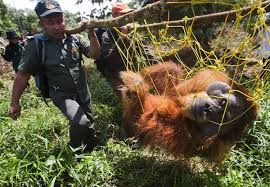
When we hear of deforestation we’re apt to think of Brazil with its persistent denigration of the Amazon jungle.  But an equally bad scenario is that of Indonesia, with half its rich forest tapestry now gone and complete decimation a mere decade away, all for the sake of plantation (usually for palm oil) and logging profits.

A heartless calamity in the making, it has consequences ultimately for all of us.  Consider, for example, that Indonesia ranks third in species diversity after Brazil and the Democratic Republic of Congo.  More specifically, it’s home to between 10 and 15 percent of the earth’s known plant, mammal and bird species.  It’s also residence for tigers, rhinoceroses, and elephants, increasingly refugees from a reduced or degraded habitat.  Soon the unique orangutan and Sumatran tiger may vanish into memory.

orang

While the central government in Jakarta has tried to impose a moratorium on logging, it goes on unabatedly in many distant local areas where law enforcement is rare.  Consequently, Indonesia is now the world’s third largest emitter of greenhouse gases, which promote temperature rise.

Financial incentives topping a billion in U. S. dollars are now underway, but their success remains in doubt, given widespread political corruption.

What’s going on in Indonesia affects not only many of its citizens displaced by plantations, but the global village as well.  Indonesia’s vast peatlands store an estimated 35 tons of carbon.  Burn or drain them and you release their warming carbons into the atmosphere.

Several weeks ago the UN’s updated report on global warming made headlines.  While deliberately opting for a subdued, or conservative report, to avoid ridicule as alarmist, it warns of an approaching irreversibility in limiting global warming if we continue at our present pace of carbon emission.  As the UN report panel’s co-chair warns, “Climate change is the greatest challenge of our time.”

Unfortunately, there still exists a minority of skeptics even among scientists, who primarily proffer up the now recognized slowing-down of temperature rise over the last fifteen years.  The truth is that no one really knows why.  While acknowledging this, the report suggests it may be a matter of variability, or simply a cyclical pause, or staircase effect.  In the long term, however, it suggests tides by century end of up to three feet.  (Other reports put it at five feet.)

Regardless of the debate, the fact remains of our witnessing forest carnage in places like Brazil, Indonesia, and the Malayan archipelago with resultant permanent ecological loss and diversity reduction with unknown consequences for all of us.

If we could invest in humanity’s ultimately viewing its relationship with nature as one of dependence rather than exploitation, then we would surely find our way out of this morass; but this is an unlikely hope, given our seeming inveterate instinct to pursue self-interest rather than collective good, abetted in turn by ignorance and indifference.

–rj

The Joy of fellowship with Nature

monarch

One of the best hobbies I’ve ever come upon is that of being an amateur naturalist.  It needn’t be expensive and you can do it in your own yard or on a walk or, believe it or not, from a car window.  And, yes, you don’t even have to leave the house.

Here’s a little checklist to see how versed you are on the natural world around you:

1.     Identify the ten most common trees in your neighborhood.

2.     Name five wild flowers that grow in your area.

3.     Identify ten flowers or plants common to your neighborhood landscaping.

4.     Identify five migrating birds that visit your yard.

5.     Name five birds that are year long residents.

6.     Identify ten common weeds in your yard.

7.     Name the planets and identify three of them in the sky

8.     Locate the North Star.

9.     Identify five rocks in your yard or area.

10.   Identify five insects in your garden

Most of us are hard pressed to do half of these IDs.  But then, that’s the fun of it, that you can begin, anytime, anywhere, and discover kingdoms all around you—and even below your feet.

Be careful, though, for discovery can be addictive.  You may even choose to specialize, maybe on rocks, bees or flowers.

Being connected with nature can yield release from daily stress.

It can also give you awareness of the fragility of nature’s weave of flora and fauna, their delicate balance and our dependency on that balance.  One third of our crops are pollinated by bees, for example, but our sprays have caused a serious threat to their survival.

One other gift that comes from a love for nature is how it develops your powers of observation.   My favorite American poet, Emily Dickinson, had this acuteness, with nature’s minutia a dominant motif in her poetry.  Take, for example, this delighful poem.

A Bird came down the Walk –
He did not know I saw –
He bit an Angleworm in halves
And ate the fellow, raw,

And then he drank a Dew
From a convenient Grass –
And then hopped sidewise to the Wall
To let a Beetle pass –

 He glanced with rapid eyes
That hurried all abroad –
They looked like frightened Beads, I thought –
He stirred his Velvet Head

Like one in danger, Cautious,
I offered him a Crumb
And he unrolled his feathers
And rowed him softer home –

Than Oars divide the Ocean,
Too silver for a seam –
Or Butterflies, off Banks of Noon
Leap, plashless as they swim.

Naturalism can grow friends for you.  There are groups of people out there like you who would gladly welcome you.  It’s fun to be among other gentle stewards of the earth, sharing their experiences and concerns, working together to promote awareness and preservation.  I like the Nature Conservancy.  It buys up threatened habitat and maintains it.

Your new hobby can afford you numerous excellent, often moving, reads, like Rachel Carson’s land mark Silent Spring or Thoreau’s classic Walden.  Good stuff on rainy days!

Think about how much you and your family can enjoy that country hike, park excursion, or neighborhood walk, connecting with what you now know, challenged by what remains to fathom in a hobby salient with retreating horizon.

Through its repetitive rhythms, nature confers assurance that tomorrow the dawn and dusk will come again, the seas will rise, and the moon ascend; that after winter, spring will surely come and our aerial friends return.

In sum, Nature amply rewards those who fellowship with her, conferring not merely release, but blessedness in an often troubled world.

–rj

Declining bee numbers: we know not what we do

bees

 “The road we have long been traveling is deceptively easy,
a smooth superhighway on which we progress with great
speed, but at its end lies disaster” (Rachel Carson)

 It was ecologist Rachel Carson who put environmental awareness on the radar screen with her sobering classic, Silent Spring (1962), drawing the attention of President John F. Kennedy in its precise detailing of the havoc posed by toxic spraying on wildlife and ultimate danger to ourselves:  “It is ironic to think that man might determine his own future by something so seemingly trivial as the choice of an insect spray.”

Decades later, we seem to have tossed her warning aside.  For example, there was the recent killing of thousands of bumblebees in Wilsonville, OR.  Man-made, it shouldn’t have occurred.  Investigation showed that flowering trees adjacent to a Target store had been sprayed with the pesticide, Dinoteferan (trade name Safari) to control aphids.  It isn’t supposed to be applied to flowering trees.  According to the Xerces Society for Invertebrae Conservation, the incident is being taken seriously and the trees will be covered with nets next year to prevent access to bumblebees and other pollinators.  I ask, Why spray at all?  If you don’t like getting the sticky aphid residue on your car, then don’t park under a tree.

Perhaps the worst of spray induced bee killing occurred on September 11, 2011, when an estimated 12 million bees died within 24-hours following aerial spraying to combat mosquitos in Brevard County, Florida.  Again, is it worth it?

As is, the plight of bees is worldwide, threatening our food supply.  Since 2005, Colony Collapse Disorder (CCD) has wreaked havoc on bees, largely through the  widespread use of neonicotinoids.  In the U.S., genetically produced corn is sprayed with neonicotinoids, with residues found even in adjacent fields.  Two recent studies show possible effects on short and long term bee memory, resulting in bees not returning to their hives, the tell-tale sign of CCD.

In Europe, neonicotinoids have now been recently banned for two years by the European Union to stem a decline in bee colonies.  We know they are devastating to amphibians and bat populations as well, which have also experienced sharp population declines.

The plight of honey bees goes beyond spraying, however, with extensive mite and viral infestation occurring.  As of yet, we haven’t found a remedy.

I know people who are horrified of bees and will resort to canned sprays.  Me, I’m a gardener and I’ve put countless hours in my garden working side-by- side with bees without consequence.  I respect them and give them room.  I know their preferred hours as busy laborers as well.

I confess I used to resort to sprays often, especially to control fungus and summer’s ubiquitous Japanese beetles in my rose garden.  I know better now and use nothing more than soaps, if anything at all.  I am considering replacing my roses with more tolerant, bee friendly plants like hydrangeas.

Spraying can kill birds as well as bees, by the way, and long term, increases the risk of cancer in human beings.  As is, nearly all of us have toxic residues from years of exposure to chemical substances, many of them sprays.  Again, Carson has warned us that we continue at our own peril: “A Who’s Who of pesticides is therefore of concern to us all. If we are going to live so intimately with these chemicals eating and drinking them, taking them into the very marrow of our bones – we had better know something about their nature and their power.”

But back to bees per se.  What would a world without them be like?  Last week, my wife and I were in northern California, driving through vast groves of almond trees adjacent to both sides of the highway, neatly geometric phalanxes of greenery stretching as far as the eye can see.  Sadly, their vastness may fade into memory like the omnipresent American elm of my New England boyhood that graced our commons.  These almond orchids, spread across 800,000 acres, are in trouble.  Dependent on bees for pollination, last winter saw a decline of up to 50% in hives.

To keep things going, these groves require up to 1.6 million domestic bees annually, resulting in emergency importing of bees.  With bee declines elsewhere, the future is problematical.  Almonds are critical to California’s troubled economy, constituting its largest agricultural export, and its demise would be devastating.

Worldwide, some 100 crops require insect pollination.  Given the earth’s burgeoning population, fewer bees could mean famine for many and inflated food prices.  Meanwhile, in the U.S., neonicotinoids continue to be used widely, particularly on vegetable and fruit crops.  Ironically, they were developed as a safer alternative to pesticides like DDT.  Unfortunately, their danger goes beyond spraying, since they’re systemic, or incorporated into the growing plant.

Like global warming, the threat of declining insect pollinators may seem benign, or far off in its consequences, lulling us into denial or indifference.  The reality is that, again like global warming, the effects of declining bee populations are exponentially happening now.  Incidents like those in Oregon and Florida only make matter worse.  We are intricately linked with all earth’s creatures and their demise hastens our own.

–rj

Lexington Garden Tour (2013): Highlights

And I shall have some peace there, for peace comes dropping slow,
Dropping from the veils of the morning to where the cricket sings;
There midnight’s all a glimmer, and noon a purple glow,
And evening full of the linnet’s wings.  (William Butler Yeats)

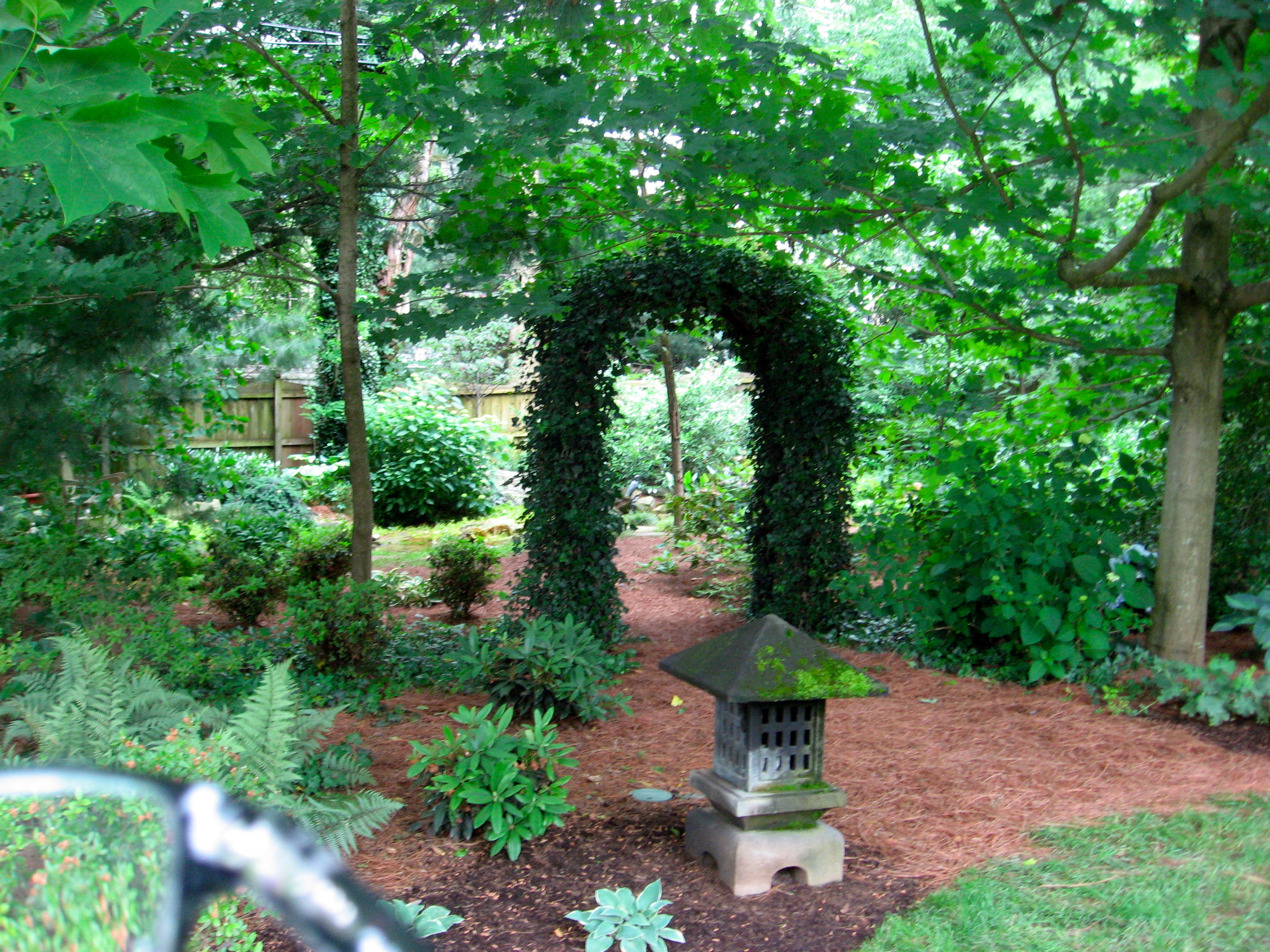
Had a great time yesterday taking-in the annual Lexington, KY garden show, with ten city gardens on display at a bargain price of $12.00.  I also got glimpses  of  Lexington’s urban beauty, rare among American cities.  It simply amazes me how much creativity,  care and passion for nature went into each of these gardens.  Any of them would be just a pleasure to retire to at the end of a stressful day at work or as diversion from life’s daily anxieties, a place which Yeats sumptuously offered “peace comes dropping slow.”  A few highlights:

2013-06-01 11.06.27

2013-06-01 10.44.00

2013-06-01 07.44.35

2013-06-01 10.38.16

2013-06-01 10.41.05

Pacific Grove and its Monarch butterflies

monarch

For all its ever burgeoning population and high cost of living, I think California still offers a lot of good living away from the crowds in small towns hugging its pristine coast, offering the surf swish of blue Pacific ocean, cradling mountains that often walk down to the sea like in Big Sur country and, of course, the soothing warmth of year-round sunny days with low humidity.  To me, California is like going into one of those specialty ice cream outlets and finding yourself overwhelmed by a dazzling array of choices.  I just love the place!

Pacific Grove, however, stands out for me, located on the Monterey peninsula not far from ritzy Pebble Beach, rugged Big Sur, and charming Carmel-by-the Sea.  This area, in particular, means a lot to me, for Karen and I spent fun honeymoon days taking in its varied tapestry twenty years ago.  I’m all about regaining paradise.

Pacific Grove wasn’t even on my radar map until several weeks ago when I happened to find it mentioned in a book off my shelf that I hadn’t read in over two decades and started reading again.  While noting the town is famous for its annual influx of migrating Monarch butterflies each November, the writer laments their declining numbers, probably due to a shrinking habitat as housing construction continues to expand. I would add the increasing loss of milkweed, a principal food supply for the larvae.

Now this was way back in 1990 and thus my curiosity was aroused as to the plight of the Monarchs since, and so I did the research and came up both buckets full with info on Pacific Grove and its wintering Monarchs.  The news is good, though it could be better.

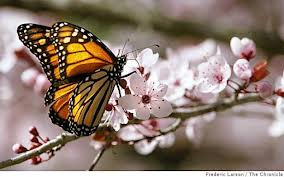
After more than twenty years, they still come to escape the winter cold of the Canadian Rockies and Southern Alaska, though in sharply diminished numbers, perhaps about 10,000, unlike the 50,000 plus in the halcyon days long gone.  The town seems attentive to its friends, even staging an annual parade (October), and why not, since they’ve built a thriving tourist industry around them and any further decline means diminished dollar intake as well.  There is a fine of $1000 for molesting a butterfly.

monarch2

Well-meaning, but on occasion, the city council can be dimwitted, opting in 2009 to prune the eucalyptus trees that the monarchs favor in their designated Monarch Grove Sanctuary, resulting in a precipitous drop shortly after to less than a thousand Monarchs.  Cutting a branch is like tearing down a house replete with its residents, since the larvae cocoon on these bare branches.  Today you’re  likely to see more Monarchs further down the coast toward Santa Cruz.  Some recent visitors report seeing just a couple of trees with butterflies, vastly changed from the swarms that blanketed the eucalyptus several decades ago.  What appalls is the council’s acting against the advice of environmental scientists.

pacificgroveThen, in November 2012,  the council was forced to make public its plan to revamp the Sanctuary, strikingly out of touch with California’s environmental recommendations.  In the past, the council has a history of foregoing environmental reviews.  As I write, I don’t know the outcome.

But I do need to be fair.  It used to be that the the principal Monarch habitat lay in the city’s George Washington Park, but urbanization, foot traffic and drought have taken their toll.  The city is trying to restore the habitat through tree planting, mulching and new trails.  The numbers are down to less than a hundred now.

The Monarchs are awesome in their intricacy of evolved pattern, suggesting aerial tigers.  They’re also, though infinitely delicate, intrepid pilgrims on their own hajj to a nesting place they’ve never been, and yet they somehow find their way in a journey consummating up to 2000 miles.

Central California is Steinbeck country and the Nobel laureate made Pacific Grove his home with his first wife, Carol, and visited it often in his later years as his own sanctuary providing renewal.  He would later tellingly write that “Pacific Grove benefits by one of those happy accidents of nature that gladden the heart, excite the imagination, and instruct the young” (Sweet Thursday).  I suspect the Monarchs had a great deal to do with that.

Be well,

rj

Where are the songs of Spring?

images

Saw a sign yesterday that read, “Spring is coming soon.”  That’s something we’re all wondering about, even in Kentucky, where we’ve been having an unusually cold March, which makes it hard to believe the Kentucky Derby is merely six weeks away.  They say it may be related to melting glaciers changing our wind patterns.

But the real sign nature is about to turn generous was yesterday’s afternoon delight in seeing my goldfinch friends, busy at their feeder, newly returned from their long and distant migration.  I remember late October when suddenly they were gone, the absence of their aerial eagerness and bright collusion of yellow and black; the silence and loneliness of it, like saying good bye to a good friend who had brought abundant joy, “A quality of loss/Affecting our discontent” (Dickinson, “A Light Exists in Spring”).

I’m not a member of the Audubon Society, but I quite understand their love for birds with their bright plumage and merry song.  I think of St. Francis of Assisi whose kindness the birds reputedly reciprocated by sitting on his shoulders.  Sometimes I think they take their own measure of me in their aerial hideaways when I replenish their several feeders in our backyard.

Birds need our help these days more than ever.  I just read the other day that an estimated 100 million birds are killed worldwide each year by outdoor cats and other scavengers.

Diminishing canopy of forest and brush, draining of wetlands, and climate change add to the toll.  Squirrels and other rodents raid their nests, devouring eggs and young hatchlings.

Migration itself can be costly, with many killed and injured, caught in storms or flying into buildings, and sometimes planes.  Many are blown off course and show up in risky environs.  I feel bad that each year several of them smash themselves into our sunroom windows and I am left with their still warm bodies.

Some of them, hawks, are wantonly shot by farmers who see them as predators.  I had an unpleasant experience in New Zealand in hearing of a crusty elderly man who had nothing better to do than shoot hawks as everyday pastime in that gorgeous Taranaki countryside of lush greenery.  In Kentucky, especially in the mountains, hawk-killing takes on a compulsion.

Down the road and around the curve, I often see a sentry red tail hawk on a high telephone wire.  I like what I see when I drive past His Majesty.

I relish reading good poetry and there are poems, great ones by Keats and Shelley, Hopkins and Dickinson, that wonderfully excel in depicting the splendor of birds like “Ode to a Nightingale, “Ode to a Skylark,” “The Windhover,” “A Bird Came Down the Walk” and, sometimes their sadness as in Angelou’s moving “I know why the Caged Bird Sings.”

But I began with the subject of Spring and so Keats’ question of “Where are the songs of spring?” (“Autumn”) comes to mind and finds its answer, for me at least, in yesterday’s return of my yellow-jacketed friends.  Let Spring’s sweet song begin!

Be well,

rj