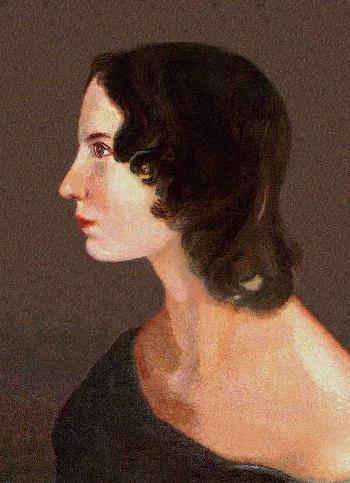
Emily Brontë’s Faith Poem: “No Coward Soul is Mine”

I’ve always admired Emily Brontë’s Wuthering Heights as a supreme literary achievement. In teaching it over the years, its structural complexity, thematic depth, and passionate intensity never failed to astound me. Putting it another way, Wuthering Heights has haunted me, much like Catherine’s ghost at Heathcliff’s window.

Years ago, I had the good fortune to visit the parsonage where she lived out her brief life in Hayworth, Yorkshire. (Her father was a clergyman with Methodist leanings.) A cramped, but lovingly preserved house, eerily next door to the church cemetery, you could easily surmise the Brontë children were temporarily out and be back shortly and we could settle down to robust conversation over a pot of tea.

While we remember Brontë for her novel, she also wrote poetry, 200 poems in fact. Sadly, her sister Charlotte, renowned for Jane Eyre, subsequently revised many of them, adding whole lines, rewording others, attempting to widen their public appeal. Scholars, trying to recover Emily’s probable texts, have found her cramped script difficult to decipher.

Of her poems, “No Coward Soul Is Mine” is well-known and my favorite. Brontë wrote it in the context of her fateful illness from tuberculosis. I’m so fond of this poem that I’ve been tempted to memorize it. I could almost think I was reading Emily Dickinson with its dismissal of religious orthodoxy and affinity for nature. That same fierce voice element of Wuthering Heights, perhaps a Wesleyan revivalism influence, you’ll find here, carried out by its heavy trochees as in the poem’s initial two lines or lines one and three of stanza five with their opening trochee feet.

You can be a non-believer and still appreciate the poem, for good poetry offers reading variance, or to borrow from medicine, “referral” nuance through well-crafted interweave of image, structure and diction. Our mortality spells change, not ending; a return to Nature’s genesis, or to what was, and is, and will always be.

No Coward Soul of Mine

No coward soul is mine
No trembler in the world’s storm-troubled sphere
I see Heaven’s glories shine
And Faith shines equal arming me from Fear

O God within my breast
Almighty ever-present Deity
Life, that in me hast rest,
As I Undying Life, have power in Thee

Vain are the thousand creeds
That move men’s hearts, unutterably vain,
Worthless as withered weeds
Or idlest froth amid the boundless main

To waken doubt in one
Holding so fast by thy infinity,
So surely anchored on
The steadfast rock of immortality.

With wide-embracing love
Thy spirit animates eternal years
Pervades and broods above,
Changes, sustains, dissolves, creates and rears

Though earth and moon were gone
And suns and universes ceased to be
And Thou wert left alone
Every Existence would exist in thee

There is not room for Death
Nor atom that his might could render void
Since thou art Being and Breath
And what thou art may never be destroyed.

The poem’s imagery, drawn from nature, supports the poem’s theme of Deity’s abiding presence. Composed of seven quatrains, reminiscent of Methodist hymnody, in alternating tetrameter/pentameter meter, rime occurs consistently throughout, lines one with three, and two with four, including the fourth stanza with its near rime, suggesting a purposive, or teleological, cosmos.

Brontë effectively softens “the world’s wind-troubled sphere” in line two of the initial stanza with alliteration, suggesting tranquility in context of storm.

Each sentence is declarative, resonating conviction. Unlike Tennyson’s “In Memoriam,” there is absence of tension, no struggle with doubt in the persona’s resolute faith, “So surely anchored on/The steadfast rock of immortality” ( Stz. 4).

Emily’s God isn’t Dickinson’s transcendent, mysterious, removed deity or Blake’s “No bods’ daddy.” Refulgent in his creation, He lives in our hearts, canceling any fear we might otherwise have, given the “world’s storm-troubled sphere” (Stz. 2). A poem of faith, it finds its affirmation not through anthropomorphic rendering, but in a pantheistic vision of Deity’s universal immanence.

Stanzas 3 and 4 logically follow in their rejection of creedal orthodoxies that are but worthless speculations, promoting anxiety, not peace. The repeated use of “vain” proves double entendre, human speculations fruitless and conceited, or of no more significance than the “idlest foam” of an infinite ocean:

Vain are the thousand creeds
That move men’s hearts, unutterably vain,
Worthless as withered weeds
Or idlest froth amid the boundless main

To waken doubt in one
Holding so fast by thy infinity,
So surely anchored on
The steadfast rock of immortality.

The stanzas that conclude the poem reiterate the persona’s vibrant faith in a deity who transcends the temporal, “Thy spirit animates eternal years,” and for all the volatile elements of impermanence, remains its arbiter, Who maternally “sustains, dissolves, creates and rears.”

Were the very cosmos to disappear, He would remain, for He is creation’s essence. The plural “universes” of the penultimate stanza intrigues. Did Emily believe in the modern concept of multiple universes? Whatever, God is infinite, boundless, present always:

Though earth and moon were gone
And suns and universes ceased to be
And Thou wert left alone
Every Existence would exist in thee.

How then can there be any cowering at death’s door? A deity synonymous with Nature, He is what has been, is now, and will be, the effulgence of it all:

There is not room for Death
Nor atom that his might could render void
Since thou art Being and Breath
And what thou art may never be destroyed.

Brontë dated her poems and wrote “No Coward Soul of Mine” on January 2, 1846. It would be her last poem (she passed two years later at age 30). At the time of the poem’s composition, she’d been completing Wuthering Heights. Emily Dickinson came upon this poem and loved it. She asked it be read at her funeral, her wish fulfilled by her friend and later editor, Thomas Wentworth Higginson, at the funeral’s conclusion.

As for Brontë, following several labored days, she slipped into eternity on December 19, 1848, unafraid, and deeply mourned by her sisters, Anne and Charlotte, and canine friend, Keeper. As with Keats, a young talent struck down early by the same illness, her posthumous fame has restored her to us, though not without conjecture of future talent lost.

As I said at the outset, the poem endures as a favorite of mine, one I’d take gladly to a desert isle, or read repeatedly when my last day summons. It accompanies me, too, when I engage Nature in the present, the sense of a hovering spirituality, that everything is linked, and means, and infinitely bigger and grander than ourselves.

–rj

Rupi Kaur: Pop Poetry Phenom

Just read New Republic’s glowing assessment of Canadian Instapoet Rupi Kaur, reflected in its swollen title, “Rupi Kaur is the Writer of the Decade.” (New Republic) Not even thirty, she’s published two poetry volumes, Milk and Honey (2015) and The Sun and Her Flowers (2017). Poet luminary of Instagram, she’s gathered 3.8 million followers. Milk and Honey, translated into 25 languages, has sold 1.4 million copies and made the NYT best seller list for 77 weeks. Her public readings are sold out. Exotic in appearance, along with a mesmerizing delivery, she just maybe has rescued poetry from slipping into oblivion in our STEM era.

But is it really poetry?

I think not.

That said, I always suspicion poetry, or a great many other things for that matter, that suddenly takes off. Popularity isn’t a criterion of excellence, given the brevity of social clamor.

I suspect three elements behind her popularity:

Accessibility:

Her “verse,” a term I prefer to use in gauging her work, is easy to understand, unlike so much of modern poetry that leaves readers stranded in a context void.

Brevity:

Social Media, that Internet darling, thrives on brevity. Say it quickly and get out. More than five lines, look out! Add a photo or two, you’re in. It’s Life magazine gone digital.

Relevance:

Give her credit. Her plaintive verse centers, like country music, in everyday happening—life’s tears, jerks and twists. It fingers loneliness, embraces assertion for the many lacking self-esteem, reaches past gender, creed and race. As a Punjabi Sikh immigrant, she speaks poignantly to the vulnerable and marginalized and that includes women. What’s more compelling than

if you were born with the weakness to fall you were born with the strength to rise (Milk and Honey).

or

how you love yourself is
how you teach others
to love you (Milk and Honey)

You’ve got sentiment, but it doesn’t make for poetry. It’s simple, but that doesn’t mean it’s good.

Poetry centers in artifice—form, metaphor and even in a time of free verse, a latent rhythm. It probes deeply. Sensory, it shows, not tells, or like a good recipe, is the sum of all its ingredients that artists call “unity.”

Poetry exhibits pattern.

It has a grammar.

To paraphrase Frost, Kaur’s miniscule verse is like playing tennis with the nets down.

She’s been accused of plagiarism by Nayyirah Waheed, another popular Instapoet, who pointed out similarities in Kaur’s verse, only to have Kaur ignore her messages.

Whatever the story here, there’s a plethora of poets who write like Kaur in what’s taken-on a fast food likeness for success. Take Warsan Shire, for example, another exemplar of the new idiom and quite possibly the better artist in her sophistication.

Kaur’s supporters are quick to invoke the identity politics fallback in countering critics. She’s a feminist of color who dares to speak out in an artisan world dominated by white men. She’s also hugely popular, makes a lot of money, and circuits the world. Artist rivalry kindled by jealousy is legendary.

But that’s not where the argument lies. We must judge Kaur by her work, not our politics. I find it cliche, platitude riddled, and banal:

i do not like the kind of love
that is draining
i want someone who energizes me.

Putting it out front, her verse resembles scribblings in book margins, succinct, but little more. The labored craft which Dylan Thomas rendered so movingly in “In My Craft Or Sullen Art” is sorely lacking,

Exercised in the still night
When only the moon rages
And the lovers lie abed
With all their griefs in their arms.

The New Republic suggesting her verse heralds an artistic revival akin to the New Harlem Renaissance or Bloomsbury Group that includes Langston Hughes, Zora Neale Hurston, Virginia Woolf and E. M. Forster requires a considerable stretch.

Kaur writes verse fitted to the Instagram. It fits well on your cell phone. But it’s prose, cleverly packaged for commercial success in line breaks to suggest profundity, often accompanied by line-drawings to augment the effect. (Sorry, she’s no e. e. cummings.)

At best, it’s aphorism. At worst, it’s exploitive prose.

It’s not poetry.

–rj

William Carlos Williams’ “Willow Poem”: Defying Temporality

“Willow Poem”

It is a willow when summer is over,
a willow by the river
from which no leaf has fallen nor
bitten by the sun
turned orange or crimson.
The leaves cling and grow paler,
swing and grow paler
over the swirling waters of the river
as if loath to let go,
they are so cool, so drunk with
the swirl of the wind and of the river—
oblivious to winter,
the last to let go and fall
into the water and on the ground.

ANALYSIS

Here is a poem for our fall season by one of my favorite poets. For me, it speaks ultimately of that tenacious defiance in the context of mortality, “oblivious to winter, “ which should define the way we live our lives up to the very end.

Less robust in tone than Dylan Thomas’ more famous “Do Not Go Gentle Into that Good Night,” it nonetheless succeeds in its implied imperative and proves no less skilled in its artifice. Intriguingly, the persona exhibits empathy for the willow—and why not?—for the tree is like ourselves, fated for that long sleep (note repeated “grow paler”), yet resilient.

Williams had a penchant for writing poems in vernacular language, unlike his fellow modernists such as Eliot and Stevens, rendering his poetry highly accessible by the public. A physician tending to progressive, if not socialist, beliefs, this simple language represented a linguistic practicum of his credo.

Having said this, I would contend Williams remains a sophisticated poet in his subtlety of technique, careful observation of the natural world, and ability to extract human relevance—all of this true of “The Willow Poem.”

Take, for example, its fourteen line construction, usually suggesting the traditional sonnet mode, except it doesn’t conform to the iambic pentameter meter, closed couplet, or sestet formulae. I take this as deliberately mirroring the poem’s theme of resistance, if not rebellion, a tree transcending autumnal demise, or at least holding out amid nature’s seasonal rhythms.

In abandoning typical sonnet protocol, Williams nevertheless manages to maintain unity, implementing language and even occasional meter in an otherwise free verse poem.

Notice the many dictional occurrences of of words ending in er: “over,” “river,” “paler” and “winter. “

Note the heavy spondee element in the poem’s frequent preference for monosyllabic diction: “The leaves cling and grow paler,/swing and grow paler” (ll. 6-7). Not least, there is the word repetition throughout.

Absent of human intrusion, the poem’s sole subject is the tree. And yet human application is suggested in its personification. An imagist poet proclaiming ‘no ideas but in things,” Williams is faithful to his creed. The tree remains a tree, yet emerging from the persona’s non-intrusive observations are potential analogies to the human quest to indulge and survive amid Nature’s ceaseless flow and inevitable sovereignty.

The willow’s river location hints at passage. A “swirling” river, it suggests Nature’s dynamism. The summer has gone. Fall, season of decline, suggests ending. Yet the tree appears impervious to Nature’s laws. Its leaves, “nor/bitten by the sun/turned orange and crimson, “ appear transcendent over temporality.

Continuing personification amplifies an ambience of resistance, its leaves “as loath to let go,” even as incipient change, and the mortality it confers, coalesce here in the increasing pallor of the leaves.

Archetypal elements, e.g., “summer,” “river,” winter,” nuancing generation, decline and death, further foreground the poem’s resonating Nature’s cyclic rhythms, without nullifying what Schopenhauer termed Wille zum Leben, or what I prefer to call “life force, “ or self-preservation instinct present in all Nature.

Simple, yet sublime, the poem validates William’s artistic acumen and esteemed standing among modern American poets.

— rjoly

An Upstart Poet I Like a Lot

I’ve had this love affair with poetry since my earliest days, relishing metaphors that translate life from prose to camera, the sheer musicality of it, the crossword deliberation it compels, the tension of its paradoxes capturing life’s myriad, inherent subtleties; above all, its ability to mine deep, probing shafts of sub-subterranean memory and feeling I had thought beyond retrieve.

It follows then that I’m always on the lookout for good poets to swell the hosts of poets like Larkin, Wilbur, Pinsky, Levine and others that provide me good company in the winters as well as summers of life.

Just the other day I made a new acquaintance in pursuing my just in-the-mailbox New Yorker and immediately I knew I’d found a friend I wanted to keep.

Maybe you know him already, Gary J. Whitehead, though for me he’s a new artist in town and one I predict will swim into renown among aficionados of good poetry.

Whitehead, a Princeton grad and Teacher of the Year recipient, teaches English and Creative Writing at Tenafly high School in New Jersey and has received numerous awards for his verse.

How lucky can high students get to share class-time with the likes of a gifted artist like Whitehead! He’s published three collections of his poetry thus far with a fourth, Strange What Rises, about to be published.

You’ll find his poetry absent of the metaphysical, yet never banal in its quotidian pursuits captured in poems such as “Making Love In the Kitchen” and “Lot’s Wife,” which are uncanny for infusing metaphor into the prosaic small deeds and events of ordinary life, granting new ways of viewing their ritual component in our lives. In this, he reminds me a lot of the late Richard Wilbur.

I especially like his passion, which is nice to come upon in an often circumscribed aesthetic aloofness among poets. I think passion frequently makes for good teaching as well. Perhaps it’s this passion that churns my emotions into butter whenever I read Gerard Manley Hopkins, just maybe my favorite old-time poet who passed so terribly young and unrecognized.

Let me try this early Whitehead poem (2002) on you and see if it fits. I think you’ll see what I‘ve been saying:

First Year Teacher to His Students

Go now into summer, into the backs of cars,
into the black maws of your own changing,
onto the boardwalks of a thousand splinters,
onto the beaches of a hundred fond memories
in wait, where the sea in all its indefatigability
stammers at the invitation. Go to your vacation,

to the late morning cool of your basement rooms,
the honeysuckle evening of the first kiss, the first
dip and pivot, swivel and twist. Go to where
the clipper ships sail far upriver, where the salmon
swim in the clean, cool pools just to spawn.
Wake to what the spider unspools into a silver

dawn dripping with light. Sleep in sleeping bags,
sleep in sand, sleep at someone else's house
in a land you've never been, where the dreamers
dream in a language you only half understand.
Slip beneath the sheets, slide toward the plate,
swing beneath the bandstand where the secret

things await. Be glad, or be sad if you want,
but be, and be a part of all that marches past
like a parade, and wade through it or swim in it
or dive in it with your eyes open and your mind
open to wind, rain, long days of sun and longer
nights of city lights mixing on wet streets like paint.

Stay up so late that you forget day-of-the-week,
week-of-the-month, month-of-the-year of what
might be the best summer, the summer
best remembered by the scar, or by the taste
you'll never now forget of someone's lips,
and the trips you took—there, there, there,

where snow still slept atop some alpine peak,
or where the moon rose so low you could see
its tranquil seas...and all your life it'll be like
some familiar body that stayed with you one night,
one summer, one year, when you were young,
and how everywhere you walked, it followed.
"First Year Teacher to His Students" by Gary J. Whitehead, from Measuring Cubits While the Thunder Claps. © David Robert Brooks, 2008.

–rj

Love for All Seasons


I hope that I will be the last victim in China’s long record of treating words as crime.” Liu Xiaobo (1955-2017)

China isn’t usually a quotidian staple of the Westerner’s mindset. Let’s face it: our culture operates in Eurocentric mode, which may ultimately hint of a latent bias unrecognized in ourselves, a sense of smugness that they’ve little to offer us, save maybe for bargain-priced goods at your local box store.

Sadly, the death of leading dissident, Liu Xiaobo, on July 13 of this year from liver cancer was inevitably passed over by most Westerners and the media, which is a pity, for he graced our earth with a loving compassion, championing basic values promoting human dignity and the sanctity of individual lives.

A writer, poet and literary critic, he was awarded the Nobel Prize in 2010. Unfortunately, his chair at the reward ceremony in Oslo would be empty. A year before, he had just begun serving an 11-year sentence for sedition against the People’s Republic of China. An outspoken critic of the Communist government, he campaigned for freedom of speech, free elections, and basic human rights.

If you google his name, you’ll find numerous links to salient quotations that speak to the decency of this man, who lived life courageously, and at ultimate cost, for his outspoken criticism of Beijing’s ubiquitous hegemony.

Among his quotations, I like this one best for its vibrant reiteration of one of humanity’s most requisite needs and fundamental rights:

Free expression is the base of human rights, the root of human nature and the mother of truth. To kill free speech is to insult human rights, to stifle human nature and to suppress truth.

We live in a time of understandable exasperation with a new Washington regime, with many calling for shutting down views they find untenable, if not despicable. We find truth, promote dignity, and enhance human freedom, however, when we allow discussion in the market place of free exchange.

I don’t want to be under the aegis of thought police, whether Right or Left, and I don’t think you do either. I’m suspicious of all peripheries.

Liu’s wife, Liu Xia, is also a remarkable denizen in the portals of courage. Gifted poet and photographer, she married Liu in 1996 at the time of his incarceration in a reeducation labor camp for having urged peaceful diplomacy toward Taiwan.

Inveterate in her love and loyalty for her husband, she paid him a prison visit shortly after the Nobel Prize. Subsequently placed under house arrest, the government denied her access to cell phone and Internet use, while permitting only a handful of approved visitors.

Presently, we don’t know her whereabouts, although the government says that she’s free.

Two poems presented here pulsate with the salient love they shared as husband and wife and are especially moving in that they were written in contexts of extreme duress.

The first is “Morning,” which Liu penned before 2000 and dedicated to his wife; the second, “Road to Darkness,” Lia wrote shortly before her husband’s death. Both poems have been translated from the Chinese by Ming Di and appear in the current issue of The New York Review of Books (September 28, 2017).

The poignant irony is that these two stalwarts of freedom are unknown in China, all mention of them having been scrubbed from social media.

                 Morning
–For Zia

Between the gray walls
and a burst of chopping sounds,
morning comes, bundled and sliced,
and vanishes with the paralyzed souls
of the chopped vegetables.

Light and darkness pass through my pupils.
How do I know the difference? 
Sitting in the rust, I can’t tell 
if it’s the shine on the shackles in the jail
or the natural light of Nature
from outside the walls.
Daylight betrays everything, the splendid sun
stunned.

Morning stretches and stretches in vain.
You are far away__
But not to far to collect the love
of my night.

            Road to Darkness
For Xiaobo

Sooner or later you will leave me, one day
and take the road to darkness
alone.

I pray for the moment to reappear
so I can see it better,
as if from memory.
I wish that I, astonished, could glow, my body
in full bloom of light for you.

But I can’t make it except
clenching my fists, not letting
the strength,
not even a little bit of it, slip
through my fingers.

Reflections on the 2017 Philip Larkin Exhibition at Hull

The Guardian (July 4, 2017) features a review of a favorite poet of mine, Philip Larkin, in connection with a current exhibit of Larkin artifacts at Hull’s Brynmore Jones Library, where he was a librarian for many years.
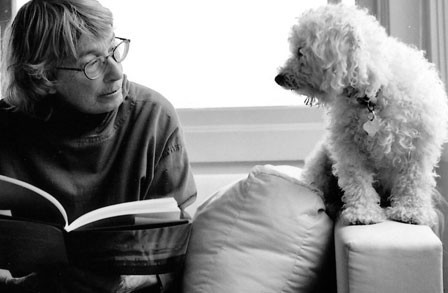
It notes his tortured sexual life, indulgence in pornography, racist asides, and complex relationships the writer terms “despicable” with several women, whom he allegedly treated unfairly, particularly Monica Jones, his lifelong lover and collaborator.

The show includes a small Hitler bust given him by his father, a Nazi sympathizer, who had once taken his son to a Nuremberg rally.

Beyond announcing the exhibit, about which there’s very little, not even its running dates, columnist Hannah Ellis Petersen tells us Larkin was obsessed with his appearance, weighing himself twice daily on two different scales, fastidious about his clothes, etc.

A good portion of the article paraphrases or quotes the exhibit’s curator Anna Farthing, who ironically seems apologetic for the exhibition, perhaps thrown on the defensive by a rehearsed biased protocol: “The challenge is alway to not judge, and present the story in a way with lots of perspectives and hooks so people can make their own minds up. I’ve had lots of different reactions to him as I’ve started to get to know him, from complete respect to being appalled.”

I find the article, spirited perhaps by feminist indulgence, a blatant dismissal of Larkin’s perfected artistry as a poet. Larkin may well be Britain’s best poet since Auden. Unfortunately, literary criticism has taken on a contemporary intrusion of sexual politics.  I side with Terry Eagleton in his contention  that we appear “less interested in ideas than in the sexual habits of those who had them.”

Her take isn’t anything new. As Stephen Walsh recalls (The Guardian, May 30, 2017), during “the 2015 premiere of a BBC documentary about the poet, a female audience member disrupted the generally cosy atmosphere by asking why Hull people should be so proud of Larkin. He was a misogynist and racist, she said, and he didn’t do anything for the image of the city.”

Aside from this, what concerns me more are those who would shun an artist on the basis of alleged moral incongruities or ideology. Ellis-Petersen dubs the exhibit “a morally complex minefield.”

Do we stop reading Voltaire or Gide because they were anti-Semitic; or more famously, D. H. Lawrence, who exhibits a considerable misogynist vein in his work? And what about Hemingway caught up in his male chauvinism? Or the writer I know best, James Joyce with his notorious kinkiness that once got Ulysses banned? Is there a new Index in town?  A moral or political registry to which artists must do obeisance?

My interest in Larkin, or any artist for that matter, isn’t foregrounded in his life. Artists, after all, are human beings, each with their flotsam of inertia or indulgence and dark secrets shaped by the interweave of parental, cultural, economic and social phenomena often imprinting them psychologically, as any reading of Freud’s seminal Civilization and Its Discontents (1929) should remind us.

Truth is, though a brilliant student at Oxford, Larkin was nonetheless self-deprecating. As a youth, he stuttered and all his life suffered from bad vision. He sought validation from women, but even that couldn’t suffice for low self-esteem.

He shied from interviews and readings. The current exhibit, virtually underwear and all, would undoubtedly have violated his sensibility and his privacy, as much, maybe more, than his inclusion in the Poets’ Corner in Westminster Abbey

Flashback to my student days in a modern poetry course at Exeter College, Oxford, summer of 1979:

I know nothing of Larkin. My tutor, one of the best ever, steeped in bibliography and intertextual nuance, introduces us to the idiomatic, conversational cadence of poems like “Church Going,” “Toads,” and “Whitsun Weddings”.

He knows Larkin personally and has invited him to our class for a reading, but Larkin cancels at the last moment, pleading illness. It’s a let down.

Ultimately, it didn’t matter, for Larkin would become a poetic staple in my life.

Larkin bravely translated the anxieties of modern life into verse. A leading candidate for Poet Laureate in 1984, the withdrawn Larkin wasn’t interested. He died the following year.

Larkin had become librarian at the University of Hull in 1955, beginning a thirty year association. He’s still remembered for his modernization and expansion of its facilities, though this gets omitted in the article.

Biographer Alan Brownjohn notes that Larkin quietly achieved “the most technically brilliant and resonantly beautiful, profoundly disturbing yet appealing and approachable, body of verse of any English poet in the last twenty-five years.”

George Dekker, in Agenda, comments that no living poet “can equal Larkin on his own ground of the familiar English lyric, drastically and poignantly limited in its sense of any life beyond, before or after, life today in England.”

Even curator Farthing finally gets it right in exclaiming “to have achieved work that is so human and engaging and continually relevant, it seems that he did it despite his demons, not because of them.”

And, of course, this is what matters.

–rj


America’s Unofficial Poet Laureate: Mary Oliver

Judging by her phenomenal sales, Mary Oliver surely rates as America’s unofficial poet laureate, and yet the anomaly that she’s never held the office since its inception in 1937.

I have to confess that I hadn’t heard of her, despite teaching modern poetry for some thirty-five years, probably because the Modernists held sway when I was in graduate school and during much of my tenure.

Likewise, she’s excluded from The Norton Anthology of Modern Poetry, a principal text in modern poetry courses, despite having won both a Pulitzer and a National Book Award.

In her favor, however, is a sympathetic overview of her work by the Poetry Foundation, which I recommend as a starting place for those new to her poetry.

I came to her poetry late and in the oddest way through an online course in meditation called “Demystifying Mindfulness, ” where one of her poems, Mindful,” was included for its affinity with mindfulness practice, often associated with Buddhism:

Every day
I see or hear
something
that more or less

kills me
with delight,
that leaves me
like a needle

in the haystack
of light.
It was what I was born for –
to look, to listen,

to lose myself
inside this soft world –
to instruct myself
over and over

in joy,
and acclamation.
Nor am I talking
about the exceptional,

the fearful, the dreadful,
the very extravagant –
but of the ordinary,
the common, the very drab,

the daily presentations.
Oh, good scholar,
I say to myself,
how can you help

but grow wise
with such teachings
as these –
the untrimmable light

of the world,
the ocean’s shine,
the prayers that are made
out of grass?

I’ve now read a lot of her poetry, with many more to go–she’s written 26 books of verse–with every poem a kingdom of delight.

I think she’s given poetry back to us with her craft wielded in directness and simplicity, yet latent in nuance. And then there’s that redolent pathos, or intensity, of a voice resolute with conviction hammered out on the anvil of experience, not always kind.

Over a lifetime, I’ve preferred a poetry complicit in ambiguity, or tension; poetry resounding in the inequities of existence and the paradoxical.

Oliver wins me over, nonetheless, because like the Romantics before her, her verse glistens with acute awareness of life’s brevity and the imperative of living each day as Wordsworth might say in “wise passivity,” mindful of the sensory aspects within ourselves that connect us with all sentient beings in the bubble of transience.

Best of all, I’ve found that in those nights that I cannot sleep, in turning to her poetry I find solace and with it, sleep.

I’m not surprised there are Buddhist affinities in poems such as “Mindful.”
Buddhism isn’t really about reincarnation; its about being alive to the nowness of the moment, whether good or bad, in a cosmos of impermanence where even the stars ultimately suffer mortality.

Buddhism, however, can’t claim her, for her poetry embraces a spirituality that transcends religion with its orthodoxies, reverencing the sanctity of all things, like her great master, Walt Whitman, in its celebration of the holiness of the profane.

Of her many poems, I think “When Death Comes,” surely a thematic key to her poetry, is my favorite. Accordingly, I find myself hungry to lock its wisdom into the privilege of each morning’s waking:

When death comes
like the hungry bear in autumn;
when death comes and takes all the bright coins from his purse

to buy me, and snaps the purse shut;
when death comes
like the measle-pox

when death comes
like an iceberg between the shoulder blades,

I want to step through the door full of curiosity, wondering:
what is it going to be like, that cottage of darkness?

And therefore I look upon everything
as a brotherhood and a sisterhood,
and I look upon time as no more than an idea,
and I consider eternity as another possibility,

and I think of each life as a flower, as common
as a field daisy, and as singular,

and each name a comfortable music in the mouth,
tending, as all music does, toward silence,

and each body a lion of courage, and something
precious to the earth.

When it’s over, I want to say all my life
I was a bride married to amazement.
I was the bridegroom, taking the world into my arms.

When it’s over, I don’t want to wonder
if I have made of my life something particular, and real.

I don’t want to find myself sighing and frightened,
or full of argument.

I don’t want to end up simply having visited this world.

–rj

Teach me to measure all my days

speedAnother year, now one of many for me, is about to pass. Life flows incessantly forward. More than ever, I’m thankful for every moment in the present, wanting to indulge, pamper, and exhaust it for its sensory fullness, or like a bowl of chocolate ice cream topped with fresh strawberries, swirling its sweet coldness slowly in my mouth, titillating my tastebuds, in vain effort to prolong its goodness.

I wake to day, rejoicing in its newness, a privilege I no longer take for granted.

Recently I’ve been in contact through Facebook with a member of my 1958 class at Newburyport High School in Massachusetts. It turns out she’s also the class secretary. The other day, she shared that of the 158 graduates, 51 have died. There might be more.

In February I turn 77, so I found this news sobering.

I don’t know how I even got this far. The average lifespan for males in the U. S. is 76.3. My once older brother, so full of life, died on his birthday. He was 47. I’ve had friends who died younger.

There’s no rhyme or reason, no logic you can apply. So much of life is simply a matter of accident, or having luck on your side. Contingency, or  incertitude in the weave of randomness, defines the wise among us in a cosmos absent of Mind.

On several occasions, I’ve missed death by inches, or like in Maryland in 1983 when I foolishly tried to pass a lumbering tractor trailer going up a steep hill, only to find another vehicle in the outside lane coming at me at rocket speed, forcing me to apply the gas pedal for all I was worth and thread the needle, barely, while in my ears, the scream of tires from a careening car, struggling for control.

I taught poetry for some forty years and I know full-well its bottom line is mortality. Think Shakespeare, Keats, Dickinson and Hopkins.

Yesterday, I came upon Stephen Batchelor’s thoughtful, eloquent summation on life’s ephemerality in my reading:

Life is a groundless ground: no sooner does it appear, than it disappears, only to renew itself, then immediately break up and vanish again. It pours forth endlessly,
like the river of Heraclitus into which one cannot step twice. If you try to grasp it, it slips away between your fingers (Confession of a  Buddhist Atheist).

And so back to the moment, this moment, its showering of sight, sound, smell, taste, and touch.

Teach me to be mindful.

To enjoy what I cannot hold.

–rj

Solace for the Hard Places: Jeffers, “Shine, Perishing Republic”

Big Sur Jeffers' residence
BIG SUR

I suppose every generation thinks it’s in crisis and, you know, they’re probably right, given the volatility of history; our time, no less so, as we make the transition to a new Washington regime that appears menacing to many of us seeking an America that fulfills its promise to promote the welfare of all its citizenry and not the interests of the privileged few, often White, endowed by wealth and power.

It’s in times like ours that I’m thankful for the healing repository of good poetry in its beauty, counsel and solace.

As I write, Robinson Jeffers (1887-1962) sweeps into my mind as a poet with uncanny prescience of America’s soul-ache in his own time, expressed in maybe his finest poem, “Shine, Perishing Republic.” What follows is his relatively short poem, with my own commentary on each stanza, and a final summation:

The Poem:

1.

While this America settles in the mould of its vulgarity, heavily thickening
to empire
And protest, only a bubble in the molten mass, pops and sighs out, and the
mass hardens.

2.

I sadly smiling remember that the flower fades to make fruit, the fruit rots
to make earth.
Out of the mother; and through the spring exultances, ripeness and deca-
dence; and home to the mother.

3.

You making haste haste on decay: not blameworthy; life is good, be it stub-
bornly long or suddenly
A mortal splendor: meteors are not needed less than mountains:
shine, perishing republic.

4.

But for my children, I would have them keep their distance from the thick-
ening center; corruption
Never has been compulsory, when the cities lie at the monster’s feet there
are left the mountains.

5.

And boys, be in nothing so moderate as in love of man, a clever servant,
insufferable master.
There is the trap that catches noblest spirits, that caught–they say–
God, when he walked on earth.

Commentary

Stanza 1.
In the initial stanza, the persona decries what he sees as burgeoning American imperialism taking its place among the nations. (Robinson lamented what he perceived as a growing “Caesarism.”). Note his “This America,” signaling out contemporary America in contrast perhaps to past America with its espousal of Jeffersonian democracy, harbinging Jeffer’s notion of genesis, maturation and decay in the subsequent stanza.

A striking image also occurs here of lava hardening to depict the insensitivy of a nation, other than for an inconsequential few who protest—“only a bubble in the molten mass, pops and sighs out.”

Stanza 2:
What follows is Jeffers’ use of the cyclic, a favorite motif, reflecting his wide reading in Voto, Spengler and Nietzsche. That nature poses not only genesis, but decline suggests consolation. In the scheme of things, humanity must inexorably yield to Nature’s conquest. So much for its arrogance or self-importance. Here, the line rhythms of the stanza’s conclusion reinforce the persona’s notion of the cyclic.

Stanza 3:
A startling, accusatory address begins the stanza: “You making haste on decay.” You perhaps refers to the individual as well as the nation. We who are mortal or perishing committing the folly of investing in the ephemeral (i. e., making haste on decay) should be accepting of our mortality, whether of Self or Nation. Dissolution or demise is Nature’s law.

Whether life is long or short, life is to be affirmed: “meteors (short-lived) are not needed less than mountains (longevity). Everything has its place in Nature’s scheme of things. The imperative then is to live life passionately: “Shine,perishing republic. ”Shine” perhaps also connotes life lived nobly, or honorably. Or like the last shine, as of a fire’s glow just before it goes out. Cf. Dylan Thomas, “Do not go gently into that good night.”

Note the speaker’s insistence that “life is good”; that is, when lived rightly, despite its governance by mortality.

Stanza 4:
Employing archetype, Jeffers emphasizes that we needn’t capitulate to the nation’s malaise centered in its cities as opposed to the sanctuary of the mountains offering transcendence. In essence, plurality often imposes its own tyranny.

Stanza 5:
The speaker would have his children live cautiously in a time such as this, i.e, with tempered idealism in regard to collective humanity with its intrinsic capacity for chicanery and despotism (“a clever servant, insufferable master”) avoiding the fate of other idealists like Jesus:

Summary: History proceeds in repetitive cycles, implying we learn little from it in ameliorating the human condition in its enamorizing power with its resulting despotism. Live apart with integrity and passion in the solace of Nature. As Jeffers memorably expressed it in his poem, “The Beauty of Things, “To feel and speak the astonishing beauty of things/…to feel /Greatly, and understand greatly, and express greatly, the natural/Beauty, is the sole business of poetry.”

In essence, Jeffers gives counsel on how to live in the context of what Buddhists might equate with Dhaka, or disillusion. Given our post-election malaise, I find it’s advice worth heeding.

–rj

Happiness that Money Can’t Buy

Edwin Arlington Robinson

I think we’ve all read E. A. Robinson’s masterful “Richard Cory” poem about a wealthy man, much admired, perhaps envied for his living the good life, who commits suicide.

Whenever Richard Cory went down town,
We people on the pavement looked at him:
He was a gentleman from sole to crown,
Clean favored, and imperially slim.

And he was always quietly arrayed,
And he was always human when he talked;
But still he fluttered pulses when he said,
“Good-morning,” and he glittered when he walked.

And he was rich – yes, richer than a king –
And admirably schooled in every grace:
In fine, we thought that he was everything
To make us wish that we were in his place.

So on we worked, and waited for the light,
And went without the meat, and cursed the bread;
And Richard Cory, one calm summer night,
Went home and put a bullet through his head.

In keeping with the poem’s theme, I recently came across a Federal study published in 2002  that showed that rich neighborhoods have higher rates of suicides than less affluent neighborhoods. This finding may come as a surprise to most people who, like those in the poem, equate wealth with contentment.

The obvious question to ask is why money, possessions, fame and power don’t assure us happiness? The answer is that they fall short in the staying power of simpler values, found largely in ourselves, not things subject to life’s vicissitudes and often paid for with daily stress.

Ironically, having money and all it buys may mask an insecurity, or need for validation,  compounding one’s misery.

According to Solberg, Diener, and Robinson, “Why Are Materialists Less Satisfied?” (2004), those values that truly sustain come down to a relative few:

Personal health.

Security.

Having goals.

Enjoying a rich relationship with others.

I’d even contend that the four can be reduced to just one, security. Defining security more specifically, what we want most is freedom from anxiety in a world of flux. As Freud might have told us, we’re all children crying in the night. Let’s face it: As human beings we’re possessed by egos that generate our desires and foster our insecurities.

This, of course, may help explain the increasing popularity of meditation to relieve our stress or, better, our fright.

I think Tolstoy, that most moral of writers, gets at the truth in his short story, How Much Land Does a Man Need?:

I would not change my way of life for yours,” said she [to her well off sister]. “We may live roughly, but at least we are free from anxiety. You live in better style than we do, but though you often earn more than you need, you are very likely to lose all you have. You know the proverb, ‘Loss and gain are brothers twain.’ It often happens that people who are wealthy one day are begging their bread the next. Our way is safer. Though a peasant’s life is not a fat one, it is a long one. We shall never grow rich, but we shall always have enough to eat.

Recently I saw Hardy’s magnificent Far From the Madding Crowd at the movies and reread the classic. Observing the reenactment of an agrarian tapestry of defined roles amid resplendent, on locale filming in Dorset, Somersetshire and Oxfordshire (Hardy’s Wessex), I couldn’t help remembering Hardy’s nostalgia for a fast fading bucolic way of life providing security, communal intimacy, and defined roles.

In our own time, in contrast, one only has to read sociologist George Packer’s The Unwinding: An Inner History of the New America (2013) to see the carnage of our free-fall from those nets of safety intrinsic to daily life.

If you were born around 1960 or afterward, you have spent your adult life in the vertigo of that unwinding. You watched structures that had been in place before your birth collapse like pillars of salt across the vast visible landscape—the farms of the Carolina Piedmont, the factories of the Mahoning Valley, Florida subdivisions, California schools. And other things, harder to see but no less vital in supporting” the order of everyday life, changed beyond recognition (pp. 12-13).

How much better the simpler life, free of complication with its inherent risk of loss, lived honestly, even if frugally, ample in the extraordinary goodness of family and friends and the joy of pursuing one’s passion.

Ok, so I’m a sentimentalist, I still hold that those times, lived in the plentitude of the simple values I enumerated earlier, provided far more in the way of genuine happiness than today’s stressful, materialistic world that increasingly marginalizes each of us and holds our contentment hostage.

–rj