In a story largely ignored by the American press, armed militants attacked a ranger station in the Democratic Republic of Congo’s Upemba National Park on March 3, 2026, killing five rangers and looting and destroying infrastructure.
The attackers remain unidentified but may be linked to Mai-Mai or Bakata Katanga militias, which have historically used Upemba and other parks as hideouts.
Britain’s Prince William, an ardent conservationist active in organizations such as United for Wikdlife, issued a statement lamenting their deaths: “Environmental protection has become one of the most dangerous jobs on the planet.”
According to the Game Rangers Association of Africa and the International Ranger Federation, at least 630 rangers have been killed protecting wildlife and protected areas since 2011, including 200 in the Congo’s sprawling Virunga National Park alone, home to one-third of Africa’s endangered mountain gorillas.
Beyond poaching and militia attacks, Africa’s wildlife faces ongoing threats from illegal mining, oil exploration, and agriculture incursion.
Adjacent human populations also place enormous pressure on parks: many rely on charcoal and bushmeat, and some establish homesteads within protected areas.
Ranger deaths in Africa average 47–60 annually. Just between June 2024 and May 2025, 67 rangers were killed. Despite their sacrifices in protecting forests, wildlife, watersheds, and ecosystems on which millions depend, these defenders rarely receive the recognition afforded to soldiers, police, or firefighters.
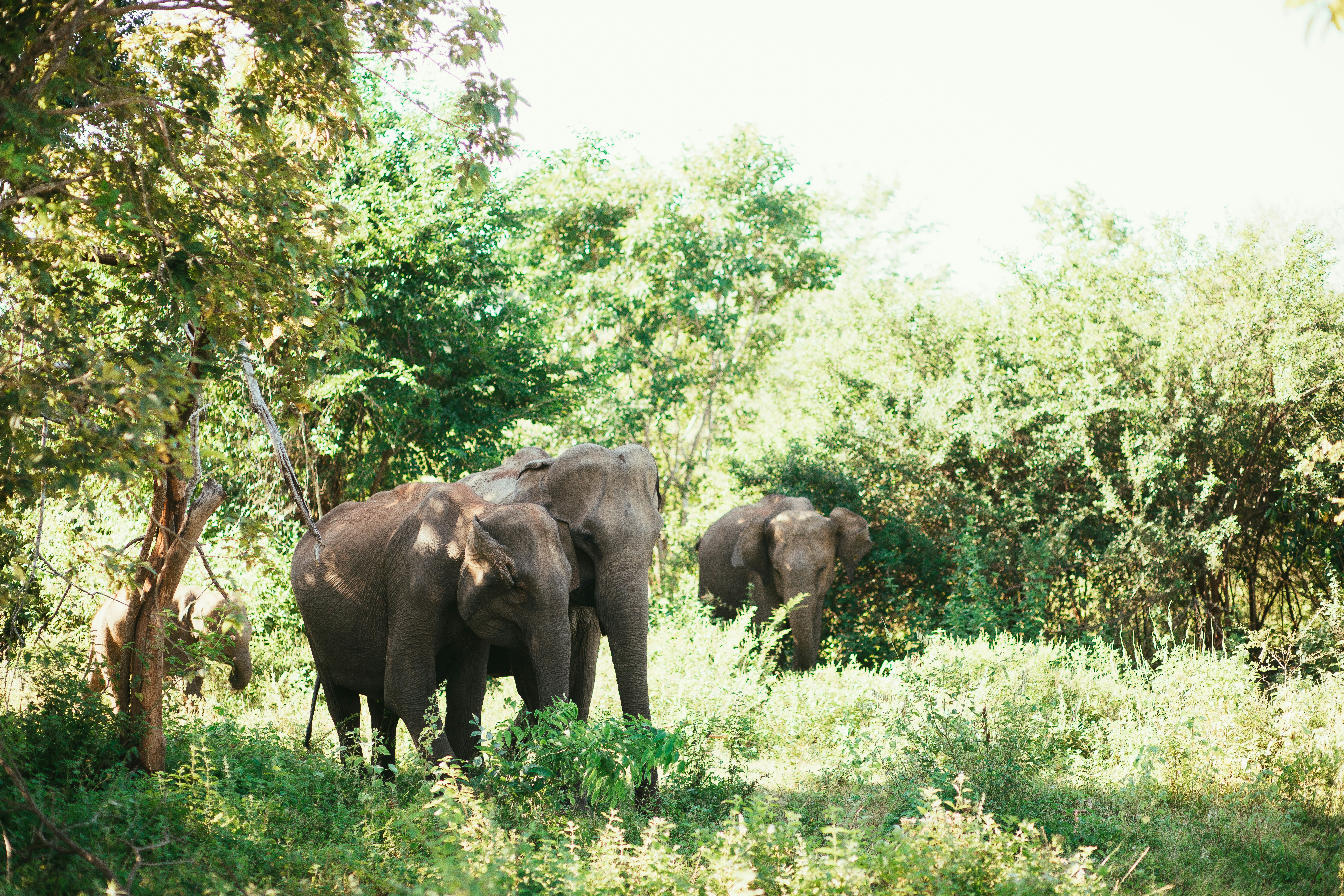
The fate of Africa’s wildlife is dire. Upemba, established in 1939 and covering over 11,000 km² of wetlands, savannas, and mountains, is home to an estimated 1,800 species. Once teeming with 100,000 elephants in the 1950s, fewer than 200 remain today. Of the once-thriving zebra population, only 200 survive in Africa’s only park offering refuge for zebras. Its lion population, once flourishing, is now extinct.
Climate change further exacerbates these threats, disrupting weather patterns and causing long-term droughts.
Rapid population growth—Africa’s net population increase averages 2.5% annually, with Nigeria projected to reach 750 million by century’s end—intensifies competition for natural resources.
Meanwhile, poverty, especially in rural areas, continues to rise. Some countries, including Zimbabwe and Angola, have recently implemented reductions of wildlife herds to feed growing populations.
Addressing this complex dilemma requires holistic solutions. Key measures include:
• Financing protective strategies, including international support, especially given climate change’s role in ecosystem stress.
• Expanding access to birth control and reproductive health services, countering population pressures.
• Establishing community-based conservation councils and alternative livelihoods like eco-tourism.
• Protecting species through migration corridors, no-entry zones, and crop-compensation programs.
• Employing satellite and monitoring technology to track poaching and militia activity.
• Restoring degraded habitats and prevent illegal settlement and mining through government-NGO partnerships.
• Strengthening ranger capacity with training, equipment, and fair compensation.
The five rangers killed in Upemba on March 3 died in a park most of the world has never heard of
While Africa’s wildlife, forests, and watersheds are under siege, the greater tragedy may be how little attention this struggle receives beyond the continent itself. In remote parks like Upemba, rangers patrol landscapes larger than some countries, confronting militias and poachers with little recognition and fewer resources.
They stand, quite literally, as the last line between survival and disappearance. If the world continues to look away, the elephants, zebras, and forests of Upemba may vanish—and the quiet heroism of the men and women who died defending them will have been in vain.
When driving, I not infrequently see bumper stickers proclaiming, “Growth is Good.” I’m not sure about that. I never have been.
I’m drawn to solitude. I can’t fully explain why; I only know it has always been so.
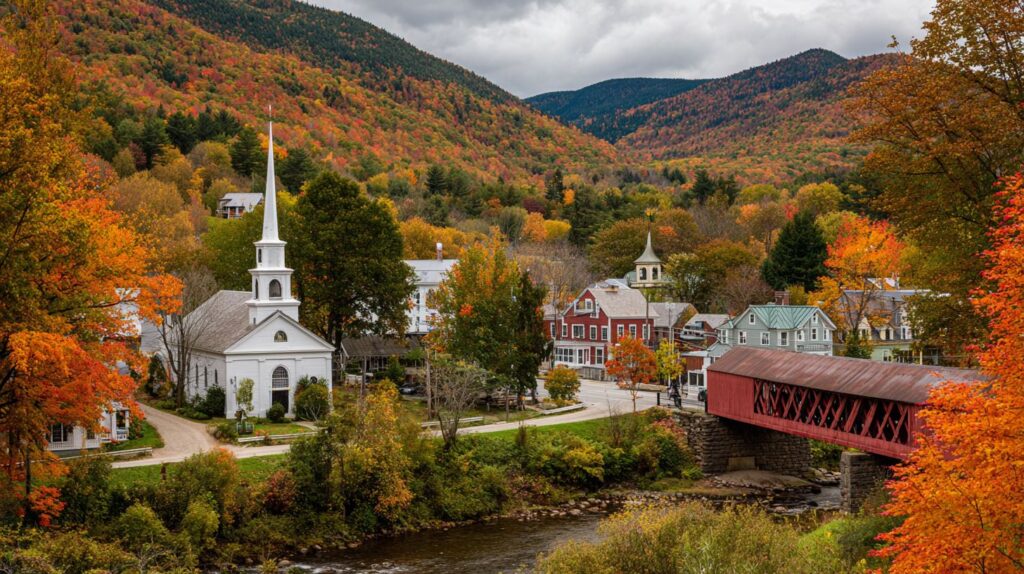
From childhood, I loved my native New England—its rural charm, its villages gathered around commons harkening back to Revolutionary times. I miss the sea, the rolling mountains, the stone walls and white-steepled churches.
Vermont has long held me in its grip, with Maine not far behind—rural, twisting lanes with scant traffic, mountains rising beyond charming villages, the faint salt scent of the seashore.
For all my love of open space, my early years were divided between rural Rowley, MA, and Philadelphia. I’ll take Rowley any day over the so-called City of Brotherly Love. I have returned to Philadelphia twice; both visits stirring up memories I would rather forget—urban blight, high crime, dirty streets, endless row houses and sweltering summer nights.
When I lived in Rowley in the 1950s, the town numbered about 1,600 souls. Thirty-five miles north of Boston, it has since tripled in population to roughly 6,400 and become a fashionable bedroom community for Boston’s well-paid professionals, aided by the MBTA Commuter Rail—a comfortable fifty-five-minute jaunt into Boston’s North Station.
We lived on Bennett Hill Road, a mile’s walk from the common. In summer I would rush out the door, glove hooked over my bicycle’s handlebar, eager for baseball on the green.
I loved walking that narrow, curving road lined with beach plum bushes and open fields, breathing the smell of nearby salt marsh bordering the ocean, as I waited for the school bus at the corner.
Home was a two-hundred-year-old house set on twenty-six wooded acres of pine. Its long driveway was lined with boulder stone walls in the old New England manner, guarded by towering elms like ancient sentries.
Deep in those woods I had a private place I visited often, drawn by its stillness—the scent of pine rising from fallen needles that softened the earth beneath my feet.
Today, Rowley finds itself embroiled in debate over a state mandate requiring density zoning for roughly six hundred new multi-family housing units near the train station.
Bennett Hill Road has changed. The beach plum bushes are gone; open fields have yielded to wooded suburban enclaves. In the 1950s, the average home sold for $10,000. Today it approaches $1 million.
I cannot forecast Rowley’s fate, though I hope it doesn’t become another Danvers or Peabody—once distinct towns now absorbed into the dense sprawl of greater Boston.
A major development called “Rowley Farms” proposes a “town within a town,” combining denser housing and retail—an idea that would have been unimaginable in 1957.
Bumper stickers may insist that growth is good. I remain unconvinced. I am, and likely will remain, a stubborn holdout for a way of life that prized quiet contentment—secluded from the noise, the restlessness, and the accumulated griefs of urban life.
Silence has always allured me, most often when it is bound to expanses empty of people—though not always. I can find it just as readily in a library, or even in my own home when left to myself.
It is not, I believe, a resistance to an oppressive environment—work, academics, trauma, peer pressure, or the quotidian churn of human caprice—what psychiatry terms “psychological reactance.” It goes deeper than that, perhaps rooted in my introversion, which inclines me away from crowds and constant social encounter.
I carry memories of three landscapes that produced instant rapture: a sense of detachment, of absence from time itself—something larger than me, and yet intimately felt.
The first occurred when I was a graduate student in North Carolina, visiting the hillside at Kitty Hawk where the Wright brothers first achieved sustained flight in their ungainly aerial contraption. I had gone with friends, who wandered along the beachfront below, leaving me alone atop the hill. There, history seemed to recede. The wind moved through the grass, the sky stretched open and unmarked, and for a moment the present dissolved, as though time itself had paused in reverence.
Then there was Arlington National Cemetery, its vast rows of symmetrical white grave markers extending beyond easy comprehension. The stillness there was not empty but weighted, a silence shaped by collective sacrifice. For a brief moment, the eternal peace of America’s fallen became my own.
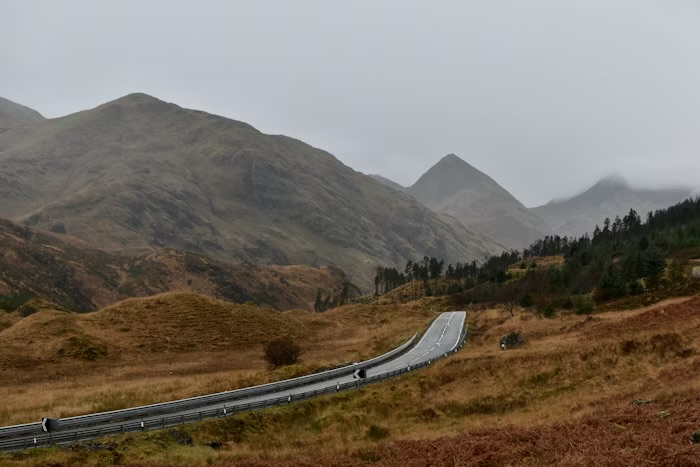
Most memorable of all were Scotland’s Highlands. Driving eastward from Edinburgh, they rose suddenly and unexpectedly across the horizon—rugged, green, and seemingly untouched by human intrusion. I pulled over, stepped out, tested the firmness of their verdure beneath my feet, and listened to what I can only call their shouting silence. That moment remains my most cherished travel memory.
As an English major in college, I once took a course devoted entirely to Wordsworth—England’s great poet of landscape. I am, perhaps, a rarity in having read all of his several hundred poems. Among them, “Tintern Abbey” most fully captures my response to those landscapes:
“…that serene and blessed mood, In which the affections gently lead us on,— Until, the breath of this corporeal frame And even the motion of our human blood Almost suspended, we are laid asleep In body, and become a living soul…”
Literary scholars describe this response under the notion of the sublime: the experience of being overwhelmed through intimacy with nature, a flash of clarity in which one intuits a larger coherence behind nature’s mystery. Wordsworth gives it further voice:
“And I have felt A presence that disturbs me with the joy Of elevated thoughts; a sense sublime Of something far more deeply interfused, Whose dwelling is the light of setting suns, And the round ocean and the living air, And the blue sky, and in the mind of man….”
Psychology approaches the experience from another angle. One theory frames it as a sensory reset—the mind’s need to unburden itself from obligation and affliction, a release from the cognitive overload of daily life.
I am especially drawn to E. O. Wilson’s Biophilia Hypothesis, which proposes that humans evolved in constant contact with nature, calibrating the nervous system through millennia of hunter-gatherer life. In that context, a deserted landscape could signal safety—the absence of predators, permission to rest.
Another perspective, the Default Mode Network, suggests that quiet environments can trigger awe by suspending habitual rumination. Freed from constant external demands, the mind drifts toward reflection, memory, and imaginative connection. In such moments, the brain is allowed to hear the rhythms it evolved to monitor.
This makes intuitive sense. We live in a world saturated with anthropophonic noise—human-made sound without pause or mercy. Though nature is never truly silent—wind, water, and the subtle movements of life persist—these sounds soothe rather than assault. They restore rather than demand.
Wordsworth seems to anticipate this longing even in the heart of the city. In “Composed upon Westminster Bridge, September 3, 1802,” he finds London redeemed by a rare moment of stillness:
“Earth has not any thing to show more fair: Dull would he be of soul who could pass by A sight so touching in its majesty: This City now doth, like a garment, wear The beauty of the morning; silent, bare, Ships, towers, domes, theatres, and temples lie Open unto the fields, and to the sky; All bright and glittering in the smokeless air. Never did sun more beautifully steep In his first splendour, valley, rock, or hill; Ne’er saw I, never felt, a calm so deep! The river glideth at his own sweet will: Dear God! the very houses seem asleep; And all that mighty heart is lying still!”
Perhaps silence, then, is not an absence but a presence—one that returns us to ourselves, quiets the mind’s noise, and restores a way of listening we once possessed, and have not entirely forgotten.
I’ve been keeping a list for some time of my favorite blogs. There are so many to choose from that discovering one capable of sparking genuine enthusiasm often feels like chance—like gazing nightly at the starry heavens and marveling at what lies beyond human reach. When such a blog does appear, it draws me back again and again, not out of habit but wonder.
Relying on that list, I came upon a short paragraph-poem this morning by Dr. Drew Lanham, the award-winning African American professor of environmental studies at Clemson University. Lanham confesses to being “a man in love with nature—a wanderer finding foundation in wild places.” What follows is both intimate and expansive:
Handle my life in your hands as if it were your own. Feel the heart beating—small as it may be—and imagine it in your own chest. Beating in syncopated time to become shared meter. That pulse, the breathing, is your rhythm. Your in’s and out’s, its in’s and out’s. Look close under whatever warty skin or soft fur or gaudy feathers and see self. Its being is your being. Be in that same skin for what moments it will allow. Then, when the convergence between you is sealed, release that wild soul to free roaming as you would desire of your own.
What strikes me is the poem’s quiet tone: a persona grounded in kinship with the natural world, alive with empathy for the vulnerable. Applied beyond nature—to our fellow humans—it gestures toward something transcendent: a way of bridging difference, whether of creed, ethnicity, or race.
Such bridging begins only when we recognize our linkage, when we are willing, even briefly, to see ourselves in others—“Be in that same skin for what moments it will allow.”
Lanham wrote this poem after rescuing a frog from his cat’s pursuit.
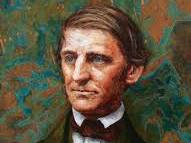
Ralph Waldo Emerson ranks high on any list of frequently quoted American sages. He has a special way of rendering human experience palpable.
Among his many essays, I’ve especially liked “Compensation,” which I first read as a young graduate student in an American Lit class.
Undoubtedly a residue of his exploration of Eastern thought, this essay has journeyed a lifetime with me in its karma undertones, buoying me up in its harbinger of moral recompense for life’s myriad inequities.
But on occasion, Emerson fumbled, as when he wrote that “money represents the prose of life, and which is hardly spoken of in parlors without an apology, is, in its effects and laws, as beautiful as roses” (“Nominalist and Realist,” Essays: Second Series, 1844).
Critics were quick to pounce, Marxists in particular seeing it as capitulating to capitalism. Emerson probably meant that the pecuniary is an integral component of the natural order.
Still, it seems a passage one wants to expunge like disturbing phlegm.
I like Saul Bellow’s correction: “Uch! How they love money, thought Wilhelm. They adore money! Holy money! Beautiful money! It was getting so that people were feeble-minded about everything except money. While if you didn’t have it you were a dummy, a dummy! You had to excuse yourself from the face of the earth!” (“Seize the Day”).
But let me also share psychologist and poet Pamela Joyce Shapiro’s response to Emerson’s remark. Her poem speaks for me and perhaps for you:
If money is the prose of life as beautiful as roses, poetry it seems must be the soil and sun of infinity, without which surely nothing grows. I see the pleasures each might bring, when flourishing in abundant spring. Though stocks and petals tend to fall in drought or storm or just because, poetry survives it all. What losses can define what loss is? Waning wealth or stolen roses? Forget the till and till the mind, plant poetry and praise the sky.
The Trump administration’s assault on the environment in the context of exponential climate change exhibits all too well the earmarks of corporate denial in the pursuit of monetary gain that will reap catastrophic consequences.
When Rachel Carson’s Silent Spring appeared in 1962, it moved two presidents to take action, Kennedy ordering an investigation of pesticide use and Nixon founding the Environmental Protection Agency.
Unfortunately, Trump’s EPA version bears little resemblance and to chart his myriad changes would try your patience.
I confess to being an environmental zealot. I read eco literature vividly, keep up with the latest happenings, donate regularly to environmental groups.
I support protecting endangered species like the whooping crane, manatee, blue and finback whales. I accept evolution’s tapestry of a variegated offspring, reaping the legacy of successful adaptation over vast aeons of time, our human presence but a wink by comparison.
I do not subscribe to the administration’s either/or assumption of jobs vs. environment. On the contrary, abundant studies show commitment to the Green New Deal would inaugurate new technologies and promote GNP growth. According to a University of Massachusetts study, commitment to a climate jobs program would generate 1.5-2 million net jobs annually for a decade (Pollin et al.).
Trump and his lackeys ignore such research. They are of a stubborn mindset, devotees of fossil industry interests,
Recently, this administration waived thirty environmental and public health studies in pursuit of building a wall through the Lower Rio Grande Valley National Wildlife Refuge, placing endangered species habitats and ecosystem corridors in jeopardy.
Meanwhile, they’ve slashed the EPA budget by 65%, cancelled or unenforced dozens of environmental rules, opened the Arctic National Wildlife Refuge and US coastal waters to oil drilling, slated public lands with their indigenous monuments for auctioning, and severely reduced national park staffing.
As for the Endangered Species Act, this administration has compromised it to allow for economic considerations. Good-bye, my beloved manatees, the Everglades, Yosemite as we once knew it in its pristine beauty,
As Rachel Carson reminds us, “Beauty — and all the values that derive from beauty — are not measured and evaluated in terms of the dollar.” (Lost Woods).
Addendum:
Yesterday, my heart quickened as Dee Dee and I drove into Lexington, honked our horn at several groups of Trump protestors gathered along the way, who exuberantly reciprocated our waves.
I want to step back from writing about politics, at least for now. We all have our views, and too often—much like professing religious beliefs—we run headlong into barbed-wire intolerance.
Some find distraction, even intoxication, in endless hours of media; others in sports; still others in hobbies that bring both pleasure and mastery—or in the familiar solace of alcohol.
I prefer reading, not just any kind, but what helps me grow and be more aware I’m not alone. Lately, it’s been nature memoirs, especially like H is for Hawk. I want to get back to my beloved Thoreau and not least, Wendell Berry. I miss Tolstoy.
Of course, we shouldn’t extract from nature what really derives from our imposed views such as we find in Wordsworth’s poetry. Nature, as writer James Rebank reminds us, “isn’t all butterflies, sunshine and healing.”
Still, whenever I step outside the human world, there descends this quieting solace, and I think myself made whole again.
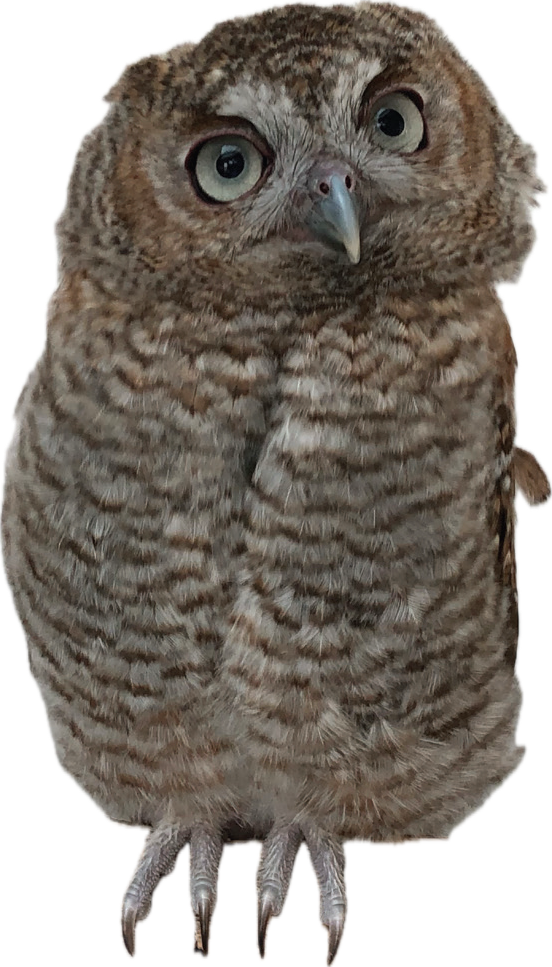
There exist those books you wish wouldn’t end. Carl Safina’s Alfie and Me: What Owls Know and Humans Think was that kind of book for me.
I had read Safina’s excellent View from Lazy Point several years ago, impressed with its detailed oberservations of wildlife and an arctic indigenous community across four seasons. That same concern for indigenous well-being and the plight of animals in a changing world continue with Alfie and Me.
Safina, a widely published ecological author and Endowed Professor of Nature and Humanity at Stony Brook University, is an expert in marine biology and recipient of many honors, including a MacArthur Fellowship, sometimes dubbed “the genius grant.”
In all his writings, Safina’s focus is on how humans relate to nature, a theme manifestly central to Alfie and Me, chronicling the story of an orphaned Eastern screech owl found in Safina’s Long Island backyard in 2018. Over the course of eighteen months, Safina and his wife, Patricia, nurtured the owl—whom they named Alfie—until her eventual release, creating a rare, intimate portrait of interspecies connection and nature’s resilience.
Safina becomes nearly a helicopter parent, monitoring Alfie’s daily development, torn between fostering her independence and protecting her from the harsh realities of the wild: “… I knew—as she did not—the relative meaninglessness of a life without risks.” An estimated two thirds of young screech hours die shortly after leaving their parents’s nest.
I found myself anxious for Alfie’s survival. Would she learn to fly, to hunt, to mate? Could she survive storms, drought, and the many predators that lurk in her world?
Species survival today depends not only on healthy ecosystems, but increasingly on humans recognizing their relationship with nature as essential to mutual survival.
Safina criticizes Western philosophy for severing this connection, beginning with Plato’s split between the material and spiritual worlds—deeming the material inferior and ultimately fueling nature’s exploitation: “Plato and his followers were perhaps the first people to feel revulsion toward the world. By forever separating our material world from the realm of perfection, Plato propounded a stark dualist doctrine,” Safina says.
For Safina, “This might be the most consequential idea in the history of human thought, its implications almost literally Earth-shattering. Most fundamentally, we are left with: an existence at odds with itself.”
Descartes and Bacon subsequently embodied a modern mechanistic view of nature, oblivious to nature’s sanctity and evolutionary intelligence, leading to its objectification. “The great blindness of the West is to grope the world as inventory,” Safina writes.
In contrast, Safina draws richly from Eastern traditions, which emphasize the unity of all life and the reverence owed to the source from which we came. Although his book is replete with references to Hindu, Buddhist, and Taoist thought, he finds Confucianism especially compelling for its focus on relationships.
Safina also turns to Indigenous cultures as contemporary models of living in harmony with nature. Their ways often involve mindful observation and sustainable stewardship rooted in mutual respect: “For most of human history, Native peoples, more intimate with their existence than we with ours, perceived that Life and the cosmos are mainly relational,” Safina says.
Reading Alfie and Me, I couldn’t help but think of the estimated one billion birds projected to die globally in 2025. According to the Audubon Society, North America alone has lost 25% of its bird population since 1970—about 3 billion birds. Contributing factors include climate change, deforestation, pesticides, habitat destruction, urban structures, insect decline, and free-roaming cats.
Safina’s book appeared in 2023, or before the current avian flu outbreak, which over the past 18 months has led to the confirmed deaths of millions of wild birds in North America—many of them common backyard visitors. The virus has now reached poultry as well, despite the culling of over 166 million birds. A future in which birds no longer sing at sunrise, once unthinkable, now feels disturbingly plausible.
This avian decline is largely human-made, driven by an economy that prioritizes profit over preservation
Why write about birds, some might ask. Shouldn’t human needs come first?
Safina answers with the words of Catholic monk Thomas Merton: “Someone will say you worry about birds: why not worry about people? I worry about both birds and people. … It is all part of the same sickness, and it all hangs together.”
Alfie and Me is not only a poignant narrative about an orphaned owl, but also a powerful meditation on our shared existence, affirming Safina’s truth: “that no isolated separation is possible. We are participant members in one existence—of life, of the cosmos, of time.”
The only biodiversity we’re going to have left is Coke versus Pepsi. We’re landscaping the whole world one stupid mistake at a time. —Chuck Palahnuk, Lullaby
The year is 2060. You are gone, but your grandchild reads to her children from a book filled with drawings of creatures once abundant and a source of wonder, now the stuff of children’s story books, only not of some fearsome Tyrannosaurus Rex, Megalodon, or Woolly Mammoth, but of elephants, giraffes, lions, tigers, rhinos, whales and monarch butterflies, now vanquished, never to grace our earth again.
Distressingly, largely due to the exponential increase in the human footprint, this is our grandchildren’s bleak future. No more condors, manatees; no more of our closest relatives, chimpanzees, orangutans, and mountain gorillas, natural selection’s vast repertoire of unique, splendid entities reaching back several million years, thoughtlessly extinguished by Homo sapiens.
Apart from the scientific community, the public appears largely unaware, perhaps even indifferent, to this unprecedented threat to species loss and the risks it imposes for its own welfare. This extends to climate change, largely human induced. A current PEW poll reveals only 41% of Americans regard it as a priority issue.
As to how many species exist, whether flora or fauna, we don’t really know. New species are continually being discovered, while others have recently become extinct or face extinction. What we do know is that many species have gone extinct even before their discovery. An estimated million others are likely to go extinct in the next several decades.
This leaves us in a quandary: do we attempt to preserve existing species for future generations or do we simply resort to preserving those serving immediate human interests? Unfortunately, our present trending indicates the latter with species everywhere in free fall.
A useful acronym for the specifics governing this decline is HIPPO: habitat loss, invasive species, pollution, population growth, over exploitation:
Habitat: Three quarters of the earth’s terrestrial environment has been altered by human activity; 66% of the marine environment.
Invasive species: Since 1970, invasive, alien species have increased 70% across 21 countries.
Pollution: 300-400 million tons of heavy metals, solvents, toxic sludge among other wastes from industrial facilities have been dumped into the world’s waters.
Population growth: The world’s population averaged an annual 1.7 increase between 1950 (2.5 billion) and 2010 (6.9 billion). In 2022, world population has reached 7. 6 billion. (Pew Research). While the growth rate has generally been plummeting, not so in Africa, averaging an annual 2.54 increase. By 2050, Nigeria will overtake the U.S. in population (The Economist); 800 million by 2300 (qz.com).
Over-exploitation: In 1930, an estimated 10 million elephants roamed Africa. Currently, that number has dwindled to 416,000, largely due to poaching and conflict (World Wildlife Federation). On the high seas, factory ships are removing fish faster than they can be replenished. Japan continues to hunt whales. Sharks are killed in the thousands for their fins (fin soup a Chinese delicacy), their carcasses thrown into the sea. Chimpanzees, our closest relatives, hunted for meat and increasingly suffering habitat loss, are now a threatened species.
Climate change needs to be added, giving us HIPPCO. It ranks second to habitat loss in imperiling biodiversity. Largely due to climate change, we are losing our polar bears, just 31,000 remaining; coral reefs with their independent ecosystem, nourishing myriad aquatic life, are dying as the sea warms and storm intensity and frequency increase. The speed of heat increase due to reliance on fossil fuels over the last 100 years now exceeds that of the previous 10,000 years.
Extinction isn’t new to earth’s history. Geologists have noted five principal occurrences, the most famous that of 65 million years ago, when a 12 kilometer wide asteroid crashed into the Yucatan, leaving a crater 10 kilometers deep and 180 kilometers wide, killing 70% of the earth species, including the dinosaurs, ending the Mesozoic Era, or Age of Reptiles, and ushering in the Cenozoic Era and the rise of mammals after 10 million years of evolution.
Humans came late on the scene. In the 1980s, aquatic biologist Eugene Stoermer coined the term Anthropocene to depict a new epoch, human dominated. In this epoch, the Earth faces a new menace, wrought not by an asteroid, but by Man. The massive extinction of this human-centered epoch has been popularized as the Sixth Extinction.
The fundamental source of our dilemma is our disconnect from nature. We have fostered Nature as something apart from ourselves. It exists, but it’s outside ourselves, an entity to be exploited for human needs.
The truth is we exist as constituents of a vast biosphere complex of interrelated life forms dependent on one another for well-being. Remove an element of this web and you potentially unleash a house of cards scenario of collapse.
Take, for example, the chestnut tree dominating the forests of Eastern North America before European settlement. Tall, fast growing, numbering an estimated four billion, their canopy housed millions of birds and their nuts provided food for many birds, insects and mammals. Then came the Asian pathogen fungus Cryphonectriaparasitica of the early 20th century. With the loss of these magnificent trees came the demise of caterpillars metamorphosing into moth pollinators, along with the plunge into oblivion of the once prodigious passenger pigeon.
In our earth’s nearly 4 billion year history, we estimate that of the 4 billion species evolved by nature, 99% are extinct. But such extinctions resulted from natural antecedents apart from human causation. Increasingly, Man has become the arbiter of species decline, not evolution or cyclic climate change, or asteroid collision. In the last 500 years, 900 species have gone extinct and the pace quickens.
Currently, 35,000 species face extinction risk, according to the International Union for Conservation of Nature’s Red List of Threatened Species:
Among these, 1 in 7 bird species.
A quarter of the world’s mammals
40% of amphibians
34% of conifers
37% of sharks and rays
21% of reptiles
33% of reef corals
It gets worse than that. The latest UN IPBES Global Assessment report (2019) forecasts more than a million species are likely to go extinct in coming decades.
The biosphere, which includes ourselves, is Nature’s survival gift, complex and delicate, requiring balance of its constituents. Safe-guarding it is crucial and its benefits not to be taken for granted. Healthy Plants convert the sun’s energy, making it available for other life forms. Bacteria and other living organisms convert organic matter into nutrients enriching the soil. Pollinators are essential to food production. Plants and oceans act as major carbon sinks. Did you know that of the 50,000 known medicinal plants, up to a fifth face extinction from deforestation? Or that approximately 120 drugs derived from rainforest plants are used to treat cancer, leukaemia malaria, heart diseases, bronchitis, rheumatism, diabetes, arthritis or tuberculosis?
As the late eminent biologist E. O. Wilson pleads in his compelling Half Earth,
The biosphere does not belong to us; we belong to it. The organisms that surround us in such beautiful profusion are the product of 3.8 billion years of evolution by natural selection. We are one of its present-day products, having arrived as a fortunate species of Old World primates. And it happened only a geological eyeblink ago. Our physiology and our minds are adapted for life in the biosphere, which we have only begun to understand. We are now able to protect the rest of life, but instead we remain recklessly prone to destroy and replace a large part of it.
Our Earth has taken ill and we are its cause. Paradoxically, we must be its healer.
Recently I posted about the plight of butterflies, especially that aerial tiger, the monarch butterfly. I mentioned that I’m trying to certify our backyard as a way station. But while I’m at it, bees also play a vital role in planning a pollinator garden.
You may be aware that bees have been disappearing over the last several decades. And we haven’t known why–that is, until now.
But let’s go back to 1958, when marine biologist Rachel Carson received a copy of a letter her friend, Olga Huckens, had sent to the Boston Herald, describing the aftermath of mosquito spraying in Duxbury, Massachusetts, the previous summer: the wipeout of songbirds, bees and other helpful insects. Ironically, the mosquitos returned in full force. Olga asked Rachel if she knew anybody in Washington, DC, with influence who could halt the spraying.
Out of this came Silent Spring, perhaps the greatest American nature classic since Thoreau’s Walden. It would catch the eye of the youthful president, John Kennedy, who would meet Rachel Carson with his team of advisors. Ultimately, her book would lead to the banning of DDT.
Unfortunately, other countries didn’t join the ban and its use continues abroad. But now there are new, perhaps even more devastating pesticides at work called neonics, sprayed on hundreds of crops you and I eat. Seeds get coated with these pesticides, infesting both soil and pollen, killing off bees, butterflies, and other insect friends.
The good news is that in 2013, the European Union enforced its newly imposed two year ban on some of the leading neontics.
The bad news is that in America, the EPA has been dragging its feet, despite President Obama’s directive to prioritize its review of neonics.
Let me expand on the fallout of neonics, since they threaten not only our insect friends, but you and me.
When you resort to neonics, not only do you kill off bees, for example, but you impair their immune system, making them vulnerable to disease.
But it doesn’t stop there. Neonics linger in the soil, water and plants for many years. As such, they threaten whole ecological systems that include earthworms, amphibians (under severe threat), and birds.
Neonics, according to the European Food Safery Authority, “may affect the developing nervous system” of children.
What may surprise you is that you may be harboring neonics in your own yard when you purchase plants at box stores like Lowes and Home Depot, According to a study launched by Friends of the Earth, on whom I’ve drawn for some of my information, “many of the so-called ‘bee friendly’ plants we grow in our gardens have been pre-treated with bee-toxic neonics at doses up to 220 times higher than those used on farms.”
Unfortunately, we’re facing an uphill fight, with giant petrochemical and seed corporations like Monsanto, Syngenta and Bayer devoting huge sums to divert attention and pedal influence.
The EPA, for example, recently gave the green light to Bayer, based on a study primarily funded by the corporation!
I haven’t even talked about the exponential use of GMO’s used massively in soy and corn production with their built-in resistance to powerful herbicides, thus allowing for their use.
There’s so much more I’d like to say, but let me end with some sobering facts regard lhoney bees:
Pollinators are essential for our crops. Honey bees (Apismellifera) are the grand masters, one hive of 50,000 bees capable of cross-pollinating twenty-five million flowers in a single day! No other insect comes close.
Now think about what you maybe had for breakfast: cereal, fruit juice, toast? Maybe you had almonds or berries topping your granola. Hey, honey bees made that possible.
For supper, cukes, zukes, squash?
Or how about that cream in your coffee from clover-foraging cows?
Or maybe your beef?
Bees helped put these foods on your table!
In nature at large, some 250,000 known plant species exist. Of these, three quarters rely on pollinators to reproduce.
Bottom line is that more than 100 crops comprising 90% of our global food supply rely on bees for pollination.
You get where I’m going with this. No bees, no food, unless you like eating bark.
Now I hate to tell you this, but our bee population has declined as much as 70% just in the last several decades. Given the stress imposed on bee colonies by neonics and GMO’s, we may have reached the tipping point.
While other factors weigh in like electromagnetic radiation–think cell phones—and climate change that encourages pathogens, organic bee colonies aren’t experiencing these huge losses in bees or collapsing colonies. In short, pesticides appear to be the villains.
Rachel Carson not only warned us 45 years ago of a world in which there would be no birds to serenade spring, but of a world in which “there was no pollination and there would be no fruit.”
What can you do?
Beautify your landscape with bee friendly indigenous, organic plants using organic starts or untreated seeds.
Shun products with neonicotinoids. Read labels carefully.
At your grocery and garden centers, opt for organics plants and produce.
Together, each of us doing what we can, we may be able to avert beemeggedon and a fruitless fall.



 Brimmings: up from the well