
On Reading Cormac McCarthy’s All the Pretty Horses

I have now read Cormac McCarthy’s All the Pretty Horses, remarkable in its stark, yet lyrical beauty reminiscent of Hemingway and Faulkner, intense in its palpable confrontation of goodness with evil; an elegy for a lost way of life; a saga of idealism’s betrayal; of mythic passage from innocence into knowledge offering no redemption, apart from the grace of endurance and a refusal to forfeit honor.

The traditional rancher spreads of west Texas have fallen on hard times, threatening a way of life. The novel opens appropriately with the death of central protagonist John Grady Cole’s grandfather, a former baron among ranch owners. The ranch, grown to 18,000 acres in 1871, has been sold, an inheritance lost. Working with horses is the only life Grady knows:

The Grady name was buried with that old man the day the norther blew the lawnchairs over the dead cemetery grass. The boy’s name was Cole. John Grady Cole.

The first of a three novels known as the Border Trilogy, All the Pretty Horses underscores the death of the Western frontier, once ripe with promise of plenitude—fortunes to be made and dreams fulfilled.

Foregrounded in historical fact, a pastoral, unfenced way of life has fallen prey to change—the dividing of holdings among family, increased taxation, a drift of young people to the cities, mechanization, the invasion of industry, government’s encroachment, relentless droughts—above all, the railroad’s ubiquity, all of which McCarthy turns into metaphor for an agrarian culture bound by hard labor and a code of honor irretrievably lost. Metaphor becomes elegy.

All the Pretty Horses  narrates the journey of cowboys John Grady and his friend Lacey Rawlins from West Texas into Mexico, joined later by a mysterious youth, Jimmy Blevins, who owns a gun and rides an elegant bay mare, foreshadowing trouble ahead.

The novel abounds in resounding passages, poetic in resonance, like this one of stellar vastness, a cosmos indifferent to Man and of a fusion with nature and of a connection now severed:

He lay on his back in his blankets and looked out where the quartermoon lay cocked over the heel of the mountains. In that false blue dawn the Pleiades seemed to be rising up into the darkness above the world and dragging all the stars away, the great diamond of Orion and Cepella and the signature of Cassiopeia all rising up through the phosphorous dark like a sea-net. He lay a long time listening to the others breathing in their sleep while he contemplated the wildness about him, the wildness within.

Acquaintance with archetype helps readers tap more easily into the novel’s multiple levels of meaning—the hero archetype of initiation, trial, and return; the paradisiacal garden of northern Mexico’s La Purisima with its grassland abundance, grazing cattle of upwards of a thousand head, and 400 horses, attended by valeros, finding fulfillment in their labor; a siren temptress, Alejandra, the forbidden fruit, daughter of wealthy hacendado Don Héctor:

She passed five feet away and turned her fineboned face and looked full at him. She had blue eyes and she nodded or perhaps she only lowered her head.

The hero’s mentor appears, Dueña Alfonsa, great aunt of Alejandra, delivering stern warning from experience, that fate often annuls human wish and that economic and social determinism govern universally. Unlike traditional mentors, she’s unhelpful, even sinister, serving as forewarner and enforcer of social codes.

Not unexpectantly, trespass —Grady and Alejandra have become lovers—makes inevitable Grady’s expulsion from paradise, commencing an ordeal with uncertain outcome in a world where idealism is often judged as weakness and evil corrupts honor with impunity.

Unjustly imprisoned, Grady and Rawlins undergo brutal imprisonment for a crime they never committed. Blevins has  been executed earlier by a rogue officer. We have reached the novel’s nadir, a replay of mythic hell. A Mexican prison, governed by bribery and savagery, tests their courage and capacity to endure.

Dueña Alfonso buys their freedom, under condition he not return to La Purisima, only to have Grady resist and encounter Alejandra’s rejection.  Rawlings has returned to Texas.

Throughout, the novel remains faithful to its hero archetype—the hero, wiser now, returns to exact justice, wounded not only by a rifle’s bullets, but a pervasive knowledge of human capacity for caprice and injustice. Grady’s loss of his horses is inextricably linked to his identity. He returns to reclaim them, necessitating violence.

Restoration of wrong occurs, but not without a tarnished innocence and a sadness that knowledge brings.

Symbolism abounds, particularly through the horses of the narrative that give rise to the novel’s title. Virtual characters, they symbolize a dying way of life and nature’s nobility.

Grady’s affinity with horses affirms a vestige of traditional human communion with nature, once vibrant, but now vulnerable to a modern world in disconnect.

I have only one criticism, and that concerns its last fifty pages in which the prose splendor slackens and we arrive at a conclusion seemingly hurried and simplistic, anticlimactic in contrast to the mesmerizing narrative of its preceding pages that sustain a reader’s interest.

But make no mistake. McCarthy succeeds in writing an extraordinary novel, and I am embarrassed to have not caught-up with him sooner.

He passed from us in 2023 at age 89, having written twelve novels, several plays and short stories. Several of his books became movies.

He was his own person, disdaining celebrity status, living much of his life in poverty. Like Grady, he persevered. Recognition came late, beginning with All the Pretty Horses, which won the National Book Award, our nation’s highest literary award. He was 59 and now famous.

I intend to continue with his trilogy, then on to Blood Meridian, which many critics regard as his opus magnum.

Transcending time and geography, McCarthy rivals Faulkner as our greatest American author.

–rj
 

Dream Rummaging

We dream–it is good we are dreaming–
It would hurt us–were we awake.
Emily Dickinson

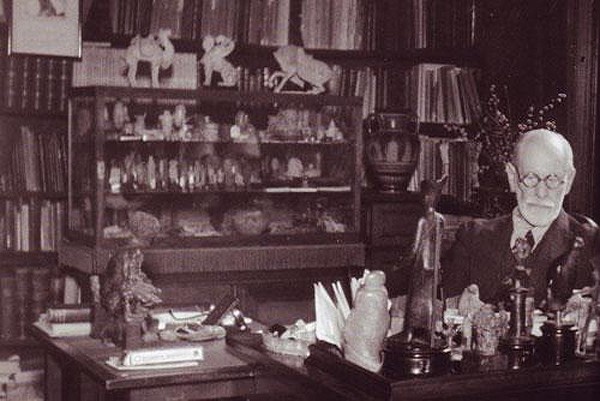
Freud in his London office (1939)

1111_Freuds-Last-Session369887

Do you dream a lot?

I know I do.

Incessantly.

I dream more now that I’ve gotten older, abetted by having to get up in the nights at this juncture.

Should I care about dreams?

Do they have meaning?

Can they help us?

Perhaps show us our real selves?

Make for a better world?

I know I’ve always been interested in them from earliest days.

The catalyst was probably Freud’s massive Interpretation of Dreams, which I confess to reading all the way through.

For Freud, dreams reflected repressed desire, often of libido.

The wish principle always.

But how can that be?

Don’t I often dream my fears?

With Freud, I always sensed a wanna-be novelist at work, ingeniously spinning narratives, howbeit, in the name of science–alas, to confirm an a priori hypothesis without the backup of today’s medical formulae of random testing and cohort studies. But then, how do you quantify something so ethereal as dreams?

But don’t get me wrong.

I think his Civilization and Its Discontents one of the great masterpieces, despite its surprising brevity.

His triad of Id, Ego, and Super Ego continues to spellbind me by virtual of the myriad ways I see it manifest itself in both myself and others.

Auden, as always, said it so well in his “Memory of Sigmund Freud” (1939):

for one who’d lived among enemies so long:
if often he was wrong and, at times, absurd,
to us he is no more a person
now but a whole climate of opinion….

I was surprised to read in neurologist Oliver Sacks’ tell-all memoir, Moving On, published just several months before his death last week, that he was seeing a psychoanalyst for some fifty years–and, remarkably–the same one every week! Sacks kept a notebook on his nightstand, recording his dreams faithfully.

Make no mistake: Sacks is a man I came to love and respect deeply. I just wish I knew why he kept finding psychoanalysis a cornucopia of self-knowledge, apart from crediting it with his rescue from drug addiction acquired from his youthful halcyon California days a la Muscle Beach.

For me, the great influence on how I look at dreams has been Freud’s former disciple, Carl Jung. His notions of anima and animus, often projected in dreams, have proved revelatory personally and hence liberating.

He taught me that so much of living life is finding equilibrium, or the balancing of Ego and Self.  Dreams offer symbols to excesses in ourselves that can be remanded.

He also introduced me to polarity as the essence of mythos truth with its tension of paradox.

If Freud looked to our past as the repository of dream content, Jung saw dreams as projections of possibility and therefore hope.

Jung was more a cultural analyst, or pseudo-anthropologist, finding universality across a wide spectrum of symbolic significance, rummaging what he collectively called archetypes.

In younger days I nearly chose becoming a licensed Jungian therapist and sometimes wonder if I committed one of the great follies in my life in turning down its seduction. Campbell, that ardent Jungian, famously urged we should follow our bliss. That maxim, aside from its latent dangers resident in reductionism, may often prove wise counsel and its rejection the source of substantial human misery.

But to sum up, I think what I’ve liked best in Jung is his acceptance of the banality of evil, Arendt’s phrasing for resident evil in Man. No liberal withering away via socio-economic exegesis, often speciously argued in my view.

Maybe my lifelong fascination with dreams stems from my youthful days drenched in fundamentalist biblical parochialism. There was Joseph, so masterful at dream interpretation that the Pharaoh took him into his confidence, ultimately saving Joseph’s kindred Hebrews.

And of course, there’s Daniel.

For the ancients, dreams gave warning and with it, admonition.

I chose to pursue a Ph. D. in English Literature. Well, you guessed it: Coleridge’s famous Kubla Khan poem, which he explained as the aftermath of an interrupted dream. But that’s just one dream poem. There are scores of other dream poems.

What I’m meaning to say is that there have been so many threads feeding into my dream fixation, not just Freud and Jung who were obviously mesmerized.

Do dreams exhibit patterns?

Do they help us to know ourselves?

I believe they do.

And that’s why I need to go back to exploring my dreams again, now that they seem to occur more frequently.

Like Sacks, I may soon be keeping a notepad on my nightstand.

–rj

Jung, Archetypes, and A Parrot: The Legacy of Nature’s Genius

Dr. Joanna Burger
Dr. Joanna Burger

I’ve just finished Joanna Burger’s The Parrot That Owns Me: The Story of a Relationship. Funny, I had this book sitting on my shelf, unread, for twelve years. Looking for something to read while eating my breakfast, I pulled it down and started what turned out to be a fun read.

I also learned a great deal about birds and, especially about parrots, surely one of the most intelligent of animal species, though we normally think of primates (gorillas, chimps, orangutans, etc.), dolphins, elephants and pigs as honorary Mensa candidates among our animal kin.

Burger, one of the world’s leading ornithologists and Rutgers University prof with over twenty books to her credit, tells how Tiko, her Red-lored Amazon, practices a repertoire of tonal warnings to distinguish varied predators, most notably, hawks, cats, and snakes.

She writes that “when Tiko gave his hawk call, Mike (her husband) and I would invariably spot a Red-tailed, Sharp-shinned, or Cooper’s Hawk flying overhead or perched in a nearby tree. Tiko’s response was so consistent that there was no question that he recognized hawkdom” (167).

Likewise, Tiko doesn’t like snakes, one of which Burger kept for a while, much to Tiko’s dismay. Only when the snake went into hibernation could he be content in the same room.

But how does Tiko pull this off?   After all, he seems to possess a genetic memory of jungle predators, even though he’s been totally reared in captivity and has never had any interaction with hawks or snakes?

Years ago I had started reading Jung, who has impressed me more than Freud as being on the mark when its comes to the seminal sources lurking behind human behavior. Jung proposed the theory of archetypes, or “primordial images” (Man and his Symbols, 67), reflecting instinctual urges of unknown origins. They can arise in our consciousness suddenly and anywhere apart from cultural influence or personal experience. Often they take shape in our consciousness through fantasy, symbol, or situational pattern.

And so with Tiko as well as ourselves, the instinctual responses perpetuating survival have become wired in the brains of sentient creatures. Untaught, they’re automatic.

Today, science overwhelmingly confirms the accuracy of Jung’s prescience. Take, for example, the eminent biologist Edward O. Wilson, who attests that monkeys “raised in the laboratory without previous exposure to snakes show the same response to them as those brought in from the wild, though in weaker form (In Search of Nature, 19).

The explanation, of course, lies in evolution’s conferring differential survival value through natural selection. Those who learn to respond to fear quickly simply pass on more of their offspring with their response mechanisms.

Wilson goes further, arguing that human culture itself is considerably biological in origin, or genetically prescribed, supported by analytical models (123-24).

A Jungian at heart, I found Tiko’s innate capacity to respond to elements of danger another in a long line of evidence supporting Jung’s pioneering perspective; on this occasion, by way of one of the world’s most astute animal behaviorists, Joanna Burger.

Nature never ceases to amaze me!

–rj


Maleficent: a must see movie!

“No society treats its women as well as its men.”
UN Development Programme, 1997)

Jolie

There’s a new movie I’m wanting to see. It’s called Maleficent and stars Angelina Jolie.

It’s timely because it’s really about rape, which has now entered into virtually every fabric of American life, including our schools. On our higher college campuses, one out of five coeds will be raped.

Time Magazine in its recent cover issue on the subject, mentions that the University of Montana (Missoula) has averaged 80 rapes annually over the last two years. It isn’t unique: even the Ivy League schools have a high incident rate–that is, of reported rapes, twenty percent of them related to alcohol. Some experts speculate that most campus rape goes unreported.

Across the nation, the same 20% figure prevails, with 80% of rape victims below age 25, according to The National Intimate Partner and Sexual Violence Survey, done in 2010, and made public last year. Stalking, now abetted by smart technology, is even more widespread, or five times the number of rapes.

But let’s get down to bedrock: The survey estimated that 1.27 million American women were raped–or one woman every 29 seconds–and 5.1 million stalked–a fall out rate of one woman every 7 seconds.

Rape is so much a part of our national fabric that it’s found its way into a Walt Disney film in a grim version of Sleeping Beauty. In the eponymous film, Maleficent is a fairy initially enjoying unlimited aerial freedom in a forest setting (i.e, archetypal rendering of situational danger), who falls in love with Stefan, a human being, who betrays her.

Rape, in the film’s metaphorical version, is transposed into Stefan’s drugging Maleficent so that he can take her wings back to the king of humans. In this age of ambien, pervasive alcohol, and PT141 on the horizon, sounds familiar, doesn’t it?

In a cogent review, http://huff.to/1lbymvh, Hayley Krischer writes that “Maleficent is a commentary on current male and female relationships. It’s a commentary on rape culture. And much more, it’s a story that allows a woman to recover. It gives her agency. It gives her power. It allows her to reclaim the story. And this is something that can’t be ignored.”

Sadly, clipping a woman’s wings is what many men do, with rape its ultimate manifestation, taking away their ability to be fully themselves, free to pursue their dreams, able to soar above the nets of male malice, discrimination, exploitation and often betrayal. (Krischer reminds us that 70% percent of rapes are committed by someone the woman knows.)

While many gains have been made with the rise of feminism in the 1960s, the rape culture is still with us, and even more, of men who still try to clip a women’s wings through unequal pay, feminization of poverty, career barriers, sexual harassment, verbal abuse, and physical violence.

In a culture still dominated by testosterone driven men I doubt this sad scenario will ever fully vanish, but at least a film like Maleficent can give women awareness and its articulation, empowering them to keep their wings intact.

–rj