Live Longer Now

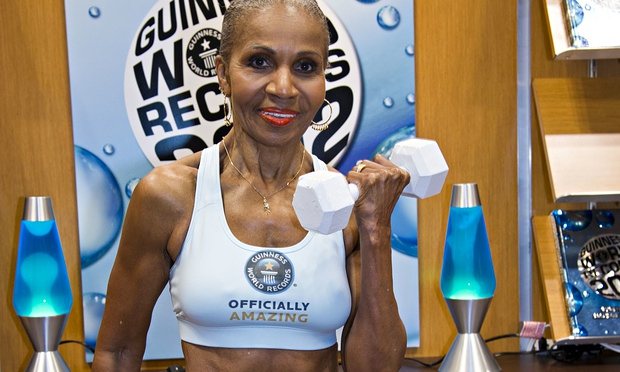
Bodybuilder Ernestine Shepard, 78

It’s funny how your mind takes vast jumps, transcending time and space, hurling you into the past or thrusting you into the future. It’s happening to me now.

I remember sitting in my sixth grade class in Florida, fascinated with my teacher’s story of Ponce de Leon’s search for the fountain of youth, motivating him to travel to a new place, which he called Florida.

I think we’re all Ponce de Leons in quest of perpetual youth. We fear ending, the withering of our youth with its exuberance and beauty; the diminishing of resolve motivated by idealism, born of innocence; the advent of entropy and the descent into morbidities presaging that eternal sleep.

We evade our mortality in many guises, obsessing about film icons who seem to have the best of good looks and agelessness.

Advertisers grow rich, pedaling snake oils to mummify us from time’s erosion.

Religion offers consolation; materialism, avoidance; power, the illusion of mastery.

Mortality is the underlying cadence of the arts, arresting time’s flow in capturing the moment’s essence. Think Keats’ Endymion: “A Thing of beauty is a joy forever/Its loveliness increases;/it will never pass into nothingness….”

Medical science isn’t any less pervaded by its own Ponce de Leon quests into unlocking the mysteries of aging, harnessing our genetic codes, refining the regimens of diet and exercise.

A good number of scientists are busy at work, confident that they’ll ultimately win the day. There is Silicon Valley’s California life Company (Calico) for example, determined and well-funded, zealously hiring the foremost scientists on what it deems a moral mission to vastly beat back aging and pre-empt physical demise.

And there are other start-ups, too, like Venter with its ambitious plan to augment Calico’s efforts by creating a gargantuan database of one million human genomes by 2020.

Unfortunately, the landscape of new technologies is littered with bad case scenarios of Frankenstein prototypes unleashing their new horrors on humanity.

I’ve been reading this wonderful book, The Science of Enlightenment by Shinzen Young, an immensely learned Buddhist monk who has made it his mission to reconcile the best of Asian mindfulness practice with contemporary neuroscience.

I happened to come across this passage that set this present blog in motion on how we needn’t concern ourselves with whether science succeeds in its endeavors of extending longevity. We can have it now:

Now imagine that you will live just a normal number of years, but that your experience of each moment will be twice as full as it currently is; that is, the scale at which you live each moment will be doubled. If you only lived each moment twice as fully as the ordinary person lives it, that would be the equivalent of one hundred twenty years of richesse. Not a bad deal.

Hey, I’ll buy into that. I’m 76 and well aware of the math underpinning insurance actuaries. I’m lucky to have gotten this far, and with reasonable health, but it wouldn’t have mattered to me overly if my demise had been at 60.

I’ve lived my life up to the brim with world travel, including third world countries, conversing and making friends; gone from a Philly street urchin, raised by an alcoholic father,  to a professor of English, privileged to share the beauty and wisdom of literature with several thousand students who’ve enriched my life and, I trust, theirs.

I’ve filled my life with passions that have anchored my happiness–a love for reading, nature, languages and writing.

I wake each day, plotting new ventures. As the remarkable Hellen Keller wonderfully put it, “Life is either a great adventure or nothing.”

Not least, there’s been Karen, who entered my life some twenty-five years ago, balancing my introversion with her openness and steady optimism, igniting new vistas with her refusal to foreclose on possibility and stunning ability to rebound from life’s vicissitudes.

Hopefully, the best part of all of this transcends Self in its yield of an encompassing empathy that’s taught me how connected we are to each other and the absolute that we love one another.

For Shinzen Young, longevity is best measured experientially, not chronologically, when we live mindfully in the present. “Meditation is the key to this kind of non-mythical life extension,” he writes. “By developing an extraordinary degree of focus and presence, it allows you to live your life two or three hundred percent ‘bigger.'”

I couldn’t agree more.
–rj

Apple vs. the FBI: How Money May Decide the Issue

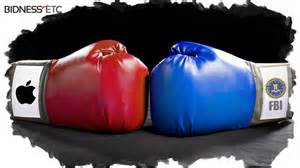
thThings are really heating up these days in the ongoing dispute between Apple and the FBI.

In December, fourteen people were killed by ISIL sympathizers Farook Malik and his wife Taskeen, in San Bernardino, CA.   In the aftermath, the FBI has been investigating the possibility they may have had accomplices. Backed by a court order, the FBI has requested Apple remove the security blocks on Farook’s iPhone.

CEO Tim Cook, speaking for Apple, refuses to comply, contending it would compromise the privacy of its smartphone users.

I’m not taking sides on the controversy here.  The issue is as heated as it is complicated, with the country divided in its opinion and perhaps SCOTUS inevitably having to make the call.

What does concern me is Apple’s new strategy to move the matter to the Congress for adjudication. (Hearings begin next Tuesday.)

Fact is, the Congress is hardly the right party to decide the issue, given the systemic corruption fostered by business conglomerates soliciting favors through huge sums of money donated to its members.

We see this, for example, with regard to the National Rifle Association (NRA), successfully preempting responsible gun legislation, despite myriad mass shootings like those in San Bernardino,.

In 2014, NRA contributions to members of Congress amounted to $984,152 with an additional $3,360,000 for lobbying.

What really fries my brain is that it spent a whopping $28, 212,718 in outside spending!

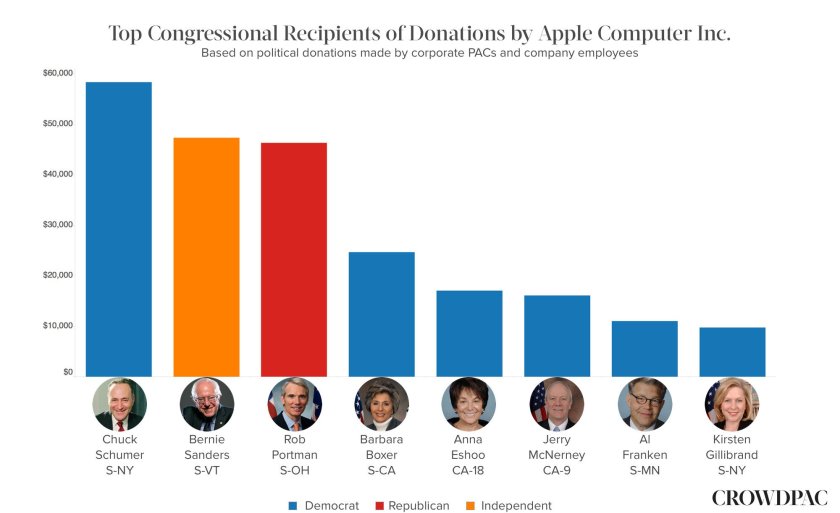
Apple, as such, is being disingenuous in attempting to shift the scenario to the Congress, having demonstrated a lengthy penchant, like its fellow high tech icons, in substantially contributing to the Congressional feedbag, their mission to deter any regulatory legislation that would rein them in. In other words, a good many Congressional members owe them favors and now’s an opportune time to collect and circumvent the courts.

Since 1990, Apple has contributed $1,902,870 and spent $27,083,008 on lobbying.

Bernie Sanders was right when he denounced PAC money contributions as undermining our democratic franchise: “People aren’t dumb.” These donors don’t give willy-nilly, but expect something in return.

On the other hand, even Bernie has had his hand in the till, ranking second among senators in receiving money from Apple and its employees.

gggty4bqbpvvfgpafcwj

Now let’s see how the system filters out elsewhere. The most prominent Democrat opposing Apple on the issue is Diane Feinstein.   Guess what? You’ll find her absent from the list of top recipients of money from Apple and its allies that include Microsoft, Google, Facebook, and Twitter.  These conglomerates are not about to waste their money on those opposing their interests.

In third world countries, we’d call it bribery.

In the U. S.  Congress, many are willing to take the bribe.

–rj

Bibliography:

OpenSecrets.org

IVN


Expanding the energy portfolio: Utilities awaken

coalEvery month our local power cooperstive, Blue Grass Energy, sends us its superbly put together magazine, Kentucky Living, filled with helpful tips on home maintenance, gardening, recipes, recommended books, regional activities, events, etc.

With all its feel good staples, it’s easy to lose sight of its primary purpose as a public relations gimmick to elicit the public’s support. Your power company is on your side, helping you enjoy the good life, offering some of the lowest energy costs in the nation, largely through the state’s substantial coal reserves.

Its editorials, however, consistently make clear that this good life is under a black cloud via the EPA’s increasingly heavy hand, encouraged by Obama’s executive decisions restricting power plant emissions at heavy local cost and marginalization of its coal resources. In its use of coal as their primary energy source, states like Kentucky, not wealthy by any yardstick, will bear a larger cost burden than other states, which they simply can’t afford, the utilities say.

Tuesday is election day and according to the latest polls, Mitch McConnell. is poised to be reelected to yet another term and possibly become senate majority leader, meaning still more congressional gridlock.

Mitch says, “I strongly oppose the EPA’s efforts to shut down Kentucky’s coal industry. I will fight to ensure the future of existing coal-fired power plants.”

He has announced that one his priorities will be to defund the EPA.

His main opponent, Alison Lundergan Grimes, touted as the Democrats’ best shot at ending McConnell’s perennial reign, has simply been a mirror to McConnell on coal issues and climate change. She has even resorted to ludicrously painting McConnell as unfriendly to the state’s coal industry, including miners, even though they’ve repeatedly come to his defense.

As for Libertarian candidate, David Patterson, he tells us that “CO2 is not a pollutant in the quantities seen today.”

Fortunately, aside from the usual debacle of politics, Kentucky utilities are starting to get the message, with movement underway to harvest clean, alternative technologies. The East Kentucky Power Cooperative, for example (which affects our household) has invested $1.7 billion to help clean-up carbon emissions at its coal-fired power plants.

With the hand-writing on the wall, Kentucky’s utilities are pursuing a diverse energy grid, including not only natural gas, but solar, wind, hydro and landfill gas.

All of this will impose increased costs, but the alternative in the context of the exponential menace of climate change makes these efforts of acquiring a diverse energy portfolio least costly in the long term.

–rj


Internet Ghouls Among Us: The Robin Williams Aftermath

williamsI haven’t any doubt that the vast majority of us mourn the tragic death of Robin Williams, who brought laughter into our hearts and with it, wisdom too. And yet there are always a few, the ghouls  I call them, who surface in such tragedies to verbally vandalize our grief with mindless, and often, acerbic commentary.

Recently a bicyclist was killed here in Lexington KY by a speeding motorist, only to have one Facebook reader comment that bicyclists shouldn’t be on the streets. Pray then, where should they ride? On sidewalks?

But it gets worse than such obvious, and silly, over-generalization. We’ve all come across those who practice a calculated meanness in exploiting social media for personal whim. These ghouls cannot tolerate an opinion different from their own, particularly when it comes to religion or politics, subjects notorious for generating heat.

But ghouls also show up in Amazon book reviews, for instance, or even in discussion forums that, more often than not, are dominated by one perspective. Cross the line, and you get personal attack rather than reasoned argument. I saw this recently in a forum perusing the effectiveness of a low carb vs low fat diet. When one reader contended graciously for the low fat approach the forum became a piling on of verbal abuse. I dub this the cascading effect, or the tendency of one negative comment to generate others.

But returning to Robin Williams, his daughter Zelda has just closed her Twitter account. She had been receiving photo shop images of her father’s body along with obscene commentary.

What transforms otherwise ordinary folks we rub elbows with everyday into Internet ghouls?

It goes back to anonymity, or the disconnect effect. When we lose face-to-face contact replete with body language and verbal cues of tone, we drift perilously close to abandoning the etiquette of meaningful communication in losing connection with our readers. Mental short cuts take over and we say dumb things.  We forfeit empathy.

But in all fairness, the disconnect effect isn’t confined to the Internet. I have known this first hand as a English teacher at the college level. It’s the writing act itself that submits us to this danger, whether an email, a letter, or an opinion piece in a newspaper. Accordingly, the fundamental axiom of all effective communication, written or oral, is maintaining awareness of one’s audience, which should spill over into our selecting our words carefully, monitoring our tone, shaping our transitions, being open to a reader’s perspective. Mindfulness is the seasoning of all effective communication.

And yet my counsel hardly proves sufficient to hold off the myriad ghouls who troll the Internet, unleashing their venom abetted by anonymity, or what Stephen King once aptly called “the alligators resident within human nature.” Frustrated with their own lives, envious of others, low in self-esteem, they seek to empower themselves by verbally dismembering others

While the social media can be invaluable in consolidating humanity for good ends, by its very nature, it is not without risk, so best be careful where you tread and cautious in what you reveal about yourself.

The vast majority of Internet users are motivated with good intent; but it takes just a few to spoil things for the many.

–rj

Reminiscence: And I could wish it were 1949 again

The other day, I had a solicitation in the mail from a magazine called Reminiscence. Apparently, a lot of folks like to engage in nostalgia. I confess I occasionally do the same, though I’m aware of how time can soften the contours of the past.

Lit Brothers
Lit Brothers

Still, I like to muse on past events that were really quite wonderful and that I wish I could relive again. After all, why are we given memory if we’re simply meant to forget? If I had to pick a year in which to indulge, it would be 1949. It was a good year for me and for America, too.


Collectively, it was a simpler time, relatively free from the frenetic pace, complexity and stress of today.

To be sure, segregation was still a factor in denying Blacks their portion of the American dream and women were still largely subservient to men. China had just fallen to the Communists. At the Kremlin, Stalin ruled with an iron fist and Russia had just tested the A-bomb. The Cold War was on in earnest and so we resorted to an ongoing airlift to save Berlin.

Nonetheless, we had a decisive president in Harry S. Truman, who never skirted making the hard choices like dropping the A-bomb to shorten a savage war or later dismissing a popular, but unruly general. In short, we felt safe.

Four years after World War II, we were at peace, with no protracted conflicts like Korea, Vietnam, Iraq and Afghanistan. We weren’t saddled with mind-boggling national debt, Congressional deadlock, inflationary pressures, the loss of our manufacturing base, or economic recession.

There weren’t any urban riots, decaying cities, or the threat of climate change that imperils our existence. We could never have imagined a 9/11 or the pervasiveness of terrorism.

Here are a few economic facts that put things into perspective about 1949:

Unemployment stood at just 3.8%.

Inflation, a mind-boggling 0.95%.

You could buy a house for an average $7500.

A car for $1400.

Gas, 17 cents for regular.

Let’s put it another way: $100 in 1949 now comes to $967.01 in 2014, with an average 3.5 inflation rate annually since that remarkable year (Bureau of Labor Statistics).

Most items were still made here in America, including TVs and cars. Cars had turned into long finned gargantuans replete with white wall tires and, with pent up demand, we couldn’t make them fast enough.

We were kings in forging steel and cities like Akron, Youngstown, Pittsburgh, Bethlehem and Lehigh lit up the night sky.

In New England, the textile mills of Lawrence, Lowell and North Adams hummed on.

We were good at making shoes and my father toiled in a neighborhood leather factory.

I was then a street urchin, much like Tom Sawyer, exploring the thoroughfares of Philadelphia, curious and, sometimes, mischievous. Occasionally, I played hooky, skipping school to walk downtown and visually rummage the big, many floor stores like Gimbels, Lit Brothers and Wanamaker’s, bustling with goods and replete with escalator stairs.

Yes, American cities once possessed vibrant downtowns that provided cohesion before the onset of suburban box stores and strip malls. Downtown was the place to be–shopping, movies, eateries.

Baseball was truly our national game, with many of the contests played in the afternoons. It was the era of greats like Williams, DiMaggio, and Musial. They hadn’t lowered the mound to boost hitters. No free agency meant modest salaries. Stadiums were named for people, not corporations or banks. Franchises didn’t move. Players didn’t cheat with drugs. Sundays and holidays meant doubleheaders. What a deal!

We didn’t have playgrounds in Kensington, the ethnic blue collar stronghold, dubbed Fishtown, where I lived near the Delaware River, but that didn’t stop us from playing stick ball, smashing cut-in-half tennis balls against factory facades. You determined singles, doubles, triples and home runs by window level.

I liked venturing down to the wharves, where I could see the cargo ships unloading, waive to their crews, and study their flags to learn their origin. It was here I developed my addiction to visit far off lands.

TVs initially with 4 inch screens, were now selling madly, or at the rate of 100,000 weekly, sadly hinting at foreclosure of neighborhood enclaves where we’d gather nightly on the white marble steps of our row housing, chatting our humanity until late evening breezes whispered their coolness and launched our escape from the steamy heat of asphalt streets and we could at last renew ourselves with sleep. We never dreamed of air conditioning, though a good many of us lived in upstair flats.

Despite TV’s inroads, radio still loomed large with shows like The Shadow, Jack Benny, Suspense and the Lone Ranger. Daytime–Arthur Godfrey was all the rage.

As for TV, showslike Mama, Texaco Theater, The Ed Sullivan Show, The Life of Riley were our staples. At most, you’d be lucky to have three channels, and after the 11 pm news, stations would shut down, sometimes to the National Anthem. They gave you a test pattern to help you get your “rabbit-ear” antennas right.

The music revolution hadn’t begun. No Elvis Presley. No Beatles. No Rock n’ Roll. No heavy metal or hip hop. We had Dick Clark and American Bandstand. Not knowing anything else, we were content.

Lyrics still rhymed, making them easy to remember. No CDs. Just vinyl records that could scratch easily, but the risk worth the sound!

Sinatra and Crosby reigned along with new stars like Rosemary Clooney, Frankie Laine, the Ames Brothers, and Dinah Shore. And then there was the handsome Mario Lanza, whose baritone thunder captured women’s hearts.

In 1949, you could escape Philly’s summer heat with a day movie for only a dime or a quarter at night, and even get in on a double header that included the world news and Disney cartoons. Bogart, Gable, Wayne, Cooper, Grant–and, yes,–Bob Hope (number one) were the big draws. On Saturday afternoons, a special treat with serial showings of Superman!

Despite technicolor and Gone with the Wind, color was rare.

Comedy was big and I laughed till my sides hurt at the likes of the three stooges, and Abbott and Costello. And then there were those shoot ’em up Westerns with Roy Rogers and Gene Autry, adept in singing prowess as well as gun savvy. Why we even got to know their horses, Trigger and Champion, unlike the plods of other Westerns apart from the Lone Ranger’s Silver.

Telephones weren’t in abundance, so sometimes we resorted to a neighbor’s phone or a telephone booth to make a call. To call long distance could be expensive, even intimidating, and thus rare. Nice, however to be out of reach. Or on the streets, free of distracted drivers.

Magazines, often pictorial, like Look, Life, and Saturday Evening Post, caught your eye and provided quick reads. And they cost cents, not dollars.

Yes, many doctors still made house calls and health costs were reasonable.

We didn’t have Interstates then. That would come with Eisenhower’s mandate. Main highways were mostly two lanes giving way occasionally to a third lane for passing. Crossing the Ben Franklin for the Jersey shore and fresh fruit took you through spacious countryside with luxuriant tomato farms. Mom and Pop cabins–no motel chains–offered accommodation for $3 a night.

There were only 150 million of us then and even California had ample elbow room. Worldwide, just under 2 billion people, meaning more manageable resources, less poverty, and a cleaner environment.

More of us began to fly–on noisy propeller contraptions that is. Passenger ships still plied the ocean like their ancient predecessors.

What I really liked were the trains and, especially, the sleek new diesel locomotives. Train stations were busy, exciting places, filled with shops, much the way it still is in Europe.

On a sadder note, I miss my once teeming family–my mother and father, brother, oodles of cousins, dear aunts and uncles, and childhood friends, in 1949, luxuriating in life’s bloom. As life stretches out, we mourn our losses as well as count our gains. We learn to appreciate what we cannot keep. I am glad for memory.

I could go on, but you get the picture, or at least my view of 1949–like a fine wine, a year of superbly good vintage. A time of innocence and simplicity, where less proved more, and thus possessed its own indulgent beauty.

But we can’t be Rip Van Winkles either. Time moves on, and we with it.

–rj

Technology and the shrinking of community

I just read Frank Somerville’s recent post (July 3) on Facebook. For the record, he’s the nightly news anchor on KTVU in Oakland, CA. I don’t live anywhere near the West Coast, so I don’t get to watch him, but Somerville keeps a page on Facebook that I read daily for its keen insights, sensitivity, and passion for social justice. Thank goodness he’s out there and how I wish there were more people like him, concerned about doing the right thing.

I say this because, quite frankly, I’m damned tired of running into people on a daily basis who, just the opposite, are full of themselves in their thoughtlessness towards others, and making matters worse, frequently mean and calculatingly offensive. Unfortunately, the downside of technology can be the marginalization of community, despite a plethora of social media.

10351899_743347829061880_8323386999323754107_nSomerville laments how many people use the Internet to get back at others. Case in point, a waitress posting the $69 dining bill of former Oakland Raider Warren Sapp, who hadn’t left her a tip. Clearly, she sought to embarrass and humiliate Sapp, who later said that he didn’t like the service and her calling him and his friends boys. I know that I’ve done the same thing as Sapp on rare occasions. Tipping is a way of saying thank you and, likewise, an incentive to serve the public well. In Europe, you don’t generally tip, since a service charge is included, and, believe me, the service can get pretty lousy.

Meanness, unfortunately, runs amuck on the Internet due to the anonymity it provides for angry types low on self-image seeking compensation. I remember Edgar Allen Poe writing in his goose-bumpy short story, “The Cask of Amontillado,” of that most perfect kind of vengeance that allows its perpetrator impunity, or escape from accountability.

I often see Poe’s maxim raise its ugly head in reader comments, especially in discussion forums, and of course, par excellence, Twitter and Facebook. I find myself aghast, not only at the repugnant foreclosure of other viewpoints, but the sheer cowardice it masks, latent with resentment and a need to enhance self by controlling others or turning them into punching bags. Sadly, there have been instances where such verbal pugilism has taken on fatal consequences.

More often, I see the pervasive fallout of anonymity virtually daily when, like Somerville (more below), I’m driving, motorists who think rules are for other people–deliberately running traffic lights, stop signs, or not yielding right of way, or pulling out in front of you, or not signaling, or slowing traffic to a snail’s pace while on their cell phone or texting in public mastabatory self-indulgence.

My wife came home the other day, telling me of a woman who turned in front of her at a three way stop. She gave her the horn, getting the one finger salute in return. I’ve counseled her to not let such ilk spoil her day. You also just don’t know who you’re up against. Stats tell us an estimated 1500 die in road rage incidents every year. Anyway, I sometimes think there really is a bit of karma going around and that the chickens ultimately come home to roost.

Somerville ends his blog with his account of a guy with a mounted camera on his dash who comes up behind him “for no apparent reason” as he is on his way to work. Turns out, he can’t get rid of him. Pulling over, the guy draws along side of him, and Somerville, not wanting the incident to escalate, calmly asks, “What are you doing?, only to have the guy grin and keep videotaping him. Speeding off, Somerville finally loses him.

Hey, so creepy! You just never know what kind of oddball that anonymity may confront you with next.

–rj


Will tablets replace your TV? The new frontier of online video

iPad3

Just came across an interesting piece in the Economist  (November 9, 2013) on the growing popularity of online video in China that threatens TV.  In fact, a recent Chinese government reports says that only 30% of Beijing households watched TV in 2012.  Online video is big bucks in China with some 450 million viewers, or 80% of the connected population.    

We haven’t seen this drift in the West where TV sets are on 5 hours a day in the average American home.  That doesn’t mean China’s online video craze won’t happen here.  Who could have predicted the rapid downturn in PC demand that followed the rise of tablets three years ago?   Computers once priced in the $1000 range can be had now for $300 or less.  What’s more, tablet users are increasingly prone to downloading Amazon or iTune TV and movie offerings to their tablets.  Cable and satellite networks like DirecTV are catching on, and so you’re not confined to your TV anymore for personal viewing.  There they are, with all the convenience of portability, right on your tablet!  Hey, let’s not leave out Netflix.

And then there’s always been the ubiquitous YouTube, more popular than ever.  Forbes.com tells us that in 2012 one hour of YouTube video was uploaded every second.  In short, video making, like self-publishing, has become the province of the everyday Joe.   According to Brent Weinstein, Head of Digital Media at United Talent Agency, “Online video today is what TV was a couple of years after it came on to the scene” (Forbes.com).

YouTube, in fact, has been a honing ground for developing sophisticated expertise, spilling over into start up multi-channel networks (MCNs) such as Ted, TubeFilter and Kaltura-Connect coms with their dedicate devotees.

The big ops can read the tea leaves.  Just the other day I saw this catchy Hulu ad.  Get your first week free, then enjoy your favorite TV shows on your tablet for just $7.95 monthly.  With prices like that, cable and satellite TV had better watch out.

Of course we’re still talking about original TV programming, even if rechanneled; nevertheless, it isn’t hard to figure out where the math is taking us.  The bottom-line is that a revolutionary change in how we get our information and entertainment is underway.

According to the Economist, Chinese online video entrepreneurs started competing directly with TV programming five years ago, coming up with their own programming.  In the U. S,  you can see this same trend reflected in  Amazon, Netflix, and Hulu making their own programs to sidestep licensing costs and gain access to a potentially huge market.  Very soon, we’ll be talking about mobile networks.

For families who like to do their viewing together, no problem.  Internet TV is on its way and of course with Apple TV, no problem transferring your tablet videos, music and photos to a larger screen right now.

Usually the scenario is that when America sneezes, the world catches a cold.  With China, what’s happening marks a seismic shift.  Better, anyway, than its usual export of Asian flu!

–rj

New York’s icon of courage: the Brooklyn Bridge

bridge

When I think of New York City landmarks, flashes of the Statue of Liberty, the Empire State Building, the legendary Yankee Stadium, alas, now gone, leap to my mind. But there’s an underdog landmark I like best: the Brooklyn Bridge, stubborn and stunning in its granite towers and glistening, criss-crossing steel cables. An inspiring story lies behind its construction against formidable odds involving three members of a remarkable family.

Opened on May 24, 1883, after 14-years of construction that would cost the lives of 27 workers, including its designer, it was the wonder of its era as America’s first steel cable suspension bridge. Celebrating its 130th birthday as of next May, it continues as a principal artery spanning the East River between Manhattan and Brooklyn with 150,000 users daily.

It originated as the idea of a German immigrant, John Augustus Roebling, in 1863. He had built earlier bridges; for example, the bridge spanning the Ohio River between Cincinnati and Northern Kentucky, and another across the Niagara Gorge. When it came to the East River, many said it couldn’t be done.

For a time, it seemed the critics had it right. Shortly before construction began in 1869, Roebling’s toes on one foot were crushed in a freak accident when a ferry boat slammed into the dock on which Roebling was standing while taking compass readings across the East River. Following amputation of his toes, he succumbed to tetanus 3-weeks later.

His son, Washington, now took charge of the project. Tragedy, however, knocked on the Roebling family door again, when Washington came down with the bends, or decompression sickness from underwater labor, resulting in lifelong confinement to a wheelchair. Forced to watch the construction from a telescope, he conveyed his instructions to his wife, Emily.

Her feat is remarkable in its own right, since she had no previous knowledge of bridge dynamics. Over the next 11-years, mastering the intricacies of her husband’s calling including mathematics, catenary curve calculations and material substances, she would accurately convey his instructions to the workers.

Appropriately, in the ceremonies featuring President Chester A. Arthur, Emily was the first to ride across the bridge, a rooster in her lap as a symbol of victory.

A super icon of a super city, the bridge was designated as a National Historic Landmark in 1964.

One of the best times to view the bridge is at night, when the Gothic charms of its pointed arches are bathed in light.

The noted historian David McCoullough details the bridge’s construction in The Great Bridge (1978) and Ken Burns followed with his first documentary in 1981.

San Francisco has its romantic Golden Gate, just maybe one of the most eye-pleasing bridges in the world. But for me, my first love remains the Brooklyn Bridge, in no small measure because my romanticism clings to the story of a family’s perseverance in the face of tragedy and thus lends hope to all of us.

New Yorkers know this especially well, whether its October 1929, or 9/11, or hurricane Sandy’s more recent devastation.

On the violence that ails us: reflections on low self-esteem

selfesteemThe news headlines thunder the shocking mayhem of school children gunned down at Sandy Hook and of four firemen ambushed in upper New York, leaving even the professionals pondering the mindset behind such horror.

Sadly, the truth may be that a good many people don’t like themselves and act out their self-loathing on others. Its origin can be subtle.

Perhaps it began as a youngster in an overly restrictive home heavy on reprimand, short on love.

Or in unabated sibling rivalry for the mother’s milk, as it were.

Perhaps from a short-fused teacher, scolding a child in view of other children, maximizing his humiliation.

Perhaps because other children excluded or bullied.

I’ve known for years the high impacting of poor reading skills on youngsters, usually boys. I had been a social worker for several years at a residential treatment center for boys 8-17, replete with its own school. Of my hundred boys or more, 90% were remedial readers with substantial low esteem and often a history of acting out in the classroom.

The origins are myriad; the result the same, and always damaging.

Nearly always a person falls into hating himself not because he’s intrinsically inadequate, but because others keep telling him so. Rejection messages accumulate their toxins like excessive radiation, fostering demise instead of intended healing.

Fairly often you can see such psychological fallout in the overachiever who flagellates himself with extraordinary effort to win approval, and hence self-validation.

Those suffering envy, and many do, languish because they’re at war with themselves. When people like themselves they don’t require what someone else seemingly has in the way of goods, talent, and reputation. They have no need to project limitations on to others and sully them through gossip, innuendo or criticism. Another’s success doesn’t hint at reprimand or reminder of personal shortcomings. Those liking themselves know their own worth and it’s quite enough.

Ironically, self-loathing may turn-up in the guise of narcissism, or conceit, a kind of whistling in the dark to keep the wolves at bay. Confident people rely upon results, not boasts.

Lacking self-esteem, every conversation, work, class or play endeavor musters into a contest for mastery in a quest for validation for those who suffer.

In the worst scenarios, self-hatred in its twisted logic leads to rage and inflicting pain on self and others. What begins as temper, may end in verbal and domestic abuse, eating disorders, drug addiction, delinquency, or even worse as our headlines testify.

Somewhere, always, its source lies in a wound that festers. It lashes out at innocents, ironically often the very sources that offer love, but can never suffice to close the gap. Fed by a flotilla of ghosts, the self-loather purees his fantasies into a malt of maiming. Filled with rage, he seeks to even the score.

As the Roman emperor, Marcus Aurelius, put it so succinctly: “A man’s life is what he thinks about all day long.”

My iPad as game-changer

iPadBuying the first generation iPad in July, 2010, has been a game changer for me like nothing else in town.  Let me tell you the how-so:

Reading: I thought I read a lot before, but it pales to what I do now; often I’m into several ebooks at a time and have to hold myself in check from downloading still more. In the last year alone I’ve read at least 20 books, maybe more. It helps that I’m increasingly exposed to new titles and book reviews, having access to applications like iBooks, Kindle, and Nook along with Publishers Weekly. Since my iPad makes me more alert for new reads, I’m easy prey for best sellers lists and new offerings. I’ve even found applications that give me access to free books, many of them classics like Fitzgerald’s Tender is the Night. Currently I’m into Arthur Conan Doyle’s first Sherlock Holmes creation, A Study in Scarlet.

News: I’ve always been a news aficionado, something I picked up from my father, but now it’s nearly a vice, as I’ve largely stopped watching the local and network newscasts. There’s this plethora of news media, domestic and foreign, I simply can’t resist on the iPad. This doesn’t include journal and magazines. I’m surprised so much of it still remains free, though the scene is in flux.

Games: I know people who are into games around the clock. That’s not where I’m at, but when I do, it’s nearly always a game of mental dexterity such as Sudoku, Better Brain, Wordladder, and Blosics. They say they’re good dementia preventatives, which spurs me into wanting to play one daily round at the very least to keep the Beast outside the door.

Productivity: I scarcely use my laptop now, since most of what I do like blogging I can do on my iPad, and this includes printing from any room in the house. I’ve become fond of Pages for its ease and facility to handle most of my needs. In fact, I do all my blogs on iPad, save using my laptop for publishing.

Music: Though access to iTunes comes standard, I like fetching my music from sites like Pandora or NPR. I especially like to listen when I first hit the sack. There’s an advantage to such sites as well since they’ll frequently introduce me to new music, which I then can download from iTunes for my personal collection. I have this one nifty app that gives the lyrics of nearly any song I list.

Reference: As a writer, or just being plain curious, I’ve several apps grouped together that access databases yielding myriads of offerings not normally accessible to a google search. If I need stats, this is where I go. If I have questions on a health issue, here I can tap into the leading med files that physicians and pharmacists use.

Social: I’m big with this, especially Twitter. And I don’t need my laptop for this either.

Sports: Couldn’t get by without access to ESPN or CBS Sports, especially in baseball season when I can find scores, player stats, standings, the latest happenings.

Travel: I can make travel arrangements on my iPad, with access to travel guides for cities and countries. I can even see the flight arrival and departure monitors at virtually any selected airport via Flightboard. Can’t beat that!

Hobbies: I’m into languages, another one of those mind game things I suppose. Maybe I’m overboard, but I’ve got around 50 apps applying to all aspects of Spanish, for example. Nothing has done more for language learning than the iPad. Then there’s gardening. Not as many, but quite a few apps, right down to identifying weeds.

Miscellaneous: I’m using this category for all those subtle apps I rely upon frequently. For cooking, I often research recipes for nutrition facts about specific foods, whether carbs, fiber, proteins, etc., or even glycemic index. I have one app that takes your pulse! Another, Ambient Science 300, that provides bio-feedback to help you relax, promote better sleep or lower blood pressure. My special favorite is StumbleUpon, which introduces you to web and blog sites by interest that you’re likely to miss. You get the picture. By the way, at last count, Apple now features around 700,000 apps, many of them available on iPad. This just blows my mind.

Back to where I started, I use my iPad virtually for every need; my laptop solely for say banking and paying bills. Computer desktop sales have dropped off precipitously with three quarters of Apple computer purchases going for laptops. Increasingly, you’re seeing the iPad invading the professional world. Have you looked at what your doctors have in their hands? In our public schools, iPads are gaining ground, replacing textbooks.

I currently use my laptop as my default device. With the mini, I see the iPad becoming the default option, and the mini with its unbelievable lightness and retina screen becoming my mainstay for daily use. Like the desktop, laptops will largely go the way of the dinosaur.

One thing I know: I’m using my laptop less and my iPad more while relishing moving up to the next iPad generation. Or maybe to the mini!