My Love Affair with Vermont

vermont2

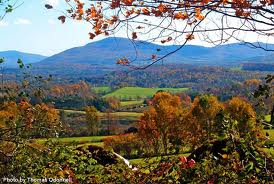
I can’t say how it began, but I know I’ve always had this love affair with Vermont, even though I’ve never lived there.  I suspect it has a lot to do with its mountain greenery, since I’ve always been partial to mountains, those silent sentries walling out an octane world fulsome with pursuit and possession, safeguarding neat valleys of Yankee towns and villages anchored by white steepled churches.

I grew up in Massachusetts with vistas much like this, and Vermont, New England at its best, not far away.  I can’t think of a wooded vista excelling that stretch of aerial road known as U. S. 9 connecting Vermont’s  quaint Bennington and Brattleboro towns in the south that I used to travel often.

A few years back, or 2005, I finally canvassed the state right up to the Canadian border before twisting back to the Massachusetts coast by way of New Hampshire’s lofty White Mountains.  One special delight was visiting Swanton, just south of the Canadian border.  My grandparents had called it home.

Retaining its small population contributes to the state’s Edenic luster, despite the continuous threat of emigres from New York and Massachusetts, not infrequently buying up commanding views, cutting trees, and building spacious palaces of material privilege.

In Vermont box store giants are rare, and thus town centers of mom and pop stores prosper and prove gathering places.  Smallness and simplicity turn back the clock.

I like the democracy of these towns with selectmen, not mayors, held to account by their  citizens in weekly meetings of equals.

vermont3

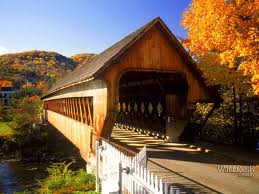
For many of us, Vermont means dairy farms, cradled among gentle hills, producing cheeses by the score; undulating countryside redolent with flaming fall foliage and winter’s maple syrup like no where else.  But it’s also a place of considerable waterways, despite being New England’s only landlocked state.  Every town seems to have its murmuring stream or running river, which sometimes menace human artifacts with storms like last year’s Sandy.  And then there’s Lake Champlain, America’s sixth largest lake, 120 miles long, 14 miles across at its widest point and 400 feet deep.  What grabs me most are its myriad covered bridges, more than anywhere else, archives of a past of horse-drawn carriages catching shelter from cacophonous clouds unleashing summer deluge.

Apart from scenic splendor and sanctuary replete with serenity, I like the state’s progressiveness.  Vermont, by the way, is the only state represented in Congress by a socialist, registered as an Independent.  Small as it is, no state ranks higher in promoting the welfare of its citizens.  It was the first to abolish slavery.  It was also first in granting women the right to vote in 1880.  Unlike neighboring Massachusetts which recently blinked under religious pressure, Vermont has now joined just Oregon and Washington in passing death with dignity legislation.  Vermont was the first state to allow civic unions and, later, gay marriage.   Looking towards the future, it’s promoting a single payer, non-profit health system akin to European and Canadian models.  Concerned about climate change, it has joined eight other states in offering rebate incentives to purchasers of electric cars.

At times, I think of Vermont as almost another country independent of the body politic. In fact, for fourteen years, it was just that–a sovereign nation before joining the Union.  Funny I should write this, but when I was in my twenties I had looked to New Zealand as my deliverance from a meaningless Asian war, burning cities, and assassinations of progressive leaders, including a president who gave possibility to Camelot.  New Zealand responded with immigrant status and employment, yet I didn’t go, for my American roots lay deeper than I knew.

A few years ago, I visited New Zealand and beautiful Taranaki which would have been my home.  I happened to meet several American ex-pats, one of whom shared that California had grown stale for him with its exponential growth in population and social burden, despoiled environment and plighted cities, accelerating crime and sky high taxes, inflated mortgages and a growing economic divide.

I wish now I had asked him if he needed to go so far, even as I had once thought of doing.  Why not Oregon, Washington, Montana?  Why not Vermont?

I wish I had asked myself that question when blessed with those options uniquely granted to the young.

–rj

What Being Centered Really Means

True peace is achieved
By 
centering
And blending with life (Tao 22).

You hear a lot about being centered, but just what is it?

The ancient Greeks advocated “the golden mean,” or middle way.

Roman writer Vergil based his Aeneid on Pietas, or something akin to self-control.

Perhaps drawing on his Hellenic education, St. Paul advised moderation in all things.

Excess is always dangerous in any pursuit, for it forecloses on alternatives that may prove more tempered and thus wiser than those fostered by our passions.

Unfortunately, indulgence, or excess, defines history with its repeated accounts of obsession gone astray for power and possession.  History is narcissism writ large.

At the everyday level, we hear continually of people who have ruined their lives and hurt others simply because they were unable to rule themselves.

Because self-interest especially dominates in politics and religion, I generally am suspicious of them both.  As I write, there’s the rancor in Congress over raising the debt ceiling so government can pay its bills.  Currently, however, a persistent few are willing to shut down government unless they have their way.  As I’ve written  in an earlier blog, political parties lead to narrow partisanship, as President Washington so wisely observed in his Farewell Address.

In religion, we needn’t dial back to the Crusades or Inquisition to access the violence of fanatical fundamentalism.  If you look at a worldwide map, you’ll find religious mayhem abundantly distributed, whether in the Middle East, India, Pakistan, Thailand, Burma, the Philippines, and Indonesia.  As for Africa, there’s last week’s heinous massacre at Nairobi’s West Gate Mall in Kenya by Somali militants, who selectively shot non-Muslims.  Nigeria has its own ongoing debacle with Islamic extremists. These things happen because without centeredness we lack balance and thus forfeit stability and often our humanity, too.

On the other hand, fraudulent centeredness can possess its own rigidity if focused merely on ourselves.  True centeredness serves as a reference point that proffers balance, always its marker, between extremes. Think acoustics. Think harmony.

Centeredness promotes equilibrium, a check on ego, a capacity to not confuse the parts with the whole, enabling us to respond more patiently and thus more wisely.  A state of being, it isn’t found in having.

Centered people aren’t dismayed by the fallout of time or chance.  They see the evolving pattern and not the ephemeral circumstance.  They’re grounded in the Eternal, not the transitory.  Thus change and loss and disappointment don’t throw them off balance.  In touch with themselves, they live in harmony with nature’s artifice. .

Writing from a jail cell and facing imminent execution, St. Paul could cogently advise his friends that they pursue “all that is noble, all that is just and pure, all that is lovable and gracious, whatever is excellent and admirable–fill all your thoughts with these things.”

This is centeredness.  This is harmony.  This is the fabric of Eternity.

–rj

Cajun Music: Addictive!

Cajun music instruments

I like to work out daily on our elliptical machine, or at least 5 times weekly for 30 minutes a session.  It beats taking a vigorous walk in often hot and humid Kentucky for up to an hour.  In contrast,  I can turn on the fan in the exercise room, plug in my iPod, and be serenated.  Lo and behold, exercise done!

One of the marvelous things about music is that there’s something out there for every taste and mood.  Most of us like a fast paced tempo when we’re trying to get the heart pulse up.  Lately, I’ve discovered that Cajun music with its dominant, happy mix of accordion, fiddle and triangle gives you real foot-stomping stuff, even if you can’t get into the French lyrics.  A vibrant variant reminiscent of the blues also exists, known as Zydeco.  It will remind  you of swing dancing and it’s both sexy and passionate!

There are a good number of Cajun bands out there and I don’t think you can really err in your selections, but I like Michael Doucet’s BeauSoleil the best.  He founded the group to try to stave off the decline of Cajun culture, especially its language, which remains an endangered species.  Back in 1950, half of the Cajun people spoke it as their language at home.  That’s declined to just 10% presently.  Cajun, by the way, comes from the French word, Acadian.

You probably know this, but the Cajuns are descendants of the former French colony known as Acadia in today’s Nova Scotia.  The British exiled them when they refused to accept British sovereignty in 1755.  Their homes and crops were burned and many family members separated.  Many, nearly a half, lost their lives at sea.  Their plight is memorialized in Longfellow’s Evangeline.

Ultimately, most of them settled in central and Southwest Louisiana (the Bayou country), preserving their culture for two centuries.  Cajun is the Acadian dialect of their forbears.   Louisiana today has about 700,000 Cajuns, though the vast majority are Anglicized.  Nonetheless, Cajun festivals are popular and frequent in Louisiana, with Lafayette their apex.

Be careful though about sampling Cajun music:  Like its spicy cuisine, its joie de vivre music can prove addictive.

–rj

Looking, Thinking and Feeling Young

Nicoya Peninsula seen from space (false color)
Nicoya Peninsula seen from space (false color) (Photo credit: Wikipedia)

In my last post, “We are all Ponce de Leon” (August 13), I noted the robust euphoria increasingly prevalent in medical circles that perhaps in the next 25 years, given science’s increasing sophistication in manipulating the DNA’s genetic formulae, many of humanity’s worst diseases like cancer and arteriosclerosis will be harnessed, if not eliminated.  One of its principal advocates is Dr, David Augus, whose best selling book, auspiciously titled, The End of Illness, aggressively pursues this notion. In Hamlet mode, it’s something to be doubtfully wished, but unfortunately untrue.  Served up in a specious brew, it trivializes the idiosyncratic nature of disease, its pernicious fall out in anguish and grief; above all, the individuality of each victim.

We live continuously in a biological world fraught like life at large with unknowns, randomness and the onset of new specters replacing those we’ve vanquished.  While the incidence rates for heart attack and stroke have indeed lessened, high blood pressure and diabetes are way up and cancer abounds (Merck Institute of Aging and Health).  If longevity has increased, it’s primarily due to the drop in child mortality and not medical breakthroughs.

Children still get cancer, a disease that we usually associate with aging,  along with other afflictions.  I lost two siblings, mere babes, from heart disease.  I lost an older brother, doomed quickly by a brain tumor within a few months of his initial symptoms.  He was 47.  I love baseball.  My favorite player, Lou Gehrig, succumbed to ALS at 41.  I noted that Augus contradicts his own optimism in forecasting–“inevitable” is the word he uses–a pandemic that like the Spanish flu of 1918, will kill millions.

It’s good to dream, so long as it’s tempered by reality.  While we’ve made progress in some areas of medicine, our best bet is probably a preventative approach, especially through lifestyle changes such as giving up smoking, monitoring our calorie intake, and exercising more.  Ironically, though we live in an information age that staggers with its seeming infinitude, we still know relatively little as to the etiology of most of our diseases, treating symptoms, not causes.

All of us want to look, think, and feel young–the Ponce de Leon quest again–but let’s not promulgate nonsense.  Aging is a fact we must live with, but it doesn’t have to mean a cane, incontinence, dementia, cancer, heart disease or stroke.  The most recent research indicates that 70% of the ills of aging lies within our control.  We can learn to live with it and live well and for a very long time.

I have some pointers, though not a panacea, that can help us in preventing or delaying many of our ills.  They’re confirmed by recent studies of demographic specialists on longevity and you can find a succinct probing, in layman’s terminology, in Dan Buettner’s Blue Zones, 2nd ed., an analysis of five global hotspots for centenarians, places where men and women still toil in the fields though in their eighties and even nineties and cancer, heart disease and diabetes are rare.

The locales, by the way, are Sardinia, Okinawa, Loma Linda, CA (large Seventh Day Adventist population), the isle of Ikaria in Greece, and Costa Rica’s Nicoya Peninsula.  I should add that these biblical paradises are quickly succumbing to outsiders who bring fast foods and sedentary living with them, eroding aeons of life-enhancing routine and a quality of existence salient in simplicity and minimal stress.

Diet:  In all of these Blue Zones, little meat was consumed, usually once a week or just on a festival occasion due to economics rather than choice.  With Seventh Day Adventists, it was a conscious choice to exclude meat.  Beans, whole grains, garden vegetables, nuts and fruit characterize the several cuisines, not processed or refined food products.  I’ve always found it a good axiom:  “If it’s white, don’t take a bite.”  If giving-up meat isn’t a palatable option for you, then eat less of it and when you do, lean portions only, avoiding red meats in particular.  Or try cutting out meat altogether two days a week.  One other thing, but central: be careful about not only what you eat, but how much.  Centenarians are far and away thin people.

Movement:  People who work physically demanding jobs tend to live longer.  New studies show that sitting more than two hours regularly can shorten life expectancy.  For those of us whose lives are largely sedentary, it’s important to engage in aerobic exercise 30-minutes, 5 times a week, to lower bad LDL and raise HDL, the good kind.  But even brisk walking (3 miles in 45 minutes) counts.  Along with aerobic exercise, it’s wise to add weights to your regimen to protect and strengthen your muscles.  Walk more, sit less.  If space allows, do a garden.  When traveling, use the motel’s exercise room or bring along resistance bands.

Connection: Those who have friends and a support network such as religion can provide are consistently happier people living longer lives.  Pursue something you can commit yourself to.  Find a congregation, book club or lodge; discover a cause; volunteer.  Hang out with positive friends.  Find something that makes you want to jump out of bed each morning.

Serenity:  Those living long lives seem to have found mastery over stress.  It isn’t that they don’t suffer stress, but that they’re able to transcend it, living lives of daily, defined routine, with simplicity a cornerstone.  We help ourselves by reducing overload and unshackling ourselves from the wrenching worry synonymous with materialism, competition, and hurry.  Yoga, Tai Chi and meditation–traditional staples of the East–reduce tension and lower blood pressure, that silent source of many of our diseases.  Tranquil music muffles our pace; a good book provides timeout; a walk along a bubbling  brook restores.  Study quietness and discover peace and with it, longer life.

Family:   Most centenarians center their lives around their families, marrying young and having children.  There is a ritual of togetherness and mutual obligation that informs their lives.  The elderly usually live with their children and thus fare better in their physical and mental capabilities.  America, however, has been trending in the opposite direction, with active families finding quality time together difficult.  Shared activities and  a daily meal spent together are increasingly atypical now.  Mobility often spaces family members widely apart.  On the other hand, those living long, happy productive lives have made family a priority, live in proximity, and exhibit a we-ness in their interaction.

While there aren’t any guarantees, given life’s caprice, individuals mirroring these trademarks tend to fare much better in living long and healthy and productive lives.

–rj

Confessions of a reluctant vegan

Food for Life distributes food on an internati...

I never thought I’d give-up meat.   Up to my mid fifties, I ate meat at virtually every meal, starting out with bacon and eggs in the morning; baloney sandwiches or a Big Mac for lunch; chicken or hamburger paddy at night.  Once a week I’d treat myself to a bucket of KFC chicken.  A steak was the right choice for special nights out.

Then it happened.  Karen shared an article she had just read in our local newspaper on the horrors of the turkey industry.  I’ll spare you the details, but it was pretty awful.

Both Karen and I then decided on switching to a veggie diet, though still including animal products such as eggs and cheese.  We made that decision the night before Thanksgiving Day, 1996, and we’ve been vegetarians now for close to 17-years and never looked back.

People choose vegetarianism for any of several reasons such as reducing weight, lowering heart risk, and promoting the environment.  We chose vegetarianism for ethical reasons, believing it wrong to inflict suffering on any sentient creature.  As the saying goes, always remember that the meat you eat once had a face.

The vegetarian diet, once you get past the meat cravings, is actually pretty good.  Sometimes it’s even too easy, what with all the veggie substitutes out there there for turkey, ham,  chicken and the like.  I can make a pasta dish complete with soy meatballs and fool people every time.  I can also fashion you a sumptuous veggie chili that tastes every bit like the original.  By the way, becoming a vegetarian doesn’t necessarily translate into a better diet than the ASD if you just gorge on junk foods like chips and sweets.

Transitioning to a vegan diet, however, has been a real challenge.  I chose to go this way about 15 months ago when a routine blood test showed my glucose at 108, meaning I was pre-diabetic.  It’s in this stage that you can make lifestyle changes that can prevent or delay the onset of diabetes.  I also found out I had high insulin resistance, meaning the insulin that the pancreas pumps out to handle blood sugar was having difficulty entering my cells, where it does its work.

I had to do two things in a hurry:  refine my diet even more by eliminating virtually all highly concentrated sugar foods such as soda, which I drank daily; candy, and baked goods.  I also needed to avoid refined, or processed, food products with their white flour, fructose, corn syrup and high sodium that are probably, along with meat and dairy, instigators of many of our health ills like obesity, coronary disease and, possibly, cancer.

I needed to eliminate foods having cholesterol content as well, which meant giving up cheese, one of my favorite foods.  Fatty foods clog the mitochondria, or cell gateways through which insulin accesses the cells, and obviously don’t do the arteries any good either.

Now I may surprise you when I say I don’t like going vegan–no more kitsch, or cheese, or morning fried eggs with buttered toast, or even pizza.  No more lovely potato salad.   No more sumptuous chocolate bars, cheese cake, apple pie.  Not even fruit juice.

It seems a diet made for hell, not heaven.  Frozen vegetables and mountains of lettuce just don’t cut it for me.  It’s like I’m turning into some kind of bunny.  It may have been ok for Gandhi, but hey, I’m not Gandhi.  Mexicans may love their beans, but day after day, it gets old for me.

What really makes things worse is that I’ve always been a slender guy not needing to lose weight.  On this diet over the past year, however, I’ve shed 15 pounds and have to cram nuts to steady my weight.  Weight loss may be great for most diabetics, who tend to be overweight, but not for yours truly.

At times I’m strongly tempted to compromise and resume the vegetarian diet, but then I remember it didn’t do anything for my insulin resistance, except maybe to encourage it.  Doing vegan, however, combined with aerobic exercise 5 times a week, I’ve cut my insulin resistance nearly in half, dropped my fasting glucose below 100, and have begun to transition from small LDL-p particles to the safer, large LDL-p particles.  Trigylcerides and bad cholesterol are way down;  HDL, the good cholesterol, is up sharply.  I think that’s where the second life style change kicks in.  You can’t just eat nutritionally dense foods.  You have to exercise vigorously 5 times a week for 30 minutes.  Even better, add resistance exercise 2 to 3 times a week.

But back to veganism.  Maybe it’s like being a baby again and Mama’s stand-by:  “Now eat up your veggies.  This bite’s for Mama.  This one for Papa.  This one for….

To put it frankly, I wish there were an easier, more appetizing route to good health.  But then again, all the studies that count show that diet matters and that a plant saturated diet does best for fostering good health.  The soundest dietary advice I ever got was put so simply by nutrition expert Michael Pollan in his fine book, In Defense of Food:  “Eat food. Not too much. Mostly plants.”  Though it isn’t easy, my own experience confirms its wisdom.

–rj

Wal-Mart: an anatomy of a colossus

walmart

You see them everywhere now, spreading like a fungus, invasive, unstoppable, a contagion blighting main street America.  What we used to call downtown is a pale shade of what once gave vitality and lent identity to our cities and towns, now reduced to a town hall, a few restaurants, maybe a police station, a bank or two, perhaps a post office and a motley of lawyer offices.

While the rise of the shopping mall, geared to a modern, mobile consumer, has played a significant role in emptying our town centers, the rise of box stores has accentuated the trend, with Wal-Mart foremost among them.

In the U.S., Wal-Mart is our largest retail employer, with 1.2 million workers; worldwide, more than 2 million.  It’s also the richest, with 2012 sales of $444 billion.  Each week, an estimated 200 million visit a Wal-Mart, at last count, some 10,700 stores located in 69 countries.  There are also ten web sites internationally for those finding it more convenient to shop at home.

Wal-Mart has its vociferous critics who malign its resistance to unions, poverty scrapping wages, marginal health benefits, and harsh impacting of local commerce.  Defending itself, Wal-Mart takes pride in pledging $2 billion through 2015 to combat hunger in America.  It gave 17 million to needy Gulf communities in the aftermath of Katrina.

Wal-Mart claims it’s done much to help small farmers by its increasing emphasis on local produce with $1 billion in purchases.  In countries such as Brazil, it has confined its meat sources to those farms not engaging in deforestation.

It has pioneered in garnering healthier foodstuffs in a commitment to reduce sodium by 25%% and added sugar by 10% and the elimination of transfats over the next two years at no price increase.  Last February, it introduced “It’s Great For You icons” to suggest healthier food items.  Along the same lines, it has contributed $26 million to programs promoting better nutrition.

In the sustainability area, Wal-Mart is a leader in transitioning to solar for 5 to 20% of the energy needs of its stores.  Last week, it announced immediate solar implementation for ten of its stores in Maryland.

But much of what Wal-Mart does is all about public relations, or polishing its image, a shellac concealing inequities.  Were it done for its own sake, or from compassion, or a sense of social need, such altruism would doubtless be received warmly.  It continues, however,  to advance itself by marginalizing worker wages and benefits.

In 2002, there were the revelations in Mexico, where bribery was used to purchase land sites and contracts. Initially, Bentonville, AR headquarters hushed up the scandal, only to sense media’s gaining on them and the fact of declining stock value.  Its response, as nearly always with Wal-Mart, was damage control.  Appointing its own investigators, it ultimately sent its findings back to the very authorities in Mexico tainted by the scandal, resulting in exoneration of the accused.

There is also no denying Wal-Mart has been fiercely anti-union.  In Canada, for example, it closed a store just after it had been unionized.  In late 2012, organized union boycotts were staged against Wal-Mart on Black Friday, though few “associates,” about 50 nationwide, took part and consumers virtually nil.  In fairness, unions were a principal factor behind the collapse of Hostess Brands following last November’s strike and have often exacerbated costs elsewhere in a marketplace keenly sensitive to foreign competition.  In Kentucky, where I live, Toyota workers have repeatedly turned down unionization by large pluralities.  My point is that when employees are treated well they have little relish for unions.  The lack of participation by Wal-Mart employees smacks of fear of reprisal, given their meager earnings yet need for income.

In those industries represented by unions, businesses in general have responded to decreased profitability by increasingly resorting to contract labor, reduced hours, reduction in workers hired, layoffs, elimination of stores and factories, or by simply packing-up and leaving the U. S.  Hostess Brands, makers of Twinkies I grew up on,  had already been struggling with indebtedness and sagging profits, and yet one of its several union called a fatal strike.  But it’s one thing to work for Toyota that treats workers like family and quite another working for parsimonious Wal-Mart, which has increasingly been turning to the same cost limiting measures.

It may come as a surprise, but nearly a third of Wal-Mart’s hires come from heavily unionized grocery stores and fast food enterprises that actually paid their workers less in wages and benefits than Wal-Mart.  According to the Bureau of Labor Statistics, the average pay of a Wal-Mart associate is $21,744 (2012) compared with $20,200 for grocery store workers.  The anomaly is that Wal-Mart prospers while retailers like Montgomery Ward have bellied-up, and chains like JC Penney and Sears may be about to follow.  It seems obvious consumers have been voting with their feet.  Sam Walton’s philosophy was to sell cheap and reap volume.  He seems to have gotten  the message, but for self-advantage rather than entering into the ethics good stewardship of wealth demands.

Turnover at Wal-Mart is high, with half of hires quitting after only a year. Still, it’s less than the 65% average in the retail industry at large, which merely demonstrates worker discontent is intrinsic in a market place defined by low wages and marginal benefits generally.

Recent headlines have focused on alleged discrimination against women in areas of  pay and promotion with several class action suits underway.  Though two-thirds of Wal-Mart’s workers are women, only a third are in management.  Wal-Mart’s argument is that the statistical disparity doesn’t reflect context, with many women preferring part-time employment or lacking in prerequisite skills.  Pay and promotion are decided by local stores anyway, not Bentonville.  In a 2011 High Court decision, the Court ruled by a 5-4 vote in Wal-Mart’s favor, based on local determination rather than national policy.  To Wal-Mart’s credit, two years ago it launched a support program to assist women in acquiring management skills.

Walmart has also been taken to task for relying on imports, especially from China, resulting in decimation of the manufacturing sector.  For me, this is reliable criticism, though I would argue America’s manufacturing exodus had begun before Wal-Mart’s emergence as a retail colossus.  I also ask, Where is this not happening and how likely its rebirth?  Still, Wal-Mart has pedaled foreign goods with unabated alacrity from the outset in consort with low wages to maximize profitability.

I started out with the given of the decimated local community; it’s a fact, much of it caused by Wal-Mart, but not solely.  What about Lowes and Home Depot, Best Buy and Macy’s among a plethora of entrepreneurial empires that have increasingly homogenized America’s look and short circuited the mom & pop stores of our childhood?  Will they also go away?

But there’s a good side, too.  Consider Vermont.  I’d gladly live there if it weren’t so cold and costly.  Vermont has only four Wal-Marts!  This comes about largely through small town pressure to maintain community cohesiveness.  Yet in Burlington, Vermont’s largest city, you’ll find the same crowded Wal-Mart aisles as anywhere else.  What’s more, it’s proved a spinoff as an anchor for other chain stores like Lowe’s.  Nonetheless, it comes at a price and I remember popular writer Bill Bryson commenting on his adopted Hanover, NH town how much he enjoyed the intactness of the town  center not yet impacted by suburban malls.

In today’s troubled economy, at least more than a million Americans have found work at Wal-Mart unlike many millions more who want to work and are open to even lower paying jobs, but cannot.  But this speaks to me of desperation and not free, and first, choice. Personally, I don’t like to shop at Wal-Mart’s and avoid doing so in favor of cleaner, less-crowded aisles; that special intimacy I find at my local drug store where they know me by name; foods that somehow look fresher and less picked-over.

I do sometimes think the Wal-Mart criticism, at times justified, borders on an unceasing venom fostered by some of my fellow Progressives yearning to restore us to a pristine world, which I doubt ever existed except in the weave of human myth, proving again Idealism’s too frequent folly in pursuing a salient, but unhelpful, simplicity. Bottom line, Wal-Mart is not some rude renegade in the business commune. They’re simply the largest and thus most visible target and hardly the sole sinner.

I suspect my fellows resent as I do the oligarchy of the rich, particularly when its comes to the money pinching Sam Walton who became America’s first billionaire, $2.8 billion, in the mid 80s.  Even then, parsimony came easily to Sam, who had a vogue for $5.00 haircuts and never left a tip.  He made sure his family, Helen and the four children, were  well-provided for, however, bequeathing a net worth of $23 billion.  Six of the surviving Walton offspring ultimately had as much money as the bottom 30% of Americans.  But money talks.  In 1992, he was awarded the Presidential Medal of Freedom by President Bush and his wife, who came to Bentonville for the occasion.

I’m chagrined at the $23 million executive salary paid to Wal-Mart CEO Michael Duke this year.  According to the Huffington Post, at an average pay of $12.67 an hour, it would take 785 years for an “associate” to earn Duke’s one year salary.  But maybe this is an unfair gripe or poor sense of what makes for injustice,  After all, Apple’s Tim Cook gets just under $400 million per annum, exhibiting capitalism’s vulgarity at its worst.

What I also fervently dislike about Wal-Mart is its intrusion into virtually every nook and cranny, not just textiles and food.  Not only do they sell gas, they now feature inside banks, subway and McDonalds outlets.  Medicine is currently all the rage, having begun with optometric services.  Now Walmart wants to be your physician, too, with thousands of clinics offering an array of services.

But I’m being unfair again, since Wal-Mart currently lags behind CVC and Walgreens in this market dash to offer such services.  But my insistent defiance leads to my confessing I now shop at a Kroger superstore for our groceries, another box store in other words, where I can also buy furniture, kitchen utensils, even jewelry.  New Yorker writer George Packer eloquently captures my mood in his acute analysis of America’s fall from grace (Unwinding [2013]) in writing of fellow resistant types:

… in parts of the country that were getting richer, on the coasts and in some big cities, many consumers regarded Wal-Mart and its vast aisles full of crappy, if not dangerous, Chinese-made goods with horror, and instead purchased their shoes and meat in expensive boutiques as if overpaying might inoculate them against the spread of cheapness, while stores like Macy’s, the bastions of a former middle-class economy, faded out, and America began to look once more like the country Mr. Sam had grown up in.

Like it or not, we’re all caught in the net. Wal-Mart has coalesced with the landscape, ubiquitous and with many imitators.  We can never, no matter what we do, get quite free again.  We can never go home again.

–rj

Pop language: America’s fountain of youth

The English language never ceases to amaze me with its huge word hoard; peculiarities such as abundant homonyms; virtual absence of inflection; large number of users, even more as a second language; and non-phonetic script. I adore its vast sentence repertoire, or what I call capacity for putting spin on a sentence through skillful modifier placement and syntactical expansion via participial and appositional phrases that, reverberating off one another, unleash a lyricism of mesmerizing tidal rhythms.

Lately, I’ve been delightfully indulging in American English with its colorful idiom, or expletives, that say it all, often with a punch lending sparkle, crackle and pop (or verbal Rice Krispies) to our daily discourse.  Like the French language with its argot, we Americans practice a unique bilingualism all our own. One thing is certain: you ain’t in till you master the dance.

I’ve posted some of the more common of these flash phrases below, though I know there are a good many more out there. Their sources are many, including media ads, movies, TV, technology, politics, music and our rich ethnic and racial mix.

Do you remember “rip off,” via the Watergate scandal?

Did you know that “chill” “cool” and “hip” are among countless African-American contributions that give sparkle to our daily lingo?

I know there are purists out there who trash pop verbiage as tawdry slang, or filler language, forfeiting precision in a numbing truncation of language reminiscent of telegrams, an aspect of verbal hurry symptomatic of being out-of-touch with the richer dividends of more imaginative language.  Pop words assume context savvy, relying on something akin to mental telepathy.

But I remember, too, one of our greatest poets, Walt Whitman, calling slang “the breath of life.” In the same vein, I’d say it’s wittier and more alive and a tribal ID that gets you in.  Witness the rush of media to use it to spice up columns; politicians to render themselves folksy; TV programming (especially for children) to connect; and, of course, the rest of us to sound in.  Like it or not, it serves a context and it’s not going away.

It’s the language of youth that keeps us young; the badge of democracy surmounting social barrier.  A cornucopia of resonance, it’s America’s medley, waxing and waning, yet always abiding.

Pop lingo:

Yeah, right!
Let’s not go there.
Hello?
You’re history.
I don’t think so.
No way, Jose.
It’s showtime!
Get a life!
Go for it!
Get real!
Thinking outside the block.
Excuse me?
Phone tag
On the same page
I hate when that happens
Who’s your daddy?
I’ll be your worst nightmare.
Day job.
Chill!
Lighten up!
Make my day!
I’m outta here!
Best case scenario
Omigod!
Kick some butt
Put his ass on the line
I’m feelin’ it.
Your comfort zone
Takes no prisoners
I can’t believe we’re having this conversation.
Walks the talk
It’s a no brainer.
You don’t have to be a rocket scientist.
And I was like
He just doesn’t get it.
Kicks ass
Yank his chain
Rattle his cage
Not a happy camper
It takes two
Twist slowly in the wind
What part of no don’t you understand?
Bad hair day.
Wiggle room
Are we having fun?
If he so much as asks
I won’t mince words
In-your-face
Crunch time
No way!
Here’s the deal.
Are you dissing me?
Bring it on!
Buzz off!
It ain’t happenin’
Get over it!
Not ready for prime time.
Not even close!
It’s a slam dunk!
Heads up!
Been there. Done that.
Whatever
Let’s bounce.
It’s like,
You know?
Up in his grill
How we roll

Lexington Garden Tour (2013): Highlights

And I shall have some peace there, for peace comes dropping slow,
Dropping from the veils of the morning to where the cricket sings;
There midnight’s all a glimmer, and noon a purple glow,
And evening full of the linnet’s wings.  (William Butler Yeats)

Had a great time yesterday taking-in the annual Lexington, KY garden show, with ten city gardens on display at a bargain price of $12.00.  I also got glimpses  of  Lexington’s urban beauty, rare among American cities.  It simply amazes me how much creativity,  care and passion for nature went into each of these gardens.  Any of them would be just a pleasure to retire to at the end of a stressful day at work or as diversion from life’s daily anxieties, a place which Yeats sumptuously offered “peace comes dropping slow.”  A few highlights:

2013-06-01 11.06.27

2013-06-01 10.44.00

2013-06-01 07.44.35

2013-06-01 10.38.16

2013-06-01 10.41.05

Courage: life’s highest elegance

One who becomes agitated
sacrifices his mastery (Lao Tsu)

The astute Jane Austen wrote a book called Sense and Sensibility in the early 19th century.  By sense, Austen meant qualities like reason, good judgment, self-control; in contrast, sensibility dealt with feelings, impulsiveness, and passions.

In our own time, I would include under sense that consummate affinity some few people possess as social observer Joseph Epstein wonderfully put it for “unerringly true taste–with perfect manners, easy elegance of dress, an eye for the beautiful in nature and art, a penetrating instinct for judgment of people, and an independent spirit that accepts only those opinions learned in one’s own heart” (Snobbery:  The American Version, p. 81).

I can’t say I’ve met anyone completely encompassing this kind of daily venue of social grace, call it class, fitted seemingly for every season.  I know I’ve always wanted it, but failed miserably pursuing what often has seemed a retreating horizon.  I’d like to know the right wine; sauté like a Chelsea Hotel chef; be up-to-date on timely, important things; be fun, but not silly; empathetic; compassionate; forgiving.  And even more.

But I also ask myself how well does all this pan out when life rears up, hurling impediments across our way, suddenly, unexpectedly, as in contexts of distress or suffering.  In a letter to F. Scott Fitzgerald, Hemingway famously dubbed such raw courage that defies circumstance as “grace under pressure.”  Musing about this, my memory retrieves just now a photo I had seen somewhere, featuring a rugged Hemingway, his fingers entwined around a rose.

I saw it last night, a beautiful thing, watching on cable a handsome young man with buoyant smile, in a wheelchair, legs severed in Boston’s marathon bombing, throw the first pitch at Fenway to loud cheers, an inspiration.  So young and such transcendence!

I think this is what Hemingway meant in calling such courage grace.  For me, it’s life’s crowned jewel.  Better, its highest elegance.

Be well and do good,

rj

Pacific Grove and its Monarch butterflies

monarch

For all its ever burgeoning population and high cost of living, I think California still offers a lot of good living away from the crowds in small towns hugging its pristine coast, offering the surf swish of blue Pacific ocean, cradling mountains that often walk down to the sea like in Big Sur country and, of course, the soothing warmth of year-round sunny days with low humidity.  To me, California is like going into one of those specialty ice cream outlets and finding yourself overwhelmed by a dazzling array of choices.  I just love the place!

Pacific Grove, however, stands out for me, located on the Monterey peninsula not far from ritzy Pebble Beach, rugged Big Sur, and charming Carmel-by-the Sea.  This area, in particular, means a lot to me, for Karen and I spent fun honeymoon days taking in its varied tapestry twenty years ago.  I’m all about regaining paradise.

Pacific Grove wasn’t even on my radar map until several weeks ago when I happened to find it mentioned in a book off my shelf that I hadn’t read in over two decades and started reading again.  While noting the town is famous for its annual influx of migrating Monarch butterflies each November, the writer laments their declining numbers, probably due to a shrinking habitat as housing construction continues to expand. I would add the increasing loss of milkweed, a principal food supply for the larvae.

Now this was way back in 1990 and thus my curiosity was aroused as to the plight of the Monarchs since, and so I did the research and came up both buckets full with info on Pacific Grove and its wintering Monarchs.  The news is good, though it could be better.

After more than twenty years, they still come to escape the winter cold of the Canadian Rockies and Southern Alaska, though in sharply diminished numbers, perhaps about 10,000, unlike the 50,000 plus in the halcyon days long gone.  The town seems attentive to its friends, even staging an annual parade (October), and why not, since they’ve built a thriving tourist industry around them and any further decline means diminished dollar intake as well.  There is a fine of $1000 for molesting a butterfly.

monarch2

Well-meaning, but on occasion, the city council can be dimwitted, opting in 2009 to prune the eucalyptus trees that the monarchs favor in their designated Monarch Grove Sanctuary, resulting in a precipitous drop shortly after to less than a thousand Monarchs.  Cutting a branch is like tearing down a house replete with its residents, since the larvae cocoon on these bare branches.  Today you’re  likely to see more Monarchs further down the coast toward Santa Cruz.  Some recent visitors report seeing just a couple of trees with butterflies, vastly changed from the swarms that blanketed the eucalyptus several decades ago.  What appalls is the council’s acting against the advice of environmental scientists.

pacificgroveThen, in November 2012,  the council was forced to make public its plan to revamp the Sanctuary, strikingly out of touch with California’s environmental recommendations.  In the past, the council has a history of foregoing environmental reviews.  As I write, I don’t know the outcome.

But I do need to be fair.  It used to be that the the principal Monarch habitat lay in the city’s George Washington Park, but urbanization, foot traffic and drought have taken their toll.  The city is trying to restore the habitat through tree planting, mulching and new trails.  The numbers are down to less than a hundred now.

The Monarchs are awesome in their intricacy of evolved pattern, suggesting aerial tigers.  They’re also, though infinitely delicate, intrepid pilgrims on their own hajj to a nesting place they’ve never been, and yet they somehow find their way in a journey consummating up to 2000 miles.

Central California is Steinbeck country and the Nobel laureate made Pacific Grove his home with his first wife, Carol, and visited it often in his later years as his own sanctuary providing renewal.  He would later tellingly write that “Pacific Grove benefits by one of those happy accidents of nature that gladden the heart, excite the imagination, and instruct the young” (Sweet Thursday).  I suspect the Monarchs had a great deal to do with that.

Be well,

rj