Did you know that the average CEO compensation at large U.S. public companies now stands at roughly 280 times the pay of a frontline worker?
That represents a staggering shift from the 1960s, when CEOs earned 20 to 30 times what their workers made. Since the 1970s, the CEO-to-worker pay ratio has increased by over 1,000 percent.
This divergence did not occur by accident. One pivotal change came in the late 1970s, when American corporations moved away from a model centered on growth, stability, and shared prosperity toward one focused on maximizing shareholder value. Executive pay was increasingly tied to stock price rather than the long-term health of the firm.
With the rise of stock options and equity grants, CEOs could reap enormous rewards without raising wages, expanding productivity, or strengthening the workforce. Compensation ballooned even when companies stagnated.
Tax policy amplified the effect. In the 1950s and 1960s, top marginal income tax rates exceeded 70 to 90 percent, effectively discouraging runaway executive pay. That restraint largely disappeared in the 1980s, as marginal tax rates fell sharply, making extreme compensation both legal and cheap.
At the same time, labor power collapsed. Union membership declined, offshoring and automation accelerated, and job security eroded. Productivity rose; worker wages did not. Executive compensation absorbed the gains.
Business leaders defend this system by claiming that outsized pay is necessary to attract top talent. In practice, this has produced a self-perpetuating escalation, as boards benchmark CEO pay against ever-rising peer averages. In a globalized economy, profits flow upward, not outward.
Yet America’s extreme CEO-worker wage gap is not an inevitable feature of advanced capitalism.
Consider international comparisons:
Typical CEO-to-worker pay ratios (large firms):
United States: ~250–350:1
Western Europe: ~40–90:1
Japan: ~15–40:1
In much of Europe, workers sit on corporate boards, restraining excess. In Japan, adopting the American compensation model would be seen as collective irresponsibility, not enlightened management.
Public anger is justified—especially amid persistent inflation and decades of wage stagnation. Can the old restraints return?
There are tentative steps. The Tax Excessive CEO Pay Act of 2025, introduced by Rep. Rashida Tlaib and Sen. Bernie Sanders among others, would raise corporate tax rates on companies whose CEO pay exceeds worker pay by extreme margins, beginning at 50-to-1. But meaningful reform would require broad coalitions and a substantial shift in Congress. Change, if it comes, will be slow—and uncertain.
Transparency may be the public’s strongest immediate tool.
What has happened in America is not merely an economic evolution; it is a moral shift. Accumulation has replaced public responsibility as the dominant ethic, not only in corporate life but across society. Its most vivid emblem is the twice-elected billionaire president, Donald Trump, whose politics celebrate wealth while dismantling social safeguards.
Since 1990, the number of U.S. billionaires has grown from 66 to more than 800, while the median hourly wage has increased by only about 20 percent.
I’m with those who believe Kamala Harris will win. Even so, America will remain deeply divided, unless the grievances of America’s working class, transcending race and ethnicity, are addressed.
Healing lies in abandoning the separation of the political and the economic.
While minority rights matter, they musn’t be set against the economic rights of all Americans to a fair share. Otherwise, we reap continuing resentment, social fissure, and exploitation.
What matters isn’t who you are, or where you’re from, but what you believe. Identity politics conversely promote discord.
Unions have shown us the way, promoting shared economic interests transcending identity factions of Left and Right.
Achieving class unity, America secures a vibrant future, true to its promise of shared equality in the pursuit of happiness.
As distinguished economist Robert Reich rightly observes, unless the new administration enlarges the economic franchise, “future demagogues like Vance will almost surely exploit the same bitterness for their own selfish ends.”
“The strongest defense we have against a future of Trumpist fascism is a large and growing middle class comprised of people who, although they may have supported Trump, come to feel they have a stake in America.”
Despite its humble beginnings in a Seattle two car garage in 1994 and web presence in 1995 as a purveyor of books, Amazon has subsequently grown into a behemoth, becoming the world’s largest online retailer with a current market cap of $1.61 trillion.
Founder Jeff Bezos, ever the visionary and e-commerce pioneer, observing that the internet was growing at a rate of 2300% a year, quit his job at a Wall Street firm and moved to Seattle, hoping his venture world payoff in the best and largest online mall.
He initially dubbed his new company Cadabra, Inc, but after his lawyers misheard it as cadaver, he decided on a change. Browsing through a dictionary, the word Amazon for the world’s largest river caught his eye.
It wasn’t long before Amazon moved beyond its foothold of selling books to diversifying in 1999 into selling and auctioning toys, electronics, tools and hardware, and kitchenware.
Sales took off and Amazon hired 20,000 seasonal employees to meet demand.
Today, Amazon continues to be the global leader in e-commerce, providing a refined marketplace which connects buyers with sellers, boasting the largest fulfillment network in the world, and promoting a vibrant culture of innovation and emerging technologies.
The Seattle based company employs more than 90,000 people in the state of Washington, with the actual number of employees exceeding 380,000 worldwide, making Amazon one of the biggest job creators in the last decade. These jobs consist of anything from corporate engineers and marketers to hourly warehouse and customer service representatives. The company operates at a scale unequaled in contemporary business and technology.
Unfortunately, it’s become “a bloody beast,” says one of its critics, swallowing up independent brick and mortar enterprises, commencing with its purchase of Whole Foods in 2017, a $13.7 billion deal.
Now a multifaceted eCommerce platform, it earns its income through arrangements of retail, third-party sellers, subscriptions and,more recently, in servers and other forms of employee data storage.
Innovation has been the hallmark of Amazon’s continuing success. Kindle, for example, proved one of its best, changing the way the public buys its books to the chagrin of physical bookstores.
Currently, Amazon has been investing in drone delivery, which would revolutionize how packages are sent and received worldwide.
Despite Amazon’s critics, the public’s response has been very favorable, with Amazon delivery trucks now a daily sight in residential neighborhoods .
Amazon’s adoption of public reviews of its many goods is a stroke of genius. Readers can see what others think before making a purchase.
Then there’s the convenience of not having to climb into your car, consuming time and gas. The fallout, of course, is huge for local retail.
Amazon is also consumer friendly, offering fast delivery, easy return of goods, and speedy refunds. According to the American Customer Satisfaction Index, Amazon is the #1 company in the US for customer satisfaction. Over 100 million paid subscribers globally have signed up for Amazon Prime, which allows for two day delivery on more than 100 million items, unlimited streaming of movies and TV shows, along with a million songs.
Recently, it purchased audio.books.
Critics have too often ignored its progressive hiring policies. Amazon has ranked in the top three for new job creation in the United States. Its employee headcount has grown from 31,000 in 2008 to 382,400 in 2017, and it is expected to continue growing. Amazon is known for creating jobs that are not temporary or seasonal.
A study done by eHealth found that Amazon ranks first as the most Military Spouse Friendly Employer in the list of the top 50. Additionally, Amazon has fulfilled its pledge to hire 25,000 Veterans and Military Spouses by 2021. Amazon is committed to training and hiring Veterans for the Career Choice Program, which is exclusively for active duty service members and spouses. The program educates and prepares them for job placement at Amazon or any other company. This exclusive program is a win for Veterans who are searching for a new career, as they receive training for a job that is guaranteed to them.
Moreover, Amazon is dedicated to hiring people with disabilities and provides accommodations for over 120 roles. They have expedited the hiring process to as little as 48 hours for those who apply.
Amazon is one of the front runners in hiring ex-offenders and individuals who were recently incarcerated. With the Ban the Box movement gaining momentum, many companies are removing criminal offense questions from their initial job applications.
Amazon has also approached the United States and Canadian Governments for vital roles in public sectors and special clearance jobs that help fund public projects. An example of this is Amazon’s creation of a second headquarters (HQ2), in Arlington, VA, which is expected to create an estimated 50,000 jobs and $5 billion in investments over the next 10-15 years.
Amazon is focused on long-term employment and has been implementing various initiatives to improve job quality and employee benefits. An example of this is the large recruiting and hiring efforts in the state of Wisconsin.
But there remain negative aspects that merit attention; namely with regard to warehouse employees, pressured to take on physically demanding tasks, skip bathroom breaks to maximize targets, penalized for taking sick days or time off, resulting in high turnover.
The extent of Amazon surveillance has led to numerous complaints as workers feel their privacy is being compromised and that they’re being treated like robots. In 2018, warehouse workers reported they were being monitored by GPS tags, with exact details of their location and any rest breaks they take.
Alongside surveillance, there are strict productivity quotas involving a completion rate of tasks within a certain time frame. Failure to do so can lead to warnings and in worse cases, termination of employment.
When it comes to stock units paid to new employees in their third or fourth year, many aren’t around to receive them.
Stress is inherent with any Amazon hire, whether in a warehouse, office, or delivery. Amazon ranks employees against each other and eliminates the bottom 6% annually.
Meanwhile, Amazon has maintained a tough stance against unions, hiring the firm Complete Solution Staffing to inform its employees of the problems with unions.
Amazon has recently been subjected to controversy over its tax policies and their implications. Over the past few years, the corporation has paid very little or no taxes to the government. Contrary to most U.S. based corporations, Amazon paid no federal taxes for the year 2017 and 2018, despite the fact it was a highly profitable company.
Despite this, the company has contributed state taxes that total almost $1.2 billion dollars and has created many jobs that have in turn, increased tax revenue. Amazon defended their tax payment policy in a statement to Business Insider: “Amazon pays all the taxes we are required to pay in the U.S. and every country where we operate, including paying $2.6 billion in corporate tax and reporting $3.4 billion in tax expense over the last three years.”
Critics cite Amazon’s dynamic growth as a detriment to retail business, under selling them and driving them out of existence. Former Amazon chief financial officer Warren Jenson commented that if your business makes a profit, Amazon sees you as the competition and will be coming for you. Currently, it seeks to imitate highly successful Trader Joe’s.
The Federal Trade Commission has recently sued Amazon for being an illegal monopoly, where 40% of online shopping occurs on Amazon.com, creating higher prices for consumers.
Amazon vigorously disputes the FTC assertion and continues to seek expansion.
The Federal Reserve keeps upping the interest rate in a concerted effort to reduce inflation. This risks inducing a recession, meaning fewer jobs and economic misery just in time for the 2024 election and Trump, either even or ahead of Biden, in current polling surveys.
Do you really like paying an extra thousand monthly on your anticipated new mortgage than a year ago or paying 84 months on your new vehicle?
Sadly, the Federal Reserve is operating on a false premise, pummeling consumers. The truth is that the major responsibility for inflation lies with corporate greed, using the cover of inflation to raise prices and augment profits.
According to the Economic Policy Institute (2023), corporate profits normally contribute 13% to prices. Currently, that figure has risen to twice that amount.
Plain evidence stares you in the face with every trip you make to your grocery store or opt for dining out and witness markups twice or more the rate of current inflation. Tyson Foods, our largest meat supplier, reported a doubling of profits from first quarter 2021 to first quarter 2022.
Chipotle Mexican Grill, has just announced it expects to increase its menu prices 15% by the end of 2023, despite reporting $257.1 million in profit in the latest quarter, a nearly 26 percent jump from a year earlier (NYT).
Sometimes, you’ll see wily corporations do the “shrinkflation” gambit: higher price, less content. They think you won’t notice. Gatorade, for example, redesigned its bottles, same height, but fewer ounces, 28 oz. vs. 32 oz, or a 14% content reduction.
Albertsons bought out Safeway, and now Kroger wants to buy Albertsons. Include Walmart, and you’ve got three firms controlling 72% of the market! (The Guardian).
No, it’s neither consumers nor unions fueling inflation, but corporate conglomerates that lie at the root of stubborn inflation, against which even the Federal Reserve’s raising interest rates have proven inadequate, ironically making it more difficult for consumers.
Lamentably, the corporate sector wields too much influence, lobbying in the Congress, and meddling in our elections. They shouldn’t enjoy the status of persons, as ruled by SCOTUS {2010), free to spend on candidates of their choice.
It’s time to play hardball: Impose a windfall profits tax on corporate profit above a reasonable margin.
Let government be suspicious of proposed mergers, with their inherent layoffs and reduced competition, heating the economy still further.
Break-up corporate monopolies too big for their britches!
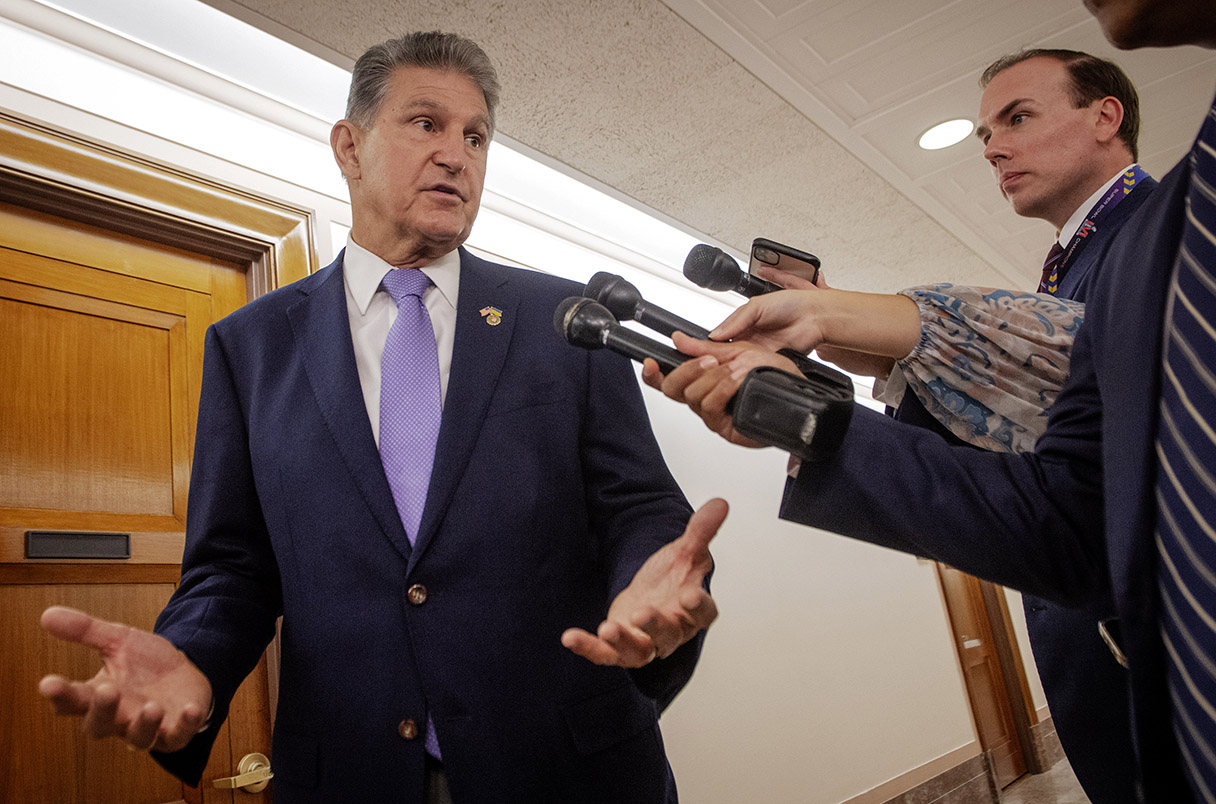
WASHINGTON, DC – JULY 21:
Sen. Joe Manchin(D-WV) faces reporters as he arrives at a hearing of the Senate Energy and Natural Resources committee at the Dirksen S.O.B. at the U.S. Capitol, in Washington, DC.
(Photo by Bill O’Leary/The Washington Post via Getty Images)
The so-called Inflation Reduction Act of 2022 promises much, but better read the fine print in this massive 700 page proposal.
A patchwork compromise with coal baron Senator Joe Manchin, its motivation is the Democratic Party leadership’s desperate need for a legislative victory in addressing escalating inflation, the primary concern of American voters, as the mid-term elections loom. Thus the bill’s name. (The previous version was called Build Back Better).
With close analysis, you’ll discover it isn’t up to the hype. While an unprecedented $369bn is dedicated to mitigating climate change, it locks in reliance on fossil fuel expansion by hamstringing the Interior Department: no renewable energy development on public lands unless drilling leases are also offered to oil and gas entities.
As such, this bill is pure political charade. Fossil fuels cause climate change, yet they’re locked into the bill’s provisions. There is no mechanism to phase them out.
What we get is the loosening of regulations regarding environmental review and, horribly, mandated drilling leases in Alaska’s Cook Inlet and the Gulf of Mexico. The result? More pipelines, oil leaks, methane leaks, wilderness lost, species endangered, and continuing temperature rise. In 2016, the U.S. averaged one crude oil spill every other day (undark.org).
There are no caps on carbon admissions!
While the legislation features tax credits for carbon capture and sequestration, the fallout is that this could extend the life of polluting coal plants, exposing the public to toxic fumes, and making it difficult to achieve clean power goals.
Not talked about is an ominous separate agreement to move a bill in September that could potentially weaken protections under the Environmental Policy Act, which grants communities a say in what happens to their local environment. This is subterfuge, pure and simple.
You’re told the legislation will reduce greenhouse gas admissions 40% by 2030 (Rhodium Group, rpg.com). Considering the pressing problems we have with securing energy resources, it’s dangerously possible that fossil fuels will gain the upper hand over renewables, upsetting any trajectory of even-handedness. As is, the Biden administration in early July held its first onshore lease auction, releasing a proposed plan for off shore drilling, despite Biden’s campaign pledge to cease new oil and gas development on federal lands and waters (insideclimatenews.org).
In short, the Inflation Reduction Act takes back what it gives out, a Faustian wager that forfeits the future for a short-sighted political shell game in the present.
I’m not saying there aren’t good things in the bill. And, yes, there are groups like Nature Conservancy, the Sierra Club, and Earth Justice, urging speedy passage of the legislation. They may be willing to drink the Kool-Aid, but not me, nor should you.
I go by the late E. O. Wilson, “Darwin’s heir,” my icon in environmental matters, who repeatedly denounced such organizations for their compromises, perpetuating environmental demise. They’ve thrown in the towel, their credo, Nature is already gone. We live in the Anthropocene. Wilderness must serve human needs (Wilson, Half–Earth: OurPlanet’sFightforLife).
This is a climate suicide pact,” comments Brett Hartl, government affairs director for the Center for Biological Diversity (CBD). “It’s self-defeating to handcuff renewable energy development to massive new oil and gas extraction.”
The U.S. Federal Reserve continues to raise interest rates to slow raging inflation. The root culprit isn’t the consumer, but the greedy corporate sector, which is using inflation as cover to maximize its profit margins. We know this every time we shop and see goods priced double, or more, the rate of inflation. What’s needed immediately is a windfall profit tax.
Meantime, the average worker faces an insufferable erosion in purchasing power, and the plight of those living on fixed incomes exacts the ultimate cruelty.
Three principal parameters to assess market expense are labor costs, nonlabor inputs, and the “mark-up” of profits beyond the first two. Recent measurements (economic policy institute.org) reveal record profit margins over the former two, or plus 53.9% growth in corporate profits, as opposed to 38.3% for non-labor cost, which includes the supply chain crisis induced by the pandemic, and just 7.9% for labor costs.
Certain sectors of the economy have especially profited, averaging above 20% in profit margins such as information technology and fossil fuels. Exxon, for example, has just published a record profit of $17.9 bn for the second quarter (NYT).
Fueling inflation is the accelerating corporate buy outs, lessening competition. You’re aghast at rising meat prices? That happens because just four meat conglomerates now control the market. Since 1990, some 75% of corporations have consolidated and control as much as 80% of the market, reports the Official Monetary and Financial Forum (OMFIF).
And things may likely get worse as a looming recession makes itself felt and corporations cut expenses to stabilize profitability. Amazon has laid off 100,000 workers, even as profits bulge. Others include Twitter, Google, Netflix, Peloton, Best Buy, Tesla, Ford, General Motors and Exxon Mobil.
Corporations aren’t by nature altruistic. They exist to reap maximum profit for their CEOs and investors. They think in numbers, not individuals.
Despite President Obama’s spirited pledge to reduce the growing gap between rich and poor, his administration has been covertly involved in negotiating a Trans Pacific Partnership (TPP) trade agreement whose potential fallout would only exacerbate, not lessen, the economic divide, consolidating what is essentially an oligarchy of Wall Street interests.
You may be unfamiliar with the TPP, as it’s not played up in the media, unless you’re a rare aficionado of the marketplace. Briefly, 14 nations bordering the Pacific, controlling 40% of the world’s GDP and 26% of its trade, have been at work for more than a year, hammering out the final details of a complex agreement that would eliminate tariffs on goods and services. Composed of 29 chapters, its scope would include not only the area of finance, or banking, but telecommunications (i.e., the Internet), and even food services. It would have devastating consequences for those of us committed to environmental concerns that include global warming.
Ominously, it includes proposals that would curtail consumer protection across a wide spectrum. According to Republican Reports, leaked TPP negotiation documents reveal the Obama administration’s attempts to stymie other governments from implementing financial regulations, believing they could mitigate another bank collapse.
These leaked documents (see citizen.org) indicate proposals allowing corporations to sue governments under the auspices of “foreign tribunals,” thus circumventing domestic courts and local laws. Corporations could even demand financial compensation for “tobacco, prescription, and environment protections” that undermine their profits.
As Senator Elizabeth Warren–I like her more everyday–warns, such provisions allow “a chance for these banks to get something done quietly out of sight that they could not accomplish in a public place without the cameras rolling and the lights on.”
Alarmingly, even without the TPP, over $3 billion has already been paid out to foreign investors under current U.S. trade and investment agreements, with another $14 billion pending, “primarily targeting environmental, energy, and public health policies” (citizen.org).
Representing the U.S. in the negotiations is Obama appointee Stefan Selig, a former Bank of America investment banker nominated to become Under Secretary for International Trade at the Department of Commerce. Since his nomination, he’s received $9 million in bonuses. (He had received $5.1 million incentive pay the previous year.)
Slated to join him in the negotiations, pending Congress’ approval, is Michael Froman, presently U.S. Trade Representative. He received $4 million from CitiGroup as an exit payment in addition to $2 million in connection with his holdings in several investment funds.
This practice of banks lining the pockets of their former cohorts upon joining government is pervasive in the banking industry, pocket money for establishing influence in contexts affecting public financial policy.
Unfortunately, for all the pretty rhetoric coming out of the White House, the oligarchy of the one percent remains entrenched, and even abetted, while the TPP, added to its already formidable arsenal of financial peddling, poses a potent means to intimidating the common citizenry, here and abroad, opposed to its hegemony of privilege.
It certainly doesn’t contribute to economic parity. According to a study by the Center for Economic Policy and Research, as reported in the Washington Post, the economic gains would largely accrue to the wealthy.
I wanted to revisit my last post of several days ago, “The Yacht Mentality that Threatens our Economy,” with this apropos poem by William Carlos Williams, one of America’s foremost modernist poets. As you may have surmised, it’s called “Yachts,” which I employed as my central metaphor in depicting the economic inequity rampant in our nation.
Williams, by the way, was a physician from Hoboken, NJ, who compassionately dedicated his practice to treating the poor, who were never far from his thoughts. We see this vividly in his symbolically dense poem that comes close to being allegory in its one-to-one application, or depiction, of the tensions governing the relationship between the oligarchy of the economically privileged (shall we call them them the 1%?) and the majority, marginalized working class folk like you and me. But first the poem, then my commentary:
Poem:
The Yachts
contend in a sea which the land partly encloses
shielding them from the too heavy blows
of an ungoverned ocean which when it chooses
tortures the biggest hulls, the best man knows
to pit against its beatings, and sinks them pitilessly.
mothlike in mists, scintillant in the minute
brilliance of cloudless days, with broad bellying sails
they glide to the wind tossing green water
from their sharp prows while over them the crew crawls
ant-like, solicitously grooming them, releasing,
making fast as they turn, lean far over and having
caught the wind again, side by side, head for the mark.
In a well guarded arena of open water surrounded by
lesser and greater craft which, sycophant, lumbering
and flittering follow them, they appear youthful, rare
as the light of a happy eye, live with the grace of all
that in the mind is fleckless, free and
naturally to be desired. Now the sea which holds them
is moody, lapping their glossy sides, as if feeling
for some slightest flaw but fails completely.
Today no race. Then the wind comes again. The yachts
move, jockeying for a start, the signal is set and they
are off. Now the waves strike at them but they are too
well made, they slip through, though they take in the canvas.
Arms with hands grasping seek to clutch at the prows.
Bodies thrown recklessly in the way are cut aside.
It is a sea of faces about them in agony, in despair
until the horror of the race dawns staggering the mind,
the whole sea becomes an entanglement of watery bodies
lost by the world bearing what they cannot hold. Broken,
beaten, desolate, reaching from the dead to be taken up
they cry out, failing, failing! Their cries rising
in waves still as the skilled yachts pass over.
Commentary:
When you first get into this poem it seems to feature Man vs Nature, but by l. 13 with the specifics about the crew, which “crawls solicitously,” it dawns on you that it also takes in humans pitted against one another.
If the earlier portion of the poem (up to l. 13) gives an imaginative, blissful view of Nature in relation to Man and, in turn, of Man’s inter-relationships, the latter portion gives you the awful reality masked by the seeming tranquility, or the potential for revolt from the status quo of both Nature and Man.
Mention of a “race” sets the stage for transition into a contest for mastery, initially of yacht vs. yacht, but note how the diction changes here with sinister implications:
“Now the sea which holds them is moody”
“As if feeling for some slightest flaw”
“Now the waves strike at them”
Note as well how the ominous turns into a personification of unleashed violence in what becomes a power struggle waged between haves and have nots, with the yachts metaphorized into repressive knife slashing entities indifferent to whom they maim:
“Bodies thrown recklessly in the way are cut aside.
“It is a sea of faces about them in agony, in despair.”
Williams’ subterranean intent now surfaces: we have a revolt put down by the yachts, the poem’s symbol for connoting the wealthy, of the normally “solicitous,” or working classes, whose labor has made their wealth possible, though they’ve gleaned little for themselves, “bearing what they cannot hold.”
“…the horror of the race dawns staggering the mind,
the whole sea become an entanglement of watery bodies
The yachts, or impervious upper class, obviously win out on this particular day, but not without leaving in their wake their decimated victims:
“Broken,
beaten, desolate, reaching from the dead to be taken up
they cry out, failing, falling! their cries rising
in waves still as the skillful yachts pass over.
In sum, Williams has delivered a Marxist polemic of poignant genius in its thematic rendering of class struggle against inequity. The very style of the poem adroitly reinforces this theme of worker repression by the economically removed in its run-on lines and skillful alliteration at poem end, the yachts unheeding of the crying wounded in “waves still as the skillful yachts pass over,” suggesting speed and, hence, indifference. For Williams, this hierarchy “live(s) with the grace of all that in the mind is fleckless, free and naturally to be desired.”
In short, their narcissism of self-indulgence (materialism) mirrors behind its proffered beauty their willful escape from responsibility to the working classes on whom their wealth is built (“the crew crawls/ant-like, solicitously grooming them”).
In an America where 37% possesses half its wealth and the top 1% often pays minimal taxes, Williams’ poem reminds us that we have much work to do to render the American dream palpable for not just a few, but for the many.
I turned on the TV while eatinglunch yesterday to a feature called “Island Paradises,” thinking Hawaii or maybe some Caribbean gem like Dominica or St. Vincent’s. Instead, it was about one man’s substantial investment, worth $28 million, in a plus 100 foot long yacht, sporting 3 recreational decks with pools, 7 bathrooms and 15 bedrooms, plus 3 bars and a below deck garage replete with several sleek motorized boats. Docked in Ft. Lauderdale, it costs– Can you believe this?–$50,000 a fill-up.
I don’t know about you, but this kind of ostentatious display of wealth rankles me, not because I’m covertly envious, but because I think it represents excess and is just plain ethically wrong in a world of so many poor. Again, I think of the 1% in my own country (USA), who own 37% of its wealth and whose income has actually increased since the economic downturn of 2008 (Pew Report, February 2013). Meanwhile, hundreds of service food workers have staged walkouts in quest of a more sustainable minimum wage, presently $7.25 an hour. The average food service worker actually makes about $11 an hour, barely above the poverty line for a single parent with one child.
The President is compassionately urging an extension of unemployment benefits for 1.3 million presently receiving unemployment insurance. (The total number of long term unemployed, however, stands at a stubborn 3.5 million.) As he rightly put it in Saturday’s weekly address, “The holiday season is a time for remembering the bonds we share and our obligations to one another as human beings.”
It isn’t that the vast majority of these folks are free loaders. It’s simply that they’ve been looking and can’t find work and that, by the way, is what the drop in unemployment to 7% really means, that thousands of despairing workers have simply given up looking for work. Unfortunately, the longer you’re out of work, the more companies shy away from you. What’s more, in a strained economy, many companies are resorting to part-timers to circumvent having to pay benefits and to maximize profits.
What really hurts is when you’re past 50 and lose the job you’ve worked at a good many years, anticipating a reasonable retirement package just a few years up ahead. This recently happened to a friend of ours, an engineer with a strong resumé in computer skills. Though he looked everywhere, he ended-up driving a school bus. So even if you find work, you’re likely to find your sharply reduced wages sure to contribute to your continuing financial distress. The situation for blacks and hispanics is even bleaker.
That yacht feature reinvests my thoughts as I write. The obscenity of it! The truth is, despite what conservative pundits tell you, a massive transfer of wealth is taking place in America and it’s not Robin Hood style from rich to poor. Consider this from the Pew Report:
During the first two years of the nation’s economic recovery, the mean net worth of households in the upper 7% of the wealth distribution rose by an estimated 28%, while the mean net worth of households in the lower 93% dropped by 4%.
Think movie stars with their posh Bel-Air and Malibu compounds; instant millionaire athletes, Wall Street traders; bank CEOs. Hey, think Walmart with its six family progeny having a bloated net worth of $144.7 billion. Wal-Mart currently pays its “associates” $8.81 an hour.
Again, our President weighs-in:
If Members of Congress don’t act before they leave on their vacations, 1.3 million Americans will lose this lifeline. These are people we know. They’re our friends and neighbors; they sit next to us in church and volunteer in our communities; their kids play with our kids. And they include 20,000 veterans who’ve served this country with honor.
In the meantime, House Speaker John Boehner, emerging as America’s Scrooge, has served notice of his opposition to any extension of unemployment insurance, set to expire December 28.
This is America. We can do better than a yacht mentality of self-absorption, extravagance and indifference.
You may have seen this morning’s AP report on growing poverty in America.:
Four out of 5 U. S, adults struggle with joblessness, near-poverty or reliance on welfare for at least parts of their lives, a sign of deteriorating economic security and an elusive American dream.
I found the report disturbing, but not unexpected, as I’ve done a lot of reading on the subject over the last several years. Things aren’t going well for us these days on so many fronts, but foremost, economically. This isn’t the America I grew-up in. Nothing is perfect, but I think of that world of the early 60s as just maybe our high water mark.
Take crime, for example: In 1963, there were only 18 arrests for drugs per 100,000 people. Our jails held far fewer people, but if you were convicted, you went to jail. We still had a lot of work to do when it came to civil rights and feminism was just coming into its genesis, but they were underway with their promise of inclusion into full citizenship. The Cold War was almost palpable, and while none of us would wish its return, ironically it may have fueled our energy, propelling us into space.
What makes things hard to swallow in difficult times like these, however, is the growing gap between rich and poor. What may surprise you is that, in sheer numbers, Whites are the majority poor, confirmed by the government’s own data, with 76% of Whites likely to experience economic insecurity (job-loss, or a year or more of dependence on government aid, or income 15% below the poverty line) by age 60. White-mother headed homes now equal those among Blacks. Overall, the number of poor in America stands at a staggering 46.2 million. Things are still difficult for minorities, but the biggest jump in poverty is among Whites.
In contrast, the well-off are doing better than ever, with 1% possessing 50% of the nation’s wealth. Since 1993, this 1% has seen a 58% increase in that wealth. Following the downturn of 2008, it has experienced 93% of the income gains. We are, in short, in danger of becoming two nations, or of those few who have, and have it abundantly, and the many who barely make ends meet, or are without work, or in danger of losing their work.
Increasingly, this confers not only economic disparity, but cultural dislocation in education, politics, and even social and intellectual values. It decides where you live, the schools your children attend, and even your personal well-being, as poverty is the primary instigator of crime. In this rare moment of American social history, many Whites now find themselves in the same realm of exclusion from opportunity as minorities. When it comes to Affirmative Action, it strikes me that the new poverty calls for a redefining of its premises, or the consideration of economic disadvantage and not soley race.
Certainly, we live in a changing world where a global economy has shrunk the market for our domestic exports and we’ve experienced a sharp decline in our manufacturing base as a consequence. When I grew up, you could reasonably expect to land a job with a steel mill, auto manufacturer, or in a coal mine for good wages, pensions, and the like, if you didn’t go to college.
Another factor exacerbating inequality is living in an information age that posits a market value on sophisticated skills that are often bred in a nurturing context of means, family stability, the right schools and colleges, and the cultivation of a network of those with influence. We’re talking then about a wholly different lifestyle for those with means.
Like most of our family members, my father was a leather worker. We weren’t well-off, but we had sufficient to make our way in a world without food stamps. With the loss of domestic shoe manufacturing to other countries, it’s a world now relegated to the back recesses of memory. I’ll not give you a litany of lost industries from textiles to furniture, for example, and their contribution to the retreating American dream.
Nobody puts the American economic malaise better than the New Yorker‘s George Packer in his must read, The Unwinding (2013):
If you were born around 1960 or afterward, you have spent your adult life in the vertigo of that unwinding. You watched structures that had been in place before your birth collapse like pillars of salt across the vast visible landscape—the farms of the Carolina Piedmont, the factories of the Mahoning Valley, Florida subdivisions, California schools.”
Lately the President has returned to emphasizing economic issues. He envisions creating “a ladder of opportunity for all.” He wants to shrink the income gap. I don’t doubt his sincerity, but is this simply a euphemism for government throwing more money at the problem, or perhaps an innuendo of Marxism with its inherent penchant to restructure the classes?
Money bailouts haven’t helped us before, though it did save the auto industry and the banks. On the other hand, Libertarians favor deregulation. Last time I looked, it got us into trouble and we’re still trying to right our balance following the Great Recession of 2008. Some think focusing on equal opportunity rather than income redistribution is the ticket. Good arguments can be had both ways.
But the President is surely right about closing the income gap, however it’s done, and most of us everyday folks are probably in lock-step with his goal, though we may differ as to method. As Charles Murphy points out in his trenchant Coming Apart, we are witnessing America’s increasing bifurcation into two classes, rich and poor: “…the divergence into these separate classes, if it continues, will end what has made America America.” Murphy’s thesis is that America is being torn apart, not by race, but by class, and I agree.
The sad thing is, nobody really knows what to do. In the meantime, what can be worse than to lose faith in your own future?





 Brimmings: up from the well