
A Poet Reminisces: Essays After Eighty

ows_141652973541643I have always liked poetry and poets, in particular, because of their sensitivity to human experience.

One poet I like a lot is Donald Hall, a giant among contemporary American poets, although he’s given up the craft, or as he puts it, since “poetry abandoned him.”

Hall is now 85.

Let me assure you, while the tropes may not come as easily as before, his acuity remains vibrant in his newest book, Essays After Eighty, a slim volume of 120 pages, yet filled with reminiscence, keen observation, and sober wisdom.

I first got introduced to Hall by way of his textbook, Writing Well, which I used for a number of years in teaching college composition. The book lived up to its title, emphasizing sentence clarity and how to achieve it, with eloquence added in.

Hall has always been a diligent stylist, whether writing poetry or prose. He confesses that he’s written some individual essay drafts for Essays After Eighty upwards of eighty times to get things said right.

I used to tell my students that the name of the game in all good writing lay in revision, pointing out that scholars have come upon nearly fifty drafts of Yeat’s famed “Second Coming” poem.

I like how Hall says it: “The greatest pleasure in writing is rewriting. My early drafts are always wretched.”

I’ve always held that a good style is etched by its economy, the right words sufficing for empty fillers drowning readers in verbosity; a pleasing rhythm like waves, in and out, upon a sea shore.

Good prose, like poetry, runs lean.

And Hall is the great master.

Let me give you a sampling of Hall’s trademark writing acumen, simple, yet keen with observation, each detail chosen well, verbs especially, accumulating into a verbal, painting, reflecting the ethos of a skilled artisan:

In spring, when the feeder is down, stowed away in the toolshed until October, I watch the fat robins come back, bluejays that harass them, warblers, red-winged blackbirds, thrushes, orioles. Mourning doves crouch in the grass, nibbling seeds. A robin returns each year to refurbish her nest after the wintry ravage. She adds new straw, twigs and lint. Soon enough she lays eggs, sets on them with short excursions for food, then tends to three or four small beaks that open for her scavenging. Before long, the infants stand, spread and clench their wings, peer at their surroundings, and fly away. I cherish them….

Reminiscence weighs heavily upon these essays, not surprising for a writer in his mid-eighties. the ghosts, as it were, looming out of the past–grandparents, Mom and Dad, aunts and uncles, friends;  wife Jane Kenyon, the love of his life and fellow poet, succumbing unexpectedly to cancer at age 47.

Even the northern New Hampshire topography has yielded to change, farms giving way to rebirth of forest as the new generation migrates to the prosperous cities of southern New Hampshire.

As I read this moving collection of personal reflections on sundry topics, I made sure to highlight a number of striking passages, and some of them I’ll share with you.

On writing:

As I work on clauses and commas, I understand that rhythm and cadence have little to do with import, but they should carry the reader on a pleasurable journey.

If the essay doesn’t include contraries, however small they be, the essay fails.

Nine-tenths of the poets who win prizes and praises, who are applauded the most, who are treated everywhere like emperors–or like statues of emperors–will go unread in thirty years.

I count it an honor that in 1975 I gave up lifetime tenure, medical expenses, and a pension in exchange for forty joyous years of freelance writing.

I expect my immortality to expire five minutes after my funeral. Literature is a zero-sum game. One poet revives; another gets deader.

On aging:

When I limped into my eighties, my readings altered, as everything did.

In the past I was advised to live in the moment. Now what else can I do.?

On leisure:

Everyone who concentrates all day, in the evening needs to let the half-wit out for a walk.

On mortality:

It is sensible of me to realize that I will die one of these days. I will not pass away.

At some time in my seventies, death stopped being interesting. I no longer checked out ages in obituaries.

These days most old people die in profit-making dormitories. Their loving sons and daughters are busy and don’t want to forgo the routine of their lives.

Essays After Eighty has been a wonderful read for me with its acerbic wit, cogent wisdom, delivered in a simple, yet elegant, style, proving again that the best art conceals itself.

And yet there’s a melancholy that haunts these excursions into reminiscence, a sense that the best is over and, now, there’s just the waiting. As Hall confesses, “My problem isn’t death, but old age.”

Hall, of course, is addressing physical decline with its imposed limitations and dreaded dependency; but surely his words resonate still more–the sense of ephemerality that mocks our labors and brings to an end all that we love most dearly.

For Hall, “There are no happy endings, because if things are happy, they have not ended.”

Still, this work, perhaps his last, formulates a testimony to a life lived well.

And, very rarely, do you find such honest telling.

–rj
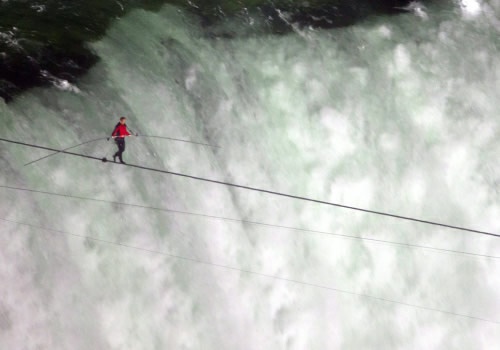
Brian Williams Remembers What He Disremembered

tightrope-niagara

There you go again, Twitter folks!

Turning on the light to bang those damn cockroaches scuddling down the wall.

You can’t do that, people!

Not to NBC News anchor, Brian Williams.

Is everything just fair game to you guys?

Doesn’t show much gratitude to a man who’s spent his life getting at the truth.

And I really resent your making me into a dumb ass just because I like the guy.

But Brian, I know full well someone like you, clean-cut, ageless all-American boy that you are, could never stoop to any kind of falsehood, though I know you’re no George Washington, who never, ever told a lie, even about that cherry tree.

Tell me I ain’t wrong, Brian!

You simply disremembered. That’s it!

I know you said your helicopter came under fire while you were reporting on a news story back in Iraq in 2003.

A really long time ago, huh?

I know it took you a some time to remember again and you needed help from the people who got to the light switch

But now you’ve got the story right.

Anyway, it doesn’t the f–k matter.

I know you walked a tightrope over Niagara Falls.

I’ve got this photo that proves it. Pictures don’t lie.

And you were in the first wave, hitting Omaha Beach.

I would never have believed it. You look so young.

Like the song says, “They can’t take that away from me.”

I think that was written for you.

What, you wrote it?

I never knew that either.

I really like how you stand-up for yourself.

No, you don’t need to say anything more.

You were just in a mental fog.

We’ve all had days like that.

Months, years?

Hey, what the hell!

Let me say my piece, Twitter people!

Give the guy a break!

You think he should be fired?

Well, I can tell you right now it ain’t happening.

Fortunately, he works at NBC and we know their loyalty to their people.

Take Al Sharpton at sister MSNBC….

He’s got this whole show to himself.

He says the rich should pay more in taxes.

He should know.

After all, he’s rich and is just dying to pay his full share.

Yeah, I know he’s 4 million behind in back taxes.

You gotta give a guy time to remember what he’s disremembered.

He’ll catch-up.

But back to you, Brian.

You’ve got real balls.

No apologies.

And why should you?

I love this in you!

A lot of others like it, too.

Like Al Gore, who invented the Internet.

Especially these guys in politics like Mark Kirk, Richard Blumenthal, and Tom Harkin.

They all disremembered, too, when it came to war.

But the people understood and made damn sure they got elected.

We’ve got your back, Brian.

What, you were with Clinton when he unzipped his fly in the Oval Office?

Wow, and you’ve held back till now?

Yeah, you disremembered this, too, but now you’ve got it right.

Yeah, I can understand why you waited.

You guys were cronies for years.

Hey, Brian, old faithful here can’t wait to see you on the news tonight.

You’re interviewing Armstrong?

Oh, I know Lance finally fessed up to being on dope all those years.

What do you expect a guy to do in a stress event like The Tour de France?

Yeah, it took him a while to remember, but he got it right.

Now he just hit two cars the other day and got so shook up that he disremembered again and thought it was his girlfriend driving.

But he got it right this time much quicker, remembering what he disremembered.

Just like you, Brian!

–rj

Note:  Williams apologized on his newscast last night:  “I made a mistake in recalling events of twelve years ago.”  The facts show he repeated his version on several occasions, the story growing with the telling.  It’s one thing to make a “mistake”; it’s another thing to lie.  I don’t buy into the twelve years ago excuse either.  If it hadn’t been for the military, Williams would still be exploiting the story for personal advantage.  Meanwhile, MSNBC didn’t cover the apology until 10:45 pm.  It’s been my experience that when caught, liars are disingenuous with language.

American Sniper: Anatomy of a Mauling

amsniper

There’s been heavy flak, to say the least, over Clint Eastwood’s blockbuster film, American Sniper.

It started with film director Michael Moore’s take on snipers as “cowards” who shoot people in the back.”

Others soon piled on, like Seth Rogen, who compared the film to Nazi propaganda.

Outspoken Bill Maher went further, condemning real life Chris Kyle, on whom the movie is based, as a psychopathic killer.

Returning blows, Kid Rock hoped Michael Moore would “catch a fist to the mouth soon.”

Surprisingly, Jane Fonda tweeted her appreciation of the film: “Bradley Cooper sensational. Bravo Clint Eastwood.”

Nominated for six academy awards, including Best Movie, the controversy hasn’t gone away and, in all probability, precludes any Oscar possibility.

Anyway, I knew I had to see the film after both my dental hygienist and neighbor, first thing out of their mouths, asked if I’d seen it.

So I dutifully went the very next day to a matinee showing, surprised by the large audience on a weekday.

I was on the edge of my seat throughout, gripped by the film’s graphic, nearly non-stop violence spurting from nearly every Sadr City window, rooftop, or corner.

Not since Platoon had I seen a you-are-there war movie like this, replete with in your face carnage inflicted by a relentless, hidden foe relying on ambush.

Retired marine sniper Jeff Crenshaw says “It’s the most realistic thing I’ve seen since the battlefield.  It shows the true nature of war and how awful it is and the toll it takes on a human being.”

Like Vietnam, not knowing who your foe is, possibly even a mother or child, you had to watch your back, and that’s where Kyle comes in, portrayed as protector, not assassin.

My take is that the film’s been misunderstood by its critics, even deliberately maligned by those with political agendas oriented to the Left. They hated the Iraqi war, thought it a ruse for oil interests. Nourishing grudges, they will neither forget nor forgive.

I found American Sniper neither a glorification of war nor right wing propaganda.

Neither a “Republican movie” nor a film appealing to innately angry audiences of Tea Party stripe.

In fact, it sidesteps politics altogether.

Even the Mahdhi insurgents are shown to be ferocious in defending what they regard as their turf against the invading American forces, superbly equipped with the latest weaponry and technology.

Hardly a psychopathic killer, Kyle is always shown as an interventionist, honing in on his target in the nick-of-time to safeguard his fellow soldiers at risk of a hurled grenade or a shot from a window.

At times he waits hard and long, reluctant to shoot a child who may be carrying an incendiary device towards unsuspecting American troops.

In another scene, he prays that a child struggling with a rocket grenade launcher will drop the weapon. He’s not in Iraq to kill children. Fortunately, the child drops the weapon.

Iraq is a place where you’d best never drop  your guard, since it’s not clear who’s enemy, as we see when Chris and other soldiers get invited to a civilian’s home, which turns out to be a setup for ambush.

Kyle ultimately breaks down, telling his wife he wants to come home, clearly having his fill of war; in fact, four tours.

Clint Eastwood has defended his movie, echoed by Gary Sinise, saying that the movie is really about what happens to our soldiers on their return home, themselves victims of war.

Married and father of two children, he may be physically present, but mentally he’s absent as his troubled wife tells him.

He endures a nagging guilt he needs to be there to protect them.

Implying Kyle was a coward is simply way over the top.

As for Maher, who quotes Kyle’s autobiography in which he denounces his foes as “barbarians” and expresses pleasure in killing them, this is umbrage born of ignorance, not surprising in people who’ve never served a day in uniform or participated in combat, nor seen their fellows blown apart, tortured or shot at.

But let’s leave the verbal broadsides of the critics aside.

The film isn’t really about Kyle.

It’s about the American soldier, or all soldiers for that matter.

Unfortunately, the critics have been engaged in killing off the messenger in failing to distinguish between statement and meaning, which is what artistic irony entails.

Literalists, they can’t fathom ambiguity.

In one scene, the at home veteran nearly kills the family’s pet fog, conflating its play with his young son as aggression.

Kyle clearly isn’t a well man.

The bottom line is that he suffers from post traumatic stress disorder (PTSD), which includes all its pervasive symptoms:

Anxiety

Guilt

Anger and irritability.

Depression

Alienation

Difficulty in relationships

Inability to focus.

I’ve just come off reading Laura Hillenbrand’s Unbroken, her masterful biography of WWII hero Louis Zamperini, who survived 48 days at sea in a rubber raft, only to land in the Japanese occupied Marshall Islands, then subsequently transported to Japan, where he endured near starvation and daily beatings at the hands of a sadistic camp commandant for two years.

Returning home at war’s end, Zamperini’s travail continued with nightmares in which his tormentor appeared, along with alcohol dependency, alienation from his wife and friends, a hatred for his captors, and a determined resolve to return to Japan and kill the man singularly responsible for heinous crimes afflicted on himself and fellow POWs.

In short, Zamperini suffered the classic symptoms of PTSD.

So what if Kyle wrote of his loathing of the enemy, Maher?

This is what inevitably happens whenever critics like Maher launch personal attacks, shallowly judging by symptoms and not rooting out causes, or lifting behavior from context.

Truth is, war often strips us of our humanity.

We say and do things alien to the better angels of ourselves.

PTSD is a wounding of the mind and spirit every bit as real as any physical wound.

Hardly simplistic, I found American Sniper a tell-it-like-it-is movie, replete with ambiguity of the kind integral to tensions formulated whenever humane values conflict with the killing mores of the battlefield.

I salute first lady Michelle Obama, speaking recently before a veteran’s group, who accurately appraised the film as “complex, emotional, and a realistic depiction of a veteran and his family.”

While I know there have been critics, I felt that, more often than not, this film touches on many of the emotions and experiences that I’ve heard firsthand from military families over these past few years.  This movie reflects . . . the complex journeys that our men and women in uniform endure.

That resonates for me, a veteran.

What’s more, it speaks for millions of audience goers as well, from every demographic: red state and blue, gender, race, and ethnicity.

rj


You Aren’t Who You Think You Are!

yoga(1)

Have you ever found yourself so angry, say in an argument, that you’ve yelled, or said mean things, or left the room, or slammed a door, only to feel ashamed later?

Have you ever panicked, ready to pull your hair out, because your fear seemed overwhelming, demanding a quick fix that seemed elusive?

Perhaps it was in getting bad news such as being fired, or being told you have a serious illness, or finding out your spouse wants out.

It’s been said many times you are what you think about. If you’re having happy thoughts, then chances are they’ll carry you through the day, making it a good one.

Conversely, when you’re upset–who knows about what?–you’re apt to put in motion unhappy scenarios throughout your day. Not only that, you may be spreading your viral malcontent to others.

But it’s your unconscious thoughts that may influence you even more, and with greater fall out, since you’re unwitting of the sources behind what you say and do. In short, it goes a lot deeper than just what you think about.

It’s as though you’re living with a stranger usurping your identity. There he is, randomly, unexpectedly, projecting himself upon your conscious world.

Your thoughts, then, seldom come close to mirroring who you really are, though they may try to tell you that you’re either lacking or even very special.

And this is the good news, since your thoughts most likely come short of who you really are.

Your mistake is identifying with them.

This becomes clearer when we resort to linguistics.

In English, we always say things like “I’m angry” or “I’m lucky” or I’m afraid,” when logically this can never be so.

This gets corrected in languages like Spanish, French and German in which we say we have anger, or luck or fear.

Now try this little exercise in predicate adjectives to catch my drift. To

I am, add an adjective that describes you:

I am …

I am happy.

I am sad.

Et cetera.

I call it the name tag game and we all play it.

As such, these tags can never summarize in any moment the totality of who you are in your uniqueness, and thus you err when you identify with them.

Name tags reach back into your childhood as you strive for validation, or self-worth, often by comparing yourself to others.

My mother likes my sister more than me.

I’m smarter than Bill.

I’m not popular.

Unfortunately, such scripts program us; that is, unless you learn to identify the falsity of their self limitations.

By doing so, you free yourself from their tyranny.

You don’t replay them anymore.

Self-acceptance prospers in an environment saturated with love. Too many of us we’re raised, however, by parents who themselves were never accepted for who they were, and thus never fully loved.

Accordingly, their love was, in turn, conditional, or a projection of themselves.

The truth is you’re far more than the stories you’ve come to believe about yourself.

You don’t need to keep modeling yourself on what you think or have been told you are or should be.

You’re worthy now.

Too often you try to compensate for life having dealt you a bad hand:

A broken home replete with violence.

An alcoholic parent.

Bullying at school.

A physical or mental handicap.

Sexual abuse.

A friend’s betrayal.

An insensitive teacher.

And while measured by status and/or accumulation, you may even seem successful to others, you find you’re still battling feelings of inferiority or unworthiness daily.

In a kind of guerrilla war, your anxiety pushes you to flush out the enemy by doing still more.

You hunger for approval, but it’s never enough.

Afraid of disapproval, you retreat from doing new things because you might do it wrong or even fail.

Freeing yourself by identifying the stories you’ve come to falsely believe about yourself is your passport to loving yourself, and with it, finding confidence and joy.

Anxiety about yourself, unfortunately, is an acquired practice.

It follows you must undo the habit.

When you think negatively or act out destructively, catch yourself at it.

This isn’t my true self.

This isn’t me.

And you’re right.

You can help yourself by retrieving your thoughts in a strainer, as it were, by practicing mindfulness,

Breathe deeply through your nose for a count of six seconds, your hand on your belly

Feel your stomach inflate.

Now breathe out for a count of four. feeling your stomach contract.

Visualize happy scenes.

Let your body relax, beginning with your toes, then your feet, legs, back, arms and neck, each in its turn.

Now listen to your thoughts,

Do this without judging them.

If you stray, as we always do, return to deep breathing.

By listening to ourselves, detached from censure, we see objectively, freeing ourselves from anxiety’s tyranny.

We don’t allow our emotions to boss us around anymore.

To this end, I find restorative yoga the most peace-rendering exercise of any I’ve come upon.

Unfortunately, most yoga practice in the West confines itself to bodily exercise, or fitness,

True yoga is much more, or holistic, the “yoking” of mind and body, for they are ultimately one. Yoga mean “to yoke.”

This is where Western medicine so often fails, treating symptoms, not causes.

We are not mere physical creatures.

We possess a spiritual component.

We are sentient beings.

In traditional parlance, we have a Soul.

In modern life, however, we’ve disconnected Body and Soul.

The consequence is that we find ourselves out-of-balance, resulting in stress, fatigue and, ultimately, illness.

Yoga reverses this, restoring health, both physical and mental.

Yoga helps you let go.

Yoga enables you to love yourself and, with it, forgive yourself and others.

I’m sadly limited to a blog, when there’s so much else I’d like to say.

But let me recommend a book that will jump start your reconnecting mind and body. I promise you’ll not want to set it down:

Brad Willis. Warrior Pose:  How Yoga (Literally) Saved My Life.

We listen too much to our head, when we should be living life with our heart.

If you follow my suggestions, hand over my heart, you’ll increasingly gain power over that stranger who’s usurped the premises.

You’ll dislike him so much, you’ll ask him to leave.

The good news is that he will!

–rj

.

Islam: The Hi-Jacking of a Faith

terroprismWe are stunned by what’s happened in France. Thursday, twelve people assassinated by two French jihadists at publisher Charlie Hebdo in Paris and a policewoman killed elsewhere. Yesterday, the three terrorists killed, along with four hostages.

In their assault on journalists, their violence poses a threat to not only press freedom, but free speech fundamental to any democracy.

Collectively, like-minded Muslim extremists have bombed newspaper offices, stabbed a Dutch filmmaker, killed writers, and imposed fatwahs, or death decrees, on others like noted author, Salmon Rushdie.  More recently, Pakistani Taliban murdered 132 school children, enraging a government where blasphemy laws are imbedded in the legal system.

Offended by cartoonists at Charlie Hebdo, these “defenders of the prophet” were part of an underground cell that may number in the hundreds of thousands across the globe, and thus impossible for intelligence sources to keep up with.

It would seem incredulous that fervent devotees to Islam, which often dubs itself “the religion of peace,” commit such heinous acts, ultimately epitomized on a larger scale in the atrocities of Al Qaeda and Isis.

But they kill each other as well. In Iraq, Sunni and Shiite factions wantonly blow-up each other every day.

For too long, we’ve heard very little from the wider Muslim community on the subject. Some Muslims, in fact, have made it known that they’re offended that when such events like those in France occur, they must speak up, indicating a public view of them as a subversive presence.

And I can understand their sensitivity about having to continually prove themselves. Still, I think they’re wrong in taking this stance, as I’ll explain in my close.

I know from my own contacts with Muslims, particularly in France where I was once a student, just how wonderfully decent they are. My friends came from Iran, Iraq, Jordan, Morocco, and Syria.

They were universally kind to me and I was invited to Jerusalem, though I never went. To this day, I rejoice for having fellowshipped with them daily.

Religion never separated us, for we shared a common humanity of sensitivity and compassion.

They were surprised to come across an American championing a free Palestine. As one of them said to me, “C’est historique!”

In all of this, we do well to remember that being zealous, whether religiously or politically, is inherently dangerous, often giving away to rancor and intimidation, and in heated moments, violence. In short, we can forfeit our humanity.

But zealots aren’t confined to any one faith. Religious totalitarians, they represent the voice of Passion, and not Reason.

I remember when one Israeli shot more than 50 worshipping Palestinians in Jerusalem many years ago.

Here, In the U. S., we have evangelical Christians who have not only maligned homosexuals, but continue to conspire against their fundamental rights.

A few have killed abortionists.

And then we have history’s testimony as to how bloody Christianity could be, whether in crusades against Muslims, or against one another during the Reformation.

As for Judaism, its sacred scriptures–or what Christians call the Old Testament– are hideously bloody, sanctioning genocide.

I had thought for many years that Buddhism was spared from all of this, but alas, it just isn’t so, as we see in places like Sri Lanka and Myanmar, where they constitute a majority.

But I want to return to Islam and point out features that characterize its scripture, the Qur’an, unwittingly, providing kindling for jihadists to fuel their violence.

Make no mistake about it, the Qur’an is foundational to Islamic law, theology, and daily life as Allah’s completed revelation via the angel Gabriel to his prophet, Mohammed. Its opening verses are recited daily in mosques all over the world. Radio and TV quote it daily.

Many Muslim children begin early to memorize the entire Qur’an.

It has its own style, often employing contrasts, and doesn’t feature a chronological or thematic ordering.

Unfortunately, it’s a sacred text subject to the limitations of all written language isolated from the immediate feedback of spoken discourse.

Fraught with ambiguity, its classical Arabic is complicated by idiom and dictional features that can allow for multiple nuances, perhaps most notably in a critical word such as jihad often being translated as “fighting,” rather than as “struggle,” its more appropriate meaning.

Because the Qur’an is essentially intra-textual, or self-referencing, it demands astute readers consider context and align verses for accurate exegesis,

Passages can have a concision, which when isolated from context, obscure the wider intent. This, in turn, often leads to non-Muslims and Muslim extremists employing isolated texts to exploit their views and debasing a noble faith.

The Qur’an doesn’t sanction violence against unbelievers, for example, though one might be led to think so based on a verse such as 2:191: “Slay them wherever you find them.” The “them” here refers to the previous verse and its “those who attack you.” (The Qur’an does permit Muslims to defend themselves if they’re under physical attack.)

Nor does the Qur’an exclude “People of the Book, ” (i.e., Jews and Christians) from salvation. In fact, it encourages them to practice their faiths (5:45, 47).

Consider this passage, for example:

We have assigned a law and a path to each of you. If God had so willed, He would have made you one community, but he wanted to test you through that which He has given you, so race to do good: you will all return to God and He will make clear to you the matters you differed about (5:48).

Yes, there are Muslim exegetes who take isolated passages to buttress their fundamentalism, denying the full amplitude of other Suras (chapters) and of cultural contexts no longer extant. But such doings aren’t confined to Islam, but a trademark of Jewish and Christian fundamentalism as well.

Iranian philosopher Ramin Jahanbigloo, responding to the tragedy in France, has articulated the barbarism that accordingly takes place whenever fundamentalism runs rampant and seeks to impose its dictates through force:

Fanatics and fundamentalists have always rejected and struggled against each other. When fundamentalism seeks to enforce sectarianism through coercion and violence, it invariably leads to terrorism. When people believe that they have the absolute truth, they end up denying other people’s existence. Then they can no longer distinguish the good from the evil and are thus unable to establish a modus vivendi among different values

Finding a common ground can only work if we share enough to behave civilly. It goes without saying that though some Jews, Muslims, Christians and Hindus may be terrorists, no religion in the world, much less Islam, teaches terrorism or inspires anyone to kill innocent people.

And he’s right. I like to call such parochialism “tribalism.”

Accordingly, what’s happened in France and happens daily in the Middle East isn’t Islam, but its distortion.

This, of course, is why Muslims must come to the forefront and speak out against those bent on hijacking their faith.

And many are doing so, along with the French Muslim Council and, here at home, the Council of American-Islamic Relations. Even the Iranian government has condemned this violence.

Terrorist ideologues such as these and their wannabe counterparts who pollute Twitter with their hate constitute the true blasphemy and not the slaughtered cartoonists of Charlie Hebdo.

–rj


On Reading E. O. Wilson’s The Meaning of Human Existence

wilsonI finished reading E. O. Wilson’s remarkable book, The Meaning of Human Existence, two weeks ago and am now finally getting to tell others why I like it so much.

For one thing, I admire its author, an eminent, cerebral champion of eco diversity given to candor that may arch the backs of some. Years ago, a member of the Marxist oriented Progressive Labor Party poured a pitcher of water on him for advocating the genetic origin of human behavior, a surely unpopular stance with today’s still entrenched view of social conditioning as the compelling factor in the ongoing nature vs. nurture debate.

The controversy once got so heated that it spilled over in 2001 into the front pages of the New York Times and Time Magazine, with some members of the science community dismissing Wilson as a misogynist and racist.

Of course, I learned long ago that scientists, just like the rest of us, are hardly free from biases that can prejudice challenges to accepted axioms rooted more in assumption–and sometimes, pecuniary interests–than objective research or the empirical.

And always there are the social ameliorists, who can be downright bullying in their evangelical intensity.

For me, Wilson makes a lot of sense. If we can take evolution into our own hands and genetically induce behavioral as well as physiological outcomes in animals such as canines, why would this not be true of evolution as a mechanism at large?

But Wilson has survived the controversy and, you name it, he’s won virtually every academic and journalism award, including two Pulitzers.

The novelist Ian McEwan aptly described Wilson as “an intellectual hero,” and that he didn’t “know of another working scientist whose prose [was] better than his. He can be witty, scathing and inspirational by turns. He is a superb celebrator of science in all its manifestations, as well as being a scourge of bogus, post-modernist, relativist pseudo-science, and so-called New Age thinking” (qtd. in The Guardian, 16 February, 2001).

This most recent book, in many ways a summation of his copious research across several decades, has been nominated for the National Book Award.

It’s far more than a tome on science, however. Replete with wisdom and concern for a diminishing biodiversity on which our survival depends, it ultimately addresses the human condition marred by tribalism, redundant in self-interest, and often (think today)   exhibiting a religious and political mindset:

The great religions are…tragically, sources of ceaseless and unnecessary suffering. Their exquisitely human flaw is tribalism. It is tribalism, not the moral tenets and humanitarian thought of pure religion, which makes good people do bad things.

In more secular societies, faith tends to be transmuted into religion-like political ideologies. Sometimes the two great categories are combined.

The Meaning of Human Existence pleads for the convergence of science and the humanities to not only confront human behavior but pursue its origin that we might remedy it.

The self-contained world of the humanities describes the human condition–but not why it is the one thing and not another. The scientific worldview is vastly larger. It encompasses the meaning of human existence–the general principles of the human condition, where the species fits in the Universe, and why it exists in the first place.

With resounding pathos, not unexpected in a man who loves Nature so fervently, Wilson   also laments our intransigent myopia that unwittingly plants the seeds of our own demise and, hence, betrays our future:

Too paralyzed with self-absorption to protect the rest of life, we continue to tear down the natural environment, our species’ irreplaceable and most precious heritage. And it is still taboo to bring up population policies aiming for an optimum population density, geographic distribution and age distribution.

I think Wilson is spot on. While the humanities can teach us how to behave, they cannot rid us of the conflicting dynamics of individualism versus altruism implanted by evolution.

And that is our tragedy. We must learn to conceive ourselves as unique offspring possessed of divided sensibilities, the finale of vast eons of time, that we might weave a more rational way of living.

Though it’s folly to suppose we can annul our fissure, we can do better. We do not have the gods to blame, nor a devil to curse. And if this frees us from a good deal of our tribalism, then so much the better.

It pains me to think this may be Wilson’s last book, since he will turn 86 next June. As is, he’s lost none of his mettle in provoking us to examine our assumptions and liberate ourselves.

In doing so, he reminds me of those Old Testament prophets that would, at great risk, prognosticate the calamitous fallout of an unheeded warning.

–rj

Being Mortal

gawandeI’ve just finished reading Being Mortal: What Matters in the End by Dr. Atul Gawande.

I had read his previous Complications about life as a surgeon several years ago, greatly impressed.

Both books have been highly praised, with the present book listed by the New York Times as among must reads of 2014.

As a surgeon at Massachusetts General Hospital, Gawande knows what he’s writing about.

And he writes well, often movingly, in layman’s language, of death scenarios with their accompanying challenges that need to be individualized, since we’re all different.

I suspect many readers will opt to avoid a seemingly morbid subject, but that’s a mistake, for   mortality knows no exceptions and our best approach is one that, through knowledge, provides us with options.

And Gawande, a writer for the prestigious New Yorker as well as a physician, delivers–deftly, compassionately, and always with eloquence, on a difficult subject.

Moreover, his book preeminently addresses the medical community, often committed to treatment paradigms that work against the patient’s welfare.

Physicians are trained to see themselves as enhancers of health and survival. They are not taught how to handle lingering illness devoid of remedy:

…within a few years, when I came to experience surgical training and practice, I encountered patients forced to confront the realities of decline and mortality, and it did not take long to realize how unready I was to help them (3).

If your problem is fixable, we know just what to do.  But if it’s not? The fact that we have had no adequate answers to this question is troubling and has caused callousness, inhumanity, and extraordinary suffering (8).

What’s the point, anyway, of continuing chemotherapy, radiation, and surgery in terminal cases when such methodologies may involve great risk and, often, increase duress?

When, in short, should doctors, not just patients, let go?

Patients cling to hope and doctors knowingly feed into this, when frequently no regimen can procure that miracle of restoring health and dignity.

Or as Gawande vividly makes clear in his allusion to Tolstoy’s powerful tale, The Death of Ivan Ilyitch:

What tormented Ivan Ilyitch most was the deception, the lie, which for some reason they all accepted, that he was not dying but was simply ill, and he only need keep quiet and undergo a treatment and then something very good would result (2).

The ultimate challenge for physicians is to accept the restraints of biology and assist their patients to come to terms when that moment arrives

Otherwise, they can inflict considerable, even barbaric, suffering.

Doctors need to be patient-centered, addressing the patient’s best interests, and sometimes the greatest kindness entails being candid..

Ultimately, it’s about providing patients with options that preserve dignity, lessen suffering, and are in accord with the patient’s priorities.

We’ve made some progress in the now universal acceptance of Advanced Directives, though initially contested. But what about options for the terminal patient, still conscious, who lingers, often in great pain, and with perhaps even greater to come?

Gawande says that there are two dominating physician protocols: the one patronizing (this is what you should do); the other, informative (here are your scenarios).

Doctors do better when they ask the right questions of their patients in such contexts:

Whenever serious sickness or injury strikes and your body breaks down, the vital questions are the same: What is your understanding of the situation and its potential outcomes? What are your fears and what are your hopes? What are the trade-offs you are willing to make or not willing to make? And what is the course of action that best serves this understanding? (259)

Palliative care, for example, may well be a better option to further surgery, chemotherapy and radiation when the outcome may make matters worse.

On the other hand, indulging patient fantasy may invoke “a prolonged and terrible death” (4).

Gawande carries out what he advocates. For me, his account of his father’s lingering passage into mortality is deeply moving, which I think many of us can identify with in our own wrestlings with the demise of those we love.

In addition to all of you, I wish every medical practitioner would read this book.

Death isn’t an enemy, but the natural order of things.

How much better it would be in our final moments to have someone like Gawande attending–a physician, with compassion, listening and helping us discern those best options that enhance our dignity and lessen our suffering.

–rj


Medicine’s Desertion of the Elderly

elderly“There’s no escaping the tragedy of life, which is that we are all aging from the day we are born,” writes Dr. Atul Gawande in his latest book, Being Mortal: Medicine and What Matters in the End.

Accordingly, I’ve reached that point in life when I wish I could consult with a geriatrician, or specialist on the aging process. Given that we are increasingly an aging population, you’d surmise it’s no problem finding one.

Count yourself lucky, if you do. And if you do, that you’ll get in.

I live in a city of 300,000, and home of a major university with a respected medical school and first class hospitals. Still, I couldn’t find one.

In fact, it may surprise you to learn that geriatricians are an increasingly rare breed.

Take the University of Minnesota, for instance. It recently shut down its Department of Geriatrics, despite its success in enhancing the quality of life for many seniors, reducing disability, both physical and mental, remarkably and, what’s more, the need for costly home services.

Unfortunately, treatment costs exceeded any savings (Gawande 45).

Other medical centers have followed suit, reducing or eliminating their geriatric services.

The medical establishment prides itself on fixing things, when for the elderly it’s management, not healing, that should define appropriate treatment.

Technology, however, is where the big bucks are and even Medicare, tailored for those 65 and over, falls short in paying for services specific to seniors.

Additionally, doctors often feel overwhelmed by elders coming to them with not one, but several ailments. Think hypertension, diabetes, asthma, arthritis, anemia, failing hearing and eyesight, etc.

in the meantime, most Americans will ultimately spend at least a year in a nursing home at considerable expense, which quality geriatric care might well have preempted.

I can’t help but think this sorry state of affairs is somehow related to our general disregard of older people in America, often the butt of jokes or derision.

One study indicates that 68% of the elderly believe that the public is indifferent to its older citizenry.

I don’t think it was always this way. I grew up in a time when we revered age. It’s still this way in countries like China, Japan, Korea and in Latin America. China recently enacted an Elderly Rights Law, mandating its citizens “never snub or neglect the elderly.”

In Korea, turning 60 and 70 are celebrated events.

In contrast, American culture–as in other Western countries–is youth-centric, with emphasis on independence.

Maybe it’s because, thanks to many of modern medicine’s achievements, there are too many of us now, with 20% of Americans projected to be over 65 in the next twenty years.

Currently, those over 65 constitute 26% of all doctor visits, 47% of all hospital stays, 34% of all prescriptions, and 90% of all nursing home stays (Institute of Medicine Report: Retooling for an Aging America).

Unfortunately, there are only 7,000 geriatricians, and that number is declining. As such, it’s only half of what’s needed to meet a growing need (americangeriatrics.org).

The elderly often have emotional as well as physical needs. Sadly, only 3% of psychologists devote the majority of their practice to those over 65.

Geriatric psychiatrists number only about 2,000 and, like geriatricians at large, that number is declining, according to the American Association for Geriatric Psychology.

How foolhardy all of this is, since the elderly constitute a minority most of us are destined to join.

Most of us don’t like to go there when it comes to thinking about growing old and confronting our mortality. Certainly, we don’t prepare ourselves for it very well, though it may be closing in on us sooner than we think.

The UN associates age 60 with elderly status.

In the USA, several states use the same criterion.

The bottom line is that sound medicine isn’t about money. It’s about compassion

–rj

Winter Discontent: Dickinson’s “There’s a certain Slant of light”

dickinsonI’m sitting here in our sunroom, looking out this afternoon on our backyard, smothered with frost. We had our first snow cover a week ago, which came early to Kentucky.

I’m a warm weather lover, and while those around me complain about heat, I say, more is better.

You’d think coming from New England, I’d be more tolerant of snow and ice and lashing wind, but I can tell you that over time I’m liking old man winter much less.

But neither am I some isolated crank in finding winter oppressive.

Take fellow New Englander, Emily Dickinson, for example, that fervent champion of spring and summer, and with them, birds, flowers and even snakes populating her many poems, emissaries of nature’s cornucopia and the inherent goodness of its plentitude.

Understandably, she didn’t soften her distain toward winter in a poem I’ve memorized, “There’s a certain Slant of light.”

I’ve always admired this poem, like so many others she wrote, cerebral, observant, brief, but dependably engaging, centered in detail, redolent in ambience.

Here’s the poem, followed with my commentary:

There’s a certain Slant of light,
Winter Afternoons –
That oppresses, like the Heft
Of Cathedral Tunes –

 Heavenly Hurt, it gives us –
We can find no scar,
But internal difference,
Where the Meanings, are –

 None may teach it – Any –
‘Tis the Seal Despair –
An imperial affliction
Sent us of the Air –

When it comes, the Landscape listens –
Shadows – hold their breath –
When it goes, ‘tis like the Distance
On the look of Death.

 Like so many of Dickinson’s poems, this one deals with death, as ultimately revealed in its closing line. Keenly aware of the temporal, she always dreaded saying good bye to not only visiting friends, but the passage of the temperate seasons.

Appropriately, the poem’s ambience is foregrounded in emerging darkness on a winter afternoon, signified in the angular, or slanted, solstice light. While “Slant” suggests not only a way of seeing things, it more likely connotes a cosmic knife that wounds, amplified in the second stanza’s “hurt” and “scar” allusions.

In the first, stanza, however, this visual image of a slanting light evolves into one of sound, the light being like the “Heft” of Cathedral Tunes, heft denoting heaviness, or the solemnity of perhaps tolling bells or funeral music.

The speaker’s reference here to cathedrals plainly suggests the poem exceeds depiction of a gloomy New England winter’s day, entering into metaphysical concerns embracing religion, God, and mortality.

Dickinson, after all, was not only a rebel in writing non-traditional verse, both formally and thematically, but in her strident skepticism when it came to the assurances of Christianity.

In stanzas two and three, the persona traces the cosmic sources of the day’s oppressive gloom to Deity (1.e., “heavenly hurt,” “an imperial affliction /Sent us of the air”).

As to the specific nature of the transient day’s mood, it is rightfully left ambiguous (“None may teach it–Any–“), underscoring the persona’s angst in a cosmos ruled at best by a silent deity, who allows death’s intrusion into every aspect of nature.

The speaker can only offer analogies in attempting to articulate her resulting emotional dissonance in response to the waning light, since words often prove ineffectual in rendering matters of our psyche:  “We can find no scar,/But internal difference/Where the Meanings are.”

The persona’s allusion to the Book of Revelation with its apocryphal judgments, “T’is the Seal Despair,” underscores the angst of this “imperial affliction” in its psychological reign.

In the concluding stanza, two additional analogies appear, the first employing personification:  “When it comes’ the Landscape listens–/Shadows hold their breath–”

The pronoun “it” brings us back to the slanted light of the initial stanza, reminding us again that we are at the moment when the winter sun is about to slip below the horizon. With anxious anticipation, afternoon shadows stand at attention like sentries.

In the final analogy, the speaker breaks through with simile to the source of her angst in the sun’s passage:  “When it goes, ’tis like the Distance/On the look of Death–”

Or like viewing a corpse, distanced from every human concern.

In the poem’s absence of any proffered reunion or resurrection, Dickinson’s deep vein of skepticism is readily apparent, despite her Puritan forbears and living in a culture still permeated with conservative Christian belief.

But it didn’t come easily to Dickinson, earning my admiration for her candid questioning of cherished communal beliefs. In an early letter, she would confess to “an aching void in my heart which I am convinced the world cannot fill.”

Though often thought of as eccentric, preferring solitude to company, the truth is Dickinson relished her family, had close friends as her extensive correspondence confirms, and received occasional visitors.

Separation from those she loved was always acutely stressful.

And death, of course, which came early and often in her time, was the ultimate ransacker of human bonds. In a three year period she would lose some forty-six friends and relatives.

I share her sensibility when it comes to winter. I miss Nature’s teeming sights, sounds, and smells: my flowers in variegated hues blooming proudly, attended to by murmuring bees; the smell of Spring lilacs; the taste of fresh berries; chickadees in their yellow jackets at the bird feeder, impervious to the wind.

Looking out my window at a checkered landscape of grays and whites on yet another eclipsed day of light on a winter afternoon, I grieve their absence and share the sense of pervasive temporality that so haunted Dickinson.

And thus, like her, I relish the return of every spring, enjoying what I can, while I’m able, and with what light remains.

–rj


Why I blog, though few will read

Why I keep a journal, or blog for that matterIt’s time to write again about why I bother keeping a blog.

I can’t speak for others, only for myself.

What got me started this early morning was looking at a recent blog I subscribe to, and that’s very few. The writer says she’s moved from WordPress to her own domain, WordPress no longer giving her the expansive options she needs.

She doesn’t, however, specify, those needs.

Anyway, I’m glad for her success.

But wait a minute!

What do we mean by success where blogging’s concerned?

Is it all about numbers?

How many followers or comments or likes or hits?

If that’s so, then I’ve failed dramatically and the gig is up. Hey, best be movin’ on.

But I don’t play it this way, or like a lot of people who build-up masses of friends in Facebook, for example. as its own end. If you don’t hear from them again, even on your birthday, what the hell!

Yeah, I like to know people are out there, reading me for sure.

But for me, blogging has simply replaced my manuscript journal, Echoes, into which I poured myself for thirty years.

Which is another way of saying I blog foremost for myself, my posts serving to filter issues entangling my thoughts.

Blogging gives them release, enables me to scrutinize and deal with them, and just maybe, and best, provides catharsis.

I don’t blog for validation.

I blog because I’m excited about life, though often it puzzles me, especially suffering, violence, and ill-will. I want to sort it out, find equilibrium through understanding and, with it, empathy and compassion.

I blog, too, because I’ve always had this love affair with the beauty and power of words, the cadence of sentences harmoniously patterned, the sweep of metaphor that makes abstraction palpable.

If you want to join me in the conversation, all the better drinking coffee with you, bridging time and space.

There are millions upon millions of us writing blogs. We just may be rivaling the stars for sheer plentitude.

And so I’m grateful for you who do manage to find and read me.

And especially for the more than two hundred of you who follow me.

But again, I blog not to advance a particular ideology, or to serve pecuniary interests, or to assure myself I’m likable, even lovable, or to shore up verbal sandbags against tidal waves of loneliness.

I blog because I like keeping company with myself, for only then, liking myself, can I connect meaningfully with you in this one journey each of us makes beneath the vast canopy of the silent stars.

–rj