Unlearning Mt. Rushmore: Legacy of Injustice

I just downloaded the late Howard Zinn’s masterful A People’s History of the United States. You might say I’m divesting myself of the whitewash of American history handed down to me by a white culture.

As I write, Trump plans to visit Mt. Rushmore today, July 3, replete with flyover and fireworks, 7500 lottery selected attendees not observing social distancing, few wearing masks.  It sits upon sacred land, 1200 acres, stolen from the Lakota in violation of the Ft. Laramie Treaty (1868) following the discovery of gold in the Black Hills.

We know about Washington, Jefferson and Teddy. I didn’t know Lincoln ordered the hanging of 38 Dakota in Mankato, Minnesota in 1862, the largest mass execution in American history, following their uprising. In the aftermath, the Dakota were expelled, their lands seized. Subsequently, the bodies of the executed, buried in a mass grave, were exhumed and used for cadavers.

The sculptor, Gutzon Borglum, held racist sentiments and was previously known for his earlier contribution to Stone Mountain (he was dismissed from the project for his competing interest in Rushmore) near Atlanta with its gargantuan effigies of Lee, Stonewall Jackson, and Jefferson Davis.

While not a member of the Ku Klux Klan, he supported their views. In one of his letters, he complained of a “mongrel horde” contaminating the “Nordic purity” of the West. In another, he wrote of his successor at Stone Mountain, “They got themselves a Jew.”

–RJoly

70th Anniversary: Korea, the Forgotten War

A forgotten war that shaped the modern world

Seventy years ago today, North Korean troops crossed the 38th parallel, invading South Korea. I was ten years old, but my father would send me up Front Street in Philly to get the Inquirer or Bulletin. I think it was five cents in those days, fifteen on Sundays. Pa would split the paper with me.

I knew the details intimately and followed the battle lines faithfully that summer, when U. S. troops intervened in large numbers.

And then came MacArthur’s superbly executed amphibious Inchon invasion behind enemy lines that fall, reigning in the North Korean forces. Boldly, we marched into North Korea. It turned into a protracted war, however, with the intrusion of vast numbers of Chinese soldiers into the conflict in a colossal failure of U. S. intelligence that would cost many lives. I remember GI’s telling me how the bodies of charging waves of Chinese would pile-up in front of their machine guns, preventing clear fire.

Truman dismissed MacArthur, who returned home to a hero’s welcome. He had wanted to hit China. The bridges across the Yalu were never touched, allowing the Chinese free access. I remember the Chinese encirclement of our marines at the Chosin Reservoir, their desperate retreat after seventeen days of protracted battle amid sub-zero temperatures in what became America’s version of Dunkirk.

The war would continue unabated into election year, 1952, with an unpopular Truman bowing out. Eisenhower would be swept into office, pledging to end the conflict, which he did by intimating nuclear intervention. The enemy got the message and in 1953, an armistice was signed. It provided for prisoner exchange. The sad reality is it never fully happened, some 7,800 American POWs unaccounted for. All told, more than 50,000 Americans perished, 100,000 were wounded. Five million Koreans, North and South, died, the vast majority civilians.

The war proved to be the opening salvo of the Cold War, foreshadowing Vietnam. As a little boy sprawled out on the floor reading the war accounts, I never imagined I’d be part of an occupying force four years after the war’s end, safeguarding the Republic of South Korea from the North. I spent thirteen months there, initially as a seventeen year old. I remember naked, hungry children begging, adults living in holes covered over with sheet metal, bullet shredded walls.

Today, North Korea remains a rogue state, menacing not only the Republic, but with its increasingly sophisticated nuclear arsenal, the U. S. mainland as well. We are at a loss for answers.

You’ll be hard-pressed to find anniversary accounts of the conflict in today’s press, understandably consumed with the pandemic, economic turndown and, not least, Donald Trump. Still, the Korean War has long been called America’s forgotten war. It hasn’t been that way for me. More like a shadow I can’t escape.

—RJoly

Business as Usual: Lockdown Unenforced

Protestors in Texas

As experts have warned and a rogue president, prioritizing reelection, has ignored, recharging the economy when Covid-19 continues to ravage has exacted a surge in the pandemic’s victims, with a new wave anticipated this fall.

But Americans are its lead cause, a spoiled populace ignoring the laws governing exit from the crisis, wearing a mask in public, practicing social distancing, limiting unnecessary activity. Fifty states, each with its own governance, unequal to enforcing these mandates of public safety, subservient to economic interests, fuel our crisis. Shamefully, we lead the world in the pandemic’s victims.

Meanwhile, climate change exacts its continuing world toll. We tied the record in May for the highest monthly average on record; investment in renewable energy has plummeted; in the next five years, five-hundred species will disappear as humanity continues its assault on Nature, despoiling fauna and flora in a greedy rush for profit. Worse is the meat industry, a virus hotspot, progenitor of the pandemic, not just now, but historically in its previously related strains.

As I write, the Amazon forest continues to burn to make room for cattle ranches, environmentalists have been killed or discredited, indigenous tribes decimated. In Croatia, yesterday, 50 million bees died, suspected victims of pesticides. You think it only happens abroad? It’s happening here. Last year in Texas, someone deliberately set fire to beehives, killing 500,000 bees. Almonds, a prime contributor to California’s agricultural sector, may soon devolve into memory.

Where do we go from here? For the sake of the present we are ravaging our children’s future. I think anew of poet Robinson Jeffers’ credo of “inhumanism,” a summons to abandon a plethora of mass murder and commodification, to simplify our lives, to embrace with stoic discipline those values that both uplift and secure our children’s destiny.

—rjoly

Reflections on Patti Smith’s Devotion

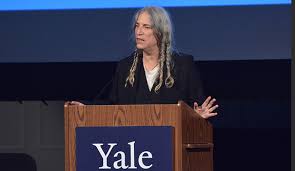
I hadn’t heard of Patti Smith before reading Devotion, her slim volume of 112 pages that expands upon her lecture presentation at Yale (2016), initiating the Windham-Campbell series, “Why I Write.”

Rock aficionados remember Smith for her punk-rock as a singer with her own band and award-winning albums.  Politically, her “People Have the Power” became the theme song for Ralph Nader in his 2000 campaign for the presidency. In 2007, she was admitted into the Rock and Roll Hall of Fame. Rolling Stone ranks her among the top 100 rock artists of all time.

She isn’t the norm among rock artists. A gifted painter, poet, and memoirist, she has achieved eminence both at home and abroad for her literary achievement, winning America’s most prestigious prize, The National Book Award for her memoir, Just Kids (2010), sharing company with the likes of Faulkner, Bellow, Didion, Ellison, Auden and Roth. Earlier (2005), France awarded her one of its most prestigious cultural honors, “Commander of the Order of the Arts and Letters.”

Smith is an ardent francophile, with a special love for symbolist poet Arthur Rimbaud. Devotion largely takes place in France, with Simone Weil and Albert Camus receiving special attention.

I stumbled upon the book when I was alerted to Good Reads during our national lockdown and Devotion got mentioned. Years ago, I had read J. M. Cameron’s early biography of the French mystic, Weil, whose posthumous writings became influential. Not least, I’ve always been enamored with Albert Camus. Their presence in the memoir drew me in.

Devotion is divided into three sections, the first and last forming a frame for a fictional narrative of sixteen year old Eugenia, and her fateful liaison with much older Alexander and his exploitation.

In the first portion, we breathe Paris everywhere, its hotels, streets, restaurants, and artist luminaries. Voltaire, Nabokov, Genet, Joyce, Weil, Camus, Modiano—they hover over the City of Light, silent emissaries of the imagination, catalysts of its powers, instigators of imitation. It’s the France I love.

Smith provides readers here with antecedents, or fragments of what we experience, often unwittingly, if not hazardly, of encounters that surreptitiously have a way of becoming part of us, influencing who we are and become.

Devotion doesn’t define the imaginative process. It demonstrates it, and thus the fictional tale at its center, an amalgram of subtle encounters in life’s passage, a mosaic the end result. As she tells us, “Most often the alchemy that produces a poem or a work of fiction is hidden within the work itself, if not embedded in the coiling ridges of the mind.”

Many readers dislike the narrative of Eugenia with its theme of alienation from what gives solace and fulfillment, ending tragically, as its center placement implies: the raison d’etre of Devotion, the essence of imagination’s weaving, or of what Smith fondly calls “alchemy” in the fusing of inchoate elements into an assemblage of unified nuance.

Eugenia, is an Estonian survivor, escaping the deportation of thousands of Estonians to Siberia by a paranoid Stalin during World War II, and owes her genesis to a Martti Helde documentary trailer called Risttuules, translated as In the Crosswind.

Similarly, Eugenia’s studied pursuit of ice skating had its source in Smith’s admiration for a sixteen year old Olympic Russian skater she saw on TV. Smith had no previous experience with the sport.

Weil is important as well in her separation at an early age from her mother through war and Jewish ancestry. Eugenia likewise experiences maternal loss, ultimately learning that her paternal grandmother was Jewish. Like Weil, Eugenia is shy, sensitive and highly intelligent, incorporating Smith’s decision to fuse the physical and intellectual in her protagonist. Writers not only imbibe, they invent.

Eugenia yearns to know her family’s history, having been raised by her mother’s sister, Irna, to keep her safe from the Soviets. She tries to recoup the past “in a futile effort to uncover a father’s eyes, a mother’s face.“

Smith’s pastiche of myriad contributory sources underscores writing as an act of retrieving the past, of making time palpable, of discovering who we are, often unknowable, or as Irina comments in her letter near the story’s end, “There are no signs that tell us who we are. Not a star, not a cross, not a number on the wrist. We are ourselves.”

Artists must be free to hone their craft. Alexander nicknames Eugenia “Philadelphia,“ central in America’s quest for freedom. When he ties her hands late in the story, he symbolically shackles that freedom and pays its consequences:

“Yes, Philadelphia, a hotbed of freedom,“ she said, pulling the trigger.

(Smith grew up in Philadelphia. I did, too.)

Eugenia has been on an archetypal journey, crossing a continent, traversing an ocean, to sojourn on a new continent, now to return to an old. She subsequently enters Alexander’s apartment, reads his notes on presumably Camus’ The Myth of Sisyphus:

The text posed a philosophic examination of the question of suicide—Is life worth living? He (Alexander) had written in the margin that perhaps there existed a deeper question—“Am I worthy of living? Five words that shook her entire being.”

Thematically, Eugenia is an orphaned child, vulnerable in her need for affection, abandoned by her last relative at sixteen. She finds compensation in daily ice skating on a secret winter pond hidden in the woods and becomes very good at it. Stalked by outsider Alexander, she is lured away from her devotion to what sustains: “Her defining sense of self was completely entwined with the laces of her skates.”

Having lost her freedom and with it, her innocence, she enters into knowledge, and seeks freedom’s retrieval. Guilt, however, intrudes with its heavy weight and she cannot pay its cost. Earlier, she had asked her tempter of a better life, “What is the price of this privilege?” Social and cultural constructs have done their mischief: “… she vowed to never skate again. It was her penance, to deny herself the one thing she could not live without.”

Devotion manifests not only Imagination’s dynamism, but its necessity for artists to complete themselves.  In sum, Smith has delivered an embedded parable of the consequences of its loss. As she tells us near Devotion’s end, defining the writer’s mission, “What is the task? To compose a work that communicates on several levels, as in a parable, devoid of the stain of cleverness.”

In resuming the frame, we again return to non-fiction in real time, a gathering of additional antecedents informing the embedded narrative—this time, not Paris, but the South of France.

There is Smith’s successful search for poet Paul Valéry’s grave, similar to her search for Weil’s when back in England, having garnered her material. She stops at an older tombstone with the word DEVOULEMENT carved diagonally across its border and asks her friend, what it means. “Devotion,” he replies, and a title is born, resonating the discipline that engenders successful artistry.

I’m curious about this. Despite the anecdote’s implied explanation of the title’s source, we should remember Rimbaud had written a poem, “Dévotion.” Rimbaud is Alexander’s favorite poet, as in real life, Smith’s. It turns out, dévoulement isn’t the word the French employ for devotion as Rimbaud’s poem title indicates. It means “devolution,” i. e., regression to a lower level or abnegation, its synonym in French. Smith doesn’t speak French and reads its literature only in translation.

In a telephone interview, Smith says she first came upon Rimbaud in a bookstall in a Philadelphia bus station. Sixteen at the time, the same age when Eugenia meets Alexander, she saw Rimbaud’s photo on the cover of a 99 cent paperback edition of Rimbaud’s Illuminations, and found him “beautiful.” No money on her, she slipped it into her pocket. Dévotion is one of its poems (Tristram Fane Sanders, telegraph.co.uk, 9 November 2019).

It’s this third section I find Smith at her very best, so many sentences I’m underscoring, observant, moving, waxing poetic. She tells of receiving an invitation from Camus’ daughter, Catherine, to visit the family residence in Lourmarin near my favorite French city, Aix-en-Province.

She is given his bedroom, still housing his books, and access to his uncompleted manuscript, Le Premier Homme. She senses his presence, that affinity of one writer with another: “One could feel a sense of a focused mission and the racing heart propelling the last words of the final paragraph, the last he was to write.” True artistry, impelling its imitation, she senses the urgency, accompanied by confidence, to create her own.

There follows Smith’s compelling close, compe in its succinctness, unceasing in its resonance:

“Why do I write? My finger, as a stylus, traces the question in the blank air. A familiar riddle posed since youth, withdrawing from play, comrades and the valley of love, girded with words, a beat outside. Why do we write? A chorus erupts. Because we cannot simply live.”

–rj

Emily Brontë’s Faith Poem: “No Coward Soul is Mine”

I’ve always admired Emily Brontë’s Wuthering Heights as a supreme literary achievement. In teaching it over the years, its structural complexity, thematic depth, and passionate intensity never failed to astound me. Putting it another way, Wuthering Heights has haunted me, much like Catherine’s ghost at Heathcliff’s window.

Years ago, I had the good fortune to visit the parsonage where she lived out her brief life in Hayworth, Yorkshire. (Her father was a clergyman with Methodist leanings.) A cramped, but lovingly preserved house, eerily next door to the church cemetery, you could easily surmise the Brontë children were temporarily out and be back shortly and we could settle down to robust conversation over a pot of tea.

While we remember Brontë for her novel, she also wrote poetry, 200 poems in fact. Sadly, her sister Charlotte, renowned for Jane Eyre, subsequently revised many of them, adding whole lines, rewording others, attempting to widen their public appeal. Scholars, trying to recover Emily’s probable texts, have found her cramped script difficult to decipher.

Of her poems, “No Coward Soul Is Mine” is well-known and my favorite. Brontë wrote it in the context of her fateful illness from tuberculosis. I’m so fond of this poem that I’ve been tempted to memorize it. I could almost think I was reading Emily Dickinson with its dismissal of religious orthodoxy and affinity for nature. That same fierce voice element of Wuthering Heights, perhaps a Wesleyan revivalism influence, you’ll find here, carried out by its heavy trochees as in the poem’s initial two lines or lines one and three of stanza five with their opening trochee feet.

You can be a non-believer and still appreciate the poem, for good poetry offers reading variance, or to borrow from medicine, “referral” nuance through well-crafted interweave of image, structure and diction. Our mortality spells change, not ending; a return to Nature’s genesis, or to what was, and is, and will always be.

No Coward Soul of Mine

No coward soul is mine
No trembler in the world’s storm-troubled sphere
I see Heaven’s glories shine
And Faith shines equal arming me from Fear

O God within my breast
Almighty ever-present Deity
Life, that in me hast rest,
As I Undying Life, have power in Thee

Vain are the thousand creeds
That move men’s hearts, unutterably vain,
Worthless as withered weeds
Or idlest froth amid the boundless main

To waken doubt in one
Holding so fast by thy infinity,
So surely anchored on
The steadfast rock of immortality.

With wide-embracing love
Thy spirit animates eternal years
Pervades and broods above,
Changes, sustains, dissolves, creates and rears

Though earth and moon were gone
And suns and universes ceased to be
And Thou wert left alone
Every Existence would exist in thee

There is not room for Death
Nor atom that his might could render void
Since thou art Being and Breath
And what thou art may never be destroyed.

The poem’s imagery, drawn from nature, supports the poem’s theme of Deity’s abiding presence. Composed of seven quatrains, reminiscent of Methodist hymnody, in alternating tetrameter/pentameter meter, rime occurs consistently throughout, lines one with three, and two with four, including the fourth stanza with its near rime, suggesting a purposive, or teleological, cosmos.

Brontë effectively softens “the world’s wind-troubled sphere” in line two of the initial stanza with alliteration, suggesting tranquility in context of storm.

Each sentence is declarative, resonating conviction. Unlike Tennyson’s “In Memoriam,” there is absence of tension, no struggle with doubt in the persona’s resolute faith, “So surely anchored on/The steadfast rock of immortality” ( Stz. 4).

Emily’s God isn’t Dickinson’s transcendent, mysterious, removed deity or Blake’s “No bods’ daddy.” Refulgent in his creation, He lives in our hearts, canceling any fear we might otherwise have, given the “world’s storm-troubled sphere” (Stz. 2). A poem of faith, it finds its affirmation not through anthropomorphic rendering, but in a pantheistic vision of Deity’s universal immanence.

Stanzas 3 and 4 logically follow in their rejection of creedal orthodoxies that are but worthless speculations, promoting anxiety, not peace. The repeated use of “vain” proves double entendre, human speculations fruitless and conceited, or of no more significance than the “idlest foam” of an infinite ocean:

Vain are the thousand creeds
That move men’s hearts, unutterably vain,
Worthless as withered weeds
Or idlest froth amid the boundless main

To waken doubt in one
Holding so fast by thy infinity,
So surely anchored on
The steadfast rock of immortality.

The stanzas that conclude the poem reiterate the persona’s vibrant faith in a deity who transcends the temporal, “Thy spirit animates eternal years,” and for all the volatile elements of impermanence, remains its arbiter, Who maternally “sustains, dissolves, creates and rears.”

Were the very cosmos to disappear, He would remain, for He is creation’s essence. The plural “universes” of the penultimate stanza intrigues. Did Emily believe in the modern concept of multiple universes? Whatever, God is infinite, boundless, present always:

Though earth and moon were gone
And suns and universes ceased to be
And Thou wert left alone
Every Existence would exist in thee.

How then can there be any cowering at death’s door? A deity synonymous with Nature, He is what has been, is now, and will be, the effulgence of it all:

There is not room for Death
Nor atom that his might could render void
Since thou art Being and Breath
And what thou art may never be destroyed.

Brontë dated her poems and wrote “No Coward Soul of Mine” on January 2, 1846. It would be her last poem (she passed two years later at age 30). At the time of the poem’s composition, she’d been completing Wuthering Heights. Emily Dickinson came upon this poem and loved it. She asked it be read at her funeral, her wish fulfilled by her friend and later editor, Thomas Wentworth Higginson, at the funeral’s conclusion.

As for Brontë, following several labored days, she slipped into eternity on December 19, 1848, unafraid, and deeply mourned by her sisters, Anne and Charlotte, and canine friend, Keeper. As with Keats, a young talent struck down early by the same illness, her posthumous fame has restored her to us, though not without conjecture of future talent lost.

As I said at the outset, the poem endures as a favorite of mine, one I’d take gladly to a desert isle, or read repeatedly when my last day summons. It accompanies me, too, when I engage Nature in the present, the sense of a hovering spirituality, that everything is linked, and means, and infinitely bigger and grander than ourselves.

–rj

The Fate of our Animal Friends in Pandemic Times

The untold suffering of our animal friends, victims of collapsing slaughter houses in the wake of mass worker viral infections, is so manifest it shouldn’t be ignored. It isn’t just Asian wet markets that need closing, though China bristles in denial, but industrial farming here at home, latent with cruelty, harbinger of disease, pervasive in despoiling the earth and advancing climate change. We rightly become angry at those who selfishly resist public safeguards like wearing masks and practicing social distancing yet, hypocritically, continue to crave meat that perpetuates such wrongs. I’m not asking you to become vegan, but at least reduce your intake of meat. Let’s get rid of this institutionalized mass cruelty. There are better ways.

This morning’s Guardian informs us that “at least two million animals have already reportedly been culled on farms, and that number is expected to rise. Approved methods for slaughtering poultry include slow suffocation by covering them with foam, or by shutting off the ventilation into the barns.” I’ll not even tell you about the plight of pigs, those most remarkably sentient animals.

Peter Singer, the world’s renowned ethicist, makes good sense to me and, hopefully, to you:

“It is tragic that countries such as China and India, as they become more prosperous, are copying western methods and putting animals in huge industrial farms. If this continues, the result will be animal suffering on an even greater scale than now exists in the west, as well as more environmental damage and a rise in heart disease and cancers of the digestive system. It will also be grossly inefficient. As consumers, we have the power – and the moral obligation – to refuse to support farming methods that are cruel to animals and bad for us.”

—rj

Rachel Carson’s Silent Spring: An Earth Day Tribute


I’ve just finished reading Rachel Carson’s classic Silent Spring, written back in 1962, but still timely. President Kennedy read it eagerly, followed by Nixon in a time when presidents read books. (President Obama is another omnivorous reader in our own time.) Nixon was so deeply affected, that he founded the Environmental Protection Agency (EPA) as a safeguard.

I first became aware of the book in teaching college English composition classes where it appeared as an anthology excerpt, modeling sound expository writing. While Carson had written a thoroughly researched book steeped in chemical analysis, she did so in a way that rendered science transparent to the public, fostering its appeal, unlike a rival text written on the same topic that virtually no one read outside the science community.

Carson’s work models not only coherent analysis at its best, but delivers its thesis with a lyrical beauty underscoring its urgency and moving readers to call for policy change. In a letter to her close friend, Dorothy Freeman, she would write, “Once the emotions have been aroused—a sense of the beautiful, the excitement of the new and unknown, a feeling of sympathy, pity, admiration and love—then we wish for the knowledge of our emotional response. Once found, it has lasting meaning.”

A perfectionist, she researched exhaustively and revised continually, concerned not only with message, but delivery. She had begun her college days as an English major before switching to biology. Carson composed Silent Spring while battling aggressive breast cancer, initially misdiagnosed. She had planned to write four other science books. The miracle is that she produced anything at all.

Since those days of teaching writing and my growing commitment to the green movement and awareness of the existential, exponential threat of climate change, I have wanted to return to her foundational work. I’m not sure how many of us are into eco-literature and Silent Spring or her other noted works, The Sea Around Us (National Book Award Winner) and best selling, The Edge of the Sea, but I knew reading it fully was something I just had to do to do, not least, to honor her—she passed so quickly from us after Silent Spring—but also as a means to gauging our progress in addressing her concerns.

Silent Spring deals with the havoc waged by land, sea, and air to the environment through indiscriminate use of pesticides by federal, state and local communities in support of economic interests, e.g., logging, agriculture, community agendas, heedless of consequences, repeatedly so, even when evidence of harmful repercussions had proven pervasive. An act of willful hubris, a genocide against nature, it resembles our own era when fossil fuels, primary contributors to a changing climate, continue as principal sources of energy reliance.

Silent Spring can be painful reading in its strident account of corporate interests in liaison with government, pillaging our environment and disregarding human welfare. Today, nearly every plant, and animal, including ourselves, even where spraying has ceased, show chemical residue. Species have been sharply reduced, disturbing a complex ecology, while augmenting pest resistance and promoting cancer proliferation.

There was a strange stillness. The birds, for example—where had they gone? Many people spoke of them, puzzled and disturbed. The feeding stations in the backyards were deserted. The few birds seen anywhere were moribund; they trembled violently and could not fly. It was a spring without voices. On the mornings that had once throbbed with the dawn chorus of robins, catbirds, doves, jays, wrens, and scores of other bird voices there was now no sound; only silence lay over the fields and woods and marsh.

All of this fallout unnecessary, for safer biological tools had proven successful, yet still, the spraying continued. The corporate sector, spending $250,000, a huge sum at the time, resisted Carson’s assault, much like today’s Monsanto, arguing correlation not establishing causality, and disparaging Carson’s credentials: no Ph. D, no standing in the science community, no academic affiliation, a “bird lover,” her followers, “health quacks.” Shockingly, the American Entomological Society listed Velsicol, Monsanto, Shell Chemical Company, and other chemical corporations among their “sustaining associates.” One major pesticide firm threatened her publisher, Houghton Mifflin, with a lawsuit if the book were published without changes.

Carson was understandably surprised by the book’s smashing success, selling 65,000 copies in its first two weeks and its subsequent Book of the Month Club selection.

Against all odds, Silent Spring had found its way into the public’s consciousness. DDT was halted, though hypocritically allowed for export, much like cigarettes later on. As noted, the EPA came into being as the book’s consequence. In 1981, years after her passing in 1964, Carson was posthumously awarded our nation’s highest civilian honor, The Presidential Medal of Freedom.

Sadly, Carson’s critics have continued their assaults, covertly changing their tactics and employing political correctness. The late science fiction novelist, Michael Crichton, for example, a vociferous climate change denier, branded her “a mass murderess” for the ultimate banning of DDT and deaths of millions of African children from malaria, while others have dismissed her as a white elitist. They ignore that DDT was actually banned only domestically, subsequently proven ineffectual against increasing mosquito resistance abroad, and replaced by newer, more effectual pesticides and innovative pharmaceuticals to contain malaria. Ironically, Carson hadn’t actually called for its banishment, but for its judicial use along with other pesticides.

Among poisonous chemical substances Carson addressed in Silent Spring, herbicides continue as a primary public menace, particularly for gardeners using the ubiquitous box store Roundup. There have been three trials involving pesticide giant Monsanto, two in state courts and the other in federal court, with up to 100,000 plaintiffs, alleging resulting non-Hodgkin lymphoma and consistent Monsanto coverup. Significantly, on March 19, 2018, a unanimous jury found Monsanto culpable and $25 million was awarded to plaintiff Edwin Hardeman.

Dismayingly, Trump’s EPA has currently sanctioned Monsanto’s employment of a new crop herbicide, dicamba, resulting in widespread crop damage, and Monsanto’s presently facing legal intervention by the Ninth Circuit Court of Appeals. As with the frequent scenario Carson underscored in Silent Spring, corporate priorities like those of Monsanto have plunged headlong into pressing economic gains, even when their own studies revealed imminent liabilities, conspiring with the EPA to soft-pedal the herbicide’s dangers:

Documents filed in court show Monsanto met multiple times with EPA officials about the concerns, even editing EPA language about certain steps Monsanto should take in communications with retailers. In an October 2017 email, an EPA official forwarded a Monsanto official comment from the agency regarding the company’s product label, writing: “Like I said, no surprises.” (Carey Gillam, The Guardian, April 2, 2020).

After so many years, Carson’s legacy continues. The Sea Around US (1951) and Silent Spring have been translated into more than forty languages, with the latter averaging 25,000 sales annually. A collection of Carson’s unpublished work appears in Lost Words: The Discovered Writing of Rachel Carson., ed. Linda Lear (1998). For a biography, and there are several, I would begin with M. H. Lytle’s thorough and cogent, The Gentle Subversive: Rachel Carson, Silent Spring, and the Rise of the Environmental Movement (2007).

I’m glad to have read Silent Spring, which launched the modern day environmental movement, and unhesitatingly regard her as one of the foremost women of the last one-hundred years, unflinching, passionate, yet empirically based in her environmental witness. I end with the final paragraph of Silent Spring:

The “control of nature” is a phrase conceived in arrogance, born of the Neanderthal age of biology and philosophy, when it was supposed that nature exists for the convenience of man. The concepts and practices of applied entomology for the most part date from that Stone Age of science. It is our alarming misfortune that so primitive a science has armed itself with most modern and terrible weapons, and that in turning them against the insects it has also turned them against the earth. 

–rj

Sally Rooney: Up to the Hype?

I took up reading Irish literary sensation Sally Rooney to find out what the fuss was all about. After all, she’s only twenty-eight and has written two novels that have rocked the literary world, Conversations with Friends (2017) and Normal People (2018), dubbing her the gatekeeper of the millennial generation. Saying you’ve read Rooney is the new chic.

Where does such youthful sagacity come from, that sureness of stroke distilled in cerebral awareness of the ambiguity, especially defining relationships, of society’s cultural constructs, social, political, and economic? Adding to the enigma, why attempt sorting out others, when we’re a mystery to ourselves as her characters abundantly demonstrate?

Rooney is a graduate of prestigious Trinity College, which becomes the principal foreground of Normal People. Its graduates include luminaries like Bram Stoker, George Berkeley, Edmund Burke, Samuel Beckett, Oscar Wilde, Jonathan Swift, William Trevor and Mary Robinson. Rooney received a master’s degree from Trinity in American literature.

She has the smarts. No one doubts that. As for her two novels, if you’re into politics, especially the progressive kind, you’ll rollick to their beat, both novels pounding the political turf with trendy leftisms, fashioned in the aftermath of the market collapse of the Celtic tiger economy in 2008 and Rooney’s own upbringing in a Marxist household. Good novelists are inevitably iconoclasts and Rooney’s two novels, love stories, don’t disappoint in this regard. The question is how well she succeeds.

Conversations with Friends is narrated in first person by Frances, a bisexual communist in love with a married man, Nick, in a dysfunctional marriage. Her political sentiments come early and uncompromisingly when confessing to Nick that she had sex recently with a guy she met on Tinder, an admirer of Yeats, whom she earlier dismisses as fascist: “No one who likes Yeats is capable of human intimacy.”

Wage inequity arises in Conversations and discourages Frances from seeking work, a sentiment shared by many unemployed or under-emplored millennials these days:

I had no plans as to my future financial sustainability: I never wanted to earn money for doing anything. […] I’d felt that my disinterest in wealth was ideologically healthy. I’d checked what the average yearly income would be if the gross world product were evenly divided among everyone, and according to Wikipedia it would be $16,100. I saw no reason, political or financial, ever to make more money than that.

In Normal People, both Connell and Marianne worry about employment, even though they’re academically achieving university students. Marianne is unfailing in dotting the i’s and crossing the t’s in her ripostes of leftist student platitudes.

Marianne comes from a well-situated family; Connell, from a working class, single mother household. Class dialectic underlines a fundamental tension between the two, save there’s no genuine synthesis, despite their mutual love.

Connell’s mother is a housecleaner in Marianne’s parents’ upscale home. Ironically, she’s a disillusioned socialist, who undermines with laughter Connell’s recent enthusiasm for a local communist candidate:

Come on now, comrade, she said. I was the one who raised you with your good socialist values, remember?

Connell texts the disappointing election results of Fine Gael’s victory to Marianne who replies, “The Party of Franco,” alluding to the sending of a brigade of 700 combatants supporting the Nationalists in Spain’s civil war, despite the party’s official neutrality status. Connell has to look up the history. Rooney has a history of never letting her Leftist orthodoxy tolerate perceived apostasy.

Although sex is paramount in both novels, replete with minutiae and underscore’s women’s sexuality and love, it pervasively mutates into pathology, or power constructs, contributing little to promoting where the narratives should be headed—the social interchanges with others that comprise our identities and potential for self-realization. In relationships of disparity, subordinates, like Frances or Marianne, may utilize sex to approximate getting what they want, but cannot have. So much of this comes down to, Am I worthy of love? Replete with self-analysis as provender of self-mastery, it sputters into repetitive ineffectuality.

If anything, sex in these novels mirrors momentary catharsis, not sequels of emancipation from social, or class, determinants. Except for Bonni, in Conversations with Friends, the characters would do well with a bit of professional counseling. Supposedly in love but enmeshed in self-interest, characters in both novels emotionally engage in mutual tug of war.

Psychologically, Conversations with Friends and Normal People exhibit all the trademarks of co-dependency. Nick and wife, Melissa, for all their mutual infidelity, will not abandon their marriage. Nick, not incidentally, suffers from chronic depression and has been an in-patient at a psychiatric hospital. Marianne engages in self-injury behavior, symptomatic of deep-seated anxiety and self-loathing. Similarly, she hooks-up with a BDSM artist while a student in Sweden. In one scene, she wants Connell to throw her out of bed. Connell lacks self-confidence and resembles Nick in his depression. Rooney foreshadows in Conversations the self-inflicted masochism we see in Normal People, Frances ruminating about Nick, “I wanted him to be cruel now, because I deserved it. I wanted him to say the most vicious things he could think of, or shake me until I couldn’t breathe.”

But let’s talk about the writing itself. Both novels are like Twitter exchanges rather than vibrant telling. Language seems almost an intrusion in the short, blunt dialogue that frequently consists of text messaging and emails absent of punctuation and capitalization, not atypical of millennials. Quotation marks never occur in these novels to demarcate speakers, a mannerism serving no purposeful function other than an underlying contrariness that earmarks her essays and interviews. Normal People meanders into cliches, and not very good ones at that.

Absent of artifice, devoid of symbol or pattern, these novels read more more like sociology texts, laconic and, worse, so continuous, they provide no real climax or meaningful denouement leading to resolution. Despite the politics, there’s no genuine revolt and we end in stasis, or where we began. At Normal People’s end, Connell still waxes control, with Marianne’s validation dependent on his acceptance in what seems a rushed ending. You’ve got oppression without liberation. Sadly, both Frances and Marianne are non-assertive women in symbiotic relationships. There are no breakthroughs.

Whether these two novels merit their accolades, they do mirror the lifestyle of many millennials today, less sure of their futures than their parents were, rebellious against traditional mores, steeped in social media, while religiously and politically cynical. Both novels are trendy, but is this enough?

Out of curiosity, I wandered over to Goodreads to view reader reactions. While Rooney has her coterie of enthusiasts, a fair number complained of a dullness in plot and characters fundamentally unhinged who you’d not like rubbing shoulders with in everyday life.

Having read both novels, I’ve gone on to reading Anita Brookner’s Hotel du Lac, a Booker Prize winning novel. No contest with lines such as “That sun, that light had faded, and she had faded with them. Now she was as grey as the season itself.” For me, Brookner wins hands down for insight, delivery, and relevance in depicting women’s efforts at finding emancipation in a patriarchal culture. Or as one critic put it long ago, “She makes some writers look a bit unsheveled and a little vulgar” (Rosemary Dinnage).

I think, too, of Edna O’Brien, Ireland’s preeminent feminist novelist hailing, like Rooney, from west Ireland and still writing at nearly ninety on similar themes of women’s internal lives, meriting a comparison to gain Rooney’s full measure, despite the generational divide. Like Rooney, she captured the essence of a new generation of women. In her formulae for writing, O’Brien comments, “Everything is very important – the landscape, the story, the character – but the rhythm and musicality and the spell of language, that’s what it is. Otherwise you’d put it on a postcard” (Irish Times, Nov. 7, 2015). I wish Rooney had taken note.

I like to think we really need something like fifty years to objectively validate a novel and, say, judge it a classic. Will posterity still read Hotel du Lac come fifty years? I’d wager yes. Not so for Conversations With Friends or Normal People.

We’d do better to heed critic Harold Rosenberg’s observation about generational thinking: “Except as a primitive means of telling time, generations are not a serious category. The opinions of a generation never amount to more than fashion. In any case, belonging to a generation is one of the lowest forms of solidarity.”

–rj

Morning Routine Wins the Day

Yes, I admit to following a daily regimen that some may call being in a rut; but I much prefer its discipline, the empowerment it confers over my many infirmities and the peace it affords in keeping chaos at bay and getting things done. I believe the passions must be made obedient to the mind. Or as Epictetus put it, “One person likes tending to his farm, another to his horse; I like to daily monitor my self-improvement.” Virtue doesn’t fall upon us out of the blue. We must toil at it.

Since I’m writing about routine, Amy Landino has written a wonderful book on its potential for transformation, Good Life: 5 Simple Habits to Master Your Day and Upgrade Your Life. Her thesis is that a good morning creates a good life; in brief, beginning your day with a sound routine can promote well-being.

Movement: Do something to move your body. You can be ambitious and hit the gym right away. I prefer just a few simple stretches and massaging the muscles on my face. When you move your body a little, you wake up.

Mindfulness: It’s too easy to pick up the phone or turn the TV on when you don’t have anything else to do. Instead of resorting to those things, start with a practice that helps you generate your own original thoughts or ideas. Meditation works for some people.

Mastery: Focus on something that you’ve been meaning to get around to or that you’re passionate about. Have you been wanting to learn a foreign language? Start the day going through flashcards or using a training app. When you make time to master something, you aren’t allowing yourself to stay stuck on the hamster wheel of the everyday.

That’s it, a simple routine with large dividends. Allons-y! Go for it!

–rj