The Shouting Silence

D.G. Chapman, Upsplash

Silence has always allured me, most often when it is bound to expanses empty of people—though not always. I can find it just as readily in a library, or even in my own home when left to myself.

It is not, I believe, a resistance to an oppressive environment—work, academics, trauma, peer pressure, or the quotidian churn of human caprice—what psychiatry terms “psychological reactance.” It goes deeper than that, perhaps rooted in my introversion, which inclines me away from crowds and constant social encounter.

I carry memories of three landscapes that produced instant rapture: a sense of detachment, of absence from time itself—something larger than me, and yet intimately felt.

The first occurred when I was a graduate student in North Carolina, visiting the hillside at Kitty Hawk where the Wright brothers first achieved sustained flight in their ungainly aerial contraption. I had gone with friends, who wandered along the beachfront below, leaving me alone atop the hill. There, history seemed to recede. The wind moved through the grass, the sky stretched open and unmarked, and for a moment the present dissolved, as though time itself had paused in reverence.

Then there was Arlington National Cemetery, its vast rows of symmetrical white grave markers extending beyond easy comprehension. The stillness there was not empty but weighted, a silence shaped by collective sacrifice. For a brief moment, the eternal peace of America’s fallen became my own.

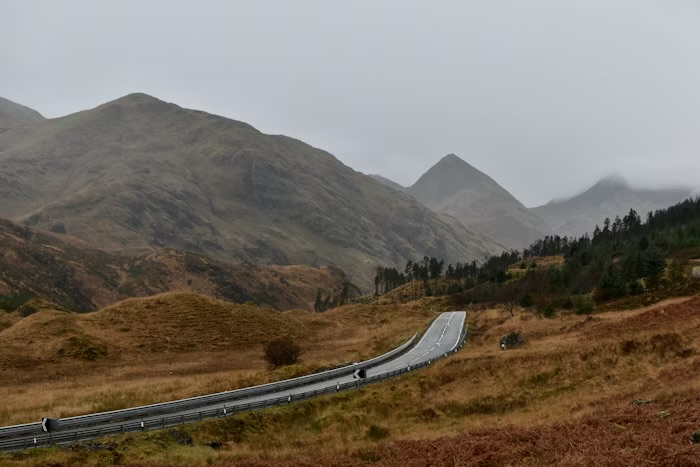
Most memorable of all were Scotland’s Highlands. Driving eastward from Edinburgh, they rose suddenly and unexpectedly across the horizon—rugged, green, and seemingly untouched by human intrusion. I pulled over, stepped out, tested the firmness of their verdure beneath my feet, and listened to what I can only call their shouting silence. That moment remains my most cherished travel memory.

As an English major in college, I once took a course devoted entirely to Wordsworth—England’s great poet of landscape. I am, perhaps, a rarity in having read all of his several hundred poems. Among them, “Tintern Abbey” most fully captures my response to those landscapes:

“…that serene and blessed mood,
In which the affections gently lead us on,—
Until, the breath of this corporeal frame
And even the motion of our human blood
Almost suspended, we are laid asleep
In body, and become a living soul…”

Literary scholars describe this response under the notion of the sublime: the experience of being overwhelmed through intimacy with nature, a flash of clarity in which one intuits a larger coherence behind nature’s mystery. Wordsworth gives it further voice:

“And I have felt
A presence that disturbs me with the joy
Of elevated thoughts; a sense sublime
Of something far more deeply interfused,
Whose dwelling is the light of setting suns,
And the round ocean and the living air,
And the blue sky, and in the mind of man….”

Psychology approaches the experience from another angle. One theory frames it as a sensory reset—the mind’s need to unburden itself from obligation and affliction, a release from the cognitive overload of daily life.

I am especially drawn to E. O. Wilson’s Biophilia Hypothesis, which proposes that humans evolved in constant contact with nature, calibrating the nervous system through millennia of hunter-gatherer life. In that context, a deserted landscape could signal safety—the absence of predators, permission to rest.

Another perspective, the Default Mode Network, suggests that quiet environments can trigger awe by suspending habitual rumination. Freed from constant external demands, the mind drifts toward reflection, memory, and imaginative connection. In such moments, the brain is allowed to hear the rhythms it evolved to monitor.

This makes intuitive sense. We live in a world saturated with anthropophonic noise—human-made sound without pause or mercy. Though nature is never truly silent—wind, water, and the subtle movements of life persist—these sounds soothe rather than assault. They restore rather than demand.

Wordsworth seems to anticipate this longing even in the heart of the city. In “Composed upon Westminster Bridge, September 3, 1802,” he finds London redeemed by a rare moment of stillness:

“Earth has not any thing to show more fair:
Dull would he be of soul who could pass by
A sight so touching in its majesty:
This City now doth, like a garment, wear
The beauty of the morning; silent, bare,
Ships, towers, domes, theatres, and temples lie
Open unto the fields, and to the sky;
All bright and glittering in the smokeless air.
Never did sun more beautifully steep
In his first splendour, valley, rock, or hill;
Ne’er saw I, never felt, a calm so deep!
The river glideth at his own sweet will:
Dear God! the very houses seem asleep;
And all that mighty heart is lying still!”

Perhaps silence, then, is not an absence but a presence—one that returns us to ourselves, quiets the mind’s noise, and restores a way of listening we once possessed, and have not entirely forgotten.

Convergence: Seeing Others as Ourselves

I’ve been keeping a list for some time of my favorite blogs. There are so many to choose from that discovering one capable of sparking genuine enthusiasm often feels like chance—like gazing nightly at the starry heavens and marveling at what lies beyond human reach. When such a blog does appear, it draws me back again and again, not out of habit but wonder.

Relying on that list, I came upon a short paragraph-poem this morning by Dr. Drew Lanham, the award-winning African American professor of environmental studies at Clemson University. Lanham confesses to being “a man in love with nature—a wanderer finding foundation in wild places.” What follows is both intimate and expansive:

Handle my life in your hands as if it were your own. Feel the heart beating—small as it may be—and imagine it in your own chest. Beating in syncopated time to become shared meter. That pulse, the breathing, is your rhythm. Your in’s and out’s, its in’s and out’s. Look close under
whatever warty skin or soft fur or gaudy feathers and see self. Its being is your being. Be in that same skin for what moments it will allow. Then, when the convergence between you is sealed, release that wild soul to free roaming as you would desire of your own.

What strikes me is the poem’s quiet tone: a persona grounded in kinship with the natural world, alive with empathy for the vulnerable. Applied beyond nature—to our fellow humans—it gestures toward something transcendent: a way of bridging difference, whether of creed, ethnicity, or race.

Such bridging begins only when we recognize our linkage, when we are willing, even briefly, to see ourselves in others—“Be in that same skin for what moments it will allow.”

Lanham wrote this poem after rescuing a frog from his cat’s pursuit.

Celebrating Emily Dickinson’s Birthday

Yesterday, Dec. 10th, marked the 194th birthday of Emily Dickinson (b. 1830), one of America’s most gifted poets.

Her love of nature, keen observations on life’s ironies, and daring truthfulness won me over early. I know of no poetry with more nuance.

Of her many poems, my favorite is “A Wounded Deer Leaps Highest” with its nature analogies exhibiting the incongruity of the outer appearance with the inner reality. We are often masters at concealing life’s griefs.

Though I’ve visited The Homestead (Amherst , MA) on several occasions, I’m ready to visit again to take-in the Dickinson Museum updates, which include the restoration of Emily’s beloved garden, her father’s gifted conservatory to Emily and her sister, Lavinia, and the recently completed reconstruction of the family’s carriage house.

In short, The Homestead is my literary Mecca, as there is much in Emily’s sensibility that resonates with me.

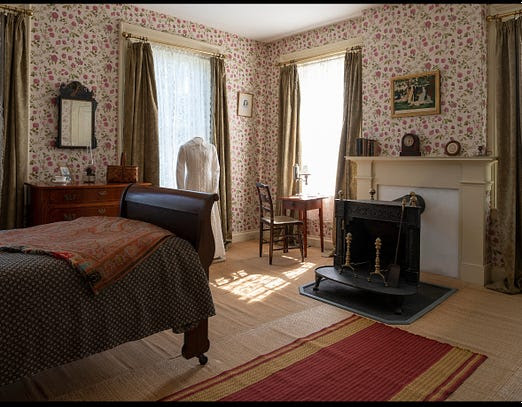
Below, Emily’s upstairs bedroom where she composed her nearly 2000 poems and many letters:

It was cerebral musician Patty Smith who reminded me of Dickinson’s birthday in her substack post, replete with quotations from her poems and letters.

I’m repeating them here, as they superbly express Dickinson’s keen sensitivity and writing acumen. Smith observes that any of them would serve well as a writing prompt:

“Forever is composed of nows.”

“I am out with lanterns, looking for myself.”

“We turn not older with years but newer every day.”

“The soul should always stand ajar, ready to welcome the ecstatic experience.”

“I know nothing in the world that has as much power as a word. Sometimes I write one, and I look at it, until it begins to shine.”

“That it will never come again is what makes life sweet. Dwell in possibility. Find ecstasy in life; the mere sense of living is joy enough.”

“If I read a book and it makes my whole body so cold no fire can warm me, I know that is poetry. If I feel physically as if the top of my head were taken off, I know that is poetry. These are the only ways I know it. Is there any other way?”

“Not knowing when the dawn will come, I open every door.”

“The dearest ones of time, the strongest friends of the soul–BOOKS.”

“The lovely flowers embarrass me. They make me regret I am not a bee…”

“I don’t profess to be profound; but I do lay claim to common sense.”

“Life is a spell so exquisite that everything conspires to break it.”

“Whenever a thing is done for the first time, it releases a little demon.”

“To shut your eyes is to travel.”

“your brain is wider than the sky”

“How do most people live without any thought? There are many people in the world,–you must have noticed them in the street,–how do they live? How do they get strength to put on their clothes in the morning?”

“I have been bent and broken, but -I hope- into a better shape.”

–RJoly