Childhood Should Be Our Eden

Childhood should be our Eden, a time for innocence before the shadows come and we lament its loss.

This morning I’m enjoying my romp in Joy Sullivan’s Instructions for Traveling West Poems, a collection of her prose poems, reminiscent in many ways of beloved Mary Oliver’s peace-conferring verse. Sullivan lived her childhood in Africa, the daughter of medical missionaries.

In one poem that means much to me, she shares her memory of untainted innocence that helps us recover our own dormant memories of a garden world we cannot enter again:

“Growing Up”

All I could think about
was filling these cups
and staining these lips and being some new kind of loveable. All the while, my mama in her quiet, weary way: one day, you’ll wish for this time without worry. No one can really ever warn you how the world is a thick leather boot. A midnight car slowing down. An oil spill. A matchstick.

I miss the girl my mother still could see— unadorned, untired. The one, at dusk, who followed the dog into the woods unafraid.

—rj

Out of Nowhere: Gaza in Poetry

I’m about to eat breakfast, but I feel guilty for the good life I wake to daily when so much of the world, removed from our shores, knows only war, destruction, death, and incalculable grief: Sudan, the Democratic Republic of the Congo, Ukraine and Gaza. Still others.

I am moved by Palestinian-American poet and physician Fady Joudah’s recent poem about Gaza. The death toll, vastly civilian, now approaches 70,000.

Joudah has lost 100 members of his Gaza family. He has served as a volunteer with Doctors Without Borders.

Since his poem is under copyright, I can only share an excerpt:

“And out of nowhere…”

And out of nowhere a girl receives an ovation
from her rescuers, all men on their knees and bellies
clearing the man-made rubble with their bare hands, disfigured by dust into ghosts.
All disasters are natural including this one, because humans are natural.
The rescuers tell her she’s incredible, powerful,
and for a split second, before the weight of her family’s disappearance sinks her, she smiles,
like a child who lived for seven years above ground receiving praise.

PostScript:
Joudah is a winner of The Yale Series of Younger Poets Competition and long listed for the National Book Award for Poetry (2024).

—rj

Sorry Emerson: Money is NOT the Prose of Life

Ralph Waldo Emerson ranks high on any list of frequently quoted American sages. He has a special way of rendering human experience palpable.

Among his many essays, I’ve especially liked “Compensation,” which I first read as a young graduate student in an American Lit class.

Undoubtedly a residue of his exploration of Eastern thought, this essay has journeyed a lifetime with me in its karma undertones, buoying me up in its harbinger of moral recompense for life’s myriad inequities.

But on occasion, Emerson fumbled, as when he wrote that “money represents the prose of life, and which is hardly spoken of in parlors without an apology, is, in its effects and laws, as beautiful as roses” (“Nominalist and Realist,” Essays: Second Series, 1844).

Critics were quick to pounce, Marxists in particular seeing it as capitulating to capitalism. Emerson probably meant that the pecuniary is an integral component of the natural order.

Still, it seems a passage one wants to expunge like disturbing phlegm.

I like Saul Bellow’s correction: “Uch! How they love money, thought Wilhelm. They adore money! Holy money! Beautiful money! It was getting so that people were feeble-minded about everything except money. While if you didn’t have it you were a dummy, a dummy! You had to excuse yourself from the face of the earth!” (“Seize the Day”).

But let me also share psychologist and poet Pamela Joyce Shapiro’s response to Emerson’s remark. Her poem speaks for me and perhaps for you:

If money is the prose of life
as beautiful as roses,
poetry it seems must be
the soil and sun of infinity,
without which surely nothing grows.
I see the pleasures each might bring,
when flourishing in abundant spring.
Though stocks and petals tend to fall
in drought or storm or just because,
poetry survives it all.
What losses can define what loss is?
Waning wealth or stolen roses?
Forget the till and till the mind,
plant poetry and praise the sky.

rj


Why I’m Still Reading Yeats

I’ve always been a devotee of the poetry of William Butler Yeats, though not of his metaphysics or his politics. Certainly, his reception in Ireland over the years has been bleak, the latest hostile critic, contemporary novelist Sally Rooney piling on, dismissing his politics as fascist, with the takeaway he isn’t worth reading.

Though he flirted with authoritarianism, agitated by the chaos he associated with democracy, he supported the Free State and later repudiated Mussolini, whom he initially admired. He was never the likes of Ezra Pound. In one of his final poems, “Politics,” he expresses his disillusionment with political ideologies proffering easy remedies for society’s ills.

Yeats should not be judged removed from the convulsions that gave birth to an Ireland free of its English masters.

Ireland’s ostracizing of its literary giants has a long history, not only with Yeats, but James Joyce, Samuel Beckett, Frank O’Connor, Sean O’Faoláin, and the late Edna O’Brien, all of whom chose exile.

I bristle against censorship and book banning to which it often leads. Things are changing in Ireland, a nation I know well, but old attitudes can find an audience still.

Yeats remains worth reading, his poetry arguing for itself in its craftsmanship, beauty, and relevance. His often quoted “The Second Coming” hovers over us in its prescient warning of autocracy’s sinister reach.

“A Prayer for My Daughter” remains among my favorite Yeats poems—subdued in tone, subtle in rhythm, redolent in wisdom.

Written in 1919 in the context of Ireland’s incipient nationalism that would spark a civil war and the country’s ultimate partition, the poem expresses Yeats’ hopes for his new daughter in a less turbulent future.

A poem abundant in symbolism, Yeats prays she shun hatreds, value inner over external beauty, find solace in tradition and ceremony.

I value the poem, not least, for its relevance to our own time.

Excerpt:

May she become a flourishing hidden tree
That all her thoughts may like the linnet be,
And have no business but dispensing round
Their magnanimities of sound,
Nor but in merriment begin a chase,
Nor but in merriment a quarrel.
O may she live like some green laurel
Rooted in one dear perpetual place.

My mind, because the minds that I have loved,
The sort of beauty that I have approved,
Prosper but little, has dried up of late,
Yet knows that to be choked with hate
May well be of all evil chances chief.
If there’s no hatred in a mind
Assault and battery of the wind
Can never tear the linnet from the leaf.

An intellectual hatred is the worst,
So let her think opinions are accursed.
Have I not seen the loveliest woman born
Out of the mouth of Plenty’s horn,
Because of her opinionated mind
Barter that horn and every good
By quiet natures understood
For an old bellows full of angry wind?

This last stanza obviously alludes to Maude Gonne, who had become a strident voice of Irish nationalism and to whom Yeats had twice proposed marriage, but was rejected.

In 1990, I was privileged to meet and converse with Anne, the daughter in this poem.

Whatever our views on artists such as Yeats, or antisemite T.S. Eliot, or Chilean fervent communist Pablo Neruda, I subscribe to the autonomy of art. It’s narcissistic to think artists must share our views.

rj

What Makes It Poetry

I read a lot, but the genre that makes my heart beat faster is poetry,
doubtless because I’m a very feeling person.

A lot of what I read these days purports to being poetry when it isn’t.

I know I’m reading poetry when it becomes more than it is, words taking on nuance beyond themselves.

Often I find poetry in music. Take, for example, Bono’s “Grace,” transcending a girl’s name, to becoming extended metaphor of redemptive goodness:

Grace
It’s the name for a girl
It’s also a thought that
Changed the world
And when she walks on the street
You can hear the strings
Grace finds goodness
In everything

Another example would be the Beatles’ haunting “Eleanor Rigby,” exemplum of loneliness, or disconnectedness, hidden amid the crowd, but profoundly present:

Eleanor Rigby picks up the rice in the church where a wedding has been
Lives in a dream
Waits at the window, wearing the face that she keeps in a jar by the door
Who is it for?

All the lonely people
Where do they all come from?
All the lonely people
Where do they all belong?

This, my friends, is poetry!

Celebrating Emily Dickinson’s Birthday

Yesterday, Dec. 10th, marked the 194th birthday of Emily Dickinson (b. 1830), one of America’s most gifted poets.

Her love of nature, keen observations on life’s ironies, and daring truthfulness won me over early. I know of no poetry with more nuance.

Of her many poems, my favorite is “A Wounded Deer Leaps Highest” with its nature analogies exhibiting the incongruity of the outer appearance with the inner reality. We are often masters at concealing life’s griefs.

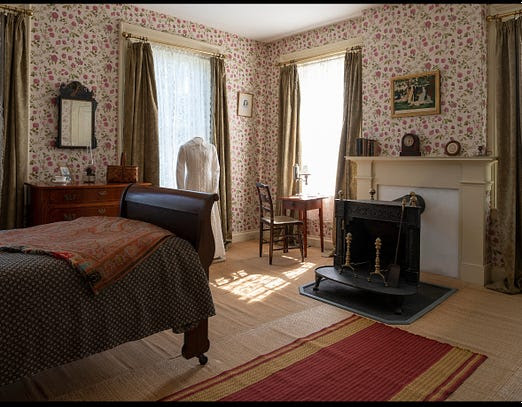
Though I’ve visited The Homestead (Amherst , MA) on several occasions, I’m ready to visit again to take-in the Dickinson Museum updates, which include the restoration of Emily’s beloved garden, her father’s gifted conservatory to Emily and her sister, Lavinia, and the recently completed reconstruction of the family’s carriage house.

In short, The Homestead is my literary Mecca, as there is much in Emily’s sensibility that resonates with me.

Below, Emily’s upstairs bedroom where she composed her nearly 2000 poems and many letters:

It was cerebral musician Patty Smith who reminded me of Dickinson’s birthday in her substack post, replete with quotations from her poems and letters.

I’m repeating them here, as they superbly express Dickinson’s keen sensitivity and writing acumen. Smith observes that any of them would serve well as a writing prompt:

“Forever is composed of nows.”

“I am out with lanterns, looking for myself.”

“We turn not older with years but newer every day.”

“The soul should always stand ajar, ready to welcome the ecstatic experience.”

“I know nothing in the world that has as much power as a word. Sometimes I write one, and I look at it, until it begins to shine.”

“That it will never come again is what makes life sweet. Dwell in possibility. Find ecstasy in life; the mere sense of living is joy enough.”

“If I read a book and it makes my whole body so cold no fire can warm me, I know that is poetry. If I feel physically as if the top of my head were taken off, I know that is poetry. These are the only ways I know it. Is there any other way?”

“Not knowing when the dawn will come, I open every door.”

“The dearest ones of time, the strongest friends of the soul–BOOKS.”

“The lovely flowers embarrass me. They make me regret I am not a bee…”

“I don’t profess to be profound; but I do lay claim to common sense.”

“Life is a spell so exquisite that everything conspires to break it.”

“Whenever a thing is done for the first time, it releases a little demon.”

“To shut your eyes is to travel.”

“your brain is wider than the sky”

“How do most people live without any thought? There are many people in the world,–you must have noticed them in the street,–how do they live? How do they get strength to put on their clothes in the morning?”

“I have been bent and broken, but -I hope- into a better shape.”

–RJoly

Ruth Stone: The Poetic Genius of Resilience and Reflection

I’ve been writing poetry or whatever it is since I was five or six years old, and I couldn’t stop, I never could stop. I don’t know why I did it.… It was like a stream that went along beside me, you know, my life went along here, and I got married and had three kids and did all the things you have to do, and all along the time this stream was going along. And I really didn’t know what it was saying. It just talked to me, and I wrote it down. So I can’t even take much credit for it.” — Ruth Stone

The late Ruth Stone’s poetry gives me goosebumps. It’s that good —observant, conversational, intimate, punctuated with humor, resonating life in all its undulations.

It’s Saturday afternoon. I lie here on my bed, going through Stone’s poems as the world pursues its daily tasks. Quietness is my paradise, allowing space to reflect on essentials that matter. Stone’s poetry does that well.

Ruth Stone (1915-2011) didn’t have it easy. A mother of three children, her husband committed suicide, plunging her into abject poverty. Her poetry prowess, however, earned her a piecemeal income through itinerant, short term teaching assignments at universities across America.

Between teaching gigs, she’d return to her home in Goshen, Vermont, crafting new poems and short stories, her talent earning her two Guggenheim awards.

Academy recognition came late. In 2002, she won the National Book Award for Poetry at age 87 (2002).

What puzzles me is that she remains widely unknown. Her poetry, abundant in robust metaphor, drawn from science and nature, stands on its own, defiant of imitation.

Stone saw life in all its teeming distillations, especially in regard to aging, about which she could be merciless.

Her death came in 2011 at age 96.

Her humble home in Goshen, soul of her prodigious output (13 books), has been designated a historical landmark and become a retreat for literary studies. Her informal grave is nearby.

Below, the Ruth Stone poem that fulfills Emily Dickinson observation on what makes for a good poem: “If I feel physically as if the top of my head were taken off, I know that is poetry…Is there any other way?” ( L342a, 1870):

“Always on the Train”

Writing poems about writing poems
is like rolling bales of hay in Texas.
Nothing but the horizon to stop you.

But consider the railroad’s edge of metal trash;
bird perches, miles of telephone wires.
What is so innocent as grazing cattle?
If you think about it, it turns into words.

Trash is so cheerful; flying up
like grasshoppers in front of the reaper.
The dust devil whirls it aloft; bronze candy wrappers,
squares of clear plastic–windows on a house of air.

Below the weedy edge in last year’s mat,
red and silver beer cans.
In bits blown equally everywhere,
the gaiety of flying paper
and the black high flung patterns of flocking birds.

—rj

“I Grant You Refuge”: Hiba Aba Nada’s Final Poem

Palestinian poet, novelist, and educator Hiba Aba Nada, age 32, wrote this poem ten days before her death in her home on October 20, 2023 from an Israeli bombing attack in south Gaza that killed many others. In the poem, God proffers an afterlife of refuge for the besieged and dying. In the closing verse, He assures the martyrs’ ultimate triumph:

1.
I grant you refuge
in invocation and prayer.
I bless the neighborhood and the minaret
to guard them
from the rocket

from the moment
it is a general’s command
until it becomes
a raid.

I grant you and the little ones refuge,
the little ones who
change the rocket’s course
before it lands
with their smiles.

2.
I grant you and the little ones refuge,
the little ones now asleep like chicks in a nest.

They don’t walk in their sleep toward dreams.
They know death lurks outside the house.

Their mothers’ tears are now doves
following them, trailing behind
every coffin.

3.
I grant the father refuge,
the little ones’ father who holds the house upright
when it tilts after the bombs.
He implores the moment of death:
“Have mercy. Spare me a little while.
For their sake, I’ve learned to love my life.
Grant them a death
as beautiful as they are.”

4.
I grant you refuge
from hurt and death,
refuge in the glory of our siege,
here in the belly of the whale.

Our streets exalt God with every bomb.
They pray for the mosques and the houses.
And every time the bombing begins in the North,
our supplications rise in the South.

5.
I grant you refuge
from hurt and suffering.

With words of sacred scripture
I shield the oranges from the sting of phosphorous
and the shades of cloud from the smog.

I grant you refuge in knowing
that the dust will clear,
and they who fell in love and died together
will one day laugh.


America’s Emissary: Walt Whitman

I’ve never formally studied Walt Whitman’s poetry, despite a graduate degree in English. That’s because I made Victorian Literature my major interest, with modern American and British Literature secondary. Still, I’ve read his landmark Leaves of Grass many times, America’s psalmody in its pioneering free verse; in its robustness, an encomium of America were it doing more than lip service to the American dream.

It says much about Whitman, out-of-joint with his generation much like contemporary Emily Dickinson, uncomfortable with the cultural shibboleths of middle class Amherst. Perhaps influenced by his father’s radical views on politics and religion, Whitman emerges an essential element of America’s constant of progressive rebellion, resistant to mercenary interests that gave us slavery, wealth inequality, desecration of nature, racial injustice, and imperialism.

If you’re looking for a summation of Leaves of Grass, nothing excels his “Credo” in the poem’s Preface. Conscious of America’s failure to live up to its promise, “Credo” exemplifies its gulf and champions its realization:

“This is what you shall do; Love the earth and sun and the animals, despise riches, give alms to everyone that asks, stand up for the stupid and crazy, devote your income and labor to others, hate tyrants, argue not concerning God, have patience and indulgence toward the people, take off your hat to nothing known or unknown or to any man or number of men, go freely with powerful uneducated persons and with the young and with the mothers of families, read these leaves in the open air every season of every year of your life, re-examine all you have been told at school or church or in any book, dismiss whatever insults your own soul, and your very flesh shall be a great poem and have the richest fluency not only in its words but in the silent lines of its lips and face and between the lashes of your eyes and in every motion and joint of your body.”

—rj

All Things are Full of God: Robinson Jeffers, Environment Poet

I’ve long revered Robinson Jeffers’ poetry, ahead of its time in addressing humanity’s pillaging of nature and its consequence.

Formerly one of our most esteemed poets, even making the cover of Time Magazine (1932), Jeffers fell out of favor with the entrance of America into WW Il. Another outplay of human interests gone amuck, he wanted no part in it. It violated his concept of “inhumanism,” the subordinating of anthropocentric interests to nature’s primacy. By 1965, much of his work was out of print.

That is no shame. Other American poets, like Dickinson and Whitman, out of joint with their times, have suffered banishment to benign forgetfulness.

As he later explained in his 1948 preface to the Double-Axe and Other Poems, “Inhumanism is the devaluation of human-centered illusions, the turning outward from man to what is boundlessly greater. The attitude is neither misanthropic nor pessimistic, nor irreligious.”

I’m not unaware that his poetry has aroused controversy with its misanthropic tenor, long narrative poems replete with violence and latent pessimism about humanity’s future.

With the 2022 UN supported IPCC study just out, conducted by more than 500 scientists from 40 countries, and running 8,000 pages, documenting climate change acceleration and biodiversity loss, Jeffers deserves the reappraisal of his poetry now underway.

Jeffers’ antipathy towards humanity is expressed in his poem, “Original Sin”:

As for me, I would rather be a worm in a wild apple than a son of man.
But we are what we are; and we might remember
Not to hate any person, for all are vicious;
And not to be astonished at any evil, all are deserved;
And not fear death: it is the only way to be cleansed

Much of his verse is rooted in Darwinian cataclysm. No Wordsworth, Jeffers wasn’t myopic about nature. He accepted its relentless tooth and claw interchange. Man, however, is the ultimate predator, which explains his hostility: “I’d sooner, except for the penalties, kill a man than a hawk” (“Hurt Hawks”).

Jeffers will not lament mankind’s ultimate passing:

I’m never sorry to think that here’s a planet
Will go on like this glen, perfectly whole and content, after mankind is
Scummed from the kettle.

Nature deserves reverence. In his poem, “Nova,” he writes,

…we know that the enormous invulnerable beauty of things
Is the face of God, to live gladly in its presence, and die without
grief or fear knowing it survives us”

In “The Answer,” he pens that

Integrity is wholeness, the greatest beauty is
Organic wholeness, the wholeness of life and things, the divine beauty of
the universe. Love that, not man

Man has violated that wholeness. In “Animals,” one of my favorites, Jeffers movingly nuances man’s estrangement from his fellow creatures:

At dawn a knot of sea-lions lies off the shore In the slow swell between the rock and the cliff,
Sharp flippers lifted, or great-eyed heads, as they roll
in the sea, Bigger than draft-horses, and barking like dogs Their all-night song. It makes me wonder a little
That life near kin to human, intelligent, hot blooded, idle
and singing, can float at ease
In the ice-cold midwinter water.

Jeffers’ poetry isn’t always easy to understand. Immensely learned, he can be deeply philosophic, much of his verse influenced by his wide reading in Lucretius, Nietzsche, Freud, Jung, Spengler, Vico, myth and anthropology.

Gifted, Jeffers read classical Greek and Latin at age 5, and as a teen, was fluent in French, German and Italian. Along with his brother, he had been educated in private schools in Geneva, Lausanne, Zurich, and Leipzig,

Recognized for his intellectual brilliance, he was admitted to Occidental College with junior standing, though only sixteen, graduating two years later. He went on to medical and forestry schools,dropping out to pursue his love for literature.

He settled with his beloved wife, Una, in Big Sur’s rugged landscape where the Santa Lucia mountains in Monterey County rise suddenly, adjacent to the Pacific ocean and not far from Carmel, a lush landscape of small farms and virgin redwood forest. I think of it as one of the most beautiful landscapes on earth. Jeffers described it as “the noblest thing I have ever seen.”

Big Sur

Relishing its beauty and isolation, he built his own house, now open to visitors, out of stone wrestled up with his own hands from the beach below, and called it Tor House. It includes Hawk Tower, where he wrote his poems each morning by a window offering mountain vistas. From it, absent of mist, visitors can glimpse many of the 2,000 cypress and eucalyptus trees he planted and hand-watered. The grounds include a well-maintained cottage garden.

Tor House merits visiting. The docent quality may vary, but here Jeffers is rekindled, few places so associated with a writer as Tor House. George Gershwin, Martha Graham, and Langston Hughes would be among those paying homage. It’s in the dining room, laid out like an English pub, that he slipped into eternity.

Jeffers settled in Big Sur in 1914. Nearby Carmel had only 350 inhabitants.

In his forward to Selected Poetry, he relished the afforded isolation, “purged of its ephemeral accretions. Men were riding after cattle, or plowing the headland, hovered by white sea-gulls, as they have done for thousands of years, and will do for thousands of years to come.”

Jeffers inspired novelist Henry Miller to settle nearby, where he would remain until Jeffers’ death in 1962. Others, like Ken Kesey and Hunter Thompson, would follow. Jack Kerouac’s Dharma Bums has its partial setting in Big Sur.

Jeffers wasn’t a rabid romantic. He knew intrusion would prove inevitable, expressing his resentment in his acclaimed pastoral lyric, “Carmel Point.”

The extraordinary patience of things!
This beautiful place defaced with a crop of suburban houses—
How beautiful when we first beheld it,
Unbroken field of poppy and lupin walled with clean cliffs;
No intrusion but two or three horses pasturing,
Or a few milch cows rubbing their flanks on the outcrop rockheads—
Now the spoiler has come: does it care?
Not faintly. It has all time. It knows the people are a tide
That swells and in time will ebb, and all
Their works dissolve. Meanwhile the image of the pristine beauty
Lives in the very grain of the granite,
Safe as the endless ocean that climbs our cliff.—As for us:
We must uncenter our minds from ourselves;
We must unhumanize our views a little, and become confident
As the rock and ocean that we were made from.

Poet Robert Hass deems Jeffers “the first American poet to grasp the devastating extent of the changes human technologies and populations were wreaking on the rest of the earth’s biological life” (“Introduction,” Rock and HawkA Selection of Shorter Poems by Robinson Jeffers).

Renowned physicist Freeman Dyson exclaims in The New York Review of Books that “Robinson Jeffers was no scientist, but he expressed better than any other poet the scientist’s vision. Ironic, detached, contemptuous like Einstein of national pride and cultural taboos, he stood in awe of nature alone. He stood alone in uncompromising opposition to the follies of the Second World War. His poems during those years of patriotic frenzy were unpublishable….I discovered Jeffers thirty years later, when the sadness and the passion of the war had become a distant memory. Fortunately, his works are now in print and you can read them for yourselves” (May 25, 1995).

Can I ever forget his magisterial “De Rerum Virtute,” alluding to Lucretius “De rerum natura”?

All things are full of God
Winter and summer, day and
night, war and peace are God …

One light is left us, the beauty of things
The immense beauty of the world, not the human world

Jeffers’ reputation may have suffered time’s undulations—a change in taste, or political rebuttal, or rebellion against his insistent passion and human dislike, but for environmentalists, he remains its patron saint, and I know that I, for one, adore him.

rj