Jack Kerouac: Soulful Wanderer

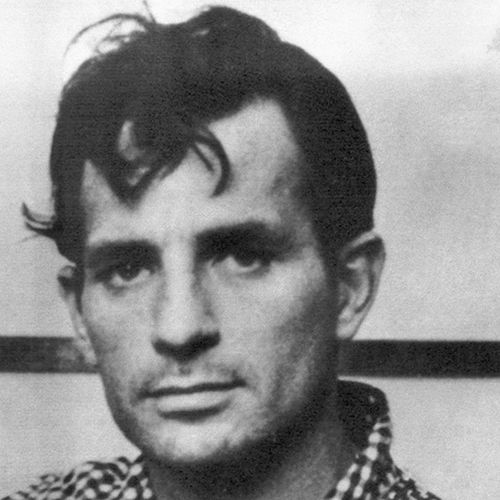
Jack Kerouac turned 102 a week ago. The fierceness of his writing overwhelms, lyrical, sensory, harnessing human moods, a fiery warmth beneath a canopy of gazing stars on cold stellar nights:

“Fury flashing on rocks that rise like gloomy sea shroud towers out of the cove, the bingbang cove with its seas booming inside caves and slapping out, the cities of seaweed floating up and down you can even see their dark leer in the phosphorescent seabeach nightlight.”

Big Sur

“…the only people for me are the mad ones, the ones who are mad to live, mad to talk, mad to be saved, desirous of everything at the same time, the ones who never yawn or say a commonplace thing, but burn, burn, burn like fabulous yellow roman candles exploding like spiders across the stars and in the middle you see the blue centerlight pop and everybody goes ‘Awww!’”

—Jack Kerouac, On the Road

We were never really born, we will never really die. It has nothing to do with the imaginary idea of a personal self, other selves, many selves everywhere: Self is only an idea, a mortal idea. That which passes into everything is one thing. It’s a dream already ended. There’s nothing to be afraid of and nothing to be glad about. I know this from staring at mountains months on end. They never show any expression, they are like empty space. Do you think the emptiness of space will ever crumble away? Mountains will crumble, but the emptiness of space, which is the one universal essence of mind, the vast awakenerhoo 0d, empty and awake, will never crumble away because it was never born.”

The Portable Jack Kerouac

The world you see is just a movie in your mind.
Rocks dont see it.
Bless and sit down.
Forgive and forget.
Practice kindness all day to everybody
and you will realize you’re already
in heaven now.
That’s the story.
That’s the message.
Nobody understands it,
nobody listens, they’re
all running around like chickens with heads cut
off. I will try to teach it but it will
be in vain, s’why I’ll
end up in a shack
praying and being
cool and singing
by my woodstove
making pancakes.

—The Portable Kerouac

I miss you, Jack. You left us all too soon.

rj

RJ´s 2024 Draw-bag Reading List


Welcome to the New Year and my sixth annual Draw-bag Booklist I’ve curated from the very best sources. Perhaps you’ll find pleasure among several of those books listed. I personally use my list to prevent my straying from the reading trail, taking time out only for the best reads, ample in their pleasure, abundant in their wisdom and solace:

FICTION:

Boyd, William. The New Confessions. (Boyd specializes in whole life narrative, delivered in conversational prose, and unfailingly riveting. Famous for Any Human Heart, this cerebral novel also has its many fans.)

Cain, James. The Postman Always Rings Twice. (Modern Library lists Cain’s novel among the best 100. A mystery classic, it’s been turned into a movie seven times.)

Chekhov, Anton. Peasants and Other Stories. (Famed critic Edmund Wilson collected and wrote the introduction to these late short stories of Chekhov that scrutinize Russian society, each a genre masterpiece.)

Colette. The Pure and the Impure. (Colette thought this novel the best she’d written and nearly autobiographical. Published in 1934, it explores love’s
labyrinths, especially among women. Get the recent New York Review of Books edition. Insightful critic Judith Thurman wrote the introduction.)

Duffy, Bruce. The World As I Found It. (Joyce Carol Oates deemed it “one of the five best books,” a blend of fact and fiction, centering on philosophers Bertrand Russell, G. E. Moore, and Ludwig Wittgenstein; on display, their disputes, contradictions, and follies.)

Gilbert, Elizabeth. The Signature of All Things. (The author of Eat, Love, Pray pens a page turner, reviving the milieu of the late 18th and 19th centuries and the courage and achievements of its remarkable female protagonist. Meticulous in its underlying research and compelling in its superlative prose, you’ll grow fond of this book.)

Laestadius, Ann-Helén. Stolen. (An indigenous Sámi author’s novel reveals a repressed culture struggling for survival in Scandinavia. A best seller in Sweden.)

Santayana, George. The Last Puritan: A Memoir in the Form of a NoveI. (Words fail to adequately express my devotion to Santayana, an eclectic essayist, scintillating in observation, endowed with sagacity, verbally in command, cultural connoisseur, ever eloquent, and unflinchingly honest. The Last Puritan, his only novel among his many publications, tells the story of Puritan descendant Oliver Alden, embedded in its strictures, seeking escape, yet unable to break their hold. Published in 1936, it finished second to Gone with the Wind in popularity.)

Smith, Betty. A Tree Grows in Brooklyn. (A favorite American classic, it tells the story of a young girl at the turn of the 20th Century and her family’s struggle with poverty. Replete with wisdom, poignant and beautifully told, it deserves its wide esteem.)

Spark, Muriel. A Far Cry From Kensington. (A widow in a postwar London publishing firm reminisces. Somewhat autobiographical.)

Strout, Elizabeth. Olive Kitteridge. (This book won a Pulitzer Prize. Comprised of thirteen stories, centering around its eponymous protagonist, it narrates the fear of change, yet the hope it may bring.)~~

E. B. White. Charlotte’s Web. (Among the most beloved stories for children, White, celebrated for his prose mastery, wrote it late in his career, narrating the friendship between livestock pig Wilbur and barnyard spider Charlotte. Publishers Weekly thought it the best children’s story ever written. Adults admire it too.)

Non-Fiction

Bradatan, Costica. In Praise of Failure: Lessons in Humility. (Failure can help us find our better selves. Portraitures of Weil, Gandhi, Cioran, Mishima, and Seneca by a renowned contemporary philosopher guaranteed to inspire.)

Dawidziak, Mark. A Mystery of Mysteries.(Edgar Allen Poe’s last days and untimely death have been shrouded in mystery. Dawidziak’s research into primary resources offers convincing explanatory evidence unveiling Poe’s final days.)

Hume, David. Treatise on Understanding. (Must reading by a landmark empiricist that continues to reverberate in its bold analysis of the human mind.)

Malik, Kenan. Not So Black and White: A History of Race from White Supremacy to Identity. (A stunning refutation of identity politics on the subject of contemporary racism by a noted Observer columnist.)

Marsh, Henry. And Finally: Matters of Life and Death. (A neuroscientist confronts his mortality with lessons for all of us. Of Marsh, The Economist writes, “neuroscience has found its Boswell.”)

Mill, John Stuart Mill. Three Essays on Religion: Nature, the Utility of Religion, and Theism. (In these essays, published posthumously, “the saint of rationalism” advocates a humanism grounded in reason, and serving human needs. Mill is among those who have influenced me profoundly.)

Nussbaum, Martha. Justice for Animals. Our Collective Responsibility. (One of the most salient pleas for the rights of animals you’ll ever read.)

Raban, Jonathan. Passage to Juneau: A Sea and Its Meaning. (Acclaimed literary travel writer, Raban pens a biographical travel venture of middle-age. Many consider this book his finest.)

Saunders, George. A Swim in the Pond in the Rain. (Seven masterful Russian short stories, with subsequent analysis. You’ll never read a short story the same way again. Saunders is one of America’s most gifted writers and winner of the prestigious Booker Prize.)

Snyder, Timothy. The Road to Unfreedom. (A sobering review of the rise of contemporary authoritarianism by an eminent Yale historian.)

Thunberg, Greta. The Climate Book. (A compendium of the latest on the past, present and future of climate change compiled from more than 100 experts.)

Thurman, Judith. A Left-Handed Woman: Essays. (Second volume of New Yorker essays by one of our preeminent biographers and essayists, winner of the National Book Award for her biography of Isaac Dinesen. Vivid, unforgettable portraitures of bold, independent women.)

—rj

E.B. White: Beauty in Complexity

I finished reading E.B. White Essays moments ago. Since the essay genre happens to be my favorite indulgence, I found White fascinating, the great master, and among the finest American essayists of the last century that includes the likes of Didion, Dillard, Wallace, Baldwin and Sontag.

White wrote several thousand essays, 1800 of them for the New Yorker. I have liked his modesty, his unaffected style, keen powers of observation, evocative musings, and love of nature.

He adored Thoreau’s Walden, my favorite American classic. Like Thoreau, White questioned some of the assumptions of his fellows, that technology assured happiness and that man could improve upon nature.

How can I not admire this good man who found beauty in life’s complexity and changing moods?

I must say a chill went up my spine when I read “Here is New York,” written in a steamy 1948 summer and, for many critics, the finest tribute ever rendered to Gotham. White was deeply troubled by the advent of the atom and hydrogen bombs, fearing their exponential future consequences. America had escaped WWII’s destruction, but danger stalked its future, with New York vulnerable as a primary target:

The subtlest change in New York is something people don’t speak much about but that is in everyone’s mind. The city, for the first time in its long history, is destructible. A single flight of planes no bigger than a wedge of geese can quickly end this island fantasy, burn the towers….

I can’t say I’ve ever encountered anything more prescient than this foreboding passage written 52 years before 9/11.  

But this is partially witness to why White is worth your time, observant, asking the hard questions, sifting out the implications.

Unfortunately, if you google “greatest 20th century American essayists,” he gets omitted.  This is perhaps due to his three best selling children’s books, including Charlotte’s Web, resulting in his essay prowess being overshadowed.

Those of us who did English composition in our freshman year of college are more apt to associate him with Strunk and White’s Elements of Style, one of the most effective writing guides ever published. White had studied at Cornell under Dr. William Strunk, Jr.  who had originally published it in 1920.  White revised it in 1959, adding to it substantially.  A no nonsense guide, it called for concise prose, accurate grammar, unified paragraphs, concrete description, and avoidance of the passive voice.

White carried out its precepts and is famed as a writer of the unembellished  style, direct, easy to follow, yet sophisticated in its declarative sentence structure and keen observations with their implications.  You’ll not find many subordinated clauses or inverted sentences.  No semicolons or dashes.  No arcane vocabulary.

Of the 31 essays in this collection, chosen by White for inclusion, my favorite is “Back to the Lake,” moving in its reminiscence as he takes his eleven year old son back to the Maine lake of his childhood, an essay critic Joseph Epstein remarks “shimmers like a perfect poem; everything in it clicks” in its theme of birth, rebirth, and death:

When the others went swimming, my son said he was going in, too. He pulled his dripping trunks from the line where they had hung all through the shower and wrung them out. Languidly, and with no thought of going in, I watched him, his hard little body, skinny and bare, saw him wince slightly as he pulled up around his vitals the small, soggy, icy garment. As he buckled the swollen belt, suddenly my groin felt the chill of death.

Though critics often refer to White’s humor, there looms a stubborn apocalyptic streak in his writing as in “Here is New York.” Or take this passage:

I think when the end of the world comes the sky will be its old blue self, with white cumulus clouds drifting along. You will be looking out of a window, say, at a tree; and then after a bit the tree won’t be there any more, and the looking won’t be there any more, only the window will be there, in memory—the thing through which the looking has been done. I can see God, walking through the garden and noticing that the world is done for, reach down and pick it up and put it on His compost pile. It ought to make a fine ferment.

White struggled with general anxiety, beginning in his childhood. There were so many fears that plagued him, especially about his health. He was afraid of meeting people and of giving speeches. He didn’t show when being awarded the Presidential Medal of Freedom. He avoided parties and weddings.  

White would ultimately be honored with virtually every literary prize, including a Pulitzer, yet remained a shy, unassuming man, modest in his wants, relishing farm life in Maine.

Some readers may find White too dry or intellectual for their taste and some of his essays dated or discursive. White was never fated to win the Nobel, but he always made sense in half the space, which would have made Strunk smile. White excels when he foregoes political commentary, taking up instead depictions of everyday life:

I like the cold. I like the snow. I like the descent to the dark, cold kitchen at six in the morning, to put a fire in the wood stove…. I steal down in my wrapper carrying a pair of corduroy pants…and fill the kettle with fresh spring water…with a poker I clear the grate in the big black Home Crawford 8-20, roll up two sheets of yesterday’s Bangor Daily News, and lay them in the firebox along with a few sticks of cedar kindling and two sticks of stovewood on top of that” (“The Winter of the Great Snows”).

I have loved keeping company with White these last several days, his honesty, clarity, remonstrances, love for animals and nature uplifting. So many passages, wise and luxurious in sentiment like this one from “Letter from the East”:

With so much that is disturbing our lives and clouding our future, beginning right here in my own little principality, with its private pools of energy (the woodpile, the black stove, the germ in the seed, the chick in the egg), and extending outward to our unhappy land and our plundered planet, it is hard to foretell what is going to happen. I know one thing that has happened: the willow by the brook has slipped into her yellow dress, lending, along with the faded pink of the snow fences, a spot of color to the vast gray-and-white world.

White passed from us at his beloved North Brooklin home in Maine on October 1, 1985.  He was 86.

His legacy, like that of Thoreau, will endure, for talent always makes room for itself.

—rj


Jane Goodall’s “Reason For Hope: A Spiritual Journey”

Finished reading Jane Goodall’s Reason For Hope: A Spiritual Journey, minutes ago, a compelling, yet difficult read, as Goodall bares not only triumphs, but personal tragedies in her long life.

Renowned for championing chimpanzees, our closest relative and, now, an endangered species, at 89 she travels widely, raising funds and informing audiences of the myriad challenges of entrenched poverty, species loss, and climate change. In 1950, 2 million chimpanzees roamed Africa’s then teeming wilderness. That’s dwindled to just 150,000 currently.

A compassionate woman who empathizes keenly with all who suffer, whether humans or animals, she’s not without hope that the human capacity for good as well as evil will ultimately triumph, saving not only mankind, but a beleagured Mother Earth. Above all, abides Jane’s vigorous faith in a greater Consciousness that pervades our universe and seeks our good.

Salient passages:

“But I have tried to write my story honestly—else why write the book at all?”

“It is probably the case that inappropriate or morally wrong behaviors are more often changed by the influence of outsiders, looking with different eyes, from different backgrounds.”

“In particular I became intensely aware of the being-ness of trees. The feel of rough sun-warmed bark of an ancient forest giant, or the cool, smooth skin of a young and eager sapling, gave me a strange, intuitive sense of the sap as it was sucked up by unseen roots and drawn up to the very tips of the branches, high overhead.”

“I saw chimps use and modify other objects as tools, such as crumpled leaves to sop rainwater from a hollow in a tree. Stones could be missiles; some of the males threw with good aim—as I sat there, keeping vigil, I thought, as I have thought so often since, what an amazing privilegeit was—to be utterly accepted thus by a wild, freeanimal. It is a privilege I shall never take for granted.”

“I found that my whole attitude to eating flesh abruptly changed. When I looked at a piece of meat on my plate I saw it as part of a once living creature, killed for me, and it seemed to symbolize fear, pain, and death—not exactly appetizing. So I stopped eating meat. For me, one of the delightful side effects of becoming a vegetarian was the change in my own health.”

“And people are beginning to suffer; in some places women must dig up the roots of trees long since cut down to get the firewood they need for cooking. And all this change is because the numbers of people have increased dramatically—mainly due to the explosive population growth, but also due to repeated influxes of refugees from troubled Burundi in the north, and more recently from eastern Congo. And this scenario is repeated again and again across the African continent and other developing countries: increased population growth, diminishing resources, and the destruction of nature, resulting in poverty and human suffering. Yes, we are destroying our planet. The forests are going, the soil is eroding, the water tables are drying, the deserts are increasing. There is famine, disease, poverty, and ignorance. There is human cruelty, greed, jealousy, vindictiveness, and corruption.“

“Each one of us matters, has a role to play, and makes a difference. Each one of us must take responsibility for our own lives, and above all, show respect and love for living things around us, especially each other. Together we must reestablish our connections with the natural world and with the Spiritual Power that is around us. And then we can move, triumphantly, joyously, into the final stage of human evolution—spiritual evolution.”

—rj

Why The Writers Guild of America Deserves Support

If you’ve been keeping-up with the Writers Guild of America strike, ongoing since May 2, 2023, you know it’s still a long ways from resolution. The Guild is seeking a fairer share of streaming residuals. They also want AI such as ChatGPT limited to research or facilitating ideas and not as a means to replacing them.

But just how big a threat does AI pose for WGA writers? Many members think AI has its limitations but, nonetheless, could make inroads on some of their tasks.

While AI may pose a greater threat longterm as it progresses in sophistication (Paul McCartney reports he recently used AI to compose his latest song), I view AI as assisting, not replacing writers. It simply can’t replace the subtleties of the human mind, or what I like to call emotive intelligence.

New technologies like AI, however, do require adaptation, those using it replacing writers who don’t. It’s like calculators. They abound, but so do mathematicians. Fields requiring deep, often intuitive, knowledge, like psychology, sociology, etc, and most fields of medicine, will remain valid. I seriously doubt AI will replace engineers, or for that matter, your local plumber.

But back to the WGA. They deserve fair payment for what they do, providing the texts without which TV, movie, and theater couldn’t exist. Residuals are already paid to actors and, of course, the streaming moguls reap the far greater share of remuneration.

I’ve always felt that writers, in general, suffer a dismal fate when it comes to earnings. We hear about the 2% who make it to the highest tier. The vast majority of writers don’t give-up their day jobs.

Did you know that the average annual earnings by a New Yorker staff writer is a mere $54,000 annually?

I admire empathetic actors like Vincent D’Onofrio who see the unfairness and are lending their full support to WGA members.

–rj