Retired English prof (Ph. D., UNC), who likes to garden, blog, pursue languages (especially Spanish) and to share in serious discussion on vital issues such as global warming, the role of government, energy alternatives, etc. Am a vegan and, yes, a tree hugger enthusiastically. If you write me, I'll answer.
Russia’s cruise missile attack on Kyiv yesterday just after UN Secretary António Guterres’ visit with Ukraine’s President Zelenskiy demonstrates the determined, relentless resolve of Putin to bring Ukraine to heel and punish its Western sympathizers.
We know about Russia’s crimes against civilians, raped, tortured and executed; its killing of soldiers who have surrendered; bombings of train facilities providing civilian egress from war zones; attacks on schools and hospitals.
The truth is Russia blundered into this war, thinking a quick assault on Kyiv and regime change would yield victory within a few weeks.
Surprised by the vehemence of Western reprisals via sanctions and steadfast supply of weaponry, increasingly of an advanced nature, and fierce Ukrainian resistance, Russia now faces prolonged, bloody entrenchment and even defeat.
British intelligence indicates a loss of 15,000 troops, with many more wounded.
American sources indicate the Russians have lost 25% of their military capability.
Now the war has expanded into Russia, with military infrastructure within Russia being hit, causing panic upon nearby civilians and calls for retaliation.
Meanwhile, despite Putin’s denials, the Russian economy has suffered enormously.
For several weeks, Putin has been menacing the West with apocalyptic warnings of nuclear consequences for nations threatening its security, notably the U.S. and Britain: “If anyone intervenes in Ukraine and creates unacceptable threats for us that are strategic in nature, our response will be lightning fast. We have all the tools for this that no one else can boast of having. We won’t boast about it, we’ll use them, if needed.”
Will Putin carry out his threat?
Yes, but not against NATO nations, for that would lead to an unimaginable horror fallout of nuclear exchange and Moscow’s decimation to rubble in minutes.
What’s more likely to happen is a low-yield employment of nuclear tactical weaponry delivered through aircraft and artillery.
Russia, probably correctly, thinks the West will pull back its support and Ukraine will surrender, with huge loss of its territory, in short order.
Putin cannot afford to lose this war he’s presumptuously waged.
Thus far, the West has not singled any probable response to nuclear weaponry in Ukraine, increasing the likelihood of Russia’s adopting such draconian measures similar to what the U.S. resorted to in Japan.
I’ve been reading Ryan Holiday’s inspiring Courage is Calling. Holliday practices Stoicism, a way of life that’s become my life credo, though I confess my frequent failure to live up to its tenets of courage, temperance, justice and wisdom.
Stoicism is a discipline requiring daily practice. It’s taught me how much fear lies behind our modern anxiety and behavior. As Holliday writes, “This is how it goes, whether you’re a billionaire or an ordinary person, no matter how physically tough or brilliant you are. Fear determines what is or isn’t possible. If you think something is too scary, it’s too scary for you. If you don’t think you have any power . . . you don’t. If you aren’t the captain of your fate . . . then fate is the captain of you.”
Anxiety with its burden of worries culminates in stress, and we know its harsh consequences for our mental and physical health.
Worry teaches you that the future is happening now.
It falsely tells you that worry will make it go away.
Worry makes you care more about what others think.
It inhibits your boldly attempting new things like falling in love again, having children, resuming your education, investing your money, traveling to new places, changing your residence, trying a new doctor. Maybe even quitting your job for something, even if for less money, but more fulfilling.
It says you can’t ever escape your past, whether a bad childhood or failed marriage, a hurtful friendship or demeaning rejection.
Fear anchors you to what’s familiar, seemingly safe. It forfeits possibility and, with it, the future.
The truth is life is inherent with risk. Loss, illness, grief, death embrace every nook and cranny of life. Its remedy is to step up and step out, doing what you can.
Paradoxically, mastering anxiety begins with acceptance of what you can’t change. Uncertainty is inherent with life. In his book, The Liberated Mind, psychologist Steven Hayes writes that “people like to think the world is ‘happy happy joy joy,’ but if you live long enough, you start running into pain and illness and loss and tragedies of all sorts. It’s just part of it. That’s part of life.”
But there are things you can change. Yes, you can master living in a temporal world of vicissitude, but you must be willing to sign the bottom line.
Take inventory of what inhibits your resolve.
It may cost you money, even estrangement, but how much better to walk away free. One of life’s caveats is knowing when and how to jettison habits and worries weighing you down.
You can be courageous in every day life in so many ways.
It takes bravery to ask for a pay raise, confront injustice, leave a demeaning relationship, find a new hobby.
Don’t let fear bully you.
Don’t let routine dictate your everyday doings.
Happiness doesn’t just happen. It requires flexibility, resilience and daily practice. Frequently, it’s a life of sips more than gulps to get there.
So much of life is living in the moment. You do what you can, attempt what you’ve wanted. You act to realize yourself, becoming agent of your own destiny.
Mastering your fears begins a new portal. Yes, you can find freedom in an unfree world.
“O if we but knew what we do
When we delve or hew —
Hack and rack the growing green!
Since country is so tender
To touch, her being só slender,
That, like this sleek and seeing ball
But a prick will make no eye at all,
Where we, even where we mean
To mend her we end her….”
--from “Binsey Poplars,” Gerard Manley Hopkins
According to the Intergovernmental Science-Policy Platform on Biodiversity and Ecosystem Services (IPBES), five principal forces are contributing to our ruthless assault on Nature and its demise: unprecedented environmental changes in land and sea use; direct exploitation of natural resources; pollution; invasion of alien species; and climate change. Their consequences for species survival should alarm all of us, since we are ecologically linked in dependency upon one another. Since 1970, wildlife population has declined by two-thirds, or some 68% (LIving Planet Report-2020).
Sadly, we are at war with nature, mindlessly exploiting ecosystems in pursuit of profit. The problem is universal, with substantial losses in mammals (65%); fish, amphibians and reptiles (45%). According to The Living Planet Index (LPI), one million species face extinction. Deforestation and agricultural expansion have contributed substantially to this decline. Ominously, they continue.
Let me give you one egregious example of a recent human created disaster scenario in an attempt to augment agricultural production by altering nature’s contour.
There lies a once flourishing body of water known as the Azul Sea, located between Kazakhstan and Uzbekistan. First mapped in 1850, it was sometimes dubbed the Blue Sea. Until the last century, it was the world’s third largest inland lake, exceeded only by the Caspian Sea and Lake Superior, extending 426 kilometers (265 miles) long and 284 kilometers (176 miles) wide.
Replenished by the 1500 mile Amu Darya and Syr Darya rivers, it supported nineteen villages dependent on its abundant fish. Things began to change in the 1930s as Soviet engineers schemed they could expand cotton and wheat output by diverting its water for irrigation. Huge channels were dug to supply water for millions of acres of farmland.
By the 1980s, the Aral Sea experienced sharp declines in area and volume, or 80% and 90% respectively.
The environmental fallout has been enormous, so much so that the lake has become increasingly dubbed the Aralqum Desert. Qum is the Uzbek word for dust.
Seventy percent of the Aralqum is now salt residue.
The fish have disappeared, fish factories abandoned and villages become ghost towns. Wind-swept, its dust pesticides have spread throughout the world. They’ve even been found in the blood of Antartica penguin and Greenland glaciers.
With the lake’s demise has come a change in the weather, with harsh summer heat and frigid winters. Winds abound.
Now one of the unhealthiest places on earth, respiratory disease and child mortality have increased sharply.
In better times. the Azul Sea featured an island sanctuary, Barsa-Kelmes, teeming with deer, wolves, and eagles. It’s just memory now.
And what about those other fresh water behemoths, Lake Superior and the Caspian Sea. Have we learned our lesson?
Fortunately, Lake Superior has largely avoided the fate of Lake Erie, contaminated by industrial and agricultural runoff. Nonetheless, it faces several incipient stressors, contributing to environmental degradation: mining, home development along its shores, airborne chemical pollutants, invasive species and climate change. In the last several years, Lake Superior is warming faster than many of the earth’s other water bodies, threatening its fish; wind speeds have increased 5% each decade since 1980; storm intensity and frequency have also increased.
The fate of the Caspian Sea, the world’s largest inland waterbody, is more troubling: According to the UN Environment Programme, the Caspian “suffers from an enormous burden of pollution from oil extraction and refining, offshore oil fields, radioactive wastes from nuclear power plants and huge volumes of untreated sewage and industrial waste introduced mainly by the Volga River” (Rpt. in The Nation. Thai Press). Climate change has led to increased evaporation, or by six centimeters annually.
The lake has seen the world’s largest sturgeon population decline by 90%.
Former home of one million seals which inhabited its shores and islands a century ago, fewer than 10% remain, the result of over-hunting and oil pollution. The species is now designated as endangered.
As Azer Garayev, the head of the Azerbaijan Society for the Protection of Animals, comments: “It would be so stupid to lose the Caspian like the Aral Sea. I don’t want to think about it. It would be a crime.”
Species population trends are important, for they are a measure of our ecological health. Unfortunately, we are living in a context of unprecedented change with a huge growth in the human footprint, spurred by global trade, population growth, urbanization, and consumption. We are losing our wilderness, our waterways are polluted, we lack clean air. We are raiding our resources faster than their ability to regenerate. As I write, 85% of our wetlands with their teeming diversity have been lost.
We are entities of a vast web of life. We belong not to ourselves, but to each other and to Nature, our great mother, on whom we depend for our health and prosperity.
I begin my day daily, reading the news, the wrong way to commence a new day, heavy with humanity’s burdens I can do little about.
I would do better in rising with the sun, to set my day’s course like a compass pointing to true North on what matters, enriches, and contributes to well-being, not only for myself but, more importantly, for others.
I remember lines from one of Mary Oliver’s last poems: “Wherever I am, /the world comes after me. /It offers me its busyness. /It does not believe that I do not want it.”
We think of ourselves as separate from the main. Prisoners of self-interest, we’ve relinquished poet John Donne’s maxim, “No man is an island.“
As humans we crave togetherness.
We abhor loneliness.
We require bonding and the cohesion it brings.
I’ve traveled to many places, often alone, but the trips I remember most were those I’ve shared with others. To experience something awesome, but with no one to share it, somehow bottoms out its delight.
Like leaves on a tree, individual in their shape and shimmering on their branches, we feed into a trunk that flourishes when its leaves work collectively. We are citizenry of a greater Self.
We live in a time of electronic fellowship. Billions turn to Facebook, Twitter, Instagram, ad infinitum, in a desire to connect, ample evidence we need one another to complete ourselves.
We find the relational in other, more meaningful ways. We love, we marry, we have children, we make friends, we frat with those sharing like interests, we bond with our pets. And yes, we write books—and even do blogs!
Unfortunately, since Descartes with his “I think, therefore I am,” we’ve weighed our lives down with ego indulgence, mindless of that greater entity of collective humanity and of Nature that grants us being and sustains.
In Victorian times, Bentham’s notion of utilitarianism was in vogue, its thesis that what promotes happiness is good; what promotes pain is bad. Essentially hedonistic, it was vehemently satirized by Dickens in Hard Times as serving the wealthy at the expense of the working class.
Modern psychology hasn’t helped mend our ways. Self-validation defines its focus. Witness the plethora of books on self-improvement. I was schooled in behaviorism at the grad level with its notion that humans are little more than pigeons, subject to stimulus response, driven by self-interest. Accordingly, prescribed behavior can be reenforced through operant conditioning that awards the positive; conversely, extinguishing the negative via the punitive. Anthony Burgess, whom I met briefly many years ago, deciphered it rightly in Clockwork Orange (1962), one of the 20th century’s most profound books.
In economics, capitalism is founded upon the same a priori of what’s in it for me, ushering in the Adam Smith credo of self-interest and competition as prerequisites to prosperity. Its consequences are with us daily, the one percent owning half the wealth, the exponential decline of the middle class, the continuous emphasis on growth despite diminishing natural resources.
In his widely published The Selfish Gene (1976), evolutionary biologist Richard Dawkins tells us that genes act to preserve their self-interest, with altruism, when it does exist, functionally symbiotic as in bees and ants. In fairness, Dawkins does propose that humans have potential capacity with growth in moral intelligence to modify evolution’s predilection for self-interest. Harvard’s eminent psychologist Stephen Pinker, who sets out in The Angels of Our Better Nature (2011) to statistically validate the decline of violence, should be pleased.
On a human scale, I think of Japan, unique in its protocol of collective behavior in the interest of public welfare that critics might disdainfully dismiss as herd mentality or, essentially, a vestige of Hobbes’ “enlightened self-interest.” Nonetheless, Japan is one of our few stable nations, high in economic equality, rare homelessness, and little crime. When the tsunami struck in 2011, unlike in other nations, there were few reports of looting. No need to send in the National Guard. My own memories of Japan confirm a pervasive politeness and honesty I’ve found unequaled in my travels.
In contrast, I think of what took place with the COVID outbreak, nearly a third of Americans not getting vaccinated and, even more, refusing to mask. As one business man told me, “It’s a personal choice.” But then this isn’t confined to America. In France, Belgium, and Germany gargantuan anti COVID protocol demonstrations, some of them violent, have occurred. Theirs is the right to infect others and continue the pandemic. By the way, Japan’s COVID mortality rate was 14.52 versus 233.8 in the U.S. as of Nov. 21, 2021, according to Johns Hopkins University stats.
Reading the news reminds me of the human folly behind the headlines, whether of individuals or nations, in pursuing self-interest. Sowing greed, we have reaped social dissonance with high crime, economic disparity, and homelessness among its results.
Frost wrote a renowned poem, “Mending Wall” in which the persona tells us of his neighbor, who advocates “Good fences make good neighbors.” I’m for tearing down walls that separate us.
In mutuality we find our common denominator, making for a better world. In discovering the Other, we find ourselves.
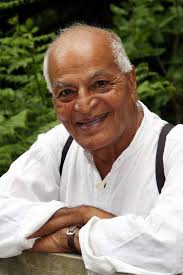
There are some books you don’t want to end and when they do, a gnawing emptiness ensues like saying a final good-bye to a cherished friend. Satish Kumar’s YOU ARE therefore I AM is one of them.
I discovered Kumar serendipity fashion, searching for Sufi poets like Rumi, subsequently chancing upon an interview with him that led me to this book, one of the most observant, sensitive, life-changing books I’ve encountered across the years. In brief, a book for discerning readers open to being inspired.
You’ll find few reviews of this book. I tried Google, and even the New York Review of Books, but no Kumar.
Kumar deserves a wider audience. He’s written ten books, received numerous literary awards, and several honorary doctorates. With E. F. Schumacher (Small is Beautiful), he founded Schumacher College, which offers master degree ecology curricula. For many years, he was editor of Resurgence& Ecologist Magazine. Now 85, he continues to write and lecture widely.
YOU ARE therefore I AM is largely autobiographical, though he’s written a more definitive version, NoDestination: The Journey of a Pilgrim ( 2014, Green Books).
Reared in India, we learn early on of his mother’s defining influence as a Jainist devoted to non-violence, leading to his becoming a Jainist monk at age nine. He would leave nine years later as a disciple of Gandhi’s teachings. He had come to believe that we stem evil not through retreat into monasteries, but with peaceful activism, promoting human and natural reconciliation.
The Jains, however, were and remain the salient source for his adoption of non-violent protest, as they also were for Mahatma Gandhi who would, in turn, influence Martin Luther King.
Kumar is famous for his peace walks in 1962 with friend E. P. . Menton to nuclear capitals Moscow, Paris, London and Washington, D.C. Remarkably, they made their 8000 mile journey without money. In England, he would meet Bertrand Russell and in America, Martin Luther King.
It was Gandhi protege Vinoba Bhave’s Talks on the Gita, oral lectures composed during Bhave’s imprisonment by the British and later written down by a fellow prisoner, that led to Kumar’s embrace of nature, society, and self as the trinity of activism needful for fostering peace within ourselves, between nations, and reconciliation with the Earth we have plundered: “THIS TRINITY OF nourishing nature, society and self gave me much food for thought. Ever since that time they have remained with me and have become the ground of my thinking and action.”
Chapter 13 details Kumar’s meeting Krishnamurti, the renowned Indian sage. Krishnamurti had rebelled against religious, political, and philosophical orthodoxy: “Truth cannot be realised through any creed, any dogma, any philosophical knowledge, any psychological technique, any ideology, any ritual or any theological system.”
Kumar agrees:
Now we live in an age of post-religious spirituality. The call of our time is to be a good human being rather than to be Muslim, Hindu, Buddhist, Jain or Christian. We don’t have to be a special kind of person to go on the adventurous journey of the spirit. Every one of us is capable of making the hero’s journey and reaching the holy grail.
Chapter 16 recounts his meeting Martin Luther King. King underscored that non-violence must not exclude justice for the disenfranchised, most often, the world’s poor and non-white. “True peace is not merely the absence of war. It is the presence of justice, equity and a non-violent social order. Non-violence is a moral force which can transform individuals and societies and bring peace.”
In the book’s late chapters, Kumar gives highlights of his return visit to his native India in 2000, fascinating in its portraiture of modern India and betrayal of Gandhi’s advocacy of land reform, self-sufficient village craft industries, and rejection of corporate interests and free trade.
Harvesting our needs, not our wants, living simply in touch with our fellows and observing the sanctity of all life, this was Gandhi’s message to capitalism motivated by greed, centered on consumption and continuous growth, fostering environmental violence economic marginalization and social injustice. This is a Gandhi unknown to most Westerners.
The final two chapters summarize Kumar’s worldview. Eloquent, timely, and wise, I found myself inspired, yet sad, sad in discovering him so late in my life’s journey.
It’s here he scorns the onset of Cartesian dualism with its aggrandizement of Self, voiding the relational. There followed Newtonian physics, treating the world as machine, Darwinism with its survival of the fittest, and depth psychology with its emphasis on ego:
These theories are, in my view, at the root of the ecological, social and spiritual crisis of our time. The dualistic world-view gives the illusion that I exist independently of the Other….’To be is to inter-be.’ We cannot be by ourselves alone. This means our being is only possible because of other beings. We are not individual beings; we are world beings.
Dualism, unfortunately, has also fostered speciesism, alienating us from Nature: “The violence to non-human species often remains unnoticed. This causes grave harm to animals, forests and wildlife of all kinds. This attitude of human superiority is the foundation of the culture of violence. The dualistic mindset which begins with controlling nature, goes on to control people.”
I’ve read many fine books over the years, some life-changing. Satish Kumar’s You Are, therefore, IAm takes its place among them, deserving yearly re-reading, lest we forget our mutual dependency and its requisite obligations.
Kumar reminds us in his close that observing the relational in every consideration is vital “for our existence and experience, for our happiness and health, for our nutrition and nourishment, we depend on the Earth. We depend on the love of the beloved, the beauty of the beautiful and the goodness of the good. Embracing vulnerability and humility, let us declare our utter dependence on the Earth, and on each other: You are, therefore I am.”
Across the country, even globally, the mad rush is on by politicians to indulge the public mood and eliminate COVID restrictions. I think it a mistake and that it comes too soon.
At home, nearly a million Americans have perished and our medical grid buckles as COVID patients, the vast majority unvaccinated, take up hospital beds. Meanwhile, many needing cancer screening, surgery or follow-up are turned aside. New research reveals its devastating consequences.
Long term COVID can be dehabilitating, even for those vaccinated. Recently, I had conversation with a man from Louisville, a home physical therapist. He shared he had come down with the virus six months ago, was placed on a ventilator, then developed pneumonia. He still doesn’t feel right. He’s married with four children and just 29. He told me—I didn’t need convincing—that he’d not be here at, all had he not been vaccinated.
Yes, omicron infections have been plummeting, but they still highly exceed the number of infections before the Delta impact, then averaging between 12,000 and 16,000 daily cases. In contrast, “the U. S. daily average of cases and hospitalizations on 16 February was about 124,000 and 81,000” (NYT).
As Vanderbilt University School of Medicine infectious disease expert William Schaffner cautions, “Some governors think we are almost there – they are dropping mask mandates – and my response is: good luck to you. My fingers are crossed on your behalf.”
I believe strongly in Biden’s mandates to ensure public safety, sadly thwarted by the courts under the auspices of the First Amendment and public non-compliance. Good government that seeks the welfare of its citizens fulfills government’s proper role without nullifying the tenets of our Constitution.
Observing COVID protocol is not a personal choice. It’s a necessity.
Orwell’s house in Wallington, Hertfordshire,where he planted roses in 1936
Ask me who my favorite essayist is and, hands down, I’ll say George Orwell. Known primarily for AnimalFarm and 1984, he excelled at the essay, writing in a direct, plain style, eschewing fancy big words, wordiness, and cliché.
You’re mistaken if you think his wise maxims are easy to practice. Orwell didn’t start out as a prose master, but worked diligently to achieve it. The trick is to heed his counsel, yet avoid the staccato effect of incessant short sentences that English teachers label, “choppy.”
I admire Orwell even more for his honesty as an essentially political writer. Famously, he taught us the dangers of “doublethink,” or language that deliberately obscures, distorts or evades.
When you get into ideology, it’s difficult to avoid partisanship and distorting your opponent’s argument; more difficult still, to candidly address the polemical liabilities of both yourself and your cohorts. A committed socialist, he nonetheless acknowledged Marxism’s own strident hypocrisies as exemplified foremost in Soviet revisionism.
All of this explains my eagerness to read Rebecca Solnit’s recently published Orwell’sRoses. Solnit’s a formidable essayist in her own right, and this is her twenty-sixth book.
She admires Orwell for his honesty and sides with his isolated criticism of Stalin and speaking out in a context of liberal, socialist idealism, unwilling to confront Soviet malevolence, resorting not infrequently to disingenuous rhetoric.
Readers will like her ardent empathy in the book for the marginalized, whether by race, sexual orientation, gender—or often missed—the working class. It stamps her indelibly as an Orwell protege. She credits Orwell for inspiring her to adopt the essay as her medium.
Feminists may find her Orwell embrace disconcerting. A strident women’s advocate elsewhere in her work, she details Orwell’s misogyny, yet gives it a cursory pass: “He was part of an age that was (with some notable exceptions) strategically oblivious to inequalities we have since worked hard to recognize…. One of Orwell’s most significant blind spots.” She admits his essays are limited to men.
Nor does she sufficiently address his marriage to first wife, Eileen O’Shaughnessy, who died on the operating table at age 39, presumingly from the anesthesia, following a routine surgery. An Oxford grad and student in psychology at the University of London, she gave up a promising career, typed and edited his manuscripts, did the housework, cooking and shopping. She accompanied him to civll war Spain, where he served as a Loyalist soldier.
Readers may be interested in pursuing Sylvia Topp’s biography of Eileen, The Making of George Orwell, tracing her influence upon Orwell. She had written a poem in 1934, speculating on the future, “End of the Century, 1984.” Her funeral occurred on April 3, 1945. In 1984, Winston Smith begins his journal on April 4.
Orwell mentions Eileen in his diary (1946) when visiting her grave on his way to his sister’s funeral and ultimately Jura, where he would write 1984: ”May 22, stopping to tend Eileen’s grave near Newcastle: Polyantha roses on E’s grave have all rooted well. Planted aubretia, miniature phlox, saxifrage, a kind of dwarf broom.”
Solnit was inspired by a passage in Orwell’s “A Good Word for the Vicar of Bray” (1946): “One of the fruit trees and one of the rose bushes died, but the rest are all flourishing. The sum total is five fruit trees, seven roses and two gooseberry bushes, all for twelve and sixpence.”
The fruit trees actually, not the roses, were what initially motivated her search for a more rounded Orwell, more quotidian in his private pursuits than his readers have known. Visiting his residence with her friend Sam, she found the fruit trees had been cut down to make room for a shed expansion. That left only the roses, though of the planted seven, she tells us only of two that still bloomed.
Nonetheless, they bequeathed Solnit with an immediate sensory connection to Orwell and his long-ago essay about roses and fruit trees: “The apparent directness of these two plants’ connection to him and to that long-ago essay about roses and fruit trees and continuity and posterity filled me with joyous exaltation. So did the fact that this man most famous for his prescient scrutiny of totalitarianism and propaganda, for facing unpleasant facts, for a spare prose style and an unyielding political vision, had planted roses.”
If you’re looking for the elusive Orwell, be prepared to meander through a thick copse of digression only tangentially relevant to Orwell. It’s her way of doing things in everything she writes.
The reality is that her book leaps beyond both roses and Orwell as a springboard for political asides, the exploitation of the working class in particular. Politics leap quickly to the surface in all her books, and may well account for their composition. Is Orwell’s Roses simply just another platform?
You will explore the history of roses, the role of British colonialism in their development, the evils of industrialism, and even climate change among other concerns.
I found the lengthy horticultural tracing of roses tedious. I tired of the long chapter exploring the origin of coal. I wanted the man. I wanted Orwell in full bloom.
In her defense, and look to the title, she tells us early that “there are many biographies of Orwell, and they’ve served me well for this book, which is not an addition to that shelf. It is instead a series of forays from one starting point, that gesture whereby one writer planted several roses. As such, it’s also a book about roses….”
We do, however, ultimately piece together Orwell, Solnit providing a biographical sketch and expanding on his frequent allusions to his love for gardening and planting of roses. Readers will find her uncovering the unfamiliar Orwell, masked by his public persona, revelatory.
One of the best parts of her rose narrative is her retelling of her visiting a gargantuan Columbian greenhouse complex outside Bogota, which flies roses by the millions daily to the U.S, especially at Christmas and on Valentine’s day in a chapter called “Going Underground.” A vivisection of labor abuse unknown to American consumers, it made me sit up and draw potential dots between other international corporate interests bent on profit heedless of worker welfare.
As I write, Chipotle reports In its Q4 that the company’s total revenue increased 22.0% to $2.0 billion in 2021, eliciting Bernie Sander’s umbrage: “The Corporate greed is Chipotle increasing its profits by 181% last year to $764 million, giving its CEO a 137% pay raise to $38 million in 2020 and blaming the rising cost of a burrito on a minimum wage worker who got a 50 cent pay raise. That’s not inflation. That’s price gouging.”
Despite the chapter’s pretentious title, “Going Underground,” Solnit has never truly gone underground in terms of its nuance. Orwell investigated labor abuse and the plight of poverty first hand by working in the coal mines of northern England and living among the homeless in London and Paris.
That said, I never tire of Solnit, despite her inveterate meanderings and intrusive politics. I like her introspective view of things in her many books, unveiling hidden foregrounds behind what I see, even admire, a kind of turning things inside out as when taking off a sweater. Her gift is one of expanding consciousness of the myriad strands of interconnectivity. Orwell’sRoses assures that continuity.
I needn’t labor on the inroads of our high tech age on our daily living habits, numerous studies elaborating on the atrophying of socialization and, dynamically, its impact on family life, parents and children exponentially independent of each other.
My purpose here is to focus on its intrusion upon our reading habits in this now predominately video age.
Consider the following:
According to The American Time Use Survey employing a representative sample of 26,000 Americans, reading for pleasure is now at its lowest point. Between 2004 and 2017, reading among men declined by 40%; among women, 29%.
Gallup tells us that the number of Americans who haven’t read a book in any given year tripled between 1978 and 2014.
For comparison, in 2017, Americans spent 17 minutes reading; 5.4 hours on their cell phones.
The menace of TV exceeds that of even social media. Some 60% of Americans eat their meals while watching TV. 47% of 9-year olds watch TV 2-5 hours daily (aft.org). On average, Americans TV binge 3-4 hours each day.
Collectively, a 2020 Nielson study reveals that the average American “spends a staggering 11 hours, 54 minutes each day connected to some form of media — TV, smartphones, radio, games” (abcnews.go.com). In short, many of us are media addicts.
You can reasonably assume this affects timeout for reading. It may also factor in our children’s continuing drop off in reading proficiency (henchingerreport.org), a vast subject in itself.
The reading of literary fare—poetry, short stories, novels, drama—has taken a special hit, even among those with college exposure, and across the board, regardless of race or ethnicity, exhibiting a ten year average decline of 14% between 1992 and 2002, according to the National Endowment for the Arts comprehensive study, Reading at Risk.
It comes at a cost. Literary reading in particular grows discernment, teaches values, fuels discussion as well as entertains. It liaisons us with the global community and cultivates cultural continuity. And, yes, it can keep us safe, crystallizing excess that imperils our well-being. All really good reads are fundamentally moral, underscoring the human contract to do the right thing by each other.
As for non-fiction, I haven’t gathered any stats, but it probably fares better. We’re not all literary aficionados and the choice of good non-fiction tomes crosses many genres, whether science, health, environment, psychology, philosophy, ad infinitum.
But judging from the TheTimesBestSellerLists, most non-fiction reads will be of the self-help or business variety. You’re unlikely to find mind-bending items like Nietzsche’s On the Genealogy of Morals,Freud’s Civilization and Its Discontents, or Hoffler’s enduring classic, The True Believer.
As such, we impoverish ourselves if, when we do read, we do so indiscriminately. Our reasoning weakens. We see in fragments and not the whole. We become prey to parochialism and its hyperbolic distortions. Like our muscles, our brain prospers with exercise.
The bottomline is that so much of what we take for granted was once imagined. What better place to tap into its limitless underground caverns than a challenging read?
Through reading we meet ourselves, learn we’re not alone, find comfort, inspiration, and discernment. Not least, we encounter the coalescence of human experience, discover that each of us is its own rivulet flowing into a vast ocean of a greater Self.
Long term, the consequences of not reading become potentially devastating for both community life and democracy. Electronic resources foster instant gratification, replacing more concentrated effort. On the other hand, research shows discerning readers are more engaged in their communities. In sum, they help foster those values that promote the public’s interest and those amenities enhancing a functional democracy.
To not read is simply one more ingredient eroding family cohesion and breeding social isolation, not only pervasive, but advancing. It exchanges commitment for passivity.
As humans, we discover our individual identity through assertion. “To be or not to be? remains the existential question. Good literature inculcates not only its resolution, but its how.
Reading requires concentration, an intellectual skill that improves with exposure. To forfeit its dividends for Esau’s porridge of instant gratification with its fallout for the family and community is nearly too nightmarish for me to contemplate.
I’ve been reading the late Irish writer William Trevor’s The Collected Stories, a sprawling anthology of nearly 1300 pages, stories that have been compared with those of Chekhov and Joyce (Dubliners), culminating in many literary prizes and Trevor’s receiving honorary knighthood. The tributes, in fact, are endless, with many deeming him our most illustrious contemporary master of the genre. For many years, he was associated with The New Yorker.
His stories, however, may prove difficult going for many in these troubled times when we reach desperately for good tidings, not quotidian gloom. While his facility with language is indisputable in its ease and fluidity, his characterization impeccable, there seems never a relief to a bleak landscape of broken lives, shattered expectations, deceit and cruelty. Many of the stories deal with the angst of aging, declining physical and mental capability, a clinging to past memories, accompanying alienation, loneliness, and anxiety in the foreground of marauding mortality.
Despite all this, his psychological prescience sustains, with characters delineated by their own compulsions, denials and lethargies. In short, the characters are people we know, perhaps uncomfortably, even ourselves, wrestling like Hamlet with the dichotomy of desire and weakness and inability for resolution.
Stories are ceaselessly open-ended, with readers left to their own interpretive nuances, not unlike life in its ambiguities. Again, a lot like what we find in Chekhov and Joyce.
Still, I miss the understated, yet resonant symbolism of short story masters like Lawrence, Hemingway, Fitzgerald, and Mansfield, their tales exploding into collective nuance, often replete with stylistic eloquence. In this, Fitzgerald remains my favorite, often quotable and always unforgettable.
I’m longing for a bit of good cheer, absent in Trevor, to soften a grim grayness. (Is it accidental he chose to follow Hardy into residing in Dorset?) After all, life isn’t all winter and following storm, the sun does peak through, and most humans, for all their liabilities, harbor irrevocable kindness.
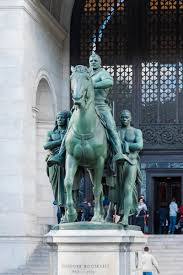
The press largely missed last week’s removal of the Teddy Roosevelt statue from the grounds of New York’s American Museum of Natural History, which had been in place for eighty years. Progressives argued it was colonialist in nature, a white man on horseback accompanied by an African and Native American on foot.
Roosevelt is consistently rated as among America’s best ten presidents, an ardent naturalist and political liberal. The African and Native American reflect his renowned role as explorer, not colonialist bent on exploitation. Nonetheless, the efforts of the Left, ignoring cultural antecedents, persist in rewriting history, or what I call “purging” it to conform with ideology.
I’m reminded of Orwell’s still relevant observation that “the really frightening thing about totalitarianism is not that it commits ‘atrocities’ but that it attacks the concept of objective truth; it claims to control the past as well as the future.” Similarly, progressives seek to assuage history’s realities by projecting their politics on to the past, while hypocritically ignoring the malignant realities of today’s Cuba, Venezuela, and Nicaragua.
As always, we do well to avoid peripheries, whether of Left or Right. We properly amend history by learning from its failures and not repeating them.



 Brimmings: up from the well