
When driving, I not infrequently see bumper stickers proclaiming, “Growth is Good.” I’m not sure about that. I never have been.
I’m drawn to solitude. I can’t fully explain why; I only know it has always been so.
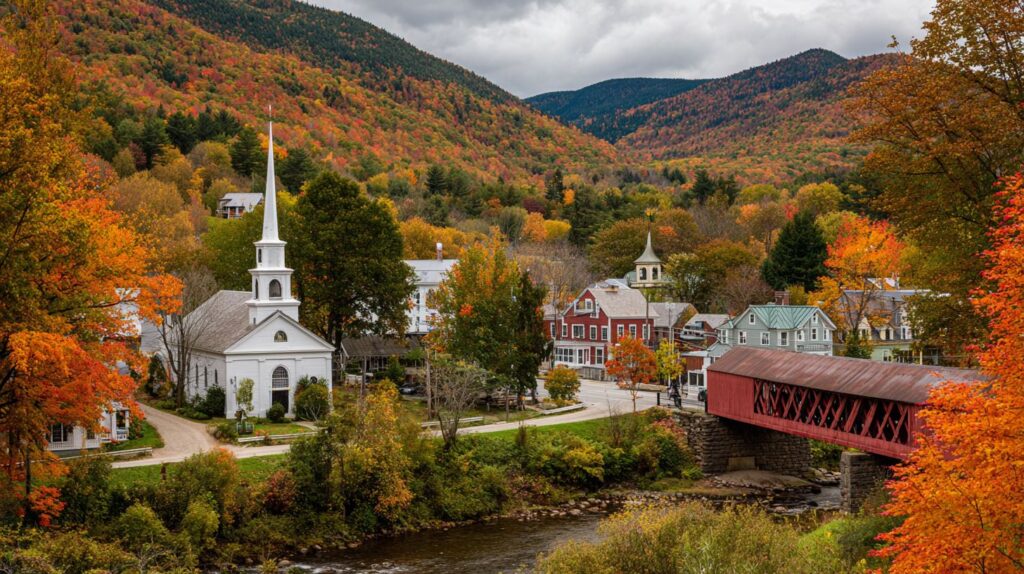
From childhood, I loved my native New England—its rural charm, its villages gathered around commons harkening back to Revolutionary times. I miss the sea, the rolling mountains, the stone walls and white-steepled churches.
Vermont has long held me in its grip, with Maine not far behind—rural, twisting lanes with scant traffic, mountains rising beyond charming villages, the faint salt scent of the seashore.
For all my love of open space, my early years were divided between rural Rowley, MA, and Philadelphia. I’ll take Rowley any day over the so-called City of Brotherly Love. I have returned to Philadelphia twice; both visits stirring up memories I would rather forget—urban blight, high crime, dirty streets, endless row houses and sweltering summer nights.
When I lived in Rowley in the 1950s, the town numbered about 1,600 souls. Thirty-five miles north of Boston, it has since tripled in population to roughly 6,400 and become a fashionable bedroom community for Boston’s well-paid professionals, aided by the MBTA Commuter Rail—a comfortable fifty-five-minute jaunt into Boston’s North Station.
We lived on Bennett Hill Road, a mile’s walk from the common. In summer I would rush out the door, glove hooked over my bicycle’s handlebar, eager for baseball on the green.
I loved walking that narrow, curving road lined with beach plum bushes and open fields, breathing the smell of nearby salt marsh bordering the ocean, as I waited for the school bus at the corner.
Home was a two-hundred-year-old house set on twenty-six wooded acres of pine. Its long driveway was lined with boulder stone walls in the old New England manner, guarded by towering elms like ancient sentries.
Deep in those woods I had a private place I visited often, drawn by its stillness—the scent of pine rising from fallen needles that softened the earth beneath my feet.
Today, Rowley finds itself embroiled in debate over a state mandate requiring density zoning for roughly six hundred new multi-family housing units near the train station.
Bennett Hill Road has changed. The beach plum bushes are gone; open fields have yielded to wooded suburban enclaves. In the 1950s, the average home sold for $10,000. Today it approaches $1 million.
I cannot forecast Rowley’s fate, though I hope it doesn’t become another Danvers or Peabody—once distinct towns now absorbed into the dense sprawl of greater Boston.
A major development called “Rowley Farms” proposes a “town within a town,” combining denser housing and retail—an idea that would have been unimaginable in 1957.
Bumper stickers may insist that growth is good. I remain unconvinced. I am, and likely will remain, a stubborn holdout for a way of life that prized quiet contentment—secluded from the noise, the restlessness, and the accumulated griefs of urban life.
—rj

 Brimmings: up from the well