We Will Not Have a King! America Says No to Donald Trump

I know I’m preaching to the choir for the most part, but silence is not an option given a White House ogre who would be king, trampling the bounds of our Constitution and violating every norm of moral decency

Not a single day passes without his intrusion. He is everywhere — America’s unprecedented micromanager — overriding the citizenry’s right to dissent and Congress’ constitutional sovereignty over the nation’s purse.

He persecutes critics with vitriol, weaponizes the Department of Justice for revenge and governs, not by law, but by impulse and ego.

It was not enough for him to pave over Jackie Kennedy’s iconic Rose Garden. Now a $200 million, 90,000-square-foot ballroom extravaganza is under construction — an East Wing expansion with bulletproof glass and ostentatious design that mocks the White House’s classical restraint.

Three days ago, during a dinner for corporate behemoths — Amazon, Apple, Meta, Google, Microsoft, T-Mobile, and Comcast among them — he unveiled plans for an American Arc de Triomphe to rise across the Potomac, opposite the Lincoln Memorial. Contributors, he promised, will have their names engraved.

Within the White House he’s installed a “Presidential Walk of Fame” lined with photos of his predecessors, except for former President Joe Biden, represented by an autopen image.

On his orders, massive flagpoles have been installed on the White House south grounds. It appears he wants to emulate France’s Louis XIV and facsimile Versailles.

Meanwhile, our nation suffers as his tariffs induce seismic consequence for world markets, a boomerang policy ensuring economic stress here at home. Consumers already feel the pinch.

Yesterday, the would be King informed visiting Ukrainian president Zelensky he’ll not be getting those coveted tomahawk missiles after all. Russia and Ukraine must stop their war, even if it means Ukraine must surrender much of its land. In coming weeks, he will meet a second time with despot Putin in Budapest to hammer out Ukraine’s fate. He deems himself a peacemaker even as he plots Venezuelan intervention and guns down boats at sea.

Today, media reports Ukraine’s defenses are rapidly buckling; more so, its morale. Trump’s misfire, propelled by egotism, promises to outweigh Russia’s nightly onslaught of missiles and drones, delivering a coup de grâce assuring Ukraine’s doom.

Yesterday, Trump pardoned the notorious George Santos, sentenced to seven years for multifarious deceit. Will Epstein’s collaborator Ghislaine Maxwell be next?

In this time of climate challenge posing a future earth transformed into a version of Mars, Trump has systematically, unhesitatingly, chosen to war on the environment, auctioning off public lands for fossil fuel development, sanctioned logging the nation’s remaining pristine wilderness, suspended curbs on air and water pollution, subsidies for renewable energy technology—electric vehicles, solar and wind—visionary endeavors prodigious with promise.

Ominously, yesterday he sent 80% of our nuclear arsenal guardians home, surely sheer madness in a time of mounting Russian, Chinese, and North Korean intimidation.

Implementing his autocratic reach for fascism are his incompetent lackeys and sycophantic Republican enablers, who conflate loyalty with virtue.

Let him build his Versailles of glass and steel. We choose otherwise, our priority a republic defined by courage and conscience.

March boldly, my fellow warriors for freedom. Let your voices fill every street and square: “We will not have a king!”

–RJ

Susan Sontag’s Regarding the Pain of Others: A Review

Deborah Feingold/Corbis via Getty Images) Susan Sontag (Photo by Deborah


Taking photos is now so universally accessible via our smartphones that we’re likely to take it for granted.

Until recently, it required buying a dedicated camera, inserting a film roll, setting the lens, then waiting—perhaps a week or more—to see the results of a distant lab.

I think of photos as a freeze on time, lovers as Keats reminded us, still fresh in their youth; sons and daughters, children still; parents and grandparents as we remember them. But photos, buttressed with videos, do even more, providing a window on what ails us.

Susan Sontag in her splendid book I’ve just read, Regarding the Pain of Others, argues that the visual not only helps us remember, but sensitizes us to the plight of those who acutely suffer while we warm ourselves under the blankets on cold winter nights, our bellies full. A moralist and cultural critic, she takes on the scourge of war’s ravages, a predominantly male enterprise it seems, unleashing the human capacity to inflict limitless evil, often with impunity.

Photography reminds us of Hiroshima and Nagasaki viewed aerially following their atom bomb devastations, incinerating 200,000 civilians within minutes; of emaciated prisoners released from Nazi death camps, the residue of 12 million exterminated; of ethnic strife in Bosnia in 1992, culminating in Srebrenica; of the dead and dying of 9/11; the machete butchering, killing 500,000 Tutsis in Rwanda. We cannot afford to let their horrors be relegated to the dumpsters of oblivion.

I remember Vietnam and My Lai (1968) and the American massacre of 500 villagers, the burning of their village, that consolidated American resistance to a needless, barbarous conflict consuming 64000 allied lives and 900,000 Vietnamese, ending a president’s re-election bid. Without film crews, we would have lacked evidence, much like when unleashed Soviet troops raped 130,000 German women after taking Berlin.

The trail is long. Much of Sontag’s narrative isn’t pleasurable reading to be sure, but without photography’s capability for exactitude, man’s inhumanity will never be addressed and perhaps, though distantly, vanish like slavery from the human repertoire. It is our duty not to turn aside, but remember and, beyond acknowledgement, understand war’s antecedents and protest their repetition.

I mourn Sontag’s passing from us in her prime—her cerebral introspection of what ails us, delivered always with compassion and unceasing hope that we can and will do better.

After reading her book, I thought of Palestinians in the Gaza strip, desperate for food, killed daily, many of them women and children. As I write, the UN Office for the Coordination of Humanitarian Affairs (OCHA) informs us that 900 Palestinians seeking food have been killed since mid-May. Unlike other conflicts, the foreign press has been banned from access to Gaza.

I think, too, of Putin’s accelerated nightly aerial assaults, on Ukraine, targeting civilian infrastructures: hospitals, ambulances, apartment buildings, shopping malls and, by day, farmers plowing their fields.

Photography offers documentation. Sontag was right: without photography, we are denied access to the truth and the scourge of war is assured its continuence.

—rj


Ambush at the White House: A Hero Humiliated

Zelensky arrived at the White House, mocked openly by Trump for not wearing a suit. Zelensky soon discovered that the anticipated signing of an agreement for access to 50% of Ukraine’s minerals offered no security guarantees. Unwilling to sign, Zelensky was lured into an ambush before a gathered press. If you are defined by the friends you keep, then the reality sinks in: Trump’s friend is Vladimir Putin. In what followed. he lavished praise for the dictator, who he said can be trusted to keep his word.

As usual, Trump couldn’t get the facts straight. Boasting of the US giving Ukraine $340b, the truth is $119b, a not inconsiderable sum, but Europe has given more at $138b.

Zelensky was expelled and the planned celebratory luncheon canceled.

Trump appears ready to cut off all military aid to the besieged nation. Meanwhile, the Russian press has been exuberant in its praise of Trump.

We are in a shameful moment of a fascist government, run by incompetents, trampling on dissent, imperiling our obligations to the marginalized, abandoning its allies, and subordinating itself to corporate oligarchy.

Stand up for Ukraine. Incorporate its flag into your FB profile. Support the boycott movement, the public protests. It isn’t just about Ukraine. It’s coming cuts to Medicaid, the suspension of environmental and health safeguards, the cut off of aid to developing nations.

America is engaged in a war—a moral one. We can win, and with your help, we will.

–RJoly

Putin’s Aggression, Trump’s Betrayal, and Europe’s Challenge

  • Photo by Ukraine.ua on September 07, 2023.

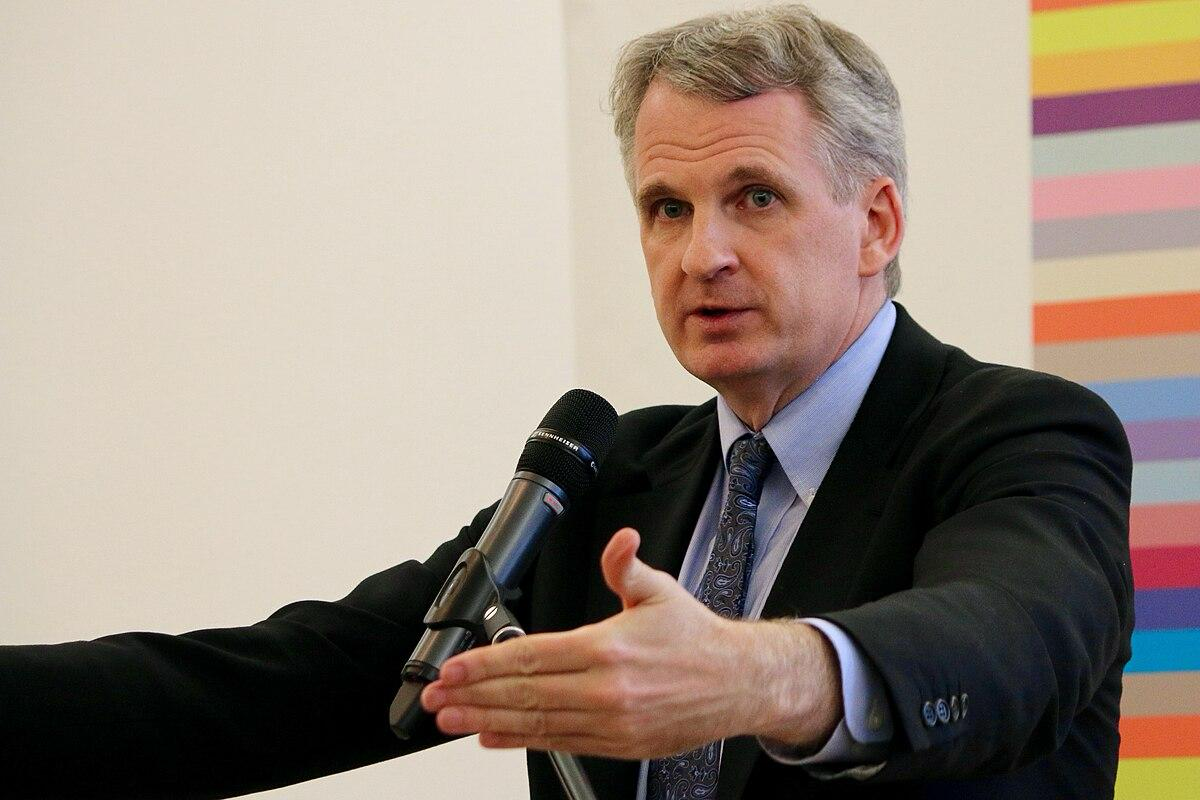
You may not have heard of Tim Snyder, but he’s worth knowing. A Yale professor of Eastern European history and authority on the Holocaust, his vitae includes sixteen books and many academic awards. A Brown and Oxford graduate, he speaks five European languages and reads in ten.

I mention him because of his ardent defense of a free Ukraine, whose fate now lies in jeopardy. This month he’s been in Ukraine, a participant in a dedication of a new underground school for children a mere twenty miles from the front and within twenty second reach of Russian cruise missiles.

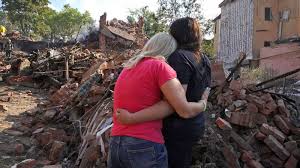
Today marks the end of three years of Ukraine’s brave resistance to its Russian invaders, who now occupy twenty percent of its land. The school has to be underground, as Russian targets include schools as well as hospitals, civilian housing, energy infrastructure, and even shopping malls.

Now Ukraine confronts its most insidious danger—Trump’s abandonment of Ukraine. Snyder reminds us that Trump cares little about Europe. What matters is making deals in exchange for profit as seen in his demand Ukraine grant rights to fifty percent of its minerals. Like Gaza, Greenland, and the Panama Canal, it’s about adding real estate to his portfolio.

Ukraine’s destiny now lies in European hands, but their commitment isn’t assured. Rewarding Kremlin aggression makes more aggression likely, particularly involving the Baltic nations of Estonia, Latvia, and Lithuania, each with a considerable Russian minority similar to that of Ukraine.

There are ways you can help Ukrainians. Snyder sponsors Documenting Ukraine, which affords Ukrainians a voice. There is also Come Back Arrive, supporting Ukrainian soldiers; RAZOM assisting civilians; and United 24, the Ukrainian government’s site for donations.

Few will read my lengthy post, but for those who do, donate, if you can—and while at it, join the resistance. You know what I mean.

—RJoly

Defending Democracy: What We Must Do

A year ago this month, Russian opposition leader Alexei Navalny died in a labor camp under circumstances that strongly suggest Kremlin involvement. His courageous fight against Russian despotism should have inspired a global recommitment to democracy. Instead, we see authoritarianism advancing—both abroad and at home.

Donald Trump, long an admirer of Vladimir Putin, has once again echoed Kremlin propaganda, calling Ukrainian President Volodymyr Zelensky a “dictator” and blaming him for the war—simply because Zelensky rejected his negotiating Ukraine’s surrender on Putin’s terms.

Unsurprisingly, Russian state media has embraced Trump as a political rock star, amplifying his rhetoric to weaken Western resolve.

Meanwhile, here in the United States, our own democratic values are under siege, the rule of law undermined, institutions eroded, and authoritarianism on the rise.

The threats we face today, both at home and abroad, make the world more dangerous for all who believe in freedom.

But we will not stand idly by. We must resist—through the courts, in Congress, and in the streets through peaceful protest.

The fight for America’s soul is far from over. If we stay united, we will prevail. In two years, we have the opportunity to reclaim Congress, hold those who threaten democracy accountable, and ensure that America remains a beacon of freedom—not an ally to autocrats.

—R Joly

Freedom’s Warrior: Timothy Snyder


Chances are you don’t know who Timothy Snyder is, though all who love a free Ukraine should. Snyder is an esteemed centrist Yale historian, graduate of Brown University (B.A.) and the University of Oxford (D. Phil).

Snyder specializes in central and eastern Europe, the former Soviet Union, and the Holocaust. Fluent in English, German, Polish, and Ukrainian, he reads in ten languages.

He’s also a permanent fellow at the Institute for Human Science in Vienna. Prolific, Snyder has authored sixteen books to date, translated into forty languages, with a forthcoming book to be published in September, 2024.

Raised by Quaker parents in Ohio with leftist leanings, there’s a moral insistence conveyed in unadorned prose throughout his many books. In his classes, he uses no notes and with ease can blend Plato, Hegel, DuBois, and polymath René Girard to make his point (Baird, The Guardian, March 23, 2023).

His international awards are numerous. They include Carnegie and Guggenheim fellowships and Hannah Arendt Award for Political Thought. He was a Marshall scholarship student at Oxford.

I hadn’t anticipated an ardent defense of Ukraine, buttressed from someone at Yale, but there he was, Timothy Snyder, forthright, unapologetic, in his op-ed appearance in the New York Times:

“As in the 1930s, democracy is in retreat around the world and fascists have moved to make war on their neighbors. If Russia wins in Ukraine, it won’t be just the destruction of a democracy by force, though that is bad enough. It will be a demoralization for democracies everywhere. Even before the war, Russia’s friends — Marine Le Pen, Viktor Orban, Tucker Carlson — were the enemies of democracy. Fascist battlefield victories would confirm that might makes right, that reason is for the losers, that democracies must fail” (NYT, May 19, 2022).

I’ve been following Snyder ever since.

Snyder has his detractors, of course, some regarding him more as a pundit, offering personal opinion in the guise of expertise. For a good summation, and counterpointing (see LA Review of Books, Unshared History, Oct. 16, 2012).

His Marxist critics principally object to his inclusion of Russia as fascist under Putin, as they like to reserve the term for their right wing opponents. Historically, fascism was a term used by the Soviets to denounce Nazis and other factions opposed to its dictates.

Snyder answers that “People disagree, often vehemently, over what constitutes fascism. But today’s Russia meets most of the criteria that scholars tend to apply. It has a cult around a single leader, Vladimir Putin. It has a cult of the dead, organized around World War II. It has a myth of a past golden age of imperial greatness, to be restored by a war of healing violence — the murderous war on Ukraine” (NYT, May 19, 2022).

If you’re curious about Snyder’s political biases, he endorsed Biden in 2020 and in a Guardian interview, shared, “I vote Democrat!” He sees Trump as an autocrat appealing to popular prejudices inimical to American democracy’s survival. Trump’s policies are about making White people feel comfortable.

Snyder’s immediate concern, however, is the war in Ukraine, about to enter its third year, pitting a David against a Goliath, pitiless and unpausing in attacks on Ukraine’s civilian infrastructure in a crucial struggle presently overshadowed by events in Gaza.

To his credit, Snyder has tried valiantly to keep the Ukrainian conflict center-stage: “If Ukraine does not win, we can expect decades of darkness” (NYT, May 19, 2022).

Hospitals, churches, shopping centers, apartment dwellings, it’s all fair game to Putin, whose aim is to inflict maximum terror, destroy food supplies, disrupt the electricity grid, and deny water resources to a nation he regards as historically integral to the Russian empire.

Much of Putin’s onslaught comes from not only cruise missiles, but thousands of drones, many of them supplied by North Korea and Iran.

The Biden administration and its NATO allies have been slow to respond. Patriot defense batteries are just now arriving, antiquated, and short of the seven President Zelensky says Ukraine needs to ward off the daily aerial assaults.

In contrast, Israel has 32 up-to-date batteries proven highly effective against Iran’s massive missile and drone response of April 14, 2024 (Defense Express, April 15, 2024).

If Ukrainian skies are safer now, it’s because Timothy Snyder stepped in, not the White House, raising $2,300,000 for Safe Skies, a program allowing Ukraine to install thousands of sensors throughout eight Ukrainian regions.

Safe Skies provides an early-warning alert and rapid response to drones and cruise missiles: “I visited one of the sites and saw some of the technology at work, as well as the impressive cooperation between the Ministry of Digital Transformation and the armed forces,” Snyder said (The Free Press, Substack, August 17, 2024).

Donations were largely individual worldwide, with a few corporations also contributing.

We nearly lost Snyder in 2019 when, feeling ill, he resorted to ER in New Haven, spending seventeen hours there, before being diagnosed with a baseball-sized tumor in his liver along with sepsis. Snyder would subsequently spend the next three months in five hospitals.

But you don’t mess with Snyder, who kept notes on his hospital sojourn, the later basis of a scathing indictment of American healthcare: Our Malady:
Lessons in Liberty from a Hospital Diary.

Thankfully, he’s still with us, a boon for freedom lovers everywhere,

–rjoly

One Year Ago Today: Russia Invades Ukraine

A year ago today, Russian troops invaded Ukraine. Bravely, the Ukrainians have held out, despite massive loss of life and daily drone and missile attacks on civilian infrastructure. Fighting remains intense in Bakhmut, with many killed on both sides.

It’s a ruthless enemy, resorting to crimes against humanity, as the mass burial sites of Bucha and Izium bear witness, hundreds of civilians shot, their bodies evidencing torture and mutilation. Wheat fields have been bombed, Ukrainian children deported to Russia.

Western military assistance has been crucial to the Ukrainian resistance. That’s now in jeopardy, given increasing malaise in the West to support Ukraine. In the U.S., a newly elected House majority of Republicans presses for a funding cutoff.

If this happens, Ukraine loses the war and previous Russian imperialism (Chechnya, Georgia, Moldavia), continues and its contagion spreads. Think China, Iran, North Korea.

Loss of Western political will is demagogue Putin’s best hope.

—rj

Putin: Better Think Again!

putinIn a recent interview with Fox’s Chris Wallace, former Defense Secretary Robert Gates has said Crimea can be written off as a Ukrainian entity, with the possibility of still further Russian intervention in Ukraine until Putin gets a government to his liking.  I’ve always respected Gates, one of the best defense secretaries ever. 

The problem with Putin is that escalating our threats just won’t work.  He has options too.  Just recently there’s been a rumbling that if the West plays rough, then Russia will no longer allow inspections of its nuclear arsenal.  In short, we’d be virtually back to the Cold War.  And if Europe does take meaningful measures–highly unlikely–it can easily limit natural gas supplies Europe depends on.

Tough talk may even provoke Putin to order troops into Kiev to depose its interim government, which he argues resulted from an illegal coup.  We take it for granted we’re dealing with a rational leader, not a Kim Jong Un, but don’t bet on it.  We do know that he served 16-years with The KGB, or secret police, much of it in East Germany with its Stasi repression.  In a post-Soviet era, his thinking is a throwback to Communist conspiracy.

Asked recently what he considered Russia’s greatest catastrophe, he replied, “the break-up of the Soviet Union,” which goes a long way to explaining his designs on Ukraine and desire to reconsolidate its former vast territorial domain under the guise of the Eurasian Customs Union, slated to go into effect next year.  (See my earlier post,  February 28, 2014:  Russia Likely to Intervene in Ukraine.)

Certainly, world criticism never bothered the Soviets when they invaded Hungary in 1956; nor the Putin regime when it invaded Georgia in 2008, occupying two breakaway provinces where they still remain.  It’s bare-chested, black belt Putin fully on display, true to the narcissistic personality disorder with its broad symptoms of enhanced self-regard, arrogance, absence of sympathy for others, and readiness to exploit.  We’ve seen it all before in the Hitler and Mussolini demagogues of modern history.

I don’t think for a moment our president impresses the Kremlin leader, certainly not after turning his back on a cruise missile strike.  So far the White House response has been one of rhetoric rather than any substance.  While I don’t agree with Republican hawks advocating revival of a missile defense system for eastern Europe, I do think this isn’t the time for reducing our troop numbers.  I’d settle for booting Russia out of the G8 rather than just canceling its upcoming June meeting.  As in most things, the bottom line is money.  We must make Putin’s Ukraine strategy costly.

Russia’s economy, by the way, for all the show time glitter of robust health in its $40 billion outlay for the winter olympics at Sochi, continues in disarray, with present growth forecast at just 1%.  Much of Russia’s financial resources depend on gas and oil exports, or as much as 80% by most financial analysts.

For Russia to cut supplies to Europe is a no-starter.  Russia’s future, in fact, looks ominous, with America on a fast track to energy independence and with potential capacity to supply Europe.  Ironically,  securing the Ukraine, a nation $35 billion in the red, is surely the albatross around the neck that should give Putin pause.

Russia ought to worry instead about shoring up its deplorable infrastructure.  When I traveled by bus several years ago from Moscow to Tula, a distance of about 120 miles, I wished I’d had a kidney belt, what with our wheels tumbling in yard wide holes all the way to the nearby Tolstoy homestead (Yasnaya Polyana).

Its oil and gas infrastructure is declining as well and will entail Russia laying out billions to modernize, compounded by worldwide demand for technical prowess at competitive prices.

Putin has seemingly forgotten his Russian comrades–all 144 million.  Just a few days ago, Russia underwent the biggest stock sell off in 5-years, with the ruble tumbing to a record low, requiring the central bank to raise interest rates.

As is, Russia is fast losing its talented young people with emigration increasing 22% in 2012, and with them, its future.  In the last ten years, nearly two million from the middle class have left Russia.   Ukraine, understandably, wants no part of a dismal future with the Russian Federation.

The pity of Russia with its vast resources is that, like many third world nations, its economy is dominated by a kleptomaniac oligarchy lining its pockets at the expense of a long suffering people.   No wonder the exodus.

Will the last one out please get the lights!

–rj

Sequel to Russian Incursion: Ukraine’s Likely Fate

ukraine4

What we’re seeing in Ukraine we’ve seen before; namely, Russia’s incursion into Georgia in 2008 when that government attempted to wrest back its secessionist breakaway territories of South Ossetia and Abkhazia.  We did nothing then.  We will do little now, simply because we lack leverage.

The Crimea itself,  now fully occupied by Russian troops, poses a strategic necessity for Russia that goes back 240 years.  Adjacent to the Black Sea, it provides Russia with warm water naval outreach to the Eastern Mediterranean and Middle East.   Russia is unlikely to hand it back to a belligerent regime.

The scenario could get even worse for Ukraine, since Russian incursion may not stop with seizing the Crimea.  After all, a large swath of Eastern Ukraine is also Russian speaking.  One incident and Putin is likely to seize upon it as pretext for moving troops into this area as well.  Just yesterday, there was a bloody exchange between rival factions in the region.  In short, the dismemberment of Ukraine may already be underway.

But the situation could prove even more sinister:  Russia may decide to depose the Ukraine’s interim government and install a puppet regime loyal to its interests.  It tried to do this in Afghanistan in the 1980s, propping up a Marxist government.  What this would mean for Ukrainians is painful to contemplate–perhaps civil war between the factions or an incipient resistance movement.

I find it ironic, to say the least, that Russia has waged two conflicts to keep Chechnya within the Mother Land, yet has abetted secession efforts in Georgia and, currently, Ukraine.

In all of this, our hands are sadly tied, exacerbated by our own confusion.  The G8 nations of which Russia is a member, could refuse to attend this June’s trade summit scheduled in Sochi. Acting more bravely–don’t hold your breath–it could expel Russia.  This would sting.

But doing so could hurt our own interests as well.  We need Russian cooperation on Syria and Iran, say critics.  I would argue, however, that this is moot discussion, since it assumes Russian cooperation as a verity.  The truth is that Russia continues its efforts to support a ruthless Syrian regime and remains a potential menace to our efforts to curtail Iranian access to nuclear weaponry.  It’s quite evident that Russia, deeply jealous of the West and, especially the U. S., suffers from an immense insecurity complex reflected in a historic penchant for destabilizing Western aims.

Meanwhile, the UN can muster the Security Council, but to what end, since Russia will employ its veto yet again.

In all of this, Russia ironically doesn’t need to invoke troops, since its ultimate weapon to keep Ukraine in line is natural gas, which it enjoys in abundance.  Ukraine needs that gas desperately and presently owes Russian billions in deferred payment.  Putin, additionally, was already supplying the country with natural gas at sharply reduced rates.

As for the EU, it’s a given that it knows the potential seismic effects of a reduced gas supply from Russia to power its own economies, several of which are already floundering.

In all of this, I would draw a parallel with what happened in 1956 in Hungry, when the Soviets invaded to overthrow an insurgent rebel government.  2000 Hungarians and 700 Soviet soldiers died;  13,000 Hungarians were imprisoned; hundreds executed; and 200,000 refugees fled to the West.  Then, as now, the invaders blamed the revolt on western instigation and facist-nazi reactionaries.

The more the free-world protested, the more things stayed the same.  The Russians vetoed the Security Council’s mandate to withdraw and ignored the General Assembly’s majority vote.  Then, as now, the Kremlin called the West’s bluffs.  A few months later, both East and West were working trade deals.

And this is the way things will end for the brave people of Ukraine, despite Western protests and threatened sanctions.  Human rights didn’t keep the world from swarming to Sochi for the Winter Olympics.

The heavy truth is that politics has always operated in a context of power, not morality.  Right now, Russia enjoys the upper hand.

–rj

Russia Likely to Intervene in Ukraine

ukraine

Last week, Ukrainian protestors in Kiev’s Maidan (its central square) were mowed down by security forces of the hated Yanukovych regime.  Undeterred, they advanced into the fusillade. What is life without freedom?

I’ve been thinking a lot about Ukraine, no doubt heightened by media coverage of the continuing unrest in that nation of 46 million.  But it’s more than the headlines.  When I was a young boy growing up in Massachusetts, I played with a friend who had recently arrived in the U.S. from Ukraine with his mother and siblings.  Though young, he had seen vestiges of World War II’s carnage.  While I can’t recall the details, they left me with an impression of a people that had endured considerable suffering.

In Lexington, Kentucky, there exists a vibrant, growing Ukrainian community.  We’ve had a lot of renovation done at our house and one of the primary workers is a Ukrainian affectionately dubbed “Slav” by his fellow workers.  We’ve talked about Ukraine on occasion.  On one occasion I accepted his invite to a bake sale at his Ukrainian church.  The church is doing well and is an anchor in providing a social network for newly arrived Ukrainians, which include many young people. The other day, I was walking back to my car after grocery shopping at Meijer’s, when a car honked. It was Slav. He had just returned from the Ukraine.  

Just maybe Lexington’s best roofing enterprise happens to be Ukrainian. My physician is from the Ukraine.  How can I not think about them?

It’s estimated that some 7 million Ukrainians perished from famine following Stalin’s collectivization of Ukraine’s peasant owned farmlands in 1932-33.  Another 10-million perished in World War II.  What most historians miss is that Ukraine bore the biggest brunt of the Nazi invasion, being a total battleground between German and Soviet armies.  Only 5% of Russian territory was occupied.

Following the 1991 collapse of the Soviet Union, Ukraine announced its independence.  There was little Russia could do, since the world’s third largest nuclear arsenal was on Ukrainian soil.  In 2009, an agreement was worked out between the negotiating parties, which included the United States.  One of Ukraine’s demands was a guarantee of its sovereignty.  The U. S. granted Ukraine the same assurances guaranteed to non-nuclear signatories of the Non-Proliferation Treaty (NPT) and the signatories of the Final Helsinki Act (1975).

As I write, paramilitary forces in Russian dominated Crimea have seized the local parliament buildings and its airports and Putin has put 150,000 troops on alert.  The Crimea had been added to the Russian Empire under Catherine II.  In 1954, it was restored to Ukraine by Nikita Khrushchev, an ethnic Ukrainian.

Despite Secretary of State Kerry’s warning to Russia not to interfere, it’s not going to mean much in a way of any meaningful U.S. response, especially with an indecisive president in office who runs from confrontation; has failed to support moderate rebels in Syria, allowing extremist sectarian factions to enter into the fray; has never really signed on to supporting our troops in Iraq or Afghanistan; and is now bent on unilaterally reducing our army to pre-World War II levels.  No one wants war.  But it’s doubtful the EU or U.S. will invoke economic or trade measures either.

What seems a given is that Putin isn’t going to allow Ukraine to cozy-up with the West, culminating in joining the EU and becoming a NATO member.  Putin dreams of reestablishing a political and trade confederation of the former constituencies of the Soviet Union under the auspices of the Eurasian Customs Union (ECU).  Slated to go into full effect in 2015, its prototype presently includes Russia, Belarus, and Kazakstan, with Kyrgyzstan to join soon.  This grand scheme ultimately includes Ukraine, which can only be accomplished by Russian economic pressure and/or military intervention.  Putin’s scheme is to return Russia to its past preeminence, a world competitor on equal footing with the EU, USA, and China.  It’s what Sochi was all about.

Right now, the situation in Ukraine is ominous, given the large Russian majority population in Crimea and eastern Ukraine.  Historians may remember that Hitler used the pretext of a mistreated German minority to invade Poland.

It will only take a spark for history to repeat itself.

–rj