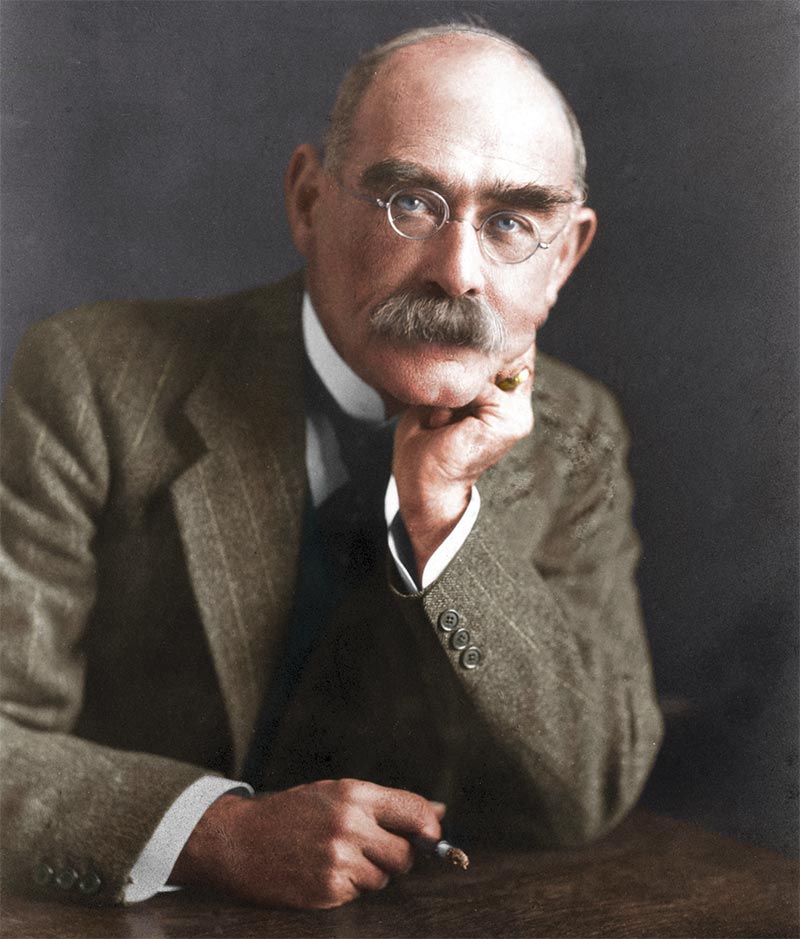
A Polarizing Artist: Rudyard Kipling’s Legacy

I remember it well. I was a young graduate student, privileged to study under one of the world’s foremost professors of Victorian literature, a renowned authority on Thomas Hardy.

The course was rigorous. We read the greats of the age—Macaulay, Tennyson, Browning, Dickens, Mill, Newman, Arnold, Morris, Ruskin, the Rossettis, Swinburne, Hopkins, Pater, and of course Hardy. Yet strikingly absent was Rudyard Kipling. Our professor dismissed him as the mere voice of imperialist Britain—an attitude then dominant in the Academy, and one I suspect still lingers on American university campuses.

I had never read Kipling. I had not yet learned to question. I accepted what I was told.

It was only later, during a summer course at Exeter College, Oxford, that I encountered another view: one that esteemed Kipling’s literary brilliance without committing the American folly of conflating his politics with the merits of his artistry.

Kipling’s literary range was astonishing. His verse, endowed with rhythmic command, borders on the hypnotic. He opened poetry to colloquial speech and became a supreme craftsman of the ballad form.

Yes, he gave voice to Empire in works like The White Man’s Burden, Kim, and The Jungle Books. But he also revered Indian culture—its spirituality, wisdom, and sensory richness. Often, with subtle irony, he questioned the very order he seemed to affirm.

Perhaps his greatest achievement lies in the short story. With precision and nuance, he crafted narratives of extraordinary compression, modern in their suggestiveness, wide-ranging in their scope. The Man Who Would Be King remains a masterpiece—its sweep and power undiminished. Kipling’s influence on Conrad, Maugham, Hemingway, Borges, and others is beyond doubt.

He was awarded the Nobel Prize in Literature in 1907—the first English-language writer to receive it—honored for his “power of observation, originality of imagination, virility of ideas, and remarkable talent for narration.”

Kipling’s stories, like all enduring art, probe psychological depths. They are complex, skeptical of conventional wisdom, and riveting in their precision.

In today’s multicultural Britain, he is taught in context: his genius as a storyteller acknowledged, his colonial perspective rejected. Lewis, Tolkien, and Pullman have recognized him as a precursor to modern fantasy.

In India, where he was born and spent his early years, his reception is understandably ambivalent: many readers disdaining his imperial condescension, yet acknowledging his literary craftsmanship. Salman Rushdie has called Kim “one of the greatest novels written about India,.” Other Indian writers continue where Kipling left off, offering vivid vignettes of India, but through an Indian prism.

Controversy about his place in the Western literary canon remains. Vladimir Nabokov, in his Cornell lectures, dismissed Kipling for his moralizing, He deemed his indulgence in exotic adventure stories as juvenile. Great literature, he argued, obeys the aesthetic imperative of narrative neutrality, or distance, as in Flaubert and Joyce.

On the other hand, the late eminent Yale critic Harold Bloom came to Kipling’s defense. In his The Western Canon. Bloom lists Kipling among hundreds of writers deserving inclusion in the canon. Bloom saw Kipling as a myth maker and gifted story teller, especially in his short stories. On the other hand, he found his poetry “scarcely bear reading.”

While I find merit in both Nabokov’s and Bloom’s arguments, I lean towards Bloom’s appraisal as more balanced. I have long resisted either/or equations, particularly as to the political or aesthetic. Over a lifetime, I have frequently found reasoned judgment occupies a middle place. I have given my own arguments earlier in this essay for his belonging in the canon.

Whatever a reader’s verdict, Kipling was a singular voice, very much his own man. In short, authentic. As he said in an interview shortly before his death,

“The individual has always had to struggle to keep from being overwhelmed by the tribe. To be your own man is a hard business. If you try it, you’ll be lonely often, and sometimes frightened. But no price is too high to pay for the privilege of owning yourself” (Qtd. in the Kipling Journal, June 1967).

rj

Sad news out of India: a vindictive government persecutes its critics

The news out of India is disturbing, violence and repression of those opposed to Prime Minister Narendra Modi and his Bharatiya Janata party (BJP) daily occurrences.

Recently reelected to a third five-year term, but with diminished support that’s resulted in a loss of his parliamentary majority, Modi must now rely on a coalition government to maintain power.

This hasn’t proved a roadblock to his recent cabinet appointments, none of them Muslim, though India has a burgeoning Muslim population exceeding 200 million, presently 14% of the country’s population. Nor has it tempered his embrace of a Hindu hegemony (Hindutva).

Speaking out against his policies and the BJP risks severe consequences.

Many of his political opponents have been jailed on trumped up charges of corruption, while others are under investigation.

In March, 2024, Modi’s government froze the bank accounts of its main adversary, the Nationalist Congress Party, alleging non-payment of taxes.

In 2023, it eliminated the country’s chief justice as one of three commissioners overseeing elections. The BJP now enjoys a majority vote.

For another example, there’s the ongoing harassment of Waheed-Ur-Rehman, arrested in 2019 and held for two years, much of it in solitary confinement, for his opposition to the crackdown on Kashmir resistance to the suspension of Kashmir’s semi-autonomous status.

Now comes the BJP’s newest outrage in pursuing prosecution of 1997 Booker Award winner Arundhati Roy (The God of Small Things) for her remarking in 2010 that Kashmir was never a part of India.

Kashmiri academic Sheikh Showkat Hussain, who appeared with her at the rally in Delhi, will also be prosecuted under India’s Unlawful Activities Prevention Act (1967).

Roy has been a longtime critic of Modi policy.

If media pundits thought the Modi government would learn from its election setback, they’re sadly mistaken.

The BJP has become even more vindictive—more arrests, more violence.

In 2023, the Biden administration gave Modi a lavish welcome, replete with a state dinner. Talk about Kissinger, expediency is still in vogue.

Entrepreneurial moguls Bill Gates and Elon Musk, who view India as an investment quarry, sent their congratulations to Modi on his win.

At the just concluded G7, a lengthy queue assembled to do acquiescence to its invited guest.

The casualty is India’s secular constitution.

—rj

Martyr’s Day: Gandhi’s Vanishing Legacy

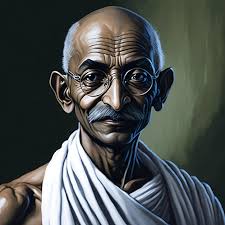
Today marks Martyr’s Day in India. On this day, January 30, 1948, Mahatma Gandhi, father of a free India, visiting New Delhi to address an evening Hindu prayer meeting, was gunned down by nationalist Nathuram Vinayak Godse, who fired three bullets into his chest, killing him. Godse believed Gandhi was overly conciliatory to Muslims.

Falling to the ground, Gandhi reputedly moved his hand to his forehead in the Hindu sign of forgiveness, his final words, “He Ram, He Ram” (“Oh God, Oh God”).

This happened a mere five months after India had won independence from British rule.

Committed to the Tolstoy principle of non-violence, Gandhi would be appalled at the changes sweeping across today’s India in the wake of a Hindu fundamentalism of tsunami proportions not adverse to employing violence against those perceived as threatening its interests, augmented by a Modi government keen to buttress its hegemony by supporting religious bias.

A few days ago, January 22, saw the dedication of the new Ram temple in Ayodhya, said to be Ram’s birthplace. Ram is the seventh avatar of the god, Vishnu, and regarded as deity.

_=Ram Temple, Inauguration Day

Modi had promised the temple in his initial run for prime minister and was present to inaugurate the temple: “Today, our Ram has come. After centuries of patience and sacrifice, our Lord Ram has come,” said Modi.

Built on a 70-acre site previously occupied by the four century old Babri Mosque, torn down in 1992 by a frenzied Hindu mob, thousands died in the sectarian violence that followed. None of the perpetrators were sentenced.

Not that any of this mattered to the Bharatiya Janata Party (BJP) of Narendra Modi, entrenched in power since 2014. The Ram Temple symbolizes the supremacy of both the BJP and a Hindu culture that discourages pluralism.

In contrast, India’s founding fathers, recognizing the myriad religious diversity of India—Muslims, Buddhists Christians, and Jains—eschewed pandering to any faction.

Ironically, India seems to be following in the steps of Pakistan, deliberately created as a Muslim state.

Chillingly, there’s the legacy of Hindu nationalist M. S. Golwalkar, advocating that “minorities in Hindusthan must either adopt the Hindu culture and language, must learn to respect and hold in reverence Hindu religion, must entertain no idea but those of the glorification of the Hindu race and culture, i.e., of the Hindu nation and must lose their separate existence to merge in the Hindu race, or may stay in the country, wholly subordinated to the Hindu Nation, claiming nothing, deserving no privileges, far less any preferential treatment – not even citizen’s rights.”

Modi deemed Golwalkar one of his primary influences in his 2008 book, Jyotipunj (Beams of Light).

Today’s Hindu dominated India, 80% of its population, increasingly imposes Golwalkar’s dictum of a monolithic culture impervious to those it views as interlopers, deserving of restriction and possibly extinction.

In the first eight months of 2023, 525 attacks on Christians occurred. In the state of Manipur, 642 churches were torched by Hindu arsonists “receiving support from people in power,” said the United Christian Forum (UCF).

Notorious was the killing of Australian missionary Graham Stuart Staines in 1999, along with his two sons, Philip (aged 10) and Timothy (aged 6), burnt to death by a Hindu Nationalist group named Bajrang Dal. Stains, a medical doctor, had come to India several years earlier to treat lepers and minister to the poor. He was accused of “forced conversions,” a common rumored charge among Hindu nationalists.

As is, Christians comprise a mere 2.3 % of India’s teeming population.

Indian Muslims, comprising the third largest Muslim population in the world, have likewise been continuously assaulted, often accused of cattle rustling.

2020 saw the Delhi riots, killing 53 people, 40 of them Muslim. In its aftermath, Modi denied his government discriminates against Muslims, despite the BJP’s legislating the Citizen’s Act, restricting citizen eligibility of undocumented immigrants, largely Muslim, and prohibiting proselytizing by Muslims and Christians.

An investigation of the Delhi riots by the independent Delhi Minorities Commission found the violence “planned and targeted” and several police actively participating in attacking Muslims. A subsequent video confirmed several policemen beating five seriously injured Muslim men lying on the street and forcing them to sing the Indian national anthem to prove their patriotism.

I won’t go into persecution of the Sikh population, increasingly viewed as disloyal citizenry, seeking establishment of an independent state. Canadian and American intelligence agencies have uncovered assassination plots, one of them succeeding in Canada, against Sikh diaspora leadership.

Meanwhile, President Biden went all out for the state visit of Prime Minister Midi, hosting a vegetarian dinner on June 21, 2023, despite protestors among Democrats and the urgings of Human Rights Watch and Amnesty International that he confront Modi on the matter of human rights in India. The President would later say he did so in private conversation with Modi, but if so, any details were excluded from his public closing summation.

India, which held so much promise for an enlightened democracy upon its emergence as a free nation, has altered its raison d’être over the last decade, increasingly disenfranchising its minorities and critics.

I have wondered how my friends are faring in Kerala, where the apostle Thomas ministered to the natives 2000 years ago. Its Christian community is India’s largest . Unfortunately, the Catholic leadership has cozied up to the BJP in return for its support of a good price for Kerala rubber. I find it a dubious Faustian exchange, prioritizing profit over the welfare of Christians elsewhere in the nation.

I think back to my privileged visit years ago to Gandhi’s simple bed, cup, and walking stick. I had read about him at age ten, which began my lifetime devotion to this great man, advocate of non-violence, charity to the poor, abolishing caste, proponent of women’s emancipation and, of course, India’s freedom. His impact on Martin Luther King and the American civil rights movement is fully acknowledged.

It’s Martyr’s Day as I said at the outset. Is it conceivable Gandhi’s leading India’s into the promise land of sovereignty has transpired into a new tyranny of oppression, imposed not by a foreign entity, but by an Indian government weaponizing nationalism for its own ends?

Sadly, Modi and the BJP enjoy widespread favorability in today’s India, assuring long term oppression of India’s religious and political minorities, usurping the enlightened legacy of Gandhi and Nehru with their targeted bigotry.

–rj

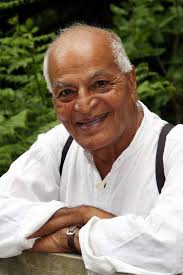
Satish Kumar’s YOU ARE therefore I AM

A055AE27-9E17-4824-AB0D-6FD0FC6ECB96
There are some books you don’t want to end and when they do, a gnawing emptiness ensues like saying a final good-bye to a cherished friend. Satish Kumar’s YOU ARE therefore I AM is one of them.

I discovered Kumar serendipity fashion, searching for Sufi poets like Rumi, subsequently chancing upon an interview with him that led me to this book, one of the most observant, sensitive, life-changing books I’ve encountered across the years. In brief, a book for discerning readers open to being inspired.

You’ll find few reviews of this book. I tried Google, and even the New York Review of Books, but no Kumar.

Kumar deserves a wider audience. He’s written ten books, received numerous literary awards, and several honorary doctorates. With E. F. Schumacher (Small is Beautiful), he founded Schumacher College, which offers master degree ecology curricula. For many years, he was editor of Resurgence & Ecologist Magazine. Now 85, he continues to write and lecture widely.

YOU ARE therefore I AM is largely autobiographical, though he’s written a more definitive version, No Destination: The Journey of a Pilgrim ( 2014, Green Books).

Reared in India, we learn early on of his mother’s defining influence as a Jainist devoted to non-violence, leading to his becoming a Jainist monk at age nine. He would leave nine years later as a disciple of Gandhi’s teachings. He had come to believe that we stem evil not through retreat into monasteries, but with peaceful activism, promoting human and natural reconciliation.

The Jains, however, were and remain the salient source for his adoption of non-violent protest, as they also were for Mahatma Gandhi who would, in turn, influence Martin Luther King.

Kumar is famous for his peace walks in 1962 with friend E. P. . Menton to nuclear capitals Moscow, Paris, London and Washington, D.C. Remarkably, they made their 8000 mile journey without money. In England, he would meet Bertrand Russell and in America, Martin Luther King.

It was Gandhi protege Vinoba Bhave’s Talks on the Gita, oral lectures composed during Bhave’s imprisonment by the British and later written down by a fellow prisoner, that led to Kumar’s embrace of nature, society, and self as the trinity of activism needful for fostering peace within ourselves, between nations, and reconciliation with the Earth we have plundered: “THIS TRINITY OF nourishing nature, society and self gave me much food for thought. Ever since that time they have remained with me and have become the ground of my thinking and action.”

Chapter 13 details Kumar’s meeting Krishnamurti, the renowned Indian sage. Krishnamurti had rebelled against religious, political, and philosophical orthodoxy: “Truth cannot be realised through any creed, any dogma, any philosophical knowledge, any psychological technique, any ideology, any ritual or any theological system.”  

Kumar agrees:

Now we live in an age of post-religious spirituality. The call of our time is to be a good human being rather than to be Muslim, Hindu, Buddhist, Jain or Christian. We don’t have to be a special kind of person to go on the adventurous journey of the spirit. Every one of us is capable of making the hero’s journey and reaching the holy grail.

Chapter 16 recounts his meeting Martin Luther King. King underscored that non-violence must not exclude justice for the disenfranchised, most often, the world’s poor and non-white. “True peace is not merely the absence of war. It is the presence of justice, equity and a non-violent social order. Non-violence is a moral force which can transform individuals and societies and bring peace.”

In the book’s late chapters, Kumar gives highlights of his return visit to his native India in 2000, fascinating in its portraiture of modern India and betrayal of Gandhi’s advocacy of land reform, self-sufficient village craft industries, and rejection of corporate interests and free trade.

Harvesting our needs, not our wants, living simply in touch with our fellows and observing the sanctity of all life, this was Gandhi’s message to capitalism motivated by greed, centered on consumption and continuous growth, fostering environmental violence economic marginalization and social injustice. This is a Gandhi unknown to most Westerners.

The final two chapters summarize Kumar’s worldview. Eloquent, timely, and wise, I found myself inspired, yet sad, sad in discovering him so late in my life’s journey.

It’s here he scorns the onset of Cartesian dualism with its aggrandizement of Self, voiding the relational. There followed Newtonian physics, treating the world as machine, Darwinism with its survival of the fittest, and depth psychology with its emphasis on ego:

These theories are, in my view, at the root of the ecological, social and spiritual crisis of our time. The dualistic world-view gives the illusion that I exist independently of the Other….’To be is to inter-be.’ We cannot be by ourselves alone. This means our being is only possible because of other beings. We are not individual beings; we are world beings.

Dualism, unfortunately, has also fostered speciesism, alienating us from Nature: “The violence to non-human species often remains unnoticed. This causes grave harm to animals, forests and wildlife of all kinds. This attitude of human superiority is the foundation of the culture of violence. The dualistic mindset which begins with controlling nature, goes on to control people.”

I’ve read many fine books over the years, some life-changing.  Satish Kumar’s You Are, therefore, I Am takes its place among them, deserving yearly re-reading, lest we forget our mutual dependency and its requisite obligations.

Kumar reminds us in his close that observing the relational in every consideration is vital “for our existence and experience, for our happiness and health, for our nutrition and nourishment, we depend on the Earth. We depend on the love of the beloved, the beauty of the beautiful and the goodness of the good. Embracing vulnerability and humility, let us declare our utter dependence on the Earth, and on each other: You are, therefore I am.”

—rj